Archive for ‘Politics’

15/10/2019

China calls on Turkey to halt military incursion in Syria and ‘return to right track’

  • Beijing joins global condemnation of attack launched by Ankara on Kurdish fighters after US President Donald Trump decided to pull out troops
  • Foreign ministry spokesman says issue should be resolved with ‘political solutions’ and the operation may result in a revival of Islamic State
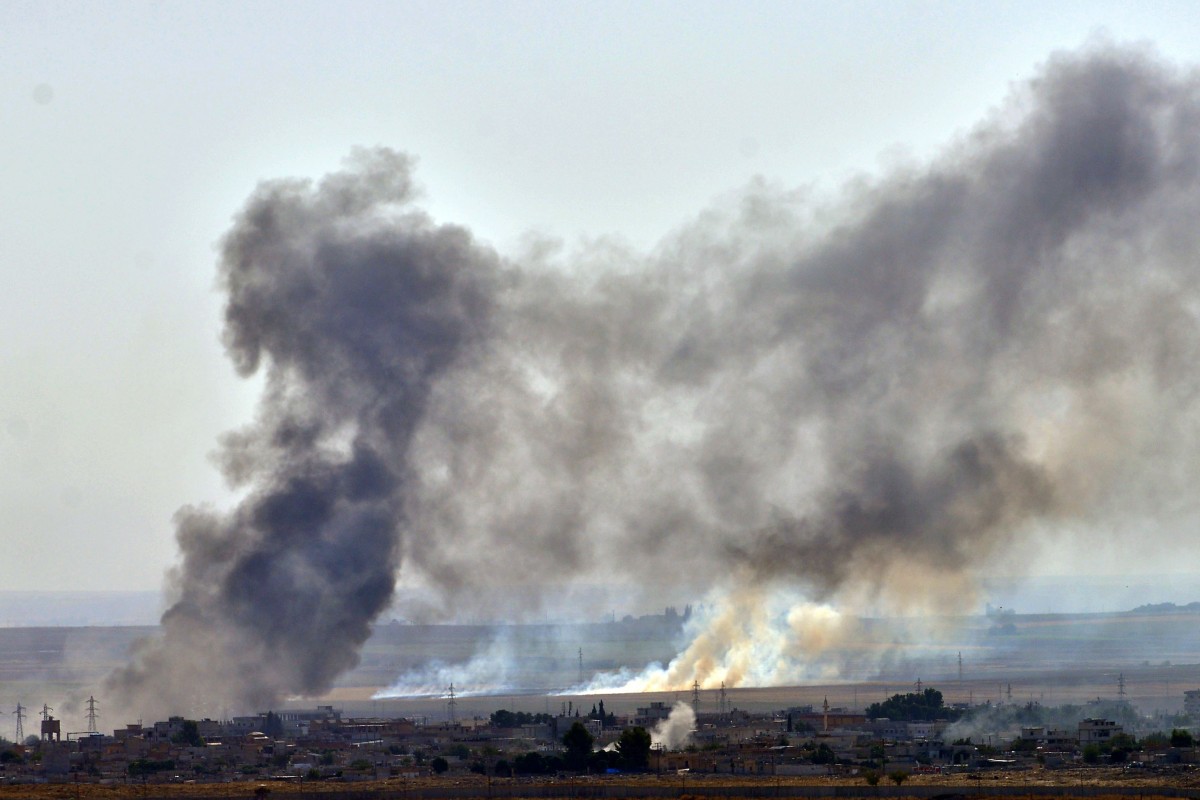
Turkey launched the attack on Kurdish fighters in northeastern Syria last week. Photo: Xinhua

China has urged Turkey to stop the military offensive it began in northeastern Syria last week and “return to the right track”.

Beijing is the latest to join global condemnation of the cross-border attack launched by Ankara on Kurdish fighters last Wednesday following US President Donald Trump’s decision to withdraw US troops from the region.

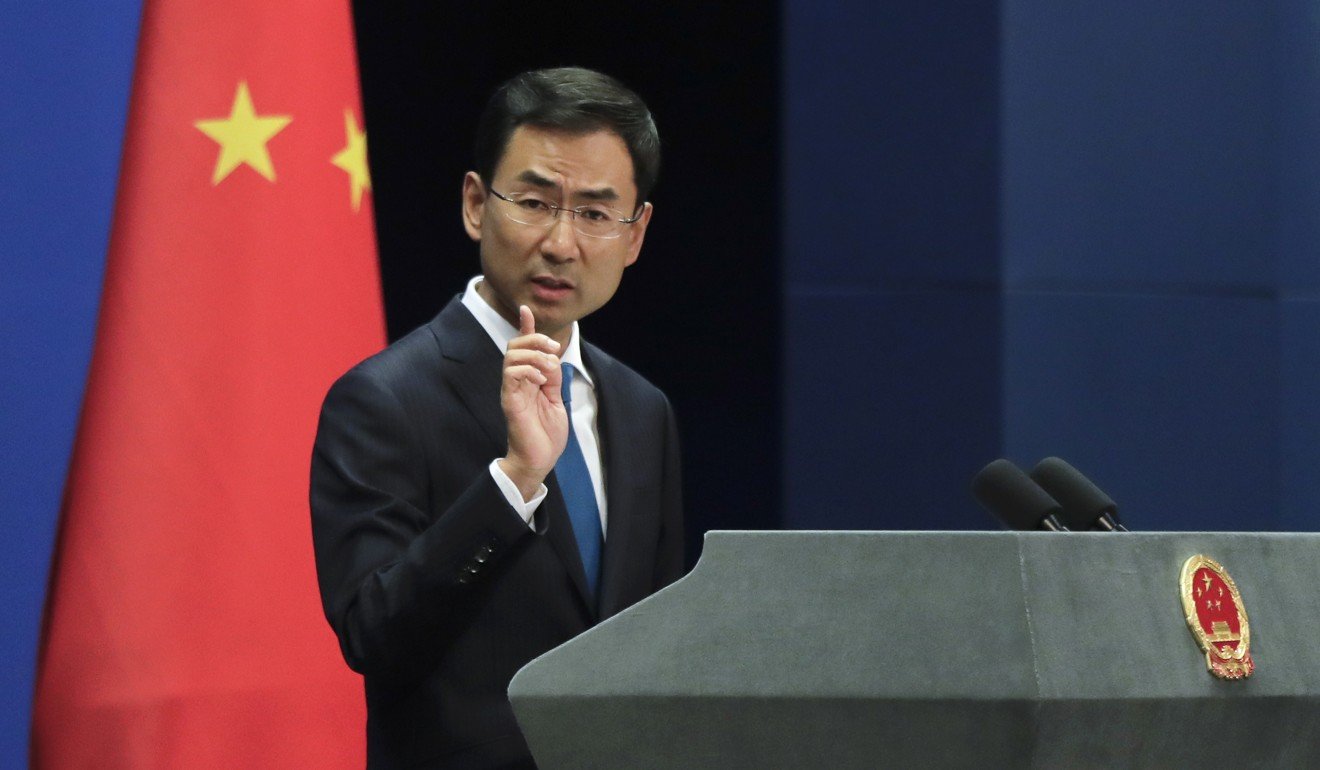
Foreign ministry spokesman Geng Shuang on Tuesday called for a ceasefire.

“The Chinese side has always opposed the use of force in international relations and has advocated for adherence to the Charter of the United Nations, and to resolve problems through political and diplomatic channels,” Geng said during a regular press briefing, when asked about Beijing’s position on the situation.

“Sovereignty, independence, unification and territorial integrity should be respected and protected,” he said. “We urge Turkey to halt military action and to return to the right track, resolving the issue with political solutions.”

Chinese foreign ministry spokesman Geng Shuang called on Turkey to “work with the international community in fighting against terrorism”. Photo: AP

Geng also said the “anti-terrorism situation in Syria is still severe”, and the military operation could result in a comeback by Islamic State.

“We urge Turkey to take responsibility and work with the international community in fighting against terrorism,” he said.

Explained: why are Syria’s Kurds accusing the US of betrayal?
Trump’s move has drawn sharp criticism from around the world. Critics say he has abandoned the allies that helped fight against Isis, and that withdrawing troops could pave the way for a resurgence of the jihadist group whose violent takeover of Syrian and Iraqi land five years ago was the reason US forces went in.

The US president said about 1,000 US troops who had been partnering with local Kurdish fighters to battle Islamic State in northern Syria were leaving the country. He said they would remain in the Middle East to “monitor the situation” and to prevent a revival of Isis – a goal that even Trump’s allies say has become much more difficult as a result of the US pull-out.

Turkey says the offensive aims to remove the Kurdish-led Syrian Democratic Forces from the border area and create what it calls a “safe zone” to relocate 1 million Syrian refugees.

Facing mounting criticism, Trump on Monday announced sanctions would be imposed

 on Turkey, halted bilateral trade negotiations and called for an immediate ceasefire.
Vice-President Mike Pence also said Trump was sending him to the Middle East because the president was concerned about instability in the region.
Beijing has long worried that conflict in the region could spill over to Chinese soil after thousands of Uygurs – the Turkic-speaking Muslim minority from far western China – travelled to Syria to train and fight as jihadists.
Source: SCMP
15/10/2019

Vietnam urges restraint amid maritime tensions with China

HANOI (Reuters) – Vietnamese President and Communist Party chief Nguyen Phu Trong has called for restraint in the disputed South China Sea amid a tense months-long standoff between Chinese and Vietnamese ships, state media reported on Tuesday.

China claims almost all the energy-rich waters but neighbours Brunei, Malaysia, the Philippines, Taiwan and Vietnam also have claims.

Tension escalated when Beijing dispatched a research ship to conduct an energy survey in waters controlled by Vietnam in July.

“On the subject of foreign policy, including the East Sea issue, the General Secretary stressed the importance of maintaining a peaceful and stable environment, and resolutely fighting to protect Vietnam’s independence, sovereignty and territorial integrity,” the state-run Voice of Vietnam (VOV) said on its website.

The South China Sea is known as the East Sea in Vietnam.

Vietnam has good relations with China but should “never compromise” on its sovereignty and territorial integrity, VOV quoted Trong as saying.

The Chinese vessel, the Haiyang Dizhi 8, was continuing its survey in Vietnam’s exclusive economic zone late on Tuesday, under escort from at least three Chinese ships, according to data from Marine Traffic, a website that tracks vessel movements.
Vietnam’s foreign ministry has repeatedly accused the vessel and its escorts of violating its sovereignty and has demanded that China remove its ships from the area.
On Sunday, Vietnam pulled DreamWorks’ animated film “Abominable” from cinemas over a scene featuring a map which shows China’s unilaterally declared “nine-dash line” in the South China Sea.
The U-shaped line is used on Chinese maps to illustrate its claims, including large swathes of Vietnam’s continental shelf, where it has awarded oil concessions.
In August, police broke up a brief protest outside the Chinese embassy in Hanoi over the survey vessel.
Trong has made more public appearances in recent weeks after suffering from an unspecified illness..
The 75-year-old has presided over a widespread crackdown on corruption in the Southeast Asian country that has seen several high-ranking ministers and politicians, including one Politburo member, sent to prison on charges ranging from embezzlement to economic mismanagement.
Source: Reuters
13/10/2019

Xi, Modi agree to trim trade deficit, boost mutual trust amid US-China tensions

  • The leaders agreed to set up a mechanism to boost economic ties and tackle India’s trade deficit with China after their second informal summit
  • As 2020 is the 70th anniversary of diplomatic ties between both countries, India and China will hold 70 events next year to promote relations
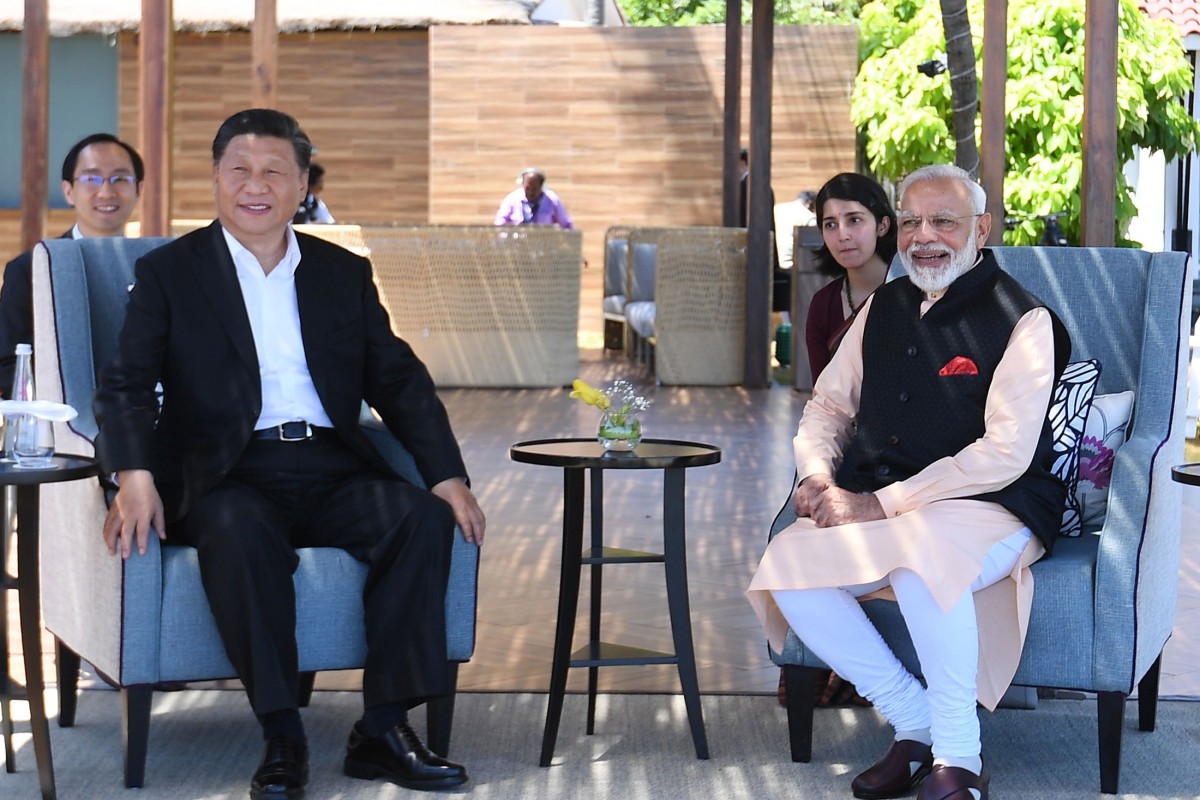
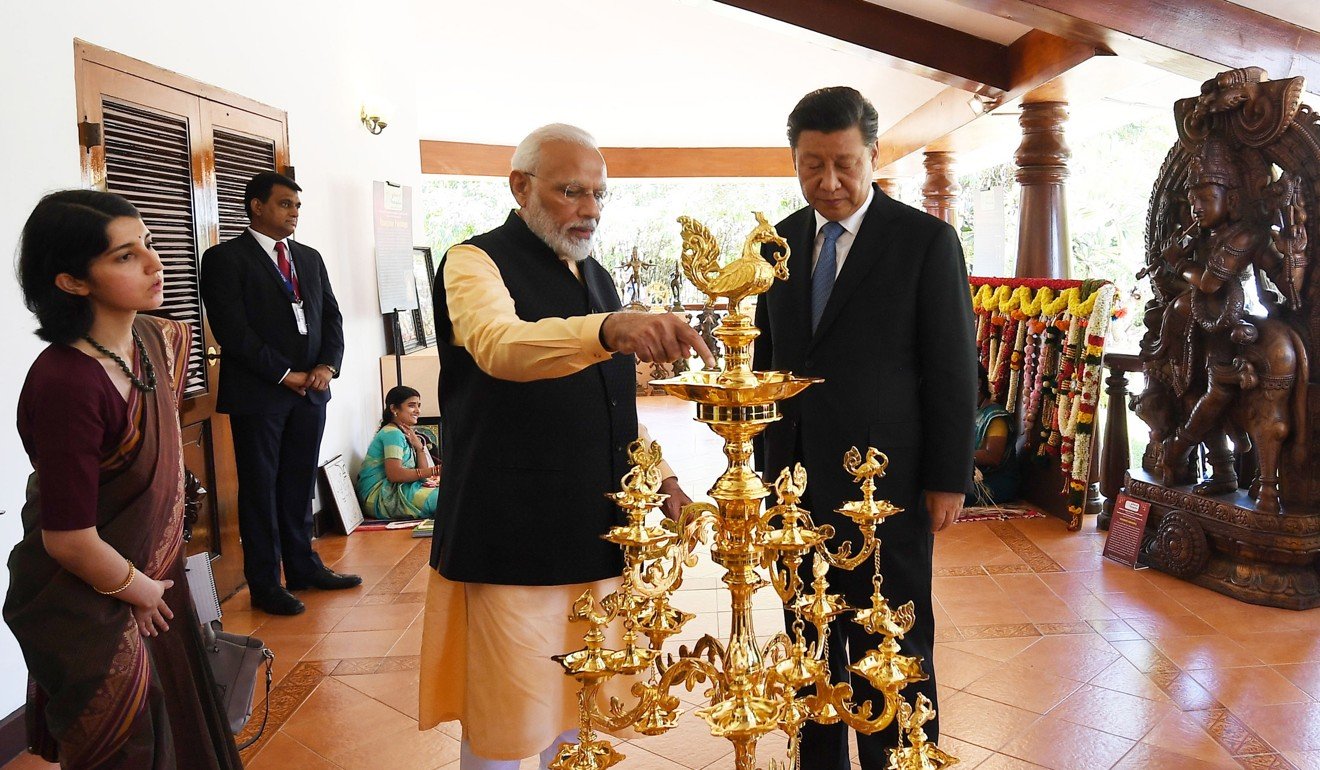
Indian Prime Minister Narendra Modi and Chinese President Xi Jinping during their meeting in Mamallapuram, Chennai. Photo: EPA
Chinese President Xi Jinping and Indian Prime Minster Narendra Modi concluded their second informal summit on Saturday by pledging to overcome trade differences and appreciate “each other’s autonomous foreign policies”, signalling an effort to focus on mutual interests rather than on long-standing contentious issues.
Modi remarked that both sides had agreed to be “sensitive” to each other’s concerns and not let differences escalate into disputes, while Xi called for communication to “alleviate suspicions” and for India and China to enhance strategic mutual trust, according to state news broadcaster CCTV.
Their desire to look beyond irritants in diplomatic ties, including a decades-long border row and China’s close military ties with India’s arch rival, Pakistan, comes as Beijing is embroiled in a tariff war with Washington that has rocked the global economy.
In a sign of China’s willingness to address India’s trade deficit with it, the leaders agreed to launch a “High Level Economic and Trade Dialogue”.
As Xi meets Modi, Chinese in Chennai hope to witness the ‘Wuhan spirit’
Chinese Vice-Premier Hu Chunhua and Indian Finance Minister Nirmala Sitharaman will meet regularly to discuss ways to boost two-way trade and investments, Indian foreign secretary Vijay Gokhale said in a media briefing.
India has a US$53 billion trade deficit with China, which makes up almost a third of its total trade deficit. It is also facing pressure to decide if it will commit to the China-led

Regional Comprehensive Economic Partnership

(RCEP), which aims to create the world’s largest trading bloc involving 16 countries before the end of the year.

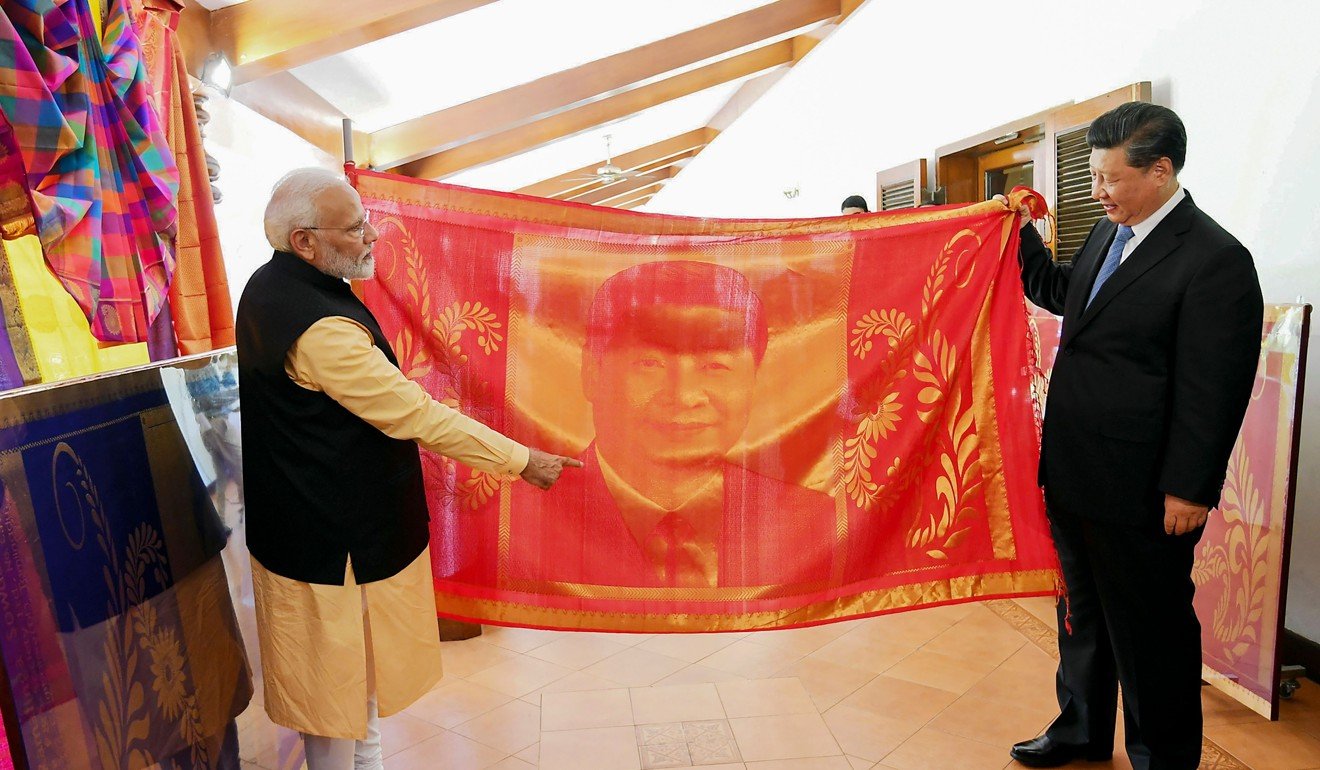
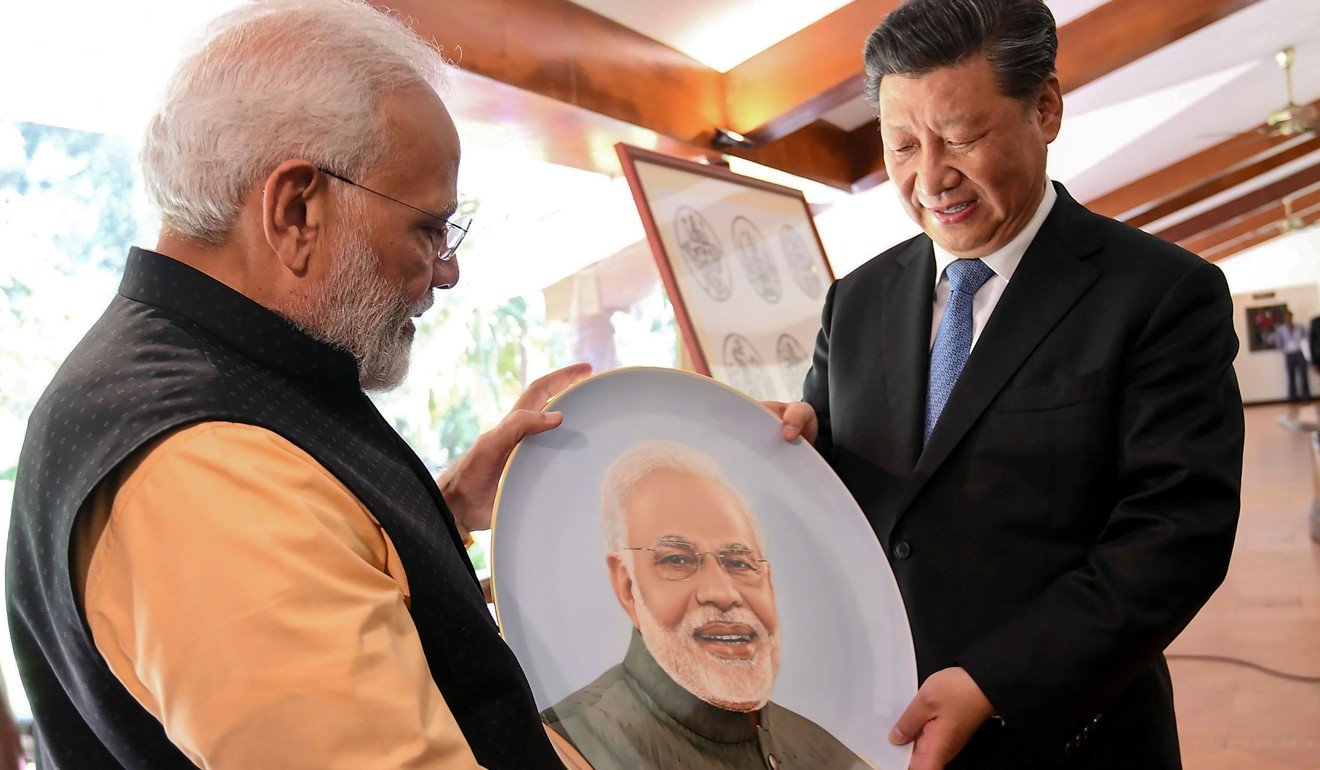
Narendra Modi exchanges gifts with Xi Jinping. Photo: AFP

Negotiations are ongoing with talks taking place in Bangkok this week, but India’s domestic producers have opposed the agreement over fears of a flood of Chinese imports. On Friday, the Indian government rejected clauses in the agreement related to e-commerce, according to reports.

Gokhale told the media briefing that both leaders, who met in the coastal town of Mamallapuram about 50km away from Chennai, briefly discussed the RCEP.

“PM Modi said India was looking forward to the RCEP but it is important that RCEP is balanced, that a balance is maintained in trade in goods, trade in services and investments,” he said, adding that Xi agreed to further discussions of India’s concerns on the issue.

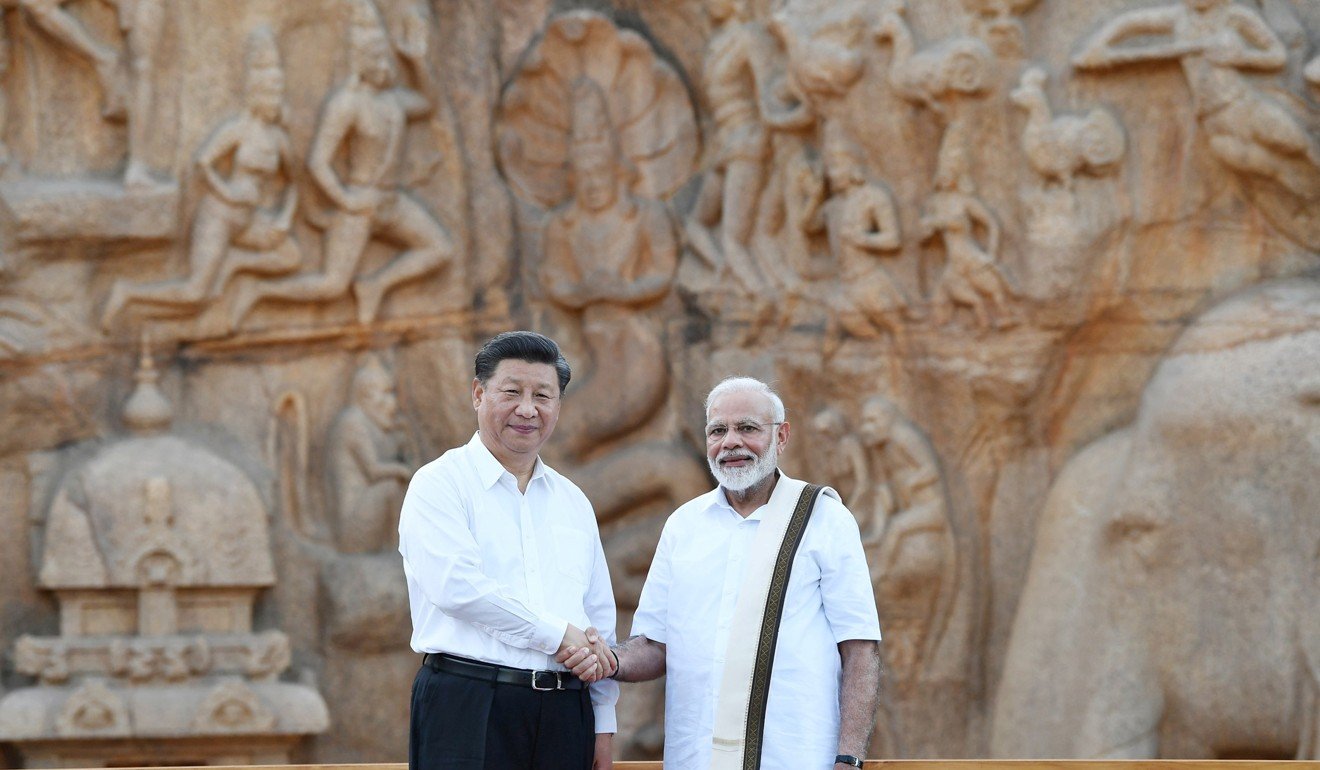
Narendra Modi with Xi Jinping in Mamallapuram. Photo: EPA

CCTV said Xi had six suggestions for how China and India could further improve ties, including assessing each other correctly and stepping up cooperation between their militaries. Besides economic and trade dialogue, China welcomed Indian pharmaceutical and IT companies to invest there, he said.

“We should look at disputes with a correct mind, and not let disputes affect cooperation.

“Both sides should properly and fairly get a solution for border disputes that are acceptable to each other … [and] cautiously handle each other’s core interests, and take proper measures to control issues that cannot be resolved immediately,” the president reportedly said.

Gokhale told reporters that both countries had agreed to pursue, through special representatives, an ongoing dialogue on their disputed border. China and India have held more than 20 rounds of talks to resolve their boundary dispute, over which they went to war in 1962. Different mechanisms have been set up to maintain peace along the 4,000-kilometre (2,485-mile) so-called Line of Actual Control.

Xi and Modi bank on chemistry as they talk trade and terrorism

Gokhale confirmed that the leaders – who met for a total of seven hours over Friday and Saturday, with the bulk of their time spent in one-on-one talks – did not discuss 

Kashmir

, a region that is currently divided between India and Pakistan but which both nuclear-armed rivals claim in full.

Since India revoked the autonomy of the area it controls in August and imposed a lockdown,

Pakistan

has lobbied its allies – including its all-weather friend China – to support its opposition to the move. New Delhi had reacted sharply to Beijing’s move to take the matter to the United Nations, insisting that it was a purely bilateral issue. Two days before the summit, Xi had hosted Pakistan Prime Minister Imran Khan and had assured him of China’s support on all core issues, a statement that had irked India.

Gokhale said both leaders “emphasised the importance of having independent and autonomous foreign policies”.
“President Xi said that the two countries needed to have more extensive dialogue in order to understand each other’s perspectives on major global and regional issues,” he added.
Narendra Modi exchanges gifts with Xi Jinping. Photo: AFP

The leaders also discussed terrorism, with a statement issued later by New Delhi saying both sides would make efforts to ensure the international community strengthened its framework “against training, financing and supporting terrorist groups throughout the world and on a non-discriminatory basis”.

The China-led multilateral Financial Action Task Force, which has been investigating Pakistan’s efforts to stamp out the financing of terrorism, is expected to decide soon if it would add Islamabad to its blacklist along with Iran and North Korea, a move that could invite stringent economic sanctions and drive away international financial institutions, both of which could affect Pakistan’s already-indebted economy adversely.

Gokhale added that as 2020 is the 70th anniversary of diplomatic ties between both countries, India and China will hold 70 events next year to promote people-to-people ties, with Modi accepting an invitation by Xi for the next informal summit to be held in China.

Both leaders had struck positive notes on the summit – with Xi describing their discussions as “candid” and between friends and Modi hailing the “Chennai Connect” meeting as marking a new era of cooperation between both countries.

War games, Kashmir and a US$57b question: the issues as Xi meets Modi

But analysts said they would be looking to see how the newly-announced high-level mechanism on trade panned out.

Narayani Basu, a New Delhi-based author, foreign policy analyst and China watcher felt the summit had achieved its purpose of bagging small wins for both sides.

“Discussing contentious issues would have defeated the purpose of the summit. The idea behind such a summit must be that despite the overarching posturing on different divergent issues, the two countries can achieve the easily-achievable wins. That is what the summit seems to have tried doing.”

But in terms of actual outcomes, she said she remained sceptical.

“I don’t think there has been much progress in the ties between the two countries since the last summit in Wuhan. Hence, this time, there is a lot more caution and scepticism towards such a summit,” she said, referring to the first summit last year in the Chinese city of Wuhan.

During Xi’s visit to southern India, which lasted 24 hours in all, Modi took him on a personal tour of temple monuments dating back to the seventh and eighth century in Mamallapuram when regional leaders had trade ties with Chinese provinces. He was also shown local artisan handicrafts and art forms, and gifted a handwoven silk portrait, a lamp and a painting.

Xi gave Modi a porcelain plate with the image of the prime minister’s face printed on it.

Xi Jinping with Narendra Modi in Mamallapuram. Photo: Reuters

On Friday, New Delhi announced that visa rules for Chinese nationals visiting India would be relaxed, with multiple-entry visas with a validity period of five years available from this month onwards. At present, most visas are single-entry and usually for between 30 and 60 days. Visa fees would also be reduced, the government said, with the multiple-entry visa costing US$80.

This was aimed at further enhancing “people-to-people exchanges between the two countries and [encouraging] more Chinese tourists to choose India as a destination for tourism purposes,” it said in a statement.

Xi left Chennai on Saturday afternoon and arrived in Nepal, which lies in between India and China. He will be the first Chinese president to visit Nepal in 22 years and is expected to sign a slew of deals with Nepal’s Prime Minister K.P. Sharma Oli, including the planned extension of the rail link from remote, mountainous Tibet to Nepal’s capital, Kathmandu.

The link will be part of Beijing’s ambitious infrastructure project to boost trade, the 

Belt and Road Initiative

(BRI), that Nepal joined two years ago.

More than 120 countries have signed on to the BRI, including Pakistan, where a series of projects worth US$46 billion are being constructed under the China-Pakistan Economic Corridor (CPEC). India has snubbed the BRI and questioned the transparency of funding agreements.
Source: SCMP
10/10/2019

Taiwan leader rejects China’s ‘one country, two systems’ offer

President Tsai Ing-wen also vowed in a National Day speech to defend Taiwan’s sovereignty, saying her government would safeguard freedom and democracy as Beijing ramps up pressure on the self-ruled island it considers a wayward province.

Tsai, who is seeking re-election in January amid criticism of her policy towards China, referred to the arrangement for the return of the former British colony of Hong Kong to Chinese rule in 1997 as a failure.

Hong Kong has been hit by months of anti-government protests triggered by widespread resentment of what many city residents see as relentless efforts by Beijing to exert control of their city despite the promises of autonomy.

China has proposed that Taiwan be brought under Chinese rule under a similar arrangement, but Tsai said Beijing’s policies towards the island were a danger to regional stability.

“China is still threatening to impose its ‘one country, two systems’ model for Taiwan. Their diplomatic offensives and military coercion pose a serious challenge to regional stability and peace,” Tsai said.

“The overwhelming consensus among Taiwan’s 23 million people is our rejection of ‘one country, two systems,’ regardless of party affiliation or political position.”
Taiwan’s National Day, marking the anniversary of the start of a 1911 uprising that led to the end of dynastic rule in China and the founding of a republic, was celebrated in Taipei with singing, dancing and parades.
Cold War hostility between the island and the mainland had eased over the past decade or so as both sides focused more on expanding business ties, but relations have cooled considerably since Tsai took office in 2016.
China suspects Tsai and her independence-leaning Democratic Progressive Party of pushing for the island’s formal independence, and this year threatened it with war if there was any such move.
Tsai denies seeking independence and reiterated that she would not unilaterally change the status quo with China.

FLASHPOINT

Despite her assurances, Beijing has stepped up pressure on the island to seek “reunification” and backed up its warnings by flying regular bomber patrols around it.

Beijing also says Taiwan does not have the right to state-to-state relations and is keen to isolate it diplomatically.

Seven countries have severed diplomatic ties with the Taiwan and switched allegiance to Beijing since Tsai coming to power. It now has formal diplomatic ties with just 15 nations.

But Tsai said Taiwan was undaunted.

“The determination of the Taiwanese people to embrace the world has never wavered,” she said, adding that Taiwan must work with “like-minded countries” to ensure peace and stability across the Taiwan Strait.

Tsai said under her watch Taiwan has boosted its combat capabilities with the purchase of advanced weapons and development of home-made aircraft.

Taiwan unveiled its largest defence spending increase in more than a decade in August, aiming to purchase more advanced weapons from overseas.

The island has long been a flashpoint in the U.S.-China relationship.

In July, the United States approved the sale of an $2.2 billion worth of weapons to Taiwan, angering Beijing.

The United States has no formal ties with Taiwan but is bound by law to help provide it with the means to defend itself.

Source: Reuters

09/10/2019

US imposes China visa restrictions over Uighur issue

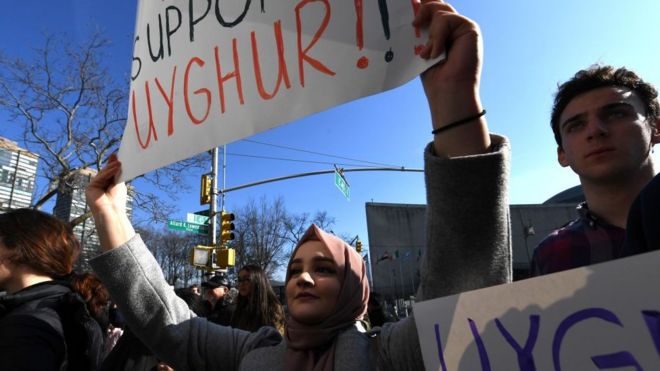
Uighur protesters demonstrating in the US in FebruaryImage copyright GETTY IMAGES
Image caption Protests calling for Uighur freedom have been happening all year

The US has said it will impose visa restrictions on Chinese officials accused of involvement in repression of Muslim populations.

It follows the decision on Monday to blacklist 28 Chinese organisations linked by the US to allegations of abuse in the Xinjiang region.

US Secretary of State Mike Pompeo said the Chinese government had instituted “a highly repressive campaign”.

China has dismissed the allegations as groundless.

In a statement, Mr Pompeo accused the Chinese government of a string of abuses against Uighurs, ethnic Kazakhs, Kyrgyz Muslims and other minority Muslim groups.

These included “mass detentions in internment camps; pervasive, high-tech surveillance; draconian controls on expressions of cultural and religious identities; and coercion of individuals to return from abroad to an often perilous fate in China”.

China has rebuffed the US moves.

“There is no such thing as these so-called ‘human rights issues’ as claimed by the United States,” foreign ministry spokesman Geng Shuang said on Monday.

“These accusations are nothing more than an excuse for the United States to deliberately interfere in China’s internal affairs.”

Media caption The BBC visits the camps where China’s Muslims have their “thoughts transformed”

Visa restrictions are to be imposed on Chinese government and Communist Party officials, as well as their family members.

“The United States calls on the People’s Republic of China to immediately end its campaign of repression in Xinjiang, release all those arbitrarily detained, and cease efforts to coerce members of Chinese Muslim minority groups residing abroad to return to China to face an uncertain fate,” the US statement said.

The US and China are currently embroiled in a trade war, and have sent delegations to Washington for a meeting about the tensions later this week.

What is the situation in Xinjiang?

China has been carrying out a massive security operation in Xinjiang, in its far west, in recent years.

Human rights groups and the UN say China has rounded up and detained more than a million Uighurs and other ethnic minorities in vast detention camps, where they are forced to renounce Islam, speak only in Mandarin Chinese and learn obedience to the communist government.

But China says they are attending “vocational training centres” which are giving them jobs and helping them integrate into Chinese society, in the name of preventing terrorism.

Media caption The BBC’s John Sudworth meets Uighur parents in Turkey who say their children are missing in China

There have been increasingly vocal denunciations from the US and other countries about China’s actions in Xinjiang.

Last week, Mr Pompeo alleged that China “demands its citizens worship government, not God” in a press conference in the Vatican.

And in July more than 20 countries at the UN Human Rights Council signed a joint letter criticising China’s treatment of the Uighurs and other Muslims.

Who are the Uighurs?

Uighurs are ethnically Turkic Muslims. They make up about 45% of the Xinjiang region’s population; 40% are Han Chinese.

China re-established control in 1949 after crushing short-lived state of East Turkestan.

Since then, there has been large-scale immigration of Han Chinese and Uighurs fear erosion of their culture.

Xinjiang is officially designated an autonomous region within China, like Tibet to its south.

Source: The BBC

06/10/2019

Xinhua Headlines: China’s Greater Bay Area busy laying foundation for innovation

As China aims to develop its Greater Bay Area into an international innovation and technology hub, innovation and entrepreneurship resources are shared in the area to provide more opportunities for young Hong Kong and Macao entrepreneurs.

The provincial government of Guangdong has stepped up efforts to improve basic research capability, considered the backbone of an international innovation and technology hub, by building large scientific installations and launching provincial labs.

by Xinhua writers Liu Yiwei, Quan Xiaoshu, Wang Pan, Jing Huaiqiao

GUANGZHOU, Oct. 5 (Xinhua) — Hong Kong man Andy Ng was surprised his shared workspace Timetable was rented out completely only six months after it had started operation in Guangzhou, capital of south China’s Guangdong Province.

While studying economics at City University of Hong Kong, Ng set up his first business, developing an online education platform, but soon realized the Hong Kong market was too small. After earning a master’s degree in the UK in 2017, Ng returned to China and chose Guangzhou as his new base.

Timetable is now accumulating popularity and even fans in Dianping.com, China’s major online consumer guide. Ng feels lucky that his business caught the implementation of the Guangdong-Hong Kong-Macao Greater Bay Area (GBA) development plan.

The bay area, covering 56,000 square km, comprises Hong Kong and Macao, as well as nine cities in Guangdong. It had a combined population of about 70 million at the end of 2017, and is one of the most open and dynamic regions in China.

Aerial photo taken on July 11, 2018 shows the Hong Kong-Zhuhai-Macao Bridge in south China. (Xinhua/Liang Xu)

In July 2017, a framework agreement on the development of the bay area was signed. On February 18 this year, China issued the more specific Outline Development Plan for the Guangdong-Hong Kong-Macao Greater Bay Area. One of its major aims is to develop the area into an international innovation and technology hub.

OPPORTUNITIES FOR YOUTH

The plan proposes that innovation and entrepreneurship resources be shared in the bay area to provide more opportunities for young Hong Kong and Macao entrepreneurs.

An incubator for entrepreneurship, Timetable is home to 52 companies, including 15 from Hong Kong and Macao, such as Redspots, a virtual reality company that won the Hong Kong Information and Communications Technology (ICT) Awards 2019.

“I persuaded them one by one to come here,” Ng said. “I told them of my own experience that the GBA is a great stage for starting a business with ever-upgrading technologies, ever-changing consumer tastes and a population 10 times that of Hong Kong.”

Timetable is a startup base of the Guangzhou Tianhe Hong Kong and Macao Youth Association, which has assisted 65 enterprises founded by Hong Kong and Macao young people since its establishment in October 2017.

The association and its four bases provide a package of services from training and registering to policy and legal consultation, said Chen Jingzhan, one of the association founders.

Tong Yat, a young Macao man who teaches children programming, is grateful the association encouraged him to come to Guangdong, where young people enjoy more preferential policies to start their own businesses.

“The GBA development not only benefits us, but paves the way for the next generation,” Tong said. “If one of my students were to become a tech tycoon in the future and tell others that his first science and technology teacher was me, I would think it all worthwhile.”

In the first quarter of this year, there were more than 980 science and technology business incubators in Guangdong, including more than 50 for young people from Hong Kong and Macao, said Wu Hanrong, an official with the Department of Science and Technology of Guangdong Province.

INNOVATION HIGHLAND

As the young entrepreneurs create a bustling innovative atmosphere, the Guangdong government has stepped up efforts to improve basic research capability, considered the backbone of an international innovation and technology hub, by building large scientific installations and launching provincial labs.

Several large scientific facilities have settled in Guangdong. China Spallation Neutron Source (CSNS) operates in Dongguan City; a neutrino observatory is under construction in Jiangmen City; a high intensity heavy-ion accelerator is being built in Huizhou City.

Aerial photo taken on June 23, 2019 shows the construction site of the Jiangmen Underground Neutrino Observatory (JUNO) in Jiangmen, south China’s Guangdong Province. (Xinhua/Liu Dawei)

Guangdong also plans to build about 10 provincial labs, covering regenerative medicine, materials, advanced manufacturing, next-generation network communications, chemical and fine chemicals, marine research and other areas, said Zhang Yan, of the provincial department of science and technology.

Unlike traditional universities or research institutions, the provincial labs enjoy a high degree of autonomy in policy and spending. A market-oriented salary system allows them to recruit talent from all over the world, and researchers from other domestic organizations can work for the laboratories without giving up their original jobs, Zhang said.

The labs are also open to professionals from Hong Kong and Macao. Research teams from the universities of the two special administrative regions have been involved in many of the key programs, Zhang said.

For example, the provincial lab of regenerative medicine and health has jointly established a regenerative medicine research institute with the Chinese University of Hong Kong, a heart research center with the University of Hong Kong, and a neuroscience research center with the Hong Kong University of Science and Technology (HKUST).

Photo taken on July 24, 2019 shows a rapid cycling synchrotron at the China Spallation Neutron Source (CSNS) in Dongguan, south China’s Guangdong Province. (Xinhua/Liu Dawei)

Guangdong has been trying to break down institutional barriers to help cooperation, encouraging Hong Kong and Macao research institutions to participate in provincial research programs, exploring the cross-border use of provincial government-sponsored research funds, and shielding Hong Kong researchers in Guangdong from higher mainland taxes.

NANSHA FOCUS

Located at the center of the bay area, Guangzhou’s Nansha District is designed as the national economic and technological development zone and national free trade zone, and is an important pivot in building the area into an international innovation and technology hub.

The construction of a science park covering about 200 hectares started on Sept. 26. Gong Shangyun, an official with the Nansha government, said the park will be completed in 2022.

Jointly built by the Guangzhou government and the Chinese Academy of Sciences (CAS), the science park will accommodate CAS research institutes from around Guangzhou, including the South China Sea Institute of Oceanology, the South China Botanical Garden (SCBG) and the Guangzhou Institute of Energy Conversion.

Ren Hai, director of the SCBG, is looking forward to expanding the research platforms in Nansha. “We will build a new economic plant platform serving the green development of the Pearl River Delta, a new botanical garden open to the public, and promote the establishment of the GBA botanical garden union.”

Wang Ying, a researcher with the SCBG, said the union will help deepen the long cooperation among its members and improve scientific research, science popularization and ecological protection. “Predecessors of our botanical garden have helped the Hong Kong and Macao counterparts gradually establish their regional flora since the 1950s and 1960s.”

HKUST also started to build a new campus in Nansha the same day as the science park broke ground. “Located next to the high-speed rail station, the Guangzhou campus is only a 30-minute journey from the Hong Kong campus. A delegation from the HKUST once paid a visit to the site and found it very convenient to work here,” Gong said.

Chief Executive of the Hong Kong Special Administrative Region (HKSAR) Carrie Lam hoped the new campus would help create a new chapter for the exchanges and cooperation on higher education between Guangzhou and Hong Kong, and cultivate more talents with innovative capabilities.

Nansha’s layout is a miniature of the provincial blueprint for an emerging international innovation and technology hub.

“We are seeking partnership with other leading domestic research institutions and encouraging universities from Hong Kong and Macao to set up R&D institutions in Guangdong,” said Zhang Kaisheng, an official with the provincial department of science and technology.

“We are much busier now, because research institutes at home and abroad come to talk about collaboration every week. The GBA is a rising attraction to global scientific researchers,” Zhang said.

Source: Xinhua

02/10/2019

Commentary: New China turns 70, witnessing a golden age

BEIJING, Oct. 2 (Xinhua) — While turning 70 often signals the beginning of a person’s twilight years, for the People’s Republic of China (PRC) it marks a golden age full of hope and vigor.

The PRC celebrated its 70th birthday on Oct. 1. China’s transformation from an agricultural society isolated from the West into the world’s second-largest economy open wide is nothing short of a miracle.

More importantly, it has charted a new path for developing countries to modernize.

Seven decades ago, the war-ravaged country started from scratch. Observers are astonished at China’s large-scale modernization, its reduction of the number of people living in poverty and the sheer volume of its consumer market. Their heads have been turned not only because of the speed of the transition but also by the unique path taken to realize this great transformation.

Reflecting on its past and present, and through experimentation, China has identified and will continue down the right path — socialism with Chinese characteristics.

Reform is the engine of China’s miracle. There is no ready-made solution for the development issues facing China. From creating special economic zones to building free trade pilot zones, from carrying out family-based production contracts to revitalizing state-owned enterprises, China has been one of the most successful countries in piloting reforms over the past decades. Now the reform is more in-depth and more comprehensive in economic, political, cultural, social and ecological sectors.

The Chinese government stresses being effective and responsive to the public interest. Development outlines are far-sighted. For example, the five-year plans are made to deal with comprehensive aspects that concern human development: food, transportation, communication, environment, health and education. These plans are a priority for the government.

Of course these achievements could never have been realized without the leadership of the CPC.

From the people and for the people, the CPC has always upheld its principle of striving for the happiness of the people and the rejuvenation of the nation.

At a life-or-death moment, the CPC shouldered the mission of saving the nation from existential peril. After 28 years of bloody struggle, it led the Chinese people to overthrow the “three mountains” placed on their heads and put an end to the semi-colonial and semi-feudal society of old China. Gone are the days where any attempt to bully China with “fists” or “intimidation” would succeed.

Despite overseas doubts, misunderstandings and predictions that its survival would be short-lived, the CPC has stunned the world with its leadership, innovative theories and ability to unite and organize the people.

It abolished the agricultural tax that had been in place for more than 2,600 years; it established a political system in which people are masters of their own affairs; it did its utmost to help people shake off poverty and keep nearly 1.4 billion people well-off.

No ruling party in the world can match the CPC’s record of adhering to the truth, versing itself in self-reform and self-purification, and turning impossibility into certainty in the face of difficulties and challenges, again and again.

The 70-year journey was never smooth. Trials and hardships abounded. The Chinese people dealt with floods and massive earthquakes and guarded against SARS and financial tsunamis. Yet these twists and turns never blocked China’s way forward but made it more sober, determined and mature.

Today, more than at any other time in history, China is closer to, more confident and more capable of achieving the great rejuvenation of the Chinese nation. However, lofty goals are never easily reached.

The world has been undergoing tremendous changes unseen in a century. Resistant external forces and headwinds still remain. “Zero-sum game” and “superior civilization” mentalities, among others, are prevailing.

The CPC will continue to lead the Chinese people to fight trade bullying, blackmailing and hegemonism. Only the CPC can lead China to emerge as a stronger country.

It all started long ago, and the journey is far from over.

Source: Xinhua

02/10/2019

Xi Jinping ‘no dictator’, American businessman Michael Bloomberg says

  • US billionaire says it will take time to solve problems like air pollution but China is taking action
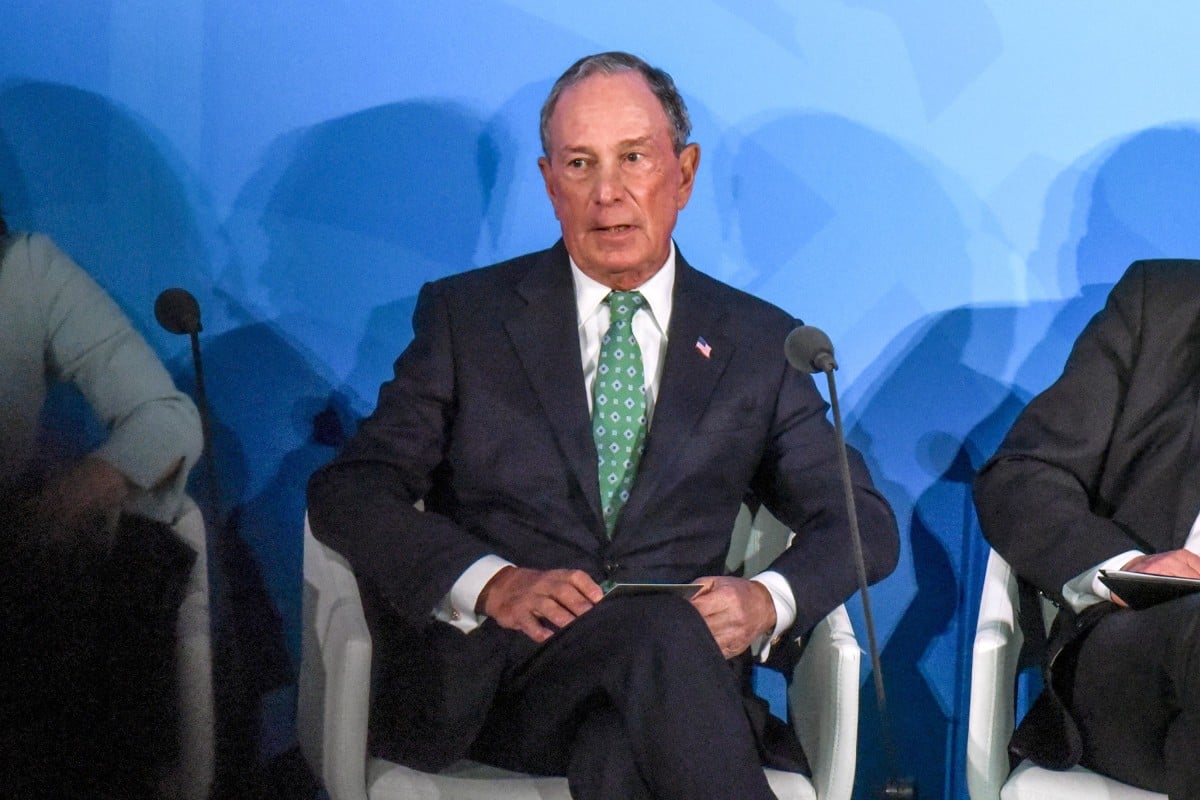
Billionaire Michael Bloomberg says it will take time for China to resolve problems like air pollution. Photo: AFP

US billionaire Michael Bloomberg has spoken out in support of Chinese President Xi Jinping, saying Xi is “not a dictator” and the Communist Party “listens to the public” on issues like air pollution.

Bloomberg made the comments in an interview on the weekend with Margaret Hoover, host of PBS’ Firing Line public affairs show, ahead of November’s Bloomberg New Economy Forum in Beijing, an event designed to rival the World Economic Forum in Davos.

When asked whether China could be a good partner in the fight against climate change, Bloomberg said “China is doing a lot”.

“Yes, they are still building a bunch of coal-fired power plants. Yes, they are [burning coal]. But they are now moving plants away from the cities. The Communist Party wants to stay in power in China and they listen to the public,” he said.

“When the public says ‘I can’t breathe the air’, Xi Jinping is not a dictator. He has to satisfy his constituents, or he’s not going to survive … The trouble is you can’t overnight move cement plants and power plants just outside the city that are polluting the air and you have to have their product. So some of it takes time.”
China prepares for next round of nationwide inspections in ‘war on pollution’

Hoover countered, saying China was not a democracy and Xi was not answerable to voters.

“He doesn’t have a vote, he doesn’t have a democracy. He [isn’t held] accountable by voters. Is the check on him just a revolution?” she said.

“You’re not going to have a revolution. No government survives without the will of the majority of its people,” Bloomberg said. “He has to deliver services.”

Hoover then said: “I’m looking at people in Hong Kong who are protesting and wondering whether the Chinese government cares what they have to say.”

Bloomberg said that in government – “even governments that aren’t what we could call a democracy” – there were many stakeholders with vested interests and “they have an impact”.

Smog in northern China rises in first four months of 2019 as anti-pollution drive loses ‘momentum’

Bloomberg’s comments come seven years after his news service published an investigative story about the finances of the extended family of Xi, then vice-president.

The story was published at a sensitive time, with China holding a once-a-decade leadership transition that saw Xi become president.

China banned the use of Bloomberg financial data tracking terminals but the company’s relations warmed gradually after three years.

In August 2015, Bloomberg was given a high-profile reception by then vice-premier Zhang Gaoli. He also published an opinion piece in party mouthpiece People’s Daily.

Beijing lifted the ban on Bloomberg in 2016.

Source: SCMP

02/10/2019

France’s Emmanuel Macron to meet Xi Jinping in China next month with focus on climate change and trade, source says

  • The trip comes amid growing resistance from European leaders over what they see as China’s failure to change long-term practices unfair to foreign investors
  • French President’s trip to Beijing follows Chinese leader’s visit to France in March
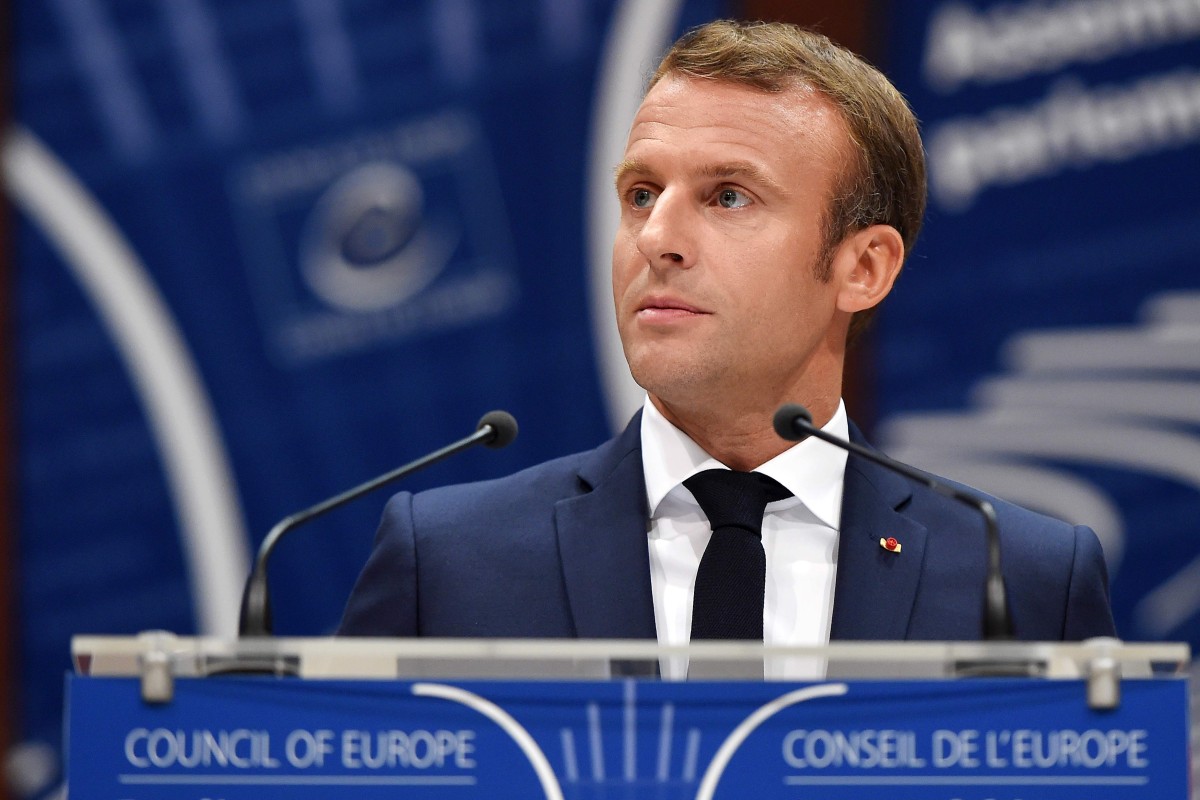
President Emmanuel Macron of France speaks to the Council of Europe parliamentary assembly on Tuesday. Photo: AFP

French President Emmanuel Macron will visit China next month as Europe’s most diplomatically active leader focuses on climate change cooperation and trade promotion with Asia’s leading power, a source briefed on the Elysee Palace’s discussions said.

This will be the second Chinese tour for Macron since he took office in 2017, and it will come amid escalating resistance from European politicians and business communities over what they see as China’s failure to change long-standing practices unfair to foreign investors.

His visit also comes at a time when France – as well as the European Union as a whole – is bracing for Washington’s potential levies of tariffs on European products, and the lack of progress on climate change policies with US President Donald Trump’s administration.

“President Macron will meet President Xi [Jinping], while France strives for better cooperation with China on climate and trade,” the source said. “His itinerary is still in the pipeline, but he is expected to visit Beijing and Shanghai.”

Macron, 41, who is widely seen as emerging as Europe’s most aggressive leader filling the political vacuum left by German Chancellor Angela Merkel’s political twilight, has cast himself as an honest broker between Russia and Ukraine, and between the US and Iran.

He has also been critical of China’s influence in Europe, joining forces with Merkel to push for a tougher EU stance on the world’s second biggest economy.

In March, when Xi claimed a major diplomatic victory by clinching a memorandum of understanding with Italy on the Belt and Road Initiative, Macron declared: “The time of European naivety is ended. For many years we had an uncoordinated approach and China took advantage of our divisions.”

Macron also backed investment screening mechanisms for Chinese business moves in Europe, while endorsing plans to change the EU’s notoriously strict antitrust rules in order to facilitate mergers between large European groups and companies to counter Chinese companies’ global ambitions.

Macron urges Iran and US to show ‘courage of building peace’

The EU is also wary of China’s effort to “divide and rule” the European Union. Greece and Hungary – both recipients of large amounts of Chinese investments – have repeatedly wanted to water down EU’s stance on issues deemed sensitive to Beijing, including the South China Sea and China’s human rights violations.

“It would be good [for Macron] to stress that 17+1 is irritating,” said Joerg Wuttke, president of EU Chamber of Commerce in China, in reference to China’s engagement with a group of EU and non-EU member states in eastern and southeastern Europe.

“After all, the EU has a ‘one China’ policy, [so] EU could expect this position from China too.”

Macron’s domestic call for EU unity has translated into diplomatic appeals, with China being one of the targets.

(From left) Jean-Claude Juncker, president of the European Commission; Xi Jinping, China’s leader; Emmanuel Macron, France’s president; and Angela Merkel, Germany's chancellor, ahead of a meeting in Paris on March 26. Photo: Christophe Morin/Bloomberg
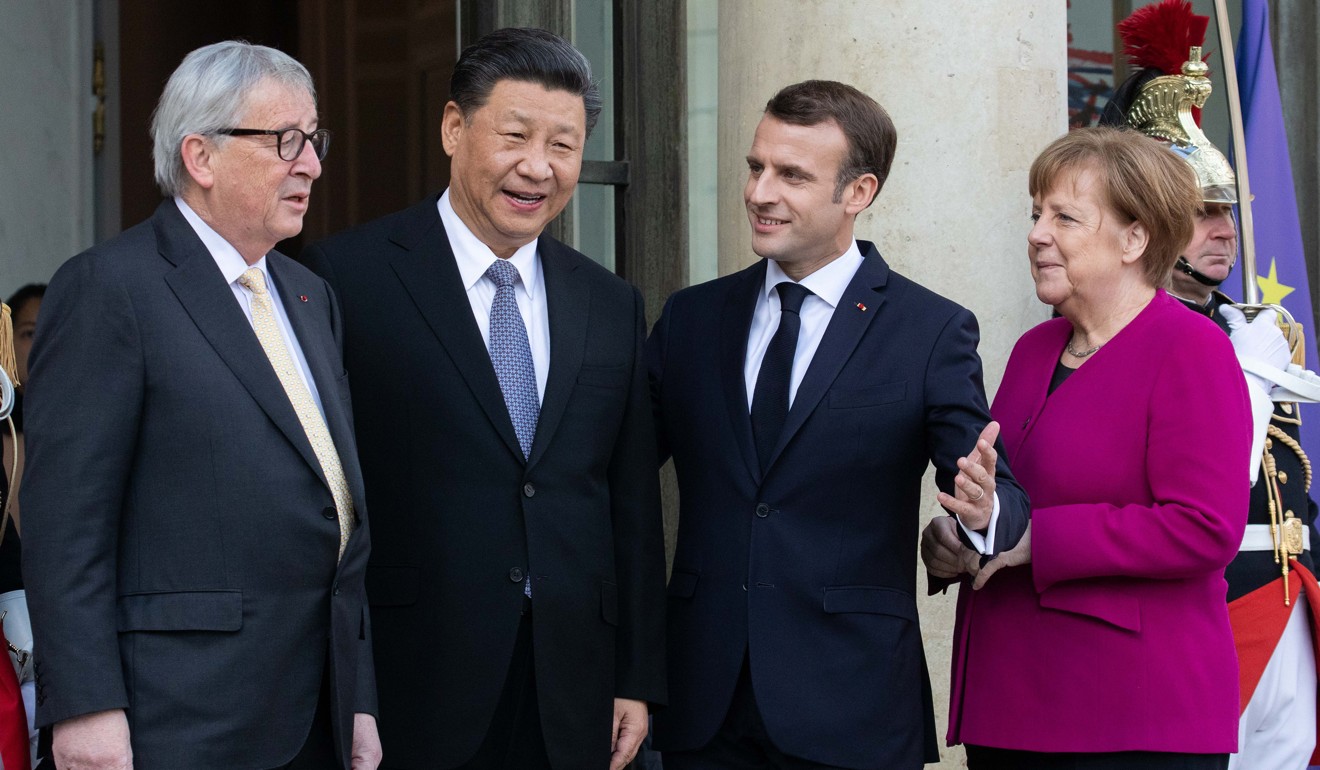
(From left) Jean-Claude Juncker, president of the European Commission; Xi Jinping, China’s leader; Emmanuel Macron, France’s president; and Angela Merkel, Germany’s chancellor, ahead of a meeting in Paris on March 26. Photo: Christophe Morin/Bloomberg

When Xi visited France in March, Macron hosted him at the Elysee Palace in the presence of Merkel and European Commission President Jean-Claude Juncker, showcasing European solidarity when it comes to EU-China policies.

In terms of French-Chinese bilateral ties, trade imbalances have persisted after Macron called for a “rebalancing” during his last visit.

France has a 1.4 per cent market share in China, compared with China’s 9 per cent market share in France. China represents France’s largest bilateral trade deficit, totalling €US$29.2 billion (US$31.9 billion) last year, ahead of Germany.

The EU has been calling for reciprocal investment treatment with China, a call that European business leaders in China expect Macron to make.

France bids farewell to late president Jacques Chirac

“We [Europe] need … a solid investment agreement to allow EU business to conduct their affairs in a similar manner as Chinese companies can operate in Europe. The agreement should be finalised in 2020, but not at all cost,” said Wuttke.

“The last thing EU business needs in China is a weak agreement that institutionalises imbalances,” he added.

Part of that involves building “more efficient defensive tools to prevent abusive technology transfers and to address the deep asymmetry in EU-China relations when it comes to access to public procurement markets,” said Mathieu Duchâtel, director of Asia programme at the Paris-based think tank Institut Montaigne.

Duchâtel added that it was also important to convey the message to Beijing that there are areas for cooperation even amid a more defensive China policy from France.

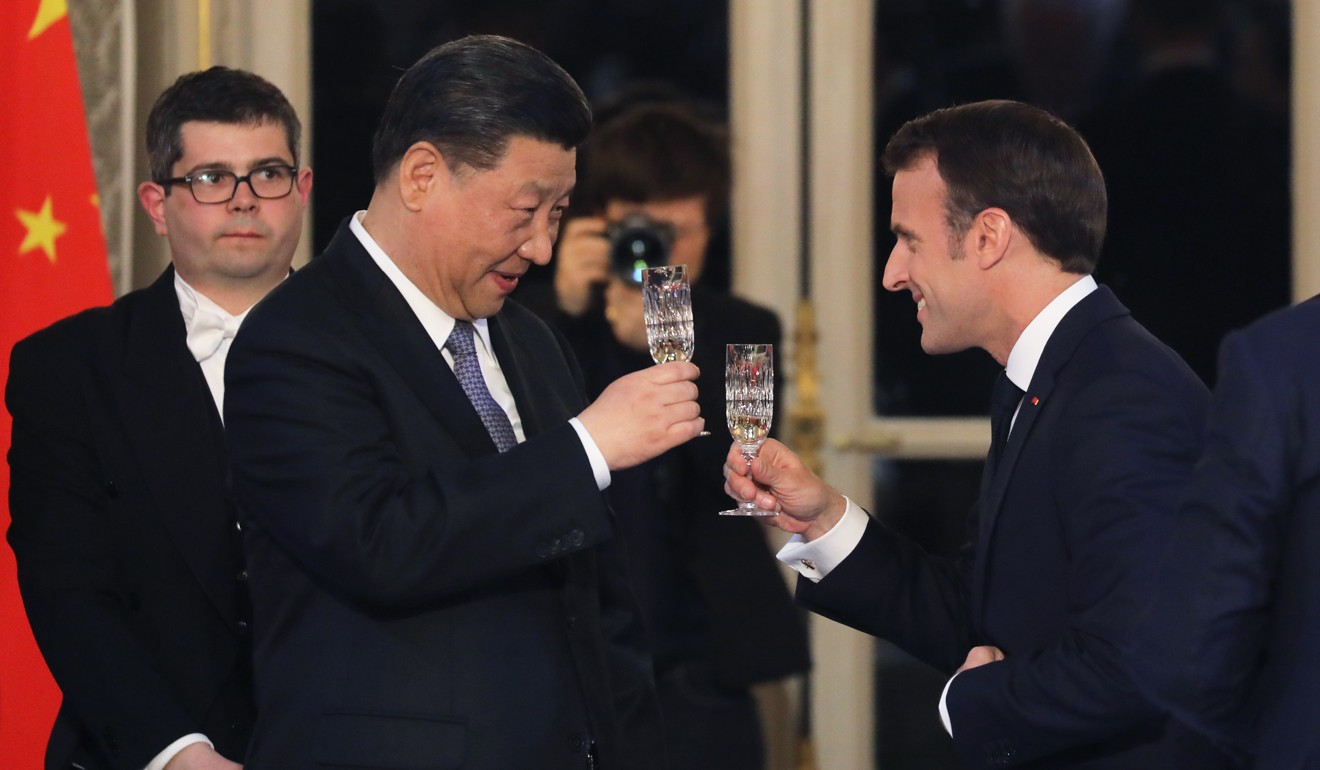
Chinese President Xi Jinping and French leader Emmanuel Macron toast raise a toast during a state dinner in Paris on March 25. Photo: EPA-EFE

One such area is the climate and environment, where China is “an important partner” for France to reach its goal of global carbon neutrality by 2050, he said.

“The energy/environment agenda is a political priority in Paris and one of very few issues on which cooperation with China remains promising and will continue to create business opportunities,” he said.

China is the world’s biggest carbon polluter, producing around 30 per cent of the planet’s man-made carbon dioxide. It remains committed to the 2015 Paris accord on climate change, even after Trump pulled the US out of the deal.

Under the agreement, the long-term temperature goal is to keep the increase in global average temperature to well below 2°C above pre-industrial levels, and to pursue efforts to limit the increase to 1.5°C.

Source: SCMP

01/10/2019

Military advances and Xi Jinping’s supreme status among the themes as Beijing celebrates National Day

  • 70th anniversary of the founding of the People’s Republic of China marked by its biggest ever military parade and huge civilian parade
  • Xi says no force can stop China ‘marching forward’ and vows to protect the long-term stability of Hong Kong
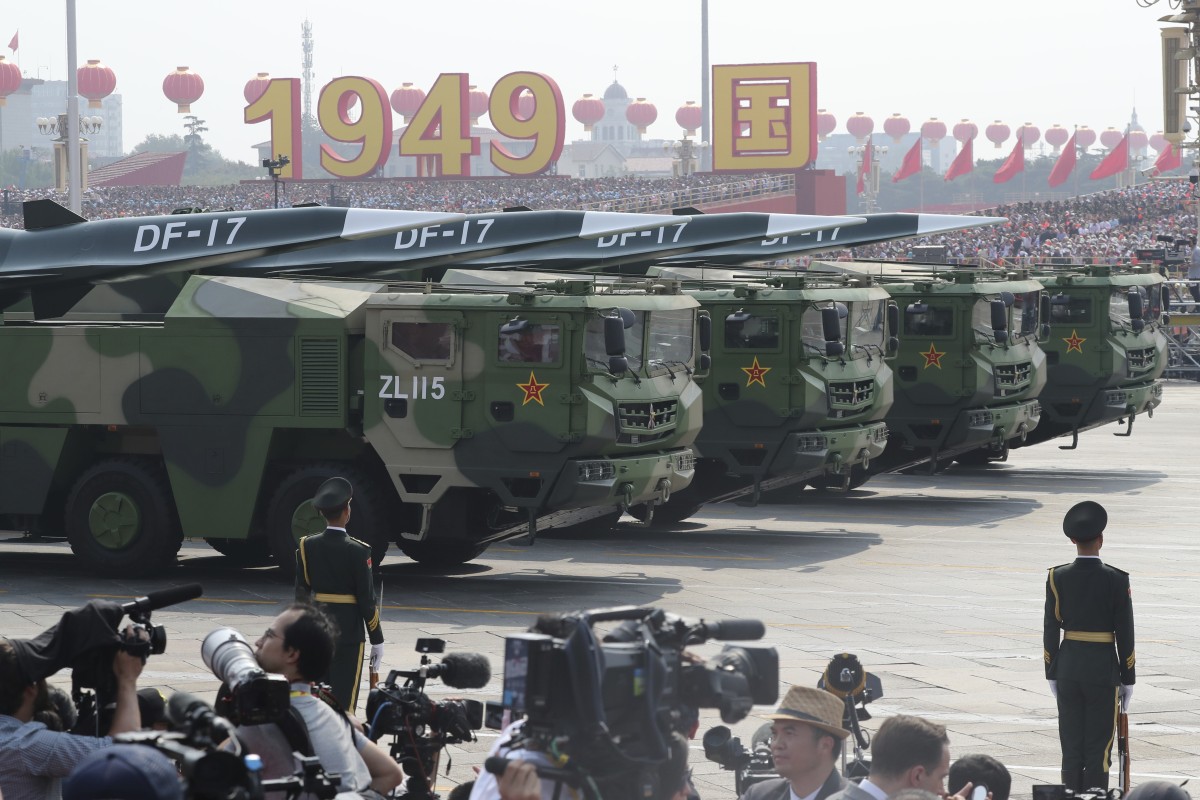
Military vehicles carry DF-17 missiles capable of reaching the US mainland during the parade to mark 70 years of the People’s Republic. Photo: AP
China staged a massive military parade in Beijing on Tuesday to mark the 70th anniversary of the founding of the People’s Republic, with much of the smog-shrouded capital city under a security lockdown.
President Xi Jinping inspected over 15,000 troops, more than 160 aircraft and 580 weapon systems in a show of the country’s growing military might and his drive to modernise the People’s Liberation Army.
He also delivered a bullish eight-minute speech hailing the accomplishments of seven decades of Communist rule and pledging to achieve his vision of a “Chinese dream” of national rejuvenation and global prominence.

Here are some of the key takeaways from a day of celebration in Beijing:

A show of unity

Xi presided over the ceremony in Tiananmen Square flanked by his predecessors Jiang Zemin and Hu Jintao, along with other retired and present party elders.

The rare appearance of Jiang and Hu – on the rostrum of the Gate of Heavenly Peace, where the country’s founding father Mao Zedong declared Communist rule on October 1, 1949 – was clearly aimed at projecting unity and solidarity in the face of daunting domestic and international challenges.

China’s National Day parade, as it happened
Hu had been absent from the funeral of former premier Li Peng in late July, although the ailing Jiang attended.

Former vice-president Zeng Qinghong and Song Ping, the oldest party elder in attendance, also appeared on the rostrum.

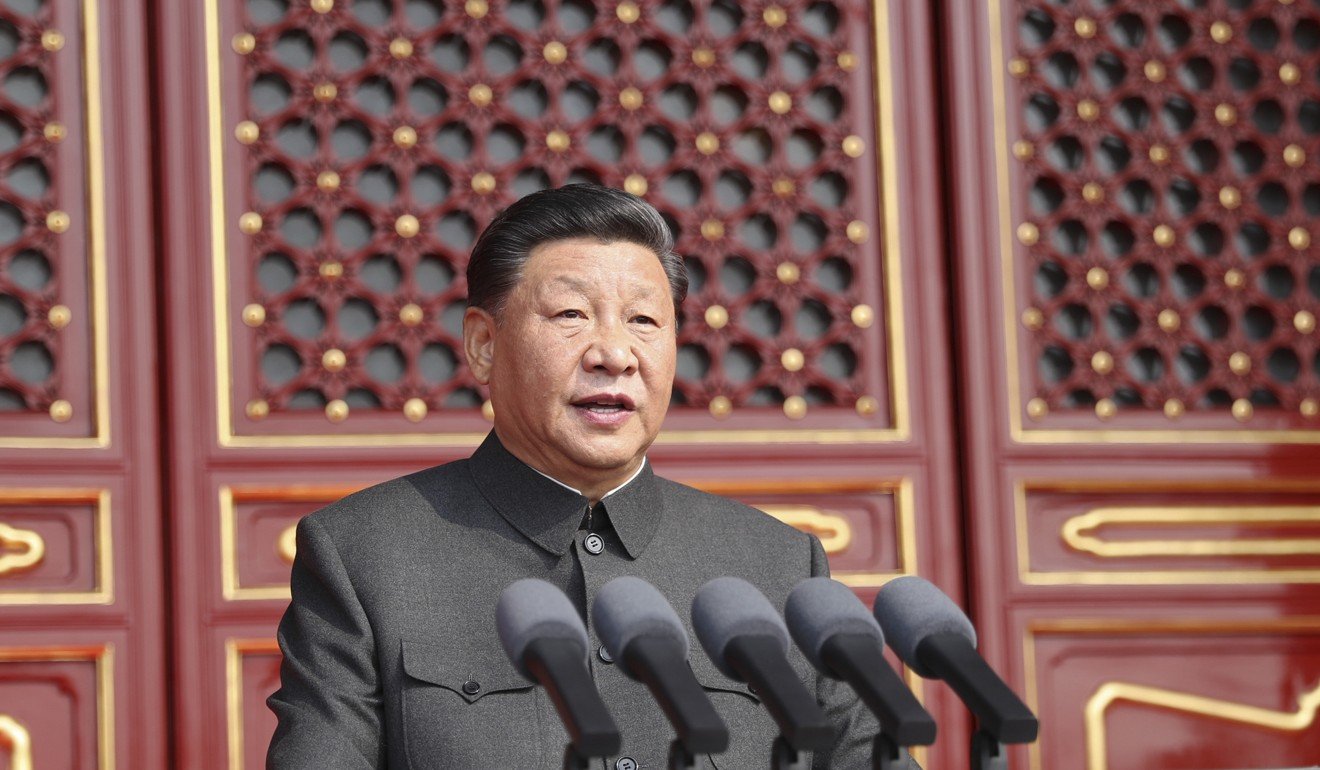
President Xi Jinping speaks in Tiananmen Square during Tuesday’s celebrations. Photo: Xinhua

But notably, while former premier Wen Jiabao was present, his predecessor Zhu Rongji was not.

‘No force can shake China’

Dressed in a Mao suit, Xi’s nationally televised speech invoked China’s “century of humiliation” and praised the achievements of its people, saying there was no force that could stop it forging ahead.

“No force can shake the status of our great motherland, and no force can stop the Chinese people and the Chinese nation from marching forward,” he said.

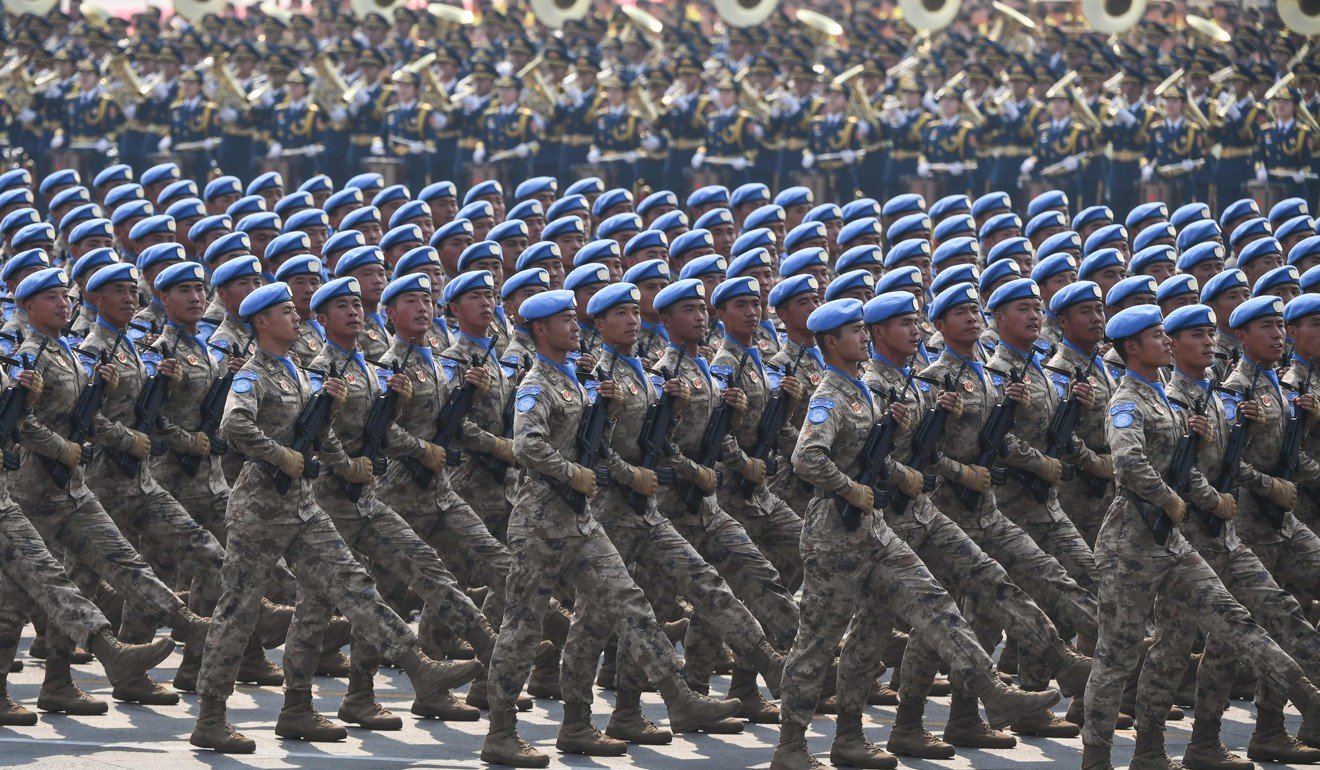
Chinese troops take part in the Republic’s largest ever military parade. Photo: AFP
“The People’s Liberation Army [PLA] will serve its purpose in safeguarding the sovereignty, security and development interests of the country, and world peace,” he said, at a time when Beijing has expanded its military footprint globally, including with its first overseas military base in Djibouti.
Xi called on the Communist Party and the country to unite and continue to fight for the realisation of what he called the “Chinese dream” – the nation’s rejuvenation.
One country, two systems
Amid escalating unrest in Hong Kong, which has plunged the city into a deepening crisis and threatened to overshadow the National Day celebrations, Xi vowed that the central government would uphold “one country, two systems”.
He said the central government would protect the long-term stability of Hong Kong and Macau, and stressed the goal of “peaceful reunification” with the self-ruling Taiwan, repeating a message frequently used by his predecessors, including Deng Xiaoping, Jiang and Hu.

The theme of one country, two systems later appeared in a National Day parade for the first time, with placards forming the words: “Hong Kong’s tomorrow will be better.”

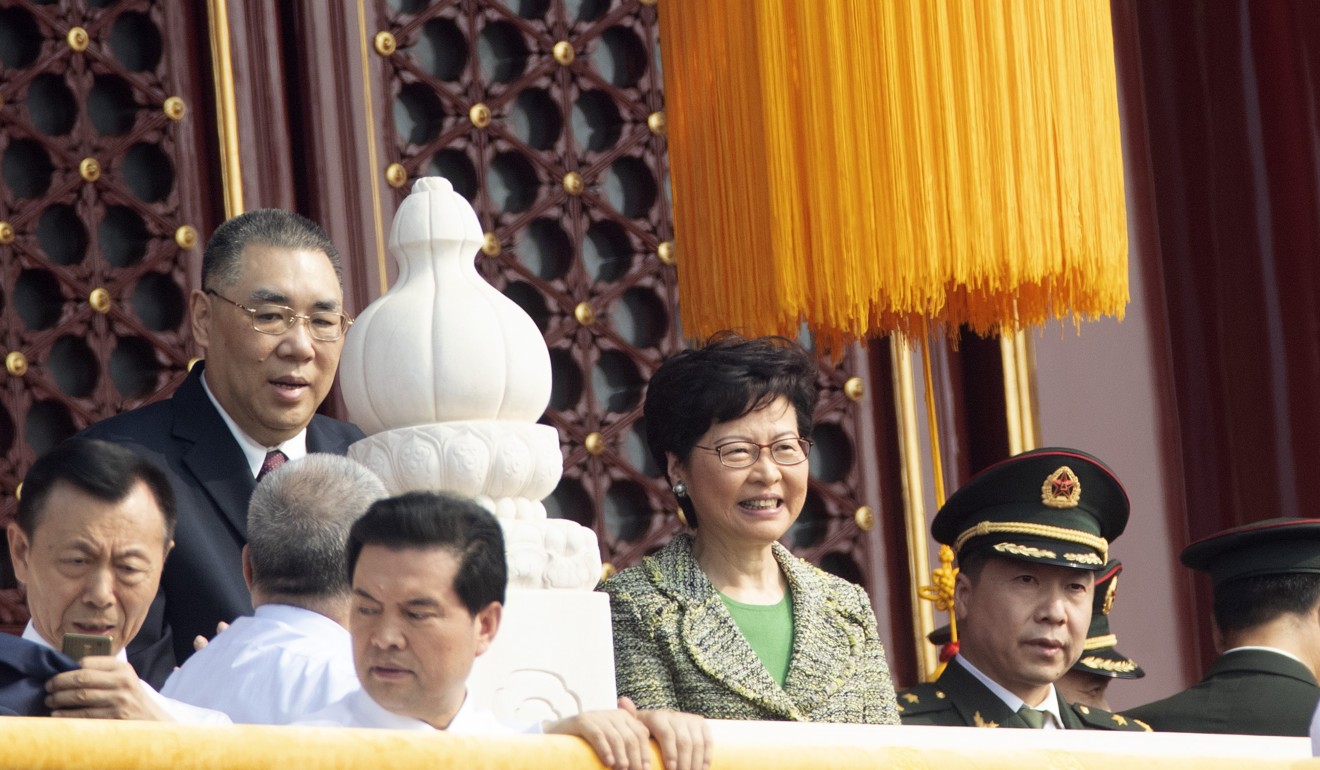
Hong Kong Chief Executive Cheng Yuet-ngor attended the ceremony, as did 10 Hong Kong police officers involved in suppressing anti-government protests in the city.
Showing off new weapons
China’s advancement in military weaponry was on full display, with almost half of the items featured being shown to the public for the first time.
Hong Kong leader Carrie Lam was among the guests in Beijing on Tuesday. Photo: AP

The morning’s celebrations included an 80-minute military parade – the biggest since the founding of the People’s Republic – in an apparent effort to showcase the prowess of the PLA, the world’s biggest military with 2 million personnel.

Among the weapons shown were DF series missiles, including the DF-17, a nuclear-capable glider that has the capacity to strike the US mainland, and the DF-41, which has a range of up to 15,000km, making it the world’s longest-range military missile.

Signalling Xi’s status

A 100,000-strong civilian parade featuring huge portraits of Xi and predecessors including Mao, Deng, Jiang and Hu wrapped up the morning celebration.

The procession was divided into three parts, representing three eras of the People’s Republic: the Mao era, Deng’s reform and opening up, and Xi’s era, which seeks global prominence on a par with that of the United States.

Xi appeared keen to project his supreme status in the party, reinforced since he abolished the constitutional term limit a year ago, allowing him potentially to remain leader for life.

He waved at his own portrait, unveiled alongside a sign reading “Carry out Xi Jinping Thought on Socialism with Chinese Characteristics for a New Era”.

Source: SCMP

Law of Unintended Consequences

continuously updated blog about China & India

ChiaHou's Book Reviews

continuously updated blog about China & India

What's wrong with the world; and its economy

continuously updated blog about China & India