CHINDIA ALERT: You'll be living in their world, very soon

continuously updated blog about China & India

  • Home
    • HOME: Why Chindia?
    • Chindia sources
  • Historical Perspectives
    • 4,000 years of records
    • Before the Raj
    • China’s first-half 20C Timeline
    • India’s first-half 20C Timeline
    • 70 years from Liberation
    • 70 years from Independence
  • Social & Cultural Factors
    • India’s British influence
    • China is homogeneous
    • India is diverse
    • Very different mindsets
    • Chinese mindset
    • Indian mindset
    • Chinese body, mind and spirit
    • Indian body, mind and spirit
    • Uncanny similarities
    • Major events or changes in China – Social & Cultural 2013:
    • Major events or changes in India – Social & Cultural 2013
  • Economic Factors
    • Major Chinese Economic events or changes: 2013 – 2019
    • Major Indian economic events or changes: 2013 – 2017
    • Chinese overseas acquisitions / investments
    • China needs to rebalance her economy
    • China’s infrastructure
    • ‘Greening’ of China
    • China’s manufacturing
    • India changes gear in 1991
    • India’s services
    • Consumerism blossoms
    • Information Technology
  • Political Factors
    • Major Chinese Political events or changes: 2013 – 2017
    • Major Indian Political events or changes: 2013 – 2017
    • Intrinsic uncertainty and instability – China
    • Intrinsic uncertainty and instability – India
    • Geopolitics: Chinese
    • 2014 is a year of bumper harvest for China’s diplomacy, FM says
    • Geopolitics: Indian
  • Prognosis?
    • Will China be a superpower by 2038?
    • How close will India be in 2038?
    • China’s relationship with the Rest of the World
    • Chinese challenges?
    • Indian challenges?
    • How well will China and India innovate – to 2017?
  • In Closing
    • Eight ways China is changing your world
    • Ten forces forging China’s future
    • Reimagining India: Unlocking the Potential of Asia’s Next Superpower
  • ABOUT / Contact us
  • Chindia Alert: You’ll be Living in their World Very Soon

    aims to alert you to the threats and opportunities that China and India present. China and India require serious attention; case of ‘hidden dragon and crouching tiger’.

    Without this attention, governments, businesses and, indeed, individuals may find themselves at a great disadvantage sooner rather than later.

    The POSTs (front webpages) are mainly 'cuttings' from reliable sources, updated continuously.

    The PAGEs (see Tabs, above) attempt to make the information more meaningful by putting some structure to the information we have researched and assembled since 2006.

  • Follow CHINDIA ALERT: You'll be living in their world, very soon on WordPress.com
  • If you wish to read the material on the PAGES in an eBook format; here it is

    You will be living in their world, very soon

  • If you wish to read the material on China on the PAGES in a paperback format; here it is

    Beware the Waking Dragon

  • Categories

  • Beijing China China alert Chindia Alert Chinese President Xi Jinping coronavirus corruption COVID-19 Diplomacy Economics GeoPolitics Good news History Hong Kong India alert Internal politics Japan Manufacturing Military Neighbour conflict Pakistan Politics Pollution Shanghai Social & cultural Technology Uncategorized United States Washington Wuhan
  • Since July 21, 2012 free counters
  • Blogs I Follow

    • CCChang
    • Law of Unintended Consequences
    • ChiaHou's Book Reviews
    • What's wrong with the world; and its economy

Archive for ‘Prime Minister Narendra Modi’

« Older Entries  |   Newer Entries »
11/04/2019

India election 2019: Voting begins in world’s largest election

Indians have begun voting in the first phase of a general election that is being seen as a referendum on Prime Minister Narendra Modi.

Tens of millions of Indians across 20 states and union territories are voting in 91 constituencies.

The seven-phase vote to elect a new lower house of parliament will continue until 19 May. Counting day is 23 May.

With 900 million eligible voters across the country, this is the largest election ever seen.

  • Live updates from across India

Some observers have billed this as the most important election in decades and the tone of the campaign has been acrimonious.

Mr Modi’s Hindu nationalist Bharatiya Janata Party (BJP) won a historic landslide in the last elections in 2014. He stakes his claim to lead India on a tough image and remains the governing BJP’s main vote-getter.

But critics say his promises of economic growth and job creation haven’t met expectations and India has become more religiously polarised under his leadership.

The BJP faces challenges from strong regional parties and a resurgent Congress party, led by Rahul Gandhi. Mr Gandhi’s father, grandmother and great-grandfather are all former Indian prime ministers. His sister, Priyanka Gandhi, formally joined politics in January.
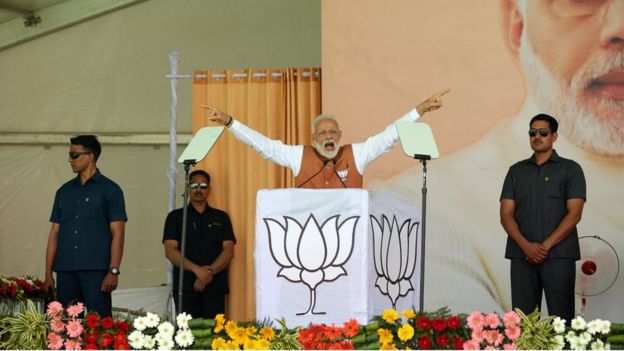
Modi at a rally in Meerut
Image captionMr Modi has made national security a key election issue

How has voting gone so far?

The Lok Sabha, or lower house of parliament has 543 elected seats and any party or coalition needs a minimum of 272 MPs to form a government.

Hundreds of voters began to queue up outside polling centres early Thursday morning. In the north-eastern state of Assam, lines of voters began forming almost an hour before voting officially began.

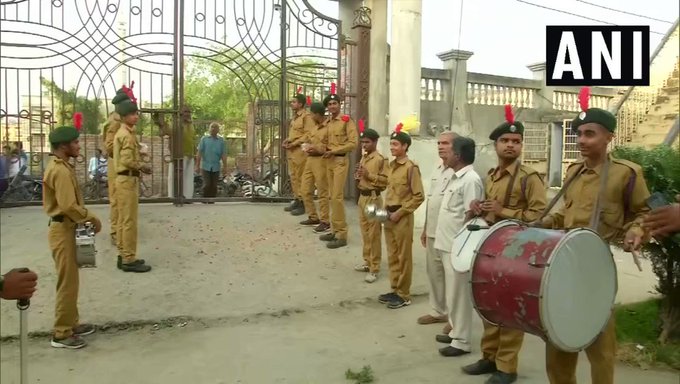
Voters at one polling booth in Baraut – in the northern state of Uttar Pradesh – got a royal welcome with people greeted by drums and a shower of flower petals.
Skip Twitter post by @ANINewsUP

Embedded video

But violence has flared in several places already. One person has died after clashes erupted at a polling station in Anantpur, in southern Andhra Pradesh state. Four others were critically injured in the fight that broke out between workers from two parties, BBC Telugu reports.
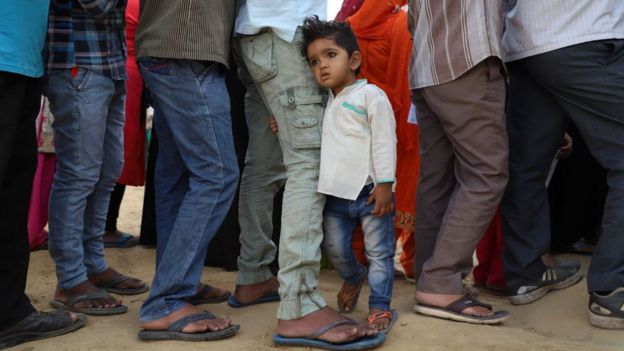
A little boy clutches his father outside a polling booth in Ghaziabad in Uttar Pradesh stateImage copyrightGETTY IMAGES
Image caption A little boy clutches his father outside a polling booth in Ghaziabad in Uttar Pradesh state

In central Chhattisgarh state, suspected Maoists detonated an IED device near a polling booth at around 04:00 local time (23:30 BST) – no injuries were reported.

The mineral-rich state has witnessed an armed conflict for more than three decades and attacks by Maoist rebels on security forces are common. On Tuesday a state lawmaker was killed in a suspected rebel attack.

How big is this election?

It is mind-bogglingly vast – about 900 million people above the age of 18 will be eligible to cast their ballots at one million polling stations. At the last election, vote turn-out was around 66%.

More than 100 million people are eligible to vote in the first phase of the election on Thursday.
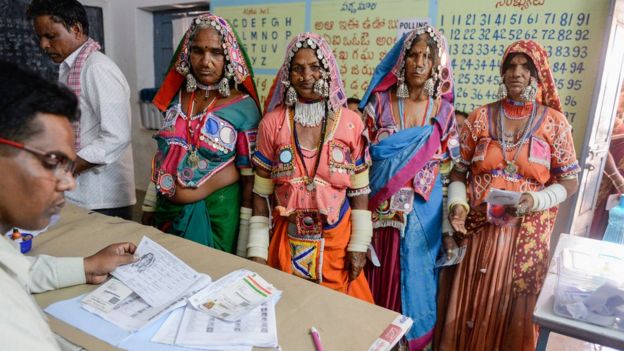
An official checks the names of Indian lambadi tribeswomen at a polling station during India's general election at Pedda Shapur village on the outskirts of Hyderabad on April 11, 2019.Image copyrightGETTY IMAGES
Image caption Indian lambadi tribeswomen at a polling station in southern India

No voter is meant to have to travel more than 2km to reach a polling station. Because of the enormous number of election officials and security personnel involved, voting will take place in seven stages between 11 April and 19 May.

India’s historic first election in 1951-52 took three months to complete. Between 1962 and 1989, elections were completed in four to 10 days. The four-day elections in 1980 were the country’s shortest ever.

Source: The BBC
Posted in Anantpur, Andhra Pradesh, Assam, Baraut, BBC Telugu, Bharatiya Janata Party (BJP), congress party, election 2019, Ghaziabad, India alert, lambadi tribeswomen, largest election, Lok Sabha, maoist rebels, Prime Minister Narendra Modi, Priyanka Gandhi,, rahul gandhi, Uncategorized, Uttar Pradesh, Voting begins | Leave a Comment »

08/04/2019

BJP vows to strip Kashmir of special rights

NEW DELHI (Reuters) – India’s Hindu nationalist ruling party vowed on Monday to strip decades-old special rights from the people of Jammu and Kashmir, making an election promise that could provoke a backlash in the country’s only Muslim-majority state.

Prime Minister Narendra Modi’s Bharatiya Janata Party (BJP)is widely expected to retain power after a general election that starts on Thursday, though with a much smaller mandate, hit by concerns over a shortage of jobs and weak farm prices.

Pollsters say its re-election campaign got a boost from recent hostilities with arch-rival Pakistan, after a militant group based there claimed a February suicide bombing that killed 40 Indian security forces in the Himalayan region.

“Nationalism is our inspiration,” Modi said after releasing the BJP’s election manifesto at its headquarters in New Delhi, as supporters chanted “Modi, Modi”.

The BJP has consistently advocated an end to Kashmir’s special constitutional status, which prevents outsiders from buying property there, arguing that such laws have hindered its integration with the rest of India.

“We believe that Article 35A is an obstacle in the development of the state,” the party said, referring to a constitutional provision dating from 1954, and reiterated its long-held desire to abolish Kashmir’s autonomous status by scrapping another law known as Article 370.

BJP supporters have demanded the removal, expressing anger at many Kashmiris’ resistance to rule by India, which has spent three decades battling an armed insurgency in the region also claimed by Pakistan.

“The BJP’s campaign is largely around nationalism, national security and this is what is getting echoed in their manifesto,” said Sanjay Kumar, director of thinktank the Centre for the Study of Developing Societies.

Repeal would bring widespread unrest, Kashmiri political leaders warned.

“Let them do it and it will pave the way for our azadi,” Farooq Abdullah, president of Kashmir’s National Conference party, told an election rally, referring to freedom for the region. “They are wrong. We will fight against it.”

Mohammad Yousuf Tarigami, the leader of a left party in Kashmir, warned of “disastrous and unimaginable repercussions”.

Voting in the general election reut.rs/2KhaQlG begins on Thursday, but with about 900 million eligible voters, will be spread across several weeks, with ballots counted on May 23.

INCREASED INVESTMENT, TAX REFORM

In its manifesto last week, the main opposition Congress party pledged to create more jobs, hand money to India’s poorest and change a law on special powers for troops in Kashmir.

It dismissed the BJP manifesto as anti-farmer, despite its pledge of a pension scheme for small and marginal farmers who make up more than 80 percent of India’s estimated 263 million farmers, with landholdings smaller than 2 hectares (5 acres).

“Remember the good old days before 2014 when Indians had jobs and a PM that didn’t lie to them,” Congress said on Twitter, with a hashtag calling the BJP manifesto a gimmick.

The BJP also promised capital investment of 100 trillion rupees ($1.44 trillion) in infrastructure by 2024, to help create jobs for millions entering the workforce each year.

It pledged to simplify the goods and services tax, which disrupted businesses and hurt growth when Modi introduced it in 2017.

The party will work to cut tax and boost credit to small businesses to 1 trillion rupees ($14.4 billion) by 2024, it added.

Source: Reuters

Posted in BJP, India alert, Kashmir, Prime Minister Narendra Modi, special rights, strip, Uncategorized | Leave a Comment »

01/04/2019

Is India a space superpower?

Indian Prime Minister Narendra Modi has called his country a space superpower after the successful shooting down of one of its own satellites in a test of its national space defences.

India has been reaching for the stars since the 1970s. Today, the country has become a premier destination for other nations and companies to launch satellites cheaply.

Reality Check takes a look at India’s ambitions in space.

Source: The BBC

Posted in India alert, national space defences, Prime Minister Narendra Modi, space superpower, Uncategorized | Leave a Comment »

22/03/2019

India election 2019: When will broadband reach all villages?

Indian women check their mobile phones at a free Wi-Fi zone in Mumbai in February 2016Image copyrightGETTY IMAGES

India’s Prime Minister Narendra Modi wants more than a billion Indians connected to the internet – and his BJP government is counting on a project taking cheap high-speed broadband to rural areas to achieve this.

The project, to build a nationwide optical fibre network, was launched in 2014 and is the flagship scheme of the government’s Digital India programme.

In the run-up to the Indian election, which gets under way on 11 April, BBC Reality Check is examining claims and pledges made by the main political parties.

So has the project been a success?

Presentational grey line

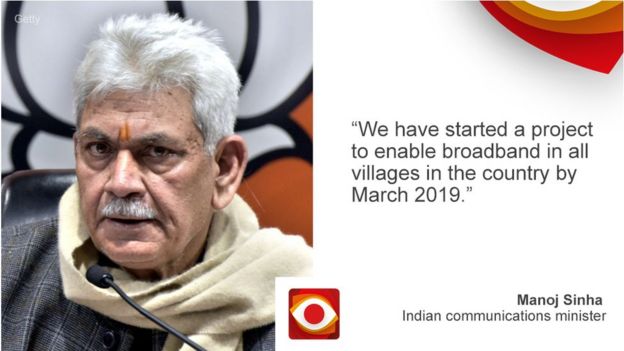
Pledge: Indian Communications Minister Manoj Sinha promised to provide every village in the country with high speed broadband and that this would be achieved by March 2019.

Verdict: The project to set up digital infrastructure in rural India has made substantial headway but has so far achieved less than 50% of its intended target.

Quote card for Indian minister of state (communications) Manoj Sinha
Presentational grey line

An ambitious plan

India has the second highest number of internet users in the world but the penetration is quite low for its size and population.

The BharatNet scheme aims to connect more than 600,000 villages in India with a minimum broadband speed of 100Mbps.

It would enable local service providers to offer internet access to the local population, primarily through mobile phones and other portable devices.

India’s telecom regulator says there were 560 million internet connections in India in September last year.

What’s been achieved so far?

The government’s overall target is to connect 250,000 village councils covering more than 600,000 individual villages across the country.

The work of laying cables and installing equipment to connect 100,000 of them was finally completed in December 2017 after significant delays.

This milestone was hailed a success but there were also critical voices, especially from government opponents about whether the cables were actually operational.

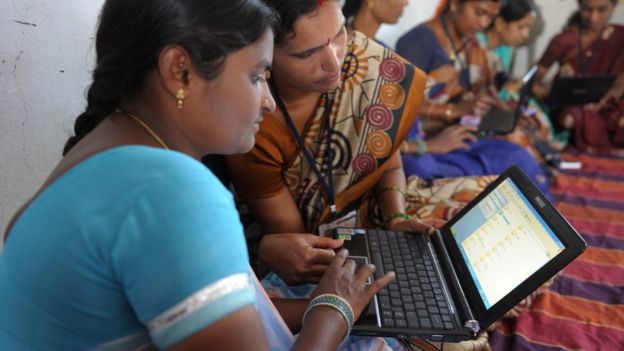
Indian villagers from a self-help group with laptops in Bibinagar village outskirts of Hyderabad on 7 March 2013Image copyrightGETTY IMAGES

The next phase, to connect the remaining councils by March 2019, has been under way for a year now.

In total, as of the end of January this year, official data shows optical fibre cables have been laid in 123,489 village councils – and equipment installed in 116,876 of them.

There is also a plan to install wi-fi hotspots in more than 100,000 council areas – but as of January these were operational in only 12,500 of them.

Old plan, new name

It has been an ambition of successive governments to connect all India to the internet but plans have hit many roadblocks.

BharatNet was first conceived in 2011 by the then Congress government as the National Optical Fibre Network but did not make much headway in its pilot phase.

A parliamentary committee said the project had been affected by “inadequate planning and design” from 2011 to 2014.

When the BJP came to power in 2014, it took over the project and has pushed ahead with national broadband coverage.

And in January last year, the government said it would complete the work ahead of the stipulated deadline of March 2019.

Has the deadline been met?

There was impressive progress made in 2016 and 2017 but since then the pace has slowed.

In January this year, the agency executing BharatNet said 116,411 village councils were “service ready”.

This means that provisions for ready-to-use connectivity have been made.

But not all “service ready” village councils have proper connections, says Osama Manzar, from the non-governmental Digital Empowerment Foundation (DEF).

DEF found that only 50 of 269 “service ready” councils inspected across 13 states in 2018 had the required device and internet connection set-up.

And only 31 of them had “functional”, but slow, internet connections.

Mr Manzar notes that this is problematic considering “the public welfare distribution and the financial sectors rely heavily on digital infrastructure today”.

Another report, citing an internal official memo, said most of the councils had non-functioning networks or faulty equipment.

Next steps

BharatNet has faced also difficulties with electricity supply, theft, low-quality cables and poorly maintained equipment.

And these delays come as India aims to provide broadband in all households and move to 5G networks by 2022.

An official source defended BharatNet as a large-scale infrastructure project tackling difficult sites and not a service scheme, saying it was natural to see delays between set-up and use.

Source: The BBC

Posted in BJP government, broadband, election 2019, high-speed broadband, India alert, Internet, Prime Minister Narendra Modi, rural areas, Uncategorized, villages | Leave a Comment »

21/03/2019

India election 2019: Will fast broadband reach all villages?

Indian women check their mobile phones at a free Wi-Fi zone in Mumbai in February 2016Image copyrightGETTY IMAGES

India’s Prime Minister Narendra Modi wants to connect more than a billion Indians to the internet – and his BJP government is counting on a project taking cheap high-speed broadband to rural areas to achieve this.

The project, to build a nationwide optical fibre network, was launched in 2014 and is the flagship scheme of the government’s Digital India programme.

In the run-up to the Indian election, which gets under way on 11 April, BBC Reality Check is examining claims and pledges made by the main political parties.

So has the project been a success?

Presentational grey line

Pledge: Indian Communications Minister Manoj Sinha promised to provide every village in the country with high speed broadband and that this would be achieved by March 2019.

Verdict: The project to set up digital infrastructure in rural India has made substantial headway but has so far achieved less than 50% of its intended target.

Quote card for Indian minister of state (communications) Manoj Sinha
Presentational grey line

An ambitious plan

India has the second highest number of internet users in the world but the penetration is quite low for its size and population.

The BharatNet scheme aims to connect more than 600,000 villages in India with a minimum broadband speed of 100Mbps.

It would enable local service providers to offer internet access to the local population, primarily through mobile phones and other portable devices.

India’s telecom regulator says there were 560 million internet connections in India in September last year.

India’s broadband users

Source:

But the pace of internet adoption is lower in rural areas, where most Indians live.

What’s been achieved so far?

The government’s overall target is to connect 250,000 village councils covering more than 600,000 individual villages across the country.

The work of laying cables and installing equipment to connect 100,000 of them was finally completed in December 2017 after significant delays.

This milestone was hailed a success but there were also critical voices, especially from government opponents about whether the cables were actually operational.

Indian villagers from a self-help group with laptops in Bibinagar village outskirts of Hyderabad on 7 March 2013Image copyrightGETTY IMAGES

The next phase, to connect the remaining councils by March 2019, has been under way for a year now.

In total, as of the end of January this year, official data shows optical fibre cables have been laid in 123,489 village councils – and equipment installed in 116,876 of them.

There is also a plan to install wi-fi hotspots in more than 100,000 council areas – but as of January these were operational in only 12,500 of them.

Old plan, new name

It has been an ambition of successive governments to connect all India to the internet but plans have hit many roadblocks.

BharatNet was first conceived in 2011 by the then Congress government as the National Optical Fibre Network but did not make much headway in its pilot phase.

A parliamentary committee said the project had been affected by “inadequate planning and design” from 2011 to 2014.

When the BJP came to power in 2014, it took over the project and has pushed ahead with national broadband coverage.

And in January last year, the government said it would complete the work ahead of the stipulated deadline of March 2019.

Has the deadline been met?

There was impressive progress made in 2016 and 2017 but since then the pace has slowed.

In January this year, the agency executing BharatNet said 116,411 village councils were “service ready”.

This means that provisions for ready-to-use connectivity have been made.

Status of BharatNet project

Source: Bharat Broadband Network Limited

But not all “service ready” village councils have proper connections, says Osama Manzar, from the non-governmental Digital Empowerment Foundation (DEF).

DEF found that only 50 of 269 “service ready” councils inspected across 13 states in 2018 had the required device and internet connection set-up.

And only 31 of them had “functional”, but slow, internet connections.

Mr Manzar notes that this is problematic considering “the public welfare distribution and the financial sectors rely heavily on digital infrastructure today”.

Another report, citing an internal official memo, said most of the councils had non-functioning networks or faulty equipment.

Next steps

BharatNet has faced also difficulties with electricity supply, theft, low-quality cables and poorly maintained equipment.

And these delays come as India aims to provide broadband in all households and move to 5G networks by 2022.

An official source defended BharatNet as a large-scale infrastructure project tackling difficult sites and not a service scheme, saying it was natural to see delays between set-up and use.

Source: The BBC

Posted in BJP government, election 2019, fast broadband, India alert, Prime Minister Narendra Modi, reach, Uncategorized, villages | Leave a Comment »

20/03/2019

India election 2019: Are three times more roads being built?

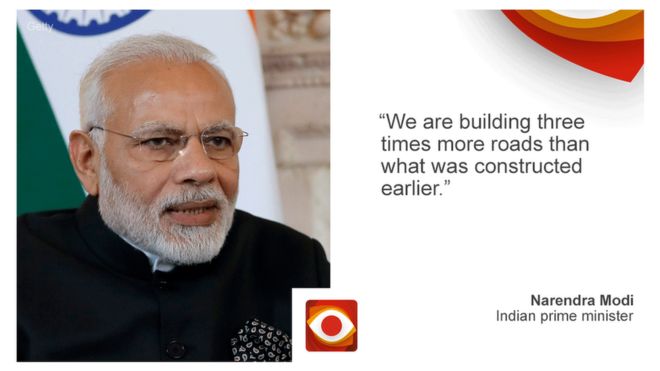
Quote card of PM Modi

In April 2018, India’s Prime Minister, Narendra Modi, said his government was building more roads than ever.

“Today, the volume of work that is being done every day is three times what was done previously,” he said.

India has one of the largest road networks in the world, covering a total of 5.5 million km (3.4 million miles).

In the run-up to the Indian election, which gets under way on 11 April, BBC Reality Check is examining claims and pledges made by the main political parties.

Presentational grey line

Claim: The current government says it is building three times as many roads in India, compared with previous governments.

Verdict: Road-building has gone up significantly under this government, although not as much as Mr Modi has claimed.

Presentational grey line
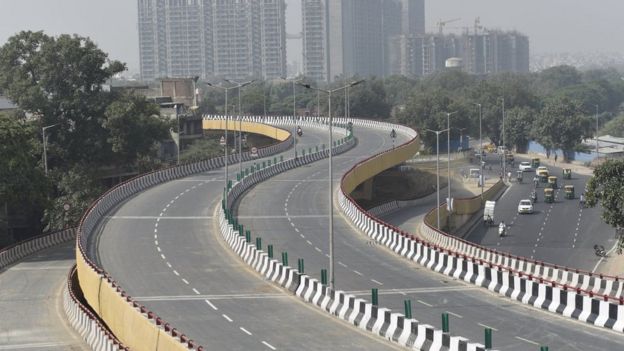
New highway near DelhiImage copyrightGETTY IMAGES
Image captionA recently opened stretch of highway in Delhi

Road infrastructure in India is divided into three categories:

  • national highways
  • state highways
  • rural roads

At independence in 1947 the total length of national highways in India – the main routes that cross the country – was around 21,000km.

By 2018, it had gone up to almost 130,000km.

National highways are funded and constructed by the government, in Delhi, and state highways by state governments across India.

Rural roads come under the Ministry of Rural Development, in Delhi.

Presentational grey line

Construction rate rises

Official government data for the past decade shows the total length of highways built each year increased sharply after 2014, when the BJP came to power.

In its last year in office, in 2013-14, the previous Congress-led government built 4,260km of national highway.

In 2017-18, the current BJP government built a total of 9,829km of highway – more than double but not as much as three times the 2013-14 figure.

National highways in India

In a December 2018 review, the Ministry of Road Transport and Highways said more than 300 government highway projects would be completed by the end of 2019.

The present government has also set aside increasing amounts in the budget each financial year for developing national highways.

Budget allocated to highways

The Highways and Transport Minister, Nitin Gadkari, has said roads and highways are “a country’s assets”

Rural road building

Plans for extending roads in rural areas are not new – in fact, they date back to a previous BJP-led government in 2000.

India rural roadImage copyrightGETTY IMAGES
Image captionThe BJP claimed that construction of rural roads reached an all-time high in 2016-2017

In May last year, the current BJP government said more than 47,000km of rural roads had been constructed in the financial year 2016-17.

“Construction of rural roads reached an all-time high in 2016-17, under the Modi government,” it said.

However, official data for the past decade shows that 2009-10 saw an even higher length of rural roads built – 60,117km.

And this was when a Congress-led government was in power.

Rural roads built in India

Sine the BJP came to power, the budget for rural roads has increased every financial year – to expand the network to less accessible areas.

And the World Bank, which has been helping finance rural road building since 2004, said, in a report issued in December 2018, that progress had been “highly satisfactory”.

Source: The BBC

Posted in election 2019, India alert, Prime Minister Narendra Modi, roads being built, Uncategorized | Leave a Comment »

14/03/2019

New Delhi feels betrayed by China on Masood Azhar; bilateral ties could suffer

The bonhomie witnessed between India and China over the last one year after the informal summit between Prime Minister Narendra Modi and Chinese President Xi Jinping in Wuhan April last year has clearly evaporated following the Chinese action

Even as China asserted on Thursday that the ‘Wuhan Spirit’ was still on, there is a sense of betrayal in New Delhi over Beijing’s decision to stand by its ‘all-weather friend’ Pakistan by blocking the designation of JeM chief Masood Azhar as a global terrorist by the UN Security Council.
The bonhomie witnessed between India and China over the last one year after the informal summit between Prime Minister Narendra Modi and Chinese President Xi Jinping in Wuhan April last year has clearly evaporated following the Chinese action.
Amid the growing clamour in India for boycotting China after it used its veto power to block listing of Masood Azhar as a global terrorist, New Delhi has expressed disappointment over Beijing’s move while reaffirming its determination to pursue all avenues to bring the JeM chief to justice for terror attacks in different parts of India.
A number of reasons, including the significant role Pakistan plays in China’s ties with the Islamic world and Beijing’s anxiety over spill-over effect of a ban on Azhar in China’s own restive Muslim-dominated Xinjiang region, could have played a role in Beijing deciding to yet again stonewall any action by the UNSC against the JeM chief, observers say.
Despite its burgeoning trade relationship with India, China has never hidden the fact that it needed Pakistan more than any other country for achieving its geo-strategic goals in the region. Pakistan’s importance for China has increased manifold in recent years in view of the heavy economic and manpower investments it has made in the China-Pakistan Economic Corridor (CPEC) as part of President Xi’s signature Belt and Road Initiative (BRI).
Sources said it was quite clear to New Delhi over the past few days that China was adopting double standards in the global fight against terrorism only to shield Pakistan. China, they said, could no longer take shelter under ‘lame excuses’ like India had not provided any ‘updated material’ on Azhar’s terrorist activities in India which could compel Beijing to reconsider its position on the JeM chief.
Sources pointed out that India had submitted to China and other key nations ‘clinching and irrefutable’ evidence linking JeM to terror attacks in India, including the Pulwama attack. All other members of the UNSC, including those in the non-permanent category, solidly backed India’s effort to get the JeM chief banned but China put a spanner in their works yet again, they regretted.
The US, meanwhile, said responsible UNSC members might be forced to other actions at the Security Council if Beijing continued to block Masood’s designation.
China’s veto against banning Masood Azhar has once again highlighted the deep-rooted suspicion and mistrust between India and China on strategic issues, particularly the fight against terrorism. Despite pledging to work with India in combating terror, China has done precious little to assuage India’s concerns over terrorism emanating from Pakistan.
China has, in fact, praised Pakistan on many occasions for its role in the global war against terrorism. Beijing’s contention has been that Pakistan itself has been one of the main victims of terrorism and it must be supported in combating the menace.
There is also a feeling in Chinese circles that the situation in Jammu and Kashmir is the prime reason for terrorism in India. The argument being advanced by them is that while Kashmir is a disputed territory, Xinjiang is a province of China and, therefore, a comparison can not be drawn between the two regions.
Read More
Source: The Statesman

Posted in Beijing, Belt and Road Initiative (BRI), betrayed, bilateral ties, bonhomie, boycotting China, China alert, China-Pakistan Economic Corridor (CPEC), Chinese President Xi Jinping, global terrorist, India alert, Islamic world, Jammu and Kashmir, JeM chief, Masood Azhar, New Delhi, Pakistan, Prime Minister Narendra Modi, trade relationship, UN Security Council, Uncategorized, UNSC, Wuhan, Wuhan Spirit, Xinjiang | Leave a Comment »

13/03/2019

India’s main opposition promises jobs for women amid heated election campaign

NEW DELHI (Reuters) – India’s main opposition Congress party will reserve a third of federal government jobs for women if it comes into power, its chief Rahul Gandhi said on Wednesday, in a sign women’s rights are rising up the political agenda for next month’s election.

Over the last week, two powerful parties from eastern India said they would field women in a third of parliamentary races, putting pressure on Prime Minister Narendra Modi’s ruling Bharatiya Janata Party (BJP) and other big parties to follow suit.

India ranks at 149 out of 193 countries – worse than neighbouring Afghanistan, Bhutan, Bangladesh and Pakistan – for the percentage of women in national parliaments, according to the Inter-Parliamentary Union, an independent organisation promoting democracy.

“…Frankly, I don’t see enough women in leadership positions. I don’t see them leading enough companies, I don’t see them leading enough states, I don’t see enough of them in the Lok Sabha and the Vidhan Sabhas,” Gandhi said in the southern city of Chennai, referring to India’s lower house of parliament and state legislatures.
Federal government jobs in India are already subject to numerous quotas, including one passed in January that reserves 10 percent of openings for people outside high income brackets.
Gandhi also said that Congress would pass the Women’s Reservation Bill this year if it came to power. The bill, which reserves 33 percent of the seats in national and state assemblies for women, has been on hold for two decades despite being championed by Congress and the BJP at different points.
The BJP, which says it has empowered women through nationwide schemes including clean fuel and sanitation, questioned how the Congress jobs plan would be implemented.
“For how many generations have people talked about reservation in party positions, reservation for elections, reservation in jobs? But it doesn’t seem to happen,” BJP spokesperson Shaina N.C. said.
There are currently 66 women out of a total 543 elected members in India’s lower house of parliament. At 12 percent, this is the highest ever proportion of women in the Lok Sabha.
Women make up nearly half of all voters in the country of 1.3 billion people, according to the Election Commission of India. Based on recent state polls, women will likely head to voting stations in droves for the elections due by May, surpassing male turnout, analysts predict.
On Tuesday, Mamata Banerjee, chief minister of West Bengal state, said her All India Trinamool Congress party would field 17 women candidates across 42 seats.
Earlier, on Sunday, the Biju Janata Dal, which rules Odisha state in eastern India, said it would reserve seven of 21 seats it is contesting for women candidates.
“33% reservation in parliament will give them bigger role in highest policy making body,” Naveen Patnaik, leader of the BJD and Odisha’s chief minister, said in a tweet.
“Women of our nation rightfully deserve this from all of us.”
Source: Reuters

Posted in Afghanistan, All India Trinamool Congress party, Bangladesh, Bharatiya Janata Party (BJP), Bhutan, Biju Janata Dal, BJD, Chennai, Chief Minister, congress party, Democracy, election campaign, Election Commission of India, India alert, Inter-Parliamentary Union, Lok Sabha, Mamata Banerjee, national parliaments, Naveen Patnaik, Odisha, opposition, Pakistan, Prime Minister Narendra Modi, promises jobs, rahul gandhi, Shaina N.C., Uncategorized, Vidhan Sabhas, West Bengal, women, Women’s Reservation Bill | Leave a Comment »

12/03/2019

Two dead after Chinese navy plane crashes

  • No other injuries reported following accident on southern island of Hainan
  • Military is currently intensifying training for pilots as it looks to strengthen capabilities

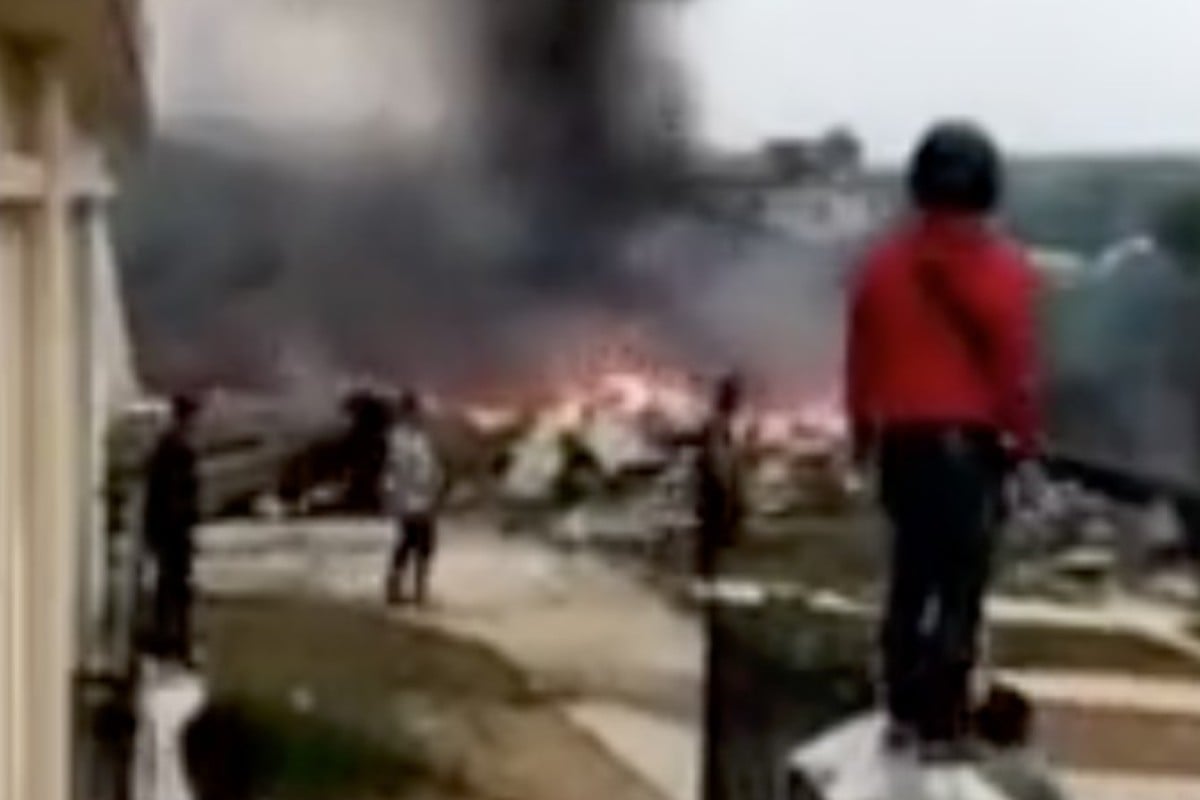
Mobile phone footage believed to be taken from the crash site. Photo: Handout
A Chinese navy plane crashed in Hainan province on Tuesday killing two crew members, the military said.
A short statement said the crash happened during a training exercise over rural Ledong county in the southern island province.
No one else was reported to have been injured after the plane hit the ground and the cause of the incident is being investigated.
Footage that purported to be taken from the crash site started circulating on social media after the accident.
The mobile phone footage, which news portal 163.com said was taken in Hainan, showed smoke rising from piles of wreckage next to a damaged water tower as bystanders gathered at the site.
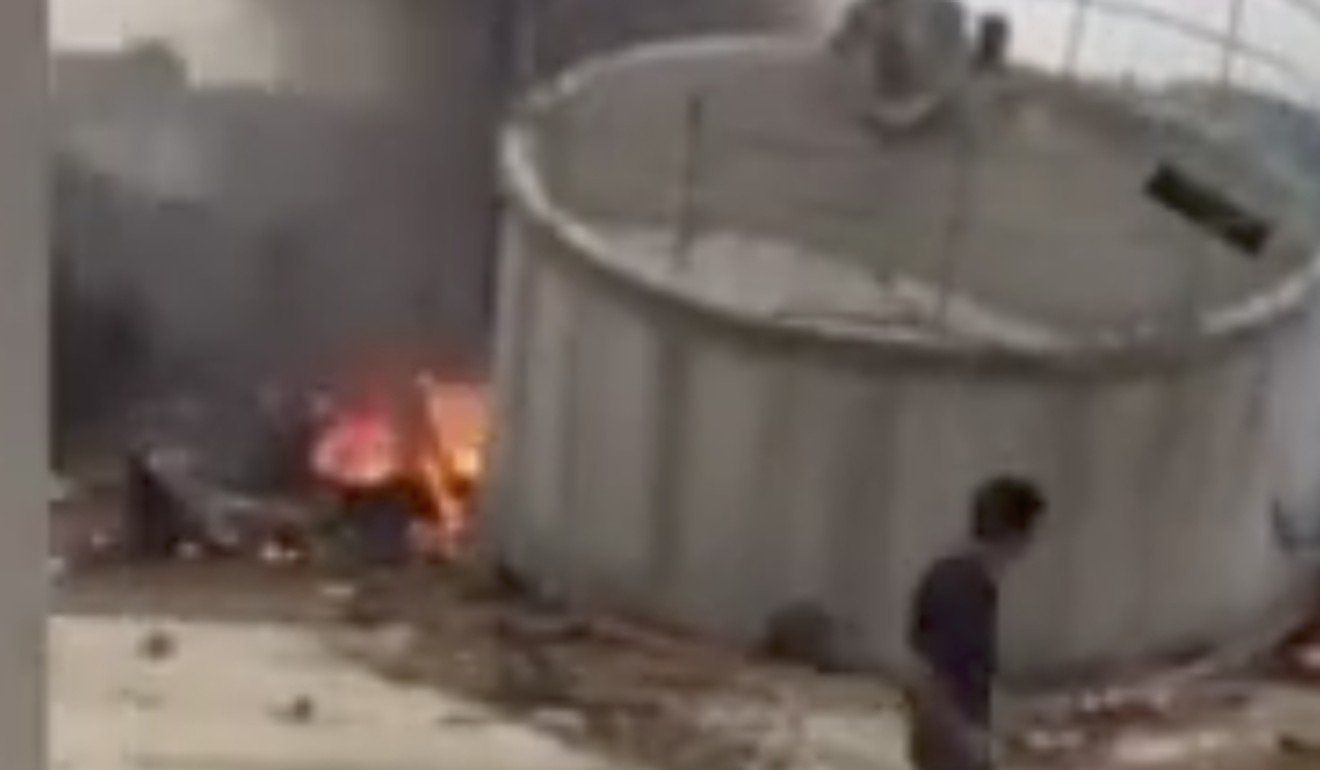
Footage apparently taken at the crash site. Photo: Handout
The person who uploaded the footage said the plane had hit the water tower before crashing into the ground.

The PLA’s official statement did not specify the type plane that crashed, although unverified witness account online said it was a twin-seat Xian JH-7 “Flying Leopard”.

The JH-7, which entered service with the navy and air force in the 1990s, has been involved in a number of fatal accidents over the years.

Former Chinese navy sailor looks after parents of friend who ‘died a hero’

The country’s worst military air accident in recent years happened in January 2018. At least 12 crew members died when a PLA Air Force plane, believed to be an electronic reconnaissance aircraft, crashed in Guizhou in the southwest of the country.

Between 2016 and 2017, there were at least four accidents involving the navy’s J-15 “Flying Sharks”, one of them resulting in the death of the pilot.

Military commentators have previously said that China’s drive to improve its combat readiness, which includes the building of new aircraft carriers and warplanes, has resulted in a serious shortage of qualified pilots.

To fill the vacancies the Chinese military has started a major recruitment drive and intensive training programme for pilot pilots.

One unverified report said the plane that crashed was a JH-7 “Flying Leopard”. Photo. Xinhua

Currently China has one aircraft carrier, the Liaoning, in service, which can carry a maximum of 24 J-15s as well as other aircraft.

Meanwhile, the new home-grown carrier Type 001A will soon be commissioned, which is designed to accommodate to carry eight more fighters.

In addition, construction is believed to have started on another carrier that will be able to carry heavier and more advanced warplanes.

Chinese navy veteran warns training, not hardware is key to military preparedness
According to figures from the end of 2016, there were only 25 pilots qualified to fly the J-15 while 12 others were in training.
Most of the Chinese navy’s pilots have been redeployed from the air force, which is itself in need of more trained pilots.
This year the navy for the first time began a nation-wide programme to scout out potential pilots.
Speaking on the sidelines of the ongoing legislative meeting in Beijing Feng Wei, a PLA pilot from the Western Theatre, said the military was currently intensifying its pilots’ training as increasing amounts of new equipment entered service.
“Personnel quality is the key to everything,” he added.
Source: SCMP

Posted in Aam Aadmi Party (AAP), Andaman & Nicobar, Andhra Pradesh, Ankur Jain, Arunachal Pradesh, Arvind Kejriwal, Assam, Bahujan Samaj Party (BSP), BBC Gujarati's editor, Bharatiya Janata Party (BJP), Bihar, Chandigarh, Chhattisgarh, China alert, Chinese navy plane, Congress, crashes, Dadar and Nagar, Dalit, Daman and Diu, Delhi, DMK and AIADMK, Electronic Voting Machines (EVMs), Feng Wei, Flying Leopard, Flying Sharks, Gandhi, Guizhou, Gujarat, Hainan, Hardik Patel, Haryana, Haveli, Himachal Pradesh, India alert, Jammu & Kashmir, Karnataka, Kerala, Lakshadweep, Lalu Prasad Yadav, Ledong county, Lok Sabha election, Madhya Pradesh, Mahagathbandhan, Maharashtra, Mayawati, Meghalaya, Mizoram, Nagaland, Narendra Modi, Nationalist Congress Party, Odisha, Patidar caste, PLA, PLA Air Force, Prime Minister Modi, Prime Minister Narendra Modi, Priyanka Gandhi,, Puducherry, Punjab, rahul gandhi, Rajasthan, Rashtriya Janata Dal (RJD), Samajwadi Party (SP), Sharad Pawar, Sikkim, social activist, Tamil Nadu, Telangana, The BBC, Trinamool Congress, Tripura, TRS, Uncategorized, Uttar Pradesh, Uttarakhand, West Bengal, Xian JH-7 | Leave a Comment »

11/03/2019

Modi’s former ally in Kashmir urges India to talk to Pakistan

SRINAGAR, India (Reuters) – India should talk to Pakistan and separatists in Kashmir to defuse tension raised by a suicide attack on an Indian paramilitary convoy that was claimed by Pakistan-based militants, a former chief minister of the state said.

Mehbooba Mufti, who was the chief minister of Jammu and Kashmir from early 2014 to June last year when Prime Minister Narendra Modi’s Hindu nationalist party withdrew support for her regional party, said an ongoing crackdown on militants and those supporting secession could further alienate the people.

India has vowed to kill all the militants in the country’s only Muslim-majority state if they don’t give up arms, after a 20-year-old local man killed 40 paramilitary troopers in a suicide attack last month.

The attack nearly led to another war between the arch rivals India and Pakistan, which both claim the Himalayan region in full but rule in part.
“I strongly feel that there has to be a dialogue process internally as well as externally, with Pakistan,” Mufti said in an interview on Friday. “The situation is going to get worse if some kind of political process is not initiated on the ground now.”
Indian officials have repeatedly ruled out talks with Pakistan unless it acts on militant groups based there. India says its warplanes late last month bombed a militant camp in Pakistan, which responded with an aerial attack the next day.
Indian Foreign Secretary Vijay Gokhale said on the day of the strike that it had killed many Jaish-e-Mohammed “terrorists”. Pakistan said no one was killed.
Pakistan Prime Minister Imran Khan, who has sought to speak with Modi amid the hostility, said no militant group would be allowed to operate from his country to carry out attacks abroad, days after his government announced a sweeping crackdown against Islamist militant organisations.
“This confrontational attitude – no talks, no discussion -has an impact,” Mufti said. “Whatever relationship we have with Pakistan, it has a direct impact on Jammu and Kashmir and we are the worst sufferers of this animosity.”
Indian authorities have arrested many separatist leaders in Kashmir in the past few weeks, and the chief of Modi’s ruling Bharatiya Janata Party (BJP) said recently that the government had made it clear to them that “if they want to live in India, they will have to speak the language of India, not Pakistan’s”.
Mufti, whose father was also a chief minister of Jammu and Kashmir, said the tough stance by Indian authorities would only lead to “some calm on the surface” that won’t last. India killed 248 militants in Kashmir in 2018 – the highest in a decade.
“Once you start choking the space for dissent in a democracy, people feel pushed to the wall and then it leads to further dissent and alienation,” she said.
Mufti said India’s general election – starting April 11 and whose results will be declared on May 23 – could delay the process of any inter-party talks on Kashmir.
Source: Reuters

Posted in Bharatiya Janata Party (BJP), Chief Minister, chief minister of Jammu and Kashmir, crackdown, Democracy, former ally, general election, Imran Khan, India alert, Indian Foreign Secretary, Islamist militant organisations, Jaish-e-Mohammed, Jammu and Kashmir, Mehbooba Mufti, militants, Muslim-majority state, Pakistan, paramilitary convoy, paramilitary troopers, PM Modi, Prime minister, Prime Minister Narendra Modi, separatists, suicide attack, terrorists, Uncategorized, Vijay Gokhale | Leave a Comment »

« Older Entries  |   Newer Entries »

Tags

air pollution Asia Barack Obama Beijing Bharatiya Janata Party Business China Chinese language climate Communist Party communist party of china Delhi Economic growth economy Economy of the People's Republic of China environment European Union Government Gross domestic product Hong Kong Hu Jintao India Japan Li Keqiang manmohan singh Mao Zedong Modi mumbai Narendra Modi New Delhi Pakistan politics President of the People's Republic of China prime minister of india Russia Shanghai Sina Weibo South China Sea South Korea State Council of the People's Republic of China technology transportation United States Xi JinPing Xinjiang

Creative Commons

Chindia Alert: forewarned is forearmed by Chindia Alert Unlimited is licensed under a Creative Commons Attribution-NonCommercial-ShareAlike 3.0 Unported License.

Archives

  • October 2023
  • June 2022
  • May 2022
  • April 2022
  • March 2022
  • June 2021
  • September 2020
  • August 2020
  • July 2020
  • June 2020
  • May 2020
  • April 2020
  • March 2020
  • February 2020
  • January 2020
  • December 2019
  • November 2019
  • October 2019
  • September 2019
  • August 2019
  • July 2019
  • June 2019
  • May 2019
  • April 2019
  • March 2019
  • February 2019
  • January 2019
  • December 2018
  • February 2018
  • January 2018
  • December 2017
  • November 2017
  • October 2017
  • September 2017
  • August 2017
  • July 2017
  • June 2017
  • May 2017
  • April 2017
  • March 2017
  • February 2017
  • January 2017
  • December 2016
  • November 2016
  • October 2016
  • September 2016
  • August 2016
  • July 2016
  • June 2016
  • May 2016
  • April 2016
  • March 2016
  • February 2016
  • January 2016
  • December 2015
  • November 2015
  • October 2015
  • September 2015
  • August 2015
  • July 2015
  • June 2015
  • May 2015
  • April 2015
  • March 2015
  • February 2015
  • January 2015
  • December 2014
  • November 2014
  • October 2014
  • September 2014
  • August 2014
  • July 2014
  • June 2014
  • May 2014
  • April 2014
  • March 2014
  • February 2014
  • January 2014
  • December 2013
  • November 2013
  • October 2013
  • September 2013
  • August 2013
  • July 2013
  • June 2013
  • May 2013
  • April 2013
  • March 2013
  • February 2013
  • January 2013
  • December 2012
  • November 2012
  • October 2012
  • September 2012
  • August 2012
  • July 2012
  • June 2012
  • May 2012
  • April 2012
  • March 2012
  • February 2012
  • January 2012

Meta

  • Create account
  • Log in
  • Entries feed
  • Comments feed
  • WordPress.com

Blog Stats

  • 241,938 hits
Create a free website or blog at WordPress.com.
CCChang

Law of Unintended Consequences

continuously updated blog about China & India

ChiaHou's Book Reviews

continuously updated blog about China & India

What's wrong with the world; and its economy

continuously updated blog about China & India

Privacy & Cookies: This site uses cookies. By continuing to use this website, you agree to their use.
To find out more, including how to control cookies, see here: Cookie Policy
  • Subscribe Subscribed
    • CHINDIA ALERT: You'll be living in their world, very soon
    • Join 846 other subscribers
    • Already have a WordPress.com account? Log in now.
    • CHINDIA ALERT: You'll be living in their world, very soon
    • Subscribe Subscribed
    • Sign up
    • Log in
    • Report this content
    • View site in Reader
    • Manage subscriptions
    • Collapse this bar