Chindia Alert: You’ll be Living in their World Very Soon
aims to alert you to the threats and opportunities that China and India present. China and India require serious attention; case of ‘hidden dragon and crouching tiger’.
Without this attention, governments, businesses and, indeed, individuals may find themselves at a great disadvantage sooner rather than later.
The POSTs (front webpages) are mainly 'cuttings' from reliable sources, updated continuously.
The PAGEs (see Tabs, above) attempt to make the information more meaningful by putting some structure to the information we have researched and assembled since 2006.
SRINAGAR, India (Reuters) – Indian police have released a pigeon belonging to a Pakistani fisherman after a probe found that the bird, which had flown across the contentious border between the nuclear-armed nations, was not a spy, two officials said on Friday.
“The pigeon was set free yesterday (May 28) after nothing suspicious was found,” said Shailendra Mishra, a senior police official in Indian-administered Kashmir. It was unclear where the bird was released and whether it flew back to its owner.
The Pakistani owner of the pigeon had urged India to return his bird, which Indian villagers turned over to police after discovering it.
“It’s just an innocent bird,” Habibullah, the owner of the bird, who goes by just one name, told Reuters on Friday.
He rejected allegations that the numbers inscribed on a ring on the pigeon’s leg were codes meant for militant groups operating in the disputed region of Kashmir.
Habibullah, who lives in a village near the Kashmir border, one of the most militarised zones in the world, said the bird had participated in a pigeon racing contest and the digits on the bird’s leg were his mobile phone number.
The sport is especially popular in the border villages, said Yasir Khalid of the Shakar Garh Pigeon Club, adding such races are held in India too, and it is not unusual to lose a bird on either side. Owners identify their birds with stamps on the wings, paint and rings on the feet.
“We had to take the bird into our custody to probe if it was being using for spying,” a senior Indian border security officer said requesting anonymity, while explaining this was part of the drill given border sensitivities.
In 2016, a pigeon was taken into Indian custody after it was found with a note threatening Indian Prime Minister Narendra Modi.
Pou Chen makes footwear for the likes of Nike and Adidas, but says it has suffered from a lack of orders as global value chains strain under the impact from the virus
Chinese workers moved to Vietnam to help set-up new factories as the company expand its production, but have now become expendable
With the likes of Nike and Adidas closing retail stores around the world to comply with social distancing requirements, analysts also said orders plummeted 50 per cent in the second quarter, although the company declined to comment on the media reports. Photo: Bloomberg
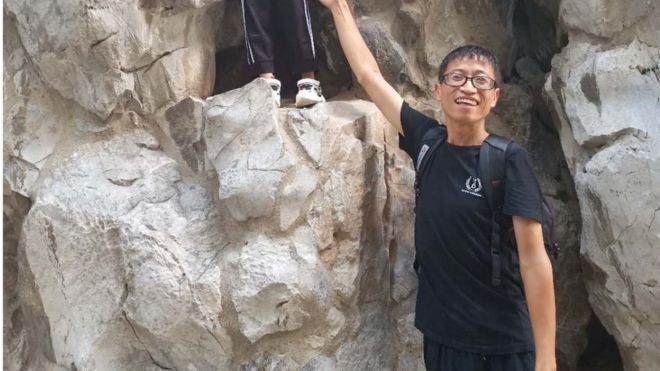
A group of 150 Chinese workers believe the world’s largest maker of trainers used the coronavirus as an excuse to fire them, having helped Taiwanese firm Pou Chen successfully expand its production into Vietnam for more than a decade.
Pou Chen, which makes footwear for the likes of Nike and Adidas, informed the group in late April that they would no longer be needed as they were unable to return to
from their hometowns in China due to the coronavirus lockdowns.
“We believe we contributed greatly to the firm’s relocation process, copying the production line management experience and successful model of China’s factories to Vietnamese factories,” said Dave Zhang, who started working for Pou Chen in Vietnam in 2003.
“Now, when the factories over there have matured, and there is a higher automation level in production, our value has faded in the management’s eyes and we got laid off, in the name of the automation level.”
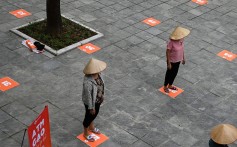
Rush hour chaos returns to Vietnam’s streets as coronavirus lockdown lifted
The group claims the firm began to fire Chinese employees several years ago, with the total number dropping from over 1,000 at its peak to around 400 last year.
“We 150 employees were the first batch of Chinese employees to be laid off this year. We are all pessimistic and expect more will be cut,” added Zhang.
In its email on April 27, Pou Chen said it was forced to terminate the contracts of the Chinese employees across five of its factories due to an unprecedented decline in orders and financial losses.
The Chinese employees, many of whom have been working for the shoemaker for decades, said the compensation offered was unfair and below the levels required by labour law in both Vietnam and China.
In a further statement to the South China Morning Post, Pou Chen stood by the move as the coronavirus pandemic had reduced demand for footwear products and so required an “adjustment of manpower.”
“[The dismissals were] in accordance with the relevant labour laws of the country of employment … and employee labour contracts,” added the statement from Pou Chen, which employs around 350,000 people worldwide.
Company data showed Pou Chen’s first quarter revenues tumbled 22.4 per cent year-on-year to NT$59.46 billion (US$1.99 billion), the weakest in six years.
With the likes of Nike and Adidas closing retail stores around the world to comply with social distancing requirements, analysts also said orders plummeted 50 per cent in the second quarter, although the company declined to comment on the media reports.
Last month, the company was also mulling pay cuts and furloughs that would affect 3,000 employees in Taiwan and officials based in its overseas factories, according to the Taipei Times.
Andy Zeng, who had worked for the firm since 1995, said the group were “very upset” when they received the news last month as the impact of the coronavirus pandemic began to reverberate around the world, disrupting global value chains.
“Most of us joined Pou Chen in the 1990s when we were in our late teens or early 20s, when the Taiwan-invested company started investing and setting up factories in mainland China. Now more than two decades have passed,” he said.
Zeng was among the first generation of skilled workers in China as Pou Chen developed rapidly, enjoying the benefits of cheap labour, although the workers themselves were rewarded with regular pay rises.
The company needed a group of skilled Chinese workers to go to its new factories in Vietnam. I said yes because I thought it was a good opportunity to see the outside world – Andy Zeng
“I worked at the Dongguan branch of Pou Chen for 11 years from 1995.” Zeng added “In the 1990s and early 2000s, the company expanded rapidly in Dongguan with a growing number of large orders, and every worker had to work hard around the clock. I remember I earned 300 yuan (US$42) a month in 1995, and my monthly salary rose to 1,000 yuan (US$141) in 1998.”
Zeng’s salary eventually rose to over 3,000 yuan in 2005 as China’s economy boomed, leading Pou Chen to seek alternative production sites in Vietnam and Indonesia where labour and land were even cheaper. However, in the early 2000s, the new locations lacked skilled shoe manufacturing workers like Zeng.
“The company needed a group of skilled Chinese workers to go to its new factories in Vietnam. I said yes because I thought it was a good opportunity to see the outside world and the offer of US$700 per month was not bad.” Zeng said.
“We actively cooperated with their plans. Over the past decade, we have been away from our families and hometowns, and followed the company’s strategy to work hard in Vietnam.
With no deaths and cases limited to the hundreds, Vietnam’s Covid-19 response appears to be working
“In 2005, the company sent me to its newly-built factory in Vietnam. This year was my 14th year in Dong Nai in Vietnam. I have witnessed the company’s production capacity in Vietnam become larger and larger. When I arrived, there were only a few production lines, and now there are at least dozens of them, employing more than 10,000 workers in each factory.”
According to a report in the Taipei Times on April 14, citing both Reuters and Bloomberg, Pou Chen was ordered to temporarily shut down one of its units in Vietnam over coronavirus concerns, according to Vietnamese state media.
The company was forced to suspend production for two days after failing to meet local rules on social distancing, Tuoi Tre newspaper reported.
“We Chinese employees actually were pathfinders for the company’s relocation from China to Vietnam,” said Zhang, who was in charge of a 1,700-worker factory producing 1.7 million shoe soles per month.
What our Chinese employees have done in Vietnam for more than a decade can be said to be very simple but very difficult – Dave Zhang
“We were sent to resolve any ‘bottlenecks’ in the production lines that were slowing down the rest of the plant, because during the launch of every new production line, Vietnamese workers would strike and get into disputes. As far as I know, there were over a thousand Chinese employees managing various aspects of the production lines in the company’s Vietnamese factories.
“In fact, what our Chinese employees have done in Vietnam for more than a decade can be said to be very simple but very difficult. That is to teach Vietnamese workers our experience of working on a production line, improve the productivity of the Vietnamese workers, and help the factories become localised.”
Overall, Pou Chen says it produces more than 300 million pairs of shoes per year, accounting for around 20 per cent of the combined wholesale value of the global branded athletic and casual footwear market.
“Because of cultural shock and great pressure to expedite orders, Vietnamese workers were not used to the management style of Taiwan factories,” Zhang added.
“Many of our Chinese employees were beaten by Vietnamese workers [due to cultural differences about work]. During anti-China protests in Vietnam, we were still under great pressure to keep the local production lines operating.”
URUMQI, April 18 (Xinhua) — A medical team of eight experts who aided Pakistan’s fight against COVID-19 returned Friday night to Urumqi, capital of northwest China’s Xinjiang Uygur Autonomous Region.
The team, consisting of experts in various fields including respiratory, critical care and traditional Chinese medicine (TCM), arrived in Pakistan on March 28 and visited cities of Islamabad, Lahore and Karachi.
The Chinese experts communicated with the Pakistani federal government, national and local health authorities, hospitals and medical schools, as well as the Red Crescent.
The team members shared their experience through several video conferences and offered practical, specific suggestions to their Pakistani peers concerning the diagnosis, clinical treatment and epidemiologic study of COVID-19, and the application of TCM, hospital infection control and the construction of temporary hospitals.
The team also assisted with improving Pakistan’s guidelines on diagnosis and treatment of COVID-19 to help build an efficient epidemic prevention and control system in Pakistan and enhance its screening and testing capabilities.
Meanwhile, the experts carried out epidemic prevention guidance and popular science education for the Chinese embassy in Pakistan, Chinese enterprises, overseas Chinese and Chinese students in the country.
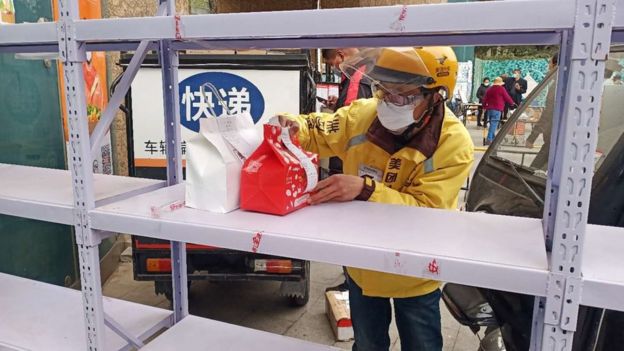
“Doctors and nurses are people who saved me from cancer and gave me strength in the darkest time. I need to return the favour,” says Li Yan, a food delivery rider based in Beijing.
Mr Li was diagnosed with lymph cancer in 2003, when he was just 17 years old. He recovered from the disease and has been full of gratitude ever since for the medical workers who nursed him back to health. With China in a national lockdown, food delivery firms found themselves in hot demand providing meals for residents stuck at home to prevent the spread of the coronavirus.
As a delivery rider for Meituan, one of China’s biggest food delivery firms, Mr Li saw an opportunity to repay the medical professionals he admires by providing them with food and drinks as they worked tirelessly on patients across the city. “Given my past experience, I felt I needed to do something for them in return during the virus outbreak,” he adds.
Beijing is a city of 21 million residents, and Mr Li covers its Tongzhou district, where there are a handful of hospitals with fever clinics, one of which is a designated hospital for Covid-19 treatment. “Many might have concerns delivering for the hospital, but I’ve chosen to deliver for them more often. I just think of the local residents and medical workers who need us. I can’t leave them being hungry. It’s not for money.”
Before the outbreak in China, he delivered more than 50 orders on an average day. But during the first ten days after the coronavirus outbreak in late January, the number of orders dropped to less than 20, as some restaurants were closed. The outbreak also coincided with the Chinese New Year period which is normally a low season.
“By mid-February when the situation was brought more under control, and people’s concerns and fears gradually began to ease, orders started to be restored. I can deliver over 40 orders a day now.”
Image copyright LI YAN
During this time, Meituan brought in a contactless delivery option which allowed food to be dropped off at designated points to avoid contact between customers and riders. “When I called customers to explain, some initially didn’t understand and wanted to cancel the order. But gradually people grew more understanding and began to welcome the contactless approach.”
Empty streets
China was in lockdown for more than two months, although restrictions are now beginning to be lifted. It will still take time before a sense of normalcy returns.
“I remember when the coronavirus first broke out, it was hazy for a few days in Beijing. Streets were empty and stores were closed. An ambulance or a delivery rider occasionally drove by. It felt like I was living in a different world.”
Mr Li says restaurants have started to re-open and people have begun coming back to work in the office since mid-February. Orders are still lower than normal but are improving.
“I miss the hustling Beijing which used to filled with traffic, the days when I could smell car exhaust when I stop at crossroads, the times when I had to walk all the way up to the 6th floor to deliver food, and even times when I was late for a delivery.”
Image copyright LI YAN
When the virus first broke out, face masks and alcohol disinfectant were the most ordered items along with supermarket groceries. “Grains, rice, cooking oil, vegetables, fruits, and solid, packaged food that lasts long. Orders often came in big sizes and transaction prices at around 200 yuan [£23; $28] to 300 yuan on one order.”
Being a food delivery rider, Mr Li feels he can not only give back to the medical community but to the city’s vulnerable too.
“I once received an order that came with a note saying the customer is a 82-year-old who lives alone and couldn’t get downstairs to pick up the food so the rider needs to enter the residential community and deliver food to the door. I had to spend some time communicating with security and finally was allowed in. The door was open when I arrived, and I put the bowl of wontons [a type of dumpling] on the table.”
Tips have increased from happy customers during the pandemic as a result. “Many more send me thank-you notes in the Meituan app and tell me to take care.”
Image copyright LI YAN
Keeping clean
Mr Li has a new routine now which involves lots of disinfecting and temperature checks. “I get my temperature checked dozens of times everyday now, before entering shopping malls, at restaurants, and returning home to the residential compound I live in. I also bring with me disinfectant sprays, a towel in my scooter and use disposable gloves when delivering to areas with reported confirmed cases.”
While he’s providing a vital service, is Mr Li worried about the risk of infection? “I did have worries when the virus spread and was at its worst time here but I feel like I’ve already been there, given what I went through in the fight against cancer.
“I’ve learnt to take things easy, look at the bright side of things and always seek strength in a dark time. As long as I take sufficient precautions, masks, gloves, disinfectants and everything, and follow advice from disease control experts, I think the possibility of getting the virus is pretty low.”
And with a seven-month pregnant wife at home, Mr Li is looking forward to happier times.
Vietnamese vessels last year spent months shadowing the Chinese Haiyang Dizhi 8 survey vessel in resource-rich waters that are a potential global flashpoint as the
China and Vietnam ‘likely to clash again’ as they build maritime militias
12 Apr 2020
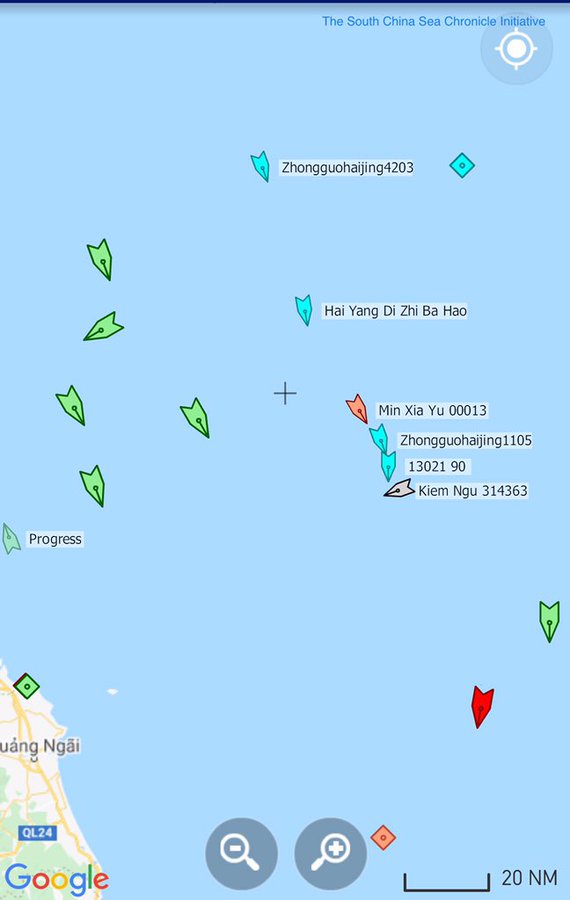
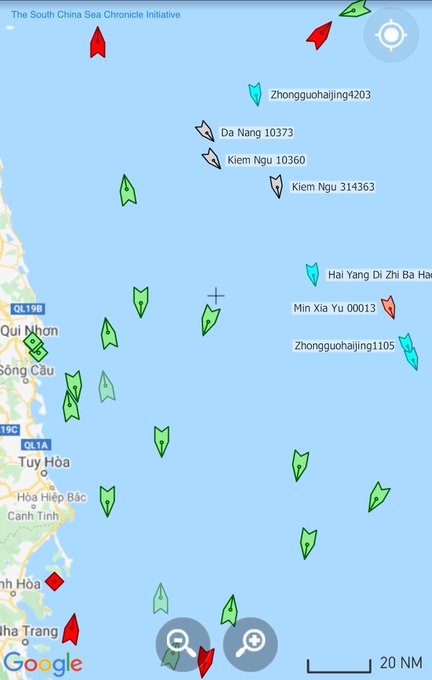
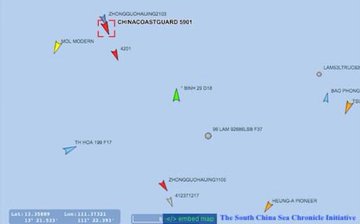
On Tuesday, the ship, which is used for offshore seismic surveys, appeared again 158km off Vietnam’s coast, within its exclusive economic zone (EEZ), flanked by at least one Chinese coastguard vessel, according to data from Marine Traffic, a website that tracks shipping.
At least three Vietnamese vessels were moving with the Chinese ship, according to data issued by the Marine Traffic site.
South China Sea News@SCS_news
·
Haiyang Dizhi 8 is heading toward #SouthChinaSea with several escort ships.
South China Sea News@SCS_news
About 50 nm ahead of Haiyang Dizhi 8 is a group of at least 3 #China Coast Guard ships, including the largest 5901. #SouthChinaSea
The presence of the Haiyang Dizhi 8 in Vietnam’s EEZ comes towards the scheduled end of a 15-day nationwide lockdown in Vietnam aimed at curbing the spread of the coronavirus.
“We call on the PRC to remain focused on supporting international efforts to combat the global pandemic, and to stop exploiting the distraction or vulnerability of other states to expand its unlawful claims in the South China Sea,” the US State Department said in a statement, referring to China.
Vietnam pulls DreamWorks’ ‘Abominable’ over South China Sea map
, which also has disputed claims in the South China Sea, has raised its concerns too.
On Saturday, the Global Times, published by the official People’s Daily newspaper of China’s ruling Communist Party, said Vietnam had used the fishing boat incident to distract from its “ineptitude” in handling the coronavirus.
Vietnam’s Ministry of Foreign Affairs did not immediately respond to a request for comment.
Helped by a mass quarantine and aggressive contact-tracing, Vietnam has recorded 265 cases of the novel coronavirus and no deaths. Nearly 122,000 coronavirus tests have been carried out in Vietnam.
China and Vietnam have for years been at loggerheads over the potentially energy-rich waters, called the East Sea by Vietnam.
China’s U-shaped “nine-dash line” on its maps marks a vast expanse of the waters that it claims, including large parts of Vietnam’s continental shelf where it has awarded oil concessions.
and Brunei claim some of the waters that China claims to the south.
During the stand-off last year, at least one Chinese coastguard vessel spent weeks in waters close to an oil rig in a Vietnamese oil block, operated by Russia’s Rosneft, while the Haihyang Dizhi 8 conducted suspected oil exploration surveys in large expanses of Vietnam’s EEZ.
“The deployment of the vessel is Beijing’s move to once again baselessly assert its sovereignty in the South China Sea,” said Ha Hoang Hop, at the Singapore-based ISEAS-Yusof Ishak Institute.
“China is using the coronavirus distraction to increase its assertiveness in the South China Sea, at a time when the US and Europe are struggling to cope with the new coronavirus.”
Comic crusader Priya, a gang-rape survivor who earlier campaigned against rape and acid attack, is back in a new avatar. This time she is fighting the trafficking of girls and women for sex.
The “modern-day female superhero” was first launched in December 2014, exactly two years after the horrific gang rape of a young woman on a bus in Delhi, to focus attention on the problems of gender and sexual violence in India.
In the latest edition – Priya and the Lost Girls – she takes on the powerful sex-trafficker Rahu, the evil demon who runs an underworld brothel city where he has entrapped many women, including Priya’s sister Lakshmi.
Indian-American actor and writer Dipti Mehta, who wrote the script of the comic, draws on ancient Indian mythology to create larger-than-life fantastical characters and delivers a powerful feminist statement.
The story of Lost Girls begins when the protagonist returns home to find that there are no girls in her village.
She then mounts her flying tiger Sahas (Hindi for courage) and arrives in Rahu’s den. It’s a city ruled by greed, jealousy and lust, where women exist only to serve and please men – and those who resist are turned into stone.
Image copyright PRIYASHAKTI
Priya is threatened and attacked, a woman who works for Rahu tries to lure her into the sex trade saying: “If you work for us, you’d serve only five to six men and not 20”, but in the end, good wins over evil and she manages to vanquish Rahu and liberate her sister and all the other trafficked girls.
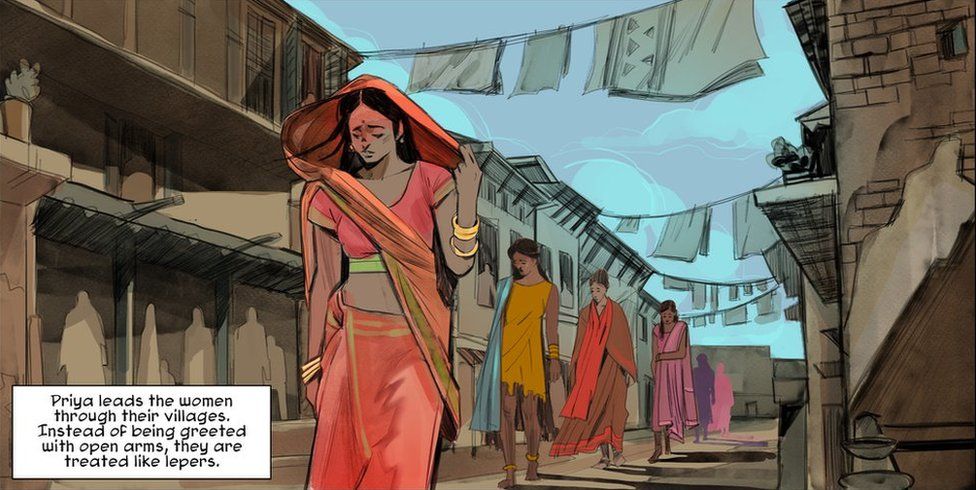
But victory still eludes her. The families of rescued girls refuse to take them back. The survivors are treated like “lepers”, facing stigma, scorn and ridicule.
But Priya and the other girls stand up to confront patriarchy, says Ms Mehta, “just as women have broken their silence to talk about MeToo”, the campaign against sexual harassment and abuse that started in Hollywood in October 2107 and later spread to many other parts of the world.
“I was very clear from the start that Lost Girls can’t be just another comic book where good guy wins and evil dies, it had to be much more than that,” Ms Mehta says.
Image copyright PRIYASHAKTI
Ram Devineni, the Indian-American creator of the comic series, told the BBC that he had decided to focus on sex trafficking in this edition after visiting Sonagachi, India’s largest red-light area in the eastern city of Kolkata, where he met several women engaged in sex work.
“Half of them told me they had been tricked into coming there and, once there, they were forced into the sex trade. The other half said they’d agreed to do this for a living because they were dirt poor and they had no alternative.
“Often there were two to three women sharing a small dingy room, many of them had young children who lived with them, and some of them said their children slept in the same bed where they serviced clients.
Mr Devineni says that from his conversations with them, he realised that many of the women there could leave, but chose not to.
“Most believed in the idea of sacrifice, for the sake of their families, their children. The shackles that hold them back are mostly emotional and psychological coercion.”
Some of their stories, he says, have found their way into the Lost Girls, which will be launched digitally on Monday to coincide with the start of United Nation’s 16 Days of Activism Against Gender-based Violence.
Image copyright PRIYASHAKTIAccording to the United Nations Office on Drugs and Crime, human trafficking is the second largest organised criminal business in the world after the arms trade. It is even ahead of the drugs trade.
“It’s a multi-billion-dollar industry,” anti-trafficking activist Ruchira Gupta told the BBC on the phone from New York.
Ms Gupta, who supports trafficked girls and women in India through her charity Apne Aap Women Worldwide, says there are 100 million people trapped in human trafficking globally, of which 27 million are in India alone, and most of the trafficking is in girls and young women.
India, Bangladesh and Nepal, she says, make up “the epicentre” of global sex trafficking.
Ms Gupta, who collaborated on Priya and the Lost Girls, says she plans to take the comic to schools and colleges in India and the US to use it as a talking tool, “as a conversation starter on what is a very difficult topic”.
The only way to fight trafficking, she believes, is to “de-normalise” sex trade – and cinema, art and pop culture are tools that can help do that.
The comic is made to appeal to young people. After its launch, it can be downloaded for free anywhere in the world; it also has “augmented reality features”, which means people can see special animation and movies by scanning the artwork with their smartphones.
Image copyright PRIYASHAKTI
“People often make flippant comments to say that prostitution is the oldest occupation in the world, but they don’t realise that trafficking is not some poor woman getting money in exchange for having sex with a man. It is the extreme exploitation of most vulnerable girls,” Ms Gupta says.
To stop this “commodification” of girls, she adds, we need to create revulsion in men’s minds about sex trade – and it’s best to catch them young.
“We must work with young boys and teenagers, 13 to 14 year olds, through storytelling and pop culture. They learn about sex from porn sites which portray sex workers as happy hookers, and no-one sees the girl behind her.
“I want to demolish that myth of the happy hooker. I want to ensure that people see the girl behind her.”
Artwork by Syd Fini and Neda Kazemifar
You may also be interested in…
Media caption Freida Pinto: Why I made a film about sex slaves
Nepali President Bidya Devi Bhandari hosts a grand farewell ceremony for Chinese President Xi Jinping at the airport in Kathmandu, Nepal, Oct. 13, 2019. Nepali Vice President Nanda Bahadur Pun, Prime Minister K.P. Sharma Oli, Chairman of the National Assembly Ganesh Prasad Timilsina, cabinet members and senior army generals also attended the ceremony. Chinese President Xi Jinping returned to Beijing from Kathmandu on Sunday. (Xinhua/Gao Jie)
BEIJING, Oct. 13 (Xinhua) — Chinese President Xi Jinping returned to Beijing Sunday evening after his second informal meeting with Indian Prime Minister Narendra Modi in India and a state visit to Nepal.
Xi’s entourage, including Ding Xuexiang, member of the Political Bureau of the Communist Party of China (CPC) Central Committee, member of the Secretariat of the CPC Central Committee, and director of the General Office of the CPC Central Committee; Yang Jiechi, member of the Political Bureau of the CPC Central Committee and director of the Office of the Foreign Affairs Commission of the CPC Central Committee; State Councilor and Foreign Minister Wang Yi; and He Lifeng, vice chairman of the National Committee of the Chinese People’s Political Consultative Conference and head of the National Development and Reform Commission, also returned to Beijing on the same plane.
As Xi and his entourage were leaving Kathmandu on Sunday noon local time, people of Nepal flocked to both sides of a road leading to the airport, waving flags and playing music to see the Chinese guests off.
Nepali President Bidya Devi Bhandari hosted a grand farewell ceremony for Xi at the airport. Nepali Vice President Nanda Bahadur Pun, Prime Minister K.P. Sharma Oli, Chairman of the National Assembly Ganesh Prasad Timilsina, cabinet members and senior army generals also attended the ceremony, which featured a 21-gun salute and the playing of national anthems of China and Nepal.
Calling his visit to Nepal a “very successful” one, Xi told Bhandari that upon his arrival, he had been warmly welcomed by the Nepali government and people.
Xi said he was convinced that the China-Nepal friendship enjoyed lasting popularity among the two peoples and will be unbreakable.
Expressing his appreciation for the arrangements made by the Nepali president, government and people, Xi said he was very satisfied with the visit that had resulted in the upgrading of bilateral relations.
He called for joint efforts to further develop the friendly relations between the two countries.
Bhandari said Xi’s successful and fruitful visit has become a milestone in the history of bilateral ties.
The Nepal-China relationship has entered a new era and stepped on a new height, Bhandari said, adding that Nepal will resolutely work with China to promote friendly and good neighborly relations and strategic cooperative partnership.
NEW DELHI/MUMBAI (Reuters) – India’s opposition Congress party selected past president Sonia Gandhi as its interim leader on Saturday, while it searches for a successor to her son Rahul Gandhi, who quit following a crushing election defeat by Prime Minister Narendra Modi.
The Congress Working Committee (CWC) unanimously decided to appoint Sonia Gandhi as “interim president pending the election of a regular president,” the party said in a statement late on Saturday night.
The committee wanted Rahul Gandhi to continue as its president but after he refused, they asked his mother to take over the reins instead, and she accepted, the statement said.
Sonia Gandhi is one of the most influential leaders of the Congress party and is credited with having brought the party back from the brink in 2004 with a surprise victory over the incumbent central government.
The widow of assassinated former Prime Minister Rajiv Gandhi, she was also the party’s longest serving president with 19 years at the helm, from 1998 to 2017, before handing over the baton to her son.
Congress, founded in 1885, is India’s oldest political party and dominated the country for decades after independence, led by generations of the Nehru-Gandhi family. The family produced three prime ministers: Jawaharlal Nehru, India’s first and longest-serving leader, his daughter Indira Gandhi and her son Rajiv.
However, Italian-born Sonia Gandhi faces a tall order to pull the party out of its worst crisis in decades and at the same time choose a worthy and dependable successor.
Party leaders and foot soldiers alike have been defecting to the ruling BJP. Remaining members have been dismayed at the party’s leadership vacuum following Modi’s re-election with a majority that surpassed his victory in 2014, and are questioning the party’s survival.
Rahul Gandhi, 49, announced his decision to quit as Congress leader in May, but the party leadership refused to accept it. They pressed him to reconsider, saying the party needed a unifying figure from the family to avoid splintering.
The party thanked Rahul Gandhi for his “exceptional leadership” during the state and general elections.
Last month in the southern state of Karnataka the defection of more than a dozen legislators from the ruling Congress-led coalition paved the way for Modi’s BJP to form a government.
Congress also appeared split in its response to Delhi’s decision to strip the state of Jammu and Kashmir of special constitutional status on Monday after putting the region on lockdown.
Some Congress members, including senior leader Jyotiraditya Scindia came out in support of the decision, and local media reported many in the party were supporting him.
Rahul Gandhi told reporters on Saturday night in New Delhi that considering there were reports of violence in Jammu and Kashmir, the government should provide transparent information about the actual situation on the ground.
















 CHINDIA ALERT: You'll be living in their world, very soon
Coronavirus: Chinese workers in Vietnam cry foul after being fired by Taiwanese firm making shoes for Nike, Adidas
A group of 150 Chinese workers believe the world’s largest maker of trainers used the coronavirus as an excuse to fire them, having helped Taiwanese firm Pou Chen successfully expand its production into Vietnam for more than a decade.
Pou Chen, which makes footwear for the likes of Nike and Adidas, informed the group in late April that they would no longer be needed as they were unable to return to
from their hometowns in China due to the coronavirus lockdowns.
“We 150 employees were the first batch of Chinese employees to be laid off this year. We are all pessimistic and expect more will be cut,” added Zhang.
In its email on April 27, Pou Chen said it was forced to terminate the contracts of the Chinese employees across five of its factories due to an unprecedented decline in orders and financial losses.
The Chinese employees, many of whom have been working for the shoemaker for decades, said the compensation offered was unfair and below the levels required by labour law in both Vietnam and China.
“[The dismissals were] in accordance with the relevant labour laws of the country of employment … and employee labour contracts,” added the statement from Pou Chen, which employs around 350,000 people worldwide.
Company data showed Pou Chen’s first quarter revenues tumbled 22.4 per cent year-on-year to NT$59.46 billion (US$1.99 billion), the weakest in six years.
With the likes of Nike and Adidas closing retail stores around the world to comply with social distancing requirements, analysts also said orders plummeted 50 per cent in the second quarter, although the company declined to comment on the media reports.
Andy Zeng, who had worked for the firm since 1995, said the group were “very upset” when they received the news last month as the impact of the coronavirus pandemic began to reverberate around the world, disrupting global value chains.
“Most of us joined Pou Chen in the 1990s when we were in our late teens or early 20s, when the Taiwan-invested company started investing and setting up factories in mainland China. Now more than two decades have passed,” he said.
Zeng was among the first generation of skilled workers in China as Pou Chen developed rapidly, enjoying the benefits of cheap labour, although the workers themselves were rewarded with regular pay rises.
The company needed a group of skilled Chinese workers to go to its new factories in Vietnam. I said yes because I thought it was a good opportunity to see the outside world – Andy Zeng
What our Chinese employees have done in Vietnam for more than a decade can be said to be very simple but very difficult – Dave Zhang
Posted in 50 per cent, accordance, Adidas, adjustment of manpower, around the world, automation level, below the levels, Bloomberg, boomed, bottlenecks, Chaos, cheaper, China, China’s economy, Chinese employees, Chinese workers, closing, comment, Company, compensation, comply, contributed, cooperated, coronavirus, coronavirus lockdowns, Covid-19 response, cry foul, cultural shock, deaths, decade, decline, declined, dismissals, disputes, Dong Nai, Dongguan, employee labour contracts,, expand, expendable, factories, families, financial losses, fired, footwear, furloughs, higher, hometowns, impact, Indonesia, Labour law, lack of orders, land, Mainland China, making, management experience, management style, media reports, Nike, opportunity, orders, pay cuts, pessimistic, plans, plummeted, Pou Chen, production, production line, relocation process, requirements, retail stores, returns, Reuters, Rush hour, second quarter, set up, shoe manufacturing, shoes, skilled, Social distancing, south china morning post, strain under, streets, strike, Taipei Times, Taiwan, Taiwan-invested, Taiwanese firm, Uncategorized, unfair, unprecedented, Vietnam, Vietnamese, Virus, workers, world’s largest maker of trainers | Leave a Comment »