Chindia Alert: You’ll be Living in their World Very Soon
aims to alert you to the threats and opportunities that China and India present. China and India require serious attention; case of ‘hidden dragon and crouching tiger’.
Without this attention, governments, businesses and, indeed, individuals may find themselves at a great disadvantage sooner rather than later.
The POSTs (front webpages) are mainly 'cuttings' from reliable sources, updated continuously.
The PAGEs (see Tabs, above) attempt to make the information more meaningful by putting some structure to the information we have researched and assembled since 2006.
Image copyright BRENDAN SMIALOWSKIImage caption Kim Jong-un has not been seen in public for more than two weeks
Speculation and rumour about Kim Jong-un’s health may amount to nothing, but questions about who might succeed him in the short or long term will always be there. The BBC spoke to analysts about the contenders and whether history is on their side.
A male member of the Kim family has been in charge of North Korea ever since its founding by Kim Il-sung in 1948 – and the mythology of this family runs deep throughout society.
Propaganda about its greatness begins for citizens before they can even read: pre-schoolers sing a song called: “I want to see our leader Kim Jong-un.”
So how can you imagine a North Korea without this symbolic and political figure at the top? How would elites organise themselves, as well as society as a whole?
The easy answer is: we don’t know. More interestingly, they don’t know either. They have never had to do it.
Image copyrightXINHUAImage captionKim Il-sung is the founder of North Korea and his son Kim Jong-il took over
As Kim Jong-un was being prepared for power, they even began using the term “Paektu Bloodline” to help legitimise his rule. Paektu is the sacred and mythologised mountain where Kim Il-sung is said to have waged guerrilla war and where Kim Jong-il was reportedly born. Kim Jong-un still goes there when he wants to emphasise important policy decisions.
There has always been a Kim at the ideological heart of the country.
What would North Korea be like without such an heir? Kim Jong-un, 36, is believed to have children – but they are far too young. It is thought he has three children, the oldest being 10 and the youngest three. Kim Jong-un himself was considered young when he took power – he was 27.
It is likely that some sort of group leadership would emerge, perhaps as in Vietnam, that leans heavily on the founder’s teachings and legitimacy to boost their own standing.
Observers can track who holds certain key positions and can follow news and open-source intelligence about important institutions, but can’t really tell how factions are developing, nor who is holding power through personal rather than institutional bonds. Moreover, sometimes vice or deputy directors wield more real power than the titular heads of institutions. This makes all predictions extremely difficult.
The three remaining Kims
Image copyrightPATRICK SEMANSKY – POOL /GETTY IMAGESImage captionKim Yo-jong, as the only woman in the top leadership, has sparked fascination
The are three Kims who could potentially be involved in the political make-up of North Korea if Kim Jong-un were to disappear. They all face limitations in carrying on family rule.
The first is Kim Yo-jong, Kim Jong-un’s younger sister. She is said to have been a favourite of her father who commented on her precocity, her interest in politics from a young age. Her manner is efficient, mild and one suspects rather observant. Much has been made of her closeness to her brother. At the Singapore Trump-Kim summit she was famously on hand to pass him a pen to sign the agreement with, and at the next summit in Hanoi, was pictured peeking out from behind corners as her brother posed for statesman-like photos.
Yet she was not above a temporary demotion after the Hanoi summit – purportedly because of its failure although this will never be confirmed. She doesn’t sit on the top policy-making body, the State Affairs Commission, but is an alternate member of the Politburo and vice director of the Propaganda and Agitation Department (PAD) of the Workers’ Party of Korea. These may seem like incomprehensible acronyms but the PAD is a powerful organisation that ensures ideological loyalty in the system.
She is a woman, however, and this makes it hard to imagine her occupying the top position in such a deeply patriarchal country. North Korea is an extremely male state, in which gender carries rigid expectations. Being supreme leader, and certainly running the military, does not fit in the range of womanly duties.
The second is Kim Jong-chul. He is Kim Jong-un’s older brother, but has never appeared interested in politics or power. (He is known to be interested in Eric Clapton.) At most, he could be a symbolic link to the Kim family: perhaps made the head of a foundation and put forward to read the odd speech.
The final one is Kim Pyong-il, Kim Jong-il’s half-brother. His mother – Kim Jong-il’s stepmother – was angling to have him become Kim Il-sung’s successor. She failed and was sidelined by Kim Jong-il as he rose in influence. Kim Pyong-il was sent to Europe in 1979, where he has held various ambassadorships, returning to North Korea only last year. This means it is very unlikely he has the network to be a central player in elite politics in Pyongyang.
The second-most powerful man in North Korea right now
Image copyrightALEXANDER NEMENOV/AFP VIA GETTY IMAGESImage captionAs special envoy for Kim Jong-un Choe Ryong-hae (right) has met foreign dignitaries
There are other individuals who have been central in the Kim Jong-un era, but it is difficult to know who among them would form co-operative relationships and who would compete with one another.
One is Choe Ryong-hae. He has had his ups and downs under Kim Jong-un, but having weathered a few storms currently sits on the presidium of the politburo and is also first vice chairman of the State Affairs Commission. Last year he became the first new president in 20 years, replacing the aging Kim Yong-nam – so he is the person who represents the North at international engagements.
Choe has also held high positions in the military and the Organization and Guidance Department (OGD) of the Worker’s Party of Korea, responsible for enforcing loyalty throughout the regime. This is an extremely powerful organisation: it enforces the adherence of all citizens to North Korea’s ideology. He is probably the second most powerful man in North Korea.
The old spymasters and rising political grandees
Image copyrightOLIVIER DOULIERY-POOL/GETTY IMAGESImage captionKim Yong-chol travelled to Washington DC to meet Donald Trump
Another is Kim Yong-chol. This general paved the way for the Trump-Kim summits, meeting US Secretary of State Mike Pompeo several times. He has been head of the United Front Department (responsible for relations with South Korea) and the Reconnaissance General Bureau, the country’s main intelligence service. He seems to have suffered a demotion following the collapse talks with the United States, but it is unlikely this spymaster will remain obscure for long.
Yet another is Kim Jae-ryong. As well as being on the State Affairs Commission, he is Premier of the Cabinet, a moderately influential position. Relatively little is known about him, but his star has risen in the past years as others have fallen. He is known for managing industries and ran the most isolated province, home to key military-industrial sites, for several years. This may mean he has been closely involved in the nuclear program.
Jong Kyong-taek is responsible for the State Security Department, which investigates and punishes political crimes. It also helps physically protect the leadership. These are crucial responsibilities that help enforce stability in the system.
Hwang Pyong-so is another official who has held top military posts and has run the OGD in the Kim Jong-un era. Like Choe (and many others) he has been disciplined; he doesn’t seem to have been rehabilitated in the same way, however. Other 2010s foreign policy stalwarts Ri Yong-ho and Ri Su-yong have also seen roles diminish recently. They have been replaced by Ri Son-gwon and Kim Hyung-jun. The former is said to be an ally of Kim Yong-chol.
The military enforcers
A handful of top generals of the Korean People’s Army (KPA) would also certainly exert influence in any transition period. Currently, two men sit atop the General Political Bureau of the KPA, Kim Su-gil and Kim Won-hong. This bureau enforces political loyalty in the military, something that would be absolutely crucial during periods of uncertainty.
Kim Won-hong, helps illustrate how difficult it is to predict how power would be shared if Kim Jong-un were no longer there. Kim Won-hong and Hwang Pyong-so had been thought to be rivals, competing to influence Kim Jong-un at the other’s expense.
Amongst top elites, who would clash and who would ally? Would there be pro and anti-Kim Yo-jong factions? Would the fear of instability stop rivalries from getting out of hand? After all, it is in no elite politician’s interest to see the state collapse, opening the door for some kind of takeover by South Korea, or even China.
There is currently no perfect contender: his sister would have to overcome the sexism and the break from tradition of a male heir. Anybody else is not directly descended from that all-important Paektu bloodline. but in the end, they will all have to think of the unity of the state they have defied every international norm to preserve.
The richest man in China opened his own Twitter account last month, in the middle of the Covid-19 outbreak. So far, every one of his posts has been devoted to his unrivalled campaign to deliver medical supplies to almost every country around the world.
“One world, one fight!” Jack Ma enthused in one of his first messages. “Together, we can do this!” he cheered in another.
The billionaire entrepreneur is the driving force behind a widespread operation to ship medical supplies to more than 150 countries so far, sending face masks and ventilators to many places that have been elbowed out of the global brawl over life-saving equipment.
But Ma’s critics and even some of his supporters aren’t sure what he’s getting himself into. Has this bold venture into global philanthropy unveiled him as the friendly face of China’s Communist Party? Or is he an independent player who is being used by the Party for propaganda purposes? He appears to be following China’s diplomatic rules, particularly when choosing which countries should benefit from his donations, but his growing clout might put him in the crosshairs of the jealous leaders at the top of China’s political pyramid.
Other tech billionaires have pledged more money to fight the effects of the virus – Twitter’s Jack Dorsey is giving $1bn (£0.8bn) to the cause. Candid, a US-based philanthropy watchdog that tracks private charitable donations, puts Alibaba 12th on a list of private Covid-19 donors. But that list doesn’t include shipments of vital supplies, which some countries might consider to be more important than money at this stage in the global outbreak.
The world’s top coronavirus financial donors
How Alibaba compares to the top five. No one else other than the effervescent Ma is capable of dispatching supplies directly to those who need them. Starting in March, the Jack Ma foundation and the related Alibaba foundation began airlifting supplies to Africa, Asia, Europe, Latin America and even to politically sensitive areas including Iran, Israel, Russia and the US.
Ma has also donated millions to coronavirus vaccine research and a handbook of medical expertise from doctors in his native Zhejiang province has been translated from Chinese into 16 languages. But it’s the medical shipments that have been making headlines, setting Ma apart.
“He has the ability and the money and the lifting power to get a Chinese supply plane out of Hangzhou to land in Addis Ababa, or wherever it needs to go,” explains Ma’s biographer, Duncan Clark. “This is logistics; this is what his company, his people and his province are all about.”
A friendly face
Jack Ma is famous for being the charismatic English teacher who went on to create China’s biggest technology company. Alibaba is now known as the “Amazon of the East”. Ma started the company inside his tiny apartment in the Chinese coastal city of Hangzhou, in the centre of China’s factory belt, back in 1999. Alibaba has since grown to become one of the dominant players in the world’s second largest economy, with key stakes in China’s online, banking and entertainment worlds. Ma himself is worth more than $40bn.
Officially, he stepped down as Alibaba’s chairman in 2018. He said he was going to focus on philanthropy. But Ma retained a permanent seat on Alibaba’s board. Coupled with his wealth and fame, he remains one of the most powerful men in China.
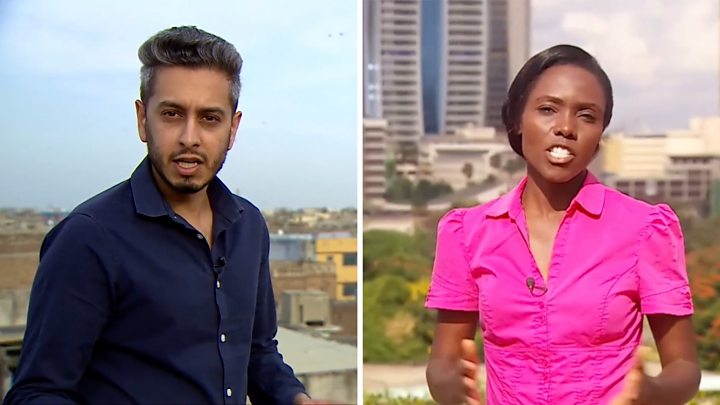
Media caption The BBC’s Secunder Kermani and Anne Soy compare how prepared Asian and African countries are
It appears that Ma’s donations are following Party guidelines: there is no evidence that any of the Jack Ma and Alibaba Foundation donations have gone to countries that have formal ties with Taiwan, China’s neighbour and diplomatic rival. Ma announced on Twitter that he was donating to 22 countries in Latin America. States that side with Taiwan but who have also called for medical supplies – from Honduras to Haiti – are among the few dozen countries that do not appear to be on the list of 150 countries. The foundations repeatedly refused to provide a detailed list of countries that have received donations, explaining that “at this moment in time, we are not sharing this level of detail”.
However, the donations that have been delivered have certainly generated a lot of goodwill. With the exception of problematic deliveries to Cuba and Eritrea, all of the foundations’ shipments dispatched from China appear to have been gratefully received. That success is giving Ma even more positive attention than usual. China’s state media has been mentioning Ma almost as often as the country’s autocratic leader, Xi Jinping.
AFP
So far…
Over 150 countries have received donations from Jack Ma, including about:
120.4mface masks
4,105,000testing kits
3,704ventilators
Source: Alizila
It’s an uncomfortable comparison. As Ma soaks up praise, Xi faces persistent questions about how he handled the early stages of the virus and where, exactly, the outbreak began.
The Chinese government has dispatched medical teams and donations of supplies to a large number of hard-hit countries, particularly in Europe and South-East Asia.
However, those efforts have sometimes fallen flat. China’s been accused of sending faulty supplies to several countries. In some cases, the tests it sent were being misused but in others, low-quality supplies went unused and the donations backfired.
In contrast, Jack Ma’s shipments have only boosted his reputation.
“It’s fair to say that Ma’s donation was universally celebrated across Africa,” says Eric Olander, managing editor of the China Africa Project website and podcast. Ma pledged to visit all countries in Africa and has been a frequent visitor since his retirement.
“What happens to the materials once they land in a country is up to the host government, so any complaints about how Nigeria’s materials were distributed are indeed a domestic Nigerian issue,” Olander adds. “But with respect to the donation itself, the Rwandan leader, Paul Kagame, called it a “shot in the arm” and pretty much everyone saw it for what it was which was: delivering badly-needed materials to a region of the world that nobody else is either willing or capable of helping at that scale.”
Walking the tightrope
But is Ma risking a backlash from Beijing? Xi Jinping isn’t known as someone who likes to share the spotlight and his government has certainly targeted famous faces before. In recent years, the country’s top actress, a celebrated news anchor and several other billionaire entrepreneurs have all “disappeared” for long periods. Some, including the news anchor, end up serving prison sentences. Others re-emerge from detention, chastened and pledging their allegiance to the Party.
“There’s a rumour that [Jack Ma] stepped down in 2018 from being the chairman of the Alibaba Group because he was seen as a homegrown entrepreneur whose popularity would eclipse that of the Communist Party,” explains Ashley Feng, research associate at the Centre for New American Security in Washington DC. Indeed, Ma surprised many when he suddenly announced his retirement in 2018. He has denied persistent rumours that Beijing forced him out of his position.
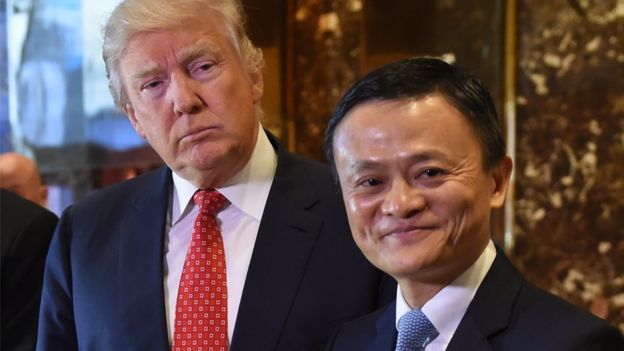
Image copyright GETTY IMAGESImage caption Ma discussed trade with then-President-elect Donald Trump in January 2017
Duncan Clark, Ma’s biographer, is also aware of reports that Ma was nudged away from Alibaba following a key incident in January 2017. The Chinese billionaire met with then-President-elect Donald Trump in Trump Tower, ostensibly to discuss Sino-US trade. The Chinese president didn’t meet with Trump until months later.
“There was a lot of speculation of time that Jack Ma had moved too fast,” Clark says. “So, I think there’s lessons learned from both sides on the need to try to coordinate.”
“Jack Ma represents a sort of entrepreneurial soft power,” Clark adds. “That also creates challenges though, because the government is quite jealous or nervous of non-Party actors taking that kind of role.”
Technically, Ma isn’t a Communist outsider: China’s wealthiest capitalist has actually been a member of the Communist Party since the 1980s, when he was a university student.
But Ma’s always had a tricky relationship with the Party, famously saying that Alibaba’s attitude towards the Party was to “be in love with it but not to marry it”.
Even if Ma and the foundations connected to him are making decisions without Beijing’s advance blessing, the Chinese government has certainly done what it can to capitalise on Ma’s generosity. Chinese ambassadors are frequently on hand at airport ceremonies to receive the medical supplies shipped over by Ma, from Sierra Leone to Cambodia.
China has also used Ma’s largesse in its critiques of the United States. “The State Department said Taiwan is a true friend as it donated 2 million masks,” the Chinese Foreign Ministry tweeted in early April. “Wonder if @StateDept has any comment on Jack Ma’s donation of 1 million masks and 500k testing kits as well as Chinese companies’ and provinces’ assistance?”
Perhaps Ma can rise above what’s happened to so many others who ran afoul of the Party. China might just need a popular global Chinese figure so much that Ma has done what no one else can: make himself indispensable.
“Here’s the one key takeaway from all that happened with Jack Ma and Africa: he said he would do something and it got done,” explains Eric Olander. “That is an incredibly powerful optic in a place where foreigners often come, make big promises and often fail to deliver. So, the huge Covid-19 donation that he did fit within that pattern. He said he would do it and mere weeks later, those masks were in the hands of healthcare workers.”
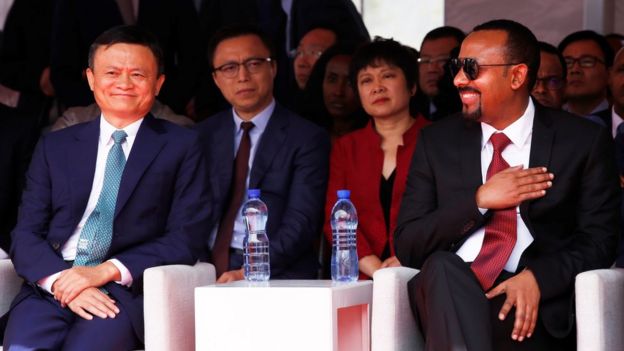
Image copyright GETTY IMAGESImage caption Ma at an Electronic World Trade Platform event with Ethiopian Prime Minister Abiy Ahmed last year
Duncan Clark argues that Ma already had a seat at China’s high table because of Alibaba’s economic heft. However, his first-name familiarity with world leaders makes him even more valuable to Beijing as China tries to repair its battered image.
“He has demonstrated the ability, with multiple IPOs under his belt, and multiple friendships overseas, to win friends and influence people. He’s the Dale Carnegie of China and that certainly, we’ve seen that that’s irritated some in the Chinese government but now it’s almost an all hands on deck situation,” Clark says.
There’s no doubt that China’s wider reputation is benefiting from the charitable work of Ma and other wealthy Chinese entrepreneurs. Andrew Grabois from Candid, the philanthropic watchdog that’s been measuring global donations in relation to Covid-19, says that the private donations coming from China are impossible to ignore.
“They’re taking a leadership role, the kind of thing that used to be done by the United States,” he says. “The most obvious past example is the response to Ebola, the Ebola outbreak in 2014. The US sent in doctors and everything to West Africa to help contain that virus before it left West Africa.”
Chinese donors are taking on that role with this virus.
“They are projecting soft power beyond their borders, going into areas, providing aid, monetary aid and expertise,” Grabois adds.
So, it’s not the right time for Beijing to stand in Jack Ma’s way.
“You know, this is a major crisis for the world right now,” Duncan Clark concludes. “But obviously, it’s also a crisis for China’s relationship with the rest of the world. So they need anybody who can help dampen down some of these those pressures.”
News of his death was met with an intense outpouring of grief on Chinese social media site Weibo – but this quickly turned into anger.
There had already been accusations against the government of downplaying the severity of the virus – and initially trying to keep it secret.
Dr Li’s death has fuelled this further and triggered a conversation about the lack of freedom of speech in China.
The country’s anti-corruption body has now said it will open an investigation into “issues involving Dr Li”.
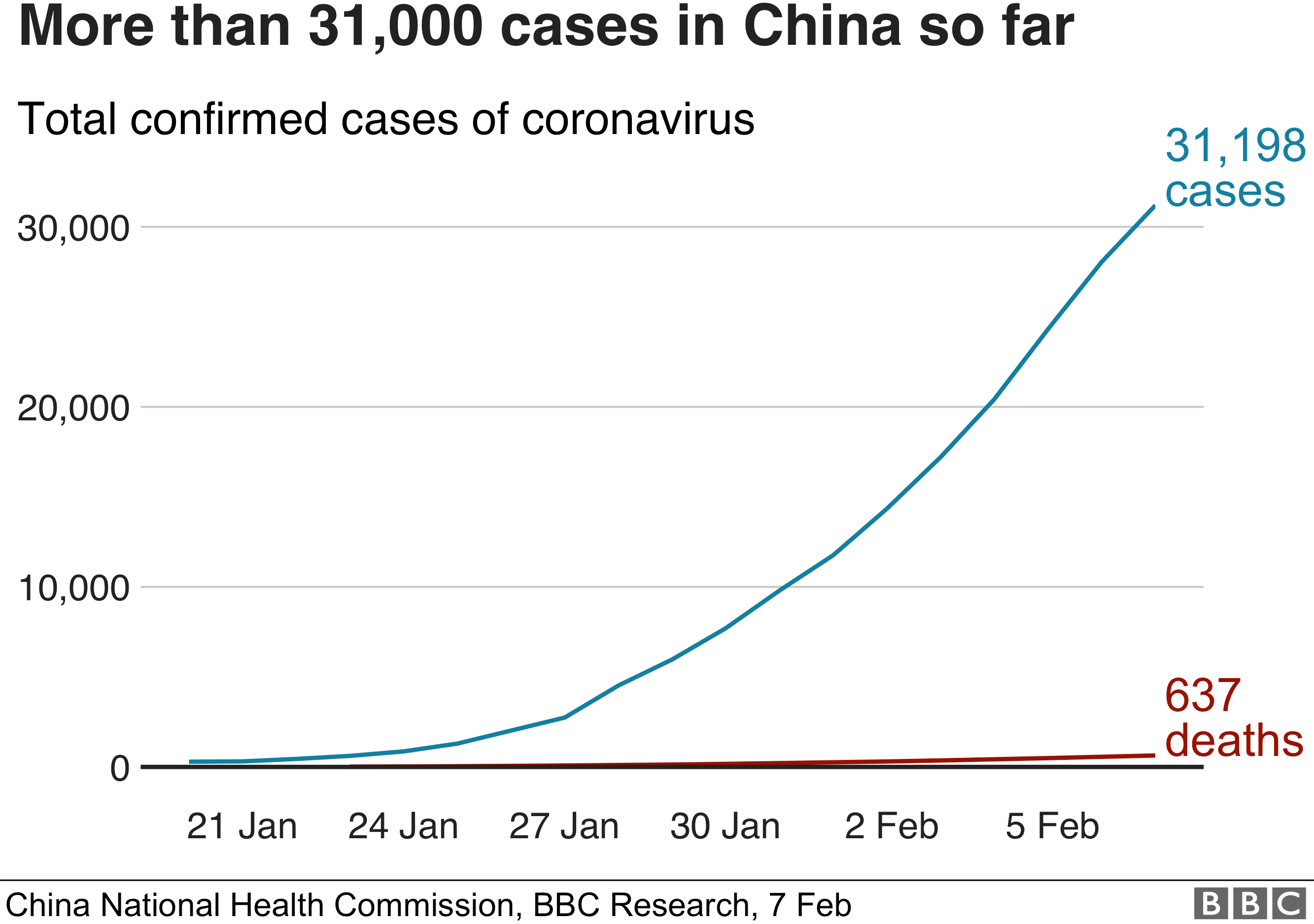
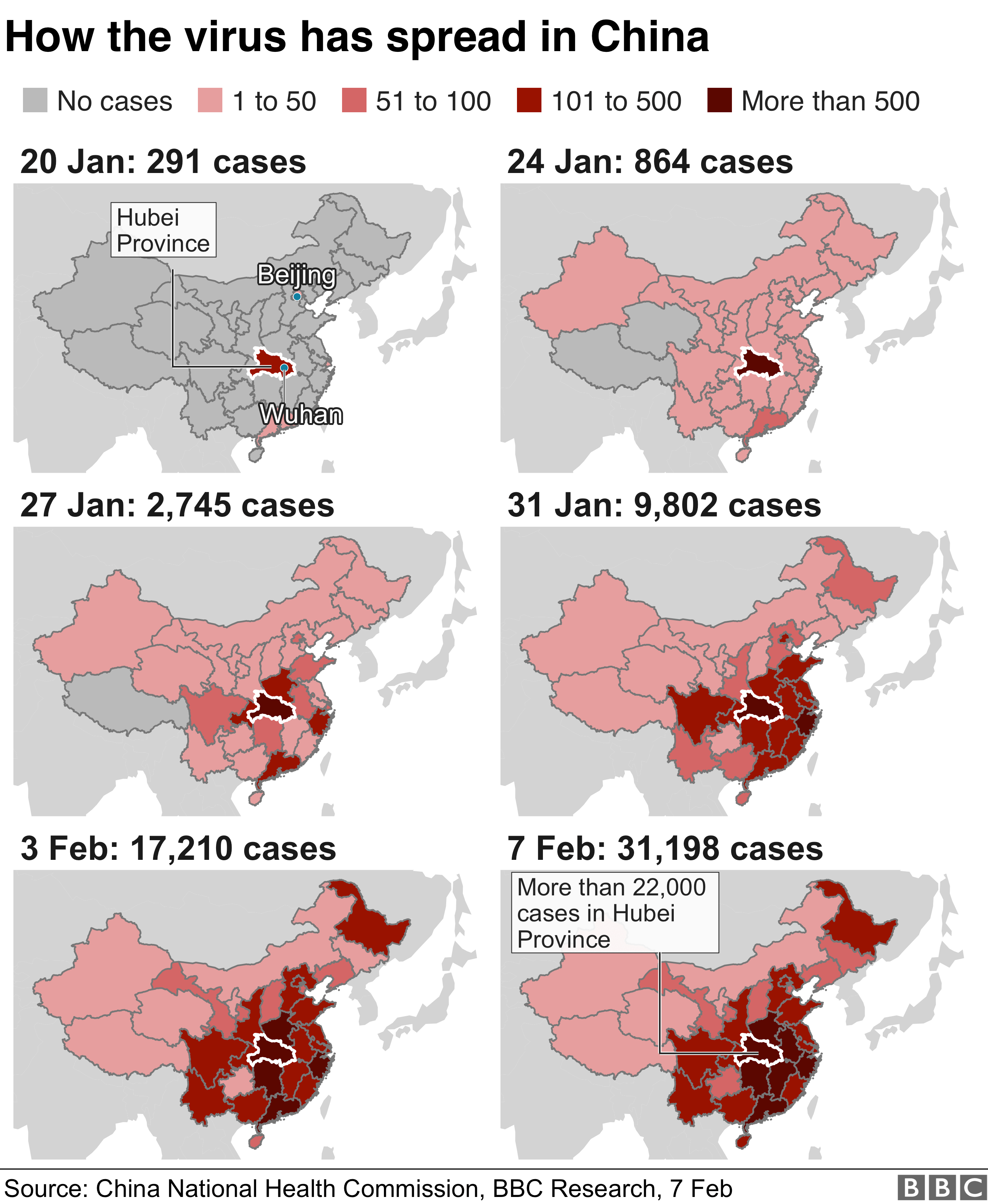
The Chinese government has previously admitted “shortcomings and deficiencies” in its response to the virus, which has now killed 636 people and infected 31,161 in mainland China.
According to Chinese site Pear Video, Dr Li’s wife is due to give birth in June.
What has the public reaction been?
Chinese social media has been flooded with anger – it is hard to recall an event in recent years that has triggered as much grief, rage and mistrust against the government.
The top two trending hashtags on the website were “Wuhan government owes Dr Li Wenliang an apology” and “We want freedom of speech”.
Both hashtags were quickly censored. When the BBC searched Weibo on Friday, hundreds of thousands of comments had been wiped. Only a handful remain.
“This is not the death of a whistleblower. This is the death of a hero,” said one comment on Weibo.
A photo circulating on Twitter reportedly sourced from messaging platform WeChat also shows a message in Chinese saying “Farewell Li Wenliang” written in the snow on a riverbank.
Many have now taken to posting under the hashtag “Can you manage, do you understand?” – a reference to the letter Dr Li was told to sign when he was accused of disturbing “social order”.
These comments do not directly name him – but are telling of the mounting anger and distrust towards the government.
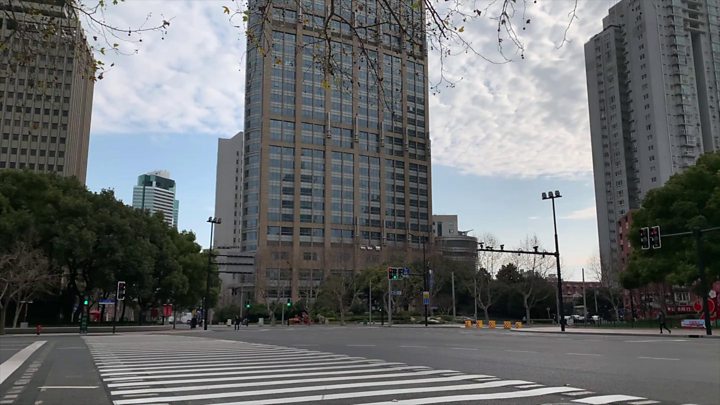
Media caption Coronavirus: Shanghai’s deserted streets and metro
“Do not forget how you feel now. Do not forget this anger. We must not let this happen again,” said one comment on Weibo.
“The truth will always be treated as a rumour. How long are you going to lie? What else do you have to hide?” another said.
“If you are angry with what you see, stand up,” one said. “To the young people of this generation, the power of change is with you.”
An epic political disaster
The death of Dr Li Wenliang has been a heart-breaking moment for this country. For the Chinese leadership it is an epic political disaster.
It lays bare the worst aspects of China’s command and control system of governance under Xi Jinping – and the Communist Party would have to be blind not to see it.
If your response to a dangerous health emergency is for the police to harass a doctor trying to blow the whistle, then your structure is obviously broken.
The city’s mayor – reaching for excuses – said he needed clearance to release critical information which all Chinese people were entitled to receive.
Now the spin doctors and censors will try to find a way to convince 1.4 billion people that Dr Li’s death is not a clear example of the limits to the party’s ability to manage an emergency – when openness can save lives, and restricting it can kill.
He was initially declared dead at 21:30 on Thursday (13:30GMT) by state media outlets the Global Times, People’s Daily and others.
Hours later the Global Times contradicted this report – saying he had been given a treatment known as ECMO, which keeps a person’s heart pumping.
Journalists and doctors at the scene said government officials had intervened – and official media outlets had been told to change their reports to say the doctor was still being treated.
But early on Friday, reports said doctors could not save Dr Li and his time of death was 02:58 on Friday.
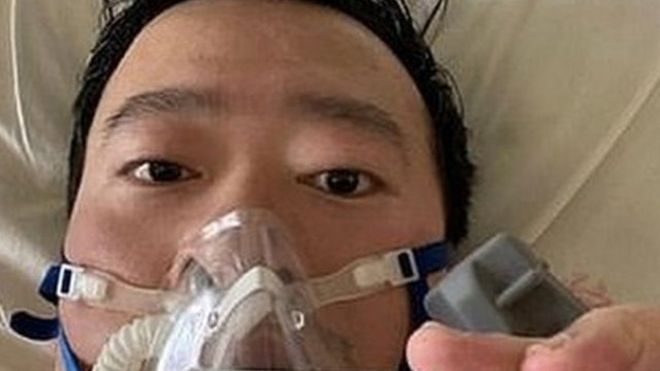
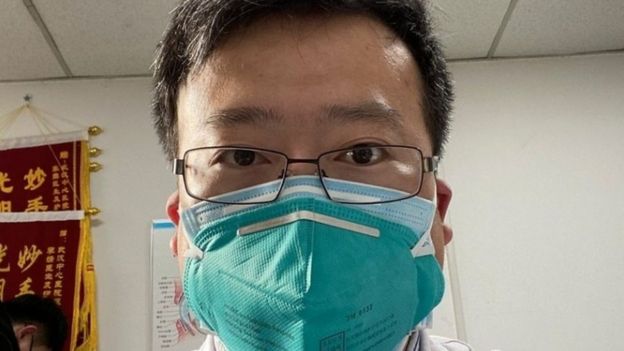
Image copyright LI WENLIANGImage caption Li Wenliang contracted the virus while working at Wuhan Central Hospital
What did Li Wenliang do?
Dr Li, an ophthalmologist, posted his story on Weibo from a hospital bed a month after sending out his initial warning.
He had noticed seven cases of a virus that he thought looked like Sars – the virus that led to a global epidemic in 2003.
On 30 December he sent a message to fellow doctors in a chat group warning them to wear protective clothing to avoid infection.
Four days later he was summoned to the Public Security Bureau where he was told to sign a letter.
In the letter he was accused of “making false comments” that had “severely disturbed the social order”. Local authorities later apologised to Dr Li.
In his Weibo post he describes how on 10 January he started coughing, the next day he had a fever and two days later he was in hospital. He was diagnosed with the coronavirus on 30 January.
Media caption The BBC’s online health editor on what we know about the virus
Singapore has raised its Disease Outbreak Response System Condition (Dorscon) level from yellow to orange. This means that the disease is deemed severe and spreads easily from person to person but has not spread widely and is being contained
Chinese President Xi Jinping has told his US counterpart Donald Trump that China is “fully confident and capable of defeating the epidemic”. The country has introduced more restrictive measures to try to control the outbreak:
The capital Beijing has banned group dining for events such as birthdays. Cities including Hangzhou and Nanchang are limiting how many family members can leave home each day
Hubei province has switched off lifts in high-rise buildings to discourage residents from going outside.
The virus has now spread to more than 25 countries. There have been more than 28,000 cases worldwide but only two of the deaths have been outside mainland China.
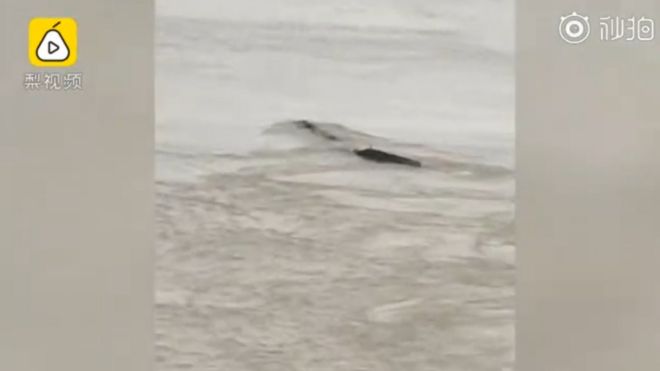
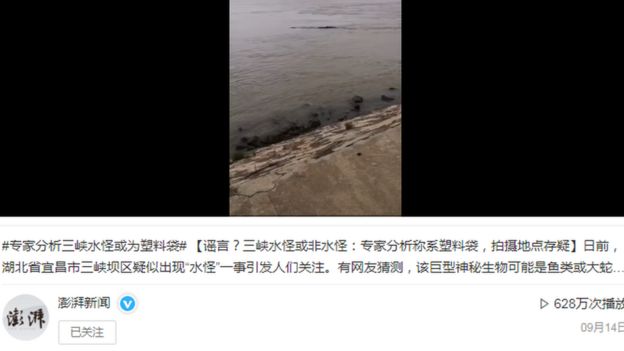
Image copyright PEAR VIDEOImage caption Grainy footage showed something that appeared to have a tail slithering back and forth in the water
Something is lurking in the deep in China’s famous Yangtze River – and social media discussion is rife over what it might be.
On Friday, footage appeared on China’s popular Sina Weibo microblog of what appeared to be a long, black creature, manoeuvring through the waters, and it has dominated online discussion ever since.
Footage has quickly racked up millions of views, and theories are rife.
Specialists have weighed in – but some think there may be a simple, and less murky, explanation.
Excitement over footage
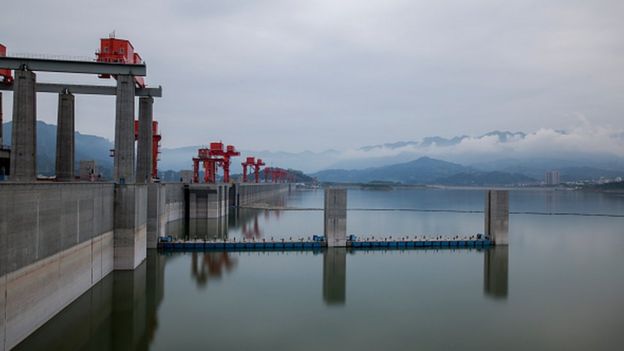
A video filmed off the coast of the city of Yichang in western Hubei province, close to the Three Gorges Dam, captured the unusual scene.
Locals are filmed watching the creature from the shore – and social media users have similarly been captivated over theories about what the creature might be.
Many have posted using the hashtag #ThreeGorgesMonsterPhotos, and specialists have begun to weigh in with their thoughts.
In an interview with Pear Video, Professor Wang Chunfang from the Huazhong Agricultural University dismissed the idea of it being a new species, saying it was likely a simple “water snake”.
Some users said that “external factors such as pollution” could have a role to play in a sea snake growing to an extraordinary size. But not everyone was convinced.
Separate footage has led some users to question whether the unidentified object is actually a living creature at all.
Image copyright THE PAPERImage caption Millions have watched footage of the item, but some think it might be a piece of simple rubbish
Popular news website The Paper shared separate footage of something long and black moving in the water that appeared to be less animated.
It asked if the whole thing was simply “a rumour” – and interviewed a biologist, Ding Li, who said that the object was neither a fish nor a snake, but simply “a floating object”.
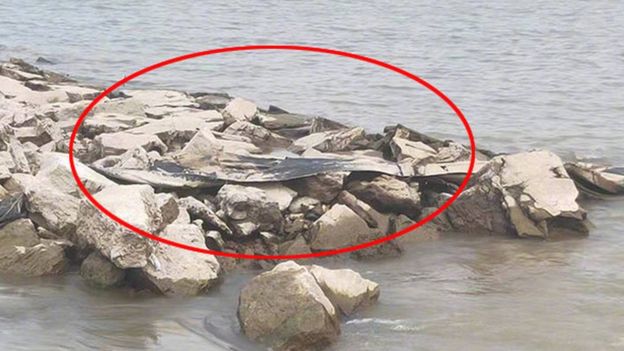
A picture has since gone viral showing a long piece of black cloth washed up on some rocks, fuelling discussion this might have been the mysterious object.
Image copyright THE PAPERImage caption The appearance of some cloth washed up on some rocks has got users asking if they were mistaken
Both have led to jokes about whether the local government was trying to attract tourism to the area, given the millions of dollars involved in building and maintaining the Three Gorges Dam.
Others have made jokes about the quality of the footage, despite the rapid development in China of high quality smartphones.
Some joked that the user obviously didn’t have a Huawei phone. Another said: “Monsters always appear only when there are few pixels.”
So what does live in the Yangtze?
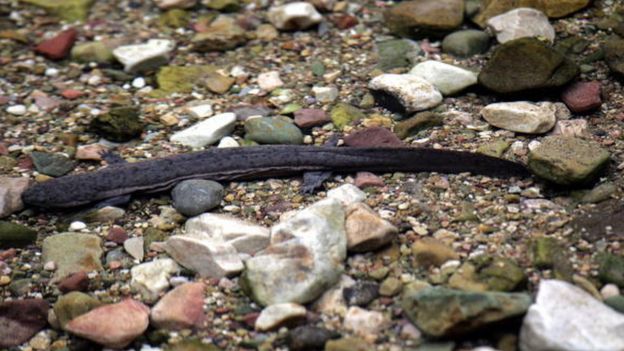
Image copyright AFPImage caption Giant Chinese salamanders live in the Yangtze river. They can grow to 1.8 metres in length
The Yangtze River is the longest river in Asia, and at 3,900 miles in length (6,300km), is the third longest in the world.
But pollution has severely affected the river in recent years, meaning that its ecosystem has become narrower, rather than wider.
The largest creature thought to exist in the waters at present is the Chinese giant salamander, which can reach some 1.8m in length.
This species is critically endangered, largely as a result of pollution.
Image copyright ZHANG PENG/GETTY IMAGESImage caption The Three Gorges Dam is the world’s latest hydroelectric dam
China’s other ‘Nessies’
China is no stranger to conspiracy theories about mythical creatures lurking in the deep.
Since 1987, questions have been asked about whether a “Lake Monster” exists in the Kanas Lake in north-western Xinjiang, following numerous reports of sightings.
However, specialists believe that this is a giant taimen, a species of salmon that can grow to 180cm long, the official China Daily said.
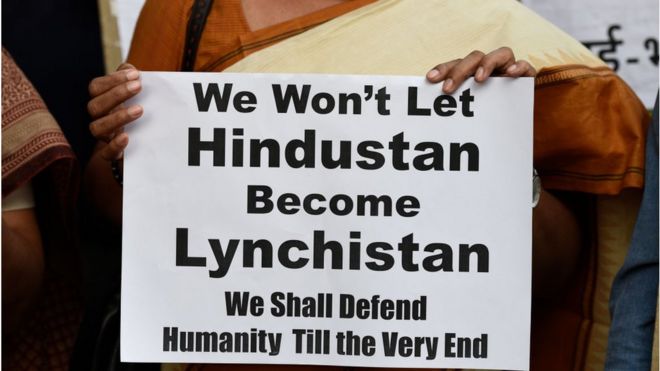
The highest number of such cases has been registered in the northern state of Uttar Pradesh, which borders Delhi.
“At least 46 cases have been reported until 29 August. In all cases, we found that there was no evidence of child trafficking,” director general of police OP Singh told the BBC.
“We appeal to the people to not believe in such rumours. If you are in doubt, just reach out to the police through phone [dial in number 100] or social media,” he added.
Media captionThe India WhatsApp video driving people to murder
In Ghaziabad district, which is on the outskirts of Delhi, six cases were registered in August.
“In one case, a group of people attacked a grandmother while she was out with her grandchild. People attacked her because her skin colour was different to her grandchild,” senior police officer Neeraj Jadaun said, adding that all suspects in the case had been arrested.
While incidents like this are being reported across India, it is not clear if kidnappings are on the rise.
Rumours of child kidnappings often spread over text messages or WhatsApp, according to reports.
Officials have urged people not to believe messages linked to child abductions and are yet to find any incidents of child abduction related to the spate of messages and videos being shared online.


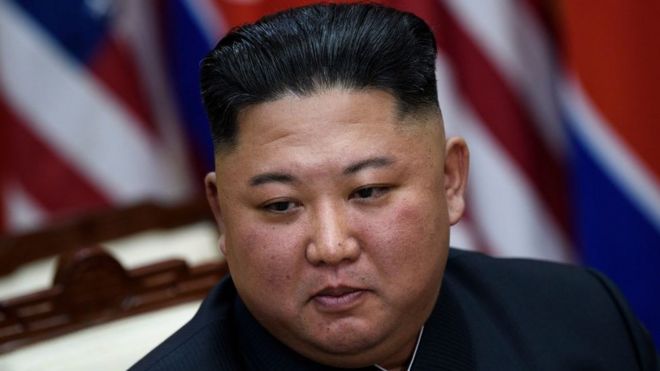 Image copyright BRENDAN SMIALOWSKI
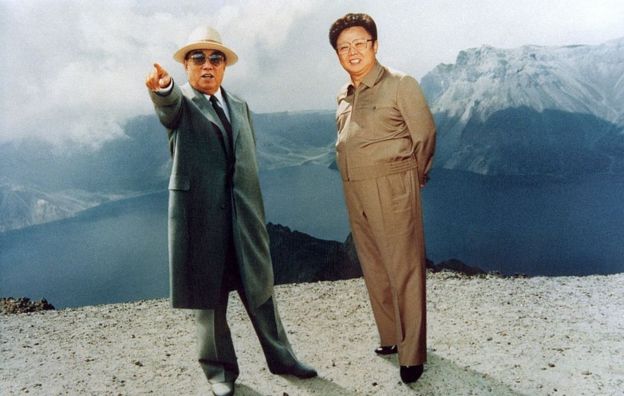 Image copyrightXINHUA
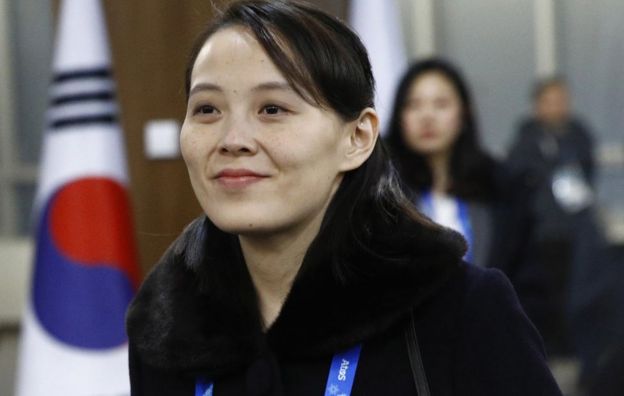 Image copyrightPATRICK SEMANSKY – POOL /GETTY IMAGES
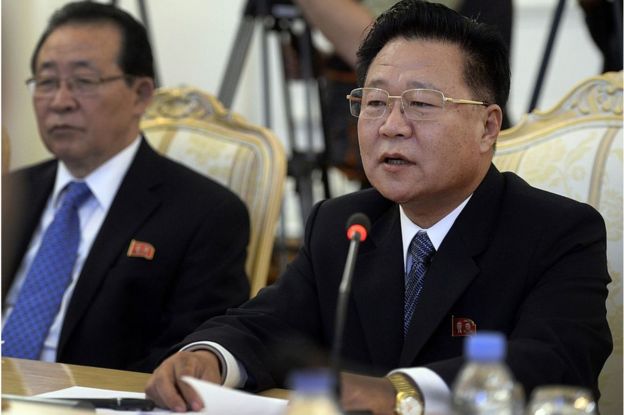 Image copyrightALEXANDER NEMENOV/AFP VIA GETTY IMAGES
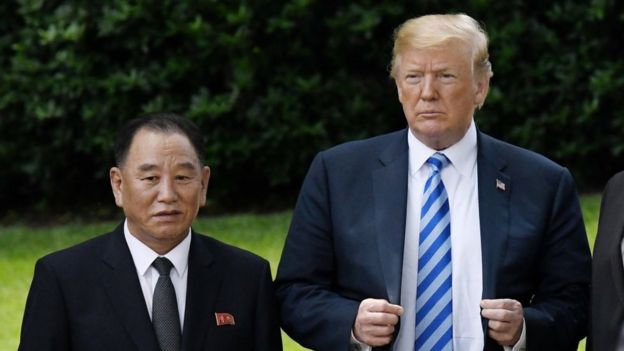 Image copyrightOLIVIER DOULIERY-POOL/GETTY IMAGES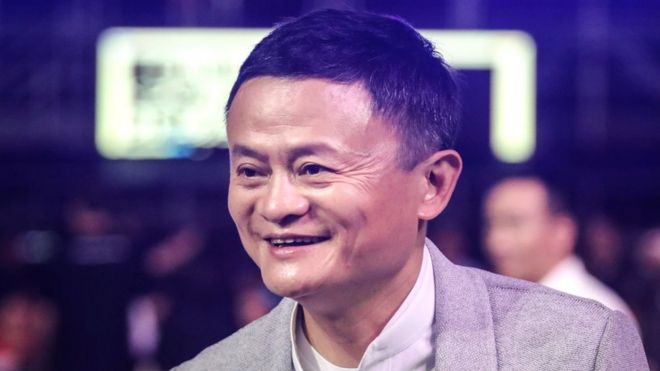








 CHINDIA ALERT: You'll be living in their world, very soon