Chindia Alert: You’ll be Living in their World Very Soon
aims to alert you to the threats and opportunities that China and India present. China and India require serious attention; case of ‘hidden dragon and crouching tiger’.
Without this attention, governments, businesses and, indeed, individuals may find themselves at a great disadvantage sooner rather than later.
The POSTs (front webpages) are mainly 'cuttings' from reliable sources, updated continuously.
The PAGEs (see Tabs, above) attempt to make the information more meaningful by putting some structure to the information we have researched and assembled since 2006.
People’s Liberation Army has officially recorded no infections but disease fears have delayed recruitment, training and operations
Analysts say Sars experience guided military’s prompt response, but combat effectiveness has been affected
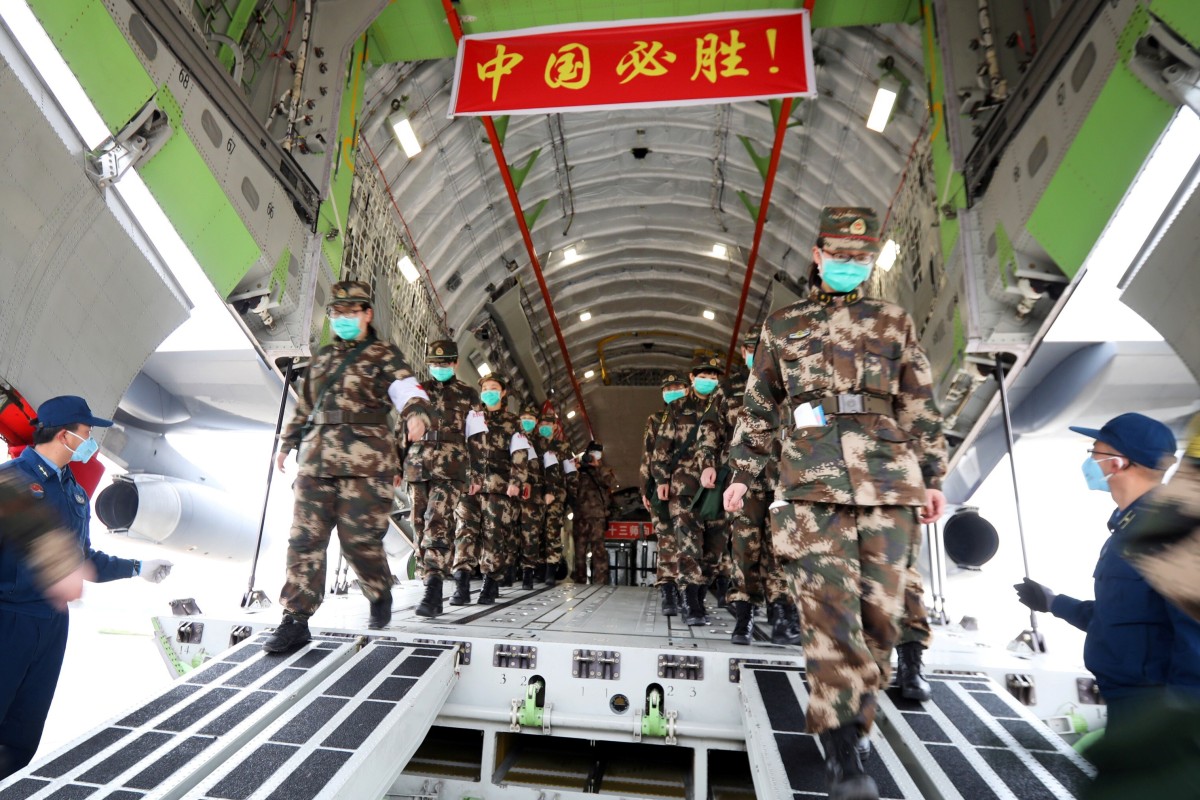
Chinese military medical personnel arriving in Wuhan in February to assist with the coronavirus outbreak response to the February. Photo: Reuters
China’s military may have been spared any coronavirus infections, but the global health crisis has slowed the progress of Chinese President Xi Jinping’s plan to transform the People’s Liberation Army into a modern fighting force capable of long-range power-projecting operations, experts say.
According to China’s defence ministry, the world’s largest armed force – with about 2.3 million personnel – has had zero confirmed cases of Covid-19. In contrast, the US and Russian militaries, ranked second- and third-largest in the world, have reported more than 4,000 and 1,000 respectively.
But the PLA has been affected in other ways by the disease, which was first reported in Wuhan in December before going on to infect 3.9 million people around the world to date.
Safety concerns delayed its annual spring recruitment programme – it has been rescheduled for August – while the PLA Navy was forced to change its training arrangements, switching to classroom study of military theory and tactics, according to Xinhua.
“The PLA is still a conscription army and, given its large turnover of soldiers every year and the late recruitment and training plan this year, the coronavirus pandemic has already affected combat effectiveness,” said Adam Ni, director of the China Policy Centre, an independent, non-profit research organisation based in Canberra, Australia.
China’s military budget will still rise despite coronavirus, experts predict
3 May 2020
The navy’s operations, in particular, would have been affected, according to Charlie Lyons Jones, a researcher from the Australian Strategic Policy Institute’s defence and strategy programme.
“The Chinese navy, short of highly effective disease control measures, is unlikely to avoid similar outbreaks of the novel coronavirus on board its warships,” he said.
“Therefore, even if the PLA Navy currently has zero personnel infected by the novel coronavirus, its position as a navy that can operate effectively in a period of higher-than-normal tension remains precarious at best,” Jones said. He also questioned Beijing’s claims that the military was virus-free.
“The PLA played an important role in China’s response to the coronavirus outbreak in Wuhan … The idea that none of these personnel working on the front lines in Wuhan became infected by the novel coronavirus would be inconsistent with the experiences of countries from around the world,” he said.
More than 4,000 military medical workers were sent to Wuhan as part of China’s effort to contain the outbreak at ground zero – which included the rapid-built emergency field facility, the Huoshenshan hospital – and their efforts were highlighted in a documentary screened recently by state broadcaster CCTV.
China opens coronavirus hospital built in 10 days
At the time, rumours were rampant that the Chinese military had been affected by the coronavirus, fuelled by a report on February 17 by the official PLA Daily that some soldiers had been placed in quarantine and Yu Qiusong, captain of the Changzhou type 054A frigate, was isolating in a guest house. The news report did not mention why the personnel were in quarantine.
But analysts said that whether the official numbers were accurate, the PLA’s closed management, fast response and past experience with severe acute respiratory syndrome (Sars) gave China’s military an advantage in keeping the coronavirus at bay.
Zhou Chenming, a Beijing-based military observer, said a key reason for the less serious hit to the PLA compared to other forces was its speed in recognising the severity of the situation.
“What’s more, the PLA has its own logistic support system that can help minimise its contact with the outside world, thus reducing the possibility of contracting the virus,” he said.
China’s long-range stealth bomber could make its debut this year
4 May 2020
According to Xinhua, the PLA’s Centre for Disease Control and Prevention drew up an emergency response plan and mobilisation arrangements on January 20, the same day Xi issued an instruction to the public that the virus must be “resolutely contained”.
Timothy Heath, a senior international defence research analyst with the Rand Corporation, a US think tank, said China’s military had benefited from its less international role, compared to US forces.
“The US is a globally distributed force while the Chinese military largely operates on the mainland. The US thus faces challenges in containing the disease that the Chinese military does not have to face … and the US military has a large range of missions and tasks it carries out to counter threats to its allies and partners, as well as to US security. This complicates efforts by the US military to carry out disease control measures,” he said.
SUIFENHE, China (Reuters) – China’s northeastern border with Russia has become a frontline in the fight against a resurgence of the coronavirus epidemic as new daily cases rose to the highest in nearly six weeks – with more than 90% involving people coming from abroad.
Having largely stamped out domestic transmission of the disease, China has been slowly easing curbs on movement as it tries to get its economy back on track, but there are fears that a rise in imported cases could spark a second wave of COVID-19.
A total of 108 new coronavirus cases were reported in mainland China on Sunday, up from 99 a day earlier, marking the highest daily tally since March 5.
Imported cases accounted for a record 98. Half involved Chinese nationals returning from Russia’s Far Eastern Federal District, home to the city of Vladivostok, who re-entered China through border crossings in Heilongjiang province.
RELATED COVERAGE
Number of people crossing China borders cut 90% as part of virus efforts: official
“Our little town here, we thought it was the safest place,” said a resident of the border city of Suifenhe, who only gave his surname as Zhu.
“Some Chinese citizens – they want to come back, but it’s not very sensible, what are you doing coming here for?”
The border is closed, except to Chinese nationals, and the land route through the city had become one of few options available for people trying to return home after Russia stopped flights to China except for those evacuating people.
Streets in Suifenhe were virtually empty on Sunday evening due to restrictions of movement and gatherings announced last week, when authorities took preventative measures similar to those imposed in Wuhan, the central Chinese city where the pandemic ripping round the world first emerged late last year.
The total number of confirmed cases in mainland China now stands at 82,160 as of Sunday, and at the peak of the first wave of the epidemic on Feb 12 there were over 15,000 new cases.
Though the number of daily infections across China has dropped sharply from that peak, China has seen the daily toll creep higher after hitting a trough on March 12 because of the rise in imported cases.
Chinese cities near the Russian frontier are tightening border controls and imposing stricter quarantines in response.
Suifenhe and Harbin, the capital of Heilongjiang, are now mandating 28 days of quarantine as well as nucleic acid and antibody tests for all arrivals from abroad.
In Shanghai, authorities found that 60 people who arrived on Aeroflot flight SU208 from Moscow on April 10 have the coronavirus, Zheng Jin, a spokeswoman for the Shanghai Municipal Health Commission, told a press conference on Monday.
Residents in Suifenhe said a lot of people had left the city fearing contagion, but others put their trust in authorities’ containment measures.
“I don’t need to worry,” Zhao Wei, another Suifenhe resident, told Reuters. “If there’s a local transmission, I would, but there’s not a single one. They’re all from the border, but they’ve all been sent to quarantine.”
was back in waters close to home on Friday afternoon, according to an online platform that provides information about maritime activity.
As of 4pm, the Haiyang Dizhi 8 (Marine Geology 8), which had been operating close to Vanguard Bank – a disputed reef in the Spratly Island chain claimed by both Beijing and Hanoi – was located just off Macau, the MarineTraffic service said.
China’s foreign ministry said on Thursday that the vessel had finished the work it had started “in Chinese-controlled waters in early July”.
“According to our understanding the work is now complete,” spokeswoman Hua Chunying told a regular press briefing, without elaborating.
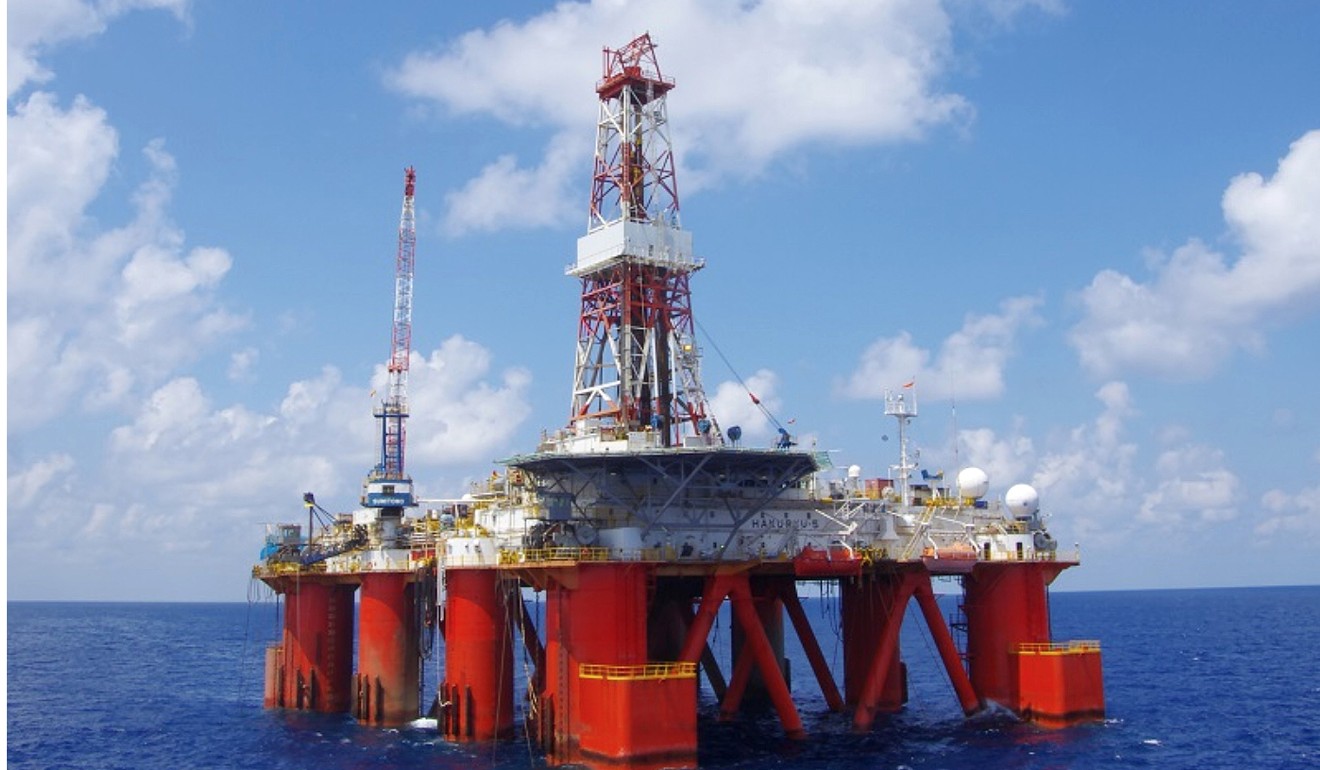
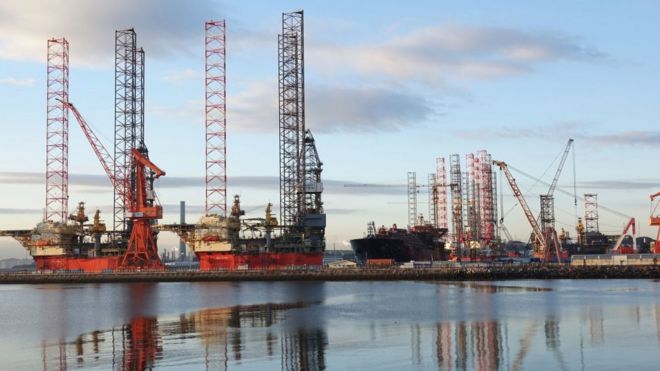
The Japanese oil rig, Hakuryu 5, is reported to have completed its drilling mission near Vanguard Bank earlier this week. Photo: Japan Drilling Co
While in the Vanguard Reef area, the Haiyang Dizhi 8, escorted by heavily armed coastguard vessels, made multiple passes by an oil block operated by Russian energy company Rosneft.
Observers say the presence of the Chinese vessels in the region is part of Beijing’s efforts to prevent Hanoi from partnering with international energy firms to explore energy reserves in the disputed waterway. The latest activity triggered a months-long stand-off between the two countries.
The departure of the Haiyang Dizhi 8 came amid reports that the Japanese oil rig, Hakuryu 5, owned by Tokyo-based Japan Drilling Company and employed by Rosneft, had earlier this week completed a drilling mission it started in May near Vanguard Bank.
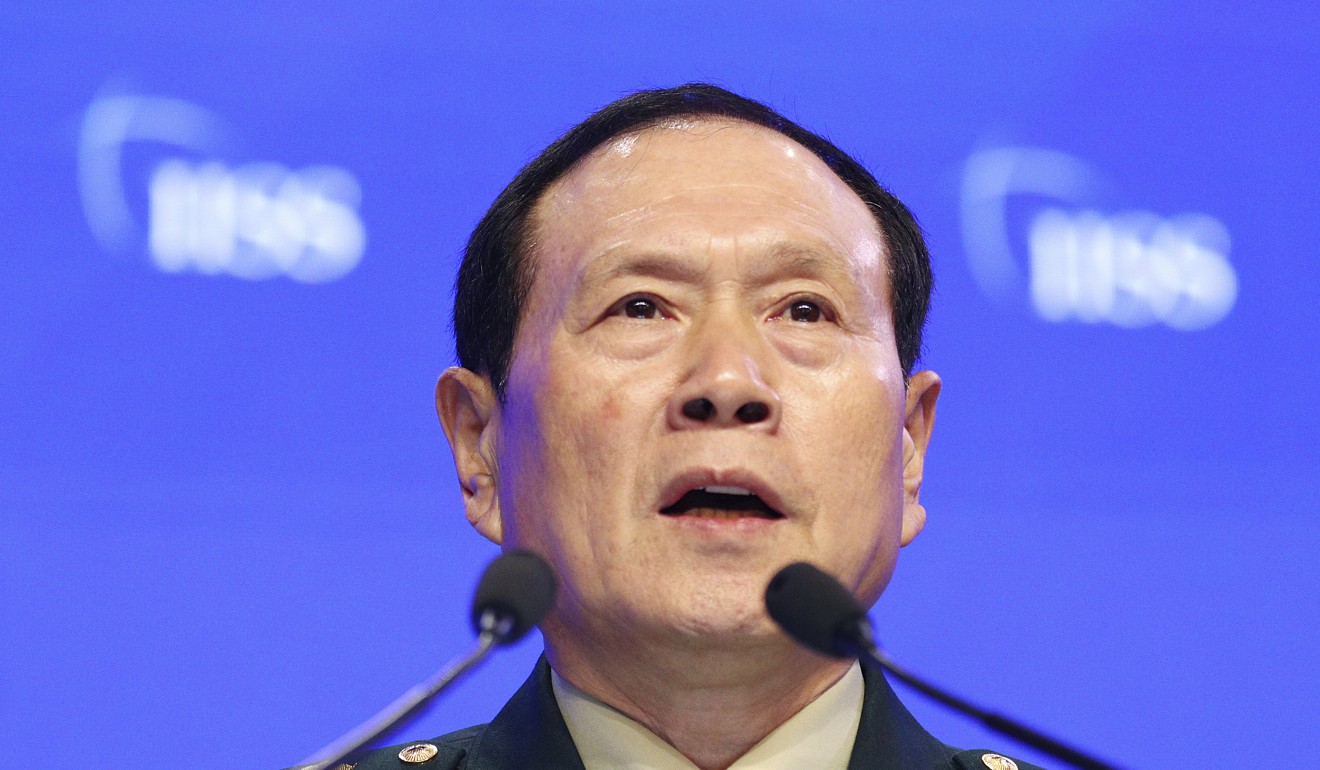
China’s Defence Minister Wei Fenghe told a regional security conference that the South China Sea was an inalienable part of China’s territory. Photo: AP
Although China and Vietnam have said they are looking for a diplomatic solution to prevent confrontations, neither has shown any signs of backing down and tensions have continued to rise.
On Monday, China’s Defence Minister Wei Fenghe told military and defence officials attending a regional security conference in Beijing that the South China Sea was an inalienable part of China’s territory.
“We will not allow even an inch of territory that our ancestors have left to us to be taken away,” he said in his opening speech at the Xiangshan Forum.
Also on Monday, Vietnamese Prime Minister Nguyen Xuan Phuc told lawmakers at the National Assembly that Hanoi would never give any territorial concessions.
“The situation in the South China Sea has become increasingly complicated,” he said. “Our party and state have consistently stated that what belongs to our independence, sovereignty and territorial integrity, we will never give up.”
Last week, Hanoi pulled DreamWorks’ animated film Abominable from theatres over a scene featuring a map that shows Beijing’s self-declared “nine-dash line” in the South China Sea. China uses the U-shaped line to claim sovereignty over more than 80 per cent of the resource-rich waterway, parts of which are also claimed by Vietnam, Malaysia, the Philippines and Brunei.
Ian Storey, a senior fellow at the ISEAS-Yusof Ishak Institute in Singapore, said that the withdrawal of the Haiyang Dizhi might only be “temporary”.
“China has made its point about drilling activities within the nine-dash line and expects Vietnam to suspend further exploration and production activities,” he said. “[But] of course Vietnam won’t.”
China, Malaysia seek to resolve South China Sea disputes with dialogue mechanism
Zhang Mingliang, a specialist in Southeast Asian affairs at Jinan University in the south China city of Guangzhou, said that the Chinese ship’s withdrawal was unlikely to have had anything to do with the comments made by Vietnam.
“I think the main reason is that it had finished its work,” he said. “But the withdrawal could also be seen as an attempt to ease the [China’s] tensions with the US.”
The significance for relations between Beijing and Hanoi was minimal, he said, as the two nations were engaged in one of the world’s most complicated territorial disputes.
“The impact on Sino-Vietnam relations will be limited because there have been too many disputes like this one,” he said.
Fly-past will begin with helicopters and feature the country’s new generation warplanes
A People’s Liberation Army Air Force officer will lead the squadron in a KJ-2000 and become the first serving commander to fly in a National Day parade
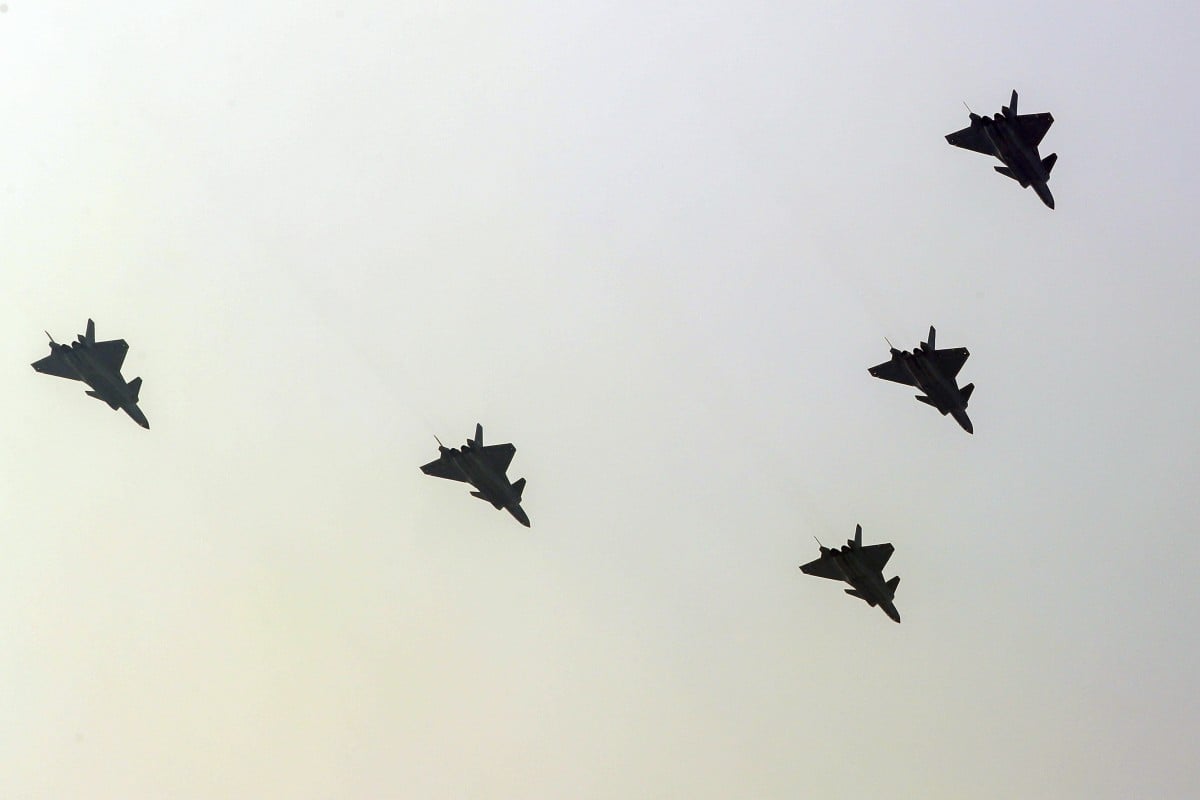
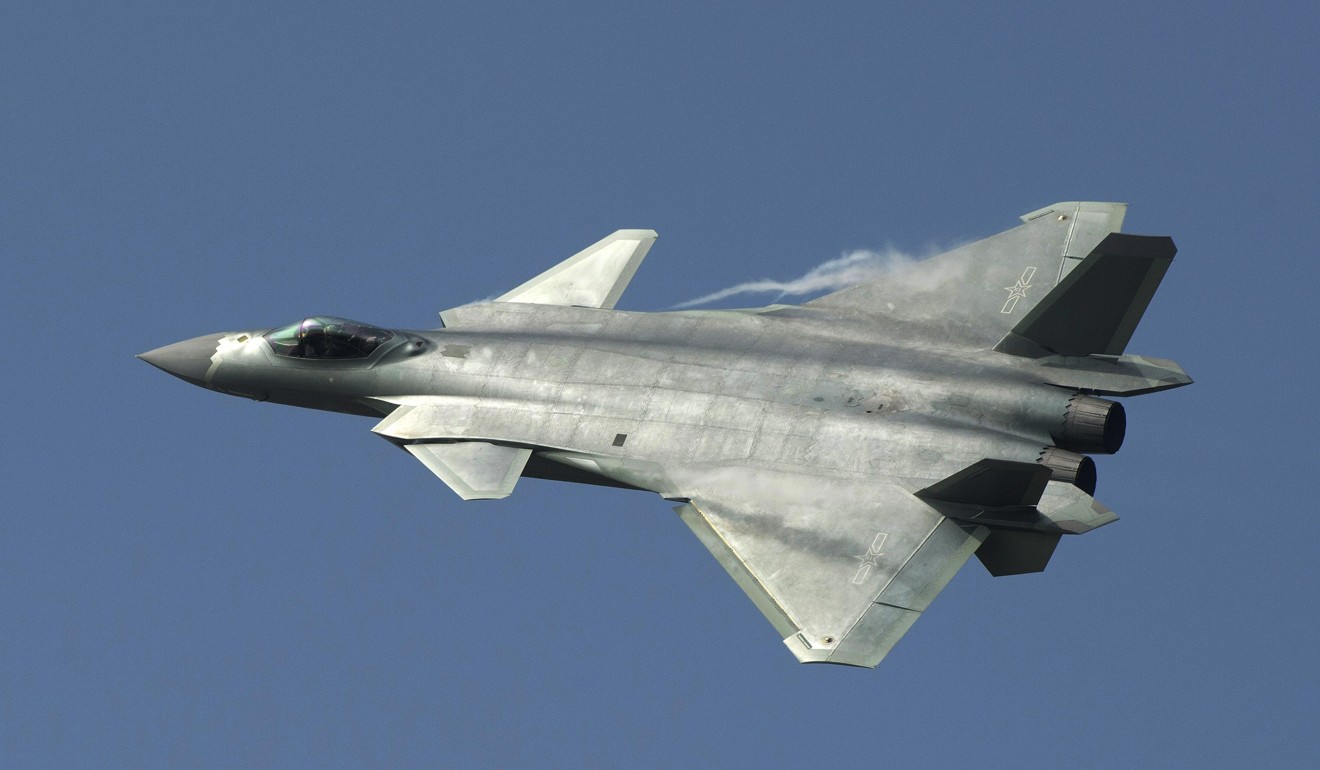
J-20 stealth fighter jets will be featured in Tuesday’s National Day parade in Beijing. Photo: AP
China will assemble the biggest squadron of its most advanced military aircraft for the National Day parade in the capital next week.
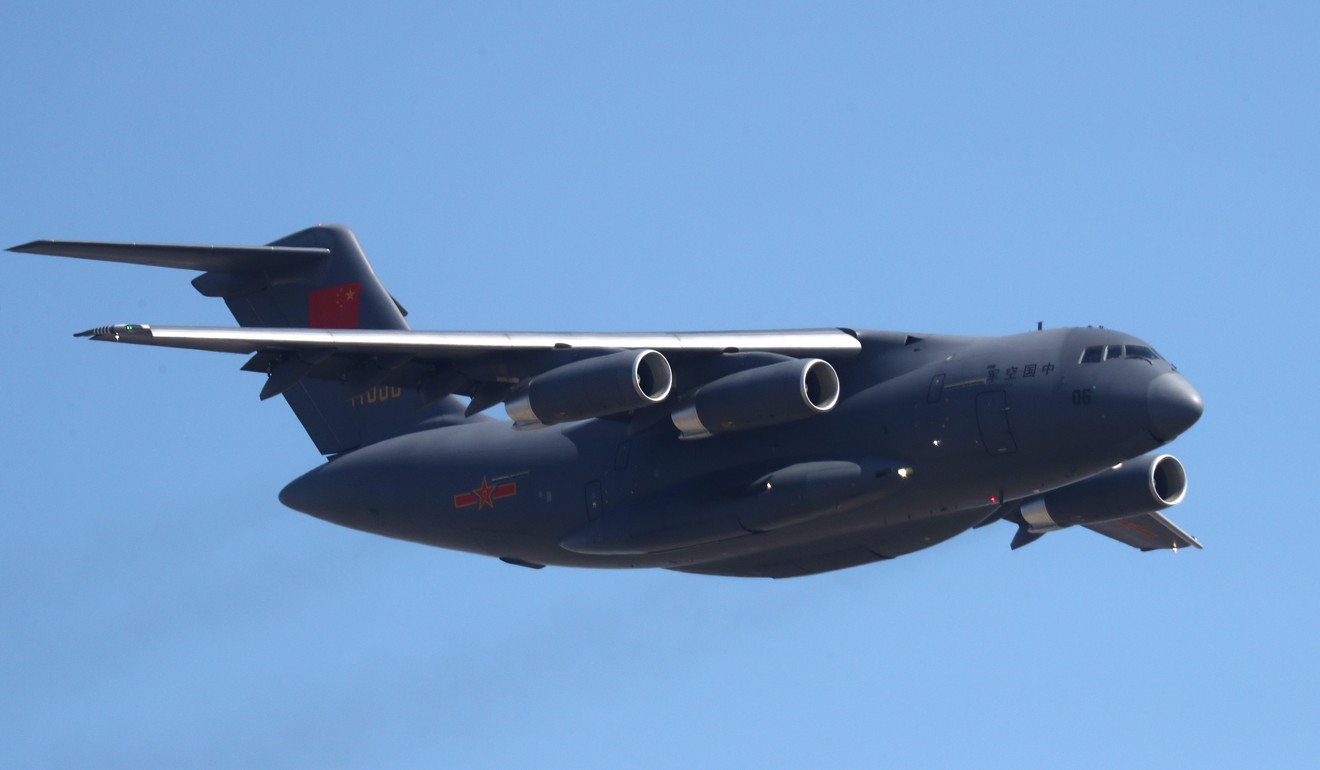
Three types of the new generation “20” series warplanes – five J-20 stealth fighter jets, three Y-20 transport planes and six Z-20 helicopters – will join airborne squadrons in the parade, according to a fly-past schedule obtained by the South China Morning Post.
“This year will be the biggest parade to have so many ‘20’ series advanced aircraft flying together,” a military insider said, referring to aircraft developed since 2000.
The J-20 is the country’s first stealth fighter; the Y-20 is China’s first heavy airlifter; and the Z-20 is a medium-lift utility helicopter comparable to the American Black Hawk.
The appearance of all three types of warplanes indicates that each one has entered production.
The H-20 subsonic stealth bomber, China’s answer to the US Air Force’s B-21 Raider, is also part of the “20” series will not make an appearance because it might need at least five more years of development.
The military insider involved in preparations for the parade, said People’s Liberation Army Air Force Commander Ding Laihang would lead the squadron in a KJ-2000 early warning aircraft.
Chinese fighter jets seen in skies over Beijing as preparations for National Day parade step up
“Ding will fly the KJ-2000 over Tiananmen Square for inspection by President Xi Jinping,” the source said, adding that Ding would be the first serving commander to fly in a National Day parade.
“The arrangement is similar to 2015 when [then] Russian Air Force commander Viktor Bondarev flew a Tu-160 strategic bomber over Moscow’s Red Square to mark the 70th anniversary of the end of the second world war.”
The KJ-2000 is the most advanced active early warning aircraft in the PLA Air Force, but it is based on the Russian Ilyushin aircraft.
The Y-20 transport aircraft will be among the new generation of planes taking part in the parade. Photo: Dickson Lee
According to the schedule, 167 aircraft will take part in the fly-past, starting with a helicopter carrying a national flag.
Eight Z-10 attack and 12 Z-19 reconnaissance helicopters will follow in formation, creating the number 70 in the sky to mark the 70th anniversary of the founding of the People’s Republic.
A source close to the navy said Z-8 multi-role and Z-19 reconnaissance helicopters be among the aircraft deployed to the Type 075 amphibious helicopter dock launched on Wednesday.
China says National Day military parade ‘won’t disappoint’ in scale or advanced weapons
A total of 44 fighter jets representing five key battle warplanes – the J-20, the J-16 fighter-bomber, the J-15 carrier-based fighter jet, the J-11 and the J-10 – will participate in the event.
But the J-8 fighter jet was not on the schedule, confirming that the first interceptor built in China has been formally retired.
Various H-6 series bombers will also make an appearance, including the H-6K and H-6N strategic bombers, as well as HU-6 refuelling plane based on the H-6 platform.
H-6K long-range bombers have been sent to the Taiwan Strait as part of “encirclement” patrols close to the self-ruled island in recent years.
Meanwhile the modified H-6N strategic bomber is designed to be armed with the Changjian-10 land-attack subsonic cruise missile, which has an operational range of more than 1,500km (932 miles).
Macau-based military observer Antony Wong Dong said that by adding more functions, the H-6 series of bombers was showing the world China had modified its combat capacity.
Wong also said the appearance of three types of training planes – the JL-8, JL-9 and JL-10 – was notable.
“It indicates that the Chinese air force had build up a systematic and comprehensive training system to train more pilots,” he said.
October 1 event is intended to be a showcase for military’s progress under Xi Jinping, with J-20 stealth fighters set to take pride of place
Domestically developed weapons are main focus of event despite long-standing problems in building aircraft engines
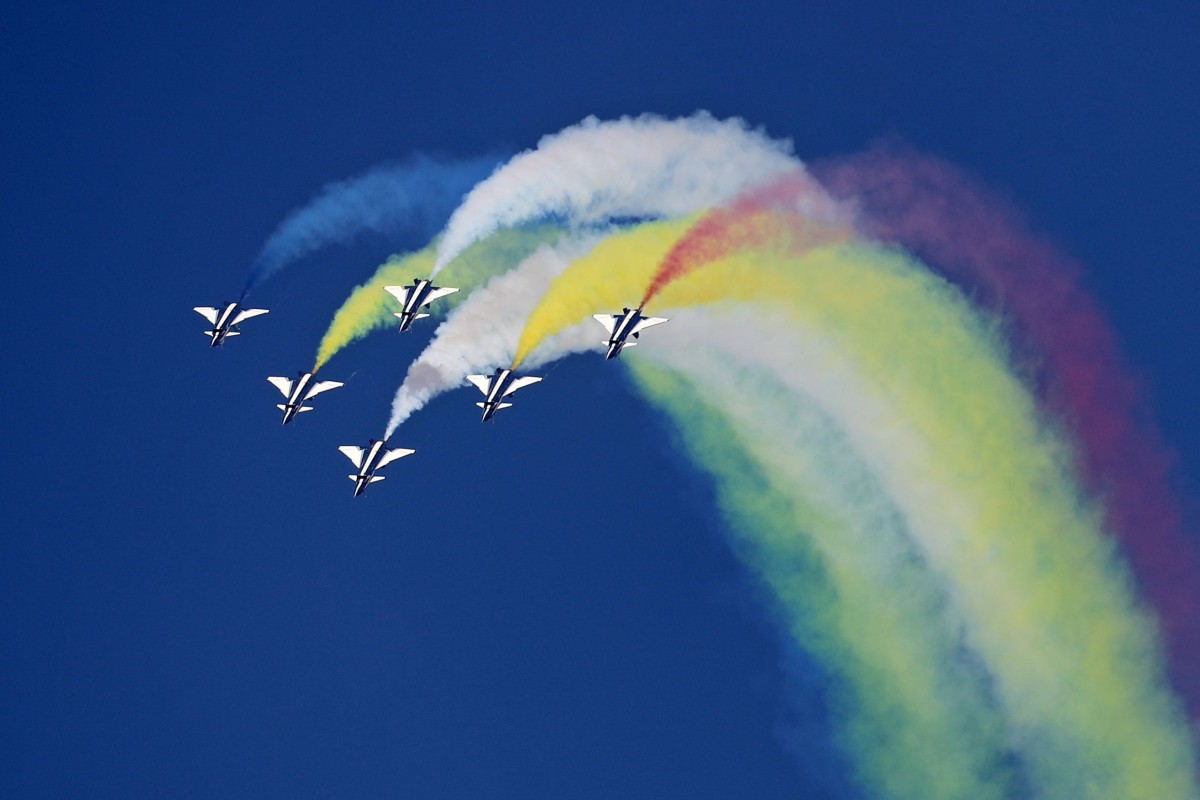
Chinese J-10 jets perform at the Dubai air show in 2017. Photo: AFP
China has stepped up intensive rehearsals for the upcoming National Day parade, which military insiders say is designed to showcase the achievements of Chinese President Xi Jinping’s modernisation drive.
The parade on October 1 will mark the 70th anniversary of the founding of the People’s Republic and will focus on weapons developed since Xi came to power in late 2012, despite long-standing problems in aircraft engine development.
Video clips circulating on mainland social media in recent days have shown at least seven types of aircraft – including the KJ-2000 airborne early warning and control aircraft and J-10 and J-11B fighter jets – taking part in rehearsals over the countryside around Beijing.
A military insider said the country’s first stealth fighter jet, the J-20, had been rehearsing over the western suburbs of the capital since April.
“There will be up to seven J-20 displayed in the military parade, which is the largest formation since its formal deployment to the Chinese air force in 2017,” the military insider said.
“The J-20 has entered mass production. So far at least 70 J-20s have been made, even though all of them are still equipped with Russian AL-31 engines.”
Earlier this month, the People’s Liberation Army Air Force released a video of a flight of seven J-20s, the largest formation seen so far, suggesting that the fifth-generation warplane has gone into mass production as an arms race with the United States mounts in the region.
The second-largest J-20 formation was shown in an air force video for PLA Day on August 1, when five of the jets were shown.
China has been forced to deploy the J-20 ahead of its schedule since the US has increased the deployment of its fifth-generation stealth fighter jets like the F-22 and F-35s in the Asia-Pacific region.
The US and its allies, including Japan and South Korea, will have more than 200 F-35s by 2025, which means China also needs a similar number of stealth fighters.
To meet demand, China has been working on the development of a purpose-built thrust engine for its stealth fighter since the early 2000s, but has yet to achieve international quality control standards due to problems that include single-crystal turbine blade technology.
China’s air force spreads its wings in 70th anniversary video
Hong Kong-based military commentator Song Zhongping said aircraft engine development had been a long-standing shortcoming but it would not affect the practical fighting capacity of the J-20, which currently uses Russian engines.
“The J-20 hasn’t used the domestic engines so far because it wants a better one, and it still has time,” Song said.
“Other [Chinese-developed] warplanes like the J-10, J-11 and multipurpose attack helicopters are all modified and advanced types, indicating comprehensive achievements amid China’s military modernisation over the past years.”
A Chinese J-20 stealth fighter has entered mass production. Photo: EPA-EFE
Besides the domestically developed aircraft, Beijing is going to display its strategic nuclear missiles, such as the DF-41 intercontinental ballistic missile and the JL-2 submarine-launched ballistic missile, as centrepieces of its National Day military parade, according to a Beijing-based military source.
Xi, who also chairs the powerful Central Military Commission, inspected the country’s biggest military parade at the Zhurihe Combined Tactics Training Base in Inner Mongolia in 2017 to celebrate the 90th anniversary of the PLA, but the source said the weapons displayed in Zhurihe had been developed under the leadership of Xi’s predecessor, Hu Jintao.
“Xi needs to highlight his personal achievements in his era, that’s why this year’s parade has political aims more than military significance,” the source said.
The source also highlighted the significance of the People’s Republic marking its 70th anniversary because the Soviet Union did not survive for that length of time.
“Xi is attempting to tell the outside world that Chinese communist regime has been consolidated under his leadership.”
With a defence budget second only to the US, China is amassing a navy that can circle the globe and developing state-of-the-art autonomous drones
The build-up is motivating surrounding countries to bolster their own armed forces, even if some big-ticket military equipment is of dubious necessity
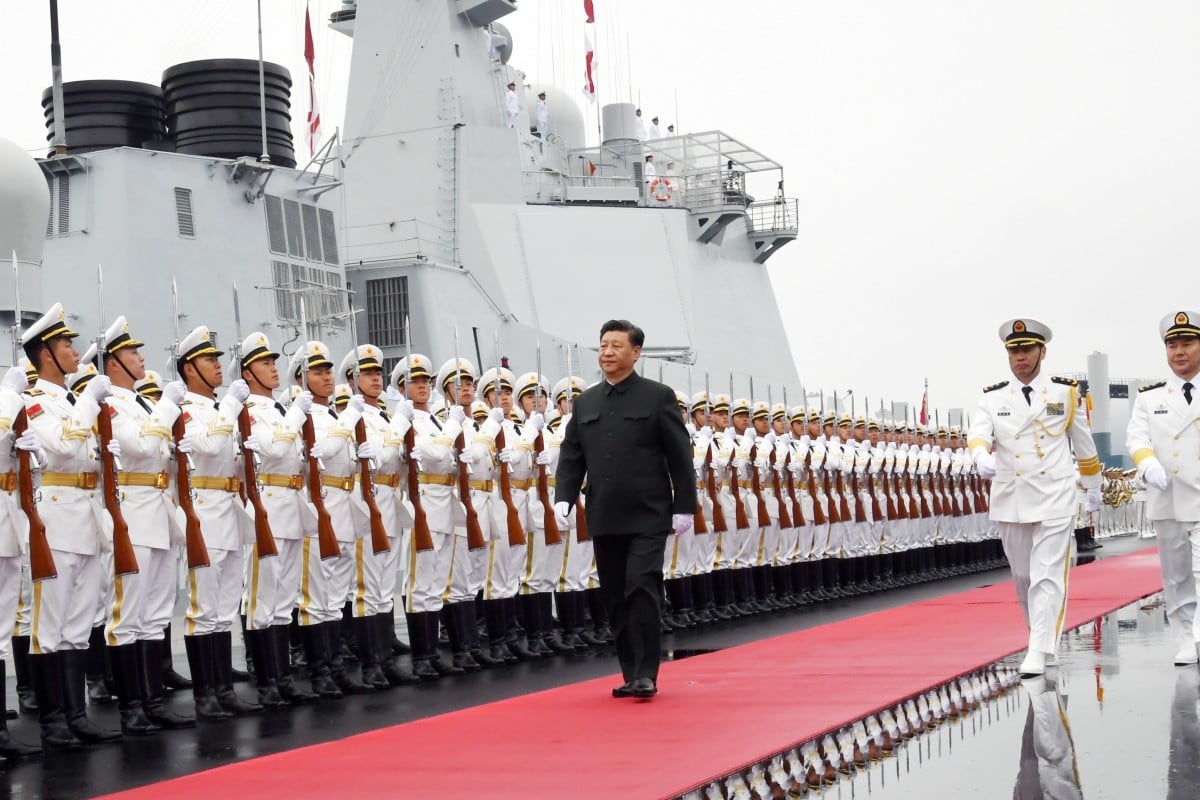
Chinese President Xi Jinping reviews an honour guards before a naval parade in Qingdao. Photo: Xinhua
The Asia-Pacific region is one of the fastest-growing markets for arms dealers, with economic growth, territorial disputes and long-sought military modernisation propelling a 52 per cent increase in defence spending over the last decade to US$392 billion in 2018, according to the Stockholm International Peace Research Institute.
The region accounts for more than one-fifth of the global defence budget and is expected to grow. That was underscored last week by news of
, China is amassing a navy that can circle the globe and developing state-of-the-art autonomous drones. The build-up is motivating surrounding countries to bolster their armed forces too – good news for purveyors of submarines, unmanned vehicles and warplanes.
Opinion: How the Shangri-La Dialogue turned into a diplomatic coup for China
Kelvin Wong, a Singapore-based analyst for Jane’s, a trade publication that has been covering the defence industry for 121 years, has developed a niche in infiltrating China’s opaque defence industry by attending obscure trade shows that are rarely advertised outside the country.
He said the US is eager to train allies in Asia and sell them arms, while also stepping up its “freedom of navigation” naval operations in contested waters in the
In his speech at the Shangri-La Dialogue, acting US Defence Secretary Patrick Shanahan touted American advancements in technology “critical to deterring and defeating the threats of the future” and said any partner could choose to win access to that technology by joining the US defence network.
Wong said the message was clear: “Buy American.”
Analysts say Chinese soldiers have less training, motivation and lower morale than their Western counterparts. Photo: Reuters
The analyst said there is a growing admission among the Chinese leadership that the
He said one executive at a Chinese defence firm told him: “The individual Chinese soldier, in terms of morale, training, education and motivation, (cannot match) Western counterparts. So the only way to level up is through the use of unmanned platforms and
To that end, China has developed one of the world’s most sophisticated drone programmes, complete with custom-built weapon systems. By comparison, Wong said,
US drones rely on weapons originally developed for helicopters.
Wong got to see one of the Chinese drones in action two years ago after cultivating a relationship with its builder, the state-owned China Aerospace Science & Technology Corporation. He viewed a demonstration of a 28-foot-long CH-4 drone launching missiles at a target with uncanny ease and precision.
“Everyone knew they had this,” Wong said. “But how effective it was, nobody knew. I could personally vouch they got it down pat.”
China unveils its answer to US Reaper drone – how does it compare?
That is what Bernard Loo Fook Weng, a military expert at Singapore’s S. Rajaratnam School of International Studies, told the author Robert Kaplan for his 2014 book, Asia’s Cauldron, about simmering tensions in the South China Sea.
He was describing the competition for big-ticket military equipment of dubious necessity.
submarines it could not figure out how to submerge.
“It’s keeping up with the Joneses,” Wong said. “There’s an element of prestige to having these systems.”
Submarines remain one of the more debatable purchases, Wong said. The vessels aren’t ideal for the South China Sea, with its narrow shipping lanes hemmed in by shallow waters and coral reefs. Yet they provide smaller countries with a powerful deterrence by enabling sneak attacks on large ships.
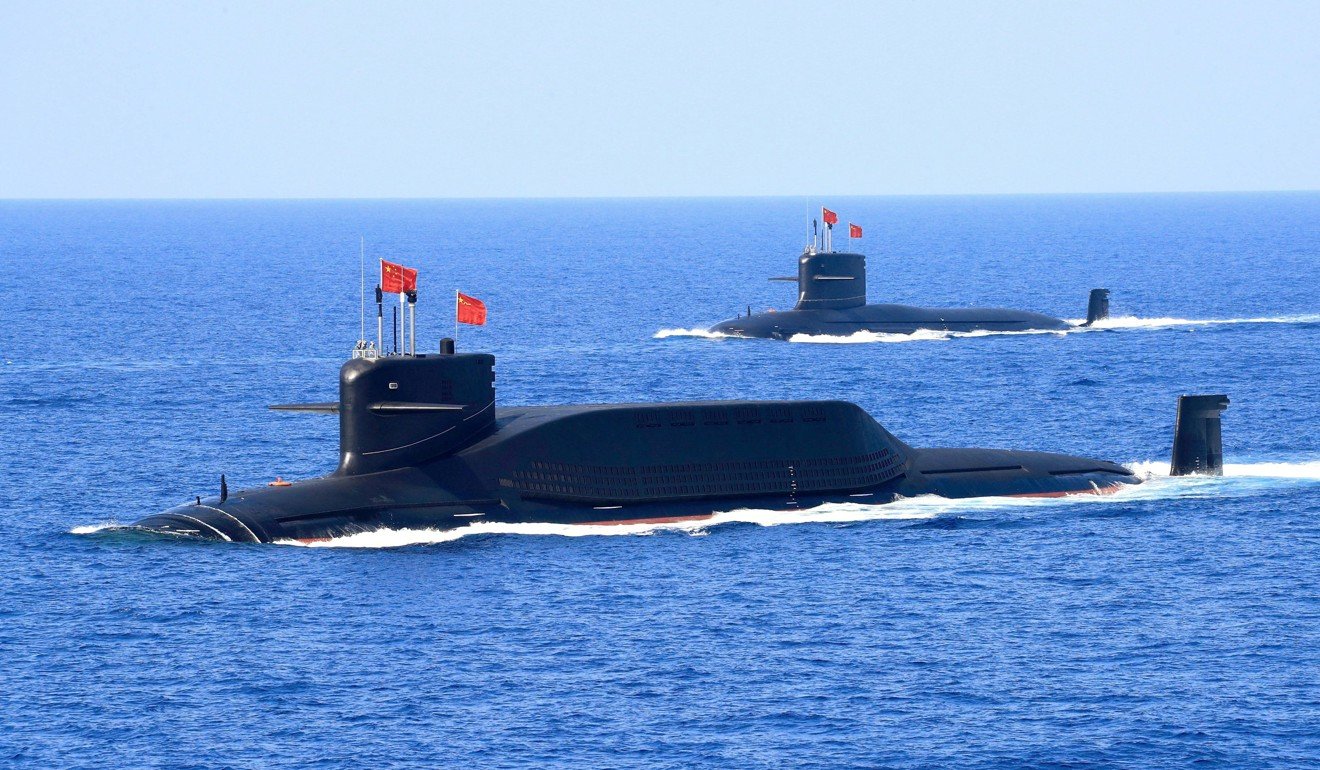
Nuclear-powered PLA Navy ballistic missile submarines in the South China Sea. Photo: Reuters
Type 218 submarines with propulsion systems that negate the need to surface more frequently. If the crew did not need to eat, the submarine could stay under water for prolonged periods. Wong said the craft were specially built for Asian crews.
“The older subs were designed for larger Europeans so the ergonomics were totally off,” he said.
Singapore, China deepen defence ties, plan larger military exercises
Tiny Singapore plays a crucial role securing the vital sea lanes linking the Strait of Malacca with the South China Sea. According to the
the country dedicates 3.3 per cent of its gross domestic product to defence, a rate higher than that of the United States.
State-of-the-art equipment defines the Singapore Armed Forces. Automation is now at the centre of the country’s military strategy, as available manpower is shrinking because of a rapidly ageing population.
Wong said Singapore is investing in autonomous systems and can operate frigates with 100 crew members – 50 fewer than they were originally designed for.
“We always have to punch above our weight,” he said.
Image copyrightGETTY IMAGESImage captionOne of China’s biggest ports is reported to have halted Australian coal imports
The Australian government says it is seeking an “urgent” clarification from Beijing over reports that a major Chinese port has halted imports of Australian coal.
Australia is a top supplier of coal to China, its biggest export market.
Beijing has not confirmed the reported halt in the port of Dalian, but called changes in such arrangements “normal”.
Canberra sought to play down speculation on Friday that the matter may be linked to bilateral tensions.
Australian officials said there was “confusion” over the situation, and they were consulting their Chinese counterparts.
“I wouldn’t jump to conclusions. The Australia-China trading relationship is exceptionally strong,” Treasurer Josh Frydenberg told the Australian Broadcasting Corporation.
Fears about the issue have prompted a fall in the Australian dollar.
What has happened?
On Thursday, Reuters reported that China’s Dalian port region would not allow Australian coal to pass through customs.
The news agency quoted officials as saying that only Australian coal had been affected, with no limits placed on Indonesian and Russian shipments.
It said other Chinese ports had delayed Australian coal shipments in recent months.
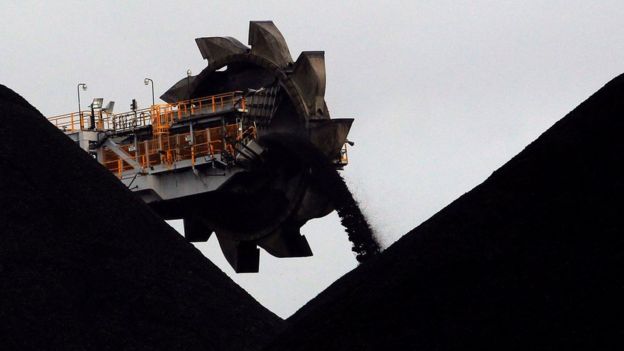
Image copyrightREUTERSImage captionCoal is Australia’s biggest export commodity
Australian trade officials said they had been notified of recent industry concerns about market access.
When asked about the reported halt, Chinese Foreign Ministry spokesman Geng Shuang offered general comments that authorities sought “to safeguard the rights and interests of Chinese importers and protect the environment”.
“The banning of those coal shipments is a form of coercion against Australia. It’s punishment against states that resist China’s pressure,” said Dr Malcolm Davis, from the Australian Strategic Policy Institute.
Other recent tensions have emerged over allegations – denied by Beijing – of Chinese interference in Australian politics and society.
However others, including the head of the Reserve Bank of Australia, have suggested that China’s concerns about its own coal industry may be behind any such halts.
Blocking “a couple of months of coal exports” would not hurt the Australian economy, said Philip Lowe.
“If it were to be the sign of a deterioration in the underlying political relationship between Australia and China then that would be more concerning,” he said.
Mr Frydenberg said: “We can see these occasional interruptions to the smooth flow but that doesn’t necessarily translate to some of the consequences that aspects of the media might seek to leap to.”
Image copyrightGETTY IMAGESImage captionOne of China’s biggest ports is reported to have halted Australian coal imports
The Australian government says it is seeking an “urgent” clarification from Beijing over reports that a major Chinese port has halted imports of Australian coal.
Australia is a top supplier of coal to China, its biggest export market.
Beijing has not confirmed the reported halt in the port of Dalian, but called changes in such arrangements “normal”.
Canberra sought to play down speculation on Friday that the matter may be linked to bilateral tensions.
Australian officials said there was “confusion” over the situation, and they were consulting their Chinese counterparts.
“I wouldn’t jump to conclusions. The Australia-China trading relationship is exceptionally strong,” Treasurer Josh Frydenberg told the Australian Broadcasting Corporation.
Fears about the issue have prompted a fall in the Australian dollar.
What has happened?
On Thursday, Reuters reported that China’s Dalian port region would not allow Australian coal to pass through customs.
The news agency quoted officials as saying that only Australian coal had been affected, with no limits placed on Indonesian and Russian shipments.
It said other Chinese ports had delayed Australian coal shipments in recent months.
Image copyrightREUTERSImage captionCoal is Australia’s biggest export commodity
Australian trade officials said they had been notified of recent industry concerns about market access.
When asked about the reported halt, Chinese Foreign Ministry spokesman Geng Shuang offered general comments that authorities sought “to safeguard the rights and interests of Chinese importers and protect the environment”.
“The banning of those coal shipments is a form of coercion against Australia. It’s punishment against states that resist China’s pressure,” said Dr Malcolm Davis, from the Australian Strategic Policy Institute.
Other recent tensions have emerged over allegations – denied by Beijing – of Chinese interference in Australian politics and society.
However others, including the head of the Reserve Bank of Australia, have suggested that China’s concerns about its own coal industry may be behind any such halts.
Blocking “a couple of months of coal exports” would not hurt the Australian economy, said Philip Lowe.
“If it were to be the sign of a deterioration in the underlying political relationship between Australia and China then that would be more concerning,” he said.
Mr Frydenberg said: “We can see these occasional interruptions to the smooth flow but that doesn’t necessarily translate to some of the consequences that aspects of the media might seek to leap to.”




 CHINDIA ALERT: You'll be living in their world, very soon