Chindia Alert: You’ll be Living in their World Very Soon
aims to alert you to the threats and opportunities that China and India present. China and India require serious attention; case of ‘hidden dragon and crouching tiger’.
Without this attention, governments, businesses and, indeed, individuals may find themselves at a great disadvantage sooner rather than later.
The POSTs (front webpages) are mainly 'cuttings' from reliable sources, updated continuously.
The PAGEs (see Tabs, above) attempt to make the information more meaningful by putting some structure to the information we have researched and assembled since 2006.
Chengdu school teaches boys to build model rockets while girls learn about knitting
Handicrafts show at school prompts question, ‘Why can’t boys knit and girls build rockets?’
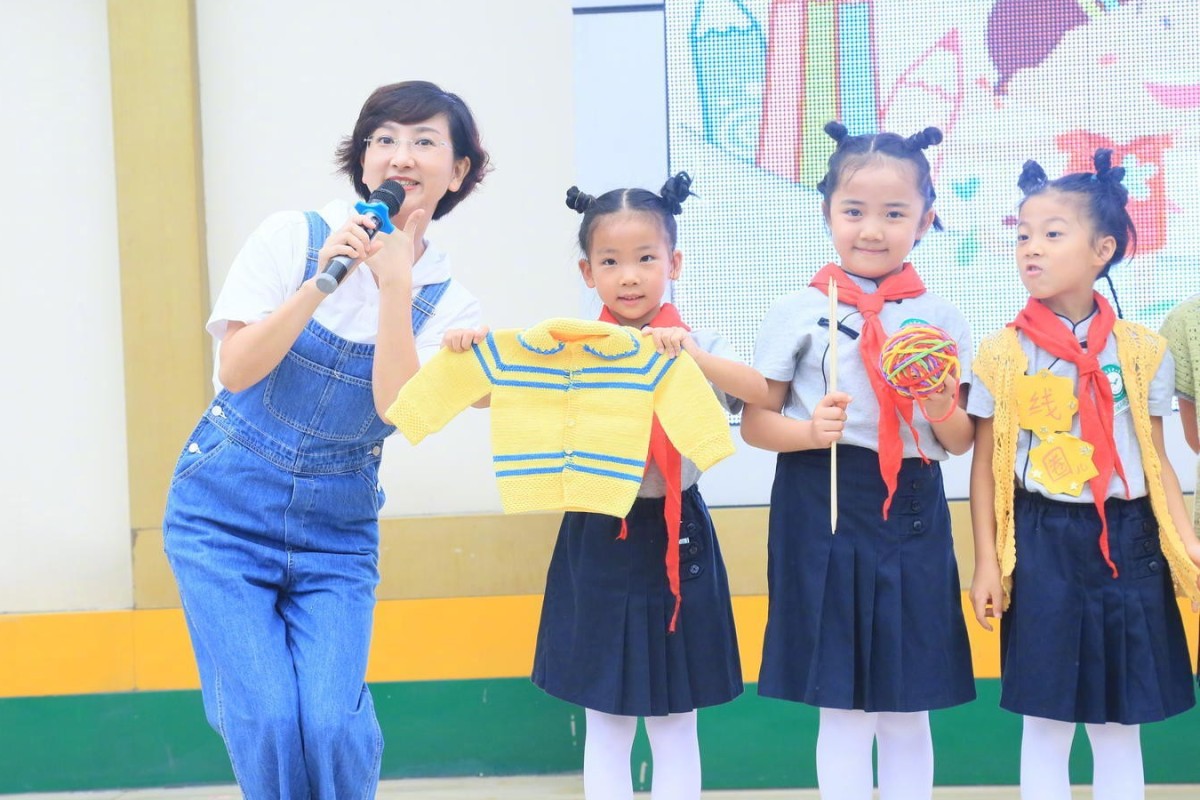
Pupils and staff at Chengdu Caotang Elementary School in Sichuan show off knitting from their Boys and Girls are Vastly Different class. Photo: Weibo
A school in southwest China that teaches boys to grow “heroically” and wants “tranquil feminine examples” for its girls has generated a heated debate about sexism.
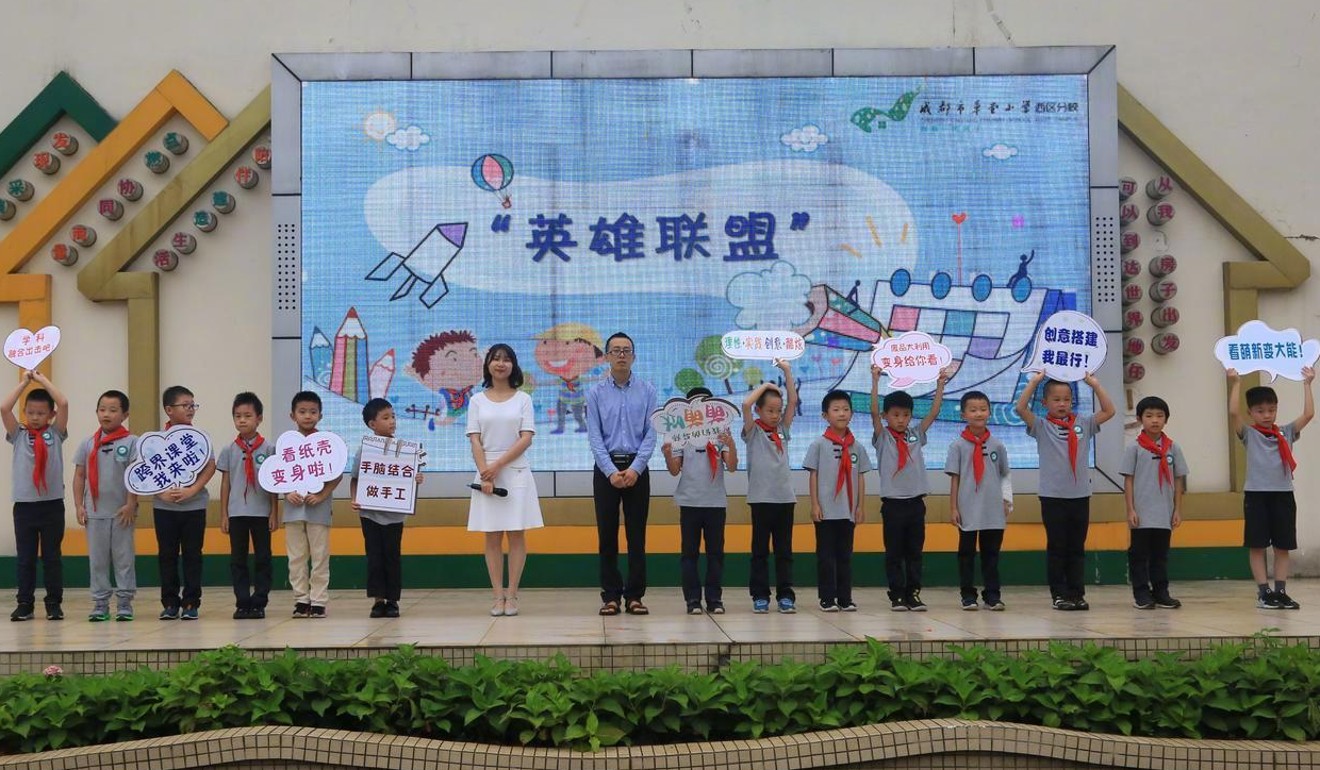
Chengdu Caotang Elementary School in Sichuan province developed a course that teaches boys to build model rockets and girls to knit alongside mainstream subjects such as maths, languages and art, in the hope of “increasing their gender knowledge”.
The course, called Boys and Girls are Vastly Different, started last semester because school managers believed that “boys and girls have been shaped in the same way recently”, principal Fu Jin told the Chengdu Economic Daily on Monday.
That “led to boys lacking enough space to grow heroically and girls lacking gentle and tranquil feminine examples to follow, so there’s some gender dislocation”, she said.
Chengdu Caotang Elementary School wants its boys to be “heroic” and its girls to be “tranquil”. Photo: Weibo
Last semester, pupils learned the differences between female and male bodies. This semester, boys are learning how to build model planes, rockets and cars, while the girls are being taught knitting by teachers and mothers who volunteer to help out in classes.
On Monday, a show of handicrafts and jumpers hosted by the school to promote the class led to a backlash on social media, with members of the public criticising the school for sexism and enforcing gender stereotypes.
“They are tying the hands of girls when young, and when these girls grow up, people would say there are only a few female scientists because girls are born unfit for that role,” a Weibo user said.
What Chinese summer camps taught teens about gender values
“It’s typical gender discrimination,” another said. “Why can’t boys knit and girls build rockets?”
Authorities cracked down on controversial classes for Chinese children after some extreme examples of gender education. In December, a Weibo account highlighted a lurid “virtue” class where a sobbing woman was seen on video confessing to teenagers at a summer camp in Wenzhou, eastern Zhejiang province that “promiscuous women got gangrene”.
“I dressed myself up in a fashionable and revealing way, and that’s an invitation for others to insult me and rape me,” she told her audience.
“Three drops of sperm are equal to poison, and they will hurt unclean women,” she said. “I’m afraid my body will rot, will stink and ache, and they’ll have to amputate my legs.”
The camp was condemned and shut down by the local government.
Doctor who helped 13-year-old girl recover says demands on her to do well at school induced condition
Weibo poll reveals that 68 per cent of participants had hair loss in school
Studies and polls suggest stress leading to hair loss is a big health concern in China. Photo: Alamy
When the 13-year-old girl walked into the hospital in southern China around eight months ago, she was almost completely bald, and her eyebrows and eyelashes had gone.
“The patient came with a hat on and did not look very confident,” Shi Ge, a dermatologist at the Sixth Affiliated Hospital of Sun Yat-sen University in Guangzhou, told the Pear Video news portal.
The girl had done well in primary school but her grades dropped in middle school, Shi said.
Under parental pressure to do well, the girl pushed herself harder, but the stress resulted in severe hair loss.
With time and medical treatment, the teen’s hair grew back but her story left a lasting impression, raising awareness of the increasing number of young people in China seeking treatment for stress-induced hair loss, according to Chinese media reports.
Jia Lijun, a doctor at Shenzhen Traditional Chinese Medicine Hospital, told state-run Xinhua News Agency in May that aside from genetics, factors such as stress in work, study and life would result in endocrine imbalances which affected the cycle of hair growth.
And in January, a survey of 1,900 people by China Youth Daily found that 64.1 per cent of people aged between 18 and 35 said they had hair loss resulting from long and irregular working hours, insomnia, and mental stress.
Hits and myths: stress and hair loss
Shi said that an increasing number of young people had come to her for treatment of hair loss in recent years, and those working in information technology and white-collar jobs were the two biggest groups.
“They usually could not sleep well at night due to high pressure or had an irregular diet because of frequent business trips,” Shi said.
A Weibo poll on Wednesday revealed that 68 per cent out of 47,000 respondents said they had had serious hair loss when they were in school. About 22 per cent said they noticed after starting their careers, while only 5 per cent said it happened after they entered middle age.
More than half of the Chinese students who took part in a China Youth Daily survey said they had hair loss. Photo Shutterstock
Research published in 2017 by AliHealth, the health and medical unit of the Alibaba Group, found that 36.1 per cent of Chinese people born in the 1990s had hair loss, compared to the 38.5 per cent born in the 1980s. Alibaba is the parent company of the South China Morning Post.
The teenager’s experience sparked a heated discussion on Weibo, with users recounting similar cases and some voicing their panic.
“My niece’s hair was gone while she was in high school and has not recovered, even after she graduated from university. This makes her feel more and more inferior,” one user said.
Hong Kong’s schoolchildren are stressed out – and their parents are making matters worse
Another said: “I lost a small portion of my hair during the high school entrance exam, but that is already scary enough for a girl in her adolescence.”
“I had to quit my job and seek treatment,” said a third, who adding that he also suffered from very serious hair loss a few months ago because of high pressure.
Analysts say mood is shifting in mainland China as demonstrators ‘cross a line’ with national symbols
Staff and students from Pui Kiu Middle School in North Point hold flag-raising ceremony on campus on Monday. Photo: Nora Tam
A Hong Kong protester’s decision to tear down a Chinese flag and throw it in Victoria Harbour on Saturday set off an outpouring of criticism, from Chinese internet users and celebrities to pro-Beijing businesses and schools in the city.
Then on Monday at about 7pm, a group of protesters went to the same flagstaff in Tsim Sha Tsui, tore down the flag again and threw it into the harbour, the second such incident in three days. In both cases, the protesters escaped.
In North Point, the Pui Kiu Middle School organised a flag-raising ceremony at the campus on Monday even though the school was officially on summer holidays.
Principal Ng Wun-kit said teachers and students were called back on short notice to take part.
“We saw [on the news] that some rioters in helmets threw the Chinese national flag in the harbour and we strongly condemn such behaviour. It was disrespectful,” Ng said.
“We wanted to show that we are one of the 1.4 billion Chinese people who want to protect the national flag. We hope that the students, teachers, and [Hong Kong] citizens who love the country and the Chinese Communist Party can respect the Chinese flag.”
Other Hong Kong businesses and organisations flying the Chinese flag on Monday included international hotel chain Courtyard by Marriott Hong Kong, Chinese engineering firm Shanghai Zhenhua Heavy Industries and Chinese pharmaceutical giant Beijing Tong Ren Tang.
Beijing’s Hong Kong affairs office condemns protesters who threw Chinese flag in the sea
A spokeswoman from the hotel chain said it had flown the flag for many years and Monday was no exception.
“We display the flag because we are a Chinese-funded company. We do not have plans to take it down any time soon,” she said.
On Sunday, a group of Beijing supporters sang the national anthem and raised the Chinese flag in Tsim Sha Tsui to replace the one taken down.
On microblogging site Weibo, mainland Chinese and Hong Kong celebrities were among those forwarding pictures of the flag or salutes to it, adding the hashtag “the Chinese national flag has 1.4 billion flag bearers”, a topic started by China Central Television (CCTV) on Sunday. As of Monday night, the trending topic had been read more than 2 billion times, with more than 8 million posts and support from Hong Kong actors Jackie Chan, Jordan Chan Siu-chun and Hawick Lau Hoi-Wai.
In a commentary published online on Sunday, CCTV said the topic had attracted a strong response because patriotism ran deep among the Chinese people.
“We protect the flag, the national emblem, our country, and we protect our country like we protect our own homes,” it said.
Hong Kong Chief Executive Carrie Lam blasts violence at Yuen Long and liaison office, amid further extradition bill unrest
Analysts said the mood on Chinese social media had changed as protesters in Hong Kong vandalised symbols of the central government, crossing a line for most mainland Chinese.
Wang Jiangyu, an associate law professor at the National University of Singapore, said that although many mainlanders had admired Hong Kong and sympathised with its civil movements in the past, the situation had changed.
“The Chinese flag being insulted is on the top of a list of things mainlanders dislike, and for state media, which represent the central government’s position, focusing on such issues can frame the protesters as enemies of the Chinese nation or the people,” Wang said.
“It can increase the hatred of mainlanders towards the Hong Kong protesters and gain support for the central government to take action in the future.”
Ma Ngok, a political scientist at Chinese University of Hong Kong, said mainland media were using the incident to achieve their own propaganda purposes.
“Mainland media made it seem like [the flag protest was] the theme for the whole movement … but it does not represent the main demands of the anti-extradition movement. They are turning single actions into broad propaganda, and biasing mainland sentiment about Hong Kong,” Ma said.
Image copyrightSUPPLIEDImage captionRotting bread was among the food found in the kitchen
One of China’s most prestigious high schools has been the target of public anger after piles of expired mouldy food were found in its canteen kitchen.
Mouldy bread, rotting meat and seafood were discovered at the Chengdu No 7 Experimental High School.
One parent told the BBC of his horror and disgust, saying the food was “stinky and disgusting” and compared it to pig slop.
The school has now apologised, saying it is deeply “embarrassed”.
Food safety scandals are not uncommon in China and they often leave authorities scrambling to defuse public outrage.
How did they discover the food?
The scandal first emerged when a small group of parents were on Monday invited to attend a tree planting event at the private high school in Chengdu, the capital city of China’s Sichuan province.
While at the school, a group of parents discovered mouldy bread, rotting meat and seafood items in the canteen kitchen canteen.
It is not clear why exactly they chose to stop by the kitchen, but one parent that the BBC’s Lulu Luo spoke to referenced an incident earlier last November where numerous school children came down with stomach-aches, constipation and various other ailments.
Image copyrightSUPPLIEDImage captionWhat looks like seafood and meat were seen in cardboard boxes
“[The items looked like they had] been in a freezer for years, [it looked] like zombie meat,” the father, who has a daughter and son enrolled in the school said.
“I smelled the pork, it was stinky. [There was] ginger, which looked disgusting too.”
Image copyrightSUPPLIEDImage captionAnd chestnuts were seen strewn on the floorImage copyrightSUPPLIEDImage captionWhat appears to be tripe is also seen covered in dirt of some kind
According to the father, the private school costs 39,000 yuan (£4,380; $5,800) a year – about 20 times the amount a public school would cost.
“We don’t even let kids have leftover food at home… I spent tens of thousands of dollars and my kids are having pigwash there,” he said.
“I dare not tell my younger son… I’m worried he might not dare to eat canteen food after that. My daughter has been telling me she has a stomach-ache. I [told] her she might have just over exercised.
“It breaks my heart.”
How did parents react?
Horrified, the group of parents shared the pictures on social media, which were soon discovered by other parents.
According to the same parent, the school immediately transported the mouldy food away in two trucks.
One truck was intercepted and stopped by a swarm of angry parents who showed up at the school in protest, he said.
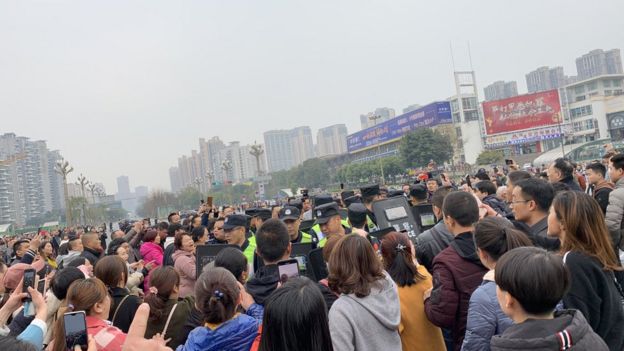
Image copyrightSUPPLIEDImage captionHundreds of parents stormed the school in protest
Videos that emerged on social media on Wednesday showed hundreds of parents angrily protesting outside the school gates.
Police were seen using brute force against them, with one video showing a group of policemen slamming a man against the ground.
In another video, parents can be seen clutching their eyes in pain, with some local news outlets saying police used pepper spray against them.
It said the parents had “severely disrupted” traffic and insulted the police. They were later released on the same day.
‘Why should they be trusted with anything?’
Stephen McDonell, BBC China correspondent
People overseas sometimes mistakenly think that there are not many protests in China. Actually, acts of dissent break out quite often and can erupt suddenly.
If family members are harmed, especially when under the care of a school or a kindergarten or a hospital, then orderly, calm communities can transform with scenes of anger spilling out onto the streets.
Faulty medicine, tainted milk powder, investment scams and perceived abuse of students under the care of teachers have all triggered public anger directed at the officials whose job it is to keep the community safe.
The school is one of the most prestigious in China and had in the past been named among China’s “Top 10 outstanding private schools”.
It said that those responsible would be dealt with by the law, saying it was “embarrassed” by the incident and that it would not happen again.
However, the parent the BBC spoke to said the case was not an “isolated incident”, saying that the same supplier catered to “over 100,000 students from across 20 schools”.
Wenjiang district government – the district in Chengdu that the school is in – issued a statement on Wednesday that said eight people responsible for food safety at the school were being investigated by authorities.
It said that 36 students from the school had been admitted into the local hospital for a check-up -all were later discharged.
The district government also said that the raw food would be sent for testing, adding that a “comprehensive and in-depth investigation” would be held into the matter.
Students at one middle school were told they could join an ‘experimental class’ if they paid US$590 for a designated device
That class was later scrapped because of a lack of interest, while the principal of the other school clarified that its plan was not compulsory
Chinese schools under fire after demanding parents pay for tablets
21 Feb 2019
Parents took to social media asking why they had to buy a new tablet when they already had one, and questioning why a specific model was needed. Photo: Alamy
Two schools in northern China have come under fire from parents after they were asked to spend thousands of yuan on tablets for their children’s studies, with one forced to cancel its plan for an “experimental class” due to a lack of interest.
At that school, paying for the device would have given a student a place in a top class where they had access to the best resources.
Earlier this week, Yuying School in Yongnian county, Hebei province demanded 3,000 yuan (US$450) from parents of Year Seven students so that tablets could be bought to assist their studies, Red Star News reported on Wednesday.
They were told via a message on social network WeChat from one of the teachers. It said students should bring the money on Thursday – the first day of the new term – because the private school wanted to “teach using tablets to improve classroom efficiency”. Screenshots of the message have been circulating on social media.
Chinese high school students create daring sex education game, earning positive reviews on Steam
But some parents were against the idea, asking on the WeChat group why they had to buy a new tablet when they already had one, and questioning why a specific model was needed.
“We have several tablets at home – can’t my child use one of them at school?” one parent asked.
Another wrote: “I’m just wondering if this tablet is really worth 3,000 yuan.”
The reaction prompted school principal Li Jinxi to clarify on Wednesday that the tablet purchase was not mandatory, and staff had “misunderstood the policy”, according to the report.
“There could be some minor impact for those students who don’t buy the tablet but it won’t be a big deal because we will also continue to use traditional teaching methods,” he was quoted as saying.
Meanwhile, at Gongyi No 1 Senior High school in Henan province, students were told they could join an “experimental class” if they paid 3,980 yuan for a designated tablet, according to a report on news app Kuaibao on Tuesday.
The school had contacted some of its top students to take part in its “smart class cloud teaching experiment”, the report said.
But the Gongyi education bureau later posted a statement on Weibo, saying only about 70 of the school’s 520 students had signed up for the plan so the school had decided to scrap the idea and would refund the money to parents.
Huawei video in Chinese school exam sparks product placement row
The school was not the first in China to give students a chance to enter a top class if they bought tablets. In 2015, a school in Longkou, Shandong province told students that those who did not pay for a tablet would end up in “ordinary classes”. After the move caused uproar, the school ended up offering a free three-month trial of the devices, with students then able to choose whether to buy one or not – a decision that would not affect which class they got put in.
One of the injured students at the hospital in Pulwama on February 13.(ANI/Twitter Photo)
Twelve students were injured in an explosion at a private school in south Kashmir’s Pulwama on Wednesday. The blast took place around 2.30pm.
The injured are students of class 10 of the Falah-i-Millat school in Pulwama’s Narbal town. Seven of them have been referred to Srinagar Hospital for further treatment.
They have been rushed to the government district hospital in Pulwama for treatment.
“I was teaching and then suddenly an explosion occurred. I can’t say how many students are injured,” Jawed Ahmed, a teacher at the school where the blast took place told news agency ANI.
The police have lodged a case and are investigating the nature of the blast.














 CHINDIA ALERT: You'll be living in their world, very soon