Chindia Alert: You’ll be Living in their World Very Soon
aims to alert you to the threats and opportunities that China and India present. China and India require serious attention; case of ‘hidden dragon and crouching tiger’.
Without this attention, governments, businesses and, indeed, individuals may find themselves at a great disadvantage sooner rather than later.
The POSTs (front webpages) are mainly 'cuttings' from reliable sources, updated continuously.
The PAGEs (see Tabs, above) attempt to make the information more meaningful by putting some structure to the information we have researched and assembled since 2006.
As China prepares its 14th five-year plan, researchers at one state-affiliated think tank predicted a more hostile global situation
Beijing urged to strengthen home-grown innovation and use vast domestic market to power economy post-coronavirus
A think tank linked to China’s State Council has encouraged Beijing to focus on home-grown technology and its vast consumer market over the next five years. Photo: Xinhua
China’s will face an increasingly hostile world over the next five years, meaning its policy plan should be focused on its vast domestic market, home-grown technological innovation and improving its citizen’s welfare, according to recommendations in a new paper.
The report by the Chinese Academy of Social Sciences (CASS), a think tank affiliated with the State Council, foresees the next five years presenting “major changes unseen in a century” for China, as “the strategic game between superpowers has intensified, while international systems and orders are reshuffled”.
While the report does not mention the coronavirus specifically, its recommendations suggest that China should become more self-reliant in response to the pandemic. This view represents one side of a lively debate among policymakers and scholars in China, ahead of the next five-year plan, which will come into place next year.
Between 2021 and 2025, the globalised economy which helped China grow into an economic power will be radically different, the report said, meaning it must adapt if it is to continue to thrive.
“The disadvantages of economic globalisation have increasingly stood out. Populism has risen as the global economy weakens, while countries are divided as imbalances expand. The old multilateral [trading] system is under pressure,” read the paper, part of a wave of preliminary studies offering advice ahead of China’s 14th five-year plan, a blueprint for economic and social development.
China is the only major economy that publishes a five-year policy plan and has been doing so since 1953, in a tradition borrowed from the Soviet Union. China’s own plans are broad strategic guidelines, rather than Moscow’s previously detailed command economy production worksheets.
China is currently in the final year of its 13th five-year plan, the stage during which the Soviet Union collapsed. The 14th plan is expected to be published in early-2021, but brainstorming about challenges and policy options is well under way among academics and state planning officials.
That debate is expected to feature prominently in the coming meetings of the “Two Sessions,” the Chinese People’s Political Consultative Congress, which is due to meet in Beijing on May 21, and the National People’s Congress, which will begin to meet a day later.
A common point in the debate is that the lessons of the past few years have shown the need to be more self-reliant. Even before the coronavirus outbreak, the US-China trade war and the growing superpower rivalry have made many think that Beijing can no longer rely on the goodwill of trading partners to continue the expansion it has enjoyed since the late-1970s.
Coronavirus pandemic creates ‘new Cold War’ as US-China relations sink to lowest point in decades
In December 2017, US President Donald Trump declared China a “strategic competitor” in anticipation of the Chinese economy reaching two-thirds the size of America’s, which happened in 2018. Since then, the two have engaged in a tit-for-tat tariff battle, while the coronavirus has served to sharpen tensions and fuel arguments for further decoupling.
“Uncertainties and instabilities are clearly increasing,” read the analysis published in the academic journal Economic Perspectives this week.
Without citing coronavirus directly, the CASS researchers suggested that China should “stick to its developmental direction and concentrate on doing its own things well”.
China now has a middle income group of between 500 and 700 million people and that alone can be a source empowering China’s economic growth for the next five years, the report said.
However, China must also attempt to smooth out a major weakness, namely unbalanced growth, including the yawning wealth gap between urban and rural groups.
In terms of innovation, the researchers led by Huang Qunhui said China should rely less on foreign technologies. “China’s innovation capacity is still lagging behind developed countries. Breakthroughs in core technologies are in urgent need,” read the report.
The Made in China 2025 plan, published in 2015, stated Beijing’s ambitions to dominate future technologies such as robotics and artificial intelligence. However, after loud complaints from the US and European Union, China has been forced to play down such bold innovative goals.
Pou Chen makes footwear for the likes of Nike and Adidas, but says it has suffered from a lack of orders as global value chains strain under the impact from the virus
Chinese workers moved to Vietnam to help set-up new factories as the company expand its production, but have now become expendable
With the likes of Nike and Adidas closing retail stores around the world to comply with social distancing requirements, analysts also said orders plummeted 50 per cent in the second quarter, although the company declined to comment on the media reports. Photo: Bloomberg
A group of 150 Chinese workers believe the world’s largest maker of trainers used the coronavirus as an excuse to fire them, having helped Taiwanese firm Pou Chen successfully expand its production into Vietnam for more than a decade.
Pou Chen, which makes footwear for the likes of Nike and Adidas, informed the group in late April that they would no longer be needed as they were unable to return to
from their hometowns in China due to the coronavirus lockdowns.
“We believe we contributed greatly to the firm’s relocation process, copying the production line management experience and successful model of China’s factories to Vietnamese factories,” said Dave Zhang, who started working for Pou Chen in Vietnam in 2003.
“Now, when the factories over there have matured, and there is a higher automation level in production, our value has faded in the management’s eyes and we got laid off, in the name of the automation level.”
Rush hour chaos returns to Vietnam’s streets as coronavirus lockdown lifted
The group claims the firm began to fire Chinese employees several years ago, with the total number dropping from over 1,000 at its peak to around 400 last year.
“We 150 employees were the first batch of Chinese employees to be laid off this year. We are all pessimistic and expect more will be cut,” added Zhang.
In its email on April 27, Pou Chen said it was forced to terminate the contracts of the Chinese employees across five of its factories due to an unprecedented decline in orders and financial losses.
The Chinese employees, many of whom have been working for the shoemaker for decades, said the compensation offered was unfair and below the levels required by labour law in both Vietnam and China.
In a further statement to the South China Morning Post, Pou Chen stood by the move as the coronavirus pandemic had reduced demand for footwear products and so required an “adjustment of manpower.”
“[The dismissals were] in accordance with the relevant labour laws of the country of employment … and employee labour contracts,” added the statement from Pou Chen, which employs around 350,000 people worldwide.
Company data showed Pou Chen’s first quarter revenues tumbled 22.4 per cent year-on-year to NT$59.46 billion (US$1.99 billion), the weakest in six years.
With the likes of Nike and Adidas closing retail stores around the world to comply with social distancing requirements, analysts also said orders plummeted 50 per cent in the second quarter, although the company declined to comment on the media reports.
Last month, the company was also mulling pay cuts and furloughs that would affect 3,000 employees in Taiwan and officials based in its overseas factories, according to the Taipei Times.
Andy Zeng, who had worked for the firm since 1995, said the group were “very upset” when they received the news last month as the impact of the coronavirus pandemic began to reverberate around the world, disrupting global value chains.
“Most of us joined Pou Chen in the 1990s when we were in our late teens or early 20s, when the Taiwan-invested company started investing and setting up factories in mainland China. Now more than two decades have passed,” he said.
Zeng was among the first generation of skilled workers in China as Pou Chen developed rapidly, enjoying the benefits of cheap labour, although the workers themselves were rewarded with regular pay rises.
The company needed a group of skilled Chinese workers to go to its new factories in Vietnam. I said yes because I thought it was a good opportunity to see the outside world – Andy Zeng
“I worked at the Dongguan branch of Pou Chen for 11 years from 1995.” Zeng added “In the 1990s and early 2000s, the company expanded rapidly in Dongguan with a growing number of large orders, and every worker had to work hard around the clock. I remember I earned 300 yuan (US$42) a month in 1995, and my monthly salary rose to 1,000 yuan (US$141) in 1998.”
Zeng’s salary eventually rose to over 3,000 yuan in 2005 as China’s economy boomed, leading Pou Chen to seek alternative production sites in Vietnam and Indonesia where labour and land were even cheaper. However, in the early 2000s, the new locations lacked skilled shoe manufacturing workers like Zeng.
“The company needed a group of skilled Chinese workers to go to its new factories in Vietnam. I said yes because I thought it was a good opportunity to see the outside world and the offer of US$700 per month was not bad.” Zeng said.
“We actively cooperated with their plans. Over the past decade, we have been away from our families and hometowns, and followed the company’s strategy to work hard in Vietnam.
With no deaths and cases limited to the hundreds, Vietnam’s Covid-19 response appears to be working
“In 2005, the company sent me to its newly-built factory in Vietnam. This year was my 14th year in Dong Nai in Vietnam. I have witnessed the company’s production capacity in Vietnam become larger and larger. When I arrived, there were only a few production lines, and now there are at least dozens of them, employing more than 10,000 workers in each factory.”
According to a report in the Taipei Times on April 14, citing both Reuters and Bloomberg, Pou Chen was ordered to temporarily shut down one of its units in Vietnam over coronavirus concerns, according to Vietnamese state media.
The company was forced to suspend production for two days after failing to meet local rules on social distancing, Tuoi Tre newspaper reported.
“We Chinese employees actually were pathfinders for the company’s relocation from China to Vietnam,” said Zhang, who was in charge of a 1,700-worker factory producing 1.7 million shoe soles per month.
What our Chinese employees have done in Vietnam for more than a decade can be said to be very simple but very difficult – Dave Zhang
“We were sent to resolve any ‘bottlenecks’ in the production lines that were slowing down the rest of the plant, because during the launch of every new production line, Vietnamese workers would strike and get into disputes. As far as I know, there were over a thousand Chinese employees managing various aspects of the production lines in the company’s Vietnamese factories.
“In fact, what our Chinese employees have done in Vietnam for more than a decade can be said to be very simple but very difficult. That is to teach Vietnamese workers our experience of working on a production line, improve the productivity of the Vietnamese workers, and help the factories become localised.”
Overall, Pou Chen says it produces more than 300 million pairs of shoes per year, accounting for around 20 per cent of the combined wholesale value of the global branded athletic and casual footwear market.
“Because of cultural shock and great pressure to expedite orders, Vietnamese workers were not used to the management style of Taiwan factories,” Zhang added.
“Many of our Chinese employees were beaten by Vietnamese workers [due to cultural differences about work]. During anti-China protests in Vietnam, we were still under great pressure to keep the local production lines operating.”
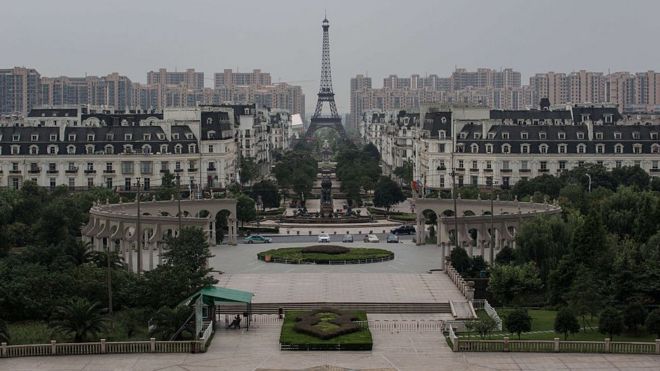
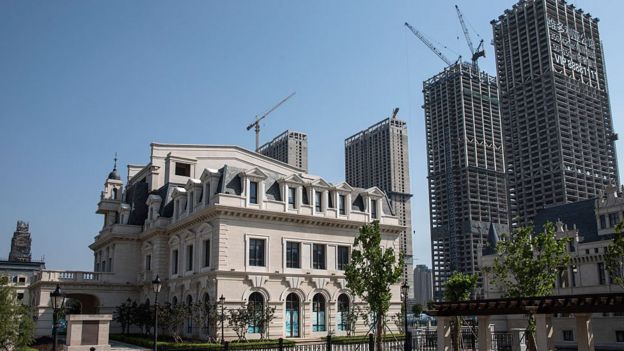
The statement, issued on 27 April but only reported this week, singles out stadiums, exhibition centres, museums and theatres as public facilities where it’s especially important to ban plagiarism.
“City constructions are the combination of a city’s external image and internal spirit, revealing a city’s culture,” the government statement says.
It calls for a “new era” of architecture to “strengthen cultural confidence, show the city’s features, exhibit the contemporary spirit, and display the Chinese characteristics”.
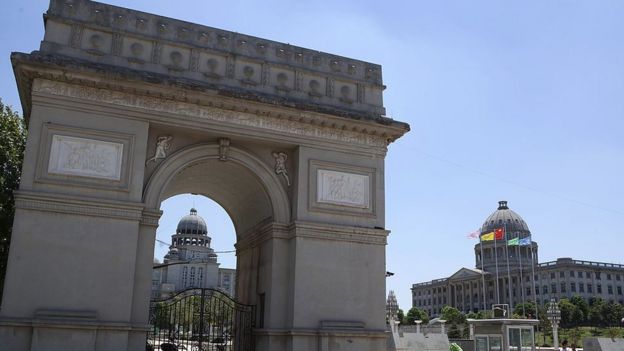
Image copyright STR / AFP / GETTYImage caption – Not the Arc de Triomphe, but a college gate in Wuhan
The guidelines on “foreign” architecture were mostly welcomed on Chinese social media.
“The ban is great,” wrote a Weibo user, according to state media the Global Times. “It’s much better to protect our historical architectures than build fake copycat ones.”
Another recalled seeing an imitation White House in Jiangsu province. “It burned my eyes,” she said.
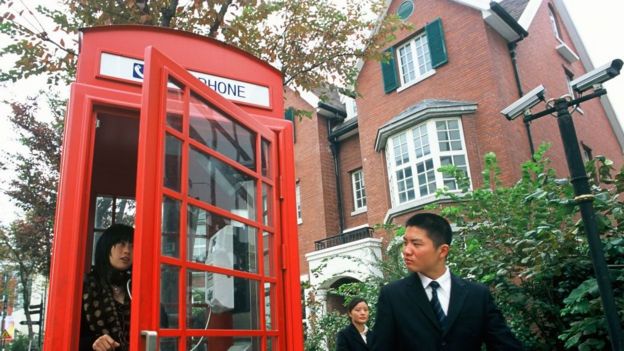
Image copyright OLIVIER CHOUCHANA / GETTYImage caption Thames Town, an English-themed town near Shanghai, pictured in 2008
In 2013, the BBC visited “Thames Town”, an imitation English town in Songjiang in Shanghai.
The town features cobbled streets, a medieval meeting hall – even a statue of Winston Churchill – and was a popular spot for wedding photos.
“Usually if you want to see foreign buildings, you have to go abroad,” said one person. “But if we import them to China, people can save money while experiencing foreign-style architecture.”
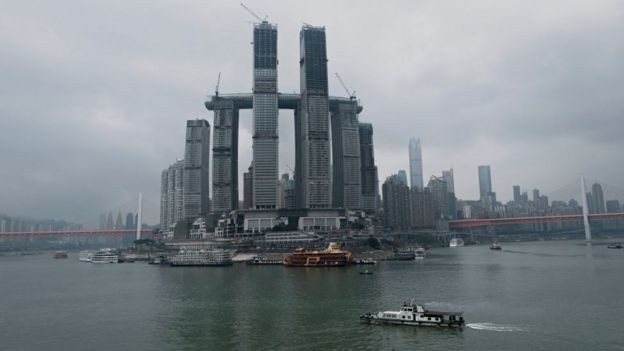
Image copyright WANG ZHAO / GETTYImage caption – Raffles City, Chongqing, in 2019 – mimicking the Marina Bay Sands hotel in Singapore
China, of course, is not the only country to borrow – or copy – other countries’ designs.
Las Vegas in the US revels in its imitations of iconic foreign architecture including the Eiffel Tower and Venetian canals.
Thailand also has developments that mimic the Italian countryside and charming English villages, mainly aimed at domestic tourists.
BEIJING (Reuters) – Tang Yue, a 27-year-old teacher from the city of Guilin in southwest China, steam-presses a blue dress and takes dozens of photographs before picking one to clinch her 200th online sale.
For a growing number of Chinese like Tang, hit by job losses, furloughs and salary cuts, the consumer economy has begun to spin in reverse. They are no longer buying – they are selling.
Instead of emerging from the coronavirus epidemic and returning to the shopping habits that helped drive the world’s second-largest economy, many young people are offloading possessions and embracing a new-found ethic for hard times: less is more.
With Tang’s monthly salary of about 7,000 yuan ($988), the self-described shopaholic said she has bought everything from Chanel lipsticks to Apple’s (AAPL.O) latest iPad in the past three years.
But the adrenaline rush that comes with binge-shopping is gone, said Tang, whose wages have been slashed with the suspension of all the classes on tourism management she usually teaches.
“The coronavirus outbreak was a wake-up call,” she said. “When I saw the collapse of so many industries, I realised I had no financial buffer should something unfortunate happen to me.”
There is no guarantee that the nascent minimalist trend will continue once the coronavirus crisis is fully over, but if it does, it could seriously damage China’s consumer sector and hurt thousands of businesses from big retailers to street-corner restaurants, gyms and beauty salons.
To be sure, there are signs that pent-up demand will drive a rush of spending as authorities reopen malls, leisure venues and tourist spots. In South Korea, the first major economy outside of China to be hit by the virus, people thronged malls this weekend to go “revenge shopping” to make up for time lost in lockdown.,
There are some signs that a similar trend will take hold in China, where some upscale malls are starting to get busy, although luxury firm Kering SA (PRTP.PA) – which owns Gucci, Balenciaga and other fashion brands – has said it is hard to predict how or when sales in China might come back.
A recent McKinsey & Co survey showed that between 20% and 30% of respondents in China said they would continue to be cautious, either consuming slightly less or, in a few cases, a lot less.
“The lockdown provided consumers with a lot of time and reasons to reflect and consider what is important to them,” said Mark Tanner, managing director at Shanghai-based research and marketing consultancy China Skinny.
“With much more of their days spent in their homes, consumers also have more time and reasons to sort through things they don’t feel they need – so they’re not living around clutter that is common in many apartments.”
#DITCHYOURSTUFF
Tang made a spreadsheet to keep track of her nearly 200 cosmetic products and hundreds of pieces of clothing. She then marked a few essentials in red that she wanted to keep. In the past two months, she has sold items worth nearly 5,000 yuan on second-hand marketplaces online.
Bargain-hunting online has become a new habit for some Chinese as the stigma that once hung over second-hand goods has begun to fade.
Idle Fish, China’s biggest online site for used goods, hit a record daily transaction volume in March, its parent company Alibaba (BABA.N) told Reuters.
Government researchers predict that transactions for used goods in China may top 1 trillion yuan ($141 billion) this year.
Posts with the hashtag #ditchyourstuff have trended on Chinese social media in recent weeks, garnering more than 140 million views.
Jiang Zhuoyue, 31, who works as an accountant at a traditional Chinese medicine company in Beijing – one of the few industries that may benefit from the health crisis – has also decided to turn to a simpler life.
“I used to shop too much and could be easily lured by discounts,” said Jiang. “One time Sephora offered 20% off for all goods, I then bought a lot of cosmetics because I feel I’m losing money if I don’t.”
Jiang, the mother of a 9-month-old baby, said she recently sold nearly 50 pieces of used clothing as the lockdown gave her the opportunity to clear things out. “It also offered me a chance to rethink what’s essential to me, and the importance of doing financial planning,” she said.
Eleven Li, a 23-year-old flight attendant, said she used to spend her money on all manner of celebrity-endorsed facial masks, snacks, concert tickets and social media activity, but now has no way to fund her spending.
“I just found a new job late last year, then COVID-19 came along, and I haven’t been able to fly once since I joined, and I’ve gotten no salary at all,” said Li, who said she was trying to sell her Kindle.
Some are even selling their pets, as they consider leaving big cities like Beijing and Shanghai where the high cost of living is finally catching up with them.
NO RETURN TO OLD WAYS?
As the coronavirus comes under control in China, the government is gradually releasing cities from lockdown, easing transport restrictions and encouraging consumers to venture back into malls and restaurants by giving out billions-worth of cash vouchers, worth between 10 yuan and 100 yuan.
But many people say they are still worried about job security and potential wage cuts because of the struggling economy. Nationwide retail sales have plunged every month so far this year.
Xu Chi, a Shanghai-based senior strategic analyst with Zhongtai Securities, said some Chinese consumers may prove the ‘21 Day Habit Theory,’ a popular scientific proposition that it only takes that long to establish new habits.
“We believe people’s spending patterns follow the well-known theory, which means most people in China, having been cooped-up at home for more than a month and not having binge-shopped, may break the habit and not return to their old ways,” Xu said.
Jiang said she was determined not to return to her free-spending ways and planned to cook more at home.
“I’ll turn to cheaper goods for some luxury brands,” she said. “I’ll choose Huawei’s smartphone, because (Apple’s) iPhone has too much brand premium.”
Tang, who has recently used 100 yuan of shopping coupons to stock up on food, is going to hold the purse strings even tighter.
“I’ve set my monthly budget at 1,000 yuan,” she said. “Including one – and just one – bottle of bubble tea.”
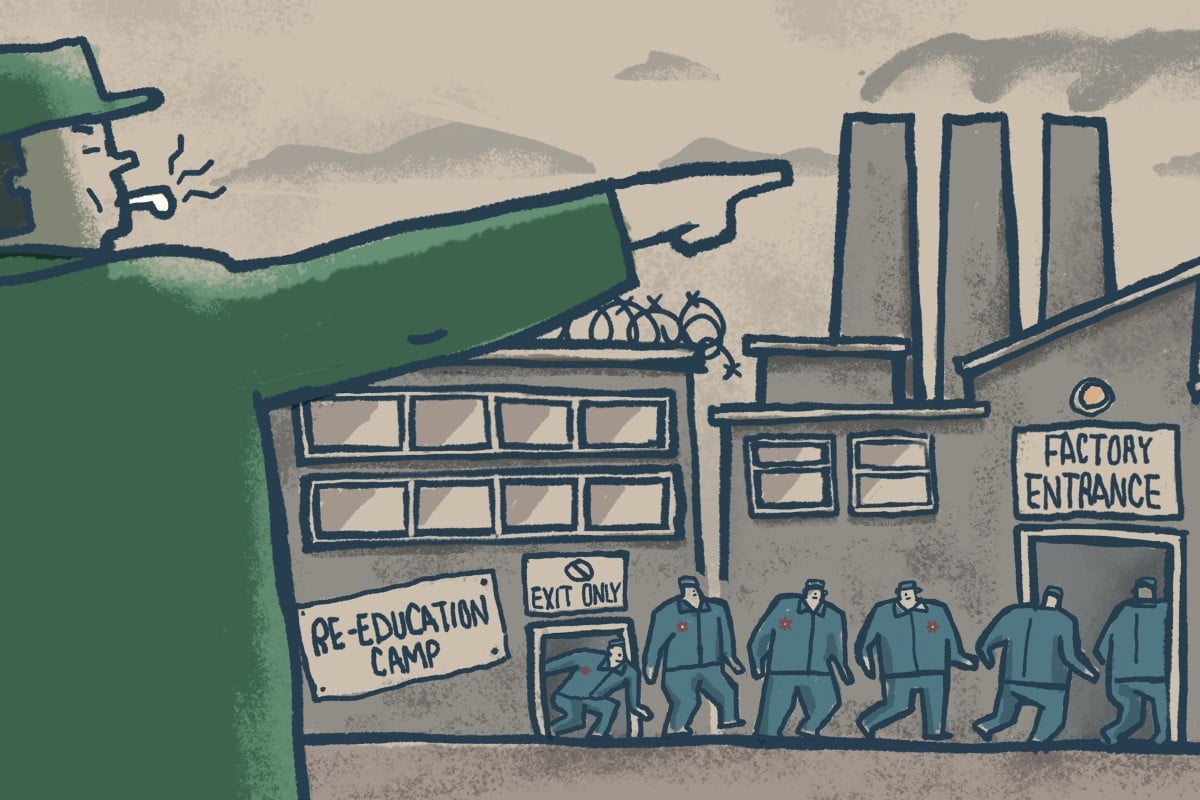
Inmates who have undergone compulsory re-education programme to be moved to other parts of China under job placement scheme delayed by Covid-19 outbreak
Critics have said the camps are a move to eradicate cultural and religious identity but Beijing has defended them as way of boosting job opportunities and combating Islamic radicalisation
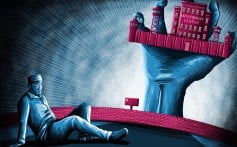
Illustration by Perry Tse
The Chinese government has resumed a job placement scheme for tens of thousands of Uygur Muslims who have completed compulsory programmes at the “re-education” camps in the far-western region of Xinjiang, sources said.
The plan, which includes a quota for the numbers provinces must take, was finalised last year but disrupted by the outbreak of Covid-19.
The delay threatens to undermine the Chinese government’s efforts to justify its use of internment camps in Xinjiang.
Critics have said these camps were part of the measures designed to eradicate the ethnic and cultural identity of Uygurs and other Muslim minorities and that participants had no choice but to undertake the re-education programme.
Beijing has repeatedly dismissed these criticisms and said the camps are to give Uygurs the training they need to find better jobs and stay away from the influence of radical fundamentalism.
First Xinjiang, now Tibet passes rules to promote ‘ethnic unity’
17 Feb 2020
Now with the disease under control, the Chinese government has resumed the job placement deal for other provinces to absorb Xinjiang labourers, sources said.
Despite the devastating impact of the disease on its economy and job markets, the Chinese authorities are determined to go ahead with the plan, which they believe would
“Excellent graduates were to be taken on as labourers by various inland governments, in particular, 19 provinces and municipalities,” said the source. It is unclear what constitutes “excellent graduates”.
Some sources earlier said that the programme may be scaled back in light of the new economic reality and uncertainties.
But a Beijing-based source said the overall targets would remain unchanged.
“The unemployment problem in Xinjiang must be resolved at all costs, despite the outbreak,” the source said.
The South China Morning Post has learned that at least 19 provinces and cities have been given quotas to hire Muslim minorities, mostly Uygurs, who have “graduated” from re-education camps.
As early as February, when the daily number of infections started to come down outside Hubei province, China already begun to send Uygur workers to their new jobs.
A photo taken in February showed thousands of young Uygurs, all wearing face masks and with huge red silk flowers pinned to their chests, being dispatched to work in factories outside their hometowns.
By the end of February, Xinjiang alone has created jobs for more than 60,000 Uygur graduates from the camps. A few thousand were also sent to work in other provinces.
Many have been employed in factories making toys and clothes.
Xinjiang’s new rules against domestic violence expand China’s ‘extremism’ front to the home
7 Apr 2020
Sources told the Post that the southern city of Shenzhen – China’s hi-tech manufacturing centre – was given a target last year to eventually resettle 50,000 Uygurs. The city is allowed to do this in several batches, with 15,000 to 20,000 planned for the first stage.
In Fujian province, a government source also said they had been told to hire “tens of thousands of Xinjiang workers”.
“I heard the first batch of several thousands would arrive soon. We have already received official directives asking us to handle their settlement with care,” said the source.
He said the preparation work includes providing halal food to the workers as well as putting in place stronger security measures to “minimise the risks of mass incidents”. It is not known whether they will be given access to prayer rooms.
There are no official statistics of how many Uygurs will be resettled to other provinces and the matter is rarely reported by the mainland media.
But in March, Anhui Daily, the province’s official newspaper, reported that it had received 1,560 “organised labourers from Xinjiang”.
The Uygur workers on average could earn between 1,200 yuan (US$170) to 4,000 yuan (US$565) a month, with accommodation and meals provided by the local authorities, according to Chinese media reports.
However, they are not allowed to leave their dormitories without permission.
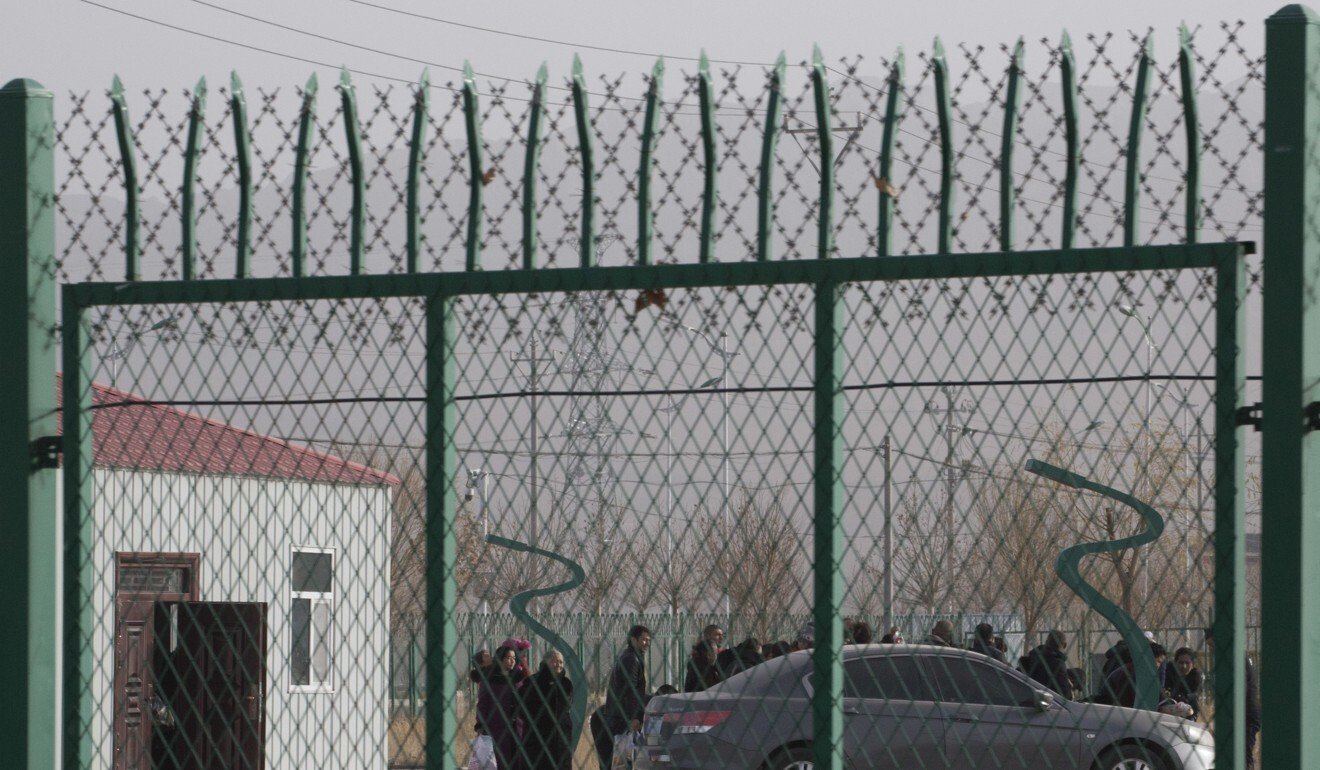
The UN has estimated that up to a million Muslims were being held in the camps. Photo: AP
Xinjiang’s per capita disposable income in 2018 was 1,791 yuan a month, according to state news agency Xinhua. But the salary level outside the region’s biggest cities such as Urumqi may be much lower.
The official unemployment rate for the region is between 3 and 4 per cent, but the statistics do not include those living in remote rural areas.
Mindful of the potential risks of the resettlement, Beijing has taken painstaking efforts to carefully manage everything – from recruitment to setting contract terms to managing the workers’ day-to-day lives.
Local officials will go to each Uygur workers’ home to personally take them to prearranged flights and trains. On arrival, they will be immediately picked up and sent to their assigned factories.
US bill would bar goods from Xinjiang, classifying them the product of forced labour by Uygurs
12 Mar 2020
Such arrangements are not unique to Uygurs and local governments have made similar arrangements for ethnic Han workers in other parts of China.
After screening them for Covid-19, local governments have arranged for workers to be sent to their workplaces in batches. They are checked again on arrival, before being sent to work.
China is accelerating such placement deals on a massive scale to offset the impact of the economic slowdown after the outbreak.
Sources told the South China Morning Post that the job placement deal was first finalised by governments in Xinjiang and other provinces last year.
The aim is to guarantee jobs for Uygur Muslim who have “completed vocational training” at the re-education camps and meet poverty alleviation deals in the region, one of the poorest parts of China.
The training they receive in the camps includes vocational training for various job types such as factory work, mechanical maintenance and hotel room servicing. They also have to study Mandarin, Chinese law, core party values and patriotic education.
Xinjiang’s massive internment camps have drawn widespread international condemnation.
The United Nations has estimated that up to 1 million Uygur and other Muslim minority citizens are being arbitrarily detained in the camps, which Beijing insists are necessary to combat terrorism and Islamic radicalisation.
Late last year, Xinjiang’s officials announced that all the inmates of these so-called vocational training centres had “graduated” and taken up employment.
Before this labour placement scheme was introduced, it was extremely difficult for Uygurs to find jobs or live and work in inland regions.
Muslim ethnic minorities, Uygurs in particular, have been subjected to blatant discrimination in China and the situation worsened after the 2009 clashes.
Earlier this month, the Australian Strategic Policy Institute released a report saying more than 80,000 Uygurs had been moved from Xinjiang to work in factories in nine Chinese regions and provinces.
It identified a total of 27 factories that supplied 83 brands, including household names such as Google, Apple, Microsoft, Mitsubishi, Siemens, Sony, Huawei, Samsung, Nike, Abercrombie and Fitch, Uniqlo, Adidas and Lacoste.
‘Psychological torture’: Uygurs abroad face mental health crisis over plight of relatives who remain in Xinjiang
11 Mar 2020
The security think tank concluded that the Chinese government had transferred Uygur workers “under conditions that strongly suggest forced labour” between 2017 and 2019, sometimes drawing labourers directly from re-education camps.
The report also said the work programme represents a “new phase in China’s social re-engineering campaign targeting minority citizens”.
Workers were typically sent to live in segregated dormitories, underwent organised Mandarin lessons and ideological training outside working hours and were subject to constant surveillance, the researcher found.
They were also forbidden from taking part in religious observances, according to the report that is based on open-source documents, satellite pictures, academic research and on-the-ground reporting.
Chinese foreign ministry spokesman Zhao Lijian criticised the report saying it had “no factual basis”.
BEIJING, April 28 (Xinhua) — China has achieved much progress in environmental protection and taken the lead in green development in recent years.
The efforts have exemplified Chinese President Xi Jinping’s proposal of “working together for a green and better future for all” made a year ago in his speech at the opening ceremony of the International Horticultural Exhibition 2019 Beijing.
In the keynote speech, Xi proposed a five-point initiative on promoting green development, namely pursuing harmony between man and nature, pursuing the prosperity based on green development, fostering a passion for nature-caring lifestyle, pursuing a scientific spirit in ecological governance, and joining hands to tackle environmental challenges.
China’s hard work on environment protection has paid off.
The ecological environment has improved significantly. People are enjoying more days of blue sky, cleaner water, and fertile land.
China has achieved the goal of zero growth of desertified land by 2030 set by the United Nations ahead of time. Besides, forest stock volume increased by 4.56 billion cubic meters compared with that of 2005.
Carbon dioxide emissions per unit of GDP in 2018 fell by 45.8 percent compared with that of 2005, exceeding the target set for the year.
After more than 30 years of hard work, the seventh largest desert in China, the Kubuqi Desert in Inner Mongolia Autonomous Region, once known as the “sea of death” difficult for birds to fly across, has turned into a green valley.
In January 2020, in a letter in reply to the student representatives of the Global Alliance of Universities on Climate, the Chinese president mentioned his thoughts about ecological civilization in his youth.
“Over four decades ago, I lived and worked for many years in a small village on the Loess Plateau in western China. Back then, the ecology and environment there was seriously damaged due to over-development and the local people were trapped in poverty as a result,” Xi wrote.
“This experience taught me that man and nature are a community of life and that the damage done to nature will ultimately hurt mankind,” said Xi.
China’s progress and achievements are recognized worldwide.
The ecological civilization and green development advocated by China are actually an endeavor to find a way to balance economic development and environmental protection, said John Cobb, Jr., the founding president of the Institute for Postmodern Development of China and member of the American Academy of Arts and Sciences.
Noting that the endeavor is a remarkable exploration, he expressed his hope that it will succeed.
China is on the right path in dealing with global climate change and achieving sustainable development, said Borge Brende, president of the World Economic Forum.
In addition to making efforts at home, China has also rolled out a series of measures to support the global combat against climate change.
In September 2015, ahead of the Paris climate change conference, Xi pledged a 20-billion-yuan (3-billion-U.S. dollars) China South-South Climate Cooperation Fund, which was dedicated to help other developing countries combat climate change.
China has also been fulfilling the obligations of the United Nations Framework Convention on Climate Change and the Paris Agreement, and achieved the goal of its intended nationally determined contributions submitted to the secretariat of the Climate Change Convention as scheduled.
UN Secretary-General Antonio Guterres expressed his appreciation for China’s important contributions to addressing the climate change and building a green “Belt and Road,” and said he expects China to continue to play a leading role in addressing the climate change and other issues.
“Lucid waters and lush mountains are invaluable assets,” a concept put forward by Xi in 2005 when he visited Yucun Village in southeast China’s Zhejiang Province as the party chief of the province, has become the motto of the Lao Ministry of Natural Resources and Environment.
In March 2020, when Xi returned to Yucun, he said that economic development should not be achieved at the expense of the ecological environment. To protect the ecological environment is to develop the productive forces, he said.
The history of civilizations shows that the rise or fall of a civilization is closely tied to its relationship with nature, Xi said at the International Horticultural Exhibition last year.
Only by joining hands can the humankind advance a global ecological civilization and march towards the bright future of building a community with a shared future for mankind.
Hardline politicians want president to fulfil promise to overhaul constitution to reflect the self-ruled island’s political reality
A petition calls for two referendums on the issue – proposing it either be replaced with a new one or revised
The push for constitutional change could lead to a cross-strait conflict. Photo: Handout
Taiwanese President Tsai Ing-wen is under growing pressure from the hardline camp to push for constitutional change to reflect the self-ruled island’s independent status – something observers say could provoke a cross-strait conflict.
With Tsai due to be sworn in for a second four-year term next month after a landslide victory in January’s election, hardline pro-independence politicians want her to fulfil a 2015 campaign promise: to overhaul the constitution so that it reflects Taiwan’s political reality. The process has been stalled since Tsai’s first term, which began in 2016.
Leading the charge is the Taiwan New Constitution Foundation, a group formed last year by a Tsai adviser and long-time independence advocate Koo Kwang-ming.
The foundation launched a petition at the end of March calling for two referendums on the constitution – proposing that it either be replaced with a new one or revised.
The existing constitution was adopted when Kuomintang leader Chiang Kai-shek and the KMT fled to Taiwan and set up an interim government in 1949 following their defeat by Mao Zedong’s communists in mainland China.
Drawn up in 1947, the constitution still puts the mainland and Mongolia under the Republic of China jurisdiction – Taiwan’s official name for itself. In reality, its jurisdiction extends only to Taiwan and its outlying islands of Penghu, Matsu and Quemoy, which is also known as Kinmen.
Taiwan’s constitution was adopted when KMT leader Chiang Kai-shek fled to the island in 1949. Photo: Handout
“We have garnered more than 3,000 signatures from the public for the first phase of initiating the proposals to hold two referendums asking the president to push for constitutional change,” Lin Yi-cheng, executive director of the Taiwan New Constitution Foundation, said on Wednesday.
He said they would propose that voters be asked two questions in the referendums: “Do you support the president in initiating a constitutional reform process for the country?”
And: “Do you support the president in pushing for the establishment of a new constitution reflecting the reality of Taiwan?”
“We’re ready to send the two referendum proposals to the Central Election Commission on Thursday,” he said.
Confusion prompts call for China Airlines name change in Taiwan, but at what cost?
14 Apr 2020
Under Taiwan’s Referendum Act, the process for holding a referendum involves three stages: a proposal, endorsement and voting.
Lin said there should be no problem for the commission to approve the proposal stage since they had gathered far more than the minimum 1,931 signatures needed under the act.
The endorsement stage requires a minimum of 290,000 signatures, and if the referendum is held, they will need at least 5 million votes.
Lin said if the process went smoothly, he expected a referendum could be held in August next year, allowing time for review and making the necessary arrangements.
He said if the referendum questions got enough public support, Tsai would need to deal with the issue.
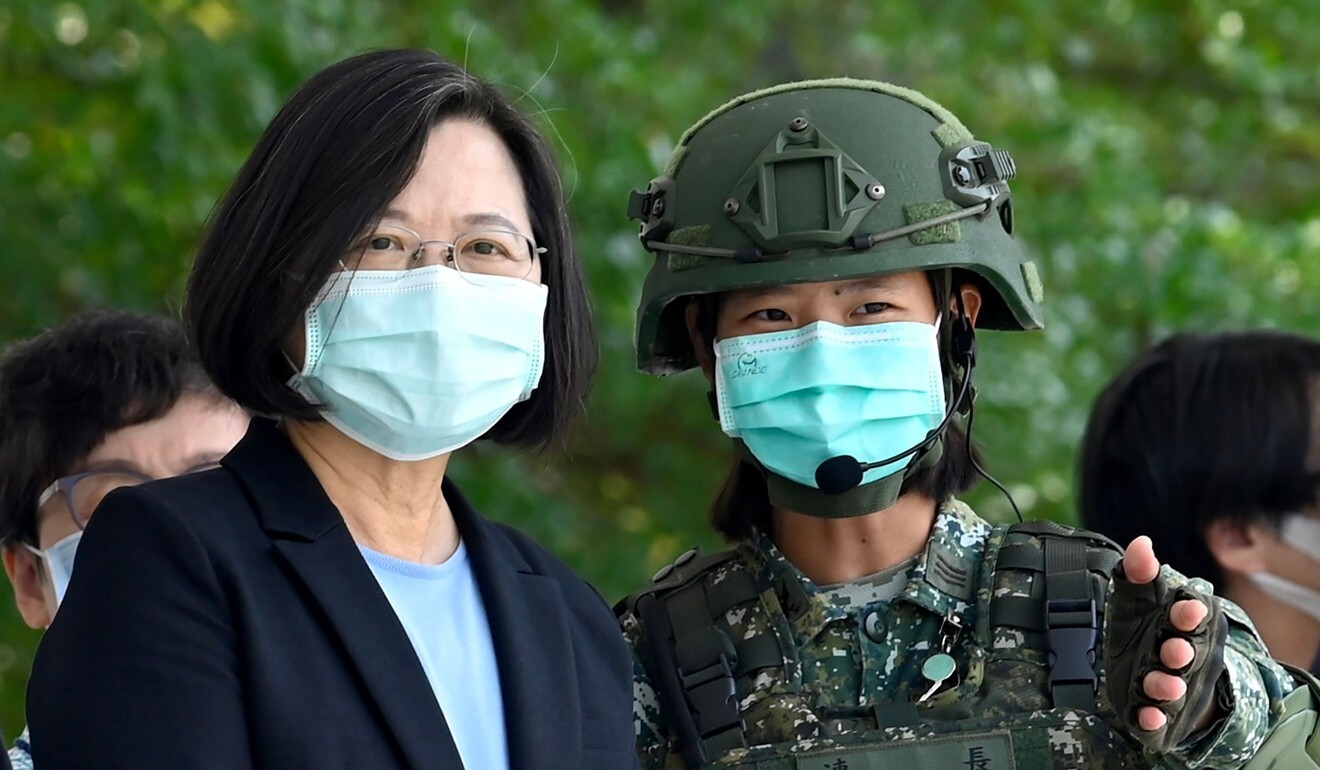
Tsai Ing-wen visits a military base in Tainan earlier this month. The pressure for constitutional change creates a dilemma for the president. Photo: AFP
Tsai’s Democratic Progressive Party government has been tight-lipped over the constitutional change issue, which Beijing sees as a move for the island to declare formal independence from the mainland.
Beijing considers Taiwan a wayward province that must be returned to the mainland fold, by force if necessary, and it has warned Tsai against declaring formal independence.
A DPP official said the foundation’s push would put Tsai in a difficult position.
“If she ignores the referendums, she will come under constant pressure from the hardline camp, and if she seriously considers taking action and instituting a new Taiwan constitution, she will risk a confrontation with Beijing, the consequence of which could be a cross-strait conflict,” said the official, who requested anonymity.
On Tuesday, Zhu Fenglian, a spokeswoman for the mainland’s Taiwan Affairs Office, warned the island against holding any referendum on constitutional revision, saying it would be doomed to end in an impasse and would ultimately fail.
“It will only push Taiwan towards an extremely dangerous abyss and bring disasters to Taiwanese compatriots,” she said.
Chinese air force’s drill ‘aimed at signalling deterrent around Taiwan’
2 Apr 2020
But according to Wang Kung-yi, a political science professor at Chinese Culture University in Taipei, Tsai should not be too worried about the hardline camp move.
“The hardline camp has been marginalised greatly in the past several years as reflected by the poor showing in the legislative elections in January,” Wang said, adding that he expected Tsai to continue her relatively moderate cross-strait policy of not sharply provoking the mainland.
BEIJING, April 28 (Xinhua) — China’s youth organizations awarded May Fourth Medals to 94 individuals and 34 groups Tuesday for their great contributions to the country.
The medals, which are awarded annually, are the top honor for young Chinese. The Central Committee of the Communist Youth League and the All-China Youth Federation released the list of winners.
Medical teams assisting Hubei Province to combat the novel coronavirus disease (COVID-19) epidemic are among the groups awarded.
Covering a wide range of sectors, the individual winners include firefighters, military personnel, scholars, teachers, engineers, workers and medical staff.
Among the list, 34 were honored posthumously, including those who sacrificed their lives in the fight against COVID-19.
Beijing’s Chaoyang district remains the last high-risk area in China, with virus preventive measures continuing to impact on travel and shopping plans
China faces the dilemma of preventing a re-emerge of the pandemic, while also pushing to get its economy back to normal
China’s continued pandemic prevention measures, coupled with still hesitant consumer demand, will inevitably lead to persistent limitations on the nation’s economic recovery, analysts said. Photo: Bloomberg
After nearly three months of being quarantined by herself in Beijing, Mary Zhao was looking forward to the upcoming long weekend at the start of May to be able to finally reunite with her parents.
But Zhao was forced to abandon her plan for the Labour Day holidays as Beijing’s upmarket Chaoyang district, where she lives, remains the only high-risk zone for coronavirus in the entire country.
If she travelled the five hours by car, or two hours via bullet train, to the neighbouring Hebei province, she would first have to undergo a 14-day quarantine before seeing her parents. Her parents would also have the same two week quarantine to look forward to once they returned home if they came to visit their daughter in Beijing.
These strict controls to prevent a re-emergence of the coronavirus outbreak are making a return to normal life impossible for many, and mean the final economic and social cost
from China’s draconian preventive measures could be much larger than expected.
Wuhan declares ‘victory’ as central Chinese city’s last Covid-19 patients leave hospital
It underscores the dilemma facing China’s leaders on how to balance the need to
and to avoid a fresh outbreak. On the surface, China may be able to declare victory as even Wuhan, the city where the virus was first detected, announced that the last Covid-19 patient had left hospital on Sunday. But fears of a renewed outbreak have kept the country’s cinemas and most schools closed, with travel between provinces discouraged.
China’s national borders also remain largely closed, with flights being cut to a minimum, and a mandatory 14-day quarantine for every arrival. In the number of places where new cases have been reported, quarantine requirements have been tightened, including Harbin and a few other cities near the border with Russia.
Chaoyang, the home to one of Beijing’s main business districts and most foreign embassies, changed its risk rating to high from low in the middle of April after three new cases were reported, dealing a fresh blow to the district’s
and forcing many of the 3.5 million residents to cancel their travel plans.
On the outskirts of Beijing, near Beijing Capital International Airport, returning migrant workers to Picun village were ordered to stop at entrance and could only be escorted inside by their landlord, with many villages and residential compounds remaining closed to outsiders.
In the high-end shopping district of Guomao, some shops also remain closed as there are few potential customers, while over in the popular Sanlitun area, metal barriers restrict access and temperature checkpoints are still required.
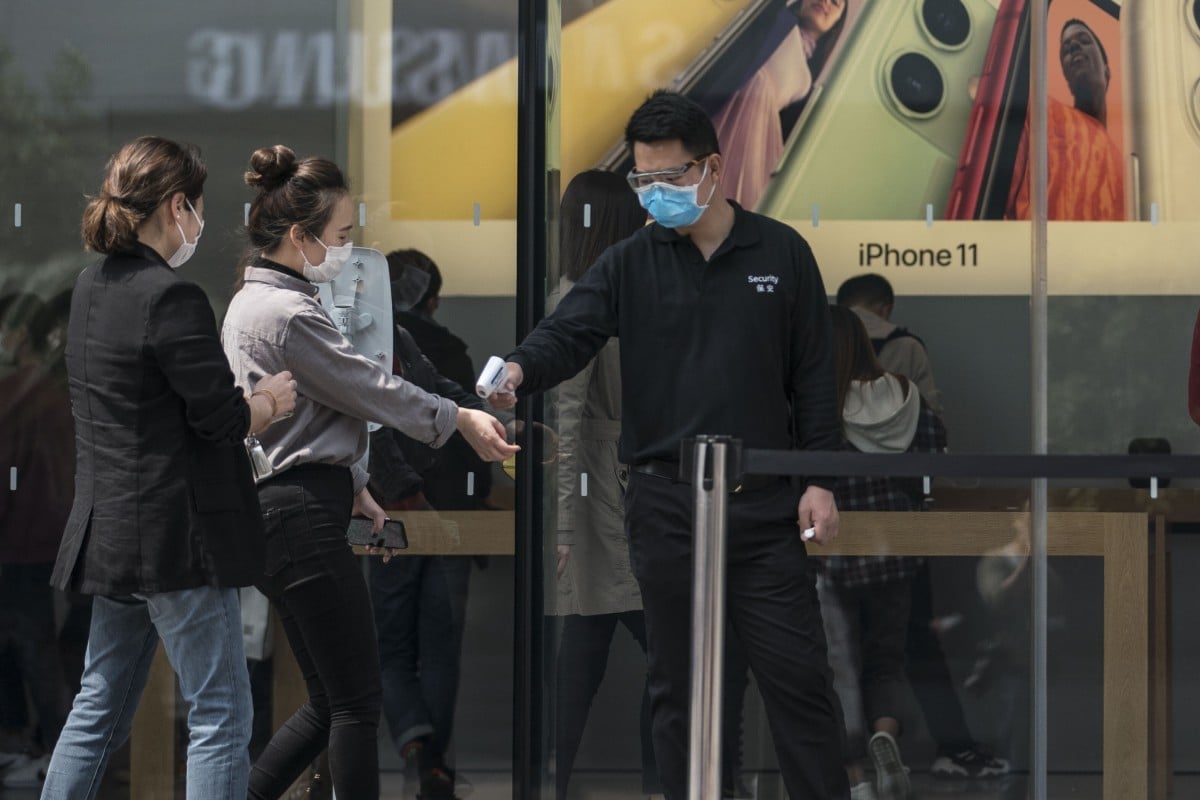
The landmark Apple Store in the popular Taikoo shopping centre is open, but with limited customers allowed inside, there are long queues outside. Customers are required to scan a QR code to check their movements over the last few days before entering.
Coronavirus: More schools reopen in China for students preparing for university entrance exams
“Why do I have to spend 20 minutes just to get into the Apple Store? The sun has almost melted me down,” one visitor complained to the security guards at the front of the shop.
China’s continued pandemic prevention measures, coupled with still hesitant consumer demand, will inevitably lead to persistent limitations on the nation’s economic recovery, analysts said.
Ernai Cui, an economist at research firm Gavekal Dragonomics, said on Monday that China’s cautious approach to lifting restrictions “points to a weak second quarter for consumer services”, adding additional pressure to the economic recovery.Mao Zhenhua, a researcher at the China Institute of Economics at Renmin University, said China’s preventive measures will inevitably be a drag on production, employment and exports.
Pupils given headwear modelled on a style worn by officials a thousand years ago to reinforce the message that they must stay a metre away from each other
One legend says the hats were given long extensions to stop courtiers whispering among themselves when meeting the emperor
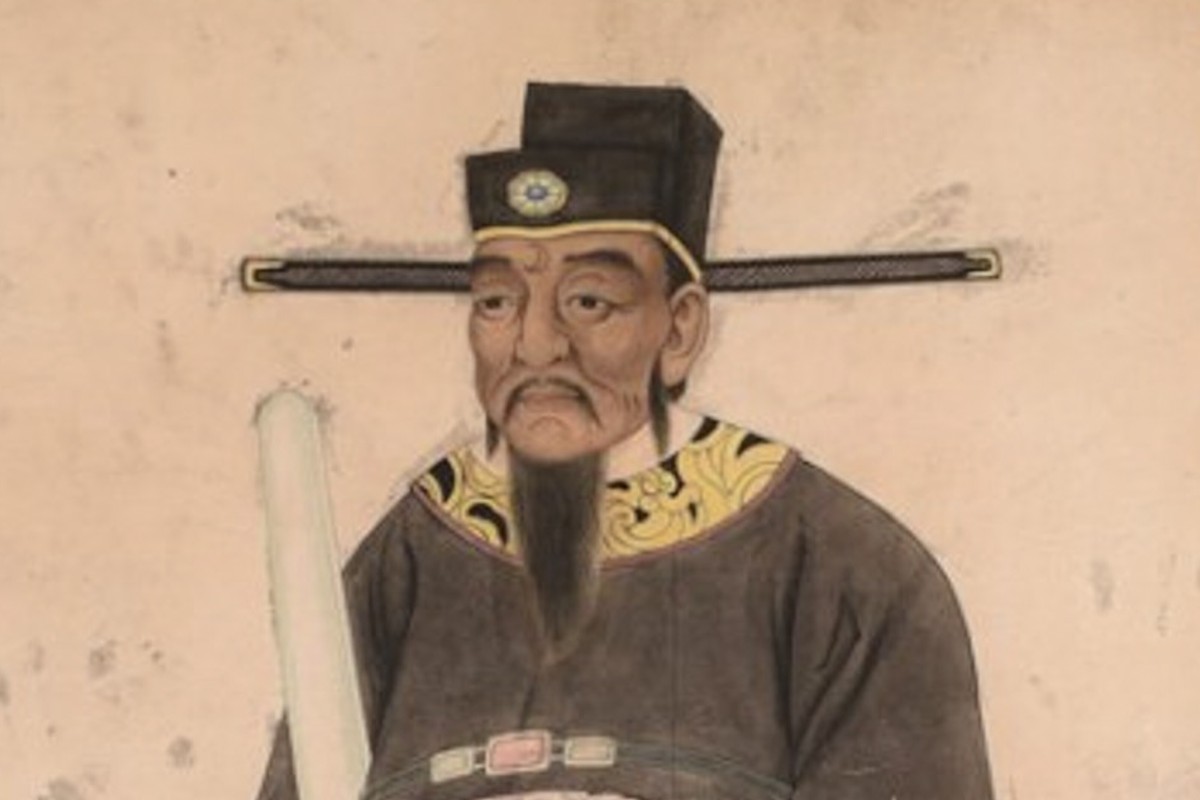
Hats with long extensions were worn by officials during the Song dynasty. Photo: Handout
An ancient Chinese hat has joined face masks and hand sanitisers as one of the weapons in the fight against Covid-19.
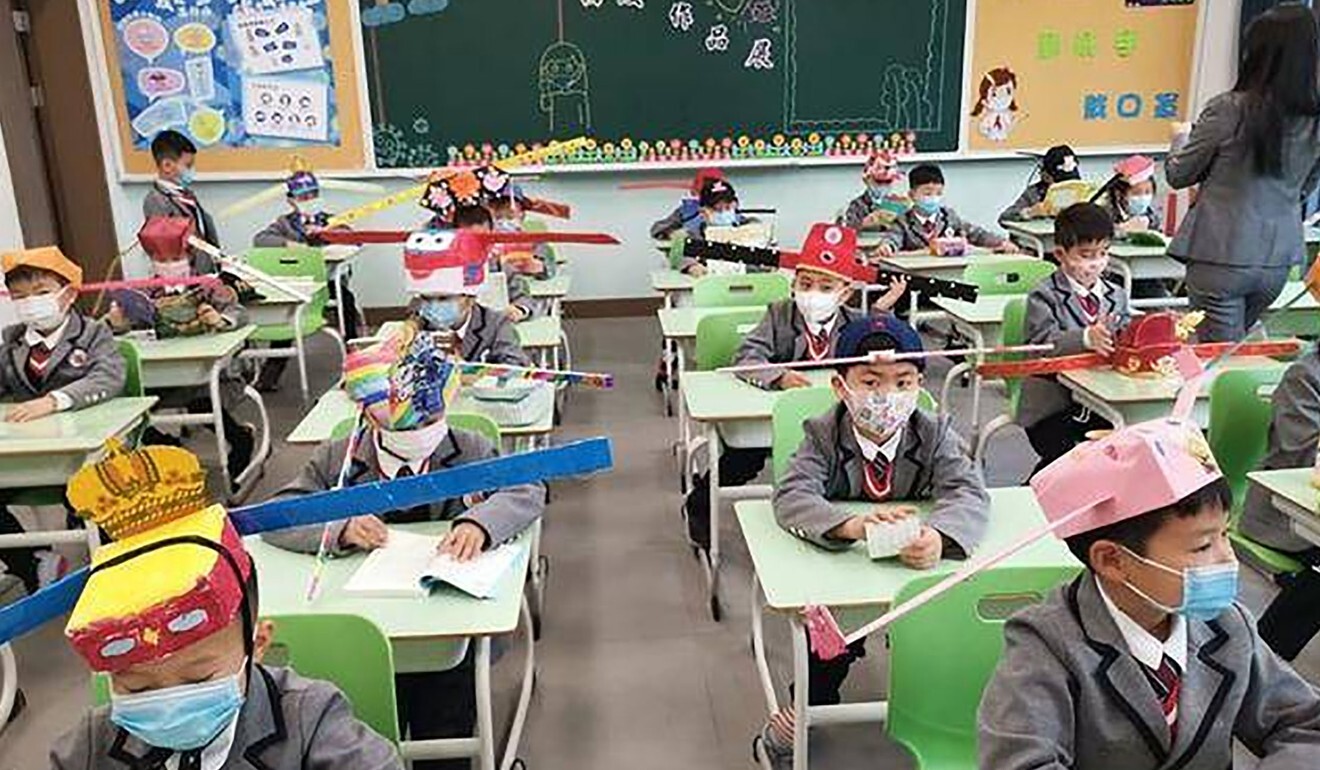
A primary school in Hangzhou in the east of the country took inspiration from the headgear worn by officials in the Song dynasty, which ruled China between 960 and 1279, to reinforce lessons on social distancing.
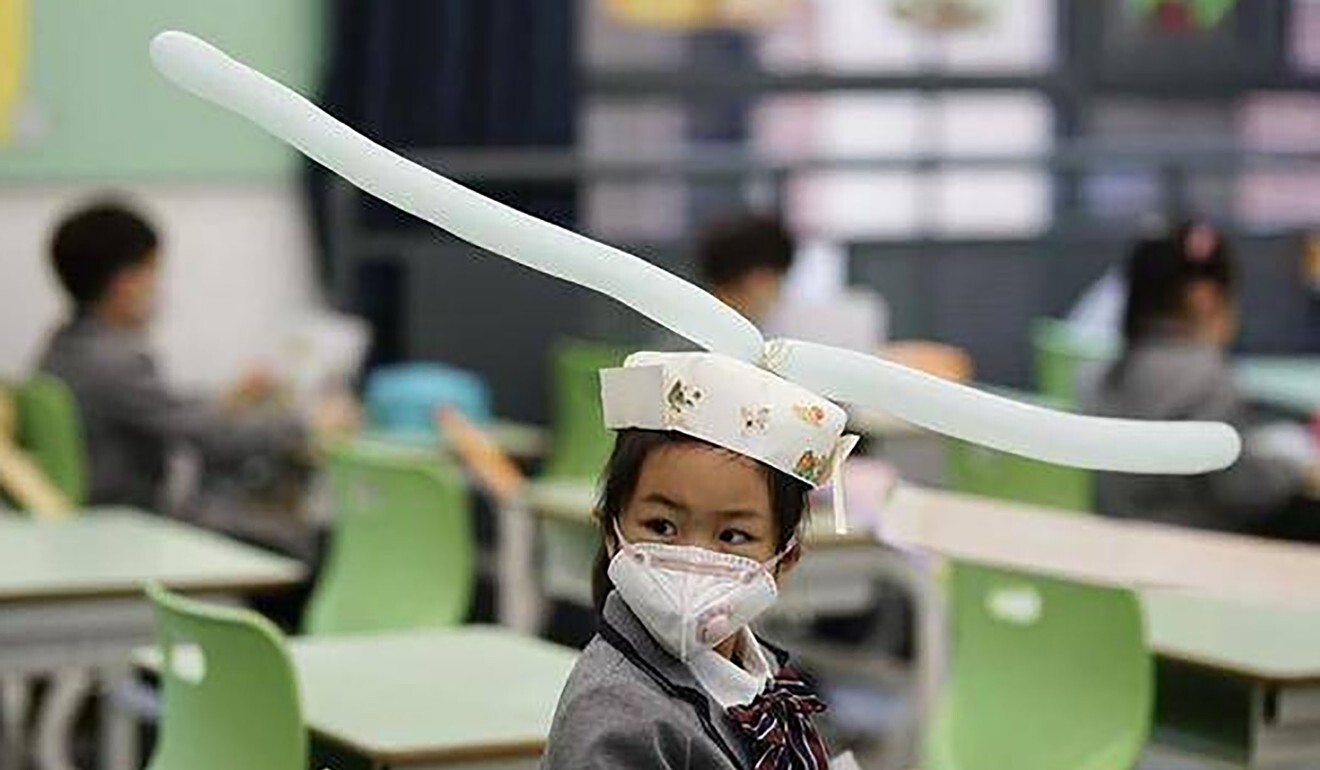
Pupils at the school wore their own handmade versions of the hats, which have long extensions, or wings, to keep them at least a metre (3ft) apart when they returned to school on Monday, state news agency Xinhua reported.
One legend says that the first Song emperor ordered his ministers to wear hats with two long wings on the sides so that they could not chitchat in court assemblies without being overheard, according to Tsui Lik-hang, a historian at City University of Hong Kong.
Pupils at a school in Hangzhou made their own versions of the hats. Photo: Weibo
However, he warned that this story came from a much later source, adding: “The Song emperors, in fact, were also depicted to have worn this kind of headwear with wing-like flaps.”
The World Health Organisation recommends that people stay at least a metre apart to curb the spread of the coronavirus that causes Covid-19.
Coronavirus droplets may travel further than personal distancing guidelines, study finds
16 Apr 2020
“If you are too close, you can breathe in the droplets, including the Covid-19 virus if the person coughing has the disease,” the global health body advises.
An early childhood education specialist said the hats were a good way to explain the concept of social distancing to young children, who find it difficult to understand abstract concepts.
The pupil’s head gear is designed to drive home the social distancing message. Photo: Weibo
“As children can see and feel these hats, and when the ‘wings’ hit one another, they may be more able to understand the expectations and remember to keep their physical distance,” said Ian Lam Chun-bun, associate head of the department of early childhood
Using pictures of footprints to indicate the right distance to keep when queuing, standing, and even talking to schoolmates was also helpful, said Lam, who recommended visual aids and aids that stimulate other senses, such as hearing and touch.
“We can use sharp colours or special textures, like tactile paving,” he added.








 CHINDIA ALERT: You'll be living in their world, very soon
Coronavirus: Chinese workers in Vietnam cry foul after being fired by Taiwanese firm making shoes for Nike, Adidas
A group of 150 Chinese workers believe the world’s largest maker of trainers used the coronavirus as an excuse to fire them, having helped Taiwanese firm Pou Chen successfully expand its production into Vietnam for more than a decade.
Pou Chen, which makes footwear for the likes of Nike and Adidas, informed the group in late April that they would no longer be needed as they were unable to return to
from their hometowns in China due to the coronavirus lockdowns.
“We 150 employees were the first batch of Chinese employees to be laid off this year. We are all pessimistic and expect more will be cut,” added Zhang.
In its email on April 27, Pou Chen said it was forced to terminate the contracts of the Chinese employees across five of its factories due to an unprecedented decline in orders and financial losses.
The Chinese employees, many of whom have been working for the shoemaker for decades, said the compensation offered was unfair and below the levels required by labour law in both Vietnam and China.
“[The dismissals were] in accordance with the relevant labour laws of the country of employment … and employee labour contracts,” added the statement from Pou Chen, which employs around 350,000 people worldwide.
Company data showed Pou Chen’s first quarter revenues tumbled 22.4 per cent year-on-year to NT$59.46 billion (US$1.99 billion), the weakest in six years.
With the likes of Nike and Adidas closing retail stores around the world to comply with social distancing requirements, analysts also said orders plummeted 50 per cent in the second quarter, although the company declined to comment on the media reports.
Andy Zeng, who had worked for the firm since 1995, said the group were “very upset” when they received the news last month as the impact of the coronavirus pandemic began to reverberate around the world, disrupting global value chains.
“Most of us joined Pou Chen in the 1990s when we were in our late teens or early 20s, when the Taiwan-invested company started investing and setting up factories in mainland China. Now more than two decades have passed,” he said.
Zeng was among the first generation of skilled workers in China as Pou Chen developed rapidly, enjoying the benefits of cheap labour, although the workers themselves were rewarded with regular pay rises.
The company needed a group of skilled Chinese workers to go to its new factories in Vietnam. I said yes because I thought it was a good opportunity to see the outside world – Andy Zeng
What our Chinese employees have done in Vietnam for more than a decade can be said to be very simple but very difficult – Dave Zhang
Posted in 50 per cent, accordance, Adidas, adjustment of manpower, around the world, automation level, below the levels, Bloomberg, boomed, bottlenecks, Chaos, cheaper, China, China’s economy, Chinese employees, Chinese workers, closing, comment, Company, compensation, comply, contributed, cooperated, coronavirus, coronavirus lockdowns, Covid-19 response, cry foul, cultural shock, deaths, decade, decline, declined, dismissals, disputes, Dong Nai, Dongguan, employee labour contracts,, expand, expendable, factories, families, financial losses, fired, footwear, furloughs, higher, hometowns, impact, Indonesia, Labour law, lack of orders, land, Mainland China, making, management experience, management style, media reports, Nike, opportunity, orders, pay cuts, pessimistic, plans, plummeted, Pou Chen, production, production line, relocation process, requirements, retail stores, returns, Reuters, Rush hour, second quarter, set up, shoe manufacturing, shoes, skilled, Social distancing, south china morning post, strain under, streets, strike, Taipei Times, Taiwan, Taiwan-invested, Taiwanese firm, Uncategorized, unfair, unprecedented, Vietnam, Vietnamese, Virus, workers, world’s largest maker of trainers | Leave a Comment »