Archive for ‘religion’

17/04/2020

India coronavirus: Officials suspended over large crowds at Hindu festival

People participating in the chariot-pulling festivalImage copyright ANI
Image caption People participating in the chariot-pulling festival

Indian officials have suspended a local magistrate and a police official for allowing large crowds to attend a chariot-pulling festival at a Hindu temple on Thursday morning.

A case has also been filed against the trustees of the temple and another 20 people, police told the BBC.

Pictures of the crowds caused outrage after they surfaced on social media.

It comes weeks after Covid-19 clusters were linked to a Muslim religious gathering in the capital, Delhi.

Revoor village, which is in the state’s Kalburagi district, has been sealed off and officials are rushing teams of medical personnel to set up fever clinics there, the deputy commissioner of the district, told the BBC.

Kalburagi recorded India’s first coronavirus-related death – it is also the first district to implement “containment areas”, which involves sealing off villages where infections are reported.

Revoor is also close to another village that has been sealed off after a two-year-old tested positive for coronavirus.

The festival was held despite temple trustees giving officials an undertaking that it would not go ahead, a state lawmaker, Priyank Kharge, told the BBC.

Officials say that the daily rituals were performed at the temple on Wednesday evening in the presence of a few priests and temple trustees.

But early the next morning, the chariot was brought out of the temple premises and was pulled by “hundreds of people,” according to one official. They estimate that under 1,000 devotees attended the event.

Source: The BBC

02/04/2020

Coronavirus latest: more than 21,000 dead as UN warns of threat to ‘whole of humanity’

  • US$2 trillion rescue package passes US Senate, heads to House
  • Malaysia’s king and queen in ‘self-quarantine’ after staff test positive
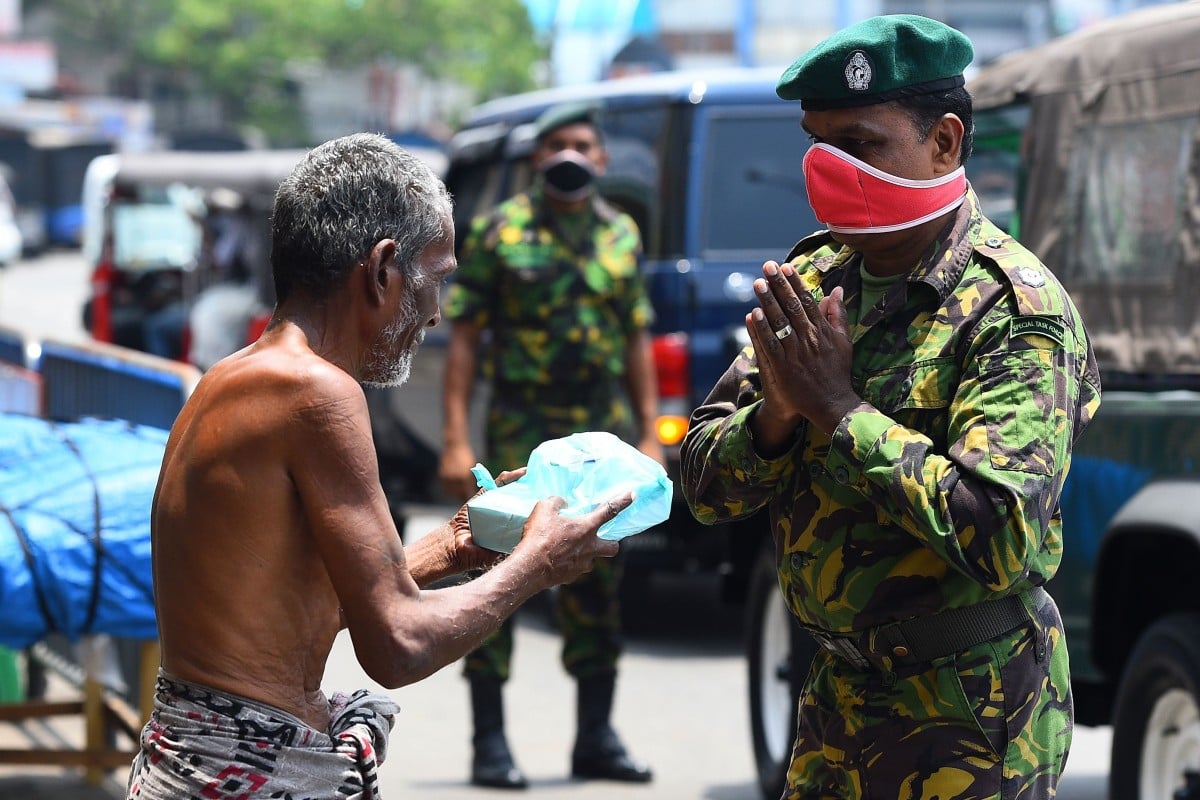
Police commandos in Sri Lanka hand out food to homeless people during a nationwide curfew against the spread of coronavirus. Photo: AFP

More than three billion people are living under lockdown measures as soaring death tolls in Europe and the US underlined a United Nations warning that the coronavirus, which has now infected nearly half a million people globally, threatens all of humanity.

The global death toll from the virus now stands at more than 21,000, with Spain joining Italy in seeing its number of fatalities overtake China, where the virus first emerged just three months ago.

“Covid-19 is threatening the whole of humanity – and the whole of humanity must fight back,” UN Secretary General Antonio Guterres said, launching an appeal for US$2 billion to help the world’s poor.

“Global action and solidarity are crucial. Individual country responses are not going to be enough.”

The G20 major economies will hold an emergency videoconference on Thursday to discuss a global response to the crisis, as will the 27 leaders of the European Union, the outbreak’s new epicentre.

The economic damage of the virus – and the lockdowns – could also be devastating, with fears of a worldwide recession worse than the financial meltdown more than a decade ago.

Here are the developments:

US$2 trillion rescue package passes US Senate

The US Senate passed the nation’s largest-ever rescue package late Wednesday, a US$2 trillion lifeline to suffering Americans, depleted hospitals and an economy all ravaged by a rapidly spreading coronavirus crisis.

The monster deal thrashed out between Republicans, Democrats and the White House includes cash payments to American taxpayers and several hundred billion dollars in grants and loans to small businesses and core industries. It also buttresses hospitals desperately in need of medical equipment and expands unemployment benefits.

The measure cleared the Senate by an overwhelming majority and was headed next to the House of Representatives, which must also pass it before it goes to President Donald Trump for his signature.

US President Donald Trump has voiced hope the US will be “raring to go” by mid-April, but his optimism appeared to stand almost alone among world leaders.

Unemployment benefit filings by Americans workers to surge to 3.3 million last week – the highest number ever recorded, the Labour Department reported on Thursday.

The normally routine report is at the front lines of the economic crisis caused by the outbreak, which has forced widespread closures of restaurants, shops and hotels, and brought airline travel to a virtual halt, prompting the stunning increase in people filing for benefits nationwide in the week ending March 21.

Nearly every state cited Covid-19 for the jump in initial jobless claims, with heavy impacts in food services, accommodation, entertainment and recreation, health care and transport, the report said.

Malaysia’s king and queen in quarantine after staff test positive

The official residence of Malaysia’s monarchy on Thursday confirmed seven of its staff have tested positive for Covid-19 and are currently receiving treatment at the Kuala Lumpur Hospital.

Malaysia’s king, Sultan Abdullah Sultan Ahmad Shah and queen, Tunku Azizah, have also been tested, but their results showed a clean bill of health, a spokesman for the Istana Negara said in a statement.

“Nevertheless, Their Majesties are now observing a 14-day self-quarantine, starting yesterday, ” he said.

Meanwhile, Prime Minister Muhyiddin Yassin, along with all federal ministers and their deputies, announced they will take a two-month pay cut, with the savings to be donated to Putrajaya’s Covid-19 fund.

The Prime Minister’s Office said the decision was made during a cabinet meeting and showed the government’s sincerity in helping those affected by the pandemic.

“The Covid-19 fund was launched on March 11 as part of the government’s efforts to help those who were affected by the disease outbreak,” the office said, adding that 8.5 million ringgit (US$1.97 million) has been collected, including government grants.

Malaysia on Wednesday announced a two-week extension of a national lockdown as part of stepped-up measures to contain the coronavirus outbreak.

The “movement control order,” which requires people to stay home and was originally set to expire on March 31, will now continue until April 14.

Moscow monitors people in coronavirus quarantine with 100,000 ‘under the skin’ surveillance cameras

Russia to ground international flights

Russia will halt all international flights from midnight on Friday under a government decree listing new measures against the coronavirus outbreak.
The decree published on Thursday orders aviation authorities to halt all regular and charter flights, with the exception of special flights evacuating Russian citizens from abroad.
The announcement came after Russia on Wednesday recorded its biggest daily spike in confirmed coronavirus infections so far, with 163 new cases for a total of 658 across the country.
Denis Protsenko, head doctor of Moscow’s new hospital treating coronavirus patients, told President Vladimir Putin that Russia needed to be ready for an “Italian scenario”, referring to what is now the hardest-hit country in the world in terms of deaths.

Singapore boosts stimulus package to 11 per cent of GDP

Singapore reported 52 new coronavirus cases on Thursday, taking its tally to 683 infections.

The health ministry said that out of the 52, 28 were imported while 24 were locally transmitted.

The city state earlier on Thursday unveiled more than $30 billion in new measures to help businesses and households fight the coronavirus pandemic that threatens to push the bellwether economy into a deep recession.

Drawing on national reserves for the first time since the global financial crisis to support an economy heading for recession, the additional spending will push up the government’s virus-related relief to almost S$55 billion, or 11 per cent of gross domestic product, Finance Minister Heng Swee Keat said in a speech in parliament Thursday. It also will widen the budget deficit for the financial year starting April 1 to 7.9 per cent of GDP, from a previous target of 2.1 per cent.

“This extraordinary situation calls for extraordinary measures,” Heng said. “We have saved up for a rainy day. The Covid-19 pandemic is already a mighty storm, and is still growing.”

Coronavirus: Italy’s slowing infection rate boosts case for lockdowns

26 Mar 2020
‘If you catch it, don’t spread it to others’, 1949 flu advice still applies to coronavirus pandemic

Imported cases rise in China

Mainland China reported a second consecutive day of no new local coronavirus infections as the epicentre of the epidemic Hubei province opened its borders, but imported cases rose as Beijing ramped up controls to prevent a resurgence of infections.

A total of 67 new cases were reported as of end-Wednesday, up from 47 a day earlier, all of which were imported, China’s National Health Commission said in a statement on Thursday.

The total number of cases now stands at 81,285.

The commission reported a total of 3,287 deaths at the end of Wednesday, up six from the previous day.

All of the new patients were travellers who came to China from overseas, with the mainland reporting no locally transmitted infections on Wednesday.

Fearing a new wave of infections from imported cases, authorities have ramped up quarantine and screening measures in other major cities including Beijing, where any travellers arriving from overseas must submit to centralised quarantine.

Coronavirus could become seasonal

There is a strong chance the new coronavirus could return in seasonal cycles, a senior US scientist said Wednesday, underscoring the urgent need to find a vaccine and effective treatments.

Anthony Fauci, who leads research into infectious diseases at the National Institutes of Health, told a briefing the virus was beginning to take root in the southern hemisphere, where winter is on its way.

“What we’re starting to see now … in southern Africa and in the southern hemisphere countries, is that we’re having cases that are appearing as they go into their winter season,” he said.

“And if, in fact, they have a substantial outbreak, it will be inevitable that we need to be prepared that we’ll get a cycle around the second time.

“It totally emphasises the need to do what we’re doing in developing a vaccine, testing it quickly and trying to get it ready so that we’ll have a vaccine available for that next cycle.”

There are currently two vaccines that have entered human trials -one in the US and one in China – and they could be a year to a year-and-a-half away from deployment.

British Columbia is testing for Covid-19 faster per head than South Korea
27 Mar 2020

Spain extends emergency by two weeks

Spain’s parliament has voted in favour of the government’s request to extend the state of emergency by two weeks that has allowed it to apply a national lockdown in hopes of stemming its coronavirus outbreak.

The parliamentary endorsement will allow the government to extend the strict stay-at-home rules and business closings for a full month. The government declared a state of emergency on March 14. It will now last until April 11.

Spain’s government solicited the two-week extension after deaths and infections from the Covid-19 virus have skyrocketed in recent days. Spain 47,600 total cases. Its 3,434 deaths only trail Italy’s death toll as the hardest-hit countries in the world.

The parliament met with fewer than 50 of its 350 members in the chamber, with the rest voting from home to reduce the risk of contagion.

Greece locks down Muslim towns

Greek authorities have quarantined a cluster of Muslim-majority towns and villages in the country’s northeast after several cases and a death from the new coronavirus in the area.

The area in Xanthi prefecture was placed in lockdown as of Wednesday evening as nine people in the region overall have tested positive for the virus over the past six days, civil protection deputy minister Nikos Hardalias told reporters.

“All residents have been temporarily confined at home. No exceptions are allowed,” Hardalias said.

The centre of the outbreak appears to be the small Pomak town of Ehinos, a community of about 2,500.

“Ehinos residents will be provided with food and medicine,” Hardalias said.

Police were deployed on Thursday on a bridge leading into town to enforce the lockdown, television footage showed.

One 72-year-old Ehinos man has died from the virus, local mayor Ridvan Deli Huseyin told Antenna television.

“It’s better to take some measures now than to cry about this later,” said Huseyin, the mayor of the local administrative centre of Miki.

The Pomaks are a Muslim group of Slavic origin who live mainly in neighbouring Bulgaria.

They make up part of Greece’s roughly 110,000-strong Muslim minority in the country’s northeast bordering Turkey.

Many of them work as migrant industrial workers in other European countries.

Economy seats go for business-class fares as travellers flee
27 Mar 2020

Colombia goes into lockdown, Chile extends schools closures

Countries across Latin America tightened measures on Wednesday to halt the spread of the deadly novel coronavirus, with more lockdowns, border closings and school closures as well as increased aid to the region’s poorest.

As cases of Covid-19 cases continue to rise – more than 7,400 and 123 deaths up to now – Bolivia and Colombia became the latest countries to impose a total lockdown, while Chile extended its schools closures until the end of April.

Brazil’s President Jair Bolsonaro has warned of possible “chaos” and the “looting” of supermarkets if state shutdowns ordered by the governors of Sao Paulo and Rio de Janeiro aren’t ended.

Bolsonaro, who has repeatedly scoffed at the severity of the deadly pandemic, had previously criticised the closing of schools and businesses in Sao Paulo and Rio states, two of the country’s most populous states.

Germany ramps up testing, approves huge bailout

Germany has boosted its coronavirus test rate to 500,000 a week, Christian Drosten, who heads the Institute of Virology at Berlin’s Charite University Hospital, said on Thursday, adding that early detection has been key in keeping the country’s death rate relatively low.

Drosten also highlighted Germany’s dense network of laboratories spread across its territory as a factor contributing to early detection.

The news came after Chancellor Angela Merkel’s government secured emergency spending, unlocking a historic rescue package designed to cushion the blow of the coronavirus pandemic.

A majority of lawmakers in the Bundestag voted on Wednesday to allow additional borrowing to combat the crisis, according to the legislature’s president. The Bundesrat, or upper house of parliament, will vote on Friday.

The extraordinary authorisation is part of a packet of legislation aimed at protecting German jobs and businesses. The new borrowing of €156 billion (US$169 billion) is equivalent to half of the country’s normal annual spending.

The country, which tightened lockdown measures this week, has about 32,700 cases and more than 150 deaths.

Trump and Widodo back chloroquine treatment, but fake news is deadly

25 Mar 2020

Ukraine declares ‘emergency situation’

Ukraine on Wednesday declared a month-long “emergency situation” to slow the coronavirus outbreak, as the number of confirmed cases jumped to 113.

Ukraine has already closed schools, universities and public spaces to stem the spread of the disease, but the measures were due to expire at the beginning of April.

The emergency situation announced on Wednesday effectively extends existing measures for 30 days until April 24, a government spokesperson said.

“We are extending quarantine and imposing an emergency situation in Ukraine,” Prime Minister Denys Shmygal said.

Unlike an official state of emergency, the initiative announced by the prime minister does not have to be rubber stamped by both the parliament and president. Ukraine has confirmed 113 cases of Covid-19 and four deaths, according to official statistics.

Prince Charles tests positive for coronavirus

Mexican governor says poor are ‘immune’

The governor of a state in central Mexico is arguing that the poor are “immune” to the new coronavirus, even as the federal government suspends all non-essential government activities beginning Thursday in a bid to prevent the spread of the virus.

Puebla Governor Miguel Barbosa’s comment on Wednesday was apparently partly a response to indications that the wealthy have made up a significant percentage of Mexicans infected to date, including some prominent business executives.

Officials say three-quarters of Mexico’s 475 confirmed cases are related to international travel, and the poor do not make many international trips. Some people apparently caught the virus on ski trips to Italy or the United States. The country has seen six deaths so far.

“The majority are wealthy people. If you are rich, you are at risk. If you are poor, no,” Barbosa said of the coronavirus. “We poor people, we are immune.”

Barbosa also appeared to be playing on an old stereotype held by some Mexicans that poor sanitation standards may have strengthened their immune systems by exposing them to bacteria or other bugs.

There is no scientific evidence to suggest the poor are in any way immune to the virus that is causing Covid-19 disease around the world.

No agreement on ‘Wuhan virus’ name as G7 spars over infection source

26 Mar 2020

Japan belatedly bans entry from Europe, Iran

Japanese Prime Minister Shinzo Abe has established a task force under the country’s revised emergency law to deal with the global rise in coronavirus infections and deaths.

In Tokyo on Thursday, Abe said it was necessary for people to act as one to overcome what can be described as a national crisis.

Japan will ban entry from 21 European countries as well as Iran, to take effect from Friday, he added.

The country has already begun asking visitors and its nationals arriving from some countries in Southeast Asia, the Middle East and Africa to self-quarantine for 14 days.

Arrivals from a total of seven Southeast Asian countries and four in the Middle East and Africa are also asked to refrain from using public transport.

Similar steps are in place for visitors from China, South Korea, most of Europe and the United States.

Malaysia to lock down two communities to curb spread

Malaysia on Thursday announced that 3,570 residents in two communities in the country’s south will be placed under complete lockdown due to their high coronavirus infection rates.

Defence Minister Ismail Sabri Yaakob said in a statement that the residents in Kluang district of Johor state are banned from leaving home for two weeks beginning Friday, to enable the health authorities to conduct door-to-door screening.

The tough measure was taken after 73 per cent of the 83 infection cases found in the district were traced to the two small communities of Kampung Dato Ibrahim Majid and Bandar Baru Dato Ibrahim Majid.

Ismail said the residents cannot leave home, not even to buy food, as the welfare department will supply them with two weeks’ worth of food. All businesses must close and all access into the two areas will be sealed. The police and army have been deployed to ensure compliance.

Australia scraps haircut time limit

The Australian government scrapped a time limit on haircuts following a backlash.

The government had imposed a rule on hairdressers and barbers on Tuesday that haircuts should take less than 30 minutes, as part of social distancing restrictions to deal with the coronavirus outbreak.

The restriction put around 40,000 hairdressers at risk, the Australian Hairdressing Council said in response.

“This decision is outrageous,” the council’s chief executive Sandy Chong said in a statement.

“Whilst many barbers can do a male haircut within that time frame, it really isn’t feasible for a majority of hairdressing salons.”

Australian Prime Minister Scott Morrison issued a statement Thursday saying the policy would be reversed with immediate effect.

But salons and barbers must still strictly observe new rules that there may only be one person per four square metres within the premises, Morrison said.

India unveils US$22.6 billion stimulus package

India’s government announced a 1.7 trillion rupee (US$22.6 billion) stimulus package, as it stepped up its response to the coronavirus pandemic.

The measures will include cash transfers as well as steps on food security, Finance Minister Nirmala Sitharaman said in New Delhi on Thursday, adding that the package will benefit migrant workers.

Asia’s third-largest economy joins countries from the US to Germany that have pledged spending to contain the economic fallout of the pandemic. India is on a total lockdown for three weeks from Wednesday in the world’s biggest isolation effort, as Prime Minister Narendra Modi seeks to prevent the virus from spreading locally.

The government will also provide an insurance cover of 5 million rupees to medical workers, Sitharaman said.

Source: SCMP

19/03/2020

Coronavirus: Indian cities go eerily quiet as cases rise

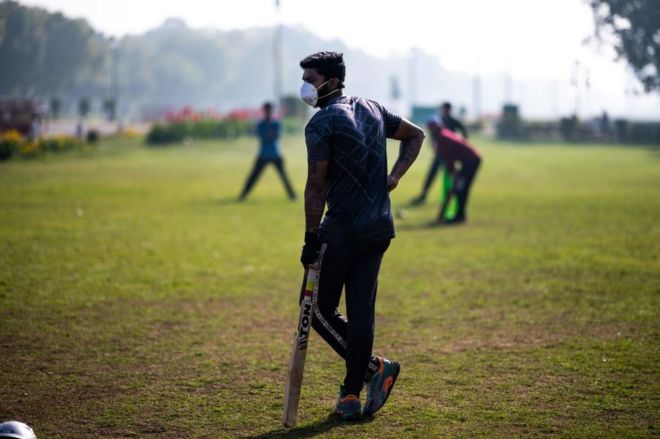
A youth (C) wearing a facemask as a preventive measure against the COVID-19 coronavirus plays cricket with his friends at a park in New Delhi on March 18, 2020.Image copyright GETTY IMAGES
Image caption Small groups of young people can be seen playing sports as schools, colleges and even gyms are shut.

Life in India has changed dramatically as the world’s second-most populous country grapples with the coronavirus outbreak.

Otherwise crowded and chaotic cities have quietened down as people stay home, traffic slows and even weddings shrink in size and scale.

India has confirmed 151 active cases and three deaths – but public health experts fear that the low count is the result of limited testing and under-reporting. The country has only conducted about 12,000 tests so far, partly because of a shortage of testing kits.

So it’s still unclear if and to what extent community transmission exists in India – community transmission means a patient had no known contact with another confirmed case or travelled from a country badly affected by the pandemic.

However, India’s central government, several state governments and city administrations have already responded with drastic measures.

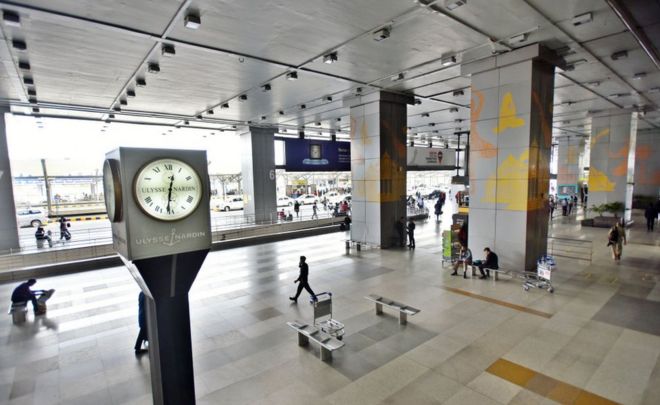
Low footfall seen at Indira Gandhi International (IGI) Airport amid rising coronavirus fear on March 16, 2020 in New Delhi, India.Image copyright GETTY IMAGES

The Indira Gandhi international airport in the national capital Delhi, is the country’s busiest airport but it appears deserted nowadays.

India has barred entry to everyone, including citizens, flying from certain countries, including the UK and most European nations. It has also cancelled most entry visas to people (excluding citizens) flying in from other countries.

This has led to numerous flight cancellations.

Airlines are also struggling as fewer people are flying even within India, wary that new regulations could see them stranded away from their homes. Two of India’s top airlines are reportedly considering grounding planes amid plummeting demand for flights.

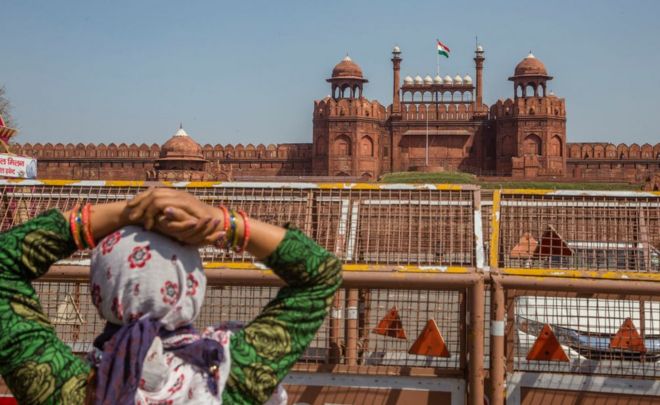
An Indian tourist disappointed to see the Red Fort, closed for tourists to prevent spread of Covid-19, as she look towards the ford on March 17, 2020 in New Delhi, India.Image copyright GETTY IMAGES

Popular Indian monuments – such as the 16th Century Red Fort in Delhi – have been shut to visitors to prevent large gatherings.

Taj Mahal, the country’s most iconic monument, closed its doors on Tuesday, along with more than 140 other monuments and museums.

With fewer people visiting and closures of public places likely to go up, tourism is expected to take a huge hit across India – the Taj alone draws as many as 70,000 people a day.

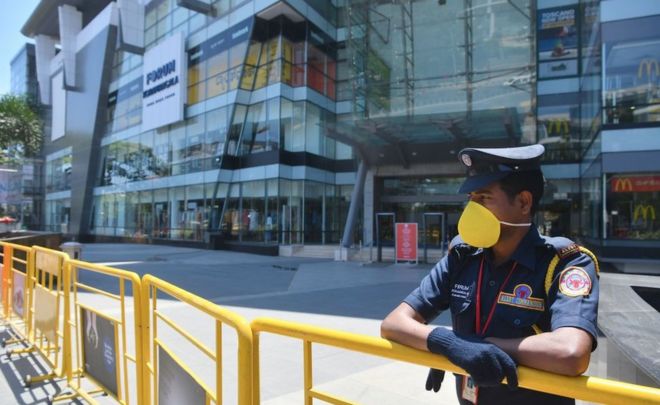
A security personnel stands guard in front of a closed shopping mall amid concerns over the spread of the COVID-19 novel coronavirus, in Bangalore on March 16, 2020.Image copyright GETTY IMAGES

Bangalore, an IT hub in southern India, is among the major cities that has shut down its malls – such as the one above – and schools, colleges, cinema halls and other public places have been closed since late last week. Other major cities such as Delhi, the financial hub Mumbai and Hyderabad in the south, have done the same.

City officials have also imposed restrictions on large gatherings such as weddings, cricket matches or any public ticketed events.

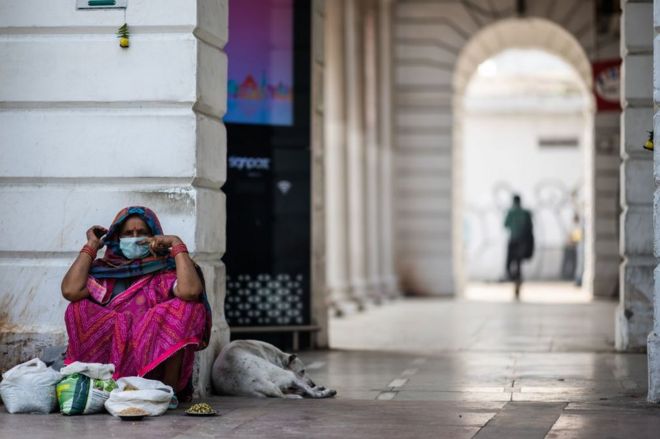
A bird feed vendor wearing a facemask as a preventive measure against the COVID-19 coronavirus waits for customers at a market area in New Delhi on March 19, 2020Image copyright GETTY IMAGES

Some of Delhi’s busiest spots, such as Connaught Place, are mostly empty.

There has also been a significant drop in the number of people using trains, which remain the most popular form of transport in India.

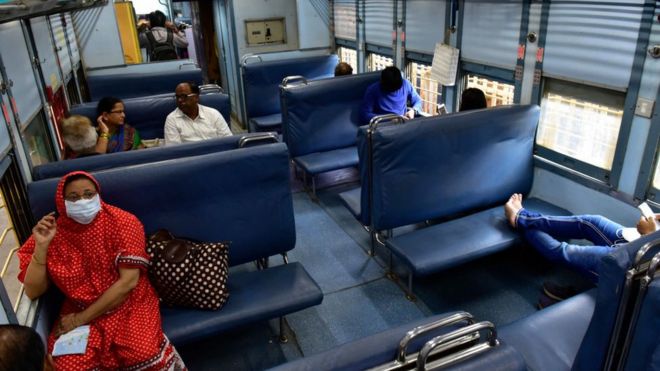
Around 25% to 30% drop of passenger traveling from Mumbai to Pune in Deccan Queen was observed after coronavirus outbreak, at CSMT, on March 16, 2020 in Mumbai, India.Image copyright GETTY IMAGES

The service from Mumbai to Pune city – which takes about three to four hours – has seen about a 30% fall in passenger traffic, according to some estimates.

The western state of Maharashtra, where both cities are located, has reported the highest number of cases in India so far. The central railways has already cancelled 23 long distance trains going to and from Mumbai – officials say the reason is both the virus and the lower number of passengers.

Overall, more than 150 trains have been cancelled across India. This number could increase in coming days.

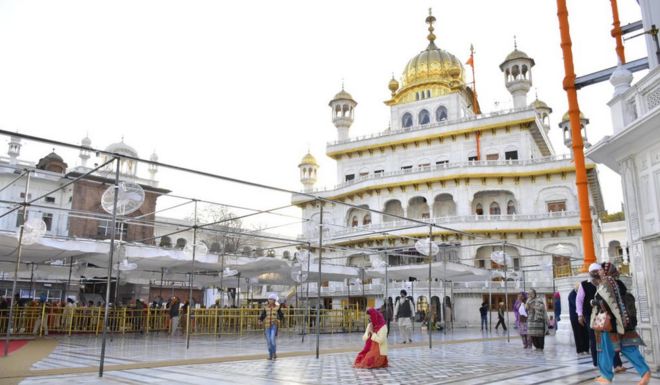
Low footfall of devotees seen at Golden Temple due to the spread of coronavirus (COVID-19) on March 17, 2020 in Amritsar, India.Image copyright GETTY IMAGES

Many holy sites, including the Golden Temple – one of the holiest shrines in Sikhism – remain open, although the footfall is much lower. It’s quite unusual to see such few people in what is one of India’s busiest shrines.

Tirumala Tirupati, the richest Hindu temple, has cancelled many of its daily rituals and is restricting the number of pilgrims for the first time.

Some major Hindu temples, such as the Siddhivinayak temple in the heart of Mumbai, and the Vaishno Devi cave shrine, have closed.

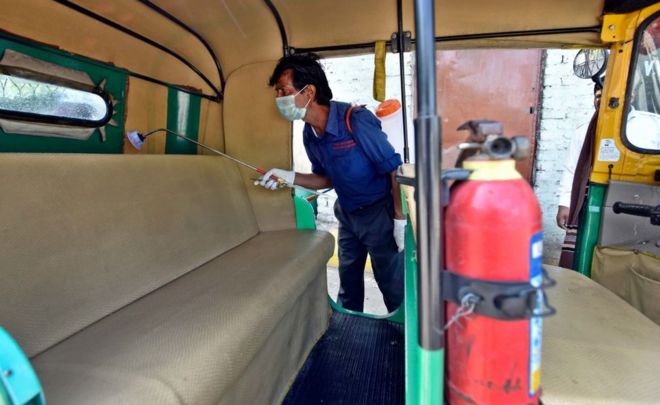
DTC cleaning staff chemically disinfect and sanitize auto rickshaw as a precautionary measure in view of coronavirus concerns, at Vasant Vihar Depot on March 17, 2020 in New Delhi, India.Image copyright GETTY IMAGES

City officials in Delhi have begun sanitising auto rickshaws and taxis to contain the spread of the virus.

Public transport poses a major challenge to containing the outbreak. But it continues to be used regularly across India, even as governments encourage people to stay home as much as possible.

But not all offices have work from home options, and this is especially a challenge for the millions who work in India’s informal sector – these include domestic help, street vendors and daily wage workers.

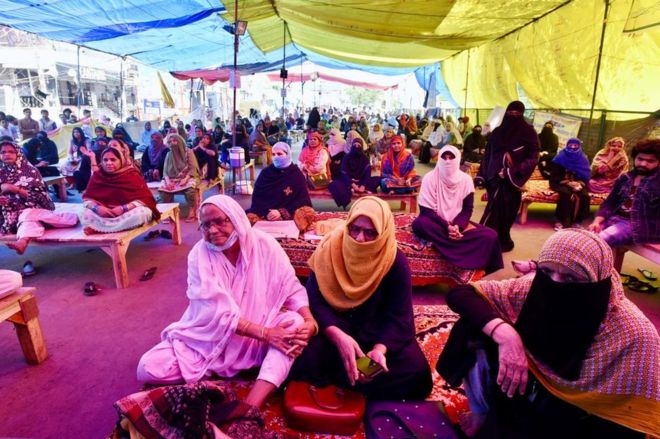
Women of Shaheen Bagh continue their sit-in protest against the CAA-NRC-NPR despite the Coronavirus advisory issued by Delhi government, at Shaheen Bagh on March 17, 2020 in New Delhi, India.Image copyright GETTY IMAGES

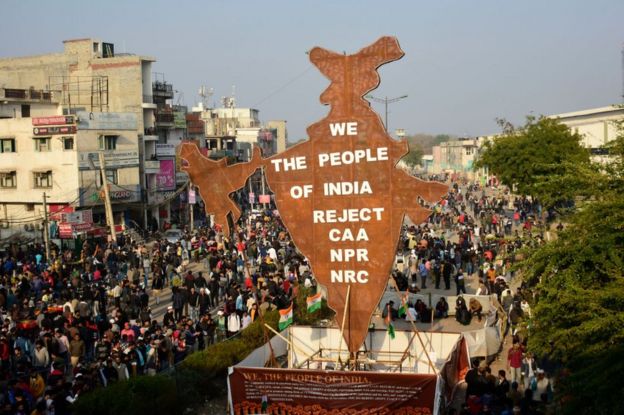
Surprisingly, sit-in protests against India’s controversial new citizenship law continue in some cities, including Delhi and Bangalore.

The most prominent of these, pictured above, is happening in Delhi’s Shaheen Bagh neighbourhood. Thousands of protesters, mostly Muslim women, have been demonstrating against the law, which critics say is anti-Muslim, since December.

But Delhi has shut down schools, colleges, gyms, night clubs, spas and swimming pools – and Chief Minister Arvind Kejriwal has said all social, political and religious gatherings with more than 50 people would be stopped.

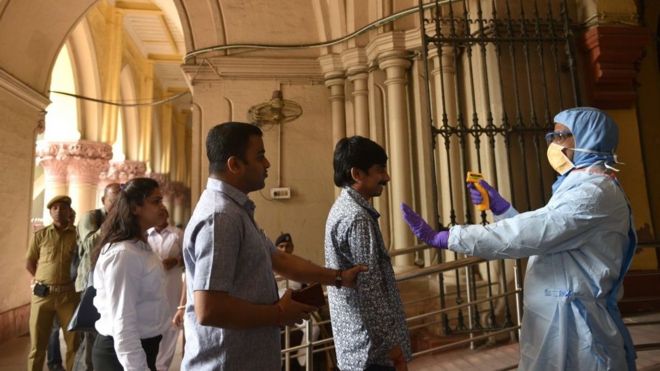
Doctor of West Bengal Health Government Department conduct thermal screening as prevention from coronavirus (COVID-19) infection at Kolkata High Court in Kolkata, India on Tuesday, March 17, 2020.Image copyright GETTY IMAGES

Temperature checks have become a common feature across cities – here, people are being screened before they enter the high court in the eastern city of Kolkata (formerly Calcutta).

This practice has been adopted at airports, corporate offices and several other places that remain open despite the restrictions.

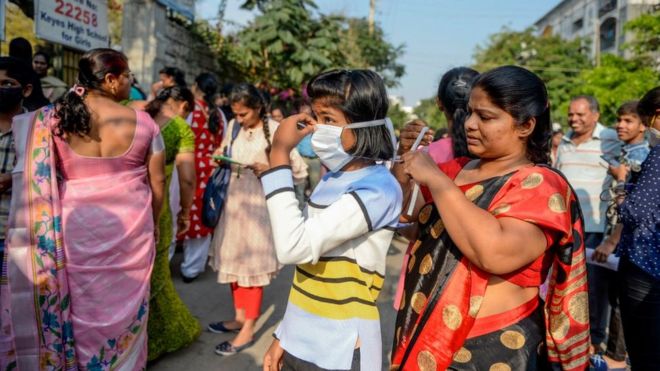
A mother ties a facemask on her daughter amid concerns over the spread of the COVID-19 coronavirus as she attends the first day of her tenth class examinations in Secunderabad, the twin city of Hyderabad, on March 19, 2020.Image copyright GETTY IMAGES

In the southern city of Hyderabad, students appeared for their school-leaving exams, but they came armed with masks.

Delhi, however, has postponed all school examinations.

Experts say India could impose more sweeping lockdowns as the toll climbs further.

Source: The BBC

28/02/2020

Amid Delhi’s blood-letting, a Hindu bride weds in a Muslim neighbourhood

NEW DELHI (Reuters) – As deadly clashes between Hindu and Muslim groups rocked parts of the Indian capital Delhi this week, the family of a young Hindu woman living in a Muslim-majority area was forced to cancel her wedding.

Dressed in her wedding finery, her hands laced maroon with henna and her skin cleansed with turmeric, 23-year-old Savitri Prasad said she was weeping in her home as violent mobs battled outside on Tuesday, which was to have been her wedding day.

But Savitri’s father then organised the wedding for the following day, saying his Muslim neighbours were family and he was comforted by their presence.

“My Muslim brothers are protecting me today,” Savitri told a Reuters team that visited the house on the day of the ceremony, breaking down again as her family and neighbours comforted her.

The rituals took place at Savitri’s home, a small brick building in a narrow alley in the Chand Bagh district. Steps away, the main street looked like a war zone, with cars and shops vandalised, a Muslim shrine torched and the area littered with rocks used in pitched battles between mobs on both sides.

At least 32 people have been killed in the fighting in Chand Bagh and nearby areas of the capital this week, and hundreds of Hindus and Muslims have been injured in the worst sectarian riots in the Indian capital in decades.

“We went to the terrace and just saw smoke and more smoke,” Bhoday Prasad, Savitri’s father, said of the scene on Monday and Tuesday. “It is terrifying. We just want peace.”

Bhoday Prasad said he has lived in the area for years alongside Muslims without any trouble.

“We don’t know who the people behind the violence are, but they are not my neighbours. There is no enmity between Hindus and Muslims here.”

On Monday evening, the day Savitri was to have henna applied on her hands in a pre-wedding ritual, violence had already spiralled out of control.

“We could hear a lot of commotion outside, but I had the henna applied, hoping things would be better next day,” she said. Instead, they got worse.

Her father told the groom and his family it was too dangerous to come to the house.

“Our heart pains for her, who would want their daughter to be sitting home crying when she is supposed to be happy?” said Sameena Begum, one of the Muslim neighbours.

Violence ebbed on Wednesday, but markets remained shut and residents stayed indoors, fearful of further clashes. Savitri’s father said he decided to organise a scaled-down ceremony.

“Hindu or Muslim, we are all humans and we are all terrified of the violence,” said Savitri’s cousin Pooja, as she helped the bride dress for the ceremony. “This fight was not about religion, but it has been made so.”

Muslim neighbours gathered to offer blessings as the groom arrived and the wedding rituals took place, with a Hindu priest reciting holy verses and the groom and bride taking the rounds of a small pyre set up inside the house.

“We live peacefully with our Hindu brothers,” said Aamir Malik, who was standing guard with several other men outside the home. “We are everything for them. It’s been like that. We are here for them.”

Following an exchange of garlands, Savitri, her husband and his family were escorted out of the alleys by her family and neighbours.

“Today, none of our relatives could attend my daughter’s wedding,” said Bhoday Prasad. “But our Muslim neighbours are here. They are our family.”

Source: Reuters

24/02/2020

New coronavirus cases rise in Italy, Korea and Iran but fall in China

BEIJING/SEOUL (Reuters) – Italy, South Korea and Iran reported sharp rises in coronavirus infections on Monday, triggering concern from the World Health Organization (WHO), but China relaxed some curbs on movement, including in Beijing, as the rate of new infections there eased.

The virus has put Chinese cities into lockdown, disrupted air traffic to the workshop of the world and blocked global supply chains for everything from cars and car parts to smartphones.

The surge of cases outside mainland China triggered steep falls in global share markets and Wall Street stock futures as investors fled to safe havens. Gold soared to a seven-year high, oil tumbled nearly 4% and the Korean won KRW= fell to its lowest level since August.[MKTS/GLOB]

But U.S. Treasury Secretary Steven Mnuchin cautioned against jumping to conclusions about the impact on the global economy or supply chains, saying it was simply too soon to know.

The World Health Organization (WHO) said it no longer had a process for declaring a pandemic, but that the coronavirus outbreak remained an international emergency.

“We are specially concerned about the rapid increase in cases in … Iran, Italy and the Republic of Korea,” WHO head Tedros Adhanom Ghebreyesus told a news conference in Sweden via video link from Geneva.

South Korea reported 231 new cases, taking its total to 833. Many are in its fourth-largest city, Daegu, which became more isolated with Asiana Airlines (020560.KS) and Korean Air (003490.KS) suspending flights there until next month.

Iran, which announced its first two cases last Wednesday, said it had confirmed 43 cases and eight deaths. Most of the infections were in the Shi’ite Muslim holy city of Qom.

Elsewhere in the Middle East, Bahrain and Iraq reported their first cases and Kuwait reported three cases involving people who had been in Iran.

Saudi Arabia, Kuwait, Iraq, Turkey, Pakistan and Afghanistan imposed restrictions on travel and immigration from Iran. Afghanistan also reported its first case, officials said.

The WHO has been saying for weeks that it dreads the disease reaching countries with weak health systems.

Europe’s biggest outbreak is in Italy, with some 150 infections – compared with just three before Friday – and a fifth death.

‘SEVERE AND COMPLEX’

Scientists around the world are scrambling to analyze the virus, but a vaccine is probably more than a year away.

“Worryingly, it seems that the virus can pass from person to person without symptoms, making it extremely difficult to track, regardless of what health authorities do,” said Simon Clarke, an expert in cellular microbiology at the University of Reading in Britain.

China postponed the annual meeting of its parliament in Beijing.

But there was a measure of relief for the world’s second-largest economy as more than 20 province-level jurisdictions, including Beijing and Shanghai, reported zero new infections, the best showing since the outbreak began.

President Xi Jinping urged businesses to get back to work, though he said the epidemic was still “severe and complex, and prevention and control work is in the most difficult and critical stage”.

Excluding the central Hubei province, center of the outbreak, mainland China reported 11 new cases, the lowest since the national health authority started publishing nationwide daily figures on Jan. 20.

The coronavirus has infected nearly 77,000 people and killed more than 2,500 in China, most in Hubei.

Overall, China reported 409 new cases on the mainland, down from 648 a day earlier, taking the total number of infections to 77,150 cases as of Feb. 23. The death toll rose by 150 to 2,592.

Outside mainland China, the outbreak has spread to about 29 countries and territories, with a death toll of about two dozen, according to a Reuters tally.

Xi said on Sunday the outbreak would have a relatively big, but short-term, impact on the economy and the government would step up policy adjustments to help cushion the blow.

Mnuchin, speaking to Reuters in the Saudi city of Riyadh, said he did not expect the coronavirus to have a material impact on the Phase 1 U.S.-China trade deal.

“Obviously that could change as the situation develops,” he added.

In northern Italy, authorities sealed off the worst-affected towns and banned public gatherings across a wide area, halting the carnival in Venice, where there were two cases.

Austria briefly suspended train services over the Alps from Italy after two travelers coming from Italy showed symptoms of fever.

Both tested negative for the new coronavirus but Austrian Interior Minister Karl Nehammer said a task force would meet on Monday to discuss whether to introduce border controls.

Japan had 773 cases as of late Sunday, mostly on a cruise ship quarantined near Tokyo. A third passenger, a Japanese man in his 80s, died on Sunday.

In South Korea, authorities reported a seventh death and dozens more cases on Monday. Of the new cases, 115 were linked to a church in the city of Daegu.

Drone footage showed what appeared to be hundreds of people queuing in a neat line outside a Daegu supermarket under the winter sunshine to buy face masks. ( tmsnrt.rs/37WP6lA )

Source: Reuters

21/02/2020

India woman held for chanting ‘long live Pakistan’ at citizenship protest

Amulya Leona at the protest event in BangaloreImage copyright ANI

Image caption Ms Leona was charged with sedition at a protest event in Bangalore city

An Indian woman has been arrested and charged with sedition for chanting “long live Pakistan” at a protest in the southern city of Bangalore.

Amulya Leona was participating in a demonstration against a controversial citizenship law, which critics say discriminates against Muslims.

Her comments were immediately condemned by a prominent local Muslim politician.

Asaduddin Owaisi, who was at the rally, said neither he nor his party supported India’s “enemy nation Pakistan”.

Muslim politicians in Hindu-majority India are often targeted as being “pro-Pakistan” by political rivals, particularly in the last few years. The neighbouring countries have a historically tense relationship, fighting three wars since Pakistan’s formation following the partition of India in 1947.

After the incident at the protest against the Citizenship Amendment Act (CAA) went viral, Ms Leona and her family were the target of massive outrage.

Clips of her comment were circulated widely, and her father has complained that a group of people came to his house and forced him to chant “hail mother India”. They also told him that he had not brought his daughter up properly and threatened him against getting bail for her.

Police in the district told BBC Hindi that they are investigating his complaint, adding that Ms Leona would be produced before a judicial magistrate in 14 days.

What is the CAA?

The law offers amnesty to non-Muslim illegal immigrants from three countries – Pakistan, Bangladesh and Afghanistan.

It amends India’s 64-year-old citizenship law, which currently prohibits illegal migrants from becoming Indian citizens.

Media caption Anti-citizenship law protests spread across Indian cities

It also expedites the path to Indian citizenship for members of six religious minority communities – Hindu, Sikh, Buddhist, Jain, Parsi and Christian – if they can prove that they are from Muslim-majority Pakistan, Afghanistan or Bangladesh. They will now only have to live or work in India for six years – instead of 11 years – before becoming eligible to apply for citizenship.

The government says this will give sanctuary to people fleeing religious persecution, but critics argue that it will marginalise India’s Muslim minority.

Source: The BBC

11/02/2020

The school play that sent a mother to prison

Shaheen School in Bidar
Image caption A play staged at Shaheen School has led to the arrest of a parent and a teacher

An Indian school play involving nine to 12-year-olds became the subject of national attention after it landed a young mother and a teacher in jail. BBC Telugu’s Deepthi Bathini reports.

“I’m not sure how I ended up here,” says 26-year-old Nazbunnisa, a single mother who did not give her last name and who works as a domestic help.

She was arrested on 30 January, along with Farida Begum, a teacher at her daughter’s school. The charge against them: sedition, which the women, both Muslim, deny.

They spoke to the BBC in a prison official’s office at Bidar district jail in the southern state of Karnataka. Both were on the verge of tears – they said they are trying to be “strong”, but their lives have suddenly turned “upside down”.

Their bail hearing is scheduled for Tuesday. Their lawyer says the charge of sedition is being misused.

Indian people protest against the controversial Citizenship Amendment Act (CAA), the National Register of Citizens (NRC) and the National Population Register (NRP) in Shaheen bagh area of New Delhi, India on 02 February 2020.Image copyright GETTY IMAGES
Image caption The citizenship law has sparked huge protests

It stems from a colonial-era law that was used to quash dissent, but is still deployed liberally despite the Supreme Court’s attempt to limit it by making incitement to violence a necessary condition.

The two women are accused of spreading “false information” and of “spreading fear among [the] Muslim community” and of using children to insult India’s Prime Minister, Narendra Modi.

Their ordeal began with a play put on by the students and staff at Shaheen School in Bidar, where Ms Nazbunnisa’s daughter studies and Farida Begum, 52, teaches.

The play was about a controversial new citizenship law, which has polarised India since it was passed in December by the governing Hindu nationalist Bharatiya Janata Party (BJP).

The Citizenship Amendment Act (CAA), offers amnesty to non-Muslim immigrants from Pakistan, Bangladesh and Afghanistan. It sparked fear among India’s 200 million-plus Muslims as it came in the wake of the government’s plans to introduce a National Register of Citizens (or NRC) based on those who can prove their ancestors were Indian citizens.

Authorities are yet to clarify what documents would be needed to prove citizenship, but taken together, the measures have spurred massive protests – critics say the government is marginalising Muslims while offering a path to citizenship for people of other religious communities who fail to make it on to the NRC.

The governing BJP denies these charges, and insists India’s Muslims have nothing to worry about.

So, given the contentious subject, after one of the parents streamed the school play live on Facebook, the recording quickly went viral. Local resident Neelesh Rakshal was among those who watched it.

Mr Rakshal, who describes himself as a social activist, says he became furious over a scene where a man approaches an elderly woman and tells her that Narendra Modi wants Muslims to produce documents proving their Indian citizenship and that of their ancestors, and if they fail to do so, they will be asked to leave the country.

Neelesh Rakshal
Image caption Mr Rakshal says the play “spreads hatred”

The woman responds that she has been in India for generations and would have to dig up the graves of her ancestors to look for documents. She then says a “boy who was selling tea”, a reference to Mr Modi who has said he used to sell tea as a teenager, is now demanding that she show him her documents.

“I will ask him for his documents and if he doesn’t show them to me, I will hit him with slippers,” she adds.

Mr Rakshal says he immediately registered a police complaint against the school for “using children in a school play to abuse the prime minister and also for spreading hatred”.

The complaint named the school management and the parent who streamed the play. While several members of the school management and the president of the school have also been charged with sedition, police told the court they are still looking for them.

“We do not know for what reason sedition charges have been invoked against the school. It is beyond the imagination of any reasonable person. We will fight it in court,” the school’s CEO, Thouseef Madikeri, says.

A Muslim child in IndiaImage copyright GETTY IMAGES
Image caption School officials allege that they are being targeted because most of the students are Muslim

Police also questioned students – videos and screen grabs of CCTV footage showing them speaking to students were shared widely on social media, prompting criticism.

Mr Madikeri alleges that on one occasion, police in uniform questioned students, with no child welfare officials present – an accusation denied by police superintendent DL Nagesh.

“The students were questioned five times. It’s mental harassment to students and this may have an impact on them in [the] long run,” Mr Madikeri says.

The Karnataka State Commission for Protection of Child Rights has asked police to explain why they questioned students so many times. Police say it was because not all the students were available at the same time.

Mr Madikeri told the BBC it was the questioning of students that led to the arrest of Farida Begum and Ms Nazbunnisa.

One parent whose child was questioned says she is now scared of going to school.

“My daughter told me police repeatedly asked her to identify the teachers and others who might have taught them the [play’s] dialogues,” he said.

“I do not understand what was wrong in the play. Children have been seeing what has been happening around the country. They picked up the dialogues from social media.”

Mirza Baig
Image caption Farida Begum’s husband is worried about what will happen

Ms Nazbunnisa is also perplexed as to why she was arrested.

“My daughter was rehearsing for the play at home,” she says. “But I did not know what it was about, or what this controversy about CAA or NRC is about. I did not even go to see her play.”

Ms Nazbunnisa has met her daughter only once since she was jailed: “It was just for a few minutes, and even then only through a window. I held back my tears. I did not want to scare her further.”

The girl is staying with a friends of the family – they told the BBC she is having nightmares and often wakes up crying for her mother.

“She has been pleading that her mother not be punished for her mistake. She is sorry for what has happened,” one of them says.

Farida Begum, who suffers from high blood pressure, says she is “scared of what the future holds”. Her husband, Mirza Baig, says he fears that his wife being in jail will affect his daughter’s marriage prospects.

“Whatever is happening is not right,” he says.

Source: The BBC

08/02/2020

Chinese UN envoy refutes U.S. accusations over counter-terrorism in Xinjiang

UNITED NATIONS, Feb. 7 (Xinhua) — A Chinese UN envoy on Friday refuted accusations by the United States over China’s counter-terrorism efforts in its northwestern region of Xinjiang.

At a Security Council meeting on the threat posed by the Islamic State, Wu Haitao, China’s deputy permanent representative to the United Nations, said the remarks by the U.S. representative regarding Xinjiang are “unwarranted.”

Senior Policy Advisor for U.S. UN Mission Michael Barkin, who addressed the council earlier than Wu, claimed that “Uighurs” (Uygurs) and other Muslims have been “detained in internment camps under the guise of counter-terrorism” in Xinjiang.

He labeled China’s counter-terrorism measure as “confinement that is based and imposed on the basis of ethnicity and religion.”

Wu said that Barkin’s “attacks” are “completely baseless, and represent a wanton interference in China’s internal affairs and a brazen attempt to provoke confrontation.”

In nature, he said, the issues Xinjiang faces are not about ethnic group or religion or human rights, but rather they are about counter-terrorism.

Recalling the past, Wu said that for some time, Xinjiang suffered frequent terrorist attacks, which seriously jeopardized the lives and property of all ethnic communities and gravely violated human dignity.

“In response, China has taken resolute, law-based measures to combat terrorism and extremism, eliminating to the extent possible the breeding ground and conditions for terrorism and extremism, effectively curbing the trend of rampant terrorist activities and safeguarding citizens’ basic rights, including the right to life and development,” Wu expounded.

“Those measures have produced good results,” he said. “At present, the situation in Xinjiang is largely stable, and local economy continues to grow. People of all ethnic groups live in harmony. The region has been free of terrorist attacks for over three years.”

He noted relevant policies and measures against terrorism and extremism in Xinjiang constitute a crucial part of the global counter-terrorism efforts.

The Chinese envoy also rejected the remarks of Britain’s representative, who echoed the U.S. stance.

“Regrettably, Britain once again blindly followed the footsteps of the United States and put up unfounded charges against China,” Wu said.

He expressed the hope that Britain has “recorded our positions on this matter,” urging Britain not to use the Security Council “to make trouble, to spread rumor and to interfere with the internal affairs of China.”

Source: Xinhua

12/11/2019

Guru Nanak: Sikh founder’s 550th birthday celebrated

Sikh pilgrims take part in a religious ritual as they gather to celebrate the 550th birth anniversary of Guru Nanak Dev, at Nankana SahibImage copyright AFP
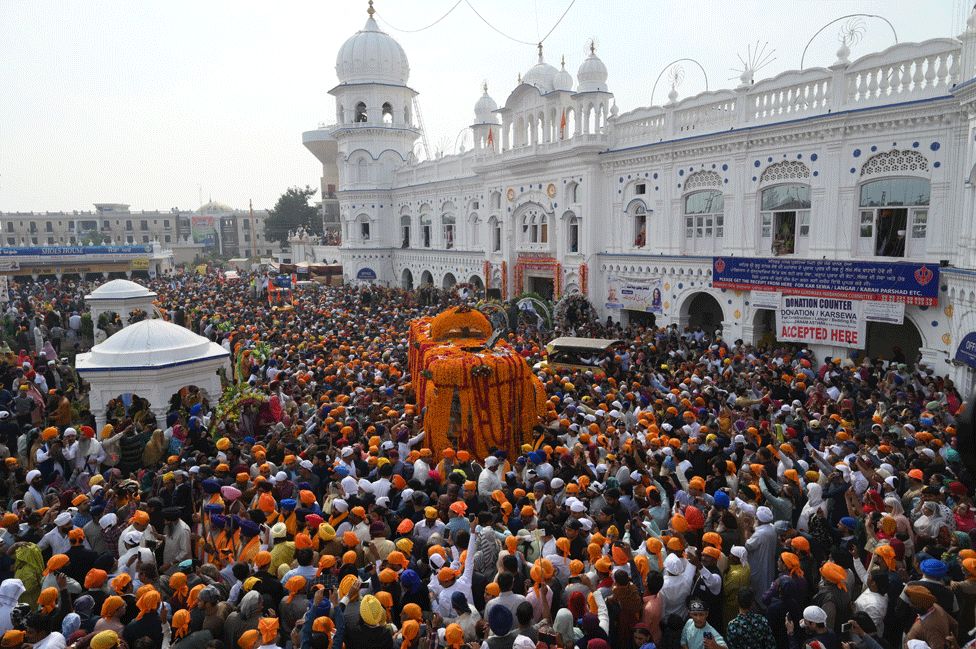
Celebrations have taken place in India and Pakistan to mark the 550th anniversary of the birth of Guru Nanak – the founder of Sikhism.

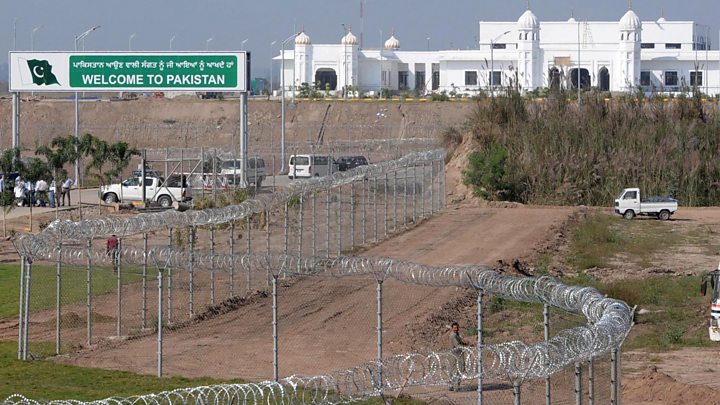
The anniversary comes just a few days after the historic opening of the Kartarpur corridor, which allows Indians access to one of Sikhism’s holiest shrines in Pakistan without having to apply for a visa.

Tensions between the neighbours have made it difficult for Indian pilgrims to visit the site in Pakistan in recent years. But an agreement reached last month allows Indians to make the 4km (2.5-mile) crossing to the Gurdwara Darbar Sahib Kartarpur – where Guru Nanak spent the last 18 years of his life.

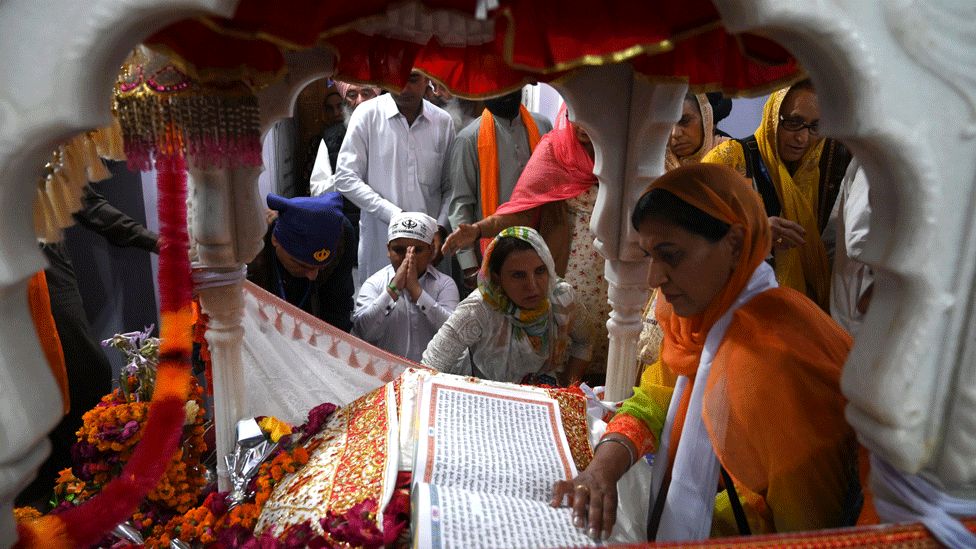
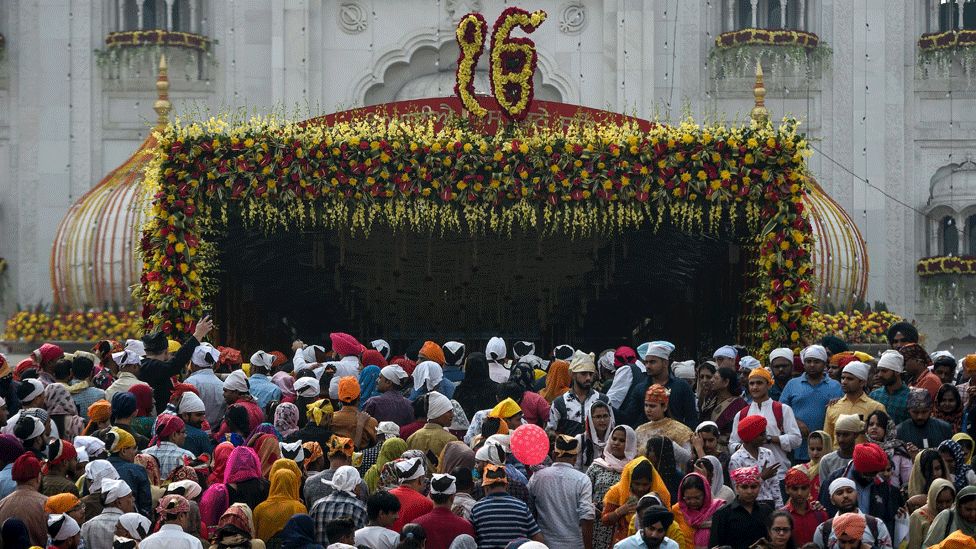
On Tuesday, Sikh pilgrims in Pakistan gathered at Nankana Sahib, the birth place of Guru Nanak, which is about 80km (50 miles) from the city of Lahore.

Sikh pilgrims take part in a religious ritual as they gather to celebrate the 550th birth anniversary of Guru Nanak Dev, at Nankana SahibImage copyright AFP

Large numbers of devotees, including women, took part in the religious rituals.

Sikh pilgrims take part in a religious ritual as they gather to celebrate the 550th birth anniversary of Guru Nanak Dev, at Nankana SahibImage copyright AFP

The auspicious day for Sikhs was also marked in India, where Guru Nanak’s birth anniversary is an annual public holiday.

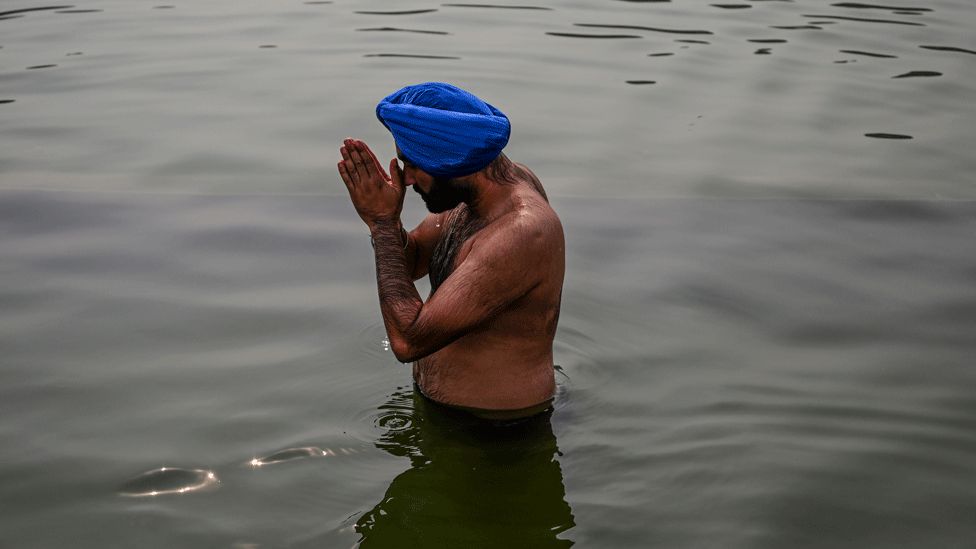
A Sikh devotee takes a holy dip on the occasion of the 550th birth anniversary of Sikhism founder Guru Nanak Dev at Gurudwara Bangla Sahib in New Delhi on November 12, 2019Image copyright AFP
Sikh devotees gathered in huge numbers at the Bangla Sahib Gurdwara in the capital Delhi.
Sikh devotees gather to pay their respects on the occasion of the 550th birth anniversary of Sikhism founder Guru Nanak Dev at Gurudwara Bangla Sahib in New Delhi on November 12, 2019Image copyright AFP

Indian Prime Minister Narendra Modi greeted the nation on the occasion, saying it was “a day to rededicate ourselves” to Guru Nanak’s “dream of a just, inclusive and harmonious society”.

Though Guru Nanak’s anniversary is an important event for Sikhs annually, this time the celebrations were more special due to the opening of the Kartarpur corridor.

Devotees from across the world visit the Kartarpur shrine every year to commemorate his birth. Indian Sikhs will now be able to visit with just their passports, but they will not be allowed to leave the site or stay overnight.

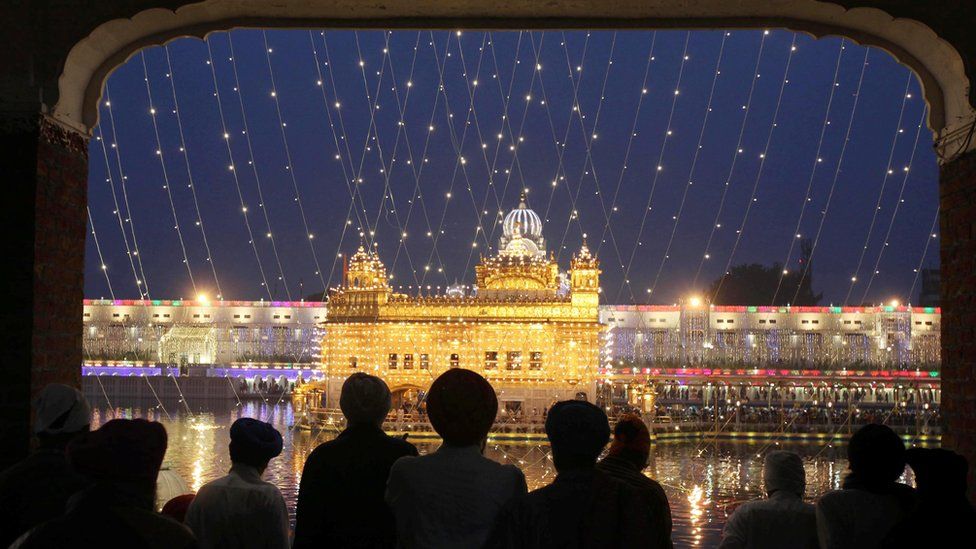
The Golden Temple in Amritsar, in north-western India, is the holiest Gurdwara (where Sikhs worship). On the eve of the anniversary, it was lit up to host processions as Sikh worshippers took part in the three-day celebration of Guru Nanak’s birth.

The Golden Temple lit up as Sikhs watch from a windowImage copyright REUTERS
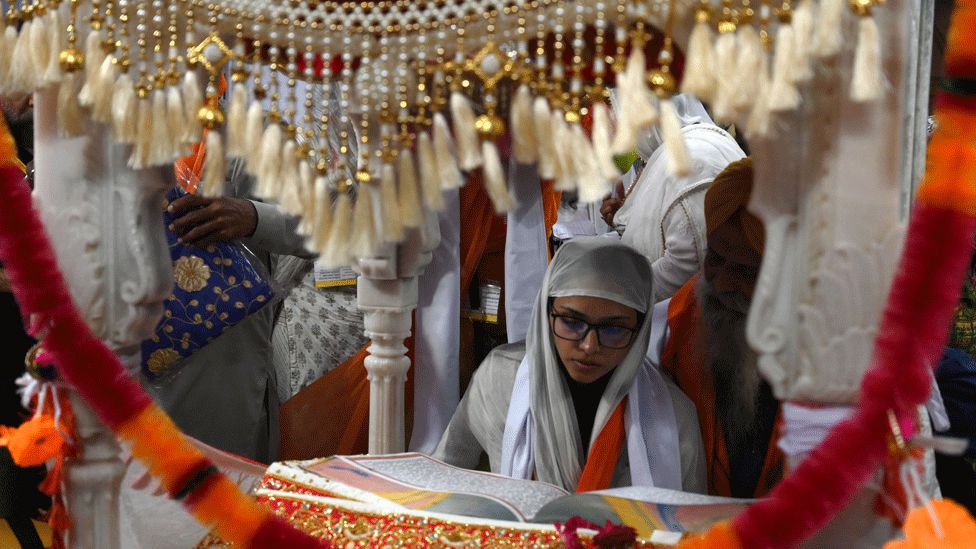
On the first day of the celebrations, Sikhs read the Sikh holy book – the Guru Granth Sahib – from beginning to end.

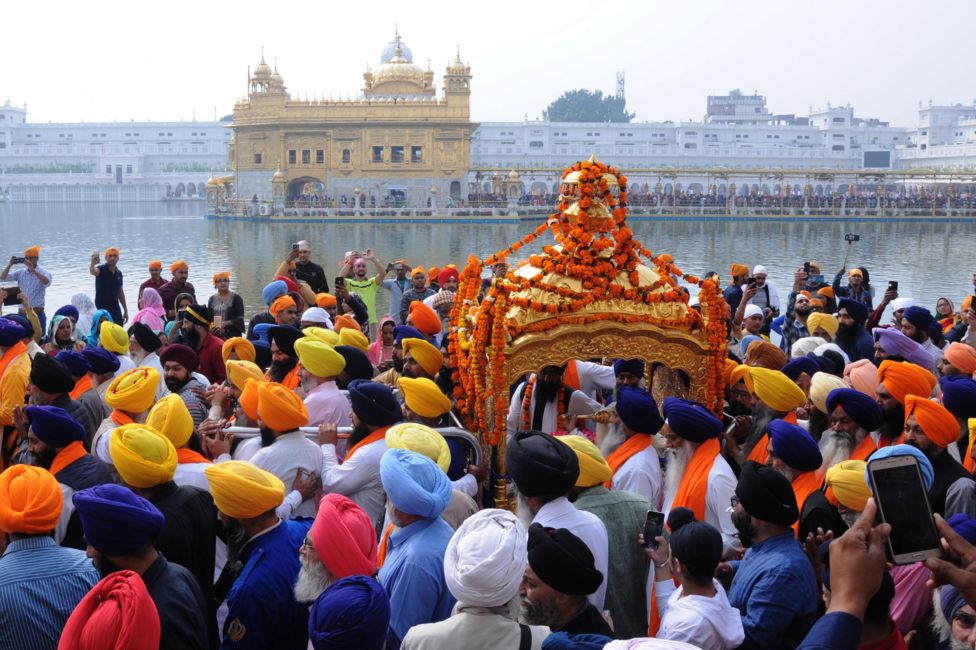
As is the tradition on the second day, the holy book was paraded through the streets of Amritsar on Monday in a hand-held carriage.

The procession was led by five people representing the original Panj Pyare – the Five Beloved Ones – who helped shape the religion.

Sikh devotees carrying the Sri Guru Granth Sahib ji - the holy book of Sikh religion - in a hand-held, golden carriageImage copyright EPA
You might also be interested in:

Media caption Find out more about the Kartarpur corridor, which leads to one of the holiest sites in the Sikh religion

Source: The BBC

Law of Unintended Consequences

continuously updated blog about China & India

ChiaHou's Book Reviews

continuously updated blog about China & India

What's wrong with the world; and its economy

continuously updated blog about China & India