Chindia Alert: You’ll be Living in their World Very Soon
aims to alert you to the threats and opportunities that China and India present. China and India require serious attention; case of ‘hidden dragon and crouching tiger’.
Without this attention, governments, businesses and, indeed, individuals may find themselves at a great disadvantage sooner rather than later.
The POSTs (front webpages) are mainly 'cuttings' from reliable sources, updated continuously.
The PAGEs (see Tabs, above) attempt to make the information more meaningful by putting some structure to the information we have researched and assembled since 2006.
BEIJING (Reuters) – Tang Yue, a 27-year-old teacher from the city of Guilin in southwest China, steam-presses a blue dress and takes dozens of photographs before picking one to clinch her 200th online sale.
For a growing number of Chinese like Tang, hit by job losses, furloughs and salary cuts, the consumer economy has begun to spin in reverse. They are no longer buying – they are selling.
Instead of emerging from the coronavirus epidemic and returning to the shopping habits that helped drive the world’s second-largest economy, many young people are offloading possessions and embracing a new-found ethic for hard times: less is more.
With Tang’s monthly salary of about 7,000 yuan ($988), the self-described shopaholic said she has bought everything from Chanel lipsticks to Apple’s (AAPL.O) latest iPad in the past three years.
But the adrenaline rush that comes with binge-shopping is gone, said Tang, whose wages have been slashed with the suspension of all the classes on tourism management she usually teaches.
“The coronavirus outbreak was a wake-up call,” she said. “When I saw the collapse of so many industries, I realised I had no financial buffer should something unfortunate happen to me.”
There is no guarantee that the nascent minimalist trend will continue once the coronavirus crisis is fully over, but if it does, it could seriously damage China’s consumer sector and hurt thousands of businesses from big retailers to street-corner restaurants, gyms and beauty salons.
To be sure, there are signs that pent-up demand will drive a rush of spending as authorities reopen malls, leisure venues and tourist spots. In South Korea, the first major economy outside of China to be hit by the virus, people thronged malls this weekend to go “revenge shopping” to make up for time lost in lockdown.,
There are some signs that a similar trend will take hold in China, where some upscale malls are starting to get busy, although luxury firm Kering SA (PRTP.PA) – which owns Gucci, Balenciaga and other fashion brands – has said it is hard to predict how or when sales in China might come back.
A recent McKinsey & Co survey showed that between 20% and 30% of respondents in China said they would continue to be cautious, either consuming slightly less or, in a few cases, a lot less.
“The lockdown provided consumers with a lot of time and reasons to reflect and consider what is important to them,” said Mark Tanner, managing director at Shanghai-based research and marketing consultancy China Skinny.
“With much more of their days spent in their homes, consumers also have more time and reasons to sort through things they don’t feel they need – so they’re not living around clutter that is common in many apartments.”
#DITCHYOURSTUFF
Tang made a spreadsheet to keep track of her nearly 200 cosmetic products and hundreds of pieces of clothing. She then marked a few essentials in red that she wanted to keep. In the past two months, she has sold items worth nearly 5,000 yuan on second-hand marketplaces online.
Bargain-hunting online has become a new habit for some Chinese as the stigma that once hung over second-hand goods has begun to fade.
Idle Fish, China’s biggest online site for used goods, hit a record daily transaction volume in March, its parent company Alibaba (BABA.N) told Reuters.
Government researchers predict that transactions for used goods in China may top 1 trillion yuan ($141 billion) this year.
Posts with the hashtag #ditchyourstuff have trended on Chinese social media in recent weeks, garnering more than 140 million views.
Jiang Zhuoyue, 31, who works as an accountant at a traditional Chinese medicine company in Beijing – one of the few industries that may benefit from the health crisis – has also decided to turn to a simpler life.
“I used to shop too much and could be easily lured by discounts,” said Jiang. “One time Sephora offered 20% off for all goods, I then bought a lot of cosmetics because I feel I’m losing money if I don’t.”
Jiang, the mother of a 9-month-old baby, said she recently sold nearly 50 pieces of used clothing as the lockdown gave her the opportunity to clear things out. “It also offered me a chance to rethink what’s essential to me, and the importance of doing financial planning,” she said.
Eleven Li, a 23-year-old flight attendant, said she used to spend her money on all manner of celebrity-endorsed facial masks, snacks, concert tickets and social media activity, but now has no way to fund her spending.
“I just found a new job late last year, then COVID-19 came along, and I haven’t been able to fly once since I joined, and I’ve gotten no salary at all,” said Li, who said she was trying to sell her Kindle.
Some are even selling their pets, as they consider leaving big cities like Beijing and Shanghai where the high cost of living is finally catching up with them.
NO RETURN TO OLD WAYS?
As the coronavirus comes under control in China, the government is gradually releasing cities from lockdown, easing transport restrictions and encouraging consumers to venture back into malls and restaurants by giving out billions-worth of cash vouchers, worth between 10 yuan and 100 yuan.
But many people say they are still worried about job security and potential wage cuts because of the struggling economy. Nationwide retail sales have plunged every month so far this year.
Xu Chi, a Shanghai-based senior strategic analyst with Zhongtai Securities, said some Chinese consumers may prove the ‘21 Day Habit Theory,’ a popular scientific proposition that it only takes that long to establish new habits.
“We believe people’s spending patterns follow the well-known theory, which means most people in China, having been cooped-up at home for more than a month and not having binge-shopped, may break the habit and not return to their old ways,” Xu said.
Jiang said she was determined not to return to her free-spending ways and planned to cook more at home.
“I’ll turn to cheaper goods for some luxury brands,” she said. “I’ll choose Huawei’s smartphone, because (Apple’s) iPhone has too much brand premium.”
Tang, who has recently used 100 yuan of shopping coupons to stock up on food, is going to hold the purse strings even tighter.
“I’ve set my monthly budget at 1,000 yuan,” she said. “Including one – and just one – bottle of bubble tea.”
SYDNEY (Reuters) – The Australian government said on Friday it would meet a week ahead of schedule to decide whether to ease social distancing restrictions, as the numbers of new coronavirus infections dwindle and pressure mounts for business and schools to reopen.
Australia has reported about 6,700 cases of the new coronavirus and 93 deaths, well below the levels reported in the United States and Europe. Growth in new infections has slowed to less 0.5% a day, compared to 25% a month ago.
Prime Minister Scott Morrison said it was imperative to lift social distancing restrictions as early as possible as 1.5 million people were now on unemployment benefits and the government forecast the unemployment rate to top 10% within months.
“We need to restart our economy, we need to restart our society. We can’t keep Australia under the doona,” Morrison said, using an Australian word for quilt.
Morrison’s government has pledged spending of more than 10% of GDP to boost the economy but the central bank still warns the country is heading for its worst contraction since the 1930s.
With less than 20 new coronavirus cases discovered each day, Morrison said state and territory lawmakers would meet on May 8 – a week earlier than expected – to determine whether to lift restrictions.
“Australians deserve an early mark for the work that they have done,” Morrison told reporters in Canberra.
Australia attributes its success in slowing the spread of COVID-19 to social distancing restrictions imposed in April, including the forced closures of pubs, restaurants and limiting the size of indoor and outdoor gatherings.
Morrison said 3.5 million people had downloaded an app on their smartphones designed to help medics trace people potentially exposed to the virus, though the government is hoping for about 40% of the country’s 25.7 million population to sign up to ensure it is effective.
Cabinet will also decide next week how to restart sport across the country, the prime minister said.
The government says any resumption of sport should not compromise the public health, and recommends a staggered start beginning with small groups that play non-contact contact sport outdoors.
The recommendations suggests Australia’s National Rugby League (NRL) competition may not get permission to restart its competition as soon as many in the sports-mad country would like.
– The last nine poverty-stricken county-level regions in east China’s Anhui Province have been removed from the country’s list of impoverished counties.
– This marks that all county-level regions in the Yangtze River Delta, consisting of Shanghai and the provinces of Jiangsu, Zhejiang and Anhui, have been officially lifted out of poverty for the first time in history.
HEFEI, April 29 (Xinhua) — Sitting in front of his smartphone, Zhang Chuanfeng touts dried sweet potatoes to viewers on China’s popular video-sharing app Douyin, also known as TikTok.
“These are made from sweet potatoes I grew myself. They are sweet and have an excellent texture,” said Zhang while livestreaming in Tangjiahui Township of Jinzhai County in east China’s Anhui Province. Tucked away in the boundless Dabie Mountains, the township used to have the biggest poor population in the county.
Aerial photo taken on April 16, 2020 shows residential buildings in Dawan Village of Jinzhai County, east China’s Anhui Province. (Xinhua/Liu Junxi)
Jinzhai County is among the last nine county-level regions in Anhui that have been removed from the country’s list of impoverished counties, according to an announcement issued by the provincial government Wednesday. They are also the last group of county-level regions that bid farewell to poverty in the Yangtze River Delta.
E-COMMERCE
Zhang might seem like a typical e-commerce businessman reaping success in China’s booming livestreaming industry. But his road to success has been a lot bumpier: he suffers from dwarfism.
A little more than 1.4 meters tall, Zhang has a babyface, making him “look like a junior school student,” he said. But the man, 38, is the father of a nine-year-old boy.
For Zhang, life was tough before 2014. “Nobody wanted me because of my ‘disabilities’ when I went out to look for jobs,” he said. “I was turned down again and again.”
Zhang was put on the government’s poverty list in 2014 as China implemented targeted poverty-relief measures. With the help of local officials, he got a bank loan of 10,000 yuan (about 1,400 U.S. dollars) and bought 22 lambs. He tended the animals whole-heartedly and seized every opportunity to learn how to raise them more professionally.
Zhang Chuanfeng feeds his lambs in Zhufan Village of Jinzhai County, east China’s Anhui Province, April 26, 2017. (Xinhua/Zhang Duan)
Within a year, the number of his lambs expanded to hundreds. In 2016, Zhang’s earnings exceeded 100,000 yuan, more than enough for him to cast off poverty.
Riding on this success, Zhang began to seek new opportunities. He rented a shop and started selling products online to embrace an e-commerce strategy the local government introduced in 2017.
More than 100 online shops, including Zhang’s, in the county have helped more than 7,000 poverty-stricken households sell about 73 million yuan worth of local specialties since 2018. Zhang alone earned 500,000 yuan from a sales revenue of 5 million yuan last year.
A villager arranges local specialties for sale at Dawan Village of Jinzhai County, east China’s Anhui Province, April 17, 2020. (Xinhua/Liu Junxi)
WICKERWORK SUCCESS
About 100 km north of Jinzhai lies Funan, a place that used to be vulnerable to constant floods.
Zhang Chaoling, who lives by the Huaihe River in Funan County, had to flee her hometown at a young age due to floods, but has flourished on a willow plantation along the river later.
“The land is largely covered by silt following continual flooding in the past. It is an ideal place to plant willows and make wickerwork,” Zhang said.
Zhang left her hometown for Guangzhou in 1993 and found a job in a garment factory. A few years later, she founded a trading company with her husband in Guangzhou, selling wickerwork products from her hometown to other countries.
Zhang returned to her hometown and set up a wickerwork production base in 2011. Funan is famous for its delicate wickerwork. Skilled craftsmen traditionally use local willow as a raw material to weave products such as baskets, furniture and home decorations.
A villager arranges wickerwork products in Funan County, east China’s Anhui Province, April 15, 2020. (Photo by Zhou Mu/Xinhua)
“The flood is well controlled now. I remember the last huge flood came in 2007,” Zhang said.
Taking advantage of the fertile land along the Huaihe River, she plants over 130 hectares of willow trees and employs hundreds of locals mostly in their 50s and 60s.
“I can process 100 to 150 kg of willow twigs per day, from which I make around 80 yuan,” said Geng Shifen, who peels willow twigs with a clamp next to the plantation.
A total of 130,000 people are engaged in the wickerwork industry in Funan, creating an output of nearly 9 billion yuan in 2019, and helping 15,000 locals shake off poverty, local statistics showed.
POVERTY REDUCTION FEAT
The Anhui provincial government Wednesday announced that its last nine county-level regions including Jinzhai and Funan are removed from the country’s list of impoverished counties.
This marks that all 31 impoverished county-level regions in Anhui have shaken off poverty, echoing China’s efforts to eradicate absolute poverty by the end of 2020.
With the announcement, all county-level regions in the Yangtze River Delta have been officially lifted out of poverty for the first time in history.
A bus runs on a rural road in Jinzhai County, east China’s Anhui Province, April 17, 2020. (Xinhua/Liu Junxi)
Covering a 358,000-square-km expanse, the Yangtze River Delta, consisting of Shanghai and the provinces of Jiangsu, Zhejiang and Anhui, is one of the most populated and economically dynamic areas in China, contributing one-fourth of the country’s GDP.
Anhui had a population of 63.65 million as of 2019, official data showed. The poor population in the province had decreased from 4.84 million in 2014 to 87,000 in 2019, and the poverty headcount ratio had been reduced from 9.1 percent to 0.16 percent during the period, according to the provincial poverty relief office.
A county can be removed from the list if its impoverished population drops to less than 2 percent, according to a national mechanism established in April 2016 to eliminate poverty in affected regions. The ratio can be loosened to 3 percent in the western region.
By the end of 2019, 5.51 million people in China were still living in poverty.
“We will continue our work to prevent people from returning to poverty, and help the remaining poor population shake off poverty by all means,” said Jiang Hong, director of the Anhui provincial poverty relief office.
SHANGHAI (Reuters) – Apple Inc’s (AAPL.O) discounts on the iPhone 11 in China and the release of a new low-price SE model have put the company in a better position than rivals to weather a coronavirus-related plunge in global smartphone demand.
While China, which accounts for roughly 15% of Apple’s revenue, appears to be a rare bright spot, investors will be keen to get a picture of global demand when the Cupertino, California-headquartered company reports second-quarter results on Thursday.
The iPhone maker has shut retail stores in the United States and Europe following the COVID-19 outbreak, and China is the only major market where it has been able to reopen all shops.
Consumer spending is expected to be muted as the pandemic has crippled economies and Apple, the world’s second-most valuable tech company, is better armed with the launch of its new price-conscious iPhone model, analysts said.
“Apple is better positioned than most to experience a rapid recovery in a post COVID world,” Evercore analyst Amit Daryanani said in a research note. “We see demand as pushed out, not canceled.”
He added that the launch of the $399 iPhone SE suggested that Apple’s supply chain was getting back on its feet after weeks of shutdown earlier this year.
Analysts expect Apple to report a 6% drop in revenue and an 11% fall in net income in its fiscal second quarter, according to Refinitiv data.
On the other hand, Chinese brands such as Oppo and Vivo who have steadily moved to offer high-end models to challenge iPhones, stand to lose marketshare as bargain hunters choose Apple.
Earlier this month, several online retailers in China slashed prices of the iPhone 11 by as much as 18% – a tactic Apple has used in the past to boost demand. And while initial social media reaction to the new iPhone SE was muted, analysts said they were seeing a pick up in demand.
The cheaper iPhone SE could tempt iPhone owners to opt for a newer device, something they might have otherwise delayed in a weak economy, said Nicole Peng, who tracks the smartphone sector at research firm Canalys.
“People want to avoid uncertainty in a downturn,” she said. “Having a brand like Apple that can showcase quality and make people less worried about breakdowns or after-sales service can bring in buyers.”
CHEAP IS GOOD
Early data suggests that the Chinese smartphone market is recovering rapidly in the aftermath of the virus, and Apple has emerged relatively unscathed.
Sales of iPhones in China jumped 21% last month from a year earlier and more than three fold from February, government data showed, meaning March-quarter sales in the country were likely to have slipped just 1%.
To be sure, a recovery in Chinese demand won’t offset sales lost in the United States and Europe. And the company is yet to launch a smartphone enabled with 5G wireless technology like those offered by Asian rivals, a disadvantage for Apple so far.
But those same expensive 5G models may not sell well in the current climate of frugality, analysts said.
“If there are no massive subsidies (in China), I doubt there will be many smartphone users who will be eager to upgrade to 5G,” said Linda Sui, who tracks the smartphone sector at research firm Strategy Analytics.
Sui expects iPhone shipments in 2020 to be down 2 percentage points at the most, versus double digit declines at Chinese firms.
Apple also has revenue from its services business to fall back on. It has leveraged its large iPhone customer base to boost services revenue from music, apps, gaming and video.
“Apple’s Services segment should remain resilient in today’s work-from-home environment, thereby demonstrating the durability of Apple’s model,” Cowen analyst Krish Sankar said.
KUNMING, April 25 (Xinhua) — Kunming, capital of southwest China’s Yunnan Province announced Friday it will issue e-vouchers worth 100 million yuan (about 14.12 million U.S. dollars) to promote consumption.
According to the Kunming Municipal Bureau of Commerce, the e-vouchers can be used for consumption in tourism, catering, and sports. The city will also issue special e-vouchers to groups of needy people.
The e-vouchers will be issued through an app online from April 28 to 30. Citizens can use the e-vouchers from May 1 to 31.
Industries in the city including tourism, catering and sports were seriously affected by the COVID-19 epidemic in the last few months.
not long ago – unless they have a child addicted to the wildly popular app, on which users make and share short, amusing videos.
It has grown explosively since its 2016 launch, with 800 million monthly active users now – 300 million of them outside China in places such as India (120 million) and the
(37 million). And many have no idea it is owned by a Chinese company, ByteDance.
The first Chinese app to mount a real global challenge to Facebook and Instagram, it is seen as one of the shiniest new weapons in the US-China technology war. And a boost, perhaps, to Chinese soft power.
TikTok, the missing link between Hong Kong and Indian protesters?
9 Feb 2020
It experienced a growth spurt in 2019 that analysts predicted would slow a little this year. That, however, was before the coronavirus, which seems to be giving the app a bump, especially beyond its core teenage fan base.
As pandemic fears rise and millions are stuck indoors, major Hollywood celebrities such as Jennifer Lopez, 50, have taken to posting their own all-singing, all-dancing videos, which then go viral on other media platforms.
Even the World Health Organisation has jumped on the bandwagon, joining the app in late February to share public health advice.
The TikTok logo on a smartphone. Photo: Getty Images
But to some, the growth of TikTok is far from benign.
Privacy advocates and several US congressmen want to rein in the app over concerns it may censor and monitor content for the Chinese government, and be used for misinformation and election interference. This despite the fact that TikTok keeps its servers outside China and swears it will not hand over user data.
Are these fears justified – or fuelled by political and anticompetitive motives?
Thinkers such as Yuval Noah Harari warn that the coronavirus pandemic could be a watershed in the history of mass surveillance.
But Eric Harwit, a professor of Asian studies at the University of Hawaii, does not buy such arguments against TikTok, especially given that 60 per cent of its US users are aged 16 to 24.
“ByteDance has done a pretty good job of having a firewall between TikTok and the Chinese version of it, Douyin.
TikTok, iPhone: all you need to escape Mumbai’s slums – for 15 seconds
1 Nov 2019
“Also, many users in the US are teens and they’re not a particularly useful source of national security information.
“So I’d say the concerns are motivated more by a general fear of any kind of Chinese telecommunication application rather than actual attempts to siphon off valuable US intelligence information.
“And Facebook and other American companies have similar products,” Harwit points out. “US government officials will always want to protect American commercial interests.”
Sarah Cook, a China analyst for Freedom House – the US government-funded think tank – disagrees.
“We have concerns about how Facebook and Twitter deal with information affecting electoral politics, and that’s magnified if you’re talking about a Chinese company that now has a user base that rivals theirs.”
Chinese officials, she argues, have shown a willingness to censor and manipulate information well beyond their country’s borders – for instance, regarding the scale of the initial outbreak in Wuhan, an obfuscation that may have exacerbated its impact abroad.
“For those who think Chinese government censorship is only Chinese people’s problem, this pandemic shows how much that’s not the case.
“And even if it’s not happening right now with TikTok, the concern is that Chinese companies are beholden to their government, whether they want to be or not.
“I’m not saying block TikTok entirely,” she says. “It’s a question of looking at it in a democratic system and deciding on reasonable oversight and safeguards to protect users and information flows when that time comes.”
When it comes to expanding China’s cultural influence, though, neither Cook nor Harwit believes the app is especially effective.
Most people are oblivious to its Chinese origins, which the user experience does not reflect in any way. So there is no goodwill-generating soft power of the sort wielded by, say,
If anything, TikTok often promotes the increasingly homogenous, Western-leaning culture seen on many globally popular social media apps.
So says Morten Bay, a lecturer in digital and social media at the University of Southern California’s Annenberg School for Communication and Journalism.
“A semi-Western culture, with small variations of local culture, is becoming the norm on social media. And Chinese soft power is difficult to assert because there’s no value difference.”
And even if Chinese tech companies keep taking bigger bites of the Western market, he is sceptical of China’s “ability to leverage that for soft power in a geopolitical sense”.
“Because there is a very big apparatus pushing against China in that regard. As soon as TikTok started gaining traction in the US, people came out against it, trying to make everyone aware of the privacy and geopolitical issues.
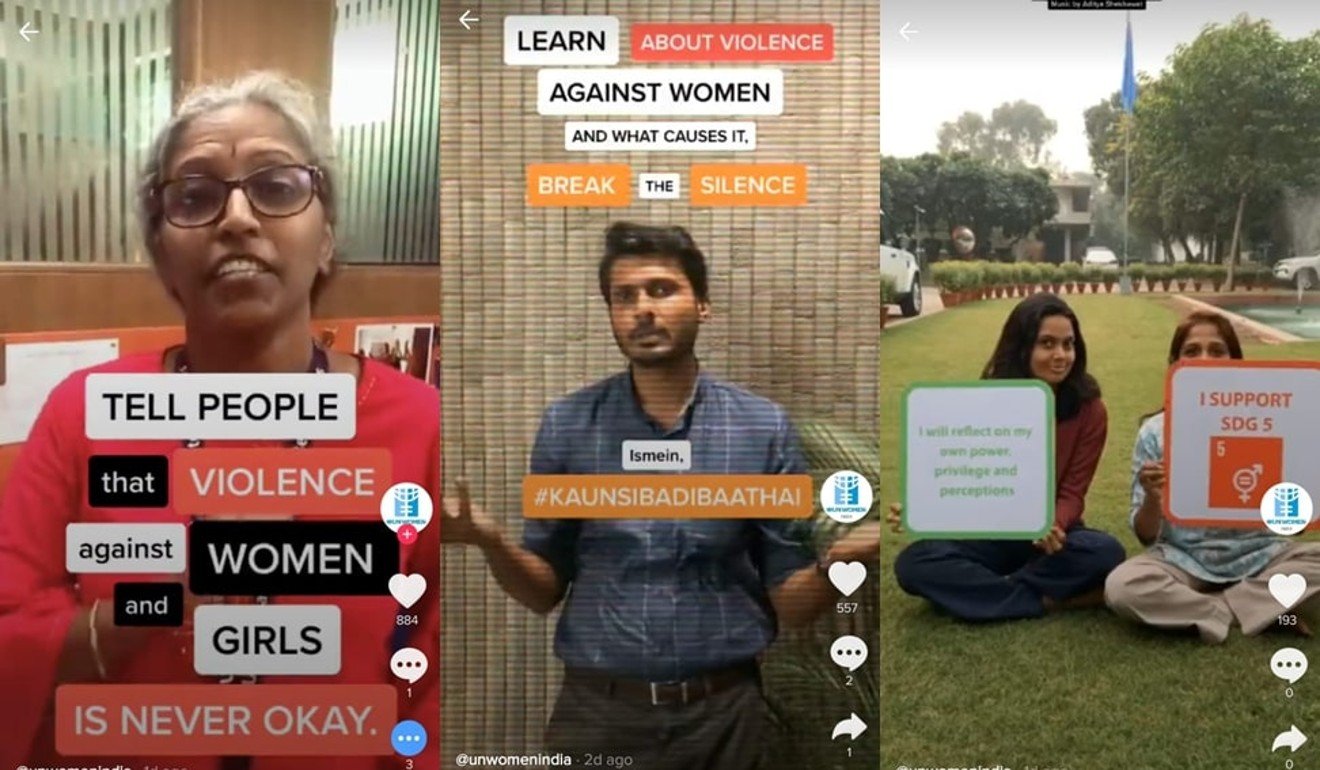
The #KaunsiBadiBaatHai campaign on TikTok aims to raise awareness about women’s safety issues in India. Image: TikTok
“So China faces a lot of resistance,” Bay concludes. “And I’m not sure a social media platform on its own can do much about that.”
Still, if you had to back a horse in this race, TikTok would be it, says Zhang Mengmeng.
When she and her colleagues from global industry analysis firm Counterpoint Research visited the company, they were impressed by its research and development capabilities.
“Because they’re a very young company, their pace for incubating new projects is a lot faster, especially compared to successful but older internet companies in China which have been around for 15 to 20 years.
Indian invasion of Chinese social media apps sparks fear and loathing in New Delhi
28 Apr 2019
“They have lots of little start-up projects within the company and their organisational structure is very flat – it doesn’t matter what your age is, if you have a good idea, you get promoted very quickly.”
TikTok’s rise is also emblematic of a broader role reversal in the US-China tech war, she believes.
“Before, the US was more advanced in terms of internet development and China seemed to just copy its new ideas. Now, this is reversing. There are so many people in China using the internet that start-ups there can test ideas very easily.
“So now it seems like a lot of US companies are trying to see what ideas are coming out of China.” ■
The enterprise collaboration industry in China is forecast to achieve a compound annual growth rate of 12.4 per cent over five years to reach US$7 billion by 2024
Tencent has been accused of using its market dominance with WeChat to stifle competition. Photo: Reuters
Tencent’s super app WeChat, with a user base of 1.2 billion people, has blocked links from a ByteDance remote work tool as Chinese tech giants fight for dominance in the burgeoning enterprise collaboration market.
The latest move adds another ByteDance app to WeChat’s blacklist, which already includes Douyin, the Chinese version of TikTok, and its sister platform Xigua Video, amid ongoing accusations that Tencent uses its market dominance to stifle competition.
Feishu, the Chinese version of ByteDance’s productivity tool Lark, said Saturday that users could not open any of its links on WeChat, nor could they share name cards to invite colleagues.
Feishu said WeChat did not provide advance notice of the ban, adding that the move has “significantly affected work efficiency and user experience” at a time when many companies in China have moved their office operations online to limit the spread of coronavirus infections.
Instead, Lark users need to copy the link and open it in a browser instead of opening it directly via WeChat.
Tencent launches new social apps as flagships WeChat and QQ show their age
13 Dec 2019
A WeChat representative declined to comment other than to cite the company’s regulations on external links. The rules, introduced in October 2019, said the platform will punish websites or apps that send links to “mislead or entice users to download or redirect to an external app”. Punishment includes blocking their domain name from opening in WeChat.
Xie Xin, a ByteDance vice president overseeing Feishu, said the app does not support sign-ups using a WeChat account nor does it enable the sharing of documents or messages on the Tencent app.
In addition to blocking the ByteDance app, WeChat also suspended two tech-focused media websites, 36Kr and ITHome, from publishing posts on the platform after they reported the Lark case over the weekend. The relevant articles have also been removed from WeChat.
The WeChat representative said it did not force media to delete their articles. Rather, the media in question have violated WeChat’s rules on multiple occasions.
The enterprise collaboration industry in China, which has received a huge boost from the health crisis, is forecast to achieve a compound annual growth rate of 12.4 per cent over five years to reach nearly 49 billion yuan (US$7 billion) by 2024, according to the Qianzhan Industry Research Institute.
Feishu is a small but fast-emerging player in the sector, jumping 40 places from late January to become the 15th most downloaded business iOS app on Monday. However, it still lags far behind Alibaba’s DingTalk and Tencent’s WeChat Work and Tencent Meeting, which ranked as the top three among business iOS apps in China as of Monday, according to App Annie.
Alibaba is the parent company of the South China Morning Post.Tencent has also blocked apps from other Chinese tech giants. Links from Taobao, Alibaba’s online marketplace, and Haokan, a short video app from Baidu, cannot be accessed on WeChat. In contrast, Tencent allows the sharing of links from JD.com and PDD pages, online marketplaces in which it owns a financial stake.
“Having more than 1 billion users, [WeChat] has a monopolistic position in the market,” said Wang Sixin, a professor at the Communication University of China who specialises in media policy and rules. “Under these circumstances, Tencent has to have legitimate reasons to block other apps, otherwise it’s taking advantage of its dominance to force out smaller rivals.”
In April 2019, a Chinese lawyer sued Tencent under the country’s anti-monopoly law, charging that the company’s actions infringed on his rights as a user. In December, the intellectual property court in Beijing heard the case, with Tencent representatives arguing that WeChat did not prevent users from sharing links and using the app on other platforms, Southern Metropolis Daily reported. The court has not yet reached a verdict.
Besides enterprise collaboration, Tencent and ByteDance are coming up against each other in other markets. Last week Tencent began testing a short video function for WeChat, a sector dominated by TikTok and Douyin, while ByteDance plans to
Media caption Americans are taken from the docked ship to Haneda airport in Tokyo
Two planes carrying hundreds of US citizens from a coronavirus-hit cruise ship have left Japan, officials say.
One plane has landed at a US Air Force air base in California, and its passengers will be isolated at military facilities for 14 days.
There were some 400 Americans on board the Diamond Princess. The ship with some 3,700 passengers and crew has been in quarantine since 3 February.
Meanwhile, China reported a total of 2,048 new cases on Monday.
Of those new cases, 1,933 were from Hubei province, the epicentre of the outbreak.
More than 70,500 people across China have been infected by the virus. In Hubei alone, the official number of cases stands at 58,182, with 1,692 deaths. Most new cases and deaths have been reported in Wuhan, Hubei’s largest city.
In other developments:
In Japan, a public gathering to celebrate the birthday of new Emperor Naruhito later this week has been cancelled, due to concerns over the spread of the virus while organisers of the Tokyo marathon due to take place on 1 March are considering whether to cancel the amateur part of the race, reports say
In China, the National People’s Congress standing committee said it would meet next week to discuss a delay of this year’s Congress – the Communist Party’s most important annual gathering – because of the outbreak
At the weekend, an American woman tested positive for the virus in Malaysia after leaving a cruise liner docked off the coast of Cambodia
A Russian court has ordered a woman who escaped from a quarantine facility to go back and stay there until she is confirmed to be disease-free, Fontanka news agency reports. Alla Ilyina has until Wednesday to return
What’s happening on the Diamond Princess?
The cruise ship was put in quarantine in Japan’s port of Yokohama after a man who disembarked in Hong Kong was found to have the virus.
On Monday, Japanese officials said there were 99 new cases of infections on board the ship, bringing the total to 454 confirmed cases. It is the largest cluster of cases outside China.
A Russian woman who was on board and tested positive is thought to be the first Russian national to contract the virus after the two previous cases found in Russia were Chinese nationals, Reuters news agency reports.
She will be taken to a hospital for treatment, the Russian embassy in Japan said.
At least 40 US citizens who were on board are infected and will be treated in Japan, Dr Anthony Fauci, Director of the National Institute of Allergy and Infectious Diseases told US broadcaster CBS.
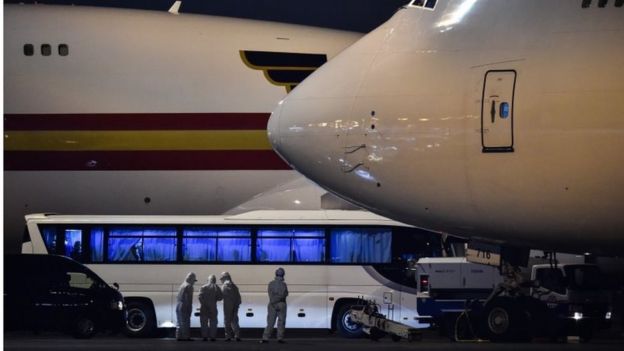
Image copyright AFPImage caption Those bound for the US left from Tokyo’s Haneda Airport
The two aircraft chartered by the US government left Tokyo’s Haneda Airport in the early hours of Monday. The second flight was due to land at another base in Texas.
More than 300 passengers are being repatriated voluntarily, the US state department said. Fourteen of them were reported during transit to have tested positive for the virus and were being kept separate from the other passengers, it said.
we would like to just finish the quarantine on the ship as planned, decompress in a non-quarantine environment in Japan for a few days, then fly back to the U.S. pursuant to our own arrangements. What’s wrong with that?
The smartphones were distributed so people could use an app, created by Japan’s health ministry, which links users with doctors, pharmacists and mental health counsellors. Phones registered outside of Japan are unable to access the app.
Other evacuation flights have been arranged to repatriate residents of Israel, Hong Kong and Canada. On Monday, Australia announced that it would evacuate 200 of its citizens too.
What is happening in China?
According to official figures for 16 February, 100 people died from the virus in Hubei, down from 139 on Saturday.
The Chinese authorities are tightening curbs on movement to combat the outbreak. People in Hubei province, which has 60 million people, have been ordered to stay at home, though they will be allowed to leave in an emergency.
In addition, a single person from each household will be allowed to leave the building or compound they live in every three days to buy food and essential items.
On housing estates, one entrance will be kept open. It will be guarded to ensure that only residents can enter or leave.
All businesses will stay closed, except chemists, hotels, food shops and medical services.
“The effects of epidemic prevention and control in various parts of the country can already be seen.”
The proportion of infected patients considered to be in a “serious condition” has dropped nationwide from more than 15% to just over 7%, according to China’s State Council.
Taiwan has reported a death from the illness – a taxi driver, 61, who had not travelled abroad recently but had diabetes and hepatitis B, Health Minister Chen Shih-chung said.
The minister said many of his passengers had come from China.
Outside China, there have been more than 500 cases in nearly 30 countries. Four others have died outside mainland China – in France, Hong Kong, the Philippines and Japan.
Meanwhile, a plane carrying 175 evacuated Nepalis, mostly students, has arrived in Kathmandu from Wuhan.
SHANGHAI (Reuters) – China’s smartphone sales may plunge by as much as 50% in the first quarter, as many retail shops have closed for an extended period and production has yet to fully resume due to the fast spread of a new coronavirus, according to research reports.
The virus outbreak, which has killed more than 900 people and roiled China’s manufacturing industry, comes as top smartphone vendors such as Huawei had hoped China’s 5G rollout plans this year would help the world’s biggest smartphone market rebound after years of falling sales.
“Vendors’ planned product launches will be canceled or delayed, given that large public events are not allowed in China,” research firm Canalys said in a note last week.
“It will take time for vendors to change their product launch roadmaps in China, which is likely to dampen 5G shipments.”
Canalys expects China’s smartphone shipments to halve in the first quarter from a year ago, while IDC, another research firm that tracks the tech sector, forecasts a 30% drop.
Apple Inc said last week it is extending its retail store closures in China and has yet to finalise opening dates, as Foxconn, which assembles iPhones, struggles to fully resume factories.
Foxconn received government approval on Monday to resume production at a plant in the city of Zhenghzou, but its major plant in Shenzhen remain unopened.
Huawei, China’s biggest smartphone vendor, said its manufacturing capacity is “running normally” without specifying further. But like many other local peers, Huawei relies heavily on third-party manufacturers for production.
If factories cannot resume production to full capacity on time, this could delay brands’ ability to bring their newest products to market, analysts said.
Xiaomi Corp, Huawei, and Oppo, three of China’s top Android brands, are all expected to announce flagship devices in the first half.
Oppo told Reuters that while the impact of the virus will affect operations at some local factories, “manufacturing capacity can be guaranteed effectively” thanks to its plants overseas.
Xiaomi did not respond to requests for comment.
“The delays in reopening factories and the labour return time will not only affect shipments to stores, it will also affect the product launch times in the mid- and long-term,” Will Wong, an IDC analyst, said.
Globally, smartphone production will decrease by 12% in the March quarter to a five-year low of 275 million units, research firm TrendForce said on Monday. It revised down iPhone production by 10% to 41 million units, while Huawei’s output forecast was cut by 15% to 42.5 million phones.
Samsung Electronics Co, the world’s top smartphone maker, is seen the least affected by the virus outbreak as its main production base is in Vietnam, the report said, lowering its production forecasts by just 3% to 71.5 million units.
People practice yoga at a park in New Delhi, India, June 21, 2019. TO GO WITH: Spotlight: Film, yoga, smartphone industries enhance China-India links (Xinhua/Zhang Naijie)
by Xinhua writers Chen Jian, Zhao Xu, Zhang Xingjun
CHENNAI, India, Oct. 11 (Xinhua) — “I would like to see a lot of collaboration between creative people from China and India, making stories that people from both countries would love to see,” said Bollywood star Aamir Khan before a film-promotion trip to China in early 2018.
As one of the most recognized Indian actors in China, Khan’s biographical sports film “Dangal” raked in nearly 1.3 billion yuan (190 million U.S. dollars) in the Chinese box office in 2017, making it the highest-grossing Indian film of all time in China.
Inspired by the real journey of an Indian wrestler, Khan acted the part of a strict father who turned his daughters into world-class athletes.
From “Dangal” and “Secret Superstar” to “Hichki” and “Thugs of Hindostan,” Bollywood hits have been immensely popular among Chinese moviegoers in recent years. Older generations were impressed by Indian films like “Awara” (1951) and “Caravan” (1971), which featured spectacular song-and-dance scenes.
Khan, who has visited China several times, said he felt Chinese and Indian people have many things in common. For example, both peoples attach great importance to family, he told Xinhua.
“Many people get to know a certain country through watching their movies. Through my work, quite a few foreign viewers start to know the sorrows and happiness of ordinary Indian people,” Khan said, adding that artists can help people with different cultural backgrounds understand each other.
Bollywood actress Rani Mukerji, whose Hindi comedy-drama film “Hichki” was screened in China last year, said Chinese audience watching her film with Chinese subtitles reacted similarly to Indian fans.
“You realize that you don’t have to know the language to connect with the film. I think that’s what makes movies so, so special … If the emotions are universal, it can connect anywhere,” she told Xinhua in an interview earlier this year.
In “Hichki,” Mukerji played the leading role of an aspiring teacher with Tourette Syndrome, who must prove herself by educating a group of underprivileged students.
Taking note of Bollywood’s developed industrial system and China’s huge film market, the Indian actress is also looking forward to India-China film co-productions.
“I am actually very keen to do India-China co-productions where I can be part of a Chinese film or Chinese actors can be part of Indian films,” she said.
YOGA IN CHINA
Before Yu Songsong, a young man from southwest China’s Guizhou Province, started to practice yoga, he knew little about India, where the practice originated.
Having spent the last six years learning yoga, he is attracted by the yoga culture and eager to travel to India.
Yu used to suffer from an emotional disorder. “It was yoga that turned me around. I was no longer lost. I’ve found a direction for my life,” he said.
Yu started to practice yoga when he was a freshman and became a vegetarian. “The physical and mental practices relieved me of psychological distress,” he said.
Through yoga, Yu is engaging in a comparative study in the philosophies of China and India, two ancient civilizations in the world.
“In the class, we discuss and compare the traditional Chinese theory that ‘man is an integral part of nature’ and the Indian idea that ‘the Buddha and I are one.’ Through this, we explore the similarities that underline the culture and civilizations of the two countries,” he said.
The China-India Yoga College, established at Kunming’s Yunnan Minzu University in June 2015, is China’s first yoga college. Fifty branches are planned to be opened in China’s major cities in the next three to five years, and are attracting batches of Indian yoga teachers to China, with 38-year-old Subbulakshmi Velusamy being one of them.
Velusamy arrived in Kunming in late 2015 and quickly adapted to the climate and life there. She said the local diet is light, which is very palatable to yoga practitioners and vegetarians.
Velusamy said teaching yoga in Yunnan was a wonderful experience as the Chinese people around her were very helpful and kind.
“They often chat with me after class and invite me to parties,” she told Xinhua in an earlier interview.
Velusamy said she was eager to learn about the ancient Chinese civilization. At the same time she introduced yoga to more Chinese as a unique and valuable Indian cultural asset.
Indian Prime Minister Narendra Modi has played a significant role in spreading yoga at home and abroad. He was instrumental in urging the United Nations to mark June 21 as International Yoga Day.
“Beyond exercise and health, yoga is about life, self-awareness and a connection with your soul. So I expect my students to understand their consciousness in today’s technologically-driven world,” said Rama Rathore, a yoga trainer in New Delhi.
CHINESE SMARTPHONE BRANDS
Smartphones are becoming easily available to everyone thanks to their affordable prices. With the exploding growth of Internet data usage and its access across the country, millions of Indians are now connected with the world thanks to their smartphones.
“It is the people’s window to the world and the growth opportunity in this sector is huge,” said Saifi Ali, a head researcher associated with a leading telecom operator located in Gurgaon on the outskirts of New Delhi.
“India has overtaken the United States in the smartphone market,” he said.
Meanwhile, Chinese smartphone brands, such as Xiaomi, Oppo and Vivo, have been successful in India’s fast growing market, according to global market research firm Canalys.
Xiaomi has been the leading smartphone brand in India for eight consecutive quarters, with a 28.3-percent market share for the second quarter of this year.
Xiaomi has become the first brand in India to sell more than 100 million smartphones within a span of five years, since the company began operations in the country in 2014.
Jobs and technical training provided by the Chinese companies have helped many Indian workers to enhance their technical skills and earn good money.
Neeraj Sharma, 25, is an Indian employee at MCM, a Noida-based Chinese company of smart terminal equipment. Sharma said he has learned a lot from the company and his technical skills have also improved.
“From here I started learning practical knowledge. Everything I know about the technology we are using here for SMT (Surface Mount Technology) and also in assembly is from this company. I started from the very lowest designation and right now I am working as a floor-in-charge there,” he told Xinhua in a recent interview.
Thanks to his stable income from MCM, Sharma, who is from the northern Uttar Pradesh state, has fulfilled his dream of buying a house in Noida, outside New Delhi.
“I came here, so at that time I had planned to buy a house here for my family. Right now I have already bought a small house. Maybe further in the future I will have a flat,” he said.











 CHINDIA ALERT: You'll be living in their world, very soon