Chindia Alert: You’ll be Living in their World Very Soon
aims to alert you to the threats and opportunities that China and India present. China and India require serious attention; case of ‘hidden dragon and crouching tiger’.
Without this attention, governments, businesses and, indeed, individuals may find themselves at a great disadvantage sooner rather than later.
The POSTs (front webpages) are mainly 'cuttings' from reliable sources, updated continuously.
The PAGEs (see Tabs, above) attempt to make the information more meaningful by putting some structure to the information we have researched and assembled since 2006.
PHNOM PENH (Reuters) – China will help Cambodia if the European Union (EU) withdraws special market access over its rights record, Cambodian Prime Minister Hun Sen said on Monday as he announced a 600 million yuan ($89 million) Chinese aid package for his military.
Hun Sen, who is on a five-day trip to China to attend a Belt and Road Initiative (BRI) forum in Beijing, held bilateral talks with President Xi Jinping and signed several agreements with Cambodia’s most important ally.
Cambodia benefits from the EU’s “Everything But Arms” trade scheme which allows the world’s least developed countries to export most goods to the EU free of duties.
But Cambodia risks losing the special access to the world’s largest trading bloc over its human rights records.
During a meeting with Chinese Prime Minister Li Keqiang, Li pledged to help Cambodia if the EU withdraws the market access, according to a post on Hun Sen’s official Facebook page.
“In this regard … Prime Minister Li Keqiang also confirmed his efforts to help Cambodia,” the post said.
China is Cambodia’s biggest aid donor and investor, pouring in billions of dollars in development aid and loans through the Belt and Road initiative, which aims to bolster land and sea links with Southeast Asia, Central Asia, the Middle East, Europe and Africa.
Unlike Western countries, China does not question Cambodia’s record on rights.
The EU, which accounts for more than one-third of Cambodia’s exports, including garments, footwear and bicycles, in February began an 18-month process that could lead to the suspension of the special market access.
Among the agreements Hun Sen struck in China was one for Huawei Technologies to help Cambodia develop a system for 5G technology. The Chinese tech giant has ambitions to build the next generation of data networks across the world and boasts 40 commercial 5G contracts worldwide.
China also agreed to import 400,000 tonnes of Cambodian rice, according to Hun Sen’s Facebook page.
“China will continue to support the national defence sector in Cambodia, and in this regard, the Chinese president announced that China will provide 600 million yuan to Cambodia’s defence sector,” the post said.
MUMBAI/NEW DELHI (Reuters) – Police broke up clashes between rival groups of voters in West Bengal on Monday as some of India’s richest families and Bollywood stars also cast their ballots in Mumbai during the fourth phase of a massive, staggered general election.
In West Bengal, a populous eastern state crucial for Prime Minister Narendra Modi’s re-election bid, supporters of his Hindu nationalist Bharatiya Janata Party (BJP) clashed with others from the regional Trinamool Congress, police said.
TV footage showed armed security forces chasing away people wielding sticks, although it was initially difficult to determine the scale of the clashes.
There were no immediate reports of any poll-related injuries in West Bengal, where at least one person was killed and three injured during the third phase of voting last week.
The BJP is in a direct, and sometimes bloody, fight in West Bengal with Trinamool, whose chief Mamata Banerjee is one of Modi’s biggest critics and a potential prime ministerial candidate.
More than 127 million people are eligible to vote in this round of the seven-phase election held across 71 seats in nine states. Modi’s coalition won more than 75 percent of the seats in the previous election in 2014.
Many of the constituencies are in Uttar Pradesh in the north and western India’s Maharashtra, where the financial capital Mumbai is located. Uttar Pradesh elects the most lawmakers, with Maharashtra next. Both states are ruled by the BJP and its allies.
However, political analysts say the BJP may struggle to repeat its strong showing this time due mainly to a jobs shortage and weak farm prices, issues upon which the main opposition Congress party has seized.
‘SOME PROGRESS’
First-time voter Ankita Bhavke, a college student in Mumbai, said she voted for economic development.
“I want the country to be at par with the best in the world,” she said. “There’s been some progress in the last five years.”
India’s financial markets were closed on Monday for the election.
Mumbai is home to the massive Hindi film industry, as well as Asia’s wealthiest man, Mukesh Ambani, and India’s richest banker, Uday Kotak.
Ambani, who heads Reliance Industries, and Kotak, managing director of Kotak Mahindra Bank, created a stir this month by publicly endorsing an opposition Congress party candidate from their upscale South Mumbai constituency.
Mumbai, which has six seats, is India’s wealthiest city but ageing and insufficient infrastructure is a major concern. Six people were killed last month when part of a pedestrian bridge collapsed, recalling memories of a 2017 rush-hour stampede that killed at least 22 people on a narrow pedestrian bridge.
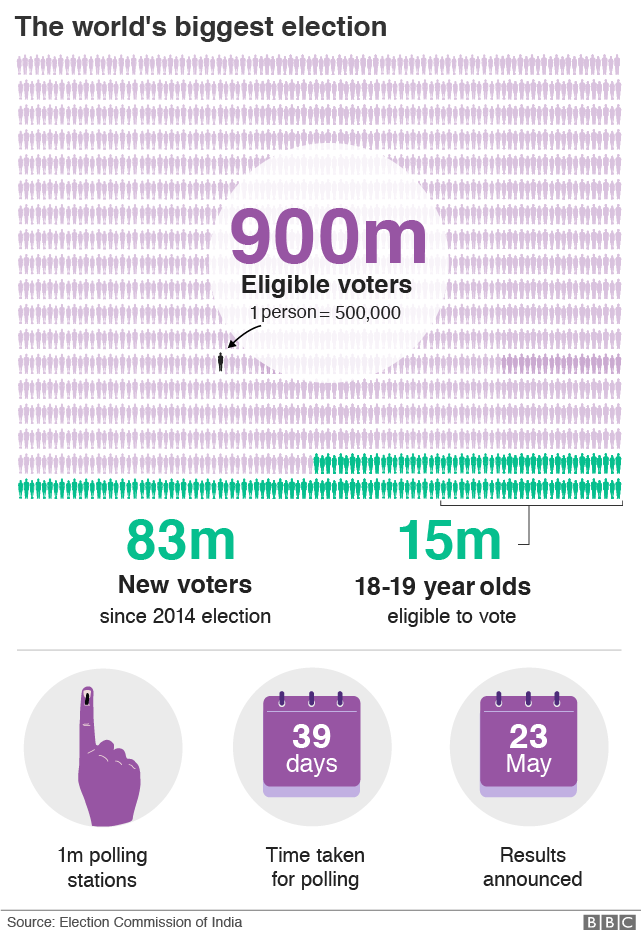
The election, the world’s biggest democratic exercise with about 900 million voters, started on April 11 with Modi in the lead amid heightened tension with long-time enemy Pakistan.
The last phase of voting is on May 19, with results released four days later.
There are a total of 545 seats in the Lok Sabha.
Modi sent warplanes into Pakistan in late February in response to a suicide attack by an Islamist militant group based there that killed 40 Indian police in the disputed Kashmir region.
Modi has sought votes on his tough response towards militancy and in recent days has evoked the deadly Easter Sunday bombings in nearby Sri Lanka.
Maidul Islam, a professor of political science at Kolkata’s Centre for Studies in Social Sciences, said long queues outside polling stations would indicate whether Modi’s national security pitch was working.
“Whenever there is a BJP kind of a wave, you see a higher voter turnout,” he said.
The NDRF and the Indian Coast Guard have been put on high alert and placed at the disposal of the state governments concerned.
INDIAUpdated: Apr 29, 2019 14:37 IST
HT Correspondent
New Delhi
Representational Image(REUTERS File)
The NDRF and the Indian Coast Guard have been put on high alert and fishermen asked not to venture into the sea, the Home Ministry said Monday.
According to the India Meteorological Department (IMD), its landfall over Tamil Nadu and Andhra Pradesh is ruled out. However, the possibility of landfall in Odisha is under continuous watch.
On Monday morning, it was located at 880 km of South-East of Chennai and it will continue to move North-West and change its path to North-East from Wednesday.
The National Disaster Response Force (NDRF) and the Indian Coast Guard have been put on high alert and placed at the disposal of the state governments concerned. Regular warnings have been issued since April 25 to fishermen not to venture into the sea and asking those at sea to return to coast, it said.
Prime Minister Narendra Modi is closely monitoring the situation and has directed Cabinet Secretary P K Sinha to convene a meeting of the National Crisis Management Committee (NCMC) to take stock of the situation with the state governments and the central ministries and agencies concerned to ensure necessary preparations to deal with the situation.
The IMD has been issuing three hourly bulletins with latest forecast to all the states concerned and the home ministry is also in continuous touch with the state governments and the central agencies concerned, the statement said.
Chinese President Xi Jinping (R) meets with Italian Prime Minister Giuseppe Conte at the Great Hall of the People in Beijing, capital of China, April 27, 2019. (Xinhua/Huang Jingwen)
BEIJING, April 27 (Xinhua) — Chinese President Xi Jinping on Saturday met with Italian Prime Minister Giuseppe Conte, who attended the Second Belt and Road Forum for International Cooperation in Beijing.
China highly commends Italy’s signing of a memorandum of understanding with China on jointly building the Belt and Road, taking the lead among major Western countries, according to Xi.
The country is ready to work with Italy in advancing the Belt and Road Initiative (BRI), and make the bilateral relations a model of Belt and Road cooperation between China and European countries, Xi said.
Xi called on both sides to firmly grasp the strategic significance of the bilateral ties, step up coordination and collaboration in improving global governance system and safeguarding free trade and multilateralism, and forge a new form of international relations featuring mutual respect, fairness, justice and win-win cooperation.
Conte said the speeches delivered by Xi at the forum helped the international community understand the significant benefits of the BRI for the world.
Italy is firmly committed to participating in the BRI, he said, adding that the initiative is a good opportunity for the world and more countries will join.
Italy welcomes Chinese companies to invest in the country, and will not adopt discriminatory policies against them, Conte said, calling on the two countries to reinforce solidarity and cooperation, and safeguard multilateralism.
Police investigation finds nearly 40 people received the shots since January last year – before the drug was approved by the Chinese regulator
Hainan hospital had rented out its medical cosmetics department to a beauty parlour, which authorities suspect administered the vaccinations
The Gardasil HPV vaccine has been in short supply in China since it was approved by the regulator last year. Photo: Shutterstock
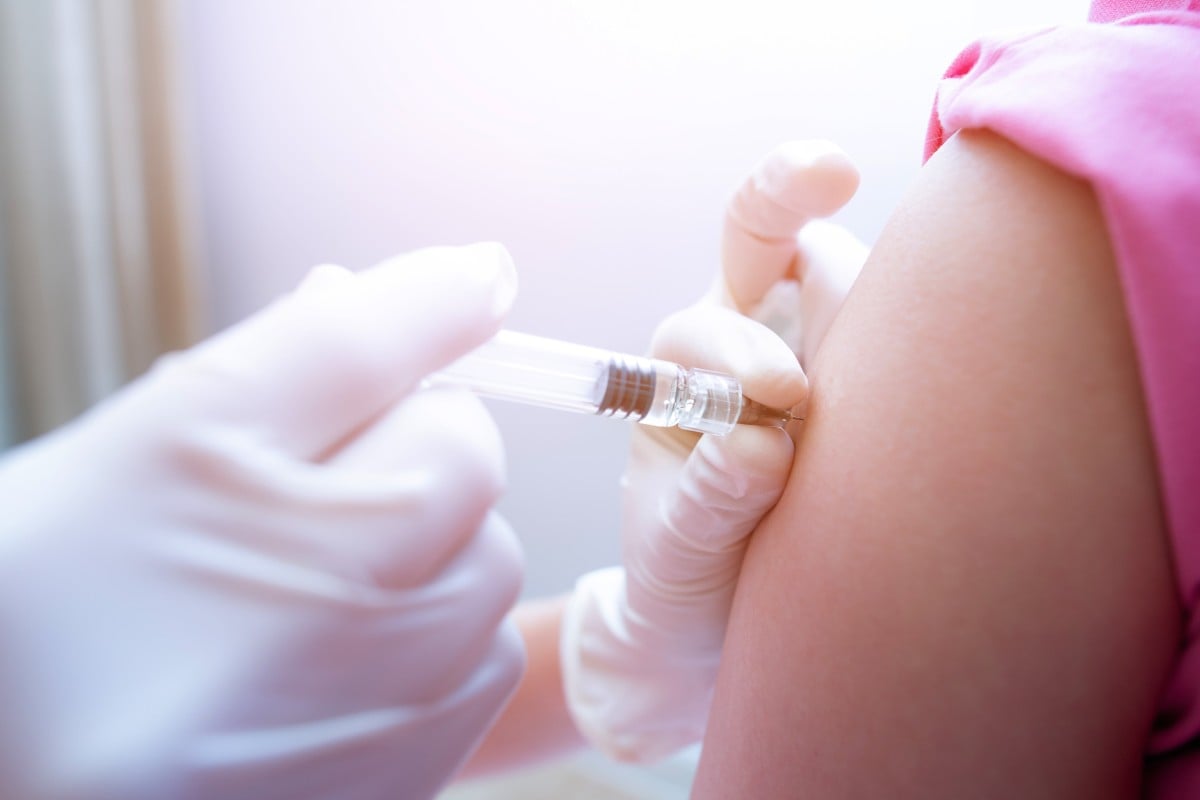
A private hospital on Hainan Island has been closed down after it gave fake HPV vaccines to dozens of patients, including at least one who was pregnant, the local health authority said.
Police found 38 people had been given the fake shots at Boao Yinfeng Healthcare International Hospital, in the city of Boao, since January last year, the Health Commission of Hainan said in a statement on Sunday.
Some of the vaccines were found to have been smuggled in from overseas before the drug was approved in China, while others were illegally made in Jilin province.
The case is the latest in a series of scandals in recent years – including drug makers
and people including children being given fake, faulty or expired vaccines – that have rocked public confidence in the industry.
The hospital began administering the fake HPV shots three months before Merck’s Gardasil vaccine against human papillomavirus, which causes cervical cancer, was approved by the Chinese regulator in April last year. There has been a constant shortage of the vaccine since it was approved and a ballot system is used at some hospitals due to the huge demand and limited supply.
All of the Boao patients given fake shots had paid 9,000 yuan (US$1,300) to be immunised except for a hospital employee, who was vaccinated for free, the statement said.
The health commission said the hospital did not have approval to administer HPV vaccines and some of the shots were given before it officially opened in March last year.
Are Philippine children’s deaths linked to dengue vaccine?
It was also in breach of the hospital management regulation because it had rented out its medical cosmetics department to a beauty parlour from Qingdao, which authorities suspect administered the fake vaccinations.
Its medical institution business licence was revoked and the hospital was fined 8,000 yuan, while authorities have confiscated the illegal proceeds of the fake vaccinations. It was not known whether any arrests had been made in the case, and the investigation was continuing.
The scandal came to light in March when a man posted on the People’s Daily website his complaint to the health authority about his pregnant wife being told by police she was given a fake HPV shot.
Another patient, who identified herself as Wang Xi, wrote on microblog site Weibo last week that she was told the hospital could receive the vaccine before it was officially approved because it was located in a medical tourism pilot zone, giving it preferential access to treatments.
“As a victim, I’m constantly worried – what have they injected into my body?” Wang wrote.
HONG KONG (Reuters) – Thousands of people marched on Hong Kong’s parliament on Sunday to demand the scrapping of proposed extradition rules that would allow people to be sent to mainland China for trial – a move which some fear puts the city’s core freedoms at risk.
Opponents of the proposal fear further erosion of rights and legal protections in the free-wheeling financial hub – freedoms which were guaranteed under the city’s handover from British colonial rule to Chinese sovereignty in 1997.
Early estimates suggested several thousand people had joined the march along Hong Kong Island from Causeway Bay to the council in the Admiralty business district.
Veteran Hong Kong activist and former legislator Leung Kwok-hung said the government’s move risked removing Hong Kongers’ “freedom from fear”.
“Hong Kong people and visitors passing by Hong Kong will lose their right not to be extradited into mainland China,” he said. “They would need to face an unjust legal system on the mainland.”
Some younger marchers said they were worried about travelling to China after the move, which comes just as the government encourages young people to deepen ties with the mainland and promotes Hong Kong’s links with southern China.
The peaceful marchers chanted demands for Hong Kong’s Executive Carrie Lam to step down, saying she had “betrayed” Hong Kong. Some sported yellow umbrellas – the symbol of the Occupy civil disobedience movement that paralysed parts of Hong Kong for 11 weeks in 2014.
The proposed changes have sparked an unusually broad chorus of concern from international business elites to lawyers and rights’ groups and even some pro-establishment figures.
Chris Patten, the last British governor of Hong Kong who handed the city back to Chinese rule in 1997, on Saturday described the move “as an assault on Hong Kong’s values, stability and security”, government-funded broadcaster RTHK reported.
Chief Executive Lam and other government officials are standing fast by their proposals, saying they are vital to plug long-standing loopholes.
Under the changes, the Hong Kong leader would have the right to order the extradition of wanted offenders to China, Macau and Taiwan as well as other countries not covered by Hong Kong’s existing extradition treaties.
As a safeguard such orders, to be issued case-by-case, could be challenged and appealed through the city’s vaunted legal system.
Government officials have said no-one at risk of the death penalty or torture or facing a political charge could be sent from Hong Kong. Under pressure from local business groups, they earlier exempted nine commercial crimes from the new provisions.
The proposals could be passed into law later in the year, with the city’s pro-democratic camp no longer holding enough seats to block the move.
The government has justified the swift introduction of the changes by saying they are needed so a young Hong Kong man suspected of murdering his girlfriend in Taiwan can be extradited to face charges there.
The government’s assurances are not enough for Lam Wing-kee, a former Hong Kong political bookseller who said in 2016 he was abducted by mainland agents in the city.
Lam left Hong Kong for Taiwan last week, saying he feared being sent back to the mainland under the new laws and his experienced showed he could have no trust in China’s legal system.
A group of 33 followers of Falun Gong, a religious sect banned in China, flew from Taiwan to Hong Kong on Saturday to join the march but were refused entry to Hong Kong, RTHK reported.
Sunday’s march comes amid renewed calls for deeper electoral reforms stalled five years ago after Occupy protests.
Four leaders of the movement were last week sentenced to jail terms ranging from eight to 16 months, part of a group of nine activists found guilty after a near month-long trial.
It is an election like no other. Those eligible to vote in India’s upcoming polls represent more than 10% of the world’s population and they will take part in the largest democratic exercise in history.
Voters will choose representatives for the Indian parliament, and in turn decide if Hindu nationalist Prime Minister Narendra Modi will run the country for another five years.
What is at stake?
Whoever wins these elections and forms a government will control the destiny of the world’s largest democracy.
While they are in charge, India’s economy is likely to overtake the UK’s and become the world’s fifth-largest.
Its population meanwhile – at more than 1.34bn people – is predicted to soon surpass China’s 1.39bn.
Hundreds of millions of Indians have escaped poverty since the turn of the millennium but huge challenges remain.
Unemployment is a major concern and is especially high among young people.
Millions of farmers are angry about low crop prices.
How the nuclear-armed country engages with the outside world – and manages a tricky relationship with its neighbour Pakistan – is also of immense importance to international security.
Who is being elected?
Indians are voting for members of parliament and the job of prime minister tends to go to the leader of the party or coalition with most seats. The current PM is Narendra Modi.
His main rival is opposition leader Rahul Gandhi.
Parliament has two houses: the Lok Sabha and the Rajya Sabha.
The lower house – Lok Sabha – is the one to watch.
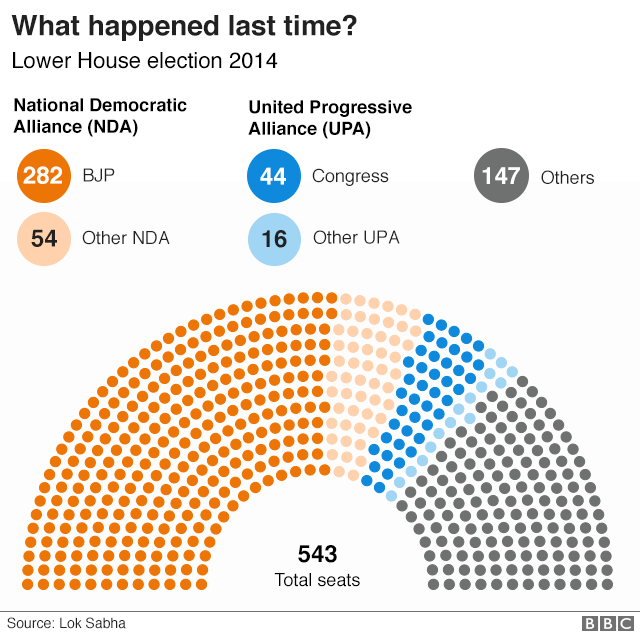
It has 543 elected seats and any party or coalition needs a minimum of 272 MPs to form a government.
At the last election in 2014, Mr Modi’s BJP won 282 seats.
Mr Gandhi’s Congress Party only took 44 seats in 2014 – down from 206 in 2009.
Why does voting take so long?
Because of the enormous number of election officials and security personnel involved, voting will take place in seven stages between 11 April and 19 May.
Different states will vote at different times.
Votes will be counted on 23 May and results are expected on the same day.
Who will win?
This election is being seen as a referendum on Mr Modi, a polarising figure adored by many but also accused of stoking divisions between India’s Hindu majority and the country’s 200 million Muslims.
Until a few months ago, Mr Modi and his BJP party were seen as the overwhelming favourites. But the loss of key states in December’s regional elections injected a sense of serious competition into the national vote.
Analysts are divided on whether Mr Modi will be able to win a simple majority again.
A recent escalation of tensions with Pakistan has given the BJP a new and popular issue to campaign on.
It will be hoping that a focus on patriotism will help the party to get past the serious challenge mounted by powerful regional parties and Congress.
AHMEDABAD/NEW DELHI (Reuters) – PepsiCo Inc has sued four Indian farmers for cultivating a potato variety that the snack food and drinks maker claims infringes its patent, the company and the growers said on Friday.
Pepsi has sued the farmers for cultivating the FC5 potato variety, grown exclusively for its popular Lay’s potato chips. The FC5 variety has a lower moisture content required to make snacks such as potato chips.
The company is seeking more than 10 million rupees (£110,669) each for alleged patent infringement.
The farmers grow potatoes in the western state of Gujarat, a leading producer of India’s most consumed vegetable.
“We have been growing potatoes for a long time and we didn’t face this problem ever, as we’ve mostly been using the seeds saved from one harvest to plant the next year’s crop,” said Bipin Patel, one of the four farmers sued by Pepsi.
Patel did not say how he came by the PepsiCo variety.
A court in Ahmedabad, the business hub of Gujarat, on Friday agreed to hear the case on June 12, said Anand Yagnik, the farmers’ lawyer.
“In this instance, we took judicial recourse against people who were illegally dealing in our registered variety,” a PepsiCo India spokesman said.
“This was done to protect our rights and safeguard the larger interest of farmers that are engaged with us and who are using and benefiting from seeds of our registered variety.”
PepsiCo, which set up its first potato chips plant in India in 1989, supplies the FC5 potato variety to a group of farmers who in turn sell their produce to the company at a fixed price.
The company said the four farmers could join the group of growers who exclusively grow the FC5 variety for its Lay’s potato chips.
“PepsiCo India has proposed to amicably settle with the people who were unlawfully using the seeds of its registered variety. PepsiCo has also proposed that they may become part of its collaborative potato farming programme,” the company spokesman said in a statement.
If the farmers do not wish to grow the FC5 potato variety for PepsiCo, they can simply sign an agreement with the company to cultivate other available varieties, he added.
The All India Kisan Sabha, or All India Farmers’ Forum, has asked the Indian government to protect the farmers.
The forum has also called for a boycott of Lay’s chips and PepsiCo’s other products.
The Ministry of Agriculture & Farmers’ Welfare did not immediately respond to an email seeking comment.
PepsiCo is the second large U.S. company to face patent infringement issues in India.
Stung by a long-standing intellectual property dispute, seed maker Monsanto, now owned by German drugmaker Bayer AG, withdrew from some businesses in India over a cotton-seed dispute with farmers, Reuters reported in 2017. (reut.rs/2ncBknn)
BEIJING, April 26 (Xinhua) — The Belt and Road Initiative (BRI) is growing up and gaining global traction, said Klaus Schwab, founder and executive chairman of the World Economic Forum (WEF), here on Friday.
In an interview with Xinhua on the sidelines of the second Belt and Road Forum for International Cooperation (BRF), he said that when he attended the first BRF in 2017, the BRI “was still a child growing up and you don’t know what the end of it will be.”
“Now the BRI has become an adult, which means that it has become an important factor in the global economy. It has grown up,” he told Xinhua.
Illustrating his understanding of the BRI in a speech at the ongoing second BRF, the professor said that through the BRI and institutions like the Asian Infrastructure Investment Bank, China can demonstrate to the world that “the philosophy and concept of the Belt and Road is more than an important initiative.”
The WEF founder, an advocate of “Globalization 4.0,” said that if people want globalization to continue as a positive force, a higher level of globalization is needed to respond to the needs and realities of a transforming world.
The BRI, he added, can be “a building block and a role model of” an advanced pattern of global cooperation that should be more sustainable, more inclusive and more collaborative.
Over the years, Schwab has articulated on many occasions his views of the BRI. At the 2015 Summer Davos Forum in northeast China’s port city of Dalian, he said he was happy to see that China proposed the BRI.
There was a huge infrastructure demand in Asia and Europe, and it was a good thing for China to play a leading role in building infrastructure in the region, he noted.
Partly thanks to the fact that it met the development needs of many countries, the BRI continued with rapid progress, promoting common development in participating countries and bringing Asia and Europe ever closer.
On May 13, 2017, the 1,000th China-Europe freight train that year departed from China’s eastern city of Yiwu to Europe, fully loaded with commodities like smallware and clothes.
The next day, Schwab reaffirmed his full support for the BRI in an address at the first BRF. Not hiding his enthusiasm about the BRI, he said the initiative “takes a long-term and holistic view, and makes a unique contribution to international cooperation and economic development.”
He pointed out that connectivity, a primary focus of the BRI, “is the new meta-pattern of our era and a key driver of our future economy.”
Citing a Chinese saying that “if you want to get rich, build a road,” he said, “I would update this to say: ‘If you seek prosperity, build connectivity.'”
One month later, in an interview with Xinhua ahead of the 2017 Summer Davos Forum, also held in Dalian, Schwab pointed to the BRI’s paradigm-shifting significance.
“The Belt and Road Initiative has great significance because it is a new approach to reach a new and open cooperation … and everybody can participate in a win-win situation as an equal partner,” he said.
Since Chinese President Xi Jinping proposed the initiative six years ago, 126 countries and 29 international organizations have signed BRI cooperation documents with China. The initiative has become the world’s largest platform for international cooperation and the most welcomed global public good.
The BRI “is now growing up into a mature initiative that can have even more impact,” Schwab told Xinhua.
Li Zhanshu (R), a member of the Standing Committee of the Political Bureau of the Communist Party of China Central Committee and chairman of the Standing Committee of the National People’s Congress, meets with General Secretary of the Lao People’s Revolutionary Party Central Committee and Lao President Bounnhang Vorachit, who is attending the Second Belt and Road Forum for International Cooperation, in Beijing, capital of China, April 26, 2019. (Xinhua/Yin Bogu)
BEIJING, April 26 (Xinhua) — Li Zhanshu, chairman of the Standing Committee of the National People’s Congress (NPC), on Friday met with Lao President Bounnhang Vorachit, who is attending the Second Belt and Road Forum for International Cooperation in Beijing.
Li, also a member of the Standing Committee of the Political Bureau of the Communist Party of China Central Committee, said that China is willing to strengthen high-level contacts between the two countries and push forward the bilateral relations.
Li said that the NPC is willing to enhance exchanges and cooperation with the Lao National Assembly.
Bounnhang, also general secretary of the Lao People’s Revolutionary Party Central Committee, said Laos is ready to work closely with China to make new progress in building a community with a shared future for the two countries.