Archive for ‘World Bank’

31/03/2020

Coronavirus latest: New York begs for help; Indonesia bans foreigners entry; Italy extends lockdown

  • US death toll passes 3,000 as New York’s hospitals are pushed to breaking point
  • Italy extends lockdown as cases exceed 100,000; UN Security Council votes by email for first time

The USNS Comfort passes the Statue of Liberty as it enters New York Harbour on Monday. Photo: Reuters

Harsh lockdowns aimed at halting the march of the coronavirus pandemic extended worldwide Monday as the death toll soared toward 37,000 amid new waves of US outbreaks.

The tough measures that have confined some two-fifths of the globe’s population to their homes were broadened. Moscow and Lagos joined the roll call of cities around the globe with eerily empty streets, while Virginia and Maryland became the latest US states to announce emergency stay-at-home orders, followed quickly by the capital city Washington.

In a symbol of the scale of the challenge facing humanity, a US military medical ship sailed into New York to relieve the pressure on overwhelmed hospitals bracing for the peak of the pandemic.

France reported its highest daily number of deaths since the outbreak began, saying 418 more people had succumbed in hospital.

Spain, which announced another 812 virus deaths in 24 hours, joined the United States and Italy in surpassing the number of cases in China, where the disease was first detected in December.

On Tuesday, mainland China reported a rise in new confirmed coronavirus cases, reversing four days of declines, due to an uptick in infections involving travellers arriving from overseas.

Mainland China had 48 new cases on Monday, the National Health Commission said, up from 31 new infections a day earlier.

All of the 48 cases were imported, bringing the total number of imported cases in China to 771 as of Monday.

There was no reported new case of local infection on Monday, according to the National Health Commission. The total number of infections reported in mainland China stood at 81,518 and the death toll at 3,305. Globally, more than 760,000 have been infected, according to official figures.

Here are the developments:

Hospital ship arrives in New York

New York’s governor issued an urgent appeal for medical volunteers Monday amid a “staggering” number of deaths from the coronavirus, saying: “Please come help us in New York, now.”

The plea from Governor Andrew Cuomo came as the death toll in New York State climbed past 1,200 – with most of the victims in the big city – and authorities warned that the crisis pushing New York’s hospitals to the breaking point is just a preview of what other cities across the US could soon face.

Cuomo said the city needs 1 million additional health care workers.

“We’ve lost over 1,000 New Yorkers,” he said. “To me, we’re beyond staggering already. We’ve reached staggering.”

The governor’s plea came as a 1,000-bed US Navy hospital ship docked in Manhattan on Monday and a field hospital was going up in Central Park for coronavirus patients.

New York City reported 914 deaths from the virus as of 4:30pm local time Monday, a 16 per cent increase from an update six hours earlier. The city, the epicentre of the US outbreak, has 38,087 confirmed cases, up by more than 1,800 from earlier in the day.

Coronavirus field hospital set up in New York’s Central Park as city’s health crisis deepens

Gloom for 24 million people in Asia

The economic fallout from the coronavirus pandemic will prevent almost 24 million people from escaping poverty in East Asia and the Pacific this year, according to the World Bank.

In a report released on Monday, the Washington-based lender also warned of “substantially higher risk” among households that depend on industries particularly vulnerable to the impact of Covid-19. These include tourism in Thailand and the Pacific islands; manufacturing in Vietnam and Cambodia; and among people dependent on “informal labour” in all countries.

The World Bank urged the region to invest in expanding conventional health care and medical equipment factories, as well as taking innovative measures like converting ordinary hospital beds for ICU use and rapidly trining people to work in basic care.

Billionaire blasted for his Instagram-perfect isolation on luxury yacht

31 Mar 2020

Indonesia bans entry of foreigners

Indonesia barred foreign nationals from entering the country as the world’s fourth-most populous country stepped up efforts to contain the spread of the coronavirus pandemic.

The travel ban, to be effective soon, will also cover foreigners transiting through the country, Foreign Minister Retno Marsudi said after a cabinet meeting in Jakarta Tuesday. The curbs will not apply to holders of work permits, diplomats and other official visitors, she said.

The curbs on foreign citizens is the latest in a raft of measures taken by Indonesia to combat the deadly virus that’s sickened more than 1,400 people and killed 122. President Joko Widodo’s administration previously banned flights to and from mainland China and some of the virus-hit regions in Italy, South Korea and Iran. The president on Monday ordered stricter implementation of social distancing and health quarantine amid calls for a lockdown to contain the pandemic.

Indonesia has highest coronavirus mortality rate in Southeast Asia

First US service member dies

The first US military service member has died from the coronavirus, the Pentagon said on Monday, as it reported another sharp hike in the number of infected troops.

The Pentagon said it was a New Jersey Army National Guardsman who had tested positive for Covid-19 and had been hospitalised since March 21. He died on Saturday, it said.

Earlier on Monday, the Pentagon said that 568 troops had tested positive for the coronavirus, up from 280 on Thursday. More than 450 Defence Department civilians, contractors and dependents have also tested positive, it said.

US military has decided to stop providing more granular data about coronavirus infections within its ranks, citing concern that the information might be used by adversaries as the virus spreads.

The new policy, which the Pentagon detailed in a statement on Monday, appears to underscore US military concerns about the potential trajectory of the virus over the coming months – both at home and abroad.

School to resume in South Korea … online

South Korean children will start the new school year on April 9 with only online classes, after repeated delays due to the outbreak of the new coronavirus, the government said Tuesday.

Prime Minister Chung Sye Kyun said that despite the nation’s utmost efforts to contain the virus and lower the risk of infection, there is consensus among teachers and others that it is too early to let children go back to school.

The nation’s elementary schools, and junior and senior high schools were supposed to start the new academic year in early March, but the government has repeatedly postponed it to keep the virus from spreading among children.

The start was last postponed until April 6, but has now been delayed three more days to allow preparations to be made for online classes.

The nation now has 9,786 confirmed cases in total, with 162 deaths.

Italy extends lockdown as cases exceed 100,000

Italy’s government on Monday said it would extend its nationwide lockdown measures
against a coronavirus outbreak, due to end on Friday, at least until the Easter season in April.
The Health Ministry did not give a date for the new end of the lockdown, but said it would be in a law the government would propose. Easter Sunday is April 12 this year. Italy is predominantly Roman Catholic and contains the Vatican, the heart of the church.

Italians have been under lockdown for three weeks, with most shops, bars and restaurants shut and people forbidden from leaving their homes for all but non-essential needs.

Italy, which is the world’s hardest hit country in terms of number of deaths and accounts for more than a third of all global fatalities, saw its total death tally rise to 11,591 since the outbreak emerged in northern regions on February 21.

The death toll has risen by 812 in the last 24 hours, the Civil Protection Agency said, reversing two days of declines, although the number of new cases rose by just 4,050, the lowest increase since March 17, reaching a total of 101,739.

Deadliest day in Italy and Spain shows worst not over yet
28 Mar 2020
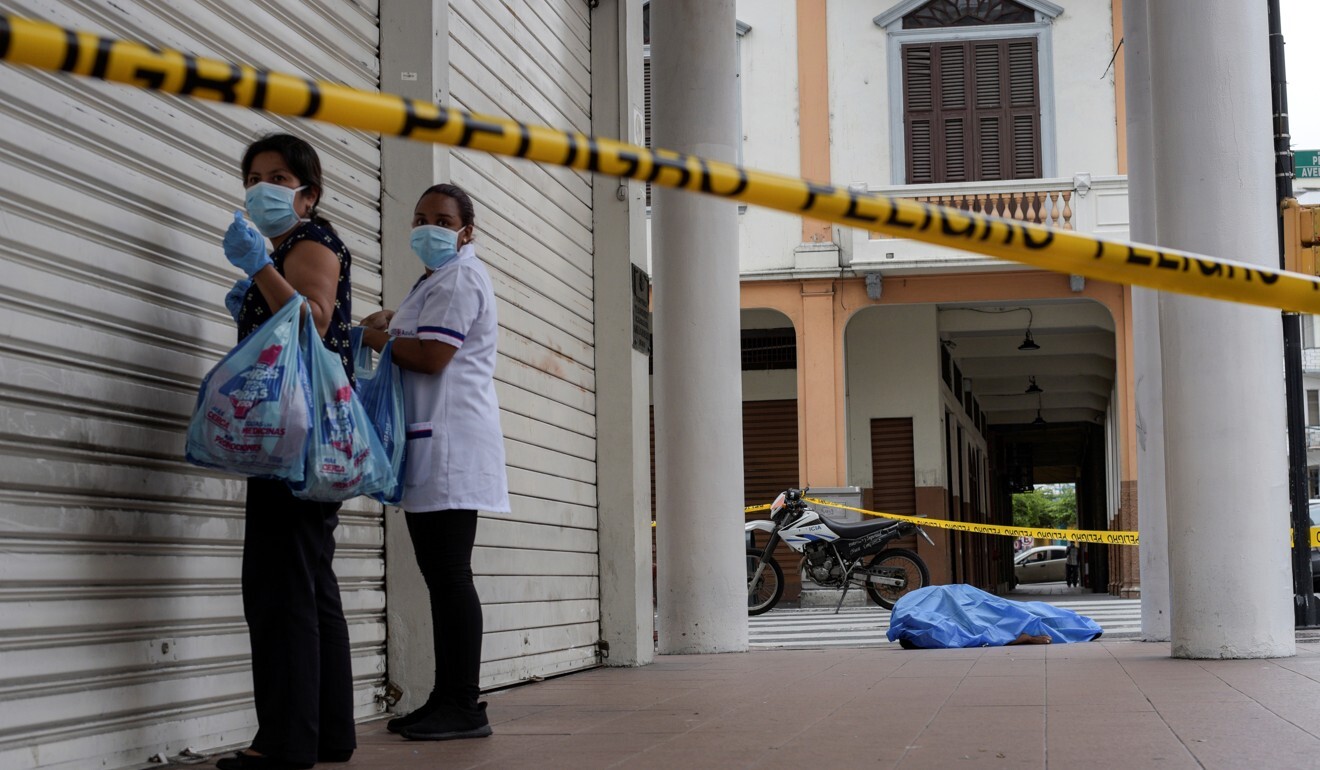
Women stand near the body of a man who died on the sidewalk in Guayaquil, Ecuador. Photo: Reuters

Ecuador struggles to collect the dead

Ecuadorean authorities said they would improve the collection of corpses, as delays related to the rapid spread of the new coronavirus has left families keeping their loved ones’ bodies in their homes for days in some cases.

Residents of Guayaquil, Ecuador’s largest city, have complained they have no way to dispose of relatives’ remains due to strict quarantine and curfew measures designed to prevent spread of the disease. Last week, authorities said they had removed 100 corpses from homes in Guayaquil.

But delays in collecting bodies in the Andean country, which has reported 1,966 cases of the virus and 62 deaths, were evident midday on Monday in downtown Guayaquil, where a man’s dead body lay on a sidewalk under a blue plastic sheet. Police said the man had collapsed while waiting in line to enter a store. Hours later, the body had been removed.

More than 70 per cent of the country’s coronavirus cases, which is among the highest tallies in Latin America, are in the southern province of Guayas, where Guayaquil is located.

Panama to restrict movement by gender

The government of Panama announced strict quarantine measures that separate citizens by gender in an effort to slow the spread of the novel coronavirus.

From Wednesday, men and women will only be able to leave their homes for two hours at a time, and on different days. Until now, quarantine regulations were not based on gender.

Men will be able to go to the supermarket or the pharmacy on Tuesdays, Thursdays and Saturdays, and women will be allowed out on Mondays, Wednesdays and Fridays.

No one will be allowed to go out on Sundays. The new measures will last for 15 days.

Police in Kenya use tear gas to enforce coronavirus curfew

Remote vote first for UN Security Council

The UN Security Council on Monday for the first time approved resolutions remotely after painstaking negotiations among diplomats who are teleworking due to the coronavirus pandemic.

The Security Council unanimously voted by email for four resolutions, including one that extended through April 2021 the expiring mandate of UN experts who are monitoring sanctions on North Korea, diplomats said.

The UN mission in Somalia was also prolonged, until the end of June, and the mission in Darfur until the end of May – two short periods decided due to uncertainty over the spread of the pandemic.

The Council also endorsed a fourth resolution aimed at improving the protection for peacekeepers.

The resolutions are the first approved by the Security Council since it began teleworking on March 12 and comes as Covid-19 rapidly spreads in New York, which has become the epicenter of the disease in the United States.

Congo ex-president dies in France

Former Republic of Congo president Jacques Joaquim Yhombi Opango died in France on Monday of the new coronavirus, his family said. He was 81.

Yhombi Opango, who led Congo-Brazzaville from 1977 until he was toppled in 1979, died at a Paris hospital of Covid-19, his son Jean-Jacques said. He had been ill before he contracted the virus.

Yhombi Opango was an army officer who rose to power after the assassination of president Marien Ngouabi.

Yhombi Opango was ousted by long-time ruler Denis Sassou Nguesso. Accused of taking part in a coup plot against Sassou Nguesso, Yhombi Opango was jailed from 1987 to 1990. He was released a few months before a 1991 national conference that introduced multiparty politics in the central African country.

When civil war broke out in Congo in 1997, Yhombi Opango fled into exile in France. He was finally able to return home in 2007, but then divided his time between France and Congo because of his health problems.

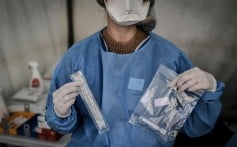
‘When I wake I cry’: France’s nurses face hell on coronavirus front line
31 Mar 2020

EU asks Britain to extend Brexit talks

The European Union expects Britain to seek an extension of its post-Brexit transition period beyond the end of the year, diplomats and officials said on Monday, as negotiations on trade have ground to a halt due to the coronavirus pandemic.

Europe has gone into a deep lockdown in a bid to curb the spread of the disease, with more than 330,000 infections reported on the continent and nearly 21,000 deaths.

In Britain, Prime Minister Boris Johnson and his health minister have both tested positive for the virus and the prime minister’s senior adviser Dominic Cummings – one of the masterminds behind Britain’s departure from the EU earlier this year – was self-isolating with symptoms.

London and the EU have been seeking to agree a new trade pact by the end of the year to kick in from 2021, even though the bloc has long said that such a time frame was extremely short to agree rules on everything from trade to security to fisheries.

The pyramid of Khufu, the largest of the Giza pyramid complex. Photo: Reuters

Great Pyramid in Egypt lights up in solidarity

Egypt’s famed Great Pyramid was emblazoned Monday evening with messages of unity and solidarity with those battling the novel coronavirus the world over.

“Stay safe”, “Stay at home” and “Thank you to those keeping us safe,” flashed in blue and green lights across the towering structure at the Giza plateau, southwest of the capital Cairo.

Egypt has so far registered 656 Covid-19 cases, including 41 deaths. Of the total infected, 150 reportedly recovered.

Egypt has carried out sweeping disinfection operations at archaeological sites, museums and other sites across the country.

In tandem, strict social distancing measures were imposed to reduce the risk of contagion among the country’s 100 million inhabitants.

Tourist and religious sites are shuttered, schools are closed and air traffic halted.
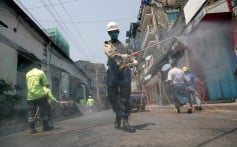
Myanmar braces for ‘big outbreak’ after migrant worker exodus from Thailand
30 Mar 2020

Saudi king to pay for all patients’ treatment

Saudi Arabia will finance treatment for anyone infected with the coronavirus in the country, the health minister said on Monday.

The kingdom has registered eight deaths among 1,453 infections, the highest among the six Gulf Arab states.

Health Minister Tawfiq Al Rabiah said King Salman would cover treatment for citizens and residents diagnosed with the virus, urging people with symptoms to get tested.

“We are all in the same boat,” he told a news conference, adding that Crown Prince Mohammed bin Salman was overseeing containment efforts “night and day”.

Denmark eyes gradual reopening after Easter

Denmark may gradually lift a lockdown after Easter if the numbers of coronavirus cases and deaths remain stable, Prime Minister Mette Frederiksen said on Monday.

The Nordic country, which has reported 77 coronavirus-related deaths, last week extended until after Easter a two-week lockdown to limit physical contact between its citizens that began on March 11.

The number of daily deaths slowed to five on Sunday from eight and 11 on Saturday and Friday respectively. Denmark has reported a total of 2,577 coronavirus infections.

“If we over the next two weeks across Easter keep standing together by staying apart, and if the numbers remain stable for the next two weeks, then the government will begin a gradual, quiet and controlled opening of our society again, at the other side of Easter,” Frederiksen said.

Source: SCMP

03/03/2020

Feature: China’s contribution to global IP governance “remarkable”

BEIJING, March 3 (Xinhua) — When talking about the development of intellectual property (IP) in China, World Intellectual Property Organization (WIPO) Director General Francis Gurry said “it’s a remarkable journey and a remarkable story.”

Born at the start of reform and opening-up, China’s IP cause has taken only decades to accomplish what the western IP system took hundreds of years to develop. While developing and improving its IP system, China has been active in international cooperation to boost global IP governance.

ACTIVE IN INT’L COOPERATION

Starting from zero at the beginning of its reform and opening-up, China has established a relatively complete IP legal system in line with prevailing international rules, joined almost all major related international treaties, and developed cooperative relations with over 80 countries and international or regional organizations in a relatively short period of time.

China has always been a follower, participant and upholder of the international rules of IP, Shen Changyu, commissioner of the National Intellectual Property Administration, told Xinhua in a recent interview.

China is an active participant in multilateral and bilateral affairs within the framework of WIPO to promote and improve global IP governance, Shen added.

In recent years, international cooperation with China on IP protection has has continuous innovative progress. IP cooperation under the Belt and Road Initiative has in particular achieved practical results.

In 2019, China and the European Union (EU) completed an eight-year negotiation on an agreement to protect geographical indications (GI), which included 275 GI from each of the two sides in the appendix, such as EU’s Irish whiskey and traditional Chinese Shaoxing wine.

With the ratification of Indonesia on Jan. 28, the Beijing Treaty on Audiovisual Performances will take effect for its 30 contracting parties on April 28.

The Beijing treaty, adopted by WIPO member states in 2012, fills a gap in the international treaty on the comprehensive protection of performers in audiovisual performance.

PROTECTION WITHOUT DISCRIMINATION

IP is not only an important strategic resource of a country, but also a booster of technological innovation and a bridge of trade globalization. China is a protector and creator of IP.

Statistics show that by the end of 2019, China had led the world in patent and trademark applications for several years running.

According to data from the WIPO for 2017 and 2018, China was the second largest applicant for international patent applications submitted through the Patent Cooperation Treaty, and the third largest for trademark registration under the Madrid System.

After about 40 years of development, China’s IP governance capability is in line with that of the international community and its IP protection has reached the international standard, which is fully recognized by the world, said Shan Xiaoguang, dean of Shanghai International College of IP at Tongji University.

In the process of advancing the development of its IP system, China has made great efforts to enhance protection and optimize policies, insisting on providing effective protection without discrimination for both domestic and foreign enterprises.

Foreign plaintiffs are able to win and receive injunctions in patent infringement cases brought in China according to the law, Patently-O, a U.S. leading patent law blog, wrote, adding that China’s IP protection practice is fair and just.

China’s effective protection brings huge benefits to foreign IP holders every year. Statistics show that the country paid 34 billion U.S. dollars for IP royalties in 2019.

China has strengthened IP protection with an open attitude, making it a magnet for global trade and innovative activities.

Global innovative activities occur mostly in metropolitan hotspots in China, Germany, Japan, South Korea and the United States, according to the 2019 edition of WIPO’s “World Intellectual Property Report.”

According to Doing Business 2020, an annual report published by the World Bank, China jumped to 31st in its ranking for ease of doing business and is among the top 10 improvers for a second consecutive year.

CHINESE WISDOM

Advanced experience accumulated during the rapid growth of the IP cause in China over the past decades has attracted worldwide attention.

China places IP at a strategic high level, pays attention to IP protection in all economic fields, and has shown its determination of long-term policy for decades, which set up examples for other countries, said Gurry.

Renata Righetti Pelosi, president of the International Association for the Protection of Intellectual Property, pointed out two reasons for the rapid development of the IP cause in China.

On the one hand, the needs of economic operators in China have increasingly overlapped with those in the world, and the two sides have reached more consensuses on IP protection, Pelosi said.

On the other, China has many IP talents with a global vision, who are leading the rapid growth of this sector, she added.

Through academic exchanges and personnel training, China is also actively contributing its wisdom to global IP governance and is more confident about joining global IP cooperation.

The first batch of students from countries that joined the Belt and Road construction successfully graduated from China with master’s degrees in IP in 2018, bringing the knowledge and experience of IP protection they learned from China to the world.

As global IP governance is facing new challenges posed by a new phase of development and a new round of scientific and technological revolution has brought great changes to the industry, many industries spawned by new technologies have gone beyond the scope of protection of the original IP system.

In the new round of scientific and technological revolution and industrial transformation, countries should learn from each other with a more open and inclusive attitude, said Shan, adding that China has led the world in such technological fields as artificial intelligence, big data and life science, and accumulated valuable experience on IP protection in related industries, which is conducive to solving global challenges.

Source: Xinhua

28/12/2019

China, Senegal continue to deepen comprehensive strategic cooperative partnership in 2019

DAKAR, Dec. 27 (Xinhua) — China has continued to be a key partner for Senegal in 2019, supporting its implementation of the Plan for an Emerging Senegal, proposed by Senegalese president Macky Sall.

Fourteen years after the resumption of diplomatic relations between Beijing and Dakar, China occupies an essential place in Senegal’s political and trade relationships.

At the beginning of the year, during a visit of Chinese State Councilor and Foreign Minister Wang Yi, Senegalese president Sall said the Senegal-China relationship is dynamic, practical and effective, hailing it as a model. He said the Senegalese side hopes to further deepen cooperation with China in various fields.

According to the Chinese Embassy in Senegal, trade between the two partners, at 2.27 billion U.S. dollars in 2018, accelerated in 2019, and China has become one of the most popular destinations among Senegalese businesspeople.

The year 2019 was marked also by numerous visits by Chinese businessmen to study the Senegalese market for potential investments opportunities. The return of Chinese traders in the marketing campaign of peanuts has been hailed by many agricultural stakeholders.

Also in 2019, the inauguration of the Chinese-built Diamniadio Industrial Park, about 30 km from Dakar, won positive response from Senegalese authorities.

In terms of infrastructure, cooperation continued in a good momentum after the opening of the Museum of Black Civilizations, the Thies-Touba, Dakar-Mbour and Dakar-Thies highways, the Grand Theater in Dakar, and the Children Hospital in Diamniadio.

Chinese expertise has won acclaim in Senegal in the construction of the first Bus Rapid Transit (BRT) serving the Senegalese capital and its suburbs. China Road and Bridge Corporation (CRBC) won the international tender for the project mostly funded by the World Bank.

Senegal also counts on China for the construction of sports facilities for the organization of the Youth Olympic Games in 2022. China built Senegal’s largest stadium, Leopold Sedar Senghor Stadium, in the 1980s, and three other regional stadiums will be rehabilitated.

In the political field, Senegal is now co-chair of the Forum on China-Africa Cooperation (FOCAC). China and Senegal have worked closely to push forward their comprehensive strategic cooperative partnership, setting a good example of high-quality and sustainable cooperation.

Throughout the year, the two sides have had in-depth exchanges on bilateral ties and other issues of common interest.

Senegalese President Macky Sall reiterated, during the last visit to Senegal by Yang Jiechi, member of the Political Bureau of the Central Committee of the Communist Party of China (CPC), Senegal firmly supports and actively participates in the Belt and Road Initiative, which was launched in 2013 by his Chinese counterpart, Xi Jinping.

On several occasions, the Senegalese authorities have welcomed the support of China for the realization of development projects in the Plan for an Emerging Senegal.

Senegal and China also increased cultural exchanges in 2019. In November, Dakar hosted an international seminar on China-Africa Cooperation and the joint construction of the Belt and Road Initiative. The event was organized by the Chinese Academy of Social Sciences and the National School of Administration of Senegal.

Senegalese Minister of Infrastructure Oumar Youm said the Belt and Road Initiative meets the real needs of China and African countries.

The initiative reflects the “sincere and firm commitment of both parties to building together a common destiny even stronger and more prosperous,” he said.

In 2019, the Chinese Embassy in Senegal granted scholarships to 48 Senegalese students for them to continue their studies in China in various fields.

Local Confucius Institute students competed in the Senegal country final of the 18th edition of the worldwide “Chinese Bridge” contest.

To mark the 70th anniversary of the People’s Republic of China, Hangzhou Art Troupe performed at the Grand Theater in Dakar to showcase Chinese culture.

In the Museum of Black Civilizations, Shanghai University presented an exhibition, “The emergence of the Chinese countryside through development,” to tell the story of China’s development.

For Birane Niang, secretary general of the Senegalese Ministry of Culture and Communication, “cultural dialogue has this ability to bring people together and strengthen their friendship and mutual respect of their differences.”

China and Senegal have also continued to strengthen cooperation in the field of public health. This year, the 17th Chinese medical team, composed of 13 health professionals, treated 76,489 patients, including nearly 200 critically ill ones, performing 5,000 operations, in Senegal.

A further deepening of relations between China and Senegal is expected in 2020.

Source: Xinhua

27/12/2019

US-China tech war’s new battleground: undersea internet cables

  • A push to connect Pacific nations highlights a submarine struggle for dominance over the world’s technology infrastructure
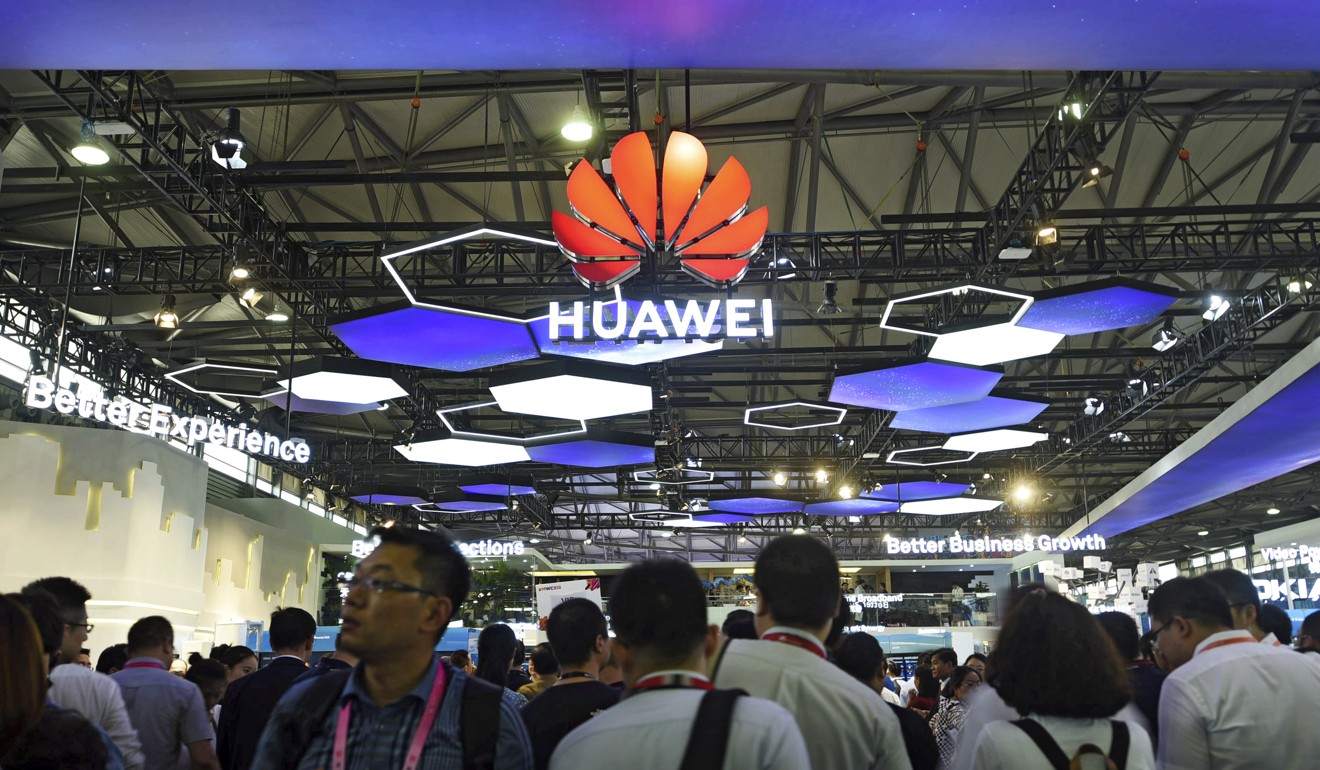
  • The ambitions of Chinese tech giants like Huawei, which have laid thousands of kilometres of cable, are of increasing concern to Washington
The ambitions of Chinese tech giants like Huawei, which have laid thousands of kilometres of cable, are of increasing concern to Washington. Photo: Reuters
In the contest between the US and China for dominance over the world’s technology
infrastructure, the latest battle is taking place under the Pacific Ocean.
While the US has been upping the pressure on its allies not to include equipment made by Chinese telecom giants like Huawei and ZTE in their 5G systems, Chinese companies have gained a foothold in some of the world’s most essential communications infrastructure – undersea internet cables.
Smart telecom cables: climate change hope or submarine spying tech?
14 Dec 2019
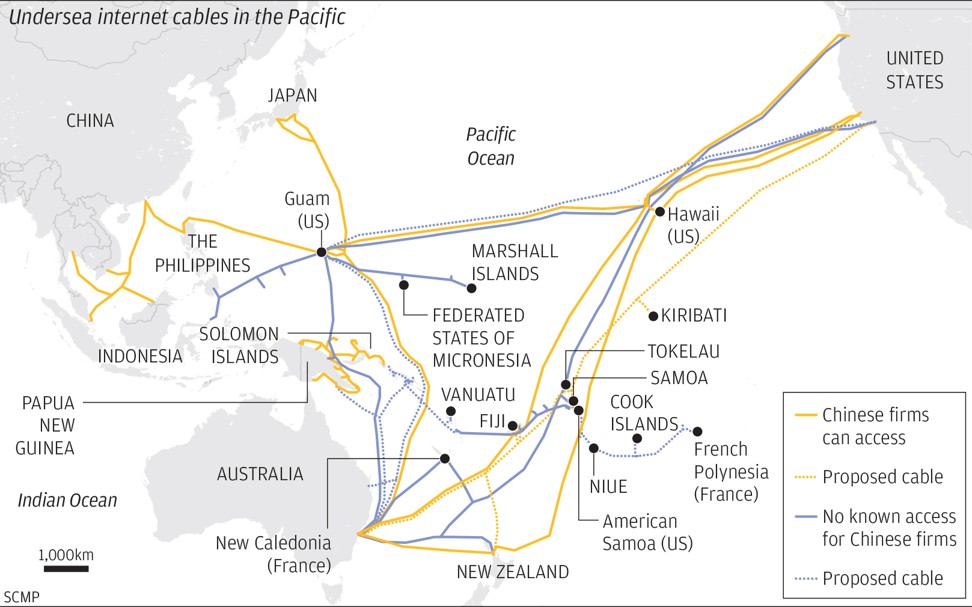
Almost all global data communications flow through cables under the ocean – just one per cent travels by satellite – and Chinese companies have quietly been eroding US, European and Japanese dominance over the backbone of the internet, the undersea cable market. Now, they have trained their sights on connecting one of the most virtually remote parts of the globe, the Pacific Island countries.
Of the 378 cables currently operating worldwide, 23 are under the Pacific. But many of these cables run right by Pacific Island nations on their paths between hubs in Los Angeles, Tokyo and Singapore.
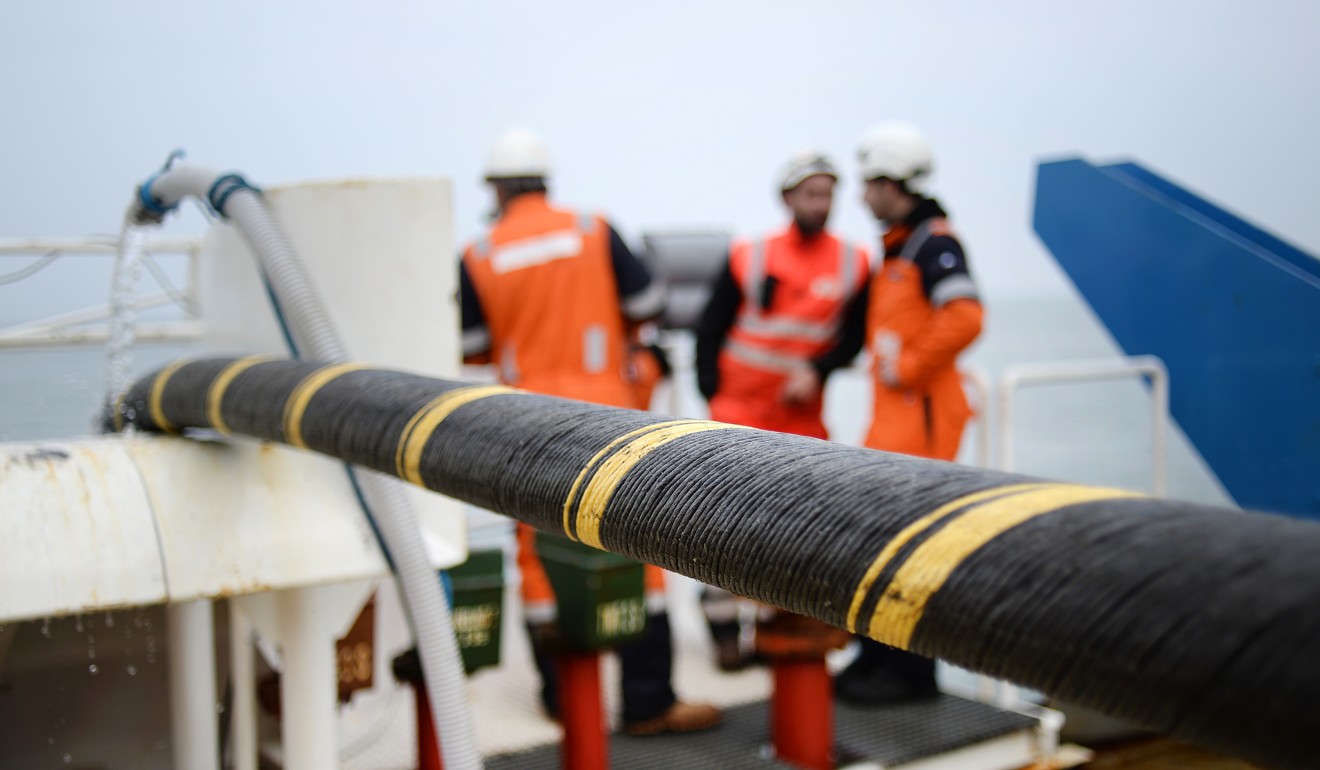
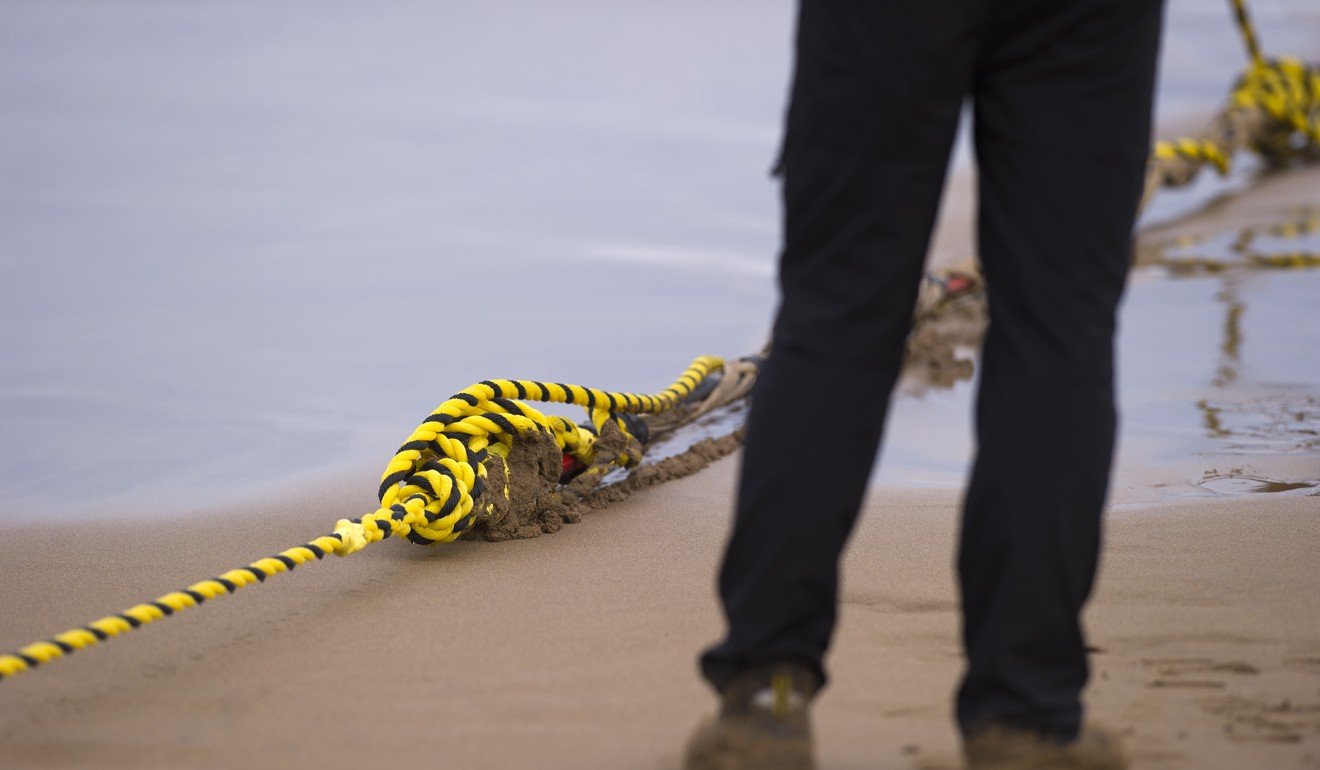
An electric submarine cable and optical fibre. File photo
Despite the volume of data flowing under the Pacific Ocean, just half a million of the 11 million people living in Pacific Island countries and Papua New Guinea – less than five per cent – have access to a wired internet connection and only 1.5 million to a mobile connection, according to the United Nations Economic and Social Commission for the Asia Pacific (UNESCAP), compared with 53 per cent of people in Thailand and 60 per cent in the Philippines.

More than US$4 billion worth of cables are to come into service by 2021, continuing a trend in which US$2 billion worth of cables have come online every year since 2016, and six of these cables will connect Pacific Island countries.

The push to connect Pacific Island nations to the latest generation of internet infrastructure has received extra scrutiny from the US and its allies like Australia
over the involvement of Chinese tech companies.
Choose Beijing over Taipei, Solomon Islands task force recommends
13 Sep 2019

SECURITY CONCERNS

While the US has moved to block Huawei from supplying equipment to its allies’ 5G networks, experts say Chinese tech companies could contest the US, EU and

Japan’s

long-standing dominance over global data traffic through investments in subsea cables.

Chinese tech giants like Huawei have entire divisions devoted to undersea connectivity that have laid thousands of kilometres of cable, and Chinese state telecommunication companies such as China Unicom have access to many of the existing trans-Pacific cables.

But a panel led by the US Department of Justice has held up a nearly complete trans-Pacific cable project over concerns about its Chinese investor, Beijing-based Dr Peng Telecom & Media Group.

The project, the Pacific Light Cable Network, could be the first cable rejected by the panel on the grounds of national security – despite being backed by American tech giants Google and Facebook – setting a precedent for a tougher US stance on Chinese involvement in subsea cables.
Chinese tech giants like Huawei have entire divisions devoted to undersea connectivity that have laid thousands of kilometres of cable. Photo: AP
Craige Sloots, director of sales at Southern Cross Cable Network, which operates the largest existing sets of trans-Pacific cables, said for any new cable, regulators were likely to scrutinise the ownership of the companies involved and the maker of the project’s equipment.
These two factors, said Sloots, “pragmatically limit some of the providers you can use if you want to connect through the US”.
Experts say that Hong Kong, where the stalled Pacific Light Cable would land, was previously considered a more secure shore landing point than mainland China. But people close to the project say the recent unrest in the city has made this distinction less relevant, according to The Wall Street Journal.

If these nations want to be part of the international economy, they need reliable communications: Bruce Howe, University of Hawaii

Similar concerns caused a proposed Huawei-backed cable linking Vanuatu with Papua New Guinea to be called off last year after Australia stepped in to fund its own cable instead.
Just months after the government-owned Solomon Islands Submarine Cable Company agreed to the project with Huawei in mid-2017, Canberra put up US$67 million to connect Sydney with the Solomon Islands and Papua New Guinea with cables laid under the Coral Sea by Nokia’s Alcatel Submarine Networks.
Simon Fletcher, CEO of Vanuatu company Interchange, which had been planning another cable in the neighbourhood connecting Vanuatu with the Solomon Islands, said the Coral Sea project undercut the viability for small private businesses to operate in the fledgling market, where services had historically been provided by international organisations like development banks. His company’s cable has been on pause since the announcement of the Coral Sea project, though Fletcher said it would go forward next year.
US-China battle for dominance extends across Pacific, above and below the sea
22 Jul 2019

VIRTUALLY REMOTE

For years, as Japan, Hong Kong and Singapore became global hubs of high-speed internet data traffic, the cables criss-crossing the ocean floor passed by just off the shores of Pacific Island countries en route between hubs on either side of the ocean.

Tiziana Bonapace, director of UNESCAP’s information technology and disaster risk-reduction division, said the Pacific Islands remain one of the most disconnected areas in the world, where “a vast proportion of the population has no access to the internet”.

Over the past five years, international organisations like UNESCAP, the Asia Development Bank and the World Bank have been pushing for better connectivity in the region. The World Bank’s Pacific Regional Connectivity Programme has invested more than US$90 million into broadband infrastructure for Fiji, the Federated States of Micronesia, Kiribati, the Marshall Islands, Palau, Samoa and Tuvalu.

Internet cables in the Pacific Ocean.
But the business case had never been good, said Bonapace.
“A cable has to travel thousands of kilometres just to connect a population smaller than one of Asia’s megacities,” she said. “As everything we do is somehow connected to the internet, the prospects for the Pacific to become virtually more remote are even higher.”
Even nations which are connected have tenuous infrastructure. In January, Tonga experienced a total internet blackout for two weeks after damage to its single cable. Most parts of the world were linked by multiple cables to prevent this type of outage, said Bruce Howe, professor of ocean and resources engineering at University of Hawaii.
“If these nations want to be part of the international economy, they need reliable communications,” Howe said.
Is Chinese support for Pacific nations shaping their stance on West Papua?
26 Aug 2019

DRAWING NEW LINES

In Papua New Guinea, where mobile internet currently reaches less than a third of the population, a partnership between local telecoms company GoPNG and the Export-Import Bank of China funded the new Huawei-built Kumul Domestic cable system, which came online this year.

The Southern Cross Next system, owned by Spark, Verizon, Singtel Optus and Telstra – the same group of shareholders which operates the massive 30,500km (19,000 mile) set of twin cables connecting the US with Australia and New Zealand known as Southern Cross – is planned to come online in 2022, and will connect directly to Fiji, Samoa, Kiribati and Tokelau.

Chinese telecoms company China Unicom counts the existing Southern Cross cables among its network capabilities – meaning it is likely to have access to the cable through a leasing agreement with one of the other companies that uses the cable, according to Canberra think tank the Australian Strategic Policy Institute (ASPI).

An undersea fibre optic cable. Photo: AFP
China Unicom and China Telecom also list the Asia America Gateway Cable System as one of their network capabilities, according to ASPI. The 20,000km (12,400-mile) cable came online in 2009 and connects the US, Guam, Hong Kong, Brunei, the Philippines, Singapore, Malaysia, Vietnam and Thailand.
It is owned by a consortium of carriers including AT&T, Telekom Malaysia, Telstra and Spark.
A cable backed by Google and the Australian Academic and Research Network connecting Japan and Australia through Guam is to come online early next year.
China: the real reason Australia’s pumping cash into the Pacific?
28 Jul 2018

WHAT’S NEXT

Natasha Beschorner, senior digital development specialist at the World Bank, said that while there were challenges ahead in terms of broadband access and affordability, increased connectivity was starting to bring new opportunities to the Pacific.

“Digital technologies can contribute to economic diversification, income generation and service delivery in the Pacific,” Beschorner said. “E-commerce and financial technologies are emerging and governments are considering how to roll out selected services online.”

Experts say the industry has recently seen a switch from cables being mostly funded by telecommunication carriers to being funded by content providers, like Google and Facebook. Members of the private cable industry say content companies can afford to invest in cable infrastructure to ensure the supply chain for their customers, but that the competition puts the squeeze on the research-and-development budgets of other types of companies.

Sloots at Southern Cross predicted that the nations which connected directly to the massive next-generation cable – Samoa, Kiribati and Tokelau – would be able to function as connecting points for intra-Pacific cables.

“There’s a blossoming effect in capability once certain islands are connected,” Sloots said.

There is also the push to locate an exchange point within the Pacific so that internet data no longer has to travel to a hub in Tokyo or Los Angeles and back to Pacific nations when processing – a move that could ultimately lower the cost of broadband internet service for consumers in the Pacific.

Perhaps the most effective outcome could be for Pacific nations to cut the cord and receive their internet by satellite.

The Asian Development Bank has agreed to give a US$50 million loan to Singapore’s Kacific Broadband Satellites International to provide up to two billion people across the Asia-Pacific region with affordable satellite-based internet.

The project is to be launched into orbit by SpaceX next week and aims to begin providing service by early next year.

Source: SCMP

22/11/2019

Chinese premier meets int’l institutions leaders on world economy

CHINA-BEIJING-LI KEQIANG-INT'L INSTITUTIONS LEADERS-ROUNDTABLE MEETING (CN)

Chinese Premier Li Keqiang and leaders of six major international economic and financial institutions meet the media after their fourth roundtable meeting in Beijing, capital of China, Nov. 21, 2019. The six leaders are World Bank Group President David Malpass, International Monetary Fund Managing Director Kristalina Georgieva, World Trade Organization Deputy Director-General Alan Wolff, International Labor Organization Director-General Guy Ryder, Organization for Economic Cooperation and Development Secretary-General Angel Gurria and Financial Stability Board Chairman Randal Quarles. (Xinhua/Yue Yuewei)

BEIJING, Nov. 21 (Xinhua) — Chinese Premier Li Keqiang held a roundtable meeting with leaders of six major international economic and financial institutions in Beijing on Thursday.

The six leaders are World Bank Group President David Malpass, International Monetary Fund Managing Director Kristalina Georgieva, World Trade Organization Deputy Director-General Alan Wolff, International Labor Organization Director-General Guy Ryder, Organization for Economic Cooperation and Development Secretary-General Angel Gurria and Financial Stability Board Chairman Randal Quarles.

Li expressed hope to build consensus, boost confidence and deepen cooperation through the meeting, so as to promote the sustained, healthy and stable development of world economy.

It is the fourth roundtable meeting for Li and leaders of the six institutions. This year’s meeting features the theme of “promoting openness, stability and high-quality development of the world economy.”

Source: Xinhua

21/11/2019

Chinese premier meets World Bank chief

CHINA-BEIJING-LI KEQIANG-MALPASS-MEETING (CN)

Chinese Premier Li Keqiang meets with World Bank President David Malpass at the Great Hall of the People in Beijing, capital of China, Nov. 20, 2019. (Xinhua/Rao Aimin)

BEIJING, Nov. 20 (Xinhua) — Chinese Premier Li Keqiang met with World Bank President David Malpass on Wednesday, expressing the willingness to deepen cooperation with the World Bank in key areas.

Li said the World Bank is a globally important multilateral development institution and China attaches importance to developing its relations with the World Bank and stands ready to deepen cooperation with the World Bank in key areas such as environmental protection, biodiversity and poverty alleviation through financial and intellectual cooperation.

At the same time, China will fulfill its international responsibilities and obligations as a large developing country to jointly promote global development, Li said.

The current international situation is complicated and grim, with the downward pressure on the world economy increasing and the economic growth of major economies slowing down, Li noted.

He said the Chinese economy has been deeply integrated into the world economy, and the country is deepening reform and expanding opening up, accelerating the building of a market-oriented, law-based and international business environment and further invigorating the market.

“China is willing to deepen mutually beneficial cooperation with all parties, uphold the rules-based free trade system, tide over difficulties and inject impetus into global economic growth and respective development,” Li added.

Malpass said the current world economy is facing severe challenges that need to be addressed by all parties.

China’s economic development has great potential and remarkable achievements have been made in opening up to the outside world, Malpass said, noting that the Chinese government is making unremitting efforts in the areas of economic growth, aging, scientific and technological innovation and environmental protection, and the World Bank is willing to strengthen cooperation with China in these areas, he added.

Source: Xinhua

17/08/2019

Are Chinese infrastructure loans putting Africa on the debt-trap express?

  • Beijing has lent billions of dollars to countries on the continent to build railways, highways and airports but critics say the borrowings are unsustainable
  • Chinese officials say the projects will pay off in the long run and host nations are well aware of their limits and needs
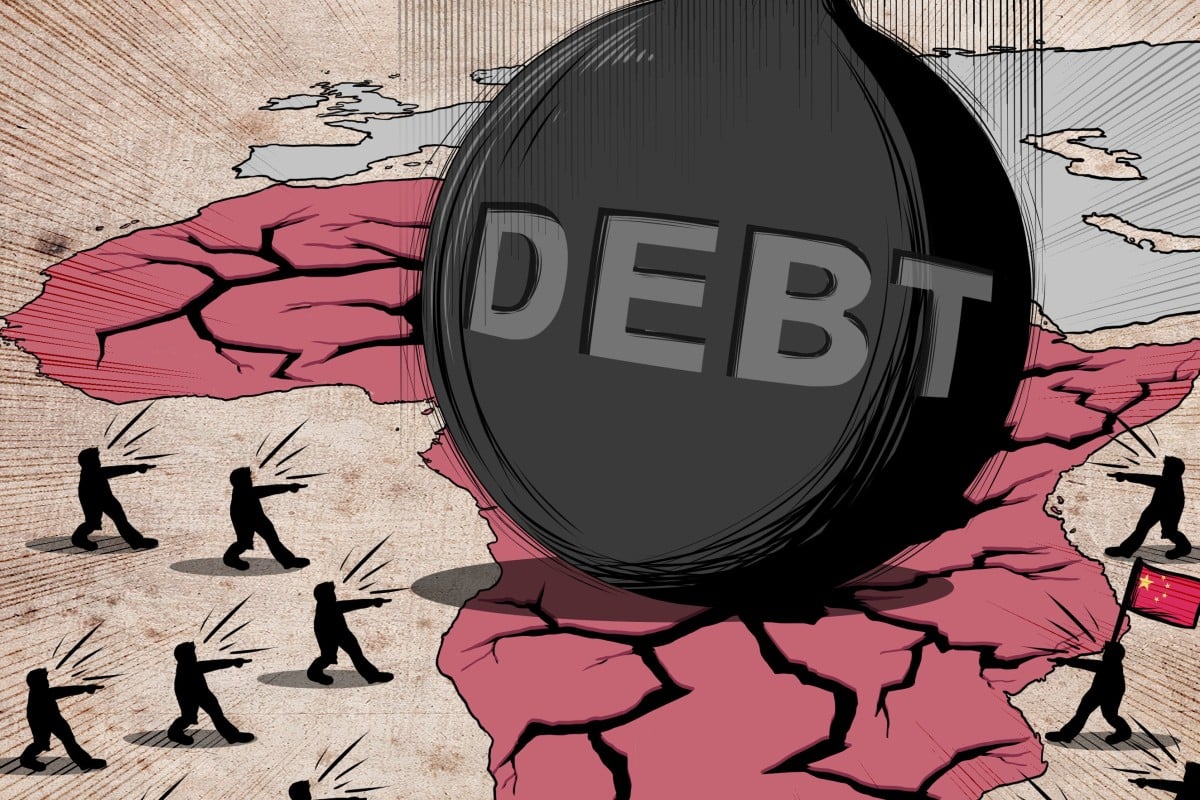
Illustration: Lau Kakuen
When Clement Mouamba went to Beijing last year, he had two main tasks.
The prime minister of the Republic of Congo needed to find out exactly how much his country owed to China, a number the struggling, oil-rich central African nation had until then not been able to provide the International Monetary Fund (IMF) to qualify for a bailout. He also needed to convince Beijing to restructure its debt to ensure sustainability.
The IMF had put talks for further loans on hold until Mouamba’s administration could say exactly how much it had to repay to the country’s external creditors, including China – the republic’s single largest bilateral lender – and oil multinationals such as Glencore and Trafigura.
The country, which heavily depends on oil revenue, turned to China and private oil majors for funding to run the government when in 2014 oil prices fell from a high of US$100 per barrel to as low as US$30.

Critics say countries on the continent are being burdened with unrealistic levels of debt for inviable infrastructure backed and built by China without adequate transparency and scrutiny.

The biggest concern is that several African countries will be left with huge debts and grandiose infrastructure that they cannot maintain and run profitably. I liken it to borrowing money to buy a Tesla when you don’t have adequate access to electricity: Obert Hodzi of the University of Helsinki in Finland

But Chinese observers say the West must take some of the blame for the countries’ debt problems and that the support China offers will benefit the host countries in the long run.

In the early 1990s, when China began to embrace Africa again after years of isolation from the outside world, the aspiring manufacturer was at a serious disadvantage in the race for raw materials and markets for its industrial goods.

The former colonial powers of the West had already sewn up deals for many of the continent’s most lucrative and readily exploitable reserves, from fossil fuels to minerals.

China needed new strategies to convince African governments to allow it access raw materials for its industries and markets for its products to a largely unfamiliar partner.

China also wanted to challenge the dominance of the US in global trade and politics so it courted allies in Africa to help it push for political legitimacy in international institutions.

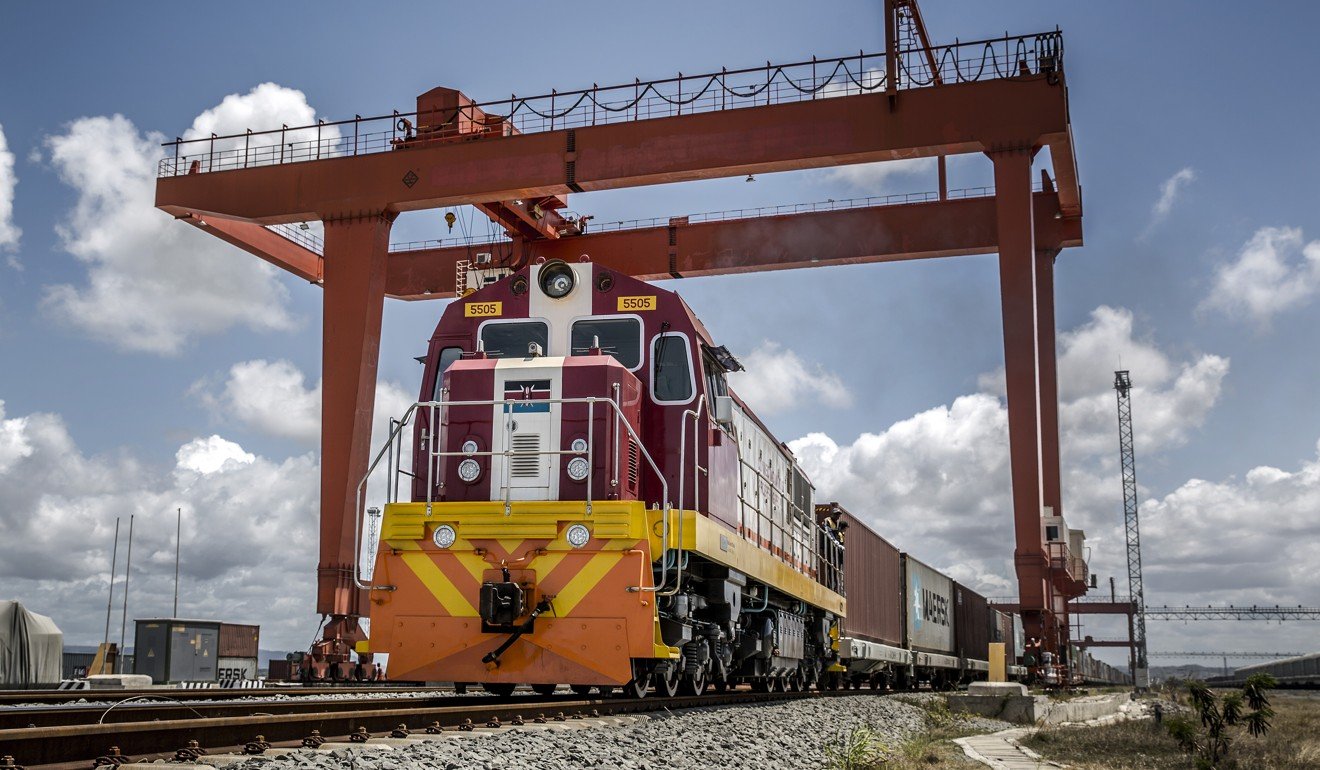
A Kenya Railways freight train leaves the port station on the Mombasa-Nairobi railway in Mombasa, Kenya, a huge project backed by China. Photo: Bloomberg

At the time, many African leaders were under fire to liberalise their economies. China’s approach was to promise not to meddle in individual country’s internal affairs and assure African countries that they could get billions in exchange for future delivery of minerals through resource-backed deals.

Beijing sold its policies that it had no conditions attached to its development finance. In the drive to drum up business, China promised affordable loans for African countries to build roads, bridges, highways, airports and power dams.

Is Kenya’s Chinese-built railway a massive white elephant?

But Beijing also pursued tied finance, ensuring that countries borrowing from China used Chinese contractors to implement the projects rather than open them up to outside bids.

In addition, many of the deals were built on weak financial, technical and environmental conditions, with Chinese state firms conducting the technical feasibility, environmental impact assessment and financial viability studies for free for projects that they also build.

For example, in Kenya, the China Road and Bridge Corporation conducted a free feasibility study that was used in the construction of the railway.

The same company was handed the contract to implement the project and is operating both the passenger and cargo train service for a fee.

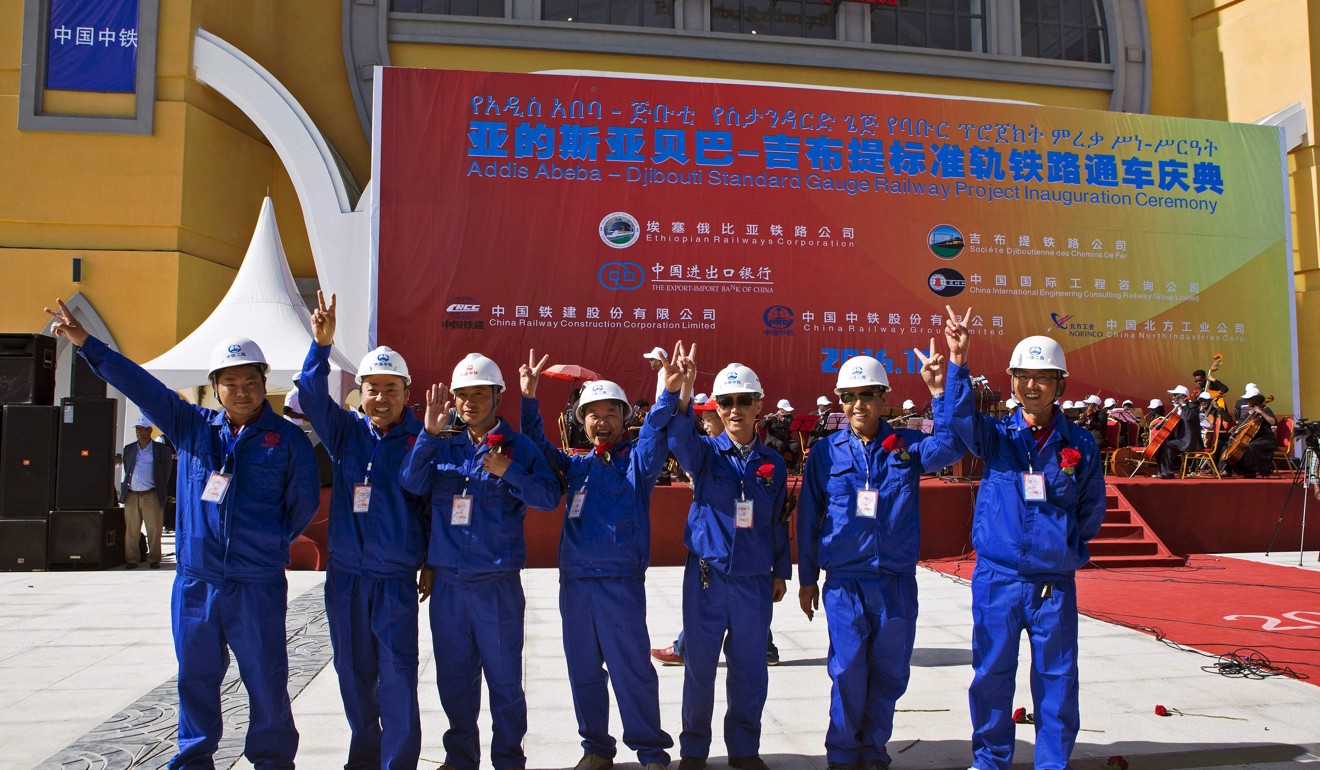
Chinese companies were responsible for the construction of a rail line between Addis Ababa and Djibouti. Photo: AFP

In contrast, the World Bank and its partner institution, the IMF, demand that such studies be done by an independent consultant and not by the company that implements the project.

According to data compiled by the China-Africa Research Initiative, at the Johns Hopkins University School of Advanced International Studies, Beijing has advanced loans worth US$143 billion to African countries since 2000, levels that some critics say are unsustainable for the borrowers.

China meets resistance over Kenya coal plant, in test of its African ambitions

For many of China’s new African partners, these arrangements – from easy lending terms, to non-competitive bidding and opaque contract details – have led to new problems – problems that corrupt or poorly managed governments now share substantial responsibility.

Some critics, both in the West and in host countries, suggest there is a “debt-trap strategy” at the heart of Beijing’s push for international business and influence, but there is no evidence that China deliberately pushes other countries into debt to seize their assets or gain sway.

However, the drive for overseas contracts and big business has led some countries into difficulties with new debts, and there are question marks over the viability of many of the projects the money is funding.

Obert Hodzi, an international relations expert at the University of Helsinki in Finland, said the Addis Ababa-Djibouti railway and the Mombasa-Nairobi railway were good examples of huge projects that were financed by easy borrowing terms from China but were not sustainable and that had in turn forced the African partners to seek further Chinese help.

“The biggest concern is that several African countries will be left with huge debts and grandiose infrastructure that they cannot maintain and run profitably,” Hodzi said. “I liken it to borrowing money to buy a Tesla when you don’t have adequate access to electricity.”

Ken Opalo, a Kenyan scholar at Georgetown University in Washington, said the key issue was the inability of African countries to design projects that were actually needed for the local economies.

A road is not just a means of transport but an economic belt or corridor that will catalyse the development of the whole region: Huang Xueqing, spokeswoman for the Chinese embassy in Nairobi

“Most African countries have been willing to accept projects designed, financed, and implemented by Chinese firms,” Opalo said.
“It would be better to decouple the feasibility studies and design phases of projects from the financing. That way African governments can ensure that they are truly getting value for money.”
But Chinese officials said Beijing had invested in infrastructure largely at the request of the host countries, adding that it could take time to yield returns on the projects.

Huang Xueqing, spokeswoman for the Chinese embassy in Nairobi, said the projects were valid assets with value that would grow in time.

“So, in the long run, it is beneficial to the host countries. Just like when young people buy a house with a mortgage, they may take some debts, but they have a place to live in and have their own assets,” Huang said.

“Underdeveloped infrastructure is the bottleneck that has been holding back Africa’s development. Up to today, many African countries, although in the same continent, are not connected with direct flights, railways or even roads. You have to fly to Paris or Zurich in order to get to some African countries.

“A road is not just a means of transport but an economic belt or corridor that will catalyse the development of the whole region.”

Huang said Beijing had advised the countries to act within their means and not to overstretch themselves when they considered projects that might not be in line with local conditions.

“When making investment decisions, the Chinese side, along with the recipient countries, carry out rigorous feasibility studies and evaluations. We do things according to our ability,” she said.

China’s leadership has also said it is paying close attention to the fiscal and financial difficulties faced by some African countries.

“As a good friend and good brother … the Chinese side is willing to lend a helping hand when needed by the African people to help them overcome temporary difficulties,” State Councillor and Foreign Minister Wang Yi said in January while on a trip to Ethiopia, adding that the debt situation in Africa is also a legacy issue.

China must allay any debt-trap fears in its dealings with Africa

“The African debt issue does not come up today, still less is it caused by the Chinese side. The African people know who are the initiators of African debt.”

The West should take a lot of the blame for worsening debt problems in some African countries, according to Li Anshan, from Peking University’s Centre for African Studies.

He cited the cases of Liberia and the Democratic Republic of Congo, two countries that have had close relations with the West for many years but remain ravaged by war and poverty despite immense natural resources.

“China-Africa relations have been going on for quite some time. Is there any African country which has got poorer because of its deal with China?” Li said.

Gyude Moore, a former Liberian minister of public works whose department oversaw construction and maintenance of various public infrastructure funded and built by China, said it would be difficult to imagine that China would knowingly ensnare its partners in debt.

“China attempts to differentiate itself from Western donors by limiting non loan-related conditionality. China also practices non-interference, so how a country manages its resources, treats its people or deploy its finances were considered ‘internal’,” he said.

“So, Chinese loans are negotiated faster and place less emphasis on public financial management.”

Moore, now a visiting fellow at the Centre for Global Development, said there were trade-offs in such situations.

China focuses on sustainable projects to dismiss fears of African debt trap

“If the loans are going to be fast – the due diligence will not be as rigorous. Chinese project selection mixes political with economic considerations. So, while a project may not make as much economic sense, it may pay political dividends,” he said.

He said non-transparent processes would invite abuse, be they Chinese, Western or African.

Other observers say the question of opacity is more directly related to China’s own economic system.

Howard French, author of China’s Second Continent: How a Million Migrants are Building a New Empire in Africa, said China has very limited transparency and public accountability in its own domestic processes.

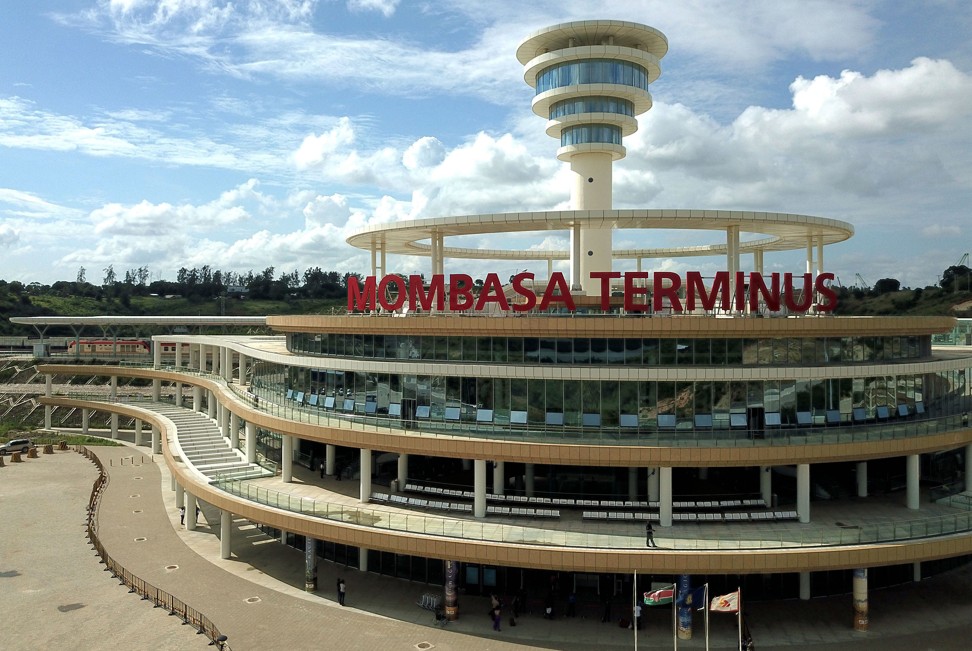
The Mombasa railway station is seen in Mombasa, Kenya, in 2018. Photo: Xinhua

“So it would be unusual to expect that China would introduce greater transparency and accountability in its dealings with African countries than it is used to at home – that is, unless African governments insist on it,” French said.

“And this is where African governance comes in. African states should insist on contract transparency but often don’t do so because that offers leaders plentiful opportunities for graft.”

David Shinn, professor of international relations at George Washington University in Washington, agreed that China’s lack of loan transparency was a huge problem and increased the risk of corruption on both the African and Chinese sides. But he also said that in some cases, African governments might have negotiated poorly.

“This is, however, the responsibility of the African government. I don’t think China is purposely trying to encourage African debts in order to gain leverage,” Shinn said.

“In fact, China is becoming more careful about its lending because it is concerned it has made too much credit available to some African countries.”

China ‘ready to talk’ about trade deal with East Africa bloc

Huang Hongxiang, director of China House, a Nairobi-based consultancy that helps Chinese in Africa integrate better, agreed, saying the Chinese government needs to communicate more about projects in Africa but African countries also have a bigger part to play in ensuring better deals.

“On commercial viability, accountability, transparency and governance, I believe the responsibility does not lie with China, the US or the West but in the hands of African countries,” he said.

Wherever the fault lies, one thing is clear when money is wasted on ill-designed projects that have little to no economic return, according to Opalo.

“The lack of planning and transparency creates default risks … [and] African taxpayers will be left holding the bag.”

This article is the third in a series examining the local impact of Chinese investment and infrastructure projects in Africa. Read part one  here and part two

 here

.

The next report will examine whether African countries can speak with one voice in relations with China.
Source: SCMP
10/08/2019

Xi Focus: China’s head-of-state diplomacy breaks new ground

BEIJING, Aug. 10 (Xinhua) — Chinese President Xi Jinping has led new advances in the development of major country diplomacy with Chinese characteristics.

Xi had a packed diplomatic schedule in the first half of 2019. In April-May, he chaired or attended three events China hosted in a row in just more than half a month. In June, he made four overseas visits and attended four important international meetings in a month.

Amid immense changes in the international situation, the head-of-state diplomacy has led the way forward.

FORGING GLOBAL PARTNERSHIP NETWORK

Xi made his first overseas visit this year in March to three European countries: Italy, Monaco and France, injecting strong impetus into the China-EU comprehensive strategic partnership.

Major-country relations continued to grow. In June, Xi paid a state visit to Russia where he and Russian President Vladimir Putin elevated the China-Russia ties to a comprehensive strategic partnership of coordination for a new era. It was Xi’s eighth visit to Russia and his 31st meeting with Putin since he took office as the Chinese president in 2013.

Friendly exchanges with neighboring countries were deepened. In June, he paid a state visit to the Democratic People’s Republic of Korea (DPRK), opening a new chapter for China-DPRK friendship. Also in June, Xi visited Kyrgyzstan and Tajikistan and met with Japanese Prime Minister Shinzo Abe in the Japanese city of Osaka. All in all, Xi met or held talks with more than 30 leaders of neighboring countries in the first half of the year.

Common progress with the vast majority of developing countries was advanced. Xi congratulated the inauguration of the China-Africa Institute, the opening of the Coordinators’ Meeting on the Implementation of the Follow-up Actions of the Beijing Summit of the Forum on the China-Africa Cooperation, and the first China-Africa Economic and Trade Expo.

Xi also chaired a China-Africa leaders’ meeting on the sidelines of the G20 summit in Osaka, at which leaders reached a broad consensus on a range of issues.

LEADING GLOBAL OPENNESS, COOPERATION

Xi has said a few anti-globalization movements that have emerged in the world cannot stop the tide of globalization.

Thinking in big-picture terms, a Chinese poem says, helps one dispel the clouds to see the sun.

At the G20 summit in Osaka, Xi announced China’s further opening-up measures which have since strengthened the confidence of the global economy.

On the sidelines of the G20 summit, Xi met with U.S. President Donald Trump. They agreed to advance a China-U.S. relationship featuring coordination, cooperation and stability.

China is playing a more positive role in the multilateral trading system, taking globalization toward the direction of more inclusiveness and benefit for all, said World Trade Organization Director General Roberto Azevedo.

Meanwhile, the China-proposed principle of extensive consultation, joint contribution and shared benefits is gaining worldwide recognition.

In April, the Second Belt and Road Forum for International Cooperation was attended by about 6,000 participants from 150 countries and 92 international organizations.

A study published by the World Bank found that fully implementing deeper policy reforms of the Belt and Road Initiative would lift 32 million people out of moderate poverty, increase global trade by up to 6.2 percent and increase global income by as much as 2.9 percent.

WORKING TOGETHER FOR BETTER FUTURE

The Chinese president has called on countries around the world to make concerted efforts and jointly shape the future of humanity.

In various occasions ranging from the global governance forum co-hosted by China and France to the Conference on Dialogue of Asian Civilizations, Xi put forward China’s approaches on global governance and encouraged all parties to build consensus on upholding multilateralism.

China has been committed to firmly upholding the international system with the United Nations at its core and international law as its foundation, and standing on the side of justice as China plays an active role in endeavors such as advancing the political settlement of the Korean Peninsula issue and supporting maintaining the Iran nuclear deal.

China has become a strong pillar of international cooperation and multilateralism, according to UN Secretary-General Antonio Guterres.

At the three events China hosted in the first half of the year, Xi expounded on the concept of building a community with a shared future for humanity from different perspectives: help developing countries break growth bottlenecks, tackle environmental challenges and look to culture and civilization to play their role.

All won broad recognition.

Under Xi’s leadership, the major country diplomacy with Chinese characteristics is sailing towards a brighter future.

Source: Xinhua

09/07/2019

China’s high-speed rail offers model for other countries: World Bank

BEIJING, July 8 (Xinhua) — China’s high-speed railway (HSR) has registered rapid growth and offered many viable practices for other countries considering HSR investment, according to a World Bank report released Monday.

Key factors enabling the growth include the development of a comprehensive long-term plan and the standardization of designs and procedures, said the report, which summarizes China’s HSR development.

China’s Medium- and Long-Term Railway Plan, which looks up to 15 years ahead, provides a clear framework for the development of the system, according to the World Bank.

Meanwhile, the construction cost of the Chinese HSR network stood at about two-thirds of the cost in other countries, the report said, citing an average of 17 million U. S. dollars to 21 million U. S. dollars per km.

“China has built the largest high-speed rail network in the world. The impacts go well beyond the railway sector and include changed patterns of urban development, increases in tourism, and promotion of regional economic growth,” said Martin Raiser, World Bank director of China.

By the end of 2018, the total railway operation mileage reached 131,000 km, five times higher than 1949, while the high-speed railway exceeded 29,000 km, accounting for more than 60 percent of the world’s total, according to a recent report by the National Bureau of Statistics.

In China, high-speed rail service is competitive with road and air transport for distances of up to about 1,200 km, while fares are about one-fourth the base fares in other countries, which allows HSR trains to attract passengers from all income groups, the report said.

“Large numbers of people are now able to travel more easily and reliably than ever before, and the network has laid the groundwork for future reductions in greenhouse gas emissions,” Raiser said.

Source: Xinhua

28/06/2019

Xinhua Headlines: China-Africa trade expo to forge closer economic partnership

Xinhua Headlines: China-Africa trade expo to forge closer economic partnership

Justin Yifu Lin, former senior vice president and chief economist at the World Bank, delivers a speech at the China-Africa Economic and Trade Expo in Changsha, central China’s Hunan Province, June 27, 2019. (Xinhua/Xue Yuge)

by Xinhua writers Cao Kai, Chu Yi, Yang Jian and Zhang Yujie

CHANGSHA, June 27 (Xinhua) — The first China-Africa Economic and Trade Expo opened Thursday in Changsha, capital of central China’s Hunan Province, in a move to forge closer economic ties between the largest developing country and the largest developing continent.

The three-day event has attracted more than 10,000 guests and traders, including those from 53 African countries, according to the organizing committee.

Chinese President Xi Jinping has sent a congratulatory letter.

The expo, announced at the Beijing Summit of the Forum on China-Africa Cooperation (FOCAC) last September, was established to provide a platform for deepening economic and trade cooperation between the two sides, he stressed.

It is hoped that the two sides will strengthen coordination to better implement the eight major initiatives put forward at the Beijing summit of the FOCAC, actively explore new paths for cooperation, open up new points of growth for collaboration, and promote China-Africa economic and trade cooperation to a new level, Xi said.

“Industrial development and free trade amongst ourselves will foster faster growth for our mutual benefit,” said Ugandan President Yoweri Museveni at the opening ceremony. “This Forum should, among others, enable us to devise ways of turning these rays of hope into a reality.”

Hailing the long-term friendship with Africa, Chinese Vice Commerce Minister Qian Keming said at the expo that bilateral trade and economic cooperation should be practical and concrete to meet the development needs of African countries in areas such as infrastructure and talent cultivation.

China saw 3 percent year-on-year growth of foreign trade with African countries in the first five months this year, hitting 84.8 billion U.S. dollars. China’s direct investment to the continent has increased by 1.5 billion U.S. dollars in the past five months, up 20 percent year on year, according to Qian.

According to Assome Aminata Diatta, Senegal’s Minister of Trade and SMEs, China is an ideal partner for Africa to improve its capacity building when China is seeking higher-quality growth driven by innovation.

Bringing modern production lines to Africa, especially in the special economic zones, will likely provide tens of millions of jobs for Africa, accelerate its industrialization and improve the trade structure between China and Africa, Diatta said.

China has set a good example for other developing countries, especially those in Africa which, having a lot in common with China, may benefit from mutual complementarity in the area of development, said Justin Yifu Lin, former senior vice president and chief economist at the World Bank.

The experience, wisdom and programs that China will offer are very good reference for African countries that are now eager to work themselves out of poverty and pursue development, Lin said.

After the opening ceremony, 13 cooperation projects involving eight African countries were signed, worth a total of more than 2.5 billion U.S. dollars.

Conferences, seminars, forums and exhibitions focusing on agriculture, trade, investment and infrastructure construction will be held during the expo, with experts sharing views on closer bilateral exchanges.

The expo will feature exhibition areas covering more than 40,000 square meters, including national pavilions and display areas for enterprises that showcase the achievements and opportunities of China-Africa economic and trade cooperation.

TRADE AND INVESTMENT

With the theme “Win-Win Cooperation for Closer China-Africa Economic Partnership,” the expo, which will become a biennial event, will open a new chapter in the history of bilateral trade.

“Nigeria has a lot of non-oil products of high quality and we want China to buy more,” Uduak M. Etokowoh, an official with the Nigerian Export Promotion Council, told Xinhua.

Nigerian gemstones, Namibian oysters, Kenyan coffee and tea as well as South African wine are attracting many Chinese visitors at the expo.

“We used to export leather materials to Italy and Spain, who now have a wobbling economy,” said Nigerian businessman Mustapha Tijjani Garo. “We are now looking east for the market.”

China has been the largest trading partner of Africa for ten consecutive years. In 2018, trade volume between China and Africa amounted to 204.2 billion U.S. dollars, up 20 percent year on year.

China’s imports of non-resource products from Africa have increased significantly. In 2018, China’s imports from Africa went up 32 percent year on year, with the imports of agricultural products up 22 percent.

“Namibian oysters are selling well in Beijing, Shanghai and Guangzhou,” said Rinouzeu Katjingisiua. “We are hoping to find more partners here.”

For Chinese businessmen, with mounting pressure on labor-intensive industries as cost is surging and industrial upgrading is urgently needed, Africa is a great destination.

Wang Lianfang, owner of Qiqihar Quanlian Heavy Forging Company Ltd. based in northeast China’s Heilongjiang Province, set up an assembling plant in Senegal two years ago to find new markets amid slump domestic demand on agriculture machinery.

“Africa has strong demand,” said Wang, who is selling seeders, tractors and harvesters in the west African country.

“The output is expected to reach 2 billion yuan (291 million U.S. dollars) within 5 years,” said Wang, adding that the company has been working hard for survival in the past three years.

The transfer of labor-intensive industries from China can also give a strong push to Africa’s industrialization and modernization. It will expedite the economic take-off of Africa in the same way as how the industrial transfer had benefited China, Justin Yifu Lin said.

AGRICULTURE AND POVERTY REDUCTION

With abundant resources, a large population and a vast market, Africa is still the poorest continent and falls behind in the overall context of development and is battling poverty and hunger.

For 11 years, paddy land has been Hu Yuefang’s battlefield in Madagascar to fight against poverty.

“Madagascar can reach the self-sufficiency in rice as long as 15 percent of its rice planting area belongs to hybrid varieties,” Hu Yuefang said, adding that the average yield of hybrid rice produced by Chinese technologies in Africa is two to three times more than that of local ones.

Buried in the field all day, the 61-year-old agriculture expert from Yuan Longping High-tech Agriculture Co. Ltd. (LPHT) has been on the frontier of closer agriculture cooperation between the two sides.

He said though he could not come to the scene, he expected fruitful results from the inaugural expo to help tackle challenges and bring shared benefits to China and Africa.

China took deliberate steps using the agriculture sector to transform its economy by setting up favorable agricultural policies, the experience of which can be learned by us to accelerate our development, according to Ugandan Minister of Agriculture Vincent Bamulangaki Ssempijja at the expo.

“We strongly believe that by working together with our Chinese friends through joint venture businesses, investment arrangements and win-win cooperation, the majority of African countries can quickly eradicate poverty,” he said.

Hunger has long been bothering African countries. To help relieve the grain shortage, Chinese agricultural enterprises and experts, like Yuan, have been devoted to the continent for years, sharing China’s wisdom and experience.

“We put red flags on the map to show our steps in promoting hybrid rice in Africa in recent years, which have covered nearly 20 countries in southeastern, western and northern parts of the continent,” said Yao Zhenqiu, LPHT’s deputy general manager.

Guided by Yuan Longping, China’s “Father of Hybrid Rice,” the LPHT expert team has successfully cultivated five kinds of high-yielding hybrid rice seeds suitable for the local soil and climate.

So far, Chinese experts and technicians have carried out more than 300 small-scale projects in nine African countries, promoted 450 agricultural technologies, and trained nearly 30,000 local farmers and technicians, according to Ma Youxiang, an official with China’s Ministry of Agriculture and Rural Affairs, at the expo.

“We will continue to send high-level agricultural experts and vocational education teachers to African countries, to further expand training in Africa and help cultivate more talent in agriculture,” he said.

The World Food Programme (WFP), the food assistance branch of the United Nations, is also taking the expo as an opportunity to meet Chinese business society to tackle food problems in Africa.

WFP will work with China to help Africa achieve the goal of ‘Zero Hunger’, said Qu Sixi, WFP China Representative.

Source: Xinhua

Law of Unintended Consequences

continuously updated blog about China & India

ChiaHou's Book Reviews

continuously updated blog about China & India

What's wrong with the world; and its economy

continuously updated blog about China & India