Archive for ‘Xinjiang’

29/09/2019

China anniversary: The deep cuts of 70 years of Communist rule

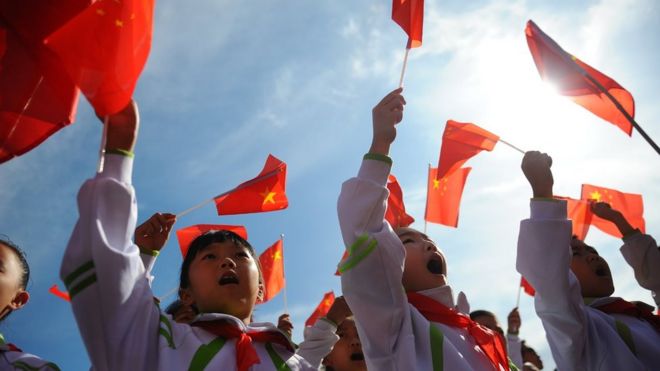
Children waving Chinese flagsImage copyright GETTY IMAGES
Image caption China’s version of its past is a story of prosperity, progress and sacrifice for the common good

China’s extraordinary rise was a defining story of the 20th Century, but as it prepares to mark its 70th anniversary, the BBC’s John Sudworth in Beijing asks who has really won under the Communist Party’s rule.

Sitting at his desk in the Chinese city of Tianjin, Zhao Jingjia’s knife is tracing the contours of a face.

Cut by delicate cut, the form emerges – the unmistakable image of Mao Zedong, founder of modern China.

The retired oil engineer discovered his skill with a blade only in later life and now spends his days using the ancient art of paper cutting to glorify leaders and events from China’s communist history.

“I’m the same age as the People’s Republic of China (PRC),” he says. “I have deep feelings for my motherland, my people and my party.”
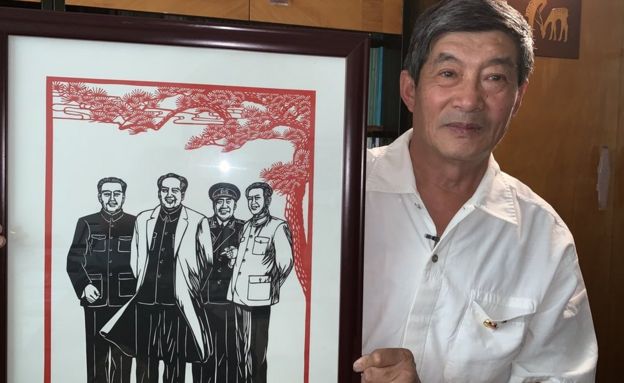
Zhao Jingjia with a paper cut of Mao Zedong
Image caption For people like Zhao Jingjia, China’s success outweighs the “mistakes” of its leaders

Born a few days before 1 October 1949 – the day the PRC was declared by Mao – Mr Zhao’s life has followed the dramatic contours of China’s development, through poverty, repression and the rise to prosperity.

Now, in his modest but comfortable apartment, his art is helping him make sense of one of the most tumultuous periods of human history.

“Wasn’t Mao a monster,” I ask, “responsible for the deaths of tens of millions of his countrymen?”

“I lived through it,” he replies. “I can tell you that Chairman Mao did make some mistakes but they weren’t his alone.”

“I respect him from my heart. He achieved our nation’s liberation. Ordinary people cannot do such things.”

On Tuesday, China will present a similar, glorious rendering of its record to the world.

The country is staging one of its biggest ever military parades, a celebration of 70 years of Communist Party rule as pure, political triumph.

Beijing will tremble to the thunder of tanks, missile launchers and 15,000 marching soldiers, a projection of national power, wealth and status watched over by the current Communist Party leader, President Xi Jinping, in Tiananmen Square.

An incomplete narrative of progress

Like Mr Zhao’s paper-cut portraits, we’re not meant to focus on the many individual scars made in the course of China’s modern history.

It is the end result that matters.
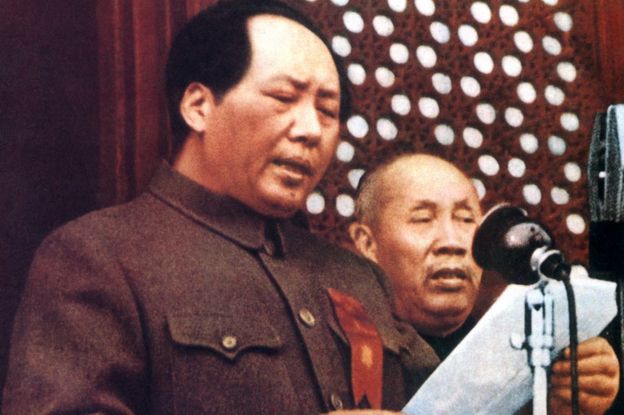
Mao Zedong declares the People's Republic of China in Beijing on 1 Oct 1949Image copyright XINHUA/AFP
Image caption Mao Zedong pronounces the dawn of the People’s Republic of China on 1 October 1949

And, on face value, the transformation has been extraordinary.

On 1 October 1949, Chairman Mao stood in Tiananmen Square urging a war-ravaged, semi-feudal state into a new era with a founding speech and a somewhat plodding parade that could muster only 17 planes for the flyby.

This week’s parade, in contrast, will reportedly feature the world’s longest range intercontinental nuclear missile and a supersonic spy-drone – the trophies of a prosperous, rising authoritarian superpower with a 400 million strong middle class.

It is a narrative of political and economic success that – while in large part true – is incomplete.

New visitors to China are often, rightly, awe-struck by the skyscraper-festooned, hi-tech megacities connected by brand new highways and the world’s largest high-speed rail network.
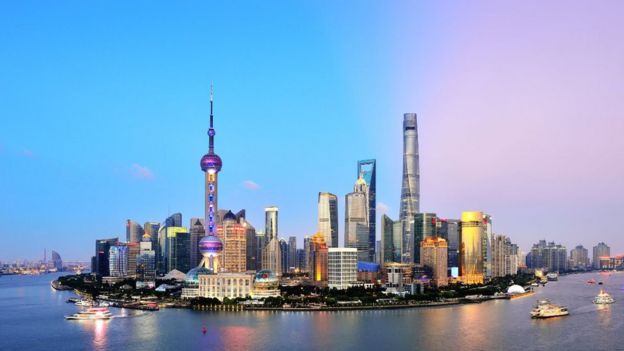
Shanghai skylineImage copyright GETTY IMAGES
Image caption Those in China’s glittering cities may accept the trade-off of political freedom for economic growth

They see a rampant consumer society with the inhabitants enjoying the freedom and free time to shop for designer goods, to dine out and to surf the internet.

“How bad can it really be?” the onlookers ask, reflecting on the negative headlines they’ve read about China back home.

The answer, as in all societies, is that it depends very much on who you are.

Many of those in China’s major cities, for example, who have benefited from this explosion of material wealth and opportunity, are genuinely grateful and loyal.

In exchange for stability and growth, they may well accept – or at least tolerate – the lack of political freedom and the censorship that feature so often in the foreign media.

For them the parade could be viewed as a fitting tribute to a national success story that mirrors their own.

But in the carving out of a new China, the knife has cut long and deep.

The dead, the jailed and the marginalised

Mao’s man-made famine – a result of radical changes to agricultural systems – claimed tens of millions of lives and his Cultural Revolution killed hundreds of thousands more in a decade-long frenzy of violence and persecution, truths that are notably absent from Chinese textbooks.
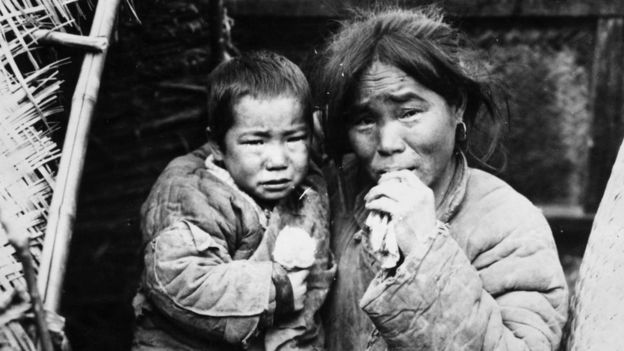
Archive image of a starving woman and child during the famine in ChinaImage copyright GETTY/TOPICAL
Image caption Tens of millions starved to death under Mao, as China radically restructured agriculture and society

After his death, the demographically calamitous One Child Policy brutalised millions over a 40-year period.

Still today, with its new Two Child Policy, the Party insists on violating that most intimate of rights – an individual’s choice over her fertility.

The list is long, with each category adding many thousands, at least, to the toll of those damaged or destroyed by one-party rule.
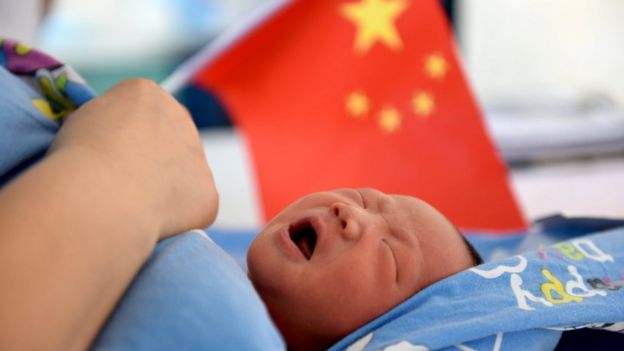
Chinese baby in front of Chinese flagImage copyright GETTY IMAGES
Image caption Beijing still regulates how many children families can have

There are the victims of religious repression, of local government land-grabs and of corruption.

There are the tens of millions of migrant workers, the backbone of China’s industrial success, who have long been shut out of the benefits of citizenship.

A strict residential permit system continues to deny them and their families the right to education or healthcare where they work.

And in recent years, there are the estimated one and a half million Muslims in China’s western region of Xinjiang – Uighurs, Kazakhs and others – who have been placed in mass incarceration camps on the basis of their faith and ethnicity.

China continues to insist they are vocational schools, and that it is pioneering a new way of preventing domestic terrorism.

The stories of the dead, the jailed and the marginalised are always much more hidden than the stories of the assimilated and the successful.

Viewed from their perspective, the censorship of large parts of China’s recent history is not simply part of a grand bargain to be exchanged for stability and prosperity.

People holding pictures of Mao and the Little Red Book in Tiananmen Square, 1966

Getty
Timeline of modern China

  • 1949 Mao declares the founding of the People’s Republic of China
  • 1966-76 Cultural Revolution brings social and political upheaval
  • 1977 Deng Xiaoping initiates major reforms of China’s economy
  • 1989 Army crushes Tiananmen Square pro-democracy protests
  • 2010 China becomes the world’s second-largest economy
  • 2018 Xi Jinping is cleared to be president for life
It is something that makes the silence of their suffering all the more difficult to penetrate.

It is the job of foreign journalists, of course, to try.

‘Falsified, faked and glorified’

But while censorship can shut people up, it cannot stop them remembering.

Prof Guo Yuhua, a sociologist at Beijing’s Tsinghua University, is one of the few scholars left trying to record, via oral histories, some of the huge changes that have affected Chinese society over the past seven decades.

Her books are banned, her communications monitored and her social media accounts are regularly deleted.

“For several generations people have received a history that has been falsified, faked, glorified and whitewashed,” she tells me, despite having been warned not to talk to the foreign media ahead of the parade.

“I think it requires the entire nation to re-study and to reflect on history. Only if we do that can we ensure that these tragedies won’t be repeated.”
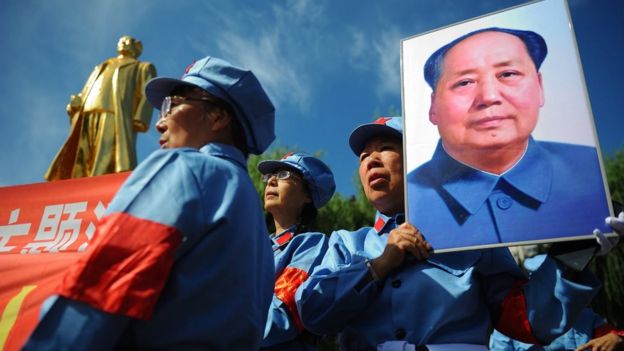
People with poster of Mao ZedongImage copyright GETTY IMAGES
Image caption Can progress really be attributed to the leadership?

A parade, she believes, that puts the Communist Party at the front and centre of the story, misses the real lesson, that China’s progress only began after Mao, when the party loosened its grip a bit.

“People are born to strive for a better, happier and more respectful life, aren’t they?” she asks me.

“If they are provided with a tiny little space, they’ll try to make a fortune and solve their survival problems. This shouldn’t be attributed to the leadership.”

‘Our happiness comes from hard work’

As if to prove the point about how the unsettled, censored pasts of authoritarian states continue to impact the present, the parade is for invited guests only.
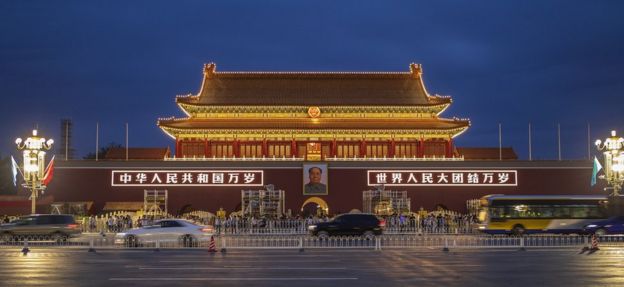
Mao's portrait hanging in Tiananmen SquareImage copyright GETTY IMAGES
Image caption Mao’s portrait will, as it always is, be watching over the events in Tiananmen Square

Another anniversary, of which Tiananmen Square is the centrepiece, is also being measured in multiples of 10 – it is 30 years since the bloody suppression of the pro-democracy protests that shook the foundations of Communist Party rule.

The troops will be marching – as they always do on these occasions – down the same avenue on which the students were gunned down.

The risk of even a lone protester using the parade to mark a piece of history that has largely been wiped from the record is just too great.

With central Beijing sealed off, ordinary people in whose honour it is supposedly being held, can only watch it on TV.
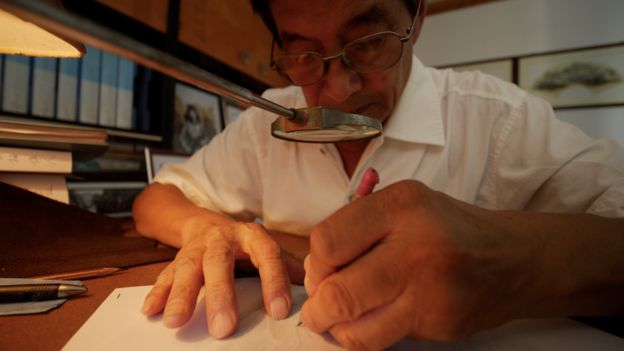
Zhao

Back in his Tianjin apartment, Zhao Jingjia shows me the intricate detail of a series of scenes, each cut from a single piece of paper, depicting the “Long March”, a time of hardship and setback for the Communist Party long before it eventually swept to power.

“Our happiness nowadays comes from hard work,” he tells me.

It is a view that echoes that of the Chinese government which, like him, has at least acknowledged that Mao made mistakes while insisting they shouldn’t be dwelt on.

“As for the 70 years of China, it’s extraordinary,” he says. “It can be seen by all. Yesterday we sent two navigation satellites into space – all citizens can enjoy the convenience that these things bring us.”
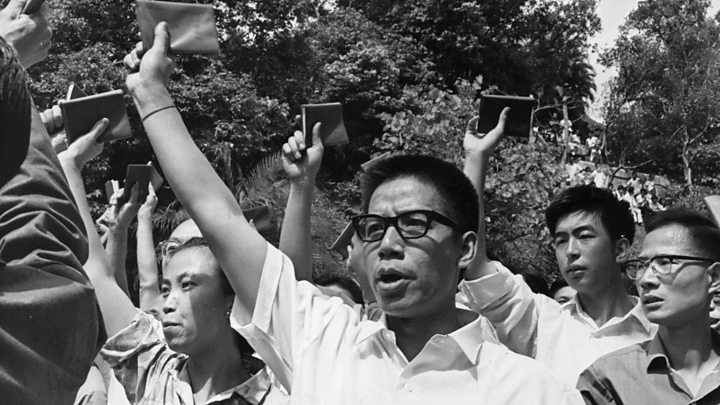
Media caption What was China’s Cultural Revolution?

Source: The BBC

17/09/2019

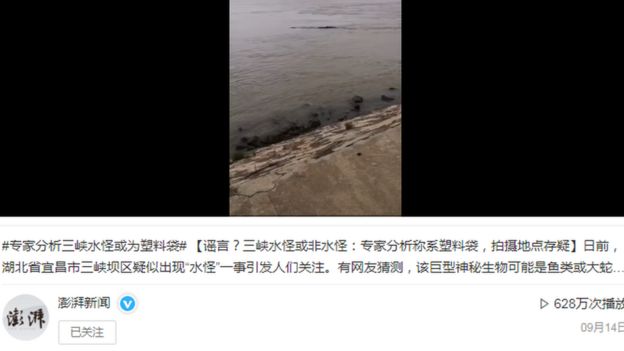
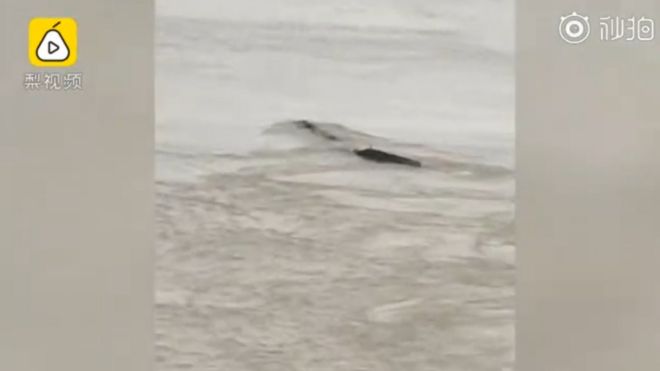
China gripped after sighting of its own ‘Loch Ness Monster’

Footage showed a long black creatureImage copyright PEAR VIDEO
Image caption Grainy footage showed something that appeared to have a tail slithering back and forth in the water

Something is lurking in the deep in China’s famous Yangtze River – and social media discussion is rife over what it might be.

On Friday, footage appeared on China’s popular Sina Weibo microblog of what appeared to be a long, black creature, manoeuvring through the waters, and it has dominated online discussion ever since.

Footage has quickly racked up millions of views, and theories are rife.

Specialists have weighed in – but some think there may be a simple, and less murky, explanation.

Excitement over footage

A video filmed off the coast of the city of Yichang in western Hubei province, close to the Three Gorges Dam, captured the unusual scene.

The video has racked up more than six million views and hundreds of thousands of likes after being shared by the popular Pear Video, and shows what looks like a giant eel or snake slithering along the surface of the water.

Locals are filmed watching the creature from the shore – and social media users have similarly been captivated over theories about what the creature might be.

Many have posted using the hashtag #ThreeGorgesMonsterPhotos, and specialists have begun to weigh in with their thoughts.

In an interview with Pear Video, Professor Wang Chunfang from the Huazhong Agricultural University dismissed the idea of it being a new species, saying it was likely a simple “water snake”.

Some users said that “external factors such as pollution” could have a role to play in a sea snake growing to an extraordinary size. But not everyone was convinced.

Separate footage has led some users to question whether the unidentified object is actually a living creature at all.

Different footage of China's 'Loch Ness'Image copyright THE PAPER
Image caption Millions have watched footage of the item, but some think it might be a piece of simple rubbish

Popular news website The Paper shared separate footage of something long and black moving in the water that appeared to be less animated.

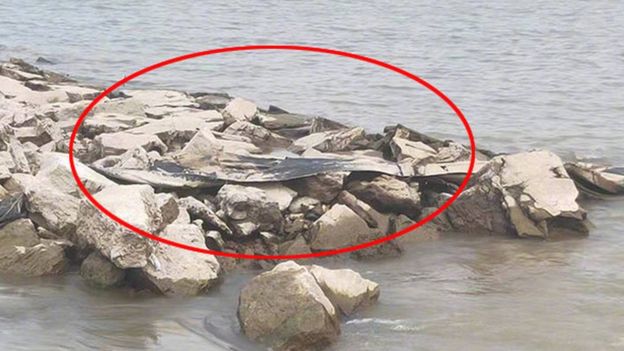
It asked if the whole thing was simply “a rumour” – and interviewed a biologist, Ding Li, who said that the object was neither a fish nor a snake, but simply “a floating object”.

A picture has since gone viral showing a long piece of black cloth washed up on some rocks, fuelling discussion this might have been the mysterious object.

Could the item have been a piece of black cloth?Image copyright THE PAPER
Image caption The appearance of some cloth washed up on some rocks has got users asking if they were mistaken

Both have led to jokes about whether the local government was trying to attract tourism to the area, given the millions of dollars involved in building and maintaining the Three Gorges Dam.

Others have made jokes about the quality of the footage, despite the rapid development in China of high quality smartphones.

Some joked that the user obviously didn’t have a Huawei phone. Another said: “Monsters always appear only when there are few pixels.”

So what does live in the Yangtze?

A baby Giant Chinese salamanderImage copyright AFP
Image caption Giant Chinese salamanders live in the Yangtze river. They can grow to 1.8 metres in length

The Yangtze River is the longest river in Asia, and at 3,900 miles in length (6,300km), is the third longest in the world.

But pollution has severely affected the river in recent years, meaning that its ecosystem has become narrower, rather than wider.

The largest creature thought to exist in the waters at present is the Chinese giant salamander, which can reach some 1.8m in length.

This species is critically endangered, largely as a result of pollution.

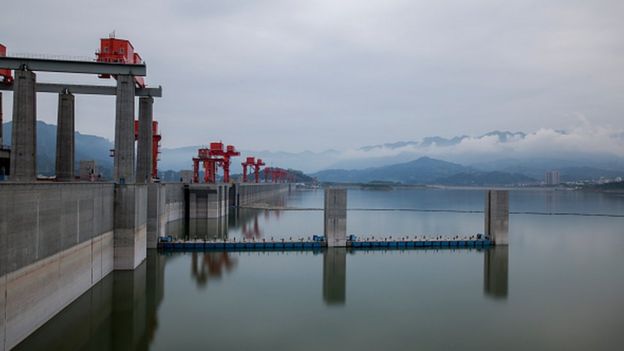
The Three Gorges Dam is the world's latest hydroelectric damImage copyright ZHANG PENG/GETTY IMAGES
Image caption The Three Gorges Dam is the world’s latest hydroelectric dam

China’s other ‘Nessies’

China is no stranger to conspiracy theories about mythical creatures lurking in the deep.

Since 1987, questions have been asked about whether a “Lake Monster” exists in the Kanas Lake in north-western Xinjiang, following numerous reports of sightings.

However, specialists believe that this is a giant taimen, a species of salmon that can grow to 180cm long, the official China Daily said.

More recently, in August 2017, footage went viral showing an unusual water creature seemingly raising its head in the waters of Luoping County in Southwest Yunnan province.

Officials, however, dismissed the “monster” as either an alligator, or a piece of floating rubbish.

Source: The BBC

04/09/2019

China develops superconducting hybrid power line that could span the country

  • Prototype tested last month transports high-voltage power and liquefied natural gas side by side
  • It could cut the high cost and waste involved in sending energy from the far west to the east coast
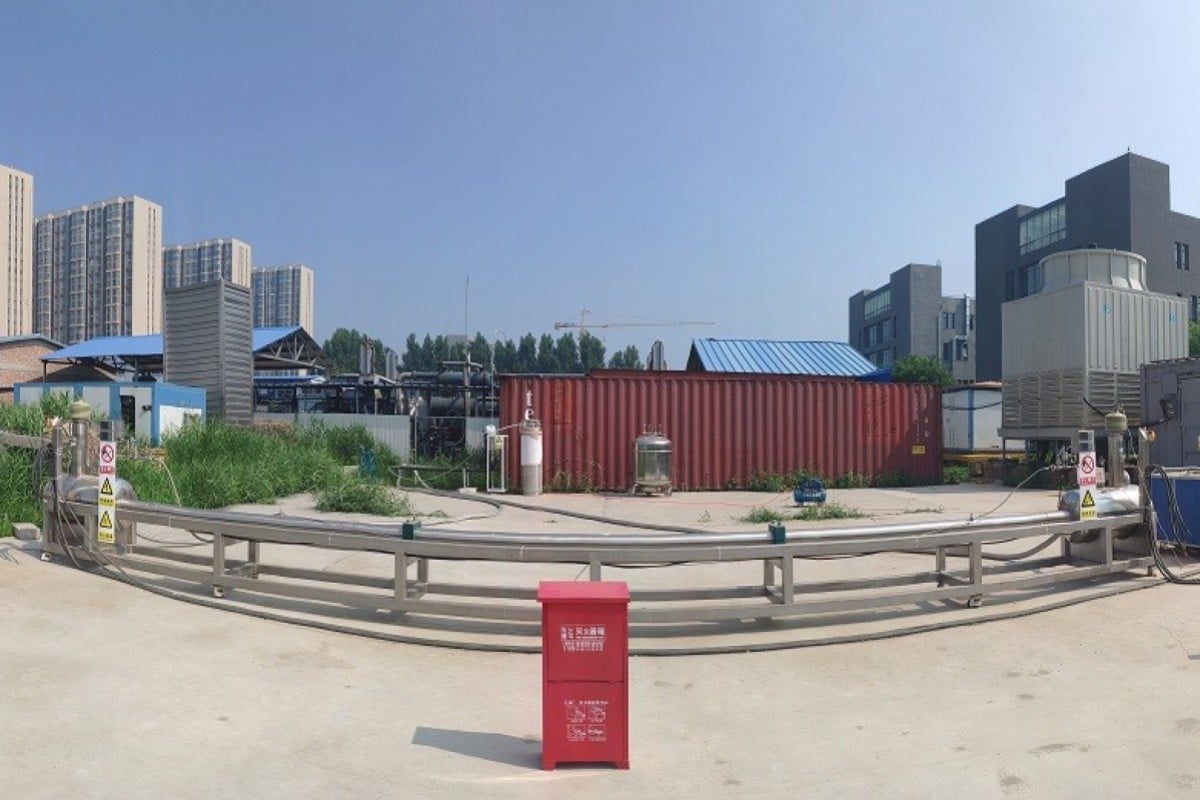
The 10-metre prototype line, combining high-voltage electricity and liquefied natural gas. Photo: Chinese Academy of Sciences

Chinese scientists have developed the world’s first prototype of a superconducting hybrid power line, paving the way for construction of a 2,000km (1,243-mile) line from energy-rich Xinjiang in the country’s far west to its eastern provinces.

The 10-metre, proof-of-concept wire and liquid natural gas hybrid transmission line was up and running at the Chinese Academy of Sciences’ Institute of Electrical Engineering in Beijing last month to show the feasibility of the technology.

The line contains a superconducting wire which can transmit nearly 1,000 amps of electric current at more than 18,000 volts with zero resistance.

In a further difference from a traditional power line, the gap between the superconducting wire and the power line’s outer shell is filled by a flow of slowly moving natural gas liquefied at low temperatures – between minus 183 and minus 173 degrees Celsius (minus 279 to minus 297 Fahrenheit). This allows the line to transfer electricity and fossil fuel at the same time.

Professor Zhang Guomin, the government research project’s lead scientist, told the South China Morning Post that the voltage and current could be much higher in its real-world applications.

“This technology can take the overall efficiency of long-distance energy transport to new heights,” he said.

Existing infrastructure to transfer energy from Xinjiang Uygur autonomous region to the developed eastern areas such as Shanghai has high operational costs because almost 10 per cent of the energy is lost in transmission, according to some studies.

That infrastructure includes the world’s most advanced high-voltage power line and four natural gas pipes, each thousands of kilometres long. One of the natural gas pipelines, from Xinjiang to Shanghai, cost 300 billion yuan (US$42 billion).

The superconductor and natural gas hybrid line offered a possible solution, Zhang said.

Loss of electricity over the superconducting wire would be almost zero because of the elimination of resistance to the movement of electrons, he said.

The transport of liquefied natural gas would also be efficient, because one cubic metre (1,000 litres) of it would be equivalent to 600 cubic metres of the same fuel in gas form.

The temperature needed for liquefaction of natural gas is almost identical to that required for occurrence of superconductivity, at about minus 163 degrees.

Wang Gengchao, professor of physics at East China University of Science and Technology in Shanghai, said the combination was a “smart idea”.

Superconducting materials are not new but their applications have been limited by the difficulty and cost of creating and maintaining the low-temperature environment.

“They are trying to kill two birds with one stone,” Wang, who was not involved in the study, said.

China is preparing to buy US liquefied gas and soybeans again

“But whether the technology can find a use in large-scale infrastructure depends on other things, such as safety. Not everyone will feel comfortable with the idea of putting a high-voltage electric line and flammable natural gas side by side.”

Zhang said another new prototype line, about 30 metres long, was being developed and the 2,000km project was awaiting government approval.

He said the team had solved some major technical obstacles, including reducing the risk of accidents from electrical sparks and gas leakage.

“Many problems remain to be solved, but we are confident this technology will work,” he said. “It will protect the environment. It will save a lot of land from being used for power and gas lines.”

Xinjiang has more energy resources than any other Chinese province or region. It has nearly half of the nation’s coal reserves, a third of its oil and gas, and some of the largest wind and solar farms, according to government statistics.

Source: SCMP

25/08/2019

Over 146,000 dilapidated houses renovated in Xinjiang

URUMQI, Aug. 25 (Xinhua) — A total of 146,055 dilapidated houses in northwestern China’s Xinjiang Uygur Autonomous Region have been renovated as of the end of July, according to the regional housing and urban-rural development department.

The region plans to finish the renovation work on a total of 200,900 dilapidated houses this year.

By the end of July, renovation work on 197,929 houses has started and 146,055 have been completed. Work on all 9,355 houses in the rural area has started and 7,834 have been finished.

So far, over 400,000 dilapidated houses have also been demolished.

Xinjiang has allocated over 2 billion yuan (about 282 million U.S. dollars) of subsidies this year to renovate dilapidated houses in its rural areas.

More than 1.9 billion yuan, accounting for 92 percent of the government-subsidized funds, has been allocated to 32 impoverished counties.

Source: Xinhua

25/08/2019

China increases its presence in Russia’s former Central Asian backyard

  • A recent joint exercise in Tajikistan is the latest example of Beijing’s growing security and economic interests in the former Soviet republic
  • Analysts say Moscow may not be happy about China’s growing reach in the lawless, mountainous area and will be keeping an eye on the situation
Chinese and Tajik troops completed a joint exercise earlier this month in the mountainous region of Gorno-Badakhshan. Photo: Xinhua
China is increasing its military and economic presence in parts of central Asia that Russia has traditionally considered its sphere of influence – a development some analysts believe could cause concern in Moscow.
While Russia’s influence remains strong in many former Soviet republics, China is steadily building up its military and economic influence in Tajikistan, particularly in the remote, mountainous areas on its western borders where central government authority is weak.

Chinese troops recently concluded a joint drill in eastern Tajikistan involving 1,200 troops from both countries.

The eight-day exercise that finished on August 13 was conducted in the autonomous Gorno-Badakhshan autonomous region, a sparsely populated territory in the high Pamir mountains, which borders China’s Xinjiang region and Afghanistan.
China has been increasing its security presence in the strategically sensitive region. Photo: Xinhua

Although this year’s exercise involved fewer troops than the 10,000 involved in a previous drill three years ago, it tested the use of advanced aerial vehicles and ground reconnaissance technology to monitor the area.

The landlocked country is strategically important for China, which is worried that the porous borders will serve as an entry point for drugs and Islamic militants into Xinjiang, where its deradicalisation strategy has led to the detention of a million Muslim minorities in reeducation camps.

It also sits along the trade routes China hopes to develop under the Belt and Road Initiative – Beijing’s flagship plan to expand its global influence through infrastructure, trade and investment – but the area has long been plagued by lawlessness and outbreaks of violence.

The recent exercise tested aerial surveillance techniques. Photo: Xinhua

Artyom Lukin, a professor of international politics at Far Eastern Federal University in Vladivostok, said Russia was not happy about the deployment of Chinese forces in Tajikistan.

“Russia has traditionally considered Central Asia, including Tajikistan, as its sphere of political-military influence,” he said.

Observers said other Central Asian republics – such as Kazakhstan, Uzbekistan and Kyrgyzstan – are likely to stay within Moscow’s orbit, but China is steadily building closer security ties with Tajikistan.

In February, China’s defence ministry denied that it was building a base and stationing troops in the country, but defended its closer military cooperation with Tajikistan.

The recent training exercise was conducted in an area Russia has long seen as part of its sphere of influence. Photo: Xinhua

China has long-standing security interests in the country and in 2016 it agreed to finance 11 border outposts and a training centre for guards along the Afghan border.

This was part of a deal Beijing made through the Quadrilateral Cooperation and Coordination Mechanism – which also involves Pakistan, Afghanistan and Tajikistan – to strengthen cooperation in combating terrorism and improving security.

China has also overtaken Russia economically, becoming the largest foreign investor in Tajikistan in 2016, accounting for 30 per cent of Tajikistan’s total direct accumulated investments, state news agency Xinhua reported.

Banned Muslim political party blamed for deadly attack on tourists in Tajikistan

China’s direct investment in Tajikistan was worth US$95 million in 2017, according to the latest available figures. China has also grown to become the country’s third largest trading partner with bilateral trade reaching around US$1.5 billion in 2018.

A recent opinion piece published by the Russian state-owned news agency Sputnik suggested China may be “getting carried away” by its investments in the region.

The article suggested that China’s growing presence in the country could lead to a “partial loss” of Tajikistan’s sovereignty and argued that Beijing may want to take control of the border with Afghanistan.

China also has economic interests to protect. Photo: Xinhua

But Lukin said even though this growing involvement may be an irritant for Russia, the strategic partnership between China and Russia will remain strong.

The two countries remain the key players in the Shanghai Cooperation Organisation, an economic and security alliance that includes the Central Asian republics and India and Pakistan.

The two are also keen to cooperate more closely due to their tense relationship with the United States. This year Russian and Chinese armed forces  have stepped up their cooperation, and last week used a UN Security Council debate to criticise the US for pulling out of the Intermediate-Range Nuclear Forces Treaty. Washington defended the move as necessary response to Beijing and Moscow’s build up of arms.

Why Chinese investors are struggling to gain a foothold in Tajikistan

Lukin said: “Moscow no doubt understands that in terms of security, Tajikistan’s border, adjacent to China’s Xinjiang and Afghanistan, is truly a vital concern for Beijing.

“The presence of Chinese troops could actually benefit Russia, because it will be China bearing the costs of policing Tajikistan’s mountainous border areas.”

Stephen Blank, a former professor at the US Army War College and a specialist in Eurasian security, said that while Russia has mostly stayed silent about China’s presence in Tajikistan, it was closely watching the situation.

“What happens in the long run depends on how far China goes to extend its military presence in Central Asia. And if it keeps extending, it may well provoke some expression of concern in Russia beyond the silence that has hitherto been the case,” Blank said.

Chinese troops could play an increasing role in policing the area in future. Photo: Xinhua

“[The recent drills] look like conventional war-fighting exercises as much as anti-terrorist operations and suggest that China may have bigger contingencies than anti-terrorism in mind.”

Mathieu Duchatel, director of the Asia programme at the Institut Montaigne, a French think tank, said both Russia and China share similar concerns about terrorism and drug trafficking in Central Asia.

He said Russia had not objected to the security pact with Pakistan, Afghanistan and Tajikistan because there are more important strategic priorities in China-Russia relations.

“Overall, Russia’s acceptance of a security role for China in Central Asia shows how Russia realistically adjusts to the changing balance of power with China, and is able to avoid a zero-sum game on issues where parallel efforts by China and Russia can serve Russian security interests,” he said.

Source: SCMP

01/08/2019

Will China send in the troops to stamp out protests in Hong Kong?

  • Fears are growing in the city that the military could be called in to quell unrest
  • But the costs and complexities of doing so mean Beijing is highly unlikely to give the orders, observers say
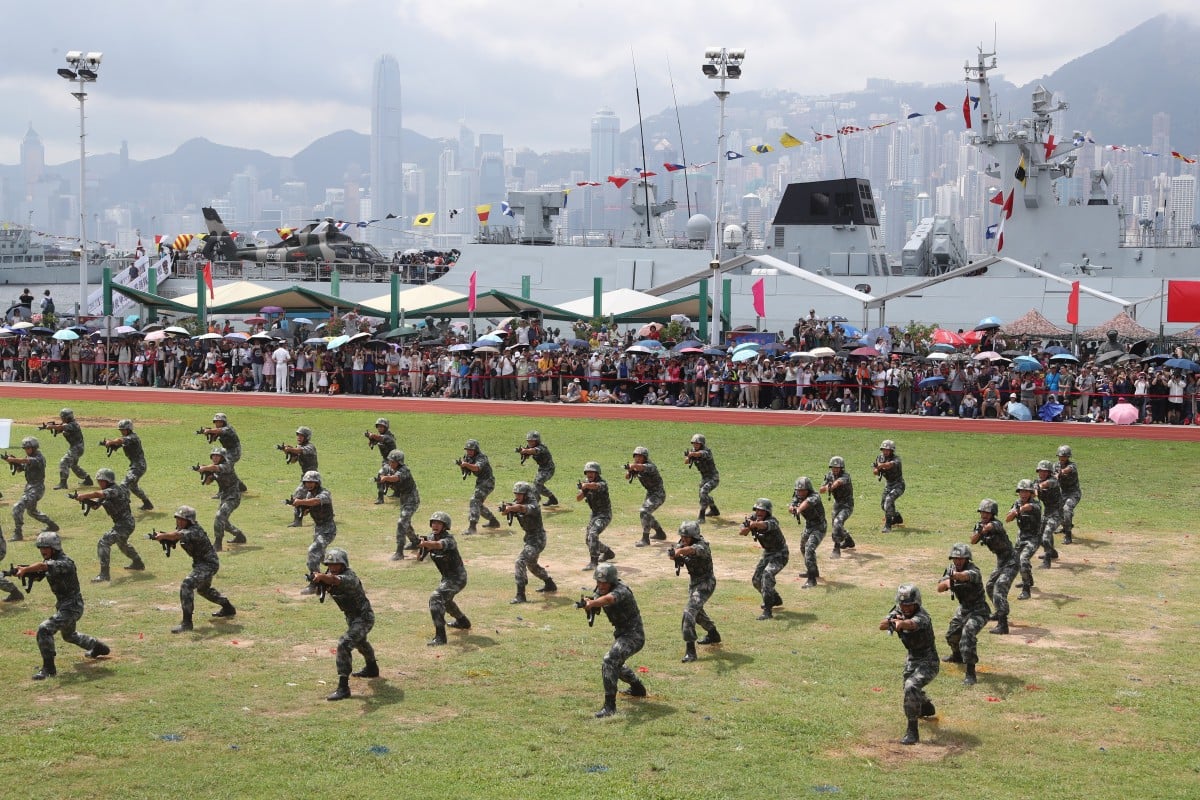
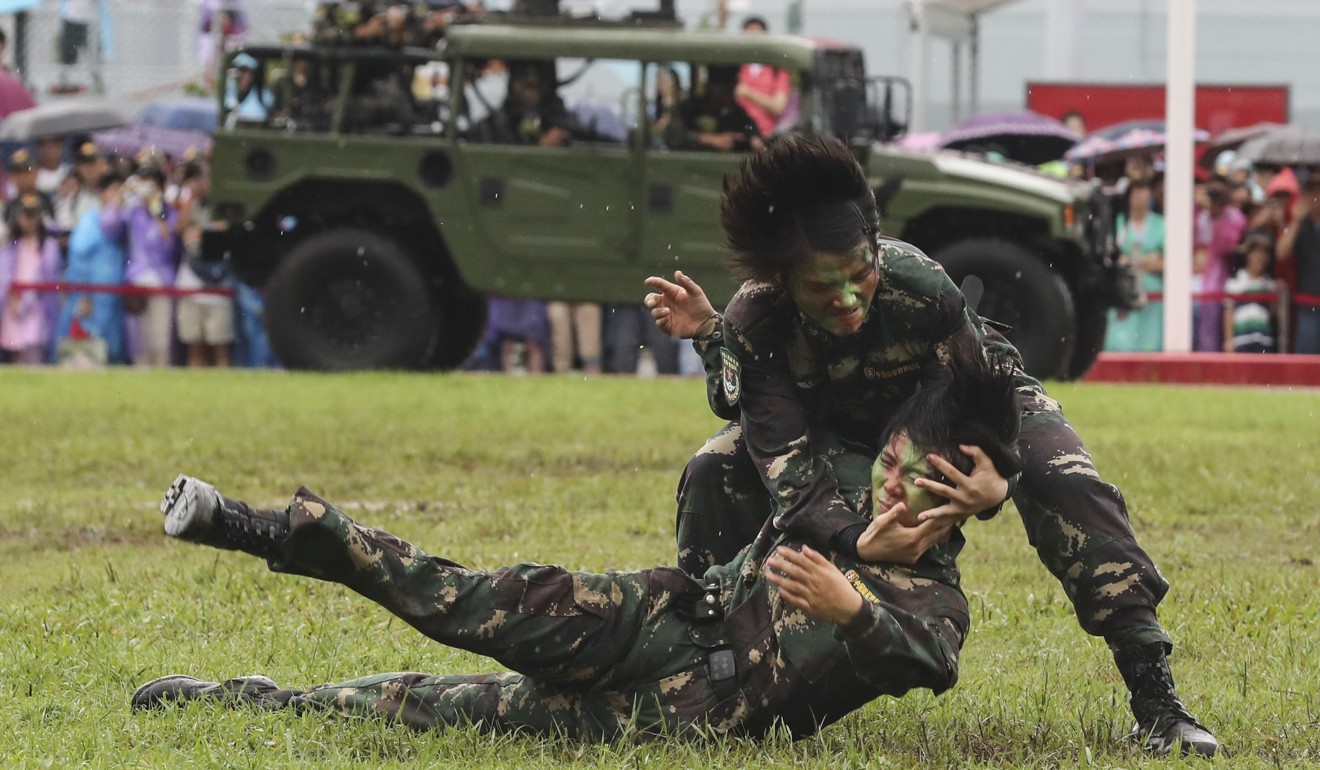
PLA soldiers show their skills during a naval base open day in Hong Kong. The PLA has had a presence in Hong Kong since the city’s return to Chinese sovereignty. Photo: K.Y. Cheng
It is a prospect dreaded by many in Hong Kong, but debate is growing in mainland China about whether the central government should end weeks of upheaval in the city by sending in the People’s Liberation Army (PLA).
The PLA has had a presence in Hong Kong since the city’s return to Chinese sovereignty but – unlike in mainland China – memories of the military’s bloody suppression of pro-democracy students and activists in Beijing in 1989 are still strong in the city three decades on.
Still, images of protesters vandalising Beijing’s liaison office in downtown Hong Kong on Sunday have fanned nationalist anger across the mainland, prompting calls for PLA intervention.

Concerns only deepened on Wednesday when defence ministry spokesman Wu Qian commented on the recent clashes and protests in Hong Kong. Without suggesting any action or plans by the PLA, Wu made clear that the Garrison Law, which governs the operations of PLA troops in Hong Kong, already stipulates that the PLA is legally allowed to help the city maintain law and order at the request of Hong Kong’s government.

“We are closely following the developments in Hong Kong, especially the violent attack against the central government’s liaison office by radicals on July 21,” Wu said.

“Some behaviour of the radical protesters is challenging the authority of the central government and the bottom line of ‘one country, two systems’,” he warned, referring to the formula that grants Hong Kong a high degree of autonomy for 50 years. “This is intolerable.”

Both Article 14 and Article 18 of the Basic Law – the city’s mini-constitution – spell out how and under what circumstances the PLA troops in Hong Kong can be used.

While the legality is clear, analysts still believe that given the exorbitant political cost and complexities involved, using the military would remain an unlikely last resort.

Even Hu Xijin, editor-in-chief of China’s nationalist tabloid Global Times, has spoken out against the idea, citing its “huge political cost” and the “severe uncertainty” it might bring to the situation.

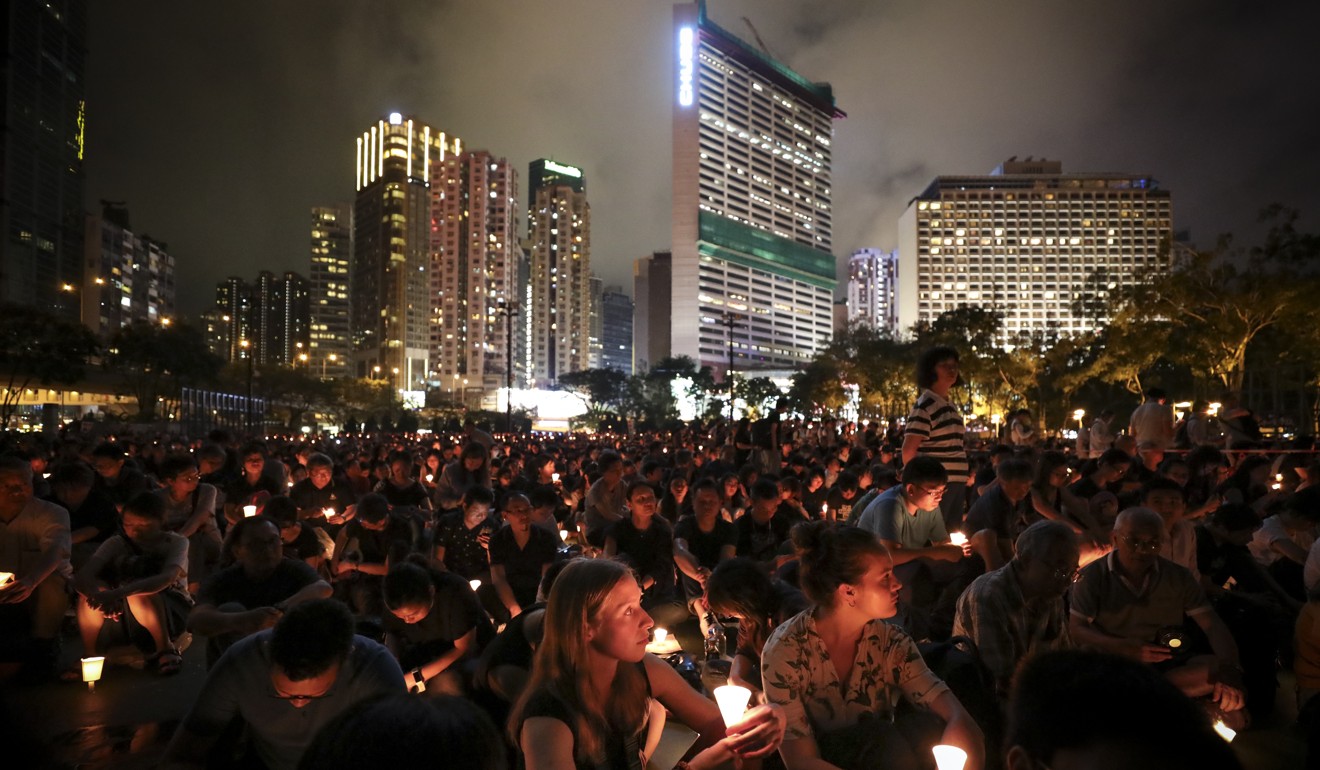
Crowds hold candles at a vigil in Victoria Park in Hong Kong in June to mark the 30th anniversary of the Tiananmen Square crackdown. Photo: James Wendlinger

“Once the PLA has taken charge of the situation in Hong Kong and quelled the riots, what’s next?” Hu said in a social media post on Monday.

Hu said there were no governance procedures in place that would allow the PLA to operate in Hong Kong and return things to normal. He also warned that any such action would be followed by international condemnation and a severe backlash among the Hong Kong public.

“The [PLA’s] Hong Kong garrison is the symbol of national sovereignty. It is not a fire brigade for law and order in Hong Kong,” he said.

Any move to use the Chinese troops will create a furore in the US Congress … They will re-examine the Hong Kong Policy Act very carefully Larry Wortzel, senior fellow at American Foreign Policy Council

The South China Morning Post reported last week that military force was not an option for mainland leaders working on a strategy to resolve the city’s biggest political crisis in decades.
And in June Major General Chen Daoxiang, commander of the Hong Kong garrison, assured David Helvey, US principal deputy assistant secretary of defence for Indo-Pacific security affairs, that Chinese troops would not interfere in the city’s affairs, according to Reuters.
The comments support analysts’ assessments that deploying the PLA is not a viable solution to Hong Kong’s crisis.
“Will the mobilisation of PLA troops further inflame the situation? There might be people who will resist or even revolt against the PLA, and that may lead to bloodshed,” said Lau Siu-kai, vice-chairman of the Chinese Association of Hong Kong and Macau Studies, a semi-official think tank.

The last time Beijing sent in troops to quell pro-democracy protests was during the Tiananmen Square crackdown on June 4, 1989 – bloodshed that has stained the PLA and the Communist Party to this day, despite decades of efforts to wipe it from public memory.

The last time Beijing sent in troops to quell pro-democracy protests was during the Tiananmen Square crackdown in 1989. Photo: Reuters

“Although they don’t like to admit it, they know they made a mistake in the way they used the PLA [in 1989],” said Larry Wortzel, a long-time PLA watcher, who witnessed the crackdown as an assistant military attache at the US embassy in Beijing 30 years ago.

“In subsequent years, when there were major demonstrations, they managed to handle them with either the People’s Armed Police [PAP] or the Public Security Bureau [PSB], or in some cases a combination of both,” said Wortzel, now a senior fellow in Asian security at the American Foreign Policy Council in Washington.

If the military was deployed [in Hong Kong], it would mean China was ready to shut its doors completely Chen Daoyin, a Shanghai-based political analyst

The PAP is a 1.5 million-strong paramilitary police force tasked with maintaining domestic security and order, while the PSB is the country’s police force.
The June 4 crackdown is still widely remembered in Hong Kong, where tens of thousands gather every year on its anniversary for a candlelight vigil in the heart of the city.
“The activities in Hong Kong and the Chinese Communist Party’s conduct there have really had a profound impact on thinking in Taiwan. It has killed any chance with any political party of [supporting] the one country, two systems,” Wortzel said.
Chinese military can be deployed at Hong Kong’s request to contain protests, Beijing says
“The last thing President Xi Jinping and the Politburo Standing Committee would want to do, if they can avoid it, is to use the PLA [in Hong Kong].”
The situation in Hong Kong is also being closely watched in the West, with many international firms basing regional headquarters in the Asian financial hub, thanks to its capitalist system and rule of law.
Deploying the PLA to Hong Kong would certainly spark an international outcry and draw huge pressure from Western countries, said Liang Yunxiang, an international affairs expert at Peking University.

“Britain, of course, would have the harshest criticism since it governed Hong Kong for a long time and signed treaties with China to ensure Beijing would keep its commitment to one country, two systems,” Liang said.

In the United States, the repercussions could go beyond verbal condemnation to a shift in policy that might fundamentally change Hong Kong’s status as an international financial centre and prompt an exodus of businesses, according to Wortzel.

“Any move to use the Chinese troops will create a furore in the US Congress … They will re-examine the Hong Kong Policy Act very carefully,” he said, referring to the bill passed in 1992 that allows Hong Kong to be treated as a non-sovereign entity distinct from mainland China on trade and economic matters.

Hong Kong head blasts violence, amid further extradition bill unrest

“They will simply treat Hong Kong like another Chinese city, which affects export controls and how the financial industry operates.”

Just last month, members of Congress reintroduced the bipartisan Hong Kong Human Rights and Democracy Act. If the legislation is passed, the US could revoke Hong Kong’s special status under American law if Beijing fails to ensure the city has “sufficient autonomy”.

The crisis comes as Beijing’s ties with Washington are already strained by a year-long trade war that has spilled into other areas of bilateral relations.

PLA troops go through their paces for the public at their Hong Kong barracks during an open day. Photo: Edward Wong

There is also mounting international pressure on China over issues such as its mass internment and political indoctrination of an estimated million or more members of Muslim minorities in Xinjiang, despite the Chinese government’s repeated denials of ill-treatment of the inmates and attempts to defend its policies.

Chen Daoyin, a Shanghai-based political analyst, said the increasing scrutiny China faced from Western countries – whether in the form of punitive tariffs or restrictions on technology – made it all the more important for China to keep Hong Kong as an open channel to connect with the world.

“If the military was deployed [in Hong Kong], it would mean China was ready to shut its doors completely,” Chen said.

Lau, from the Chinese Association of Hong Kong and Macau Studies, said the PLA should only be deployed as a last resort.

Two calls per second ‘jammed emergency lines’ during Hong Kong violence

“It would be a huge blow to the principle of ‘letting Hong Kong people govern Hong Kong with a high degree of autonomy’, since it will prove that Hong Kong people are not up to the task of governing themselves,” he said.

Hu, from Global Times, said the PLA troops could be used only if the authorities lost control of the city or an armed rebellion broke out.

Short of that, he said, the central government should let the chaos in Hong Kong run its course and wait for the public mood to flip.

This strategy of sitting it out hinges on the city’s police force holding the line and stopping Hong Kong’s slide into total anarchy.

Wortzel also warned that there were lines protesters should not cross – or risk provoking the use of military force.

“For instance, to this point, demonstrators have not gone up against the PLA garrison or any of its outposts. If they did that, I think it’s possible – actually it is very likely – that there will be a limited mobilised response [to defend the facilities],” he said.

While most analysts said the chance of Beijing resorting to military force was slim, the very idea – ludicrous to even discuss three months ago – has become a popular topic on social media on the mainland, where the discussion is not censored and many commenters support it.

The official media have been careful not to touch the subject but they too have stepped up rhetoric against the protests in Hong Kong.

In a rare move, state-run China Central Television has run commentaries and reports about protests in Hong Kong during its main evening news for five days in a row.

Only the most politically important issues receive such unusual treatment.

Source: SCMP

30/07/2019

Fight against terrorism, extremism in Xinjiang should be supported, respected: Chinese FM

BEIJING, July 29 (Xinhua) — The attempt of some Western countries to tarnish the image of the Xinjiang Uygur Autonomous Region is doomed to fail, and the fight against terrorism and extremism in Xinjiang should be supported and respected, a Chinese foreign ministry spokesperson said Monday.

Recently, ambassadors from 50 countries to the United Nations Office at Geneva (UNOG) have sent a joint letter to the President of the UN Human Rights Council (UNHRC) and the High Commissioner for Human Rights to voice their support for China’s position on issues related to Xinjiang.

The 50 ambassadors, who are from countries including Russia, Pakistan, Saudi Arabia, Algeria and Cuba, have collectively stated for the first time that the counter-terrorism and de-radicalization measures, including the establishment of vocational education and training centers, have effectively safeguarded basic human rights in Xinjiang, spokesperson Hua Chunying told a press briefing.

According to media reports, 24 members of the UNHRC have previously signed a letter criticizing China’s position on relevant issues.

“The 24 members, with a total population of no more than 600 million, are all developed Western countries, none of them being an Islamic or developing country. While of the 50 countries that support China are from Asia, Africa, Latin America and Europe, with a total population of nearly 2 billion, 28 are members of the Organization of the Islamic Cooperation, and their population is more than twice that of the 24 members that criticized China,” Hua said. “So it’s obvious who is right and who is wrong on the matter of Xinjiang,” she added.

Hua said many of the ambassadors who supported China’s Xinjiang policy have visited Xinjiang and witnessed the truth.

As the ambassadors pointed out, those who had visited Xinjiang found what they saw and heard was completely different from what was described in Western media reports, according to Hua.

“The ambassadors also appreciated China’s achievements in human rights, believed that Xinjiang’s establishment of vocational education and training centers, as well as other counter-terrorism and de-radicalization measures, effectively guaranteed basic human rights and urged relevant countries to stop their unfounded accusations against China,” said the spokesperson.

“This fully shows that the international community has its fair judgment on the development of Xinjiang,” said Hua, adding that attempt to smear Xinjiang and put pressure on China in the name of “human rights” will never succeed.

Pointing out that the current problem in Xinjiang is the issue of counter-terrorism and extremism rather than religious and human rights issues, Hua said the counter-terrorism and de-radicalization struggle in Xinjiang deserve support, respect and understanding.

“Faced with severe threats of terrorism and extremism, the Xinjiang Uygur Autonomous Region has taken a series of counter-terrorism and de-radicalization measures according to law, including the establishment of vocational education and training centers,” said Hua, adding that those measures have turned the situation around.

“In almost three years, not a single violent or terrorist incident took place in Xinjiang. The region now enjoys social stability and unity among all ethnic groups. People there are living a happy life with a stronger sense of fulfillment and security. They endorse the government’s policies and measures wholeheartedly,” said the spokesperson.

Noting that many of the 24 countries that denounce China’s Xinjiang policy have been victims of terrorism, Hua said relevant people and officials from these 24 countries are welcome to visit Xinjiang to learn about Xinjiang’s counter-terrorism and de-radicalization experience.

Hua said China is working with all parties to ensure that multilateral human rights mechanisms stick to the purposes and principles of the UN Charter. Human rights issues should be dealt with in an objective, fair and non-selective way. “We need to advance international human rights cause in a sound manner through constructive dialogue and cooperation.”

“We resolutely oppose any country’s act of using the Human Rights Council and other mechanisms to interfere in other countries’ internal affairs and wantonly criticize, smear and pressure others. We urge the relevant countries to correct their mistakes at once, not to politicize the relevant issue or practice double standards, and stop meddling in other countries’ domestic affairs,” she added.

Source: Xinhua

29/07/2019

Experts accuse U.S. of using Xinjiang to interfere in China’s domestic affairs

URUMQI, July 28 (Xinhua) — A group of Chinese experts have criticized the United States for adopting double standards on counterterrorism and deradicalization and using Xinjiang-related issues as a tool to interfere in China’s domestic affairs.

The experts, who specialize in studies in the fields of human rights, international relations and anti-terrorism, made the remarks at a seminar held recently in Urumqi, capital of Xinjiang Uygur Autonomous Region.

Wang Yu, an associate researcher with the Institute of Chinese Borderland Studies, said China’s anti-terror measures implemented in Xinjiang in recent years have provided a new solution to the global fight against terrorism.

For some time China’s Xinjiang has seen frequent incidents of terrorist attacks, but over the past nearly three years, there have been no such incidents in the region, Wang noted.

Gu Liyan, a researcher with the Xinjiang Academy of Social Sciences, accused the United States of using human rights issues to erode public trust in governments of some other countries and create social conflict and unrest there, so as to attain its global hegemony.

“Whatever measures or policies China implements on counterterrorism and deradicalization will never accord with the so-called human rights standards of the U.S.,” she said.

Li Wei, a researcher with the China Institute of Contemporary International Relations, said education and training centers were established in Xinjiang in order to prevent trainees from falling victim to terrorism and extremism.

China’s measures on deradicalization offer a successful case study to the international community and have won widespread recognition and acclaim, said Li.

Shu Hongshui, an anti-terror expert at Northwest University of Political Science and Law, said the U.S. adoption of double standards on counterterrorism and deradicalization is intended to curb China’s development.

The propaganda warfare waged by the United States and some other Western countries against China on Xinjiang-related issues is unable to conceal their strategic anxiety and predicament, Shu said

Source: Xinhua

27/07/2019

Ambassadors from 50 countries voice support for China’s position on issues related to Xinjiang


GENEVA, July 27 (Xinhua) — Ambassadors from 50 countries to the United Nations Office at Geneva (UNOG) have co-signed a letter to the President of the UN Human Rights Council (HRC) and the High Commissioner for Human Rights to voice their support for China’s position on issues related to its Xinjiang Uygur Autonomous Region.

Earlier on July 12, a number of ambassadors in Geneva sent the joint letter to show their support for China, and as of Friday evening, more ambassadors had joined, the Chinese Mission to the UNOG revealed.

In a statement issued on Friday night, the Chinese mission said that some other countries had also expressed their support in separate letters or press statements.

In the joint letter, the ambassadors commend China for its economic and social progress, effective counter-terrorism and de-radicalization measures, and strong guarantee of human rights.

They appreciate the opportunities provided by China for diplomatic envoys, officials of international organizations, and media professionals to visit Xinjiang, and point to the contrast between Xinjiang in the eyes of those who have visited it and the one portrayed by some western media.

The ambassadors also urge a certain group of countries to stop using uncorroborated information to make unfounded accusations against China.

“I was surprised that some people call these vocational training and education centers concentration or internment camps,” Vadim Pisarevich, deputy permanent representative of Belarus to the UNOG, told Xinhua.

“They’re nothing of the kind. They look like ordinary educational facilities and even I said that they are more than this because they provide life skills training to the students,” Pisarevich said.

They are “very useful institutions for addressing the problems of terrorism, extremism and separatism,” he said.

“Terrorism and extremism are an intractable challenge across the world. In the face of its grave threat, Xinjiang Uygur Autonomous Region responded with a number of lawful steps, including setting up vocational education and training centers, to prevent and combat terrorism and extremism,” the Chinese Mission to the UNOG said in its statement.

“Facts speak louder than words, and justice cannot be overshadowed. The great diversity of countries co-signing the letter — from Asia, Africa, Latin America, and Europe, especially the OIC (Organization of Islamic Cooperation) — makes it clear that the international community has drawn a fair conclusion about Xinjiang’s human rights achievement and counter-terrorism and de-radicalization outcome,” the statement said.

“Those that seek to use human rights as an excuse to slander and pressure China have only themselves to deceive,” it added.

“We oppose any attempt to use human rights issues as a cover for interference in a country’s internal affairs. We urge those who are doing so to change course, refrain from politicization and double standards, and stop interfering in the internal affairs of other countries under the pretext of human rights,” it said.

At a press conference on Friday, China’s Ambassador to the UNOG Chen Xu also rebuked some Western nations for slandering China over Xinjiang, noting that China doesn’t accept these “groundless accusations.”

Jamshed Khamidov, head of Tajikistan’s mission in Geneva, said his government opposes any attempts to use the Human Rights Council for particular political purposes, and efforts should be made to avoid any politicization of the Human Rights Council.

“We know the situation in the Xinjiang region. We know how much the government of China is doing … and what kind of measures were implemented in this region to support its peace, security and development,” he said.

In visits to the vocational training and education centers in Xinjiang’s Urumqi and Kashi, Zenon Mukongo Ngay, head of the Democratic Republic of Congo’s mission in Geneva, said he was impressed with the “level of development” in Xinjiang and how the people in the centers receive education for getting a job.

The Chinese mission also said that together with all parties, China is committed to promoting the healthy development of the international human rights cause by encouraging multilateral human rights institutions to stick to the purpose and principles of the UN Charter, handle human rights issues in an objective, impartial and non-selective manner, and engage in constructive dialogues and cooperation.

Source: Xinhua

27/07/2019

China deploys J-20 stealth fighter ‘to keep tabs on Taiwan’

  • Aircraft could also be used to counterbalance Japanese and US military activities in the region, analysts say
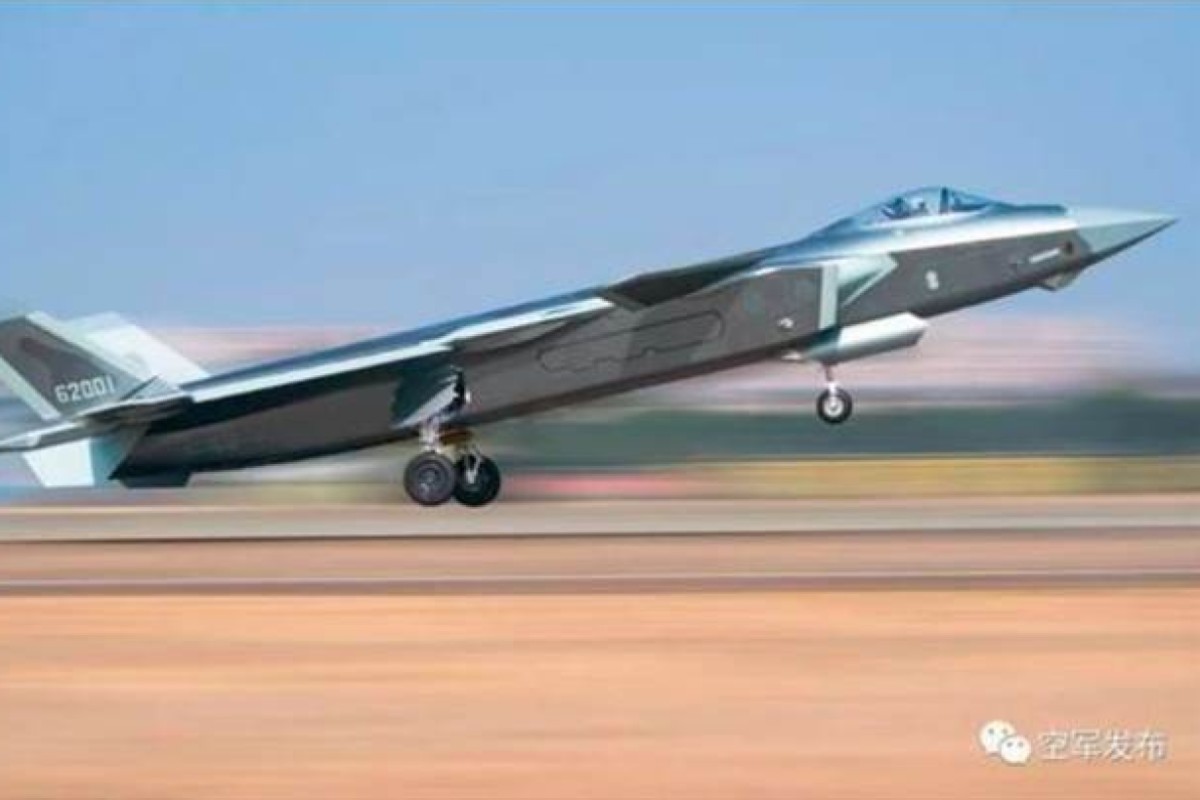
China’s J-20 stealth fighter has gone into service in the Eastern Theatre Command. Photo: PLA Air Force
China’s J-20 stealth fighter has been officially deployed to the country’s Eastern Theatre Command, suggesting it will be focused on the Taiwan Strait and military activities between Japan and the United States, observers said.
The People’s Liberation Army Air Force posted a photo on its social media account this week showing the fifth-generation fighter tagged with the number 62001, designating the aircraft as part of a frontline unit.
Chinese media reported that the stealth fighter had entered the Eastern Theatre Command, which encompasses Taiwan.
Collin Koh, a research fellow at the S Rajaratnam School of International Studies at Nanyang Technological University in Singapore, said the aircraft appeared to have two missions.
“The unit turning operational in Eastern Theatre Command is precisely aimed at Taiwan,” Koh said.
“And to challenge US military activities in Taiwan Strait, besides posing a threat to the median line that Taiwan’s air force patrols along.”
US Air Force gears up for aggressor drills to simulate combat with China’s J-20 fifth-generation fighters

The photo’s release came as China issued a defence white paper, highlighting the risks from “separatist forces”.

In the document, the military said it faced challenges from pro-independence forces in Taiwan but would always defeat those fighting for the island’s independence. It also said there were risks from separatists in the autonomous regions of Tibet and Xinjiang.
A day after the paper was released, an American warship sailed through the Taiwan Strait.

The J-20 is expected to enter mass production this year. If the aircraft was declared ready to go into active operations, it would signal China was a “greater threat” and had “greater capability” in the Pacific, General Charles Brown, the US Air Force’s Pacific commander, said in May.

Brown said US efforts to counter those developments included increasing deployments of next-generation F-35 jets and continuing overflights of strategic areas such as the South China Sea.

China’s J-20 stealth jet may be ready this year, US commander says

According to the US Defence Intelligence Agency, fielding the J-20 would add to what was already the region’s biggest air force and world’s third-largest.

China had more than 2,500 aircraft, including 1,700 combat fighters, strategic bombers, tactical bombers and multi-mission tactical and attack aircraft, in service, the agency said in a report earlier this year.

China’s J-20 fighter was part of a modernisation effort that had been “closing the gap with Western air forces across a broad spectrum of capabilities, such as aircraft performance, command and control and electronic warfare”, the report said.

Macau-based military expert Antony Wong Dong said that in addition to Taiwan, the J-20 fighter could also be used to counterbalance military activities by the United States and Japan.

But Wong added that the Chinese military was still exploring how best the fighter could be used.

“It will take a few years for the aircraft to be fully deployed and to mature. Right now, it’s still in the exploration stage,” he said.

Source: SCMP

Law of Unintended Consequences

continuously updated blog about China & India

ChiaHou's Book Reviews

continuously updated blog about China & India

What's wrong with the world; and its economy

continuously updated blog about China & India