21/10/2019
Huang Kunming, a member of the Political Bureau of the Communist Party of China (CPC) Central Committee and head of the Publicity Department of the CPC Central Committee, attends the opening ceremony of the sixth World Internet Conference in Wuzhen, east China’s Zhejiang Province, Oct. 20, 2019. Before delivering his speech, Huang read Chinese President Xi Jinping’s congratulatory letter to the conference. (Xinhua/Liu Bin)
WUZHEN, Zhejiang Province, Oct. 20 (Xinhua) — The sixth World Internet Conference opened Sunday in the river town of Wuzhen in east China’s Zhejiang Province.
With the theme of “Intelligent Interconnection for Openness and Cooperation — Building a Community with a Shared Future in Cyberspace,” the three-day conference will bring together more than 1,500 participants from over 80 countries and regions, including members of the Internet Hall of Fame, Nobel Prize winners and Turing Award winners.
Executives from major tech companies from home and abroad such as Microsoft, Qualcomm, Alibaba Group and Huawei will share their insight on the future development of the internet at 20 sub-forums, covering popular and cutting-edge topics such as artificial intelligence (AI), 5G and industrial digitization.
Huang Kunming, a member of the Political Bureau of the Communist Party of China (CPC) Central Committee and head of the Publicity Department of the CPC Central Committee, delivered a keynote speech at the opening ceremony of the conference.
Fifty years after the birth of the internet, efforts should be made to seize new opportunities and address risks and challenges to build cyberspace into a shared community that benefits all humanity, Huang said.
The senior official also called for enhanced efforts to develop the digital economy, unleash the digital dividend, and protect the security and order of cyberspace.
During the conference, reports on China and world internet development will be released to forecast the future trend of internet development.
The reports will review global internet development over the past five decades and the history of Chinese internet during the last 25 years.
Around 15 top scientific and technological projects in the internet sector will also be unveiled, covering AI, 5G, big data, cloud computing, digital manufacturing, industrial internet and other internet-related fields.
The number of internet users in China hit 854 million in June 2019, with the internet availability rate reaching 61.2 percent, according to the China Internet Network Information Center.
Source: Xinhua
Posted in 5G, Alibaba Group, artificial intelligence (AI), Big data, China Internet Network Information Center, Cloud computing, cyberspace, digital manufacturing, Huawei, industrial digitization, industrial internet, Internet Hall of Fame, Microsoft, Nobel Prize winners, Political Bureau of the Communist Party of China (CPC) Central Committee, Publicity Department of the CPC Central Committee, Qualcomm Inc, Turing Award winners, Uncategorized, World Internet Conference, zhejiang province |
Leave a Comment »
08/10/2019
BEIJING, Oct. 8 (Xinhua) — Paleontologists announced Tuesday in Beijing they had discovered a group of 100-million-year-old fossils of dinosaur footprints in east China’s Zhejiang Province.
Over 20 footprints, ranging from 22.7 cm to 82 cm in length, were discovered in a village in the city of Lanxi, according to Xing Lida, an associate professor with the China University of Geosciences (Beijing). Experts estimate the dinosaurs’ body length ranged from 3.8 to 14 meters.
The footprints are believed to date back 100 million years to the Cretaceous Period, indicating that a large number of sauropods were active in the area, which was believed to be rich in water and grass at that time. Experts infer there would have been carnivorous dinosaurs in symbiosis with these herbivorous dinosaurs, but no evidence has been found so far.
Xing and Martin Lockley, a professor at the University of Colorado, were among the authors of the study, which was published in Historical Biology.
Paleontologists are now working with local authorities to better protect these rare footprints.
Source: Xinhua
Posted in 100-million-year-old, carnivorous dinosaurs, China University of Geosciences (Beijing), Cretaceous Period, Dinosaur, footprints, found, herbivorous dinosaurs, Historical Biology, Lanxi, Paleontologists, sauropods, symbiosis, Uncategorized, University of Colorado, zhejiang province |
Leave a Comment »
03/10/2019
- Managers of the Leshan Giant Buddha and Jiuzhaigou National Park restrict ticket sales as millions head off for the holiday break
Park authorities in charge of the Leshan Giant Buddha in Sichuan have restricted visitor numbers in golden week. Photo: Xinhua
Several major
tourist attractions in China have capped visitor numbers during this year’s National Day “golden week” holiday as millions take the chance to travel.
October 1 marked the start of a week-long break on the mainland, with an estimated 800 million people expected to go on trips in China or overseas, about 10 per cent more than last year, according to the China Tourism Academy.
The academy estimated that 726 million people would take domestic trips in this peak holiday period – a 9.4 per cent increase from last year, but that is the lowest level of growth since 2007 as pressure from China’s slowing economy and the trade war with the United States take their toll.
Managers at the scenic area surrounding the Leshan Giant Buddha – a 71-metre (233 feet) tall ancient statue carved into a cliff in southwestern Sichuan province – said last week that daily tickets would be capped at 22,400 during the holiday, which runs until Monday.
West Lake in Hangzhou, Zhejiang province, drew 300,400 visitors as golden week started. Photo: Xinhua
The park said it would update visitors on daily ticket sales through social media.
“Today’s tickets for the Giant Buddha have reached the limit and sales have stopped,” the park management committee said on its Weibo account on Tuesday. “To all tourists, please rearrange your itinerary. You can visit the areas surrounding the Giant Buddha scenic spot,” it said, adding that tickets could be booked online for any day for the rest of golden week.
“I expected it to be chock-full of people, but actually today it’s still relatively calm. I had lots of fun,” a visitor to the Giant Buddha told Pear Video on Tuesday.
Hong Kong protests leave ‘golden week’ tourist boom in tatters
Jiuzhaigou National Park in Sichuan said last week that it would be limiting visitors to 5,000 per day during golden week and said on Monday that tickets had sold out.
The network of valleys known for its natural scenery was devastated by an earthquake in August 2017, and reopened with limited access in March 2018.
However, there were no restrictions at other attractions. In eastern Zhejiang province, 340,400 visitors went through the gates at Hangzhou’s West Lake on Tuesday, the Global Times’ Chinese edition reported.
“There’s too many people. I have never seen so many of them in my life,” one tourist was quoted as saying.
A guide also said that instances of “uncivilised behaviour”, such as trampling on the gardens, were down compared to last year.
“During the major holidays, many tourist attractions are so crowded that tourists can barely move an inch,” Hangzhou Daily said in an editorial on Monday.
“Not only is the tourist experience bad, but there are also safety hazards such as being trampled on, and this puts a lot of pressure on nearby public transport and food establishments.”
Travel booking platform Ctrip said that tourists heading overseas were increasingly seeking out new destinations, with bookings to places such as the Czech Republic, Austria, Croatia, Malta and Cambodia up by 45 per cent this year.
However, bookings for Hong Kong had fallen substantially after nearly four months of anti-government protests, Ctrip said.
Source: SCMP
Posted in ancient statue, Austria, Cambodia, China alert, China Tourism Academy, Croatia, crowds, Ctrip, cut, Czech Republic, domestic trips, food establishments, Giant Buddha, Global Times, golden week, Hangzhou, Hangzhou Daily, holiday break, Hong Kong, Jiuzhaigou National Park, Leshan Giant Buddha, Leshan Giant Buddha and Jiuzhaigou National Park, limit, Malta, Managers, Numbers, October 1, overseas, Pear Video, pressure, public transport, restrict, scenic sites, sichuan province, slowing economy, ticket sales, toll, tourists, trade war, trampled on, Travel booking platform, trips, Uncategorized, uncivilised behaviour, United States, visitor, Weibo, West Lake, zhejiang province |
Leave a Comment »
26/09/2019
- An increasing proportion of young people no longer willing to wait tables in China as restaurant owners look to new technology for answers
Catering robots developed by Pudu Tech, the three-year-old Shenzhen start-up, have been adopted by thousands of restaurants in China, as well as some foreign countries including Singapore, Korea, and Germany. Photo: Handout
Two years ago, Bao Xiangyi quit school and worked as a waiter in a restaurant for half a year to support himself, and the 19 year-old remembers the time vividly.
“It was crazy working in some Chinese restaurants. My WeChat steps number sometimes hit 20,000 in a day [just by delivering meals in the restaurant],” said Bao.
The WeChat steps fitness tracking function gauges how many steps you literally take and 20,000 steps per day can be compared with a whole day of outdoor activity, ranking you very high in a typical friends circle.
Bao, now a university student in Hangzhou, Zhejiang province, quit the waiter job and went back to school.
“I couldn’t accept that for 365 days a year every day would be the same,” said Bao.
“Those days were filled with complete darkness and I felt like my whole life would be spent as an inferior and insignificant waiter.”
Olivia Niu, a 23-year-old Hong Kong resident, quit her waiter job on the first day. “It was too busy during peak meal times. I was so hungry myself but I needed to pack meals for customers,” said Niu.
Being a waiter has never been a top career choice but it remains a big source of employment in China. Yang Chunyan, a waitress at the Lanlifang Hotel in Wenzhou in southeastern China, has two children and says she chose the job because she needs to make a living.
Catering robots developed by Pudu Tech, the three-year-old Shenzhen start-up. Photo: Handout
Today’s young generation have their sights on other areas though. Of those born after 2000, 24.5 per cent want careers related to literature and art. This is followed by education and the IT industry in second and third place, according to a recent report by Tencent QQ and China Youth Daily.
Help may now be at hand though for restaurants struggling to find qualified table staff who are able to withstand the daily stress of juggling hundreds of orders of food. The answer comes in the form of robots.
Japan’s industrial robots industry becomes latest victim of the trade war
Shenzhen Pudu Technology, a three-year-old Shenzhen start-up, is among the tech companies offering catering robots to thousands of restaurant owners who are scrambling to try to plug a labour shortfall with new tech such as machines, artificial intelligence and online ordering systems. It has deployed robots in China, Singapore, Korea and Germany.
With Pudu’s robot, kitchen staff can put meals on the robot, enter the table number, and the robot will deliver it to the consumer. While an average human waiter can deliver 200 meals per day – the robots can manage 300 to 400 orders.
“Nearly every restaurant owner [in China] says it’s hard to recruit people to [work as a waiter],” Zhang Tao, the founder and CEO of Pudu tech said in an interview this week. “China’s food market is huge and delivering meals is a process with high demand and frequency.”
Pudu’s robots can be used for ten years and cost between 40,000 yuan (US$5,650) and 50,000 yuan. That’s less than the average yearly salary of restaurant and hotel workers in China’s southern Guangdong province, which is roughly 60,000 yuan, according to a report co-authored by the South China Market of Human Resources and other organisations.
As such, it is no surprise that more restaurants want to use catering robots.
According to research firm Verified Market Research, the global robotics services market was valued at US$11.62 billion in 2018 and is projected to reach US$35.67 billion by 2026.
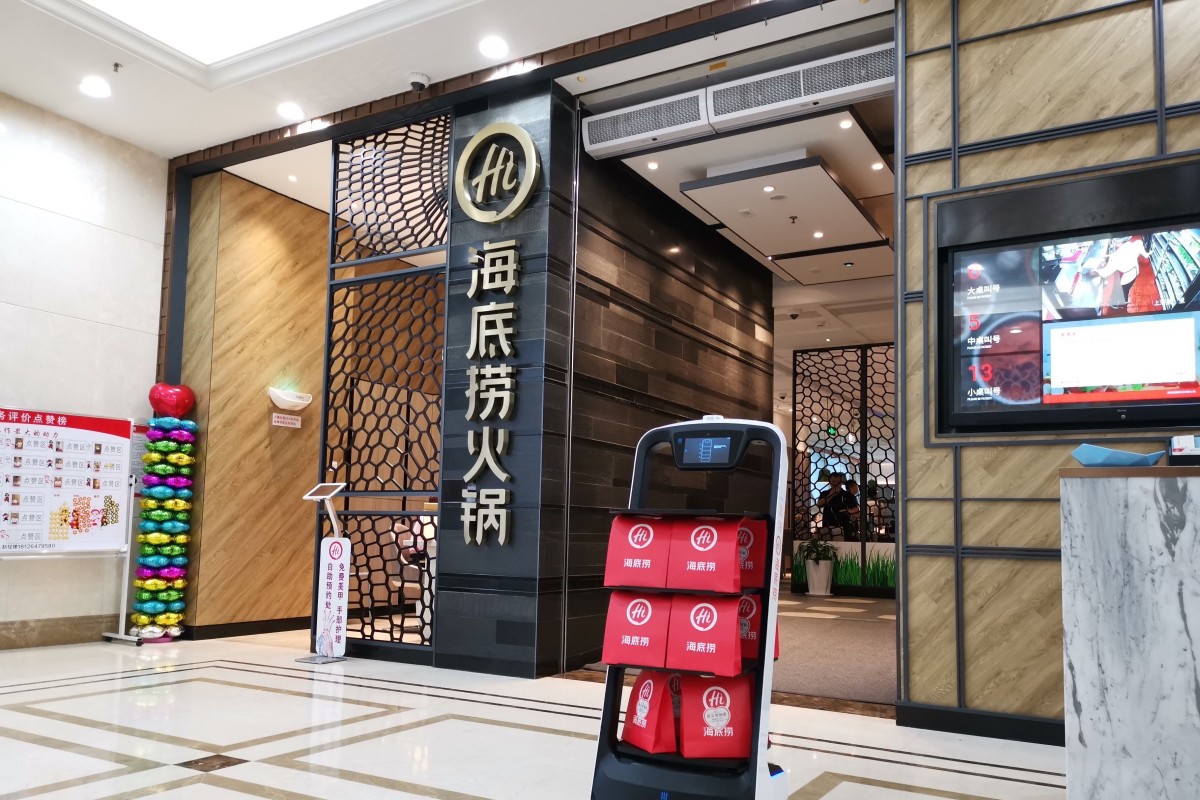
Haidilao, China’s top hotpot restaurant, has not only adopted service robots but also introduced
a smart restaurant with a mechanised kitchen in Beijing last year. And in China’s tech hub of Shenzhen,
it is hard to pay without an app as most of the restaurants have deployed an online order service.
Can robots and virtual fruit help the elderly get well in China?
China’s labour force advantage has also shrank in recent years. The working-age population, people between 16 and 59 years’ old, has reduced by 40 million since 2012 to 897 million, accounting for 64 per cent of China’s roughly 1.4 billion people in 2018, according to the national bureau of statistics.
By comparison, those of working age accounted for 69 per cent of the total population in 2012.
Other Chinese robotic companies are also entering the market. SIASUN Robot & Automation Co, a hi-tech listed enterprise belonging to the Chinese Academy of Sciences, introduced their catering robots to China’s restaurants in 2017. Delivery robots developed by Shanghai-based Keenon Robotics Co., founded in 2010, are serving people in China and overseas markets such as the US, Italy and Spain.
Pudu projects it will turn a profit this year and it is in talks with venture capital firms to raise a new round of funding, which will be announced as early as October, according to Zhang. Last year it raised 50 million yuan in a round led by Shenzhen-based QC capital.
To be sure, the service industry is still the biggest employer in China, with 359 million workers and accounting for 46.3 per cent of a working population of 776 million people in 2018, according to the national bureau of statistics.
And new technology sometimes offers up new problems – in this case, service with a smile.
“When we go out for dinner, what we want is service. It is not as simple as just delivering meals,” said Wong Kam-Fai, a professor in engineering at the Chinese University of Hong Kong and a national expert appointed by the Chinese Association for Artificial Intelligence. “If they [robot makers] can add an emotional side in future, it might work better.”
Technology companies also face some practical issues like unusual restaurant layouts.
“Having a [catering robot] traffic jam on the way to the kitchen is normal. Some passageways are very narrow with many zigzags,” Zhang said. “But this can be improved in future with more standardised layouts.”
Multi-floor restaurants can also be a problem.
Dai Qi, a sales manager at the Lanlifang Hotel, said it is impossible for her restaurant to adopt the robot. “Our kitchen is on the third floor, and we have boxes on the second, third, and fourth floor. So the robots can’t work [to deliver meals tdownstairs/upstairs],” Dai said.
But Bao says he has no plans to return to being a waiter, so the robots may have the edge.
“Why are human beings doing something robots can do? Let’s do something they [robots] can’t,” Bao said.
Source: SCMP
Posted in ability, answers, Artificial intelligence, artificial intelligence (AI), Beijing, careers, catering robot, China alert, China Youth Daily, Chinese Academy of Sciences, Chinese University of Hong Kong, complain, Consumer, education, foreign countries, founder and CEO, Germany, global robotics services market, guangdong province, Hangzhou, hard to recruit, Hong Kong resident, hundreds of orders, increasing proportion, industrial robots industry, IT industry, Japan, juggle, Korea, labour shortfall, Lanlifang Hotel, latest victim, literature and art, machines, Multi-floor restaurants, national bureau of statistics, National Bureau of Statistics (NBS), new technologies, new technology, online ordering systems, plug, problem, Pudu Tech, restaurant owners, Shanghai, Shenzhen, Shenzhen Pudu Technology, Singapore, smart restaurant, start up, table number, Tech Companies, tencent qq, top hotpot restaurant, trade war, traffic jams, Uncategorized, venture capital firms, Verified Market Research, wait tables, WeChat, Wenzhou, willing, young people, Zhang Tao, zhejiang province, zigzags |
Leave a Comment »
17/09/2019
- Hangzhou subway operator says water seeped into underground construction site
- Zhejiang’s capital was scene of subway collapse that claimed 21 workers’ lives in 2008
A yellow cloud engulfs buildings after a subway tunnel in Hangzhou, Zhejiang province, collapses. Photo: Pear Video
Homes in a major city in eastern China were evacuated on Wednesday after water seepage at a subway construction site caused a main road to cave in and cut a gas main.
Authorities in Hangzhou, Zhejiang province, said dozens of residents feared for their homes as buildings cracked and swayed from the cave-in.
Videos posted to the Weibo microblogging network showed yellow smoke engulfing the neighbourhood as the road fell below street level. Authorities said Hangzhou’s gas supplier managed to close off the mains.
Hangzhou Metro Group, the city’s subway operator and the company overseeing the network’s expansion from four lines to nine for the 2022 Asian Games, said on Weibo that water seeped into a tunnel that connected two stations in the centre of the city, leading to the collapse.
The collapse took down a four-lane road in central Hangzhou. Photo: Pear Video
That caused a hole under the carriageway and took the pavement down with it. Hangzhou Metro said homes around the site were cleared and authorities were monitoring for further danger.
It was not known how many residents were affected, but no casualties were reported.
Most residents were put up in a nearby school until accommodation could be arranged, the City Express newspaper reported, adding that several truckloads of cement were poured into the hole.
Eight Chinese killed as road collapses near subway construction project
The road collapse in central Hangzhou was the latest in a series of subway construction accidents there – some of them deadly – in the past decade as China races to expand its urban rail networks.
In November 2008, 21 workers were killed and 24 were injured when a tunnel Hangzhou’s Line 1 collapsed beneath an eight-lane road and river water rushed in. A court sent eight people to jail for terms of between three and 5½ years for negligence at the site.
Two years later at the same place, a truck driver died and another was injured as a pit collapsed.
In 2016, four construction workers were killed when mud flooded a pit at a station on Line 4.
In 2008, an eight-lane riverside road in Hangzhou fell in on workers building a subway tunnel, killing 21. Photo: AFP
A cave-in similar to Wednesday’s collapse overturned a truck at a construction site near Hangzhou railway station this month, but no one was injured, Hangzhou Metro said.
According to the China Association of Metros, by the end of last year, more than 5,700km (3,540 miles) of urban railway had been built in 35 mainland cities, of which more than a third – 2,100km – was completed since 2015.
Source: SCMP
Posted in Asian Games, capital, China alert, China Association of Metros, City Express, collapses, construction site, flee, Hangzhou, Hangzhou Metro Group, homes, mainland cities, residents, subway operator, subway tunnel\, Uncategorized, underground, urban rail networks, urban railway, water seeped, Weibo, zhejiang province |
Leave a Comment »
15/09/2019
- An increasing proportion of young people no longer willing to wait tables in China as restaurant owners look to new technology for answers
Catering robots developed by Pudu Tech, the three-year-old Shenzhen start-up, have been adopted by thousands of restaurants in China, as well as some foreign countries including Singapore, Korea, and Germany. Photo: Handout
Two years ago, Bao Xiangyi quit school and worked as a waiter in a restaurant for half a year to support himself, and the 19 year-old remembers the time vividly.
“It was crazy working in some Chinese restaurants. My WeChat steps number sometimes hit 20,000 in a day [just by delivering meals in the restaurant],” said Bao.
The WeChat steps fitness tracking function gauges how many steps you literally take and 20,000 steps per day can be compared with a whole day of outdoor activity, ranking you very high in a typical friends circle.
Bao, now a university student in Hangzhou, Zhejiang province, quit the waiter job and went back to school.
“I couldn’t accept that for 365 days a year every day would be the same,” said Bao. “Those days were filled with complete darkness and I felt like my whole life would be spent as an inferior and insignificant waiter.”
Olivia Niu, a 23-year-old Hong Kong resident, quit her waiter job on the first day. “It was too busy during peak meal times. I was so hungry myself but I needed to pack meals for customers,” said Niu.
Being a waiter has never been a top career choice but it remains a big source of employment in China. Yang Chunyan, a waitress at the Lanlifang Hotel in Wenzhou in southeastern China, has two children and says she chose the job because she needs to make a living.
Catering robots developed by Pudu Tech, the three-year-old Shenzhen start-up. Photo: Handout
Today’s young generation have their sights on other areas though. Of those born after 2000, 24.5 per cent want careers related to literature and art. This is followed by education and the IT industry in second and third place, according to a recent report by Tencent QQ and China Youth Daily.
Help may now be at hand though for restaurants struggling to find qualified table staff who are able to withstand the daily stress of juggling hundreds of orders of food. The answer comes in the form of robots.
Japan’s industrial robots industry becomes latest victim of the trade war
Shenzhen Pudu Technology, a three-year-old Shenzhen start-up, is among the tech companies offering catering robots to thousands of restaurant owners who are scrambling to try to plug a labour shortfall with new tech such as machines, artificial intelligence and online ordering systems. It has deployed robots in China, Singapore, Korea and Germany.
With Pudu’s robot, kitchen staff can put meals on the robot, enter the table number, and the robot will deliver it to the consumer. While an average human waiter can deliver 200 meals per day – the robots can manage 300 to 400 orders.
“Nearly every restaurant owner [in China] says it’s hard to recruit people to [work as a waiter],” Zhang Tao, the founder and CEO of Pudu tech said in an interview this week. “China’s food market is huge and delivering meals is a process with high demand and frequency.”
Pudu’s robots can be used for ten years and cost between 40,000 yuan (US$5,650) and 50,000 yuan. That’s less than the average yearly salary of restaurant and hotel workers in China’s southern Guangdong province, which is roughly 60,000 yuan, according to a report co-authored by the South China Market of Human Resources and other organisations.
As such, it is no surprise that more restaurants want to use catering robots.
According to research firm Verified Market Research, the global robotics services market was valued at US$11.62 billion in 2018 and is projected to reach US$35.67 billion by 2026. Haidilao, China’s top hotpot restaurant, has not only adopted service robots but also introduced a smart restaurant with a mechanised kitchen in Beijing last year. And in China’s tech hub of Shenzhen, it is hard to pay without an app as most of the restaurants have deployed an online order service.
Can robots and virtual fruit help the elderly get well in China?
China’s labour force advantage has also shrank in recent years. The working-age population, people between 16 and 59 years’ old, has reduced by 40 million since 2012 to 897 million, accounting for 64 per cent of China’s roughly 1.4 billion people in 2018, according to the national bureau of statistics.
By comparison, those of working age accounted for 69 per cent of the total population in 2012.
Other Chinese robotic companies are also entering the market. SIASUN Robot & Automation Co, a hi-tech listed enterprise belonging to the Chinese Academy of Sciences, introduced their catering robots to China’s restaurants in 2017. Delivery robots developed by Shanghai-based Keenon Robotics Co., founded in 2010, are serving people in China and overseas markets such as the US, Italy and Spain.
Pudu projects it will turn a profit this year and it is in talks with venture capital firms to raise a new round of funding, which will be announced as early as October, according to Zhang. Last year it raised 50 million yuan in a round led by Shenzhen-based QC capital.
To be sure, the service industry is still the biggest employer in China, with 359 million workers and accounting for 46.3 per cent of a working population of 776 million people in 2018, according to the national bureau of statistics.
And new technology sometimes offers up new problems – in this case, service with a smile.
“When we go out for dinner, what we want is service. It is not as simple as just delivering meals,” said Wong Kam-Fai, a professor in engineering at the Chinese University of Hong Kong and a national expert appointed by the Chinese Association for Artificial Intelligence. “If they [robot makers] can add an emotional side in future, it might work better.”
Technology companies also face some practical issues like unusual restaurant layouts.
“Having a [catering robot] traffic jam on the way to the kitchen is normal. Some passageways are very narrow with many zigzags,” Zhang said. “But this can be improved in future with more standardised layouts.”
Multi-floor restaurants can also be a problem.
Dai Qi, a sales manager at the Lanlifang Hotel, said it is impossible for her restaurant to adopt the robot. “Our kitchen is on the third floor, and we have boxes on the second, third, and fourth floor. So the robots can’t work [to deliver meals to downstairs/upstairs],” Dai said.
But Bao says he has no plans to return to being a waiter, so the robots may have the edge.
“Why are human beings doing something robots can do? Let’s do something they [robots] can’t,” Bao said.
Source: SCMP
Posted in ability, adopted, Art, artificial intelligence (AI), Bao Xiangyi, Beijing, careers, catering robots, CEO of Pudu tech, China alert, China Youth Daily, Chinese Academy of Sciences, Chinese Association for Artificial Intelligence, Chinese University of Hong Kong, complain, darkness, delivering meals, education, foreign countries, Germany, guangdong province, Haidilao, Hangzhou, hotpot restaurant, hundreds of orders, industrial robots industry, IT industry, Italy, Japan, juggle, Keenon Robotics Co, Korea, labour shortfall, Lanlifang Hotel, literature, machines, mechanised kitchen, online ordering systems, plug, Pudu Tech, QC capital, qualified table staff, quit, Restaurant, restaurants, robots, school, Shenzhen, Shenzhen Pudu Technology, SIASUN Robot & Automation Co, Singapore, smart restaurant, South China Market of Human Resources, Spain, start up, tencent qq, trade war, Uncategorized, university student, US, Verified Market Research, victim, waiter, WeChat, Wenzhou, worked, zhejiang province |
Leave a Comment »
11/09/2019
- Chengdu school teaches boys to build model rockets while girls learn about knitting
- Handicrafts show at school prompts question, ‘Why can’t boys knit and girls build rockets?’
Pupils and staff at Chengdu Caotang Elementary School in Sichuan show off knitting from their Boys and Girls are Vastly Different class. Photo: Weibo
A school in southwest China that teaches boys to grow “heroically” and wants “tranquil feminine examples” for its girls has generated a heated debate about sexism.
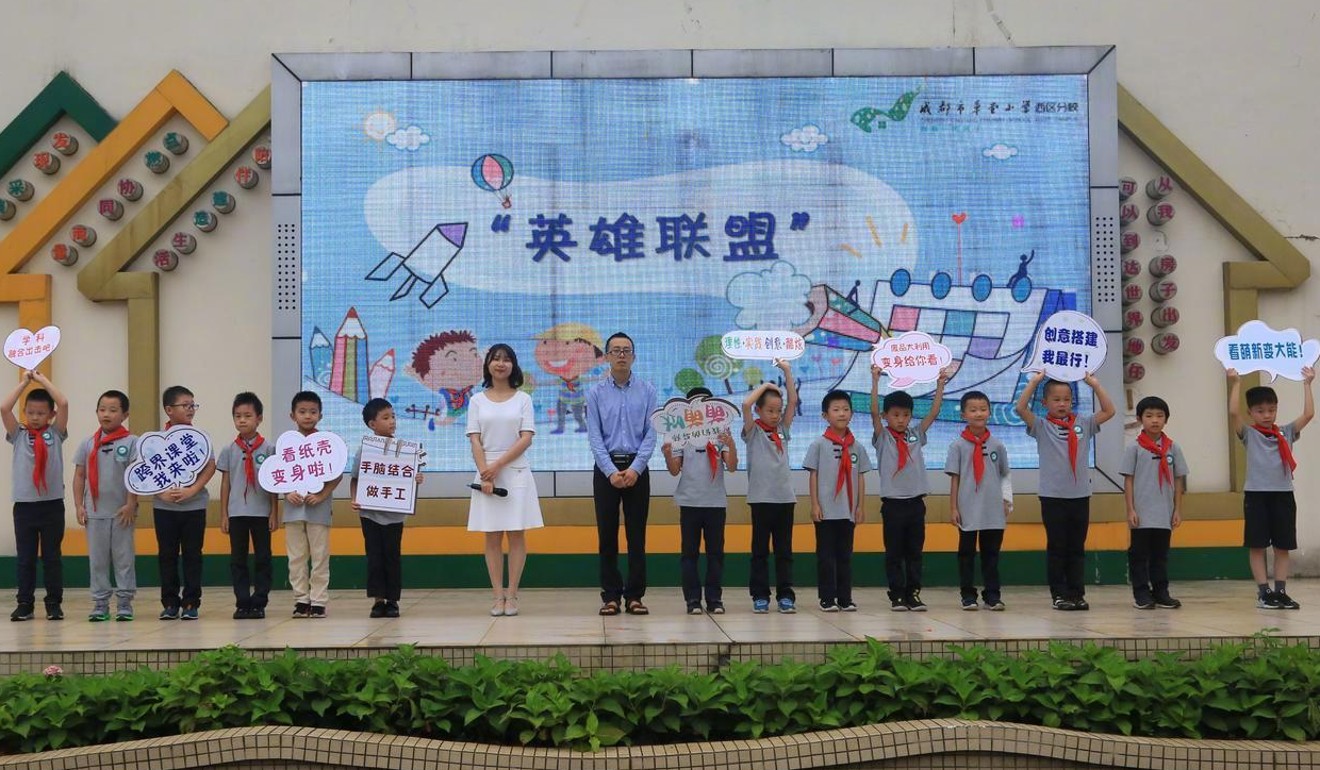
Chengdu Caotang Elementary School in Sichuan province developed a course that teaches boys to build model rockets and girls to knit alongside mainstream subjects such as maths, languages and art, in the hope of “increasing their gender knowledge”.
The course, called Boys and Girls are Vastly Different, started last semester because school managers believed that “boys and girls have been shaped in the same way recently”, principal Fu Jin told the Chengdu Economic Daily on Monday.
That “led to boys lacking enough space to grow heroically and girls lacking gentle and tranquil feminine examples to follow, so there’s some gender dislocation”, she said.
Chengdu Caotang Elementary School wants its boys to be “heroic” and its girls to be “tranquil”. Photo: Weibo
Last semester, pupils learned the differences between female and male bodies. This semester, boys are learning how to build model planes, rockets and cars, while the girls are being taught knitting by teachers and mothers who volunteer to help out in classes.
On Monday, a show of handicrafts and jumpers hosted by the school to promote the class led to a backlash on social media, with members of the public criticising the school for sexism and enforcing gender stereotypes.
“They are tying the hands of girls when young, and when these girls grow up, people would say there are only a few female scientists because girls are born unfit for that role,” a Weibo user said.
What Chinese summer camps taught teens about gender values
“It’s typical gender discrimination,” another said. “Why can’t boys knit and girls build rockets?”
Authorities cracked down on controversial classes for Chinese children after some extreme examples of gender education. In December, a Weibo account highlighted a lurid “virtue” class where a sobbing woman was seen on video confessing to teenagers at a summer camp in Wenzhou, eastern Zhejiang province that “promiscuous women got gangrene”.
“I dressed myself up in a fashionable and revealing way, and that’s an invitation for others to insult me and rape me,” she told her audience.
“Three drops of sperm are equal to poison, and they will hurt unclean women,” she said. “I’m afraid my body will rot, will stink and ache, and they’ll have to amputate my legs.”
The camp was condemned and shut down by the local government.
Source: SCMP
Posted in authorities, boys, Boys and Girls are Vastly Different, build, Chengdu, Chengdu Caotang Elementary School, Chengdu Economic Daily, Chinese school, controversial, cracked down, gangrene\, girls, grow ‘heroically’, knitting, learn about, model rockets, promiscuous women, school, semester, sexism row, sichuan province, sparks, to be ‘tranquil’, Uncategorized, Weibo, Wenzhou, zhejiang province |
Leave a Comment »
10/09/2019
- Expensive presents are officially discouraged but have become the norm at many schools on day of appreciation for educators
Students at Yangzhou Technical Vocational College form the Chinese characters for “Hello Teacher” to mark China’s Teachers’ Day. Photo: Handout
Despite a decade of official discouragement, parents in China have been struggling with one of the biggest dilemmas of the school year – how to mark the country’s annual Teacher’s Day.
Ellen Yuan agonised for a day and a night before sending her son off to kindergarten on Tuesday with a 1,000 yuan (US$140) gift card in his bag for the teacher.
It was the boy’s second week of attendance and Yuan had given no thought to any Teacher’s Day obligations –until she learned that several of her friends had been busy over the weekend preparing gifts for their children’s teachers.
“It makes me feel that I am being a drag on my son if I don’t do so,” said Yuan, who works for a foreign company in Shanghai.
Respecting teachers has traditionally been a fundamental social norm in China but gift giving on the special day for educators has gone beyond an expression of appreciation by their students, as parents have taken over with ever more expensive gifts – and sometimes cash – which they hope will mean their kids are well taken care of while at school.
What gift, how expensive it should be, and how to deliver it have become the biggest questions for many parents in the run-up to September 10 each year, even though the education ministry and its subordinate bodies have repeatedly issued directives over the past decade to ban teachers accepting gifts.
Yuan said one of her friends had bought a body care set worth more than 600 yuan for each of her child’s three teachers, another had bought an 800 yuan gift card, while a third had given the head teacher a 1,000 yuan bottle of perfume.
Some parents had delivered the presents directly to the school, while others had asked their children to take the gifts to their teachers. Yuan’s plan was to message the teacher and tell her to take the gift card from her son’s bag.
“I know it’s bad. I don’t want my kid to know that,” Yuan said.
Hundreds of teachers protest in China over poor pay
The question of whether parents should give gifts on Teacher’s Day was one of the hottest topics on Weibo, China’s Twitter-like social media platform, attracting more than 15 million views as of Tuesday afternoon.
“Of course we should not, but I don’t dare to ignore it,” one user said, winning more than 10,000 likes.
Chu Zhaohui, a researcher at the National Institute of Education Sciences, said the gift-giving trend had been partly driven by a “keeping up with the Joneses” mentality.
“Everybody has given a gift. Would my child be specially treated if I don’t? This is a common concern,” Chu said. As a result, the purpose of gift giving on Teacher’s Day had become about protecting the children’s interests instead of a sincere expression of gratitude, he said.
But not every teacher gets presents – with gifts usually reserved for those teaching the “main subjects” of mathematics, Chinese and English, which count the most in high school and college entrance examinations.
Emily Shen, an English teacher from a middle school in Hangzhou, in the eastern province of Zhejiang, said she also prepared gifts for the teachers of her two kids. “Some chocolate for them to take to school. And I myself would give a gift card to each of those who teach the main subjects,” she said.
Zhuang Ke, a music teacher at a primary school in Jiaxing, also in Zhejiang province, admitted she was embarrassed by the parents’ different treatment of teachers of “less important” subjects like her’s. “It’s always nice to receive presents. But teachers who teach music, art and PE are often forgotten,” she said.
Chinese kindergarten teacher fired for hot sun punishment
State broadcaster CCTV said in a commentary on its website on Sunday that “all forms of behavior that attempt to ruin normal teaching order and interfere in equality by sending gifts should be resolutely abandoned”. A similar message was run by a series of official media outlets at local level.
“The most fundamental way to stop parents from sending gifts is to treat the students equally and fairly every day, so that parents conclude it makes no difference whether they give a gift,” Rednet.cn, the official news portal of Hunan province, said on Monday.
Although some teachers have made it explicit to students that they will refuse presents on Teacher’s Day, Yuan said her son’s teacher accepted the gift, as did the teachers of her three friends’ children.
Source: SCMP
Posted in Art, bag, body care set, bottle of perfume, Chinese, chinese parents, Chocolate, college entrance examination, commentary, day of appreciation, discouraged, educators, English, Expensive presents, fired, foreign company, forgotten, fundamental way, gift card, gift etiquette, Hangzhou, High school, hot sun punishment, Hunan Province, Jiaxing, keeping up with the Joneses, kindergarten, mathematics, mentality, middle school, music, music teacher, National Institute of Education Sciences, norm, official news portal, officially, PE, poor pay, primary school, Protest, Rednet.cn, schools, Shanghai, sincere expression of gratitude, state broadcaster CCTV, struggle, teacher, Teacher’s Day, Uncategorized, website, Weibo, Yangzhou Technical Vocational College, zhejiang province |
Leave a Comment »
06/09/2019
- Material that generates heat from sunlight could provide self-maintaining water supply on remote islands
An international research team used solar power to generate a supply of drinking water. Photo: Chinese Academy of Sciences
A Chinese-led international research team has created a “tree” that can generate clean drinking water.
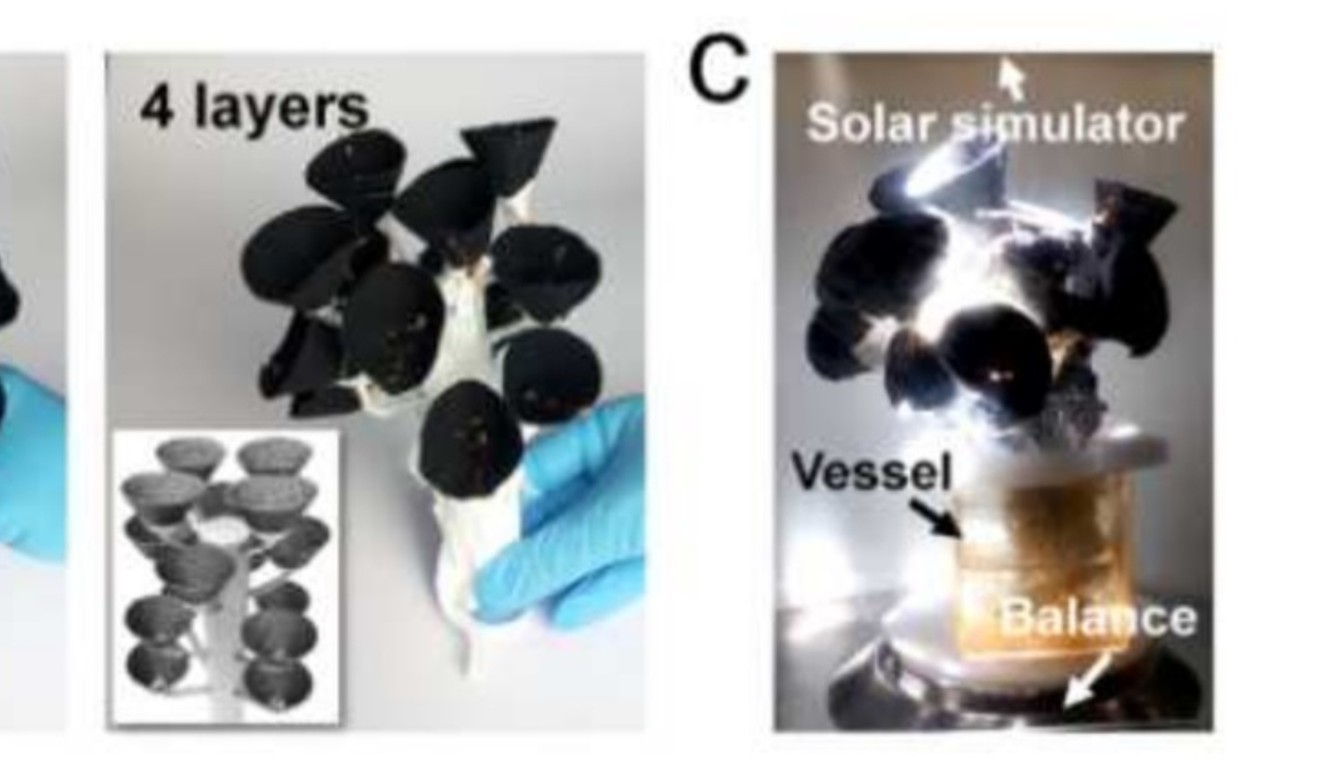
Drawing its energy entirely from the sun just like a real tree, the “water tree” has a root made of cotton fabric that can absorb water from its surroundings, such as from sand on a beach.
After water moves up the stem, it is vaporised by “leaves” made of black-carbon paper cones that convert light energy to heat, reaching nearly 50 degrees Celsius (122 Fahrenheit). The tree sits in a glass chamber with a relatively cool surface that collects the vapour.
Using standard cotton fabric and a new nanomaterial that can be cheaply mass-produced from charcoal, a paper cone with a surface area as large as 1 square metre would cost only US$2, according to the researchers.
The cones, which function like leaves, could be mass-produced cheaply, researchers say. Photo: Chinese Academy of Sciences
A cone that size can generate up to 3.4kg (7.5lbs) of condensed water per hour, faster than any other solar-powered desalination methods previously reported.
Even on a cloudy day, the total output in seven hours of sunlight can reach 5.4kg, or three times the amount the typical adult needs to stay hydrated.
One tree can have multiple layers of branches, each with several cones to increase the vapour-producing surface area.
The study, published this month in the journal Nano Energy, was led by Professor Chen Tao at the Chinese Academy of Sciences’ Ningbo Institute of Material Technology and Engineering in Zhejiang province, and also involved researchers from Singapore and Taiwan.
World’s thirst for fresh water is causing a big toxic problem
One of the paper’s co-authors, Dr Ouyang Jianyong, associate professor at the National University of Singapore’s department of materials science and engineering, told the South China Morning Post that the technology could be applied in remote places such as on islands in the South China Sea.
“It is particularly useful for isles far away without a stable drinking water supply,” Ouyang said. “These ‘trees’ may not be able to quench the thirst of a large city, but they can meet the critical demand of a small community, especially in emergencies.
“We are already in contact with some companies [to commercialise the technology],” he added.
The material used to make the cone has several advantages, according to Ouyang. The cones can absorb a wide spectrum of sunlight, maximising the amount of energy they can collect, and their porous structure allows them to release vapour quickly.
Lawmakers endorse plan for HK$7.7 billion desalination plant
When used to desalinate a supply of seawater, the trees would be self-cleaning at night, by water washing away salt residue without being vaporised as it would during sunlight hours.
The vapour-producing fabric is as thin and lightweight as a few sheets of paper. It can be folded and sewn into almost any shape, or cleaned in a washing machine, and can operate effectively for several years in a harsh environment, the researchers say.
The condensed water meets stringent safety standards for direct drinking set by the World Health Organisation, according to the researchers.
Source: SCMP
Posted in Chinese Academy of Sciences, cleaned, department of materials science and engineering, desalinate, desalination plant, Drinking water, lawmakers, Nano Energy, National University of Singapore, night, Ningbo Institute of Material Technology and Engineering, paper, remote islands, sea, Seawater, self-cleaning, self-maintaining water supply, sewn, shape, sheets, Singapore, solar-powered ‘tree’, solar-powered desalination methods, south china morning post, South China Sea, Taiwan, turns, Uncategorized, vapour-producing fabric, washing machine, World Health Organisation, zhejiang province |
Leave a Comment »
04/09/2019
- Two classrooms on Nanjing campus were chosen for pilot project
- Camera automatically captures students’ faces without their cooperation
Students pass through a facial recognition turnstile at China Pharmaceutical University in Nanjing. Photo: Weibo
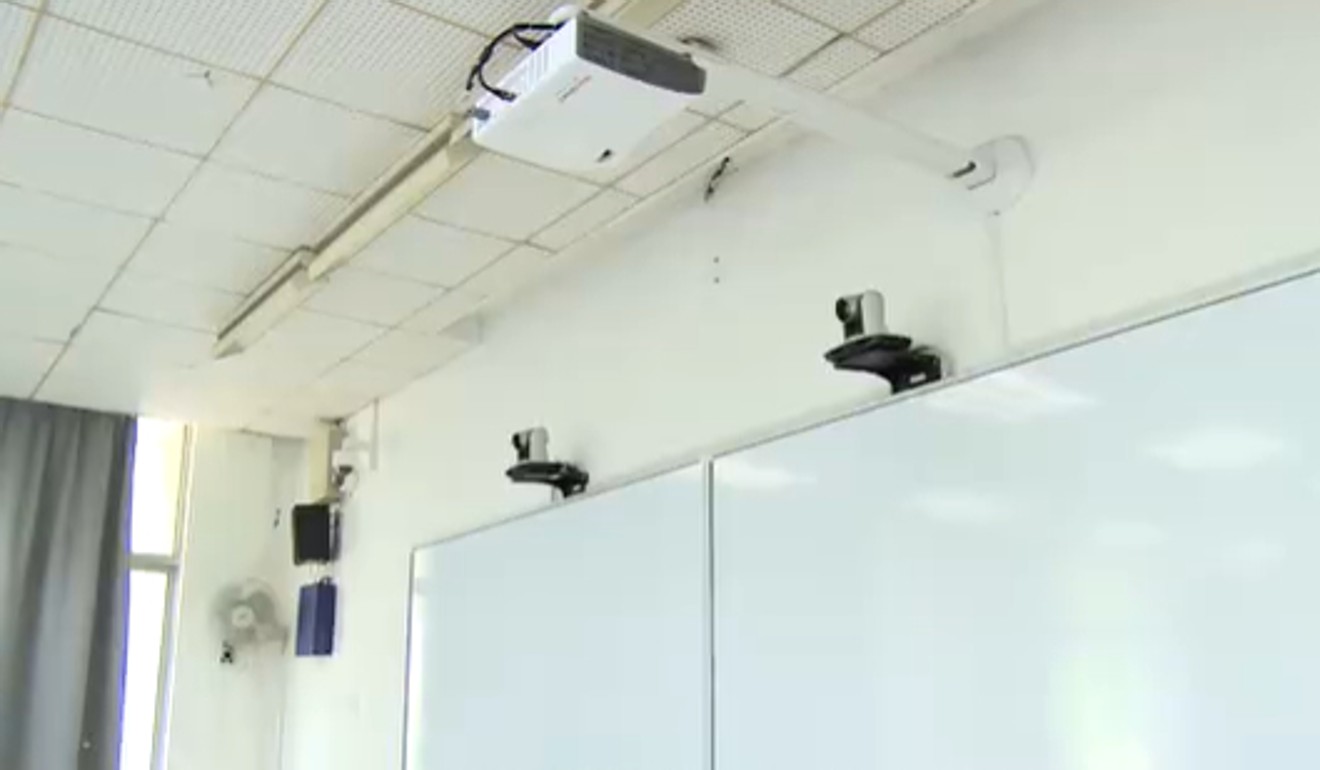
A university in eastern China has installed a facial recognition system at its entrance and in two classrooms to monitor the attendance and behaviour of students.
China Pharmaceutical University in Nanjing, Jiangsu province, announced on its website on Thursday that it was one of the first higher education institutions in the country to put such a system in place.
“It can effectively solve the management difficulties and low efficiencies in a traditional attendance system, and make it easier for managers to track their students,” Xu Jianzhen, director of the university’s library and information centre, told news website Thepaper.cn
In a pilot project, two classrooms were equipped with an attendance system using facial recognition software, with a camera that automatically captured the faces of students in class without their cooperation, the university said.
“Besides attendance, the system installed in the classroom can provide surveillance of the students’ learning, such as whether they are listening to the lectures, how many times they raise their heads, and whether they are playing on their phones or falling asleep,” Xu told the news website.
“The school is taking action to cut down on students skipping class, leaving classes early, paying for a substitute to attend classes for them and not listening in class,” he said.
The plan was not well received online, with some critics raising privacy concerns for staff and students.
Why are Hong Kong protesters targeting lamp posts?
“What kind of talent are they trying to cultivate?” a user of the Twitter-style Weibo network asked. “I’ve never seen such a method.”
Another wrote: “If this system was being installed in Europe or America, they’d be sued and the school would have to close down.”
But Xu said the university had consulted the police and sought legal advice, and was told the system would not be considered an invasion of privacy as classrooms were public spaces.
“You are complaining about [a system] that’s meant to urge you to learn? Are you a student?” he told the news website.
A spokesman said China Pharmaceutical University was using a facial recognition system to improve class attendance. Photo: Weibo
The university would seek feedback from teaching staff before deciding whether to install facial recognition systems in all of its classrooms, according to the report.
In May last year, a school in Hangzhou, Zhejiang province, installed cameras to monitor pupils’ facial expressions and attentiveness in class as part of a “smart classroom behaviour management system” to give teachers real-time information on their students.
Elsewhere, facial recognition has been used to catch unlicensed drivers in the southern technology hub of Shenzhen, jaywalkers in Shanghai, and criminal suspects at public events across China.
Source: SCMP
Posted in America, attendance, attentiveness, automatically captures, Camera, China alert, China Pharmaceutical University, Chinese university, consulted, cooperation, criminal suspects, Europe, facial expressions, Facial recognition system, Hangzhou, invasion of privacy, jaywalkers, jiangsu province, legal advice, library and information centre, Nanjing, pilot project, Police, public events, Shanghai, Shenzhen, students’ faces, sued, Thepaper.cn, Uncategorized, university, unlicensed drivers, website, Weibo, without, zhejiang province |
Leave a Comment »











 CHINDIA ALERT: You'll be living in their world, very soon
Chinese parents struggle with Teacher’s Day gift etiquette
Despite a decade of official discouragement, parents in China have been struggling with one of the biggest dilemmas of the school year – how to mark the country’s annual Teacher’s Day.
Ellen Yuan agonised for a day and a night before sending her son off to kindergarten on Tuesday with a 1,000 yuan (US$140) gift card in his bag for the teacher.
It was the boy’s second week of attendance and Yuan had given no thought to any Teacher’s Day obligations –until she learned that several of her friends had been busy over the weekend preparing gifts for their children’s teachers.
“It makes me feel that I am being a drag on my son if I don’t do so,” said Yuan, who works for a foreign company in Shanghai.
Respecting teachers has traditionally been a fundamental social norm in China but gift giving on the special day for educators has gone beyond an expression of appreciation by their students, as parents have taken over with ever more expensive gifts – and sometimes cash – which they hope will mean their kids are well taken care of while at school.
What gift, how expensive it should be, and how to deliver it have become the biggest questions for many parents in the run-up to September 10 each year, even though the education ministry and its subordinate bodies have repeatedly issued directives over the past decade to ban teachers accepting gifts.
Yuan said one of her friends had bought a body care set worth more than 600 yuan for each of her child’s three teachers, another had bought an 800 yuan gift card, while a third had given the head teacher a 1,000 yuan bottle of perfume.
Some parents had delivered the presents directly to the school, while others had asked their children to take the gifts to their teachers. Yuan’s plan was to message the teacher and tell her to take the gift card from her son’s bag.
“I know it’s bad. I don’t want my kid to know that,” Yuan said.
But not every teacher gets presents – with gifts usually reserved for those teaching the “main subjects” of mathematics, Chinese and English, which count the most in high school and college entrance examinations.
Emily Shen, an English teacher from a middle school in Hangzhou, in the eastern province of Zhejiang, said she also prepared gifts for the teachers of her two kids. “Some chocolate for them to take to school. And I myself would give a gift card to each of those who teach the main subjects,” she said.
Zhuang Ke, a music teacher at a primary school in Jiaxing, also in Zhejiang province, admitted she was embarrassed by the parents’ different treatment of teachers of “less important” subjects like her’s. “It’s always nice to receive presents. But teachers who teach music, art and PE are often forgotten,” she said.
Chinese kindergarten teacher fired for hot sun punishment
State broadcaster CCTV said in a commentary on its website on Sunday that “all forms of behavior that attempt to ruin normal teaching order and interfere in equality by sending gifts should be resolutely abandoned”. A similar message was run by a series of official media outlets at local level.
“The most fundamental way to stop parents from sending gifts is to treat the students equally and fairly every day, so that parents conclude it makes no difference whether they give a gift,” Rednet.cn, the official news portal of Hunan province, said on Monday.
Although some teachers have made it explicit to students that they will refuse presents on Teacher’s Day, Yuan said her son’s teacher accepted the gift, as did the teachers of her three friends’ children.
Source: SCMP
Posted in Art, bag, body care set, bottle of perfume, Chinese, chinese parents, Chocolate, college entrance examination, commentary, day of appreciation, discouraged, educators, English, Expensive presents, fired, foreign company, forgotten, fundamental way, gift card, gift etiquette, Hangzhou, High school, hot sun punishment, Hunan Province, Jiaxing, keeping up with the Joneses, kindergarten, mathematics, mentality, middle school, music, music teacher, National Institute of Education Sciences, norm, official news portal, officially, PE, poor pay, primary school, Protest, Rednet.cn, schools, Shanghai, sincere expression of gratitude, state broadcaster CCTV, struggle, teacher, Teacher’s Day, Uncategorized, website, Weibo, Yangzhou Technical Vocational College, zhejiang province | Leave a Comment »