Chindia Alert: You’ll be Living in their World Very Soon
aims to alert you to the threats and opportunities that China and India present. China and India require serious attention; case of ‘hidden dragon and crouching tiger’.
Without this attention, governments, businesses and, indeed, individuals may find themselves at a great disadvantage sooner rather than later.
The POSTs (front webpages) are mainly 'cuttings' from reliable sources, updated continuously.
The PAGEs (see Tabs, above) attempt to make the information more meaningful by putting some structure to the information we have researched and assembled since 2006.
GUIYANG, July 14 (Xinhua) — A completion ceremony for a new “Red Army Bridge” was hosted this week amid a cheerful tutti of gongs and drums in a small village in Liping County of southwest China’s Guizhou Province.
Shangshaozhai Village, with hundreds of years of history, was once separated from the outside world by a raging river. The only way leading outward was by boat.
Everything changed however in December 1934, when the passing-by Red Army built a wooden bridge together with local villagers.
From October 1934 to October 1936, the Red Army, the forerunner of the People’s Liberation Army (PLA), carried out a daring military maneuver that laid the foundation for the eventual victory of the Communist Party of China.
The Red Army marched through raging rivers, snowy mountains and arid grasslands to break the Kuomintang regime’s grip on the country and to continue their fight against Japanese invaders. Some of them marched as far as 12,500 km, enduring hunger, thirst and cold.
Wu Xiyan, 68, said his uncle was among the villagers who cooperated with the Red Army in building the bridge.
“They brought out all the available timber at home, and many of the villagers even volunteered to provide their bed and door boards,” said Wu. “The village truly needed a bridge.”
The bridge deck, one meter wide, is comprised of over 90 pieces of wooden boards. To commemorate the close relations between the Red Army and the local people, it was named “Red Army Bridge.”
Over 80 years on, the bridge remained the solitary channel for more than 600 villagers to exit and enter the village. Despite careful maintenance, it struggled to deal with the strain of local traffic.
Having learned the stories behind the bridge, in September 2017, Sinopec, a major Chinese state-owned enterprise, donated 1.8 million yuan (261,400 U.S. dollars) to build a new bridge for the village.
The new bridge, 4.5 meters wide, enables cars to drive across, with a weight capacity up to 20 tons.
Also named “Red Army Bridge,” the new bridge echoes its predecessor at a distance of 85 years and 50 meters.
The Red Army spirit is a treasure that the village has valued over all these years, said Wu, adding the village has done its best to preserve the old bridge over the years.
In 2012, a former Red Army member, over 90 years old, came to visit the bridge from eastern Zhejiang Province, Wu recalled.
He said the bridge looked exactly the same as what he saw in 1935, according to Wu.
“My uncle once told me the Red Army, passing by Shangshaozhai, promised that a better village would be built for us in the future,” Wu said.
“Over the course of my lifetime, I have been a constant witness to the fulfillment of this serious promise,” Wu said.
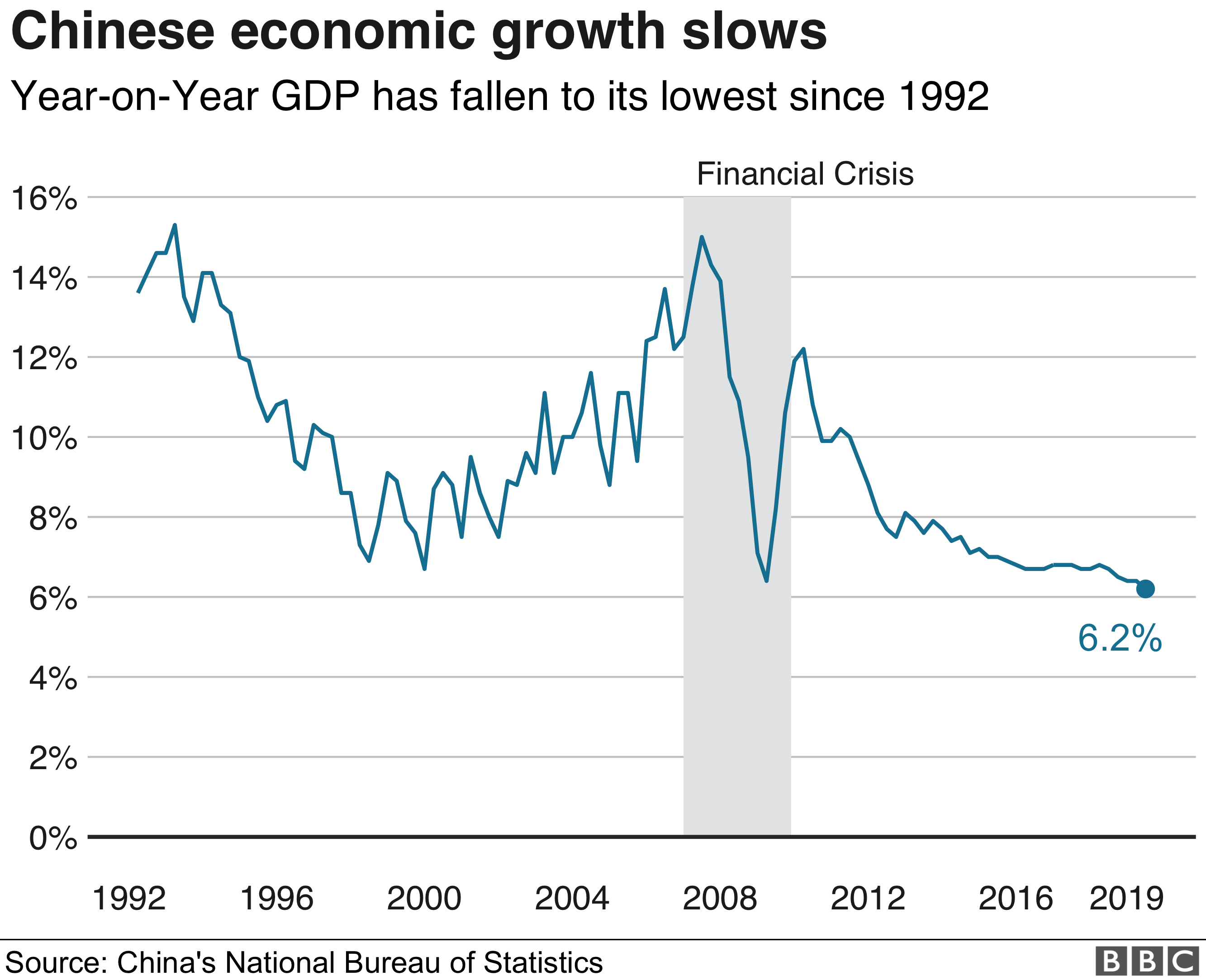
It said the economy had “performed within the reasonable range” in the first half of 2019 but that it faced “new downward pressure”.
While China watchers advise caution with Beijing’s official gross domestic product numbers, the data is seen as a useful indicator of the country’s growth trajectory.
Other data showed some signs of improvement in the world’s second largest economy.
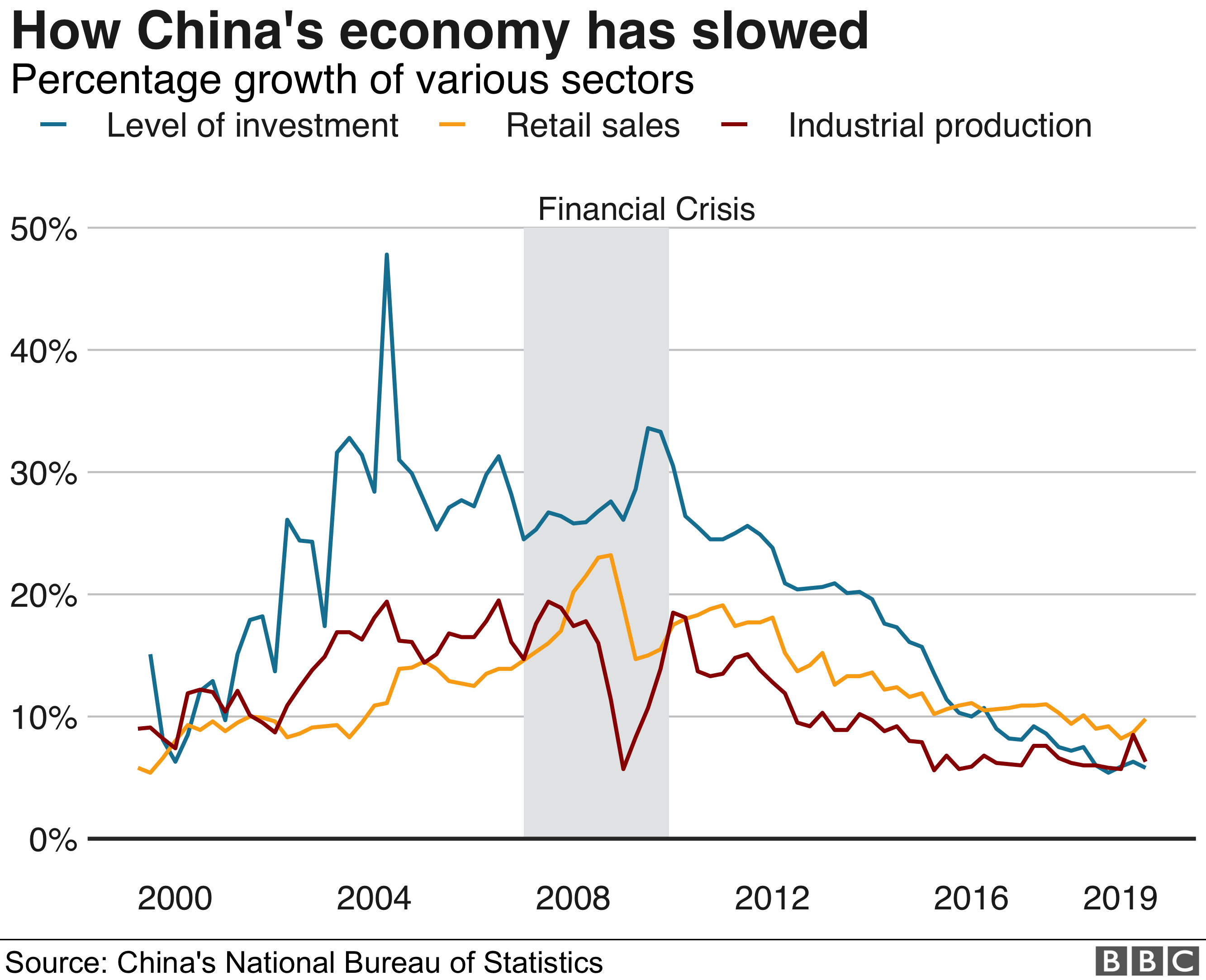
Industrial production rose 6.3% in June from a year earlier, while retail sales rose 9.8% year-on-year – both above forecasts in Reuters polls.
Global impact
Slowing growth in China has raised concerns about the potential knock-on effect on the global economy.
Earlier this year Beijing announced plans to boost spending and cut billions of dollars in taxes in an effort to support the economy.
It has also moved to provide a liquidity boost by reducing the amount of cash banks must hold in reserve.
Edward Moya, senior market analyst at Oanda, said the latest economic data “shows the slowdown remains intact and markets should expect further stimulus” from China’s central bank later this year.
The US-led trade war is another factor weighing on growth.
“The trade war is having a huge impact on the Chinese economy, and with no end sight as trade negotiations struggle for meaningful progress, we are probably not near the bottom for China’s economy,” he said.
While both sides agreed to resume trade talks at a recent G20 summit in Japan, they have already placed tariffs on billions of dollars worth of one another’s goods, hurting businesses and casting a shadow over the world economy.
The chief of the Indian Space Research Organisation (Isro), K Sivan, said this was “the most complex space mission ever to be undertaken by the agency”.
If the launch had gone to plan, the lander and rover would have been expected to touch down in early September.
India’s space agency is yet to give more details on why the launch was delayed and how it will affect the timeline.
The country’s first lunar mission in 2008 – Chandrayaan-1 – did not land on the lunar surface, but it carried out the first and most detailed search for water on the Moon using radars.
How will it get to the Moon?
Chandrayaan-2 (Moon vehicle 2) will attempt a soft landing near the little-explored south pole of the Moon.
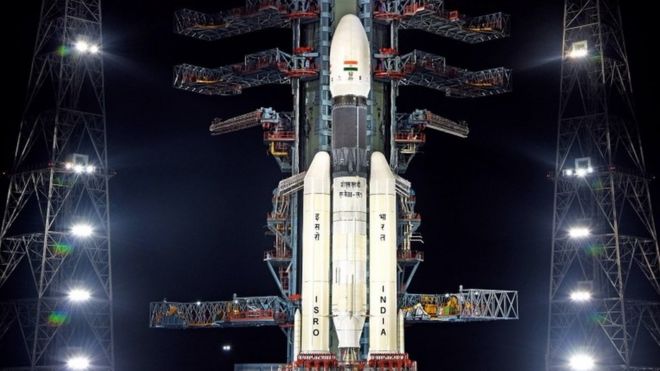
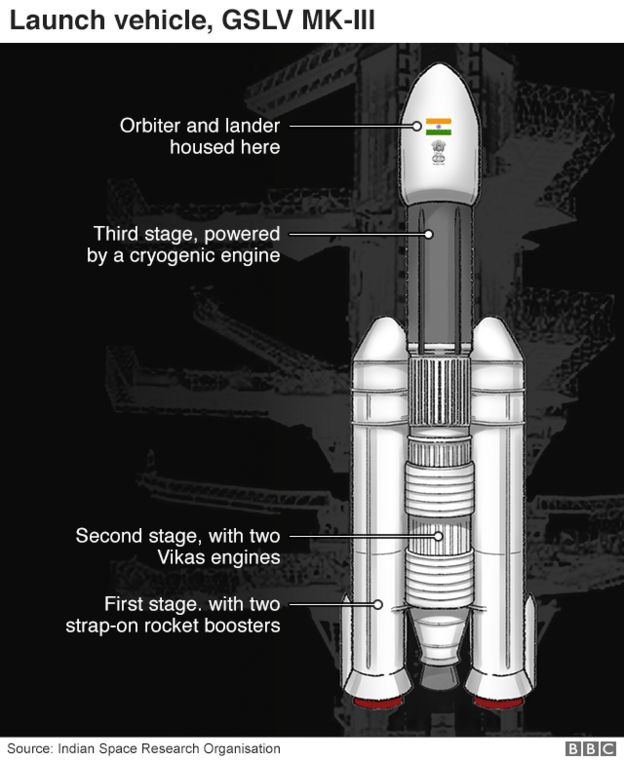
India is using its most powerful rocket, the Geosynchronous Satellite Launch Vehicle Mark III (GSLV Mk-III), in this mission. It weighs 640 tonnes (almost 1.5 times the weight of a fully-loaded 747 jumbo jet) and at 44 metres (144ft) is as high as a 14-storey building.
The spacecraft weighs 2,379kg (5,244lb) and has three distinct parts: an orbiter, a lander and a rover.
The orbiter, which has a mission life of a year, will take images of the lunar surface, and “sniff” the tenuous atmosphere.
The lander (named Vikram, after the founder of Isro) weighs about half as much, and carries within its belly a 27kg Moon rover with instruments to analyse the lunar soil. In its 14-day life, the rover (called Pragyan – wisdom in Sanskrit) can travel up to a half a kilometre from the lander and will send data and images back to Earth for analysis.
“India can hope to get the first selfies from the lunar surface once the rover gets on its job,” Dr Sivan said.
A new frontier for India’s space programme
By science writer Pallava Bagla
A soft landing on another planetary body – a feat achieved by just three other countries so far – would be a huge technological achievement for Isro and India’s space ambitions.
It would pave the way for future Indian missions to land on Mars and an asteroid. More importantly, it would open up the possibility of India sending astronauts to the Moon. India hopes to carry out a crewed space flight by 2022.
India also wants to assert itself as a space power to be reckoned with – and national pride is riding high as it aims to hoist its flag on the surface of the Moon.
A successful mission to the Moon would also be a win for India’s ambitious space agency, which has had a string of successes recently.
Media caption Is India a space superpower?
In 2014, it successfully put a satellite into orbit around Mars, becoming only the fourth nation to do so. In 2017, India created history by successfully launching 104 satellites on a single mission, overtaking the previous record of 37 satellites launched by Russia in 2014.
All eyes are on Isro again. Global interest in India’s frugal Moon mission is peaking, according to Simonetta Di Pippo, director of the UN office of Outer Space Affairs.
“The mission’s studies of lunar topography, mineralogy, elemental abundance, the lunar exosphere, and signatures of hydroxyl and water ice will contribute to scientific progress for all of humankind,” she says.
The Indian space community is nervous and Dr Sivan says “there is churning in his stomach”.
“Unknown-unknowns can kill a mission, [although] no stone has been left unturned to understand all the complexities”.
How long is the journey to the Moon?
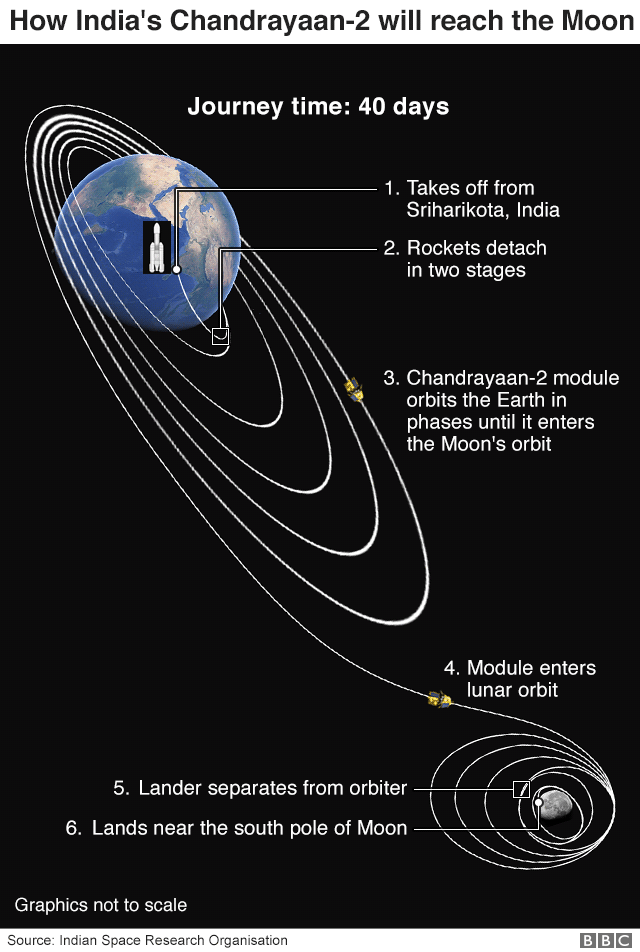
The launch is only the beginning of a 384,000km (239,000-mile) journey – the robotic craft is expected to land on the Moon some 54 days later.
Isro chose a circuitous route to take advantage of the Earth’s gravity, which will help slingshot the satellite towards the Moon. India does not have a rocket powerful enough to hurl Chandrayaan-2 on a direct path.
“There will be 15 terrifying minutes for scientists once the lander is released and is hurled towards the south pole of the Moon,” Dr Sivan says.
He explains that those who had been controlling the spacecraft until then will have no role to play in those crucial moments. The actual landing, he adds, is an autonomous operation dependent on all systems performing as they should. Otherwise, the lander could crash into the lunar surface.
Earlier this year, Israel’s first Moon mission crash-landed while attempting to touch down.
Who is on the team?
Nearly 1,000 engineers and scientists have worked on this mission. But for the first time, Isro has chosen women to lead an interplanetary expedition.
Two women are steering India’s journey to the Moon. While programme director Muthaya Vanitha has nurtured Chandrayaan-2 over the years, it will be navigated by Ritu Karidhal.
“Women power is powering India’s Moon ambitions,” Dr Sivan said, adding that at Isro, “women and men are all equal. Only talent matters – not the gender.”
The Indian prime minister refused to back the Chinese leader’s ambitious global infrastructure vision at a summit last week, but the apparent snub is not getting in the way of amicable ties between Asia’s two biggest economies
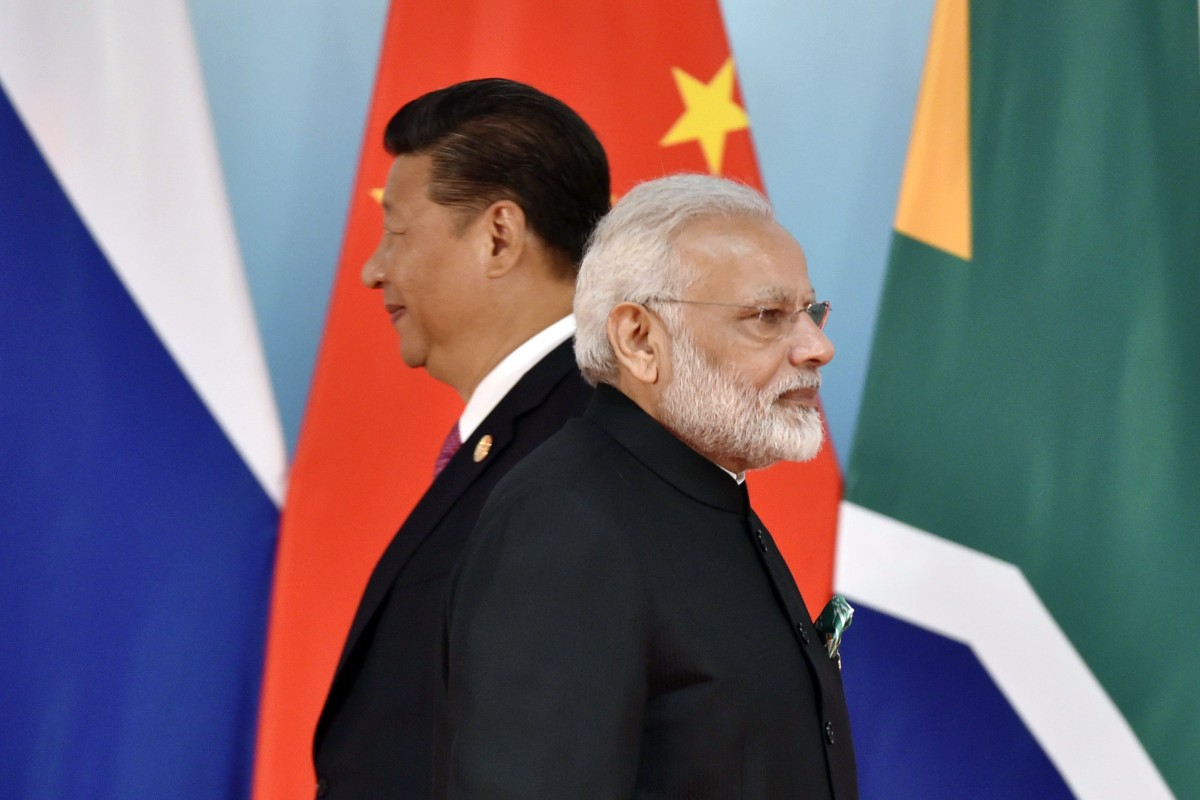
Chinese President Xi Jinping and Indian Prime Minister Narendra Modi at the BRICS Summit at the Xiamen International Conference and Exhibition Center in 2017. Photo: AFP
Their informal summit in Wuhan last year created all the right optics; even their chemistry seemed on point. So, when
met last week on the sidelines of the Shanghai Cooperation Organisation (SCO), the bonhomie seemed like it was there to stay.
But a day later, cracks appeared to emerge. India, holding on to its long-stated position, delivered a public snub to China by refusing to endorse its ambitious, trillion-dollar
in Osaka, there have been increasing signs that both countries may now be trialling a fresh approach to diplomacy – one that neither sidesteps contentious issues nor does it allow differences to derail ties.
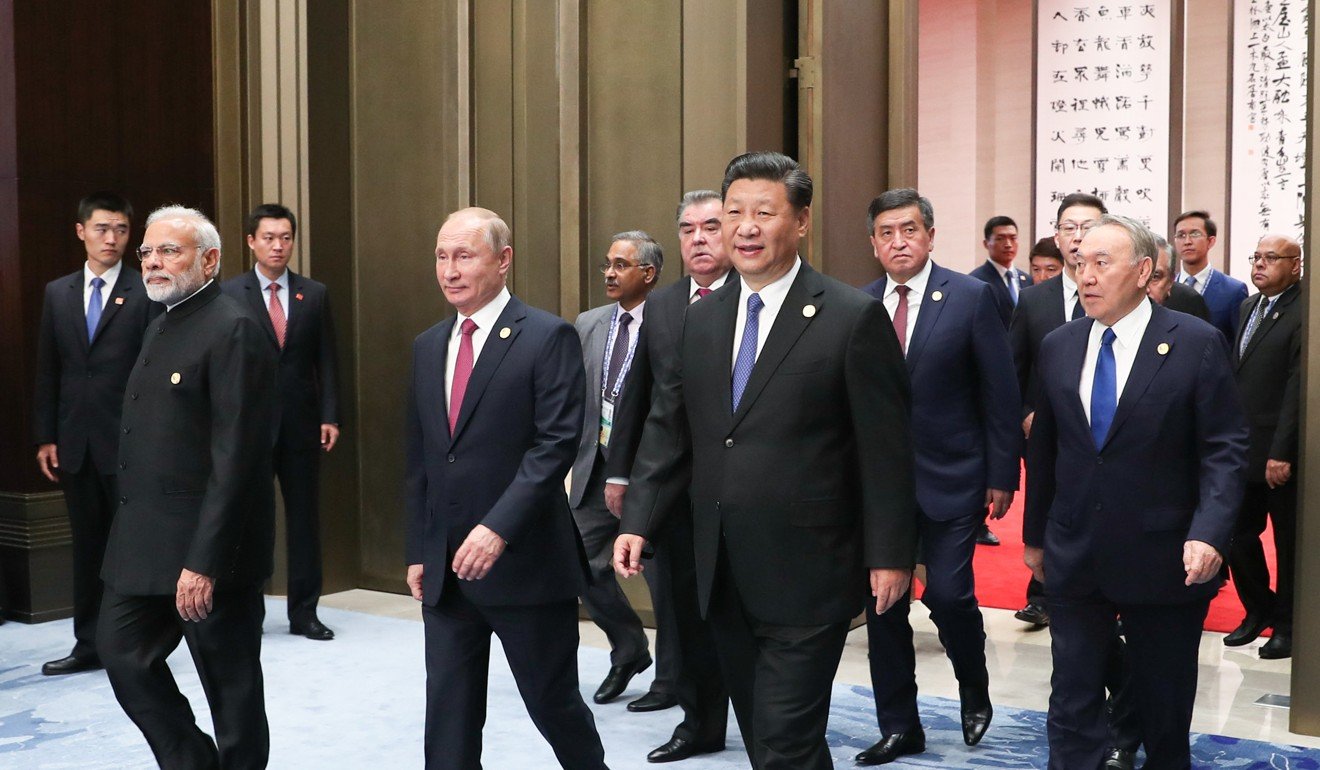
Chinese President Xi Jinping leads other leaders of Shanghai Cooperation Organisation: Russia’s Vladimir Putin and India’s Narendra Modi at the 2018 summit. Photo: Xinhua
Such an approach would delink the thorny issues – like the
was expected to scrap plans to build jointly with China an ocean observatory overlooking the Indian Ocean. The news came a week after Modi had visited the Maldives capital Male in early June.
For Modi 2.0, India’s US-China balancing act just got trickier
The Maldives’ decision to build the observatory was first mulled in December 2017, raising the Indian establishment’s hackles as it would have given China a presence in the region.
Another irritant between India and China has seemed to be the proposed 16-nation
(RCEP). India has been lukewarm on the free-trade bloc, frustrating the Chinese. Indications have been that China is likely to push for a 13-member bloc at the coming RCEP meeting in Thailand on June 20, excluding India.
BRI and border issues have not managed to overshadow the remaining business between the two countries Narayani Basu
Yet, despite all this, there has been no let down in engagement levels between Modi and Xi. Both leaders are expected to meet at the RIC summit on June 29 to 30, and have at least two more meetings planned this year alone – an informal Xi-Modi summit in India
in October and the BRICS summit on November 13 to 14.
For Narayani Basu, a New Delhi-based author and independent foreign policy analyst with a special focus on China, such sustained engagement between the two countries signals a new level of maturity.
“There has been a fairly successful attempt at delinking historical geopolitical and territorial issues from issues which are economic in nature,” Basu said. “As a result, the BRI and border issues have not managed to overshadow the remaining business between the two countries.”
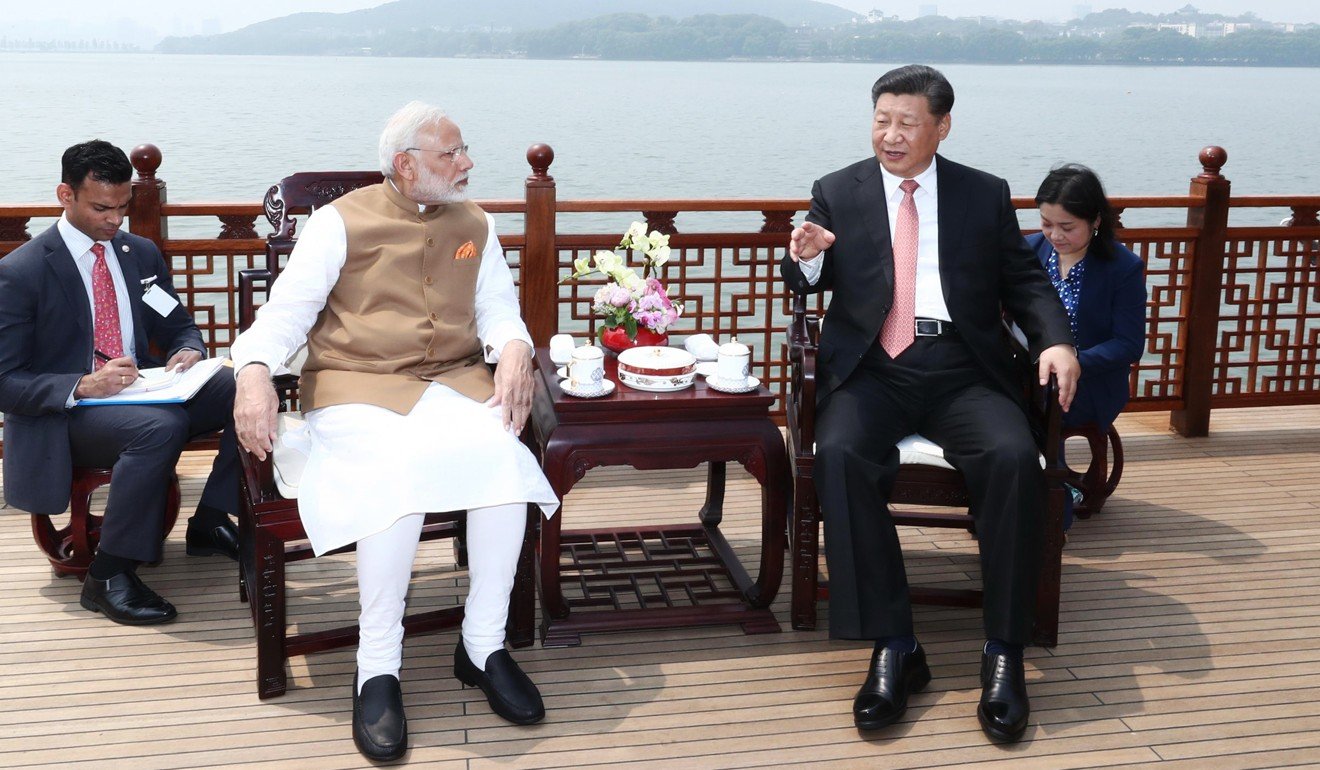
Indian Prime Minister Narendra Modi speaks with Chinese President Xi Jinping in Wuhan. Photo: Xinhua
STRONG LEADERS, STRONGER AGENDAS
The approach might also have to do with where both leaders currently stand.
Modi and his Bharatiya Janata Party (BJP) have freshly emerged from a landslide
. Through the campaign, Modi portrayed a hardline image of himself and his government, especially on issues of national security. Similarly, Xi has emerged as a stronger leader since his reappointment last year – his approach marked by a higher-than-ever emphasis on economic nationalism and connectivity. Modi made a reference to this in his SCO meeting with Xi.
Basu said Sino-India ties were also being guided by the personalities of both leaders – strong, with harder-than-before agendas.
Did Japan and India just launch a counter to belt and road?
“They both came back on agendas based on consolidation of power, protection of sovereignty and nationalism. These are all issues that will not allow either side to blink easily. “So, even as both leaders are looking to move forward, they also do not want to compromise on their core issues – primary among them being territorial sovereignty,” she said.
The message is loud – India’s opposition to the BRI does not mean India will allow adversarial relations to develop between the two Sana Hashmi
In his SCO summit speech, Modi brought up territorial sovereignty as a thinly veiled reference to China’s BRI, saying India only supported connectivity projects that are based on “respect of sovereignty” and “regional integrity”.
Sana Hashmi, an analyst with Perth-based think tank Future Directions International and author of China’s Approach Towards Territorial Disputes: Lessons and Prospects, agreed that India was not letting historical issues get in the way of its relationship with Beijing.
Hashmi noted that India’s main objections to BRI revolved around one component – the China-
Economic Corridor (CPEC), which runs through the disputed region of Kashmir.
“But to make sure this does not affect the relationship, PM Modi and President Xi are meeting numerous times,” Hashmi said. “The message is loud – India’s opposition to the BRI does not mean India will allow adversarial relations to develop between the two.”
A NEED FOR EACH OTHER
Another factor that has likely prompted the new approach between India and China is their need for each other, particularly as both Asian powers navigate bumpy relationships with US under
and is reeling from the tariffs imposed on Chinese imports to America. India, too, has seen a similar but smaller version of this trade battle play out – things have escalated especially since the Trump administration withdrew its preferential trade treatment towards India. Responding to this, India imposed tariffs on 28 US products over the weekend.
Move over, ‘Made in China’. It’s ‘Made in Bangladesh’ era now
In such a context, a stronger relationship between the two Asian giants might be in mutual interest.
Basu said the scope for the relationship to deliver on, especially economically, is vast.
“Despite the chemistry, India and China’s promises to each other on the economic front haven’t materialised on the ground. Major projects as well as investments in each country are stuck.”
Indonesian finance minister working on loan structure and criteria
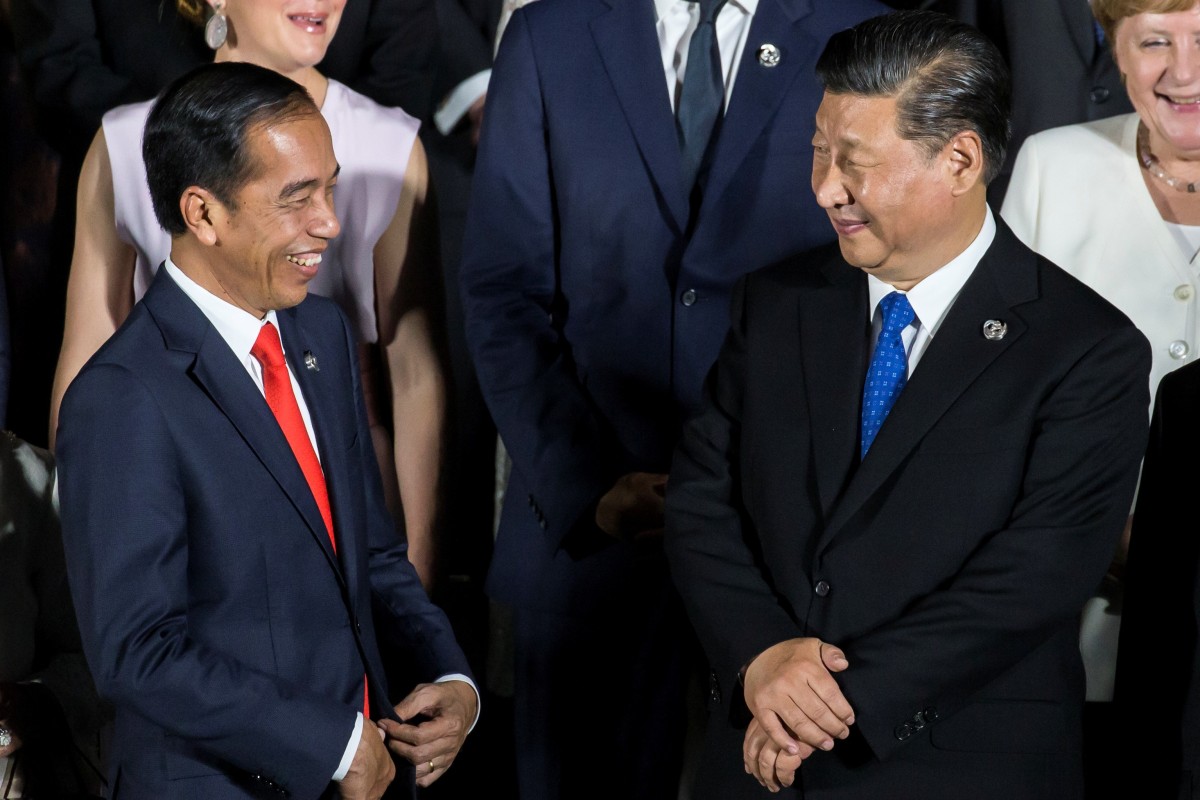
Indonesian President Joko Widodo asked Chinese President Xi Jinping for a special belt and road fund at the G20 summit in Osaka last week. Photo: Reuters
Indonesia has asked China to set up a special fund within its Belt and Road Initiative for investment in Southeast Asia’s biggest economy, after offering China projects worth US$91 billion, Indonesian government officials said on Wednesday.
Indonesia has not been among the biggest beneficiaries of China’s trillion-dollar push to create a modern-day Silk Road.
Indonesia says this is because it has insisted that any loan within the initiative’s framework is done on a business-to-business basis to avoid exposing the government in case of default.
Indonesian President Joko Widodo made the request for a special fund during a meeting with Chinese President Xi Jinping on the sideline of the Group of 20 summit in Japan last week, Indonesia’s Finance Minister Sri Mulyani Indrawati said.
Japan still leads in Southeast Asia infrastructure race, even as China ramps up belt and road investments: report
Indrawati said she had been given the responsibility of coming up with the fund’s structure, including a proposal to China on the size of the fund and the criteria for loans from it.
“I am currently doing a study about its form, its mechanism, the size of it and of course the consequences of its costs,” she said.
Luhut Pandjaitan, coordinating minister for maritime affairs, said separately the fund should provide loans “with low interest in regards to investment in Indonesia, in partnership with Indonesian companies”.
Pandjaitan, who oversees belt and road projects in Indonesia, previously said the Indonesian government had offered China involvement in about 30 projects, worth US$91 billion, during the second Belt and Road Forum in April.
The most high-profile belt and road venture in Indonesia is a US$6 billion high-speed rail project connecting the capital, Jakarta, to the textile hub of Bandung, awarded to a consortium of Chinese and Indonesian state firms in 2015.
China expert lays out trillion yuan nuclear path for belt and road plan
The project has faced land ownership issues.
Another controversial project is a US$1.5 billion hydropower plant, funded by Chinese banks and being built by the Chinese state firm Sinohydro, in the heart of the Batang Toru rainforest on the island of Sumatra, which is home to the endangered Tapanuli orangutans.
Agus Djoko Ismanto, an executive of the power plant developer PT North Sumatra Hydro Energy, on Wednesday denied disrupting the orangutan habitat. He said 11 per cent of the construction had been completed and it was due to begin operation by 2022.
Court revokes licence for coal-fired power plant in Kenyan town whose Unesco World Heritage status is at stake
Beijing’s efforts to cut emissions domestically coincide with coal-financing ventures overseas
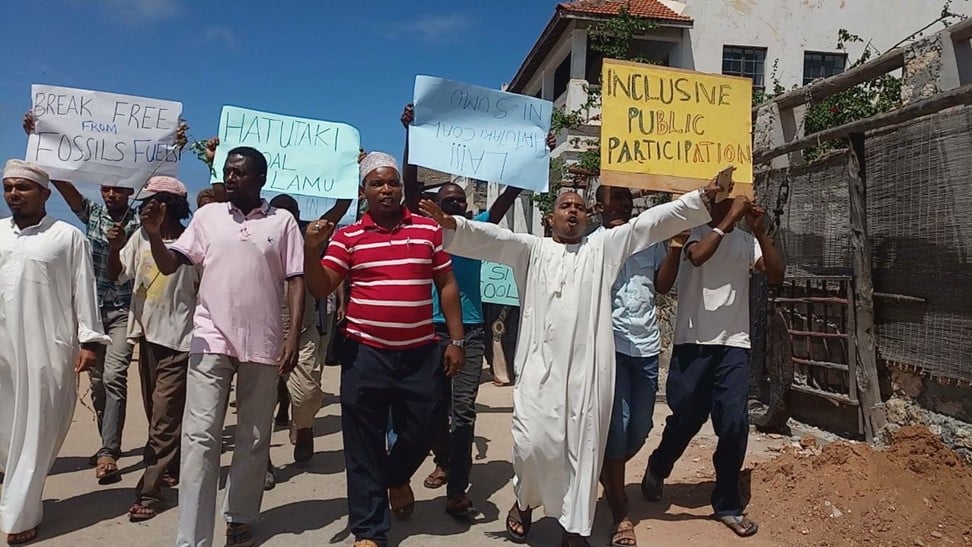
A proposed coal-fired power plant in Kenya involving four Chinese companies has provoked protests. Photo: Handout
This article is part of a series in which the South China Morning Post examines the local impact of Chinese investment and infrastructure projects in Africa.
There are a few places in the world that have held onto their traditions. One is the island of Lamu, close to Kenya’s northern coast, which is an epicentre of Swahili culture in East Africa and home to its oldest and best-preserved history.
Nowhere combines the culture’s architecture and heritage like Lamu Old Town, where there are two streets, few cars and dozens of mosques and churches. Donkeys and wooden carts are the main modes of transport.
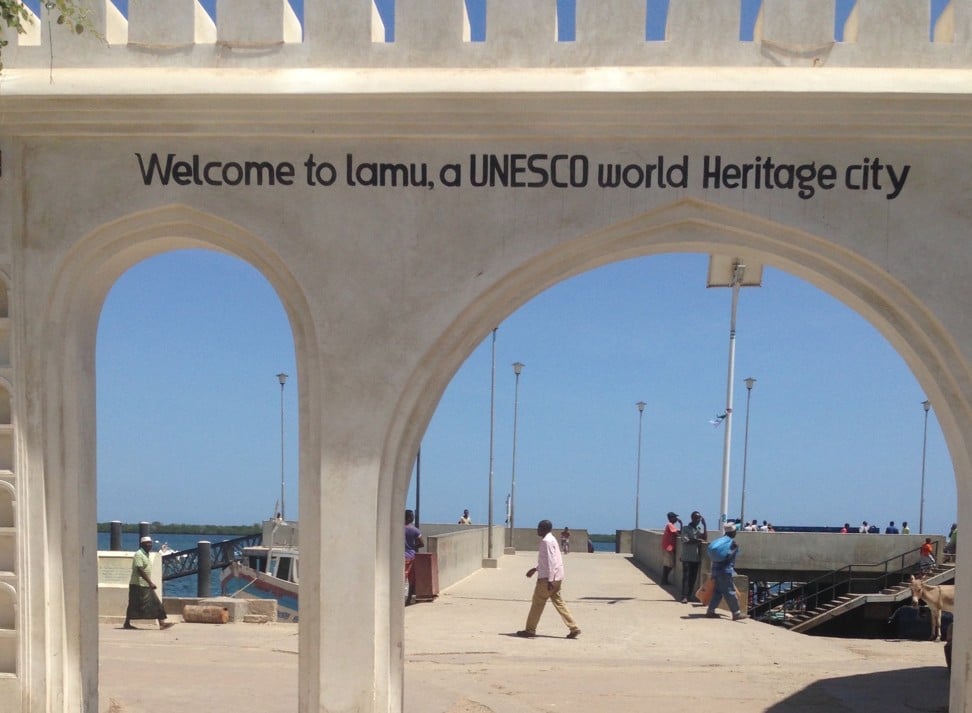
The town is a Unesco World Heritage Site with multibillion-dollar tourism and fishing industries. But it risks losing its global allure after Unesco’s World Heritage Committee warned that a US$2 billion coal-fired power plant planned in the area threatened its heritage site status.
Four Chinese companies are involved in the project. The United States also supported it, with its envoy to Kenya, Kyle McCarter, saying the country needed cheaper power and American energy firm GE promising to inject US$400 million for a 20 per cent stake in Amu Power, the operating company. The Kenyan government has said the plant would enable the country to have a diversified source of electricity.
Lamu Old Town’s Unesco status helps to support its tourism and fishing industries. Photo: Handout
However, the project’s future is uncertain after a Kenyan court, the National Environment Tribunal, ordered on June 26 that a fresh environmental impact assessment be carried out. The tribunal, which oversees decisions made by the National Environment Management Authority, also revoked the licence issued by the authority to Amu Power.
A lack of public consultation to date, as well as the environmental risks, were cited by the court, whose ruling is binding on the government. Unesco has urged Amu Power to proceed with the impact assessment, which in turn could have an impact on perceptions of Beijing’s signature transcontinental infrastructure strategy, the
Two days after the court’s verdict, Wu Peng, the Chinese ambassador to Kenya, met groups opposed to the building of the coal plant, days after they had been dispersed by police when they tried to protest at the embassy. Wu acknowledged the need to develop a different approach to hear the public’s views.
Anti-coal campaigners have been demanding China back out. Of the plant’s estimated US$2 billion cost, US$1.2 billion is coming from the Industrial Commercial Bank of China.
The three Chinese companies – Sichuan Electric Power Design and Consulting, China Huadian, and Sichuan No 3 Power Construction – teamed up with Kenya’s Centum Investments and Gulf Energy in a venture to form Amu Power. Another Chinese firm, Power Construction (PowerChina), was contracted to build the plant, which is expected to generate 1,050 megawatts of electricity.
The Chinese embassy in Nairobi said it had asked the Chinese investors to wait for Kenya’s decision on whether it should go ahead.
“Our position is that the Kenyan people are the final decision makers in this project and the Chinese government respects that,” embassy spokeswoman Huang Xueqing said.
Despite committing to cutting China’s reliance on coal, Beijing is still funding several coal-powered plants around the world. Both China and Kenya signed the
on climate change in 2016, promising to cut carbon emissions.
China may be providing a market for its coal by outsourcing its fossil fuel use to other countries, according to 350.org, which campaigns to prevent climate change and works to end use of fossil fuels.
Yossi Cadan, a senior campaigner for the organisation, said many people looked to China to be the new world leader in addressing climate change, given its government’s ambitious initiative to reduce emissions domestically. US President Donald Trump, by contrast, made the controversial decision to
Activists and Lamu residents have protested about the coal plant. Photo: Handout
“While China seems determined to meet its Paris climate agreement targets at home, it undermines those efforts to reduce global emissions by simultaneously investing in coal projects across the world,” Cadan said.
According to Cadan, cancellations and delays of coal projects in China left a desperate Chinese coal industry looking elsewhere, assisted by Chinese financial institutions.
He argued that if China was serious about being a global leader in reducing emissions and tackling the climate crisis, it must apply the same restrictions it was
Analysts said that if the Lamu coal project were to be abandoned, other Chinese-funded coal power projects in Africa would come under the spotlight.
China is funding eight coal-powered projects in Africa, including Egypt’s Hamrawein plant, which has an estimated cost of US$4.2 billion and is expected to generate six gigawatts of power.
Omar Elmawi, campaign coordinator at deCOALonize, was among the campaigners who met ambassador Wu two weeks ago.
“Other African countries could take a cue from [the Kenyan situation],” he said. “Already key financial institutions are coming up with policies that are either cutting back on or refusing to fund new coal plant projects. This will add to the pressure on China to abandon coal projects.”
Lauri Myllyvirta, lead analyst at Greenpeace’s air pollution unit, said the Lamu case could spur the Chinese government to adapt its criteria for supporting overseas energy projects. This could include requiring coal-fired power projects overseas to meet more stringent emissions standards.
“Currently, essentially all of the overseas coal-fired power projects with involvement from Chinese banks and firms plan to use much weaker emissions control technology than is allowed in China, leading to much worse air quality impacts and public health impacts – which was the case in Lamu,” Myllyvirta said.
“It’s hard to see how [a weaker emissions standard] fits with the Chinese leadership’s objectives of greening the belt and road, and projecting a positive, technologically advanced image of China overseas.”
GUWAHATI, India (Reuters) – Heavy monsoon rains in India’s northeast Assam state displaced more than a million people from their homes and flash floods killed at least 10 in the past 72 hours, state authorities said on Saturday, warning the situation could worsen in coming days.
The Brahmaputra river, which flows from the Himalayas into India and then through Bangladesh, has burst its banks, swamping more than 1,800 villages in the state.
“10 people have died in separate incidents of drowning in the past three days and more than one million people (have been) affected, with the flood situation turning grave,” a state government flood bulletin said.
Torrential rains have affected at least 25 of Assam’s 32 districts and the federal water resources body said water levels in the Brahmaputra were expected to rise, with more rains forecast over the next three days.
“The flood situation remains extremely critical,” Assam’s Water Resources Minister Keshab Mahanta told Reuters.
Assam, known for its fine quality teas, has for several years battled floods and heavy rains that have claimed dozens of lives and displaced hundreds of thousands of people.
Assam was on a maximum alert due to heavy rains forecast over the next few days, government officials said.
People in the state were also at threat from Japanese encephalitis, a mosquito-borne viral infection, government officials said. More than 160 people have been killed since January by the infection.
The federal government said it had met on Saturday to review flooding across different parts of the country, and emergency teams had rescued 750 people in Assam and nearby Bihar state, where the Kosi River had risen above the danger mark.
Flash floods and landslides in Nepal also triggered by monsoon rains killed 15 people and injured 12 overnight.
BEIJING, July 12 (Xinhua) — China has signed cooperation documents on jointly building the Belt and Road with 18 Arabian countries, the Ministry of Commerce (MOC) said Friday.
China-Arab joint efforts to push forward cooperation on the Belt and Road has reached notable achievements, showing great potential and broad prospect, Vice Minister of Commerce Qian Keming told a press conference of the fourth China-Arab States Expo.
In 2018, bilateral trade volume between China and Arabian countries reached 244.3 billion U.S. dollars, jumping 28 percent year on year.
Chinese enterprises signed 35.6 billion dollars of new project contracts in Arabian countries, with a yearly increase of 9 percent, while direct investment from Chinese companies in Arabian countries totaled 1.2 billion dollars, involving sectors such as energy, infrastructure and manufacturing.
Qian said China will further strengthen connections of development strategies with Arabian countries so as to jointly build the Belt and Road.
Chinese enterprises and financial institutions are encouraged to deepen cooperation with the Arabian side in sectors of port, railway, electricity and telecommunications, said Qian.
More efforts should be made to promote cooperation between the two sides in fields of low-carbon energy, finance and high technologies, he added.
The fourth China-Arab States Expo will be held in Yinchuan city, northwest China’s Ningxia Hui Autonomous Region, from Sept. 5 to 8.
The expo will focus on fields including cross-border e-commerce, infrastructure as well as trade and investment, aiming to promote mutually beneficial cooperation between China and Arabian countries in these areas.
Visiting Chinese State Councilor and Foreign Minister Wang Yi (L) shakes hands with Hungarian Minister of Foreign Affairs and Trade Peter Szijjarto prior to their talks in Budapest, Hungary, July 12, 2019. (Xinhua/Attila Volgyi)
BUDAPEST, July 12 (Xinhua) — Visiting Chinese State Councilor and Foreign Minister Wang Yi and Hungarian Minister of Foreign Affairs and Trade Peter Szijjarto held talks on Friday, pledging closer exchanges and more cooperation.
Noting this year marks the 70th anniversary of the establishment of China-Hungary diplomatic relations, Wang said the two countries have always respected and supported each other, showing mutual trust over the past seven decades. And in 2017, bilateral relations entered a new historical stage when a comprehensive strategic partnership was established by the leaders of two nations.
In face of increasingly unstable and uncertain international situation, Hungary, Wang said, has taken a clear-cut stance to develop friendly relations with China, firmly support the building of the Belt and Road and participate in the China and Central and Eastern European Countries (CEEC) cooperation.
Calling Hungary a reliable and trustworthy partner, the Chinese top diplomat said China will continue to back Hungary’s development path in line with its own national conditions, and support it to safeguard its legitimate rights and interests and to play a more important role in the European Union (EU) and the world.
The two sides should seize the opportunity of the 70th anniversary of establishment of bilateral diplomatic relations, maintaining, consolidating and developing the China-Hungary comprehensive strategic partnership, as well as deepening exchanges at all levels, said Wang.
The two sides should enhance all-around cooperation based on the principle of extensive consultation, joint contribution and shared benefits, he said, while also calling on the two sides to strengthen strategic coordination to safeguard their common rights and interests as well as international fairness and justice.
On his part, Szijjarto said Hungary-China bilateral relations are at their best in history.
Hungary is the first European country to sign the Belt and Road cooperation agreement with China, which aligns well with Hungary’s “Opening to the East” policy, corresponds to the China-EU cooperation, and is conducive to promote the Eurasian interconnection, he said.
Hungary is willing to work with China to maintain closer high-level exchanges, expand cooperation in areas like trade, investment, finance, and education, and closely coordinate and cooperate in multilateral affairs, so as to promote bilateral relations to make new progress, said Szijjarto.
On Thursday, the Chinese top diplomat also attended the opening ceremony of a photo exhibition marking the 70th anniversary of the establishment of China-Hungary diplomatic relations here in the Hungarian capital.
Image copyright GETTY IMAGESImage caption (File photo) They were arrested in the city of Xuzhou in Jiangsu province
Four Britons have been arrested in China’s Jiangsu province over drug-related offences.
They are among 16 foreigners – seven teachers and nine students – who were detained last week after testing positive for drug use.
At least some of those being held are from an international language school, Education First.
Police did not specify the type of drugs involved and it is not clear where the other foreigners are from.
There are extremely severe penalties for drug offences in China.
“We are in contact with the Chinese authorities following the arrest of four British people in Jiangsu province, and are providing consular assistance,” said the British embassy in Beijing.
On Tuesday, the Xuzhou Public Security Bureau, located in Jiangsu province, posted a statement on Chinese social media site Weibo saying police had successfully cracked a drug-related case.
It said 19 people had been arrested, including 16 foreigners.
According to police, 18 people had been placed under administrative detention, which carries a maximum detention period of 15 days. One person was placed in criminal detention – a procedure that usually leads to a formal arrest and an indictment.
Police did not name the school involved, but state news agency Xinhua later reported that some of the teachers were from the Switzerland-based Education First (EF) Centre.
The EF centre told Xinhua it had a “zero tolerance” policy towards drugs, adding that it was deeply regretful that some of its teachers were involved.
It said the drug-related incident had taken place during “non-work” hours.
EF first entered China in 1998 and has around 2,000 English teachers now based in the country.