21/05/2020

Two Sessions 2020: How far will Beijing go to push Article 23 national security legislation on the Hong Kong agenda?

  • Item expected to feature prominently after year of protests
  • Hong Kong delegates to meet top official from State Council’s Hong Kong and Macau Office on Thursday evening
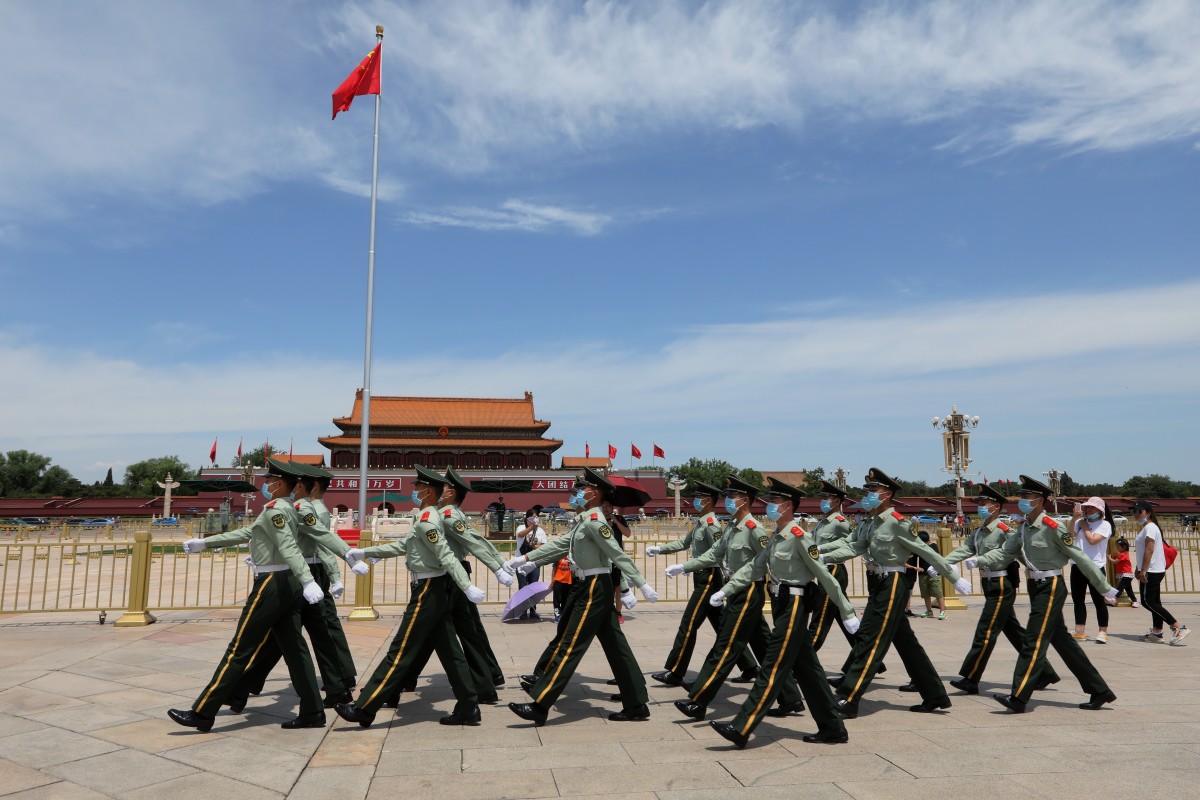
Armed policemen walk through Tiananmen Square in Beijing, ahead of the start of this year’s two sessions. Photo: Simon Song

Armed policemen walk through Tiananmen Square in Beijing, ahead of the start of this year’s two sessions. Photo: Simon Song

As Hong Kong delegates to the country’s legislature gather in Beijing for the nation’s biggest political event of the year, momentum is building behind a push for national security legislation which is expected to feature prominently on the agenda.China’s “two sessions” of parliamentary meetings open on Thursday, but for Hong Kong, all eyes will be on an evening meeting with Xia Baolong, director of the State Council’s Hong Kong and Macau Office (HKMAO), that the city’s delegates have been invited to, sources told the Post.

Zhang Qingli, vice-chairman of the Chinese People’s Political Consultative Conference, the nation’s top advisory body, is also due to attend the meeting.“The national security issue is expected to be on the agenda, given the protests in the past months,” a source, who has been invited to the gathering, said.The Basic Law, or the city’s mini-constitution, requires the Hong Kong government to enact its own national security law prohibiting acts of “treason, secession, sedition, or subversion” under Article 23.

But the law has been in abeyance since 1997. In 2003, the Hong Kong government was forced to shelve a national security bill after an estimated half a million people took to the streets to oppose the legislation, which they warned would curb their rights and freedoms.

Since then, the government has steered clear of introducing such legislation. However, pressure to do so has been mounting after the anti-extradition bill protests in 2019 morphed into a wider anti-government movement, with Beijing officials suggesting foreign hands were involved in violent activities akin to terrorism.ADVERTISINGA Beijing official source said: “Certainly, Beijing is very concerned about Hong Kong increasingly becoming the loophole in China’s national security. Director Xia Baolong and Luo Huining will meet the Hong Kong National People’s Congress (NPC) delegates after their preparatory session and with Chinese People’s Political Consultative Conference (CPPCC) members later tonight, this concern will be a key talking point.”

Actions like these make it more difficult to assess that Hong Kong remains highly autonomous from mainland ChinaUS Secretary of State Mike Pompeo

Meanwhile, a Hong Kong deputy to the NPC said deputies from the city would meet Luo, director of Beijing’s liaison office in Hong Kong, after their group meeting starting at 3pm on Thursday.CORONAVIRUS UPDATEGet updates direct to your inboxSUBSCRIBEBy registering, you agree to our T&C and Privacy Policy

The two sessions in Beijing are the annual meetings of the CPPCC National Committee, the top advisory body, and the NPC, the country’s top legislature.

These will be the first formal meetings as part of the two sessions that both Xia and Luo will have with the Hong Kong delegates. Both men took over their posts earlier this year in a major reshuffle of officials taking care of Hong Kong affairs.

As former provincial party chiefs, both are seen to be firmer hands keen to steer the city back to stability, with the protest movement quelled.Beijing’s push for national security legislation comes against the backdrop of rapidly escalating tensions between the United States and China.Secretary of State Mike Pompeo launched a verbal salvo against China on Wednesday, attacking Beijing for its policies on health, defence, Taiwan and 5G and its “brutal” regime as he expressed US concern over certifying Hong Kong’s autonomy.

Pompeo, a former CIA director, also called out the recent arrests of leading Hong Kong activists such as Democratic Party founder Martin Lee, and entrepreneur and media owner Jimmy Lai, describing how they had been “hauled into court”.

“Actions like these make it more difficult to assess that Hong Kong remains highly autonomous from mainland China,” Pompeo said. “We’re closely watching what is going on there.”https://open.spotify.com/embed-podcast/episode/7FysY5fAaEnrS3uzPHxj5a

Under the Hong Kong Human Rights and Democracy Act of 2019, the US has until the end of this month to assess whether Hong Kong remains suitably autonomous from China, a prerequisite for extending the city’s preferential US trading and investment privileges.

Coronavirus and protests highlight need for national security law in Hong Kong15 Apr 2020

While few doubt that Article 23 would feature heavily during the discussions, it was not immediately clear how the legislation could be enacted. Hong Kong’s opposition politicians have vowed to do their all to block the legislation, seeing its passage as the end of the city’s autonomy.

Pro-Beijing politicians, including NPC deputy Maggie Chan Man-ki, have argued that given Hong Kong has been unable to enact Article 23 legislation, Beijing should consider invoking its power under Article 18 to promulgate a national security law in the city.

Article 18 of the Basic Law says that national laws can apply to Hong Kong once they are listed in Annex III of the mini-constitution. And if such laws have to do with defence, foreign affairs and “other matters outside the limits” of the autonomy given to the city, they can be listed under Annex III.

The national laws would then be promulgated – imported automatically – or adapted through local legislation.

Hong Kong must not delay national security law, central government adviser says21 Dec 2019

On the possibility of passing a national security law in this NPC session, the official source said: “Sure everything is possible, but we should also note that the NPC agenda is prepared way in advance. It might be too rushed to add a national security law agenda one day before opening.”

The annual sessions of the CPPCC and NPC will open on Thursday afternoon and Friday morning, respectively. The sessions, also known as “Lianghui”, are normally held in March, but this year’s meetings were postponed because of the coronavirus pandemic.

Source:SCMP

21/05/2020

China set to implement its first civil code, as private investment slows

(Reuters) – China’s parliament is poised to enact its first civil code, a wide-ranging legislative package that includes strengthening protection of property rights in a Communist Party-ruled country whose embrace of private ownership has long been awkward.Chinese officials and delegates attend the opening session of the Chinese People’s Political Consultative Conference (CPPCC) at the Great Hall of the People in Beijing, China May 21, 2020. REUTERS/Carlos Garcia Rawlins

The civil code, in the works since 2014, will become law at a time when China needs its often-embattled private sector to step up investment to help revive a virus-battered economy, and will be a centrepiece of the annual parliamentary session that begins on Friday after a more-than two month delay.

However, the civil code is largely an amalgamation of existing laws, meaning its impact may be limited, some analysts said. And enforcement is uncertain, as courts are not independent and ultimately answer to the party, although legal reforms in recent years have aimed to give judges more independence and rein in local officials’ influence over courts.

The civil code, which among other provisions protects personal information and makes it easier to divorce or sue for sexual harassment, is expected to spell out the clearest boundary yet between government and markets since the 1949 founding of the People’s Republic of China.

It is a cornerstone of President Xi Jinping’s push to reform the country’s legal system by 2020, even as China has tightened controls on civil society and expanded party control under his leadership.

The legislation – on paper at least – reduces the scope for bureaucratic meddling and abuse that have often bedevilled private firms and property owners in a country where business owners were not allowed to join the Communist Party until 2001 and are still treated with suspicion by some party officials.

“It gives more complete protection to the rights of the individual,” said Wang Jiangyu, a law professor at the City University of Hong Kong.

“The bigger context is, is this a country that adheres to the rule of law? Is the government really executing the law?”

BUSINESS INSECURITY

Implementation of the code, which incorporates existing laws including those covering property, contracts and torts, reflects long-running concerns among business owners over protection of personal and property rights.

“All private firms have their ‘original sin,’” Xu Bin, a steel trader in Henan province, told Reuters in March, referring to the sometimes dubious actions taken by entrepreneurs in the early days of China’s reform and opening.

Some worry those “sins” can still be used against them.

A 2017 survey on the climate for private sector firms by Unirule Institute of Economics, a now-defunct liberal Beijing-based think tank, found companies rated “legal fairness” 4 out of 10.

“Without legal protection, private businessmen don’t feel safe. Our survey showed that they think there is a 22.5% chance of danger to themselves and a 26.8% chance that their assets are at risk,” Sheng Hong, an independent scholar who was previously Unirule’s executive director, told Reuters.

However, the civil code will not protect entrepreneurs in criminal cases.

“Since the Civil Code only covers civil disputes, it does not help protect property rights against seizure of assets by the state, a most important concern among entrepreneurs,” said Xin Sun, a lecturer in Chinese and East Asian business at King’s College London.

NEEDED INVESTMENT

Private sector investment in China has slowed sharply, to the worry of officials, from more than 20% growth when Xi assumed power to single digits in recent years. It fell 13% during the coronavirus-battered first four month of this year, compared with a 7 percent decline for state companies.

In an April meeting chaired by Xi, the Communist Party’s decision-making Politburo said the government will support the private economy and development of small- and medium-sized firms, which remain excluded from several industries and have long had difficulty securing bank credit.

“The civil code could restore confidence of private business owners and to help prop up economic growth,” said Hu Xingdou, a retired economics professor with Beijing Institute of Technology.

Sun, of King’s College, isn’t so sure, saying the civil code brings little added protection for rights and property, and is more symbol than substance.

“China does have a comprehensive system of high-quality written laws but a lot of concerns arise from their enforcement rather than the laws themselves,” he said.

Source: Reuters

20/05/2020

Livestreaming enables people to have chance to taste Fuzhou culture

CHINA-FUJIAN-FUZHOU-LIVESTREAMING-TOURISM (CN)

Aerial photo taken on May 19, 2020 shows staff members performing via livestreaming on a cellphone at a historical and cultural area of Fuzhou, southeast China’s Fujian Province. May 19 marks the China Tourism Day. Local authorities in Fuzhou conduct livestreaming via cellphones to enable people elsewhere to have a chance to taste the local cultures.

Source: Xinhua

20/05/2020

US semiconductor giant shuts China factory hailed as ‘a miracle’, in blow to Beijing’s chip plans

  • US chip giant GlobalFoundries confirms it has ceased operations at its only Chinese facility, with industry experts saying the poorly-planned project was doomed to fail
  • Closure deals blow to China’s plans to move up semiconductor value chain, amid increasingly hostile tech rivalry with the United States
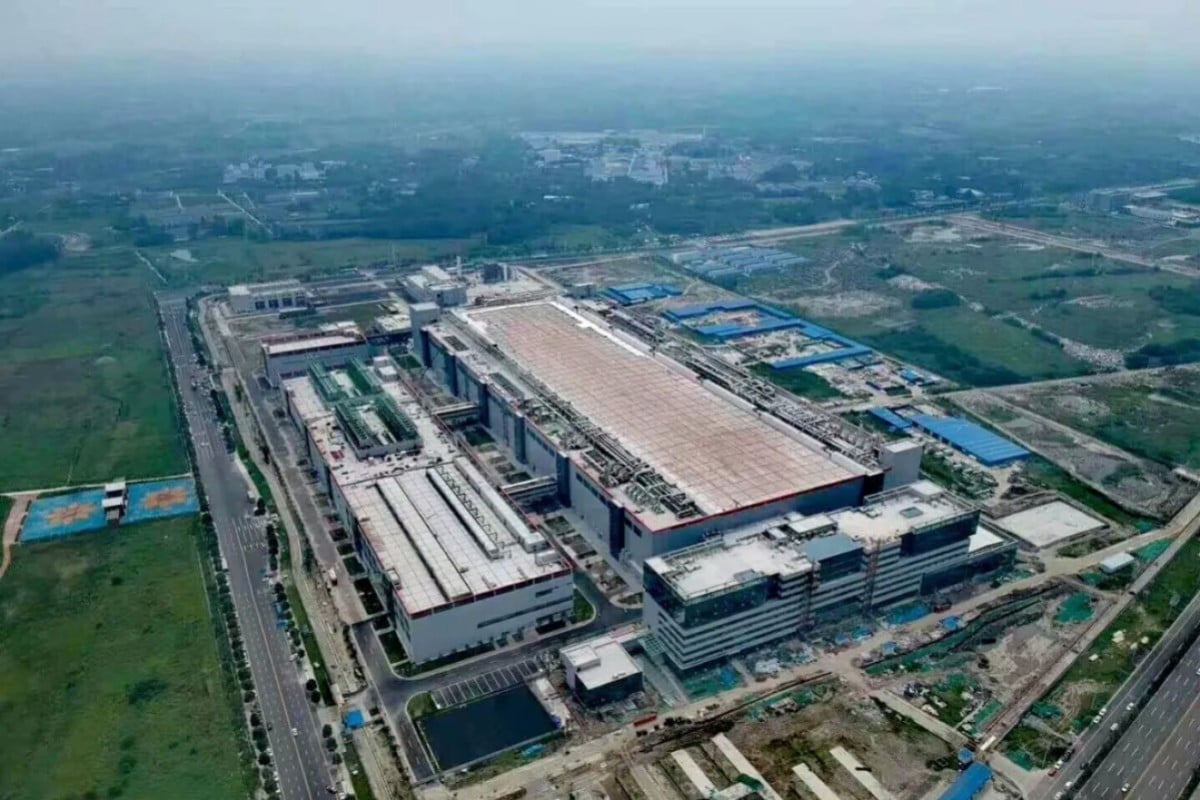
Beijing boasted that the final total investment in the GlobalFoundries plant could be US$10 billion. The plant was intended to produce 300mm wafers, a key material in making chips, but production never started at the 65,000 square metre facility, which was completed mid-2018. Photo: Weibo

US chip giant GlobalFoundries has halted operations at a joint venture factory in China, the company has confirmed, dealing a potential blow to China’s bid to own a bigger slice of the global semiconductor market.

The closure of the firm’s only China facility comes just three years after it announced plans to make chips in the mainland, and comes amid an escalating tech war with the United States.

The winding down, however, has little to do with the fierce superpower rivalry. It comes after two years of speculation as to what was actually happening at the US$100 million facility, which was hailed as “a miracle” by local media when announced to fanfare in 2017, but which never got off the ground.

Nonetheless, the symbolism is rich.

China is struggling in its efforts to boost its domestic chip research and production in a bid to counter US efforts to block it from American technology.

Last week, the US Department of Commerce upped the ante by banning the sale
of Huawei-designed chips produced outside America if they are made using the US software and technology, adding further pressure to the Chinese telecom giant’s global supply chain.
The GlobalFoundries factory, in a hi-tech park in the southwestern city of Chengdu, was one of China’s major foreign-invested semiconductor projects, for which the local government rolled out the red carpet three years ago.

At the time, Chengdu boasted that the final total investment in the plant could be US$10 billion. The plant was intended to produce 300mm wafers, a key material in making chips, but production never started at the 65,000 square metre facility, which was completed mid-2018.

A spokesperson for California-based GlobalFoundries confirmed that the Chengdu plant had stopped operations and that it had offered staff an “employee optimisation plan”, a commonly-used euphemism for lay-offs.

“The plan is being carried out on the basis of open and transparent communications with the employees and they have been offered various options to choose from based on their personal situations,” a company statement read.

A 2018 annual report from the joint venture, in which GlobalFoundries had a stake of 51 per cent with the rest controlled by an investment vehicle of the Chengdu government, showed that the plant had 320 employees.

A company notice sent to employees dated May 14 and seen by the Post said that after mid-June, the company would only pay 70 per cent of Chengdu’s minimum monthly wage, about 1,246 yuan (US$175.38), while negotiating severance packages with staff.

For some industry analysts who have followed the Chengdu project from its inception, its demise has less to do with the trade war, more to do with poor planning.

There was little detailed research and planning before the project was launched. As far as the Chengdu government is concerned, it lacks a sufficient understanding of GlobalFoundriesGu Wenjun, analyst

“There was little detailed research and planning before the project was launched. As far as the Chengdu government is concerned, it lacks a sufficient understanding of GlobalFoundries, its decision-making mechanism and economic strengths, and it did not get strong support from the central government,” said Gu Wenjun, chief analyst at Shanghai-based semiconductor research firm ICwise.
The idea of establishing a joint venture was first pitched to Chongqing municipality, a neighbouring city of Chengdu, in 2016. Chongqing signed a memorandum of understanding with GlobalFoundries to set up a plant to manufacture 300mm silicon wafers – components for making integrated circuits – using technology from GlobalFoundries’ Singapore factory.
After the deal to open a Chongqing plant fell through for unclear reasons, Chengdu moved in to cut a deal with GlobalFoundries in late-2016. A 2017 blueprint stated that 3,500 employees could be working at the site, according to Wallace Pai, then GlobalFoundries’ general manager for China.
But production never started. Initially the project was supposed to have two phases: using mainstream technologies to manufacture 300mm wafers from 2018, then transferring to more advanced technologies in late-2019.
However, in October 2018, the two partners decided to “bypass” the phase one manufacturing stage, partly because of China’s increasing demand for more advanced products and GlobalFoundries’ own financial stress. The project has since stalled.

Comparing official announcements from the Chengdu government and GlobalFroundries back in 2017, Gu from ICwise said the two had different focuses, which might explain the plant’s derailment. The government clearly wanted to bring in mainstream, lower-risk technologies to boost the city’s brand, while the company aimed for Chinese capital and government support to invest in more advanced technology, Gu said.

The joint venture will continue after the factory’s demise, with GlobalFoundries still expecting to expand sales in the Chinese market, the company said in its statement. It now has five factories, three in the US and one each in Singapore and Germany.

When The Post contacted the office of the joint venture partner within the Chengdu government, the person answering the phone said they did not know anything about the closure nor future plans, before hanging up without giving their name.

“Our focus in China is on developing and growing our partner ecosystem including creating local technology infrastructure and bringing more intellectual property vendors and electronic design automation partners to better serve the local market,” the company said.

According to the China Semiconductor Industry Association, China’s integrated circuits sales rose 15.8 per cent in 2019 from a year earlier to 756.2 billion yuan (US$106.44 billion), while sales in the global semiconductor market dropped by 12 per cent to US$412 billion.

Last week, Dutch company ASML Holding, a key supplier of chip-making equipment, set up a plant in Wuxi, in Jiangsu province, in a boost to China’s efforts to attract foreign semiconductor investment.

Source: SCMP

20/05/2020

Taiwan president rejects Beijing rule; China says ‘reunification’ inevitable

TAIPEI (Reuters) – Taiwan cannot accept becoming part of China under its “one country, two systems” offer of autonomy , President Tsai Ing-wen said on Wednesday, strongly rejecting China’s sovereignty claims and likely setting the stage for an ever worsening of ties.

China responded that “reunification” was inevitable and that it would never tolerate Taiwan’s independence.

In a speech after being sworn in for her second and final term in office, Tsai said relations between Taiwan and China had reached an historical turning point.

“Both sides have a duty to find a way to coexist over the long term and prevent the intensification of antagonism and differences,” she said.

Tsai and her Democratic Progressive Party won January’s presidential and parliamentary elections by a landslide, vowing to stand up to China, which claims Taiwan as its own and says it would be brought under Beijing’s control by force if needed.

“Here, I want to reiterate the words ‘peace, parity, democracy, and dialogue’. We will not accept the Beijing authorities’ use of ‘one country, two systems’ to downgrade Taiwan and undermine the cross-strait status quo. We stand fast by this principle,” Tsai said.

China uses the “one country, two systems” policy, which is supposed to guarantee a high degree of autonomy, to run the former British colony of Hong Kong, which returned to Chinese rule in 1997. It has offered it to Taiwan, though all major Taiwanese parties have rejected it.

China’s Taiwan Affairs Office, responding to Tsai, said Beijing would stick to “one country, two systems” – a central tenet of Chinese President Xi Jinping’s Taiwan policy – and “not leave any space for Taiwan independence separatist activities”.

“Reunification is a historical inevitability of the great rejuvenation of the Chinese nation,” it said. “We have the firm will, full confidence, and sufficient ability to defend national sovereignty and territorial integrity.”

China views Tsai as a separatist bent on formal independence for Taiwan. Tsai says Taiwan is an independent state called the Republic of China, its official name, and does not want to be part of the People’s Republic of China governed by Beijing.

TAIWAN OPEN TO DIALOGUE

China has stepped up its military drills near Taiwan since Tsai’s re-election, flying fighter jets into the island’s air space and sailing warships around Taiwan.

Tsai said Taiwan has made the greatest effort to maintain peace and stability in the narrow Taiwan Strait that separates the democratic island from its autocratic neighbour China.

“We will continue these efforts, and we are willing to engage in dialogue with China and make more concrete contributions to regional security,” she added, speaking in the garden of the old Japanese governor’s house in Taipei, in front of a socially-distanced audience of officials and diplomats.

Taiwan has become a rising source of friction between China and the United States, with the Trump administration strongly backing Taiwan even in the absence of formal diplomatic ties.

U.S. Secretary of State Mike Pompeo sent his congratulations to Tsai on Tuesday, praising her “courage and vision in leading Taiwan’s vibrant democracy”, in a rare high-level message from Washington direct to Taiwan’s government.

China’s Foreign Ministry condemned Pompeo’s remarks, and said the government would take “necessary countermeasures”, though did not elaborate.

China cut off a formal talks mechanism with Taiwan in 2016 after Tsai first won election.

Yao Chia-wen, a senior adviser to Tsai, told Reuters the chance of talks with China were small given ongoing tensions.

“We are ready to engage with them any time, but China is unlikely to make concessions to Taiwan,” he said. “In the next four years there’s little chance for the cross-strait relationship to improve.”

Source: Reuters

18/05/2020

Visitors view exhibits at Liaoning Provincial Museum in Shenyang

CHINA-LIAONING-SHENYANG-MUSEUM (CN)

Photo taken on May 18, 2020 shows an exhibit at the Liaoning Provincial Museum in Shenyang, northeast China’s Liaoning Province. May 18 marks the International Museum Day. (Xinhua/Yao Jianfeng)

Source: Xinhua

18/05/2020

Xi Focus: Xi replies to letter from Pakistani students studying in Beijing

A graduating foreign student takes selfies at Zhejiang University in Hangzhou, east China’s Zhejiang Province, June 28, 2018. (Xinhua/Long Wei)

BEIJING, May 18 (Xinhua) — Chinese President Xi Jinping extended welcome to excellent youth from all countries in the world to study in China in his Sunday reply to a letter from all Pakistani students studying in the University of Science and Technology Beijing (USTB).

In his letter, Xi encouraged the students to communicate more with their Chinese peers and join hands with youth from all countries to contribute to promoting people-to-people connectivity and building a community with a shared future for humanity.

Learning that the students have enriched their knowledge and made quite a few Chinese friends while studying in China, Xi said he felt happy for the achievements they have made.

“As you have felt, since the COVID-19 epidemic broke out, the Chinese government and schools have always cared for the lives and health of foreign students studying in China, providing all-round help for them,” Xi noted.

The Chinese government and people put people’s lives first and treat foreigners in the country the same as Chinese nationals, making no exception in offering them care, Xi wrote.

Photo taken on Nov. 7, 2019 shows the autumn scenery of the University of Science and Technology Beijing in Beijing, capital of China. (Xinhua/Chen Yehua)

Xi said he learned that many foreign students have expressed their support to the Chinese people in various ways during China’s fight against COVID-19.

“A friend in need is a friend indeed,” he said, adding that China will continue providing various help to all foreign students studying in the country.

While welcoming excellent youth from other countries to study in China, Xi encouraged them to learn more about the country, communicate more with their Chinese peers and tell the world more about the China they see.

The USTB currently has 52 Pakistani students. They recently wrote about their experiences and feelings of studying in China in a letter to Xi and expressed their gratitude to the university for providing care and help for them after the COVID-19 outbreak.

They also expressed their aspirations to join in building the Belt and Road after graduation and contribute to enhancing China-Pakistan friendship.

Source: Xinhua

18/05/2020

China sends special investigation team to Israel after ambassador’s death

  • Details remain scant one day after body of 57-year-old diplomat Du Wei is found at his home in Tel Aviv
  • Top Israeli foreign ministry official extends condolences to deputy ambassador Dai Yuming
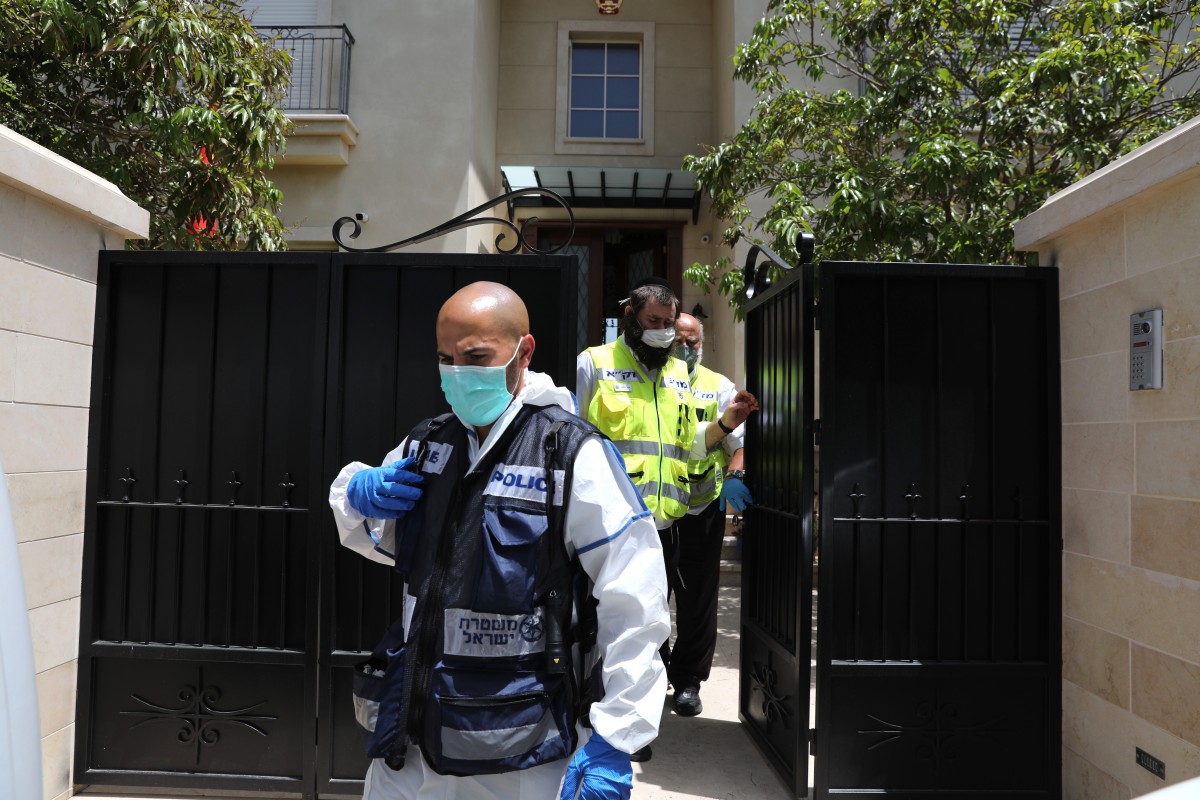
Police, ambulance and embassy staff at the residence where Chinese ambassador Du Wei was found dead on Sunday. Photo: EPA-EFE
China is sending a special investigative team to Israel following the sudden death of its ambassador Du Wei, whose body was found at his residence on Sunday.
The team, accompanied by a member of Du’s family, was due to travel on Monday, and will handle arrangements for the remains, as well as conducting its own internal investigation, according to Israeli newspaper Haaretz.
Israel’s foreign ministry said its director general Yuval Rotem had spoken with deputy ambassador Dai Yuming to express his condolences. Local police are continuing to investigate at Du’s residence in a suburb of Herzliya, near Tel Aviv.
Details from the Chinese side have been scant. China’s foreign ministry provided a statement to AFP on Sunday which said the preliminary verdict was that Du, 57, had died unexpectedly for health reasons, and details awaited further confirmation. AFP also reported that Du’s wife and son were not with him in Tel Aviv.

“As far as I know, China’s ambassador to Israel Du Wei passed away in ambassador’s residence in Tel Aviv this morning for physical reasons. It happened abruptly,” said Hu Xijin, editor-in-chief of state media tabloid Global Times in a tweet late on Sunday night.

Du was last seen in public on Tuesday in a video conference with an official from Israel’s foreign affairs ministry, according to the embassy website.

James Dorsey, senior fellow at the S. Rajaratnam School of International Studies in Singapore, said Du’s untimely death should be seen as a personal, rather than a political, tragedy for the growing relationship between China and Israel, but he said it came at an important moment for the two countries because of rising US-China tensions.

Dorsey said Israel’s increasing hi-tech cooperation with China, as well as continuing US hostility to Iran – which has close ties with China – were potentially problematic for relations between the two countries.

“I’m not sure that the China-Israel relationship can be seen as independent of the Israel-US relationship. One could argue that the Chinese may be well advised to very quickly replace him soon,” Dorsey said. “Israel could find itself on the fault line of deepening US-China decoupling,” he added.

Israel’s ambassador to China in quarantine after ‘infected’ flight to Seoul

28 Feb 2020

Following a brief trip to Jerusalem on Wednesday – his first foreign visit since March – US Secretary of State Mike Pompeo renewed warnings about China-Israel ties in an interview with Israeli state-owned media outlet Kan News.

“We do not want the Chinese Communist Party to have access to Israeli infrastructure, Israeli communication systems, all of the things that put Israeli citizens at risk,” he said.

China’s embassy in Tel Aviv blasted Pompeo’s comments as “absurd” and “ill-intentioned”. However, the embassy statement was not written by Du, but by a spokesperson.

Du had only served in Israel since February. Just before his arrival, the Chinese embassy had to issue an apology after then-acting ambassador Dai denounced Israel’s tightened restrictions on Chinese visitors by comparing them to the Holocaust.
During his brief tenure, Du gave frequent interviews to local media, speaking mainly about China’s virus control measures, US-China tensions, and friendship between China and the Jewish people.
Du had worked as a career diplomat since entering China’s foreign service in 1989. Before his appointment in Tel Aviv, he served as China’s ambassador to Ukraine from 2016-2019.
Source: SCMP
18/05/2020

Cyclone Amphan: India’s east coast braces for severe storm

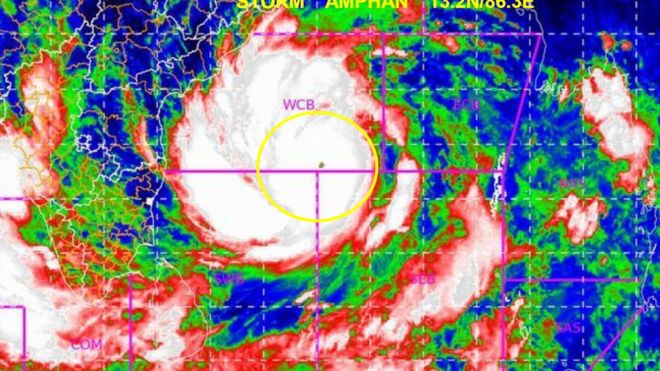
Cyclone AmphanImage copyright INDIA MET DEPARTMENT
Image caption The storm has worsened over the last 12 hours

Indian officials are on alert after Cyclone Amphan – due to make landfall on the east coast – looks likely to intensify into a “very severe” storm.

The storm is expected to make landfall on Wednesday afternoon and hit West Bengal and Odisha states. Twenty relief teams have been dispatched there.

Prime Minister Narendra Modi is due to chair a high-level meeting to further discuss preparations for the storm.

The cyclone comes amid huge levels of migration from the cities to villages.

Tens of thousands of people are fleeing cities in the wake of a lockdown to curb the spread of coronavirus. Both Odisha and West Bengal are seeing a large number of people return.

There are fears about the impact of the storm on them – many are on foot.

India’s meteorological department has issued a “yellow alert” for the region, advising fishermen not to “venture into the south Bay of Bengal during the next 24 hours, and north Bay of Bengal from 18-20 May”.

A ‘”yellow alert” or “cyclone alert” is issued “of the expected commencement of adverse weather over the coastal areas”.

Presentational white space

In a bulletin, the weather department said the storm is likely to move across the north-west Bay of Bengal, and cross West Bengal and Bangladesh coasts from noon local time on 20 May as a “very severe cyclonic storm”.

It also warned of rough seas, with storm surges that could inundate coastal areas.

The head of India’s National Disaster Relief Force (NDRF), SN Pradhan, said they were watching the situation closely and were in touch with state governments.

Last June a powerful cyclone that was expected to make landfall on India’s western coast changed its course, and moved further into the Arabian sea.

Hundreds of thousands of people had already been evacuated as the region braced for Cyclone Vayu, which was classified as “very severe”.

And in May last year India evacuated more than a million people to safety to avoid Cyclone Fani, in which 16 people were killed in Odisha.

In the Bay of Bengal, the cyclone season typically runs from April to December.

Source: The BBC

17/05/2020

Europe Coronavirus Updates: Italy sees fewer COVID-19 patients, Spanish PM seeks final extension of State of Alarm

A pedestrian waits to cross a street in Brussels, Belgium, May 6, 2020. (Xinhua/Zhang Cheng)

— New single-day COVID-19 deaths continue to drop in France

— Italy sees fewer COVID-19 patients, number of active infections falls to 70,187

— New deaths from COVID-19 keep falling in Spain as PM seeks final extension of State of Alarm

— Deaths from coronavirus top 9,000 in Belgium

BRUSSELS, May 16 (Xinhua) — The following are the latest developments of the COVID-19 pandemic in European countries.

A man makes a phone call near the Eiffel Tower at the Trocadero Palace, Paris, France, May 15, 2020. (Xinhua/Gao Jing)

PARIS — France had registered 96 new deaths from COVID-19 over the past 24 hours, fewer than the previous two 24-hour periods, while the balance of the coronavirus-related hospitalization remains negative, France’s Health Ministry said on Saturday.

According to the ministry, the 96 new single-day deaths were lower than 104 registered on Friday and 351 on Thursday. So far, 27,625 people have succumbed to the coronavirus-caused disease across France.

Meanwhile, France is now the world’s fourth worst-hit country in terms of human loss caused by COVID-19 after the United States, Britain and Italy.

As of Saturday, the country had recorded 142,291 confirmed cases, a single-day increase of 372, slower than Friday’s 563. A total of 61,066 patients had recovered and returned home since early March.

People wait in line outside a cocktail bar in Rome, Italy, May 12, 2020. (Xinhua/Cheng Tingting)

ROME — The number of COVID-19 hospitalizations and intensive care (ICU) patients dropped in Italy over the past 24 hours, according to the latest tally posted by the Civil Protection Department on Saturday.

Recoveries rose by 2,605 from a day earlier, bringing the total to 122,810.

Nationwide, the number of active infections fell to 70,187, down from 72,070 on Friday.

Of those who tested positive for the new coronavirus, 775 are in intensive care, down by 33 from Friday, and 10,400 are hospitalized with symptoms, down by 392.

The death toll on Saturday was 153, bringing the total to 31,763 since the outbreak was first recorded in Italy’s northern Lombardy region in February.

The total number of COVID-19 cases combining infections, fatalities and recoveries has risen to 224,760, up from 223,885 on Friday.

A security guard offers disinfectant gel to a woman at the entrance of a building in Barcelona, Spain, on May 11, 2020. (Photo by Sergi Camara/Xinhua)

MADRID — The Spanish Ministry of Health, Consumer Affairs and Social Welfare confirmed on Saturday falls in the number of new deaths from COVID-19 as well as new cases.

The total number of deaths in Spain rose to 27,563 after 102 people lost their lives to COVID-19 in the 24-hour period until 21:00 hours local time on Friday.

This was the lowest number of deaths in a 24-hour period since March 16, with 50 of the deaths in the regions of Madrid and Catalonia.

The same period also saw a slight fall in the number of new cases. The Health Ministry reported 539 new infections, down from 549 reported 24 hours earlier, taking the total number of confirmed cases to 230,698.

Also on Saturday, Spanish Prime Minister Pedro Sanchez said he will seek a fifth and final extension of the State of Alarm, which was imposed on March 15 to control the spread of the coronavirus.

Speaking in a televised speech, Sanchez said the upcoming final State of Alarm, which will come into effect on May 24 if approved, will be “different” from others.

“It is expected to be the last State of Alarm. We are going to request in the Congress of Deputies that it should last for a month,” he said. All the previous four extensions have been 15 days.

Few people are seen at the Saint-Hubert Royal Galleries shopping street in Brussels, Belgium, May 6, 2020. (Xinhua/Zhang Cheng)

BRUSSELS — With an increase of 47 deaths reported in the last 24 hours, the novel coronavirus had caused a total of 9,005 deaths in Belgium since the beginning of the epidemic, said the public health institute Sciensano on Saturday.

Of the 9,005 deaths, 48 percent took place in hospitals, 51 percent in nursing homes, and about 0.6 percent elsewhere, according to Sciensano. Deaths in hospitals were all confirmed COVID-19 cases. Of the fatalities in nursing homes, 23 percent were confirmed by test while the other were presumed by symptoms.

Also in the past 24 hours, 345 new cases of COVID-19 have been confirmed, raising the cumulative cases to 54,989 in Belgium.

Source: Xinhua

Law of Unintended Consequences

continuously updated blog about China & India

ChiaHou's Book Reviews

continuously updated blog about China & India

What's wrong with the world; and its economy

continuously updated blog about China & India