25/11/2019

Desperate Beijing motorists marrying people just so they can secure a licence plate for their car

  • Television report shows how drivers are willing to pay more than US$20,000 for a sham marriage with someone who has a valid registration
  • City authorities ration the number of plates that allow people to use their cars in the capital as part of efforts to tackle pollution and congestion
Beijing has started limiting the number of plates issued as part of its efforts to tackle the city’s notorious pollution and congestion. Photo: EPA-EFE

Some desperate Beijing motorists are resorting to sham marriages to get round strict licence plate rules that are designed to limit the number of cars allowed on the city’s congested roads.

A report by state broadcaster CCTV that aired on Sunday night claimed that some drivers were willing to pay the equivalent of tens of thousands of US dollars to marry someone with one of the prized plates, have it transferred into their name and then get divorced.

Specialist agencies charge over 160,000 yuan (US$22,700) to help their clients obtain a licence this way for a petrol-driven car, or over 110,000 yuan for an electric-powered one, according to the report.

The scam is the result of a licence lottery first introduced in 2011 to tackle the Chinese capital’s notorious congestion and pollution.

Chinese driver arrested for doctoring number plate to spell out obscene phrase

Because of the strict limits on the number of Beijing number plates issued, there are now 2,600 applicants for every one issued for petrol-powered vehicles. Those who wanted a licence for an electric car may have to wait until 2028, the report said.

The government has also been steadily lowering the annual quota for new local licences from 240,000 in 2013 to 100,000 last year.

The owners of locally registered cars are also banned from using them on one day a week, which is determined according to the plate number.

Cars that do not have a Beijing licence plate face severe limits on driving in the city. The owners of these cars must apply for a permit that only allows them to use their cars for seven days at a time – and as of this month they are only allowed 12 permits a year.
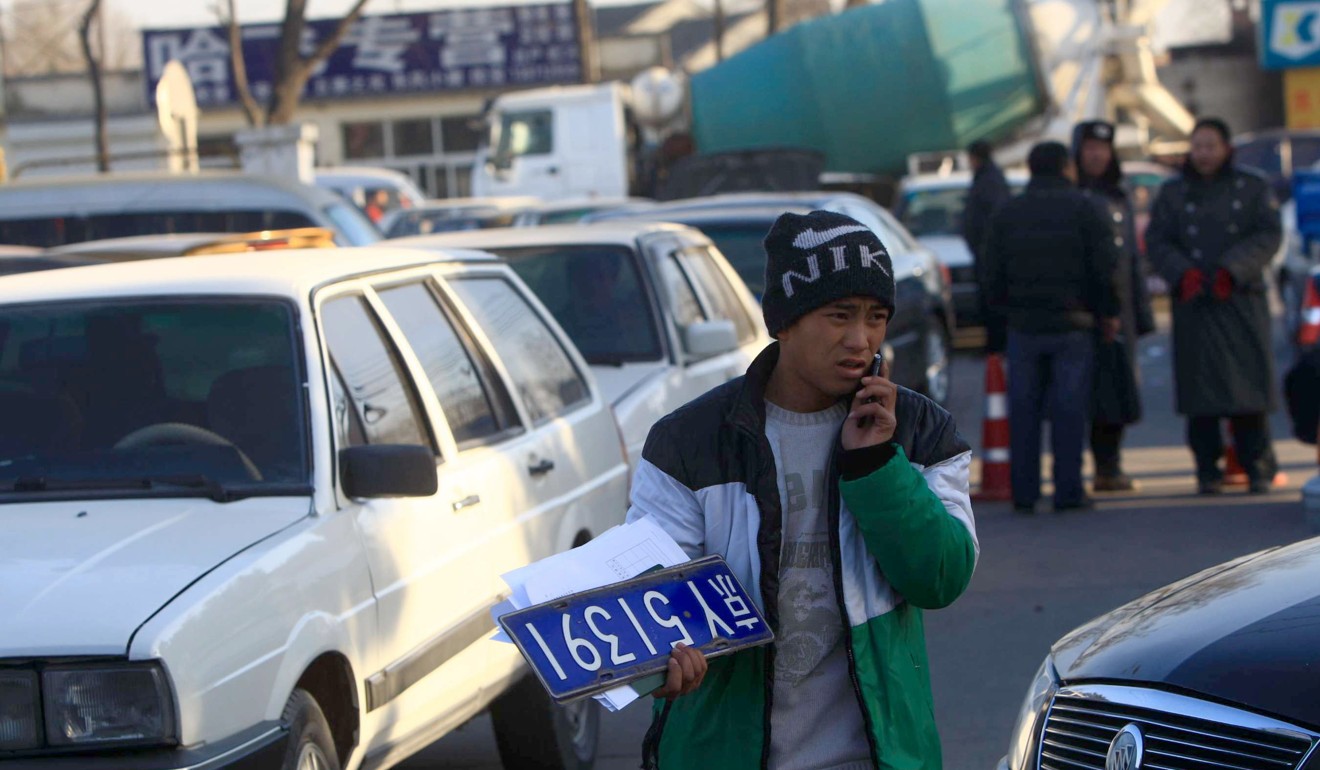
A man carries a number plate at a used car market in Beijing. Photo: AFP
The result is that many drivers have been looking for legal ways to get round the limits – with the sham marriages being one of the most extreme examples.

“We receive at least three or four clients a day asking to get a licence via fake marriages,” a manager at one agency told a CCTV reporter.

A staff worker helps go through all the procedures and if a suitable match is found, the process can be completed within 20 days.

Another loophole some are taking advantage of is to buy a car in the name of someone who has won the licence lottery, according to the agency.

Chinese police do U-turn on traffic crash after online crowd doubt official account

The actual user pays for the car in full, registers it under the licence owner’s name, and pays the latter a sum of money for using the licence – typically 20,000 yuan a year, 49,000 yuan for three years or 69,000 for a five-year deal.

In many cases, the two parties sign an agreement to limit the risk of a protracted dispute, but one judge warned that this was still a risky business.

Wang Lidan, a judge at Haidian District People’s Court in the northwest of the capital, told the programme makers that he knew of one case where a woman had paid a man with a Beijing licence to marry her, only for him to vanish after receiving the money.

Not only did the woman miss out on getting the licence but she faced an extra legal headache in getting a divorce.

Under Chinese law she had to first publish a notice about his disappearance in a newspaper and then wait three months before the divorce could go through the courts.

A rundown Beijing home with standing-room only space sells for record, in a sign of desperation for hukou in the Chinese capital

Record price for Beijing’s cubicle home shows desperation for hukou

Read more

China ponders trade-off with congestion and pollution on car purchase incentives to boost economy

Congestion or consumption? Beijing ponders trade-off on car purchases

Read more

Pollution alarm as tourism businesses contaminate home of China’s hairy crab

Pollution alarm as tourism contaminates home of China’s hairy crab

Source: SCMP
25/11/2019

Tuvalu: Pacific nation turns down Chinese islands and backs Taiwan

An aerial image of Funafuti, Tuvalu, on 15 August 2018Image copyrightGETTY IMAGES
Image captionTuvalu is battling rising sea levels

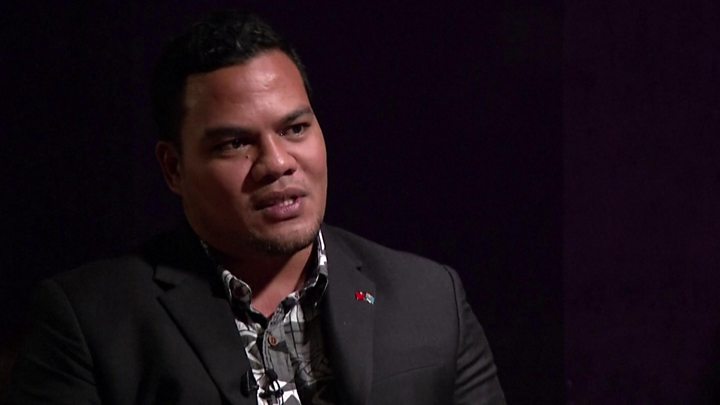
The tiny South Pacific nation of Tuvalu has rejected offers from Chinese firms to build artificial islands that would help it deal with rising sea levels, its foreign minister says.

Simon Kofe told Reuters he saw the offers as an attempt to reduce Taiwan’s influence in the region.

But he instead reaffirmed his country’s support for Taiwan.

China has increased efforts to expand its influence in the Pacific, alarming the United States and its allies.

Only 15 countries recognise Taiwan as a sovereign nation and have full diplomatic relations. A number of countries have switched their allegiance from Taiwan to China in recent years.

China refuses to have diplomatic relations with any country that recognises Taiwan.

In recent months Taiwan lost two allies in the region, when Kiribati and the Solomon Islands switched diplomatic recognition to China. Beijing has been accused of luring them in with the promise of financial aid and airplanes.

Media caption Tuvalu’s foreign minister discusses increasing pressure from China

Mr Kofe expressed his backing for Taiwan and said his nation was setting up a group to unite Taiwan’s four remaining Pacific allies – the Marshall Islands, Palau, Nauru and Tuvalu.

“We believe in the power of grouping together and collaborating,” he told Reuters news agency.

“Together with our partners, we will be able to counter the influence from mainland China.”

Mr Kofe said Chinese companies had approached local communities offering to help with a $400m (£310m) government plan to build artificial islands. He believes the companies were backed by the Chinese government.

“We are hearing a lot of information about debt,” he said. “China buying our islands and looking at setting up military bases in our part of the world. Those are things that are concerning to us.”

Beijing has proposed Taiwan operate under a “one country, two systems” structure, similar to Hong Kong.

Since Taiwan President Tsai Ing-wen took office in 2016, seven countries have dropped Taiwan as a diplomatic ally. The support from Tuvalu could help her as she seeks re-election in January.

Source: The BBC

25/11/2019

Priya: India’s female comic superhero returns to rescue ‘stolen girls’

Priya Shakti riding her pet tiger SahasImage copyright PRIYASHAKTI

Comic crusader Priya, a gang-rape survivor who earlier campaigned against rape and acid attack, is back in a new avatar. This time she is fighting the trafficking of girls and women for sex.

The “modern-day female superhero” was first launched in December 2014, exactly two years after the horrific gang rape of a young woman on a bus in Delhi, to focus attention on the problems of gender and sexual violence in India.

In the first edition, Priya Shakti, the tiger-riding heroine challenges the stigma surrounding rape while in Priya’s Mirror, the second edition, she returns to fight acid attacks.

In the latest edition – Priya and the Lost Girls – she takes on the powerful sex-trafficker Rahu, the evil demon who runs an underworld brothel city where he has entrapped many women, including Priya’s sister Lakshmi.

Indian-American actor and writer Dipti Mehta, who wrote the script of the comic, draws on ancient Indian mythology to create larger-than-life fantastical characters and delivers a powerful feminist statement.

The story of Lost Girls begins when the protagonist returns home to find that there are no girls in her village.

She then mounts her flying tiger Sahas (Hindi for courage) and arrives in Rahu’s den. It’s a city ruled by greed, jealousy and lust, where women exist only to serve and please men – and those who resist are turned into stone.

Priya with her tiger SahasImage copyright PRIYASHAKTI

Priya is threatened and attacked, a woman who works for Rahu tries to lure her into the sex trade saying: “If you work for us, you’d serve only five to six men and not 20”, but in the end, good wins over evil and she manages to vanquish Rahu and liberate her sister and all the other trafficked girls.

But victory still eludes her. The families of rescued girls refuse to take them back. The survivors are treated like “lepers”, facing stigma, scorn and ridicule.

But Priya and the other girls stand up to confront patriarchy, says Ms Mehta, “just as women have broken their silence to talk about MeToo”, the campaign against sexual harassment and abuse that started in Hollywood in October 2107 and later spread to many other parts of the world.

“I was very clear from the start that Lost Girls can’t be just another comic book where good guy wins and evil dies, it had to be much more than that,” Ms Mehta says.

Presentational grey line
Priya Shakti in the comicImage copyright PRIYASHAKTI
Presentational grey line

Ram Devineni, the Indian-American creator of the comic series, told the BBC that he had decided to focus on sex trafficking in this edition after visiting Sonagachi, India’s largest red-light area in the eastern city of Kolkata, where he met several women engaged in sex work.

“Half of them told me they had been tricked into coming there and, once there, they were forced into the sex trade. The other half said they’d agreed to do this for a living because they were dirt poor and they had no alternative.

“Often there were two to three women sharing a small dingy room, many of them had young children who lived with them, and some of them said their children slept in the same bed where they serviced clients.

“I found that really disheartening.”

Presentational grey line
Cover of Priya and The Lost GirlsImage copyright PRIYASHAKTIPresentational grey lineAccording to the United Nations Office on Drugs and Crime, human trafficking is the second largest organised criminal business in the world after the arms trade. It is even ahead of the drugs trade.

“It’s a multi-billion-dollar industry,” anti-trafficking activist Ruchira Gupta told the BBC on the phone from New York.

Ms Gupta, who supports trafficked girls and women in India through her charity Apne Aap Women Worldwide, says there are 100 million people trapped in human trafficking globally, of which 27 million are in India alone, and most of the trafficking is in girls and young women.

India, Bangladesh and Nepal, she says, make up “the epicentre” of global sex trafficking.

Ms Gupta, who collaborated on Priya and the Lost Girls, says she plans to take the comic to schools and colleges in India and the US to use it as a talking tool, “as a conversation starter on what is a very difficult topic”.

The only way to fight trafficking, she believes, is to “de-normalise” sex trade – and cinema, art and pop culture are tools that can help do that.

The comic is made to appeal to young people. After its launch, it can be downloaded for free anywhere in the world; it also has “augmented reality features”, which means people can see special animation and movies by scanning the artwork with their smartphones.

The families of rescued girls refuse to take them back, the survivors facing stigma, scorn and ridiculeImage copyright PRIYASHAKTI

“People often make flippant comments to say that prostitution is the oldest occupation in the world, but they don’t realise that trafficking is not some poor woman getting money in exchange for having sex with a man. It is the extreme exploitation of most vulnerable girls,” Ms Gupta says.

To stop this “commodification” of girls, she adds, we need to create revulsion in men’s minds about sex trade – and it’s best to catch them young.

“We must work with young boys and teenagers, 13 to 14 year olds, through storytelling and pop culture. They learn about sex from porn sites which portray sex workers as happy hookers, and no-one sees the girl behind her.

“I want to demolish that myth of the happy hooker. I want to ensure that people see the girl behind her.”

Artwork by Syd Fini and Neda KazemifarPresentational grey line

You may also be interested in…

Media caption Freida Pinto: Why I made a film about sex slaves

Source: The BBC

24/11/2019

Farmers move in new residential area, conduct various ways to boost income in Yunnan

CHINA-YUNNAN-QUJING-RURAL DEVELOPMENT (CN)

People walk in Huahongyuan residential area in Zhanyi District in Qujing, southwest China’s Yunnan Province, Nov. 22, 2019. In 2013, under the guidance of local government, farmers in Songlin community started to build a new residential area following the principle to integrate environmental improvement, infrastructure construction and industrial development into building beautiful countryside. In 2016, the farmers moved in the newly-built Huahongyuan residential area and conducted various ways to boost income. (Xinhua/Yang Zongyou)

Source: Xinhua

23/11/2019

Xi Focus: Xi says Chinese dream by no means hegemonistic

CHINA-BEIJING-XI JINPING-NEW ECONOMY FORUM-MEETING (CN)

Chinese President Xi Jinping poses for a group photo with foreign delegates attending the 2019 New Economy Forum before meeting with them at the Great Hall of the People in Beijing, capital of China, Nov. 22, 2019. (Xinhua/Huang Jingwen)

BEIJING, Nov. 22 (Xinhua) — Chinese President Xi Jinping said on Friday realizing the Chinese dream of national rejuvenation is by no means to seek hegemony.

Saying he has full confidence in China’s prospects for development, Xi noted China does not intend to replace any power, rather, its aim is to “regain the dignity and status it deserves.”

The president made the remarks when meeting with foreign delegates attending the 2019 New Economy Forum held in Beijing.

China, with a 5,000-year-old history of civilization, is home to the four great inventions that had contributed tremendously to the progress of human civilization. The country had become a semi-colonial and semi-feudal society since the Opium Wars, but the Chinese people had never yielded and spared no effort in seeking a path to national rejuvenation, Xi stressed.

Earth-shattering changes have taken place since the founding of the People’s Republic of China 70 years ago, and the humiliating history of China as a semi-colonial and semi-feudal country will never be repeated, he said.

“The fundamental reason is that we have found a correct path that suits China’s national conditions, conforms to the trends of the times and enjoys the support of the people. The path is socialism with Chinese characteristics,” Xi said.

With full confidence, the Chinese people will unswervingly follow this path, he added.

Xi noted that innovation is a major theme of the current times, as the world is undergoing changes rarely seen in a century, featuring a new round of technological revolution and rapid industrial transformation.

The common challenges facing humanity call for concerted efforts of all countries. No country can become an independent innovation center or enjoy fruits of innovation alone, Xi said. “Innovation should benefit the world rather than being encaved.”

He said China is willing to carry out cooperation in innovation with other countries including the United States, so as to better benefit the people of the two countries and the world.

Despite great achievements, China will continue to adhere to the traditional concept of “harmony in diversity,” stick to the path of peaceful development, and strive for mutually beneficial cooperation with other countries, Xi told the foreign delegates.

China will stick to the reform and opening-up through bold innovations and with a manner of “feeling the rocks on the riverbed when crossing the river,” he said.

“The more resistance we are confronted with, the more determined we will be to open up,” Xi said. “I have full confidence in China’s prospects of development.”

During the meeting, former U.S. Secretary of State Henry Kissinger, former U.S. Treasury Secretary Henry Paulson, Egyptian Tourism Minister Dalia al-Mashat, former Japanese Foreign Minister Yoriko Kawaguchi, and Credit Suisse Group AG CEO Tidjane Thiam exchanged views, and expressed their support for innovation cooperation.

The 2019 New Economy Forum, which focused on development trends and social impacts of innovation, gathered more than 500 delegates from more than 60 countries around the world.

Source: Xinhua

23/11/2019

President Xi meets IMF chief to advance cooperation

CHINA-BEIJING-XI JINPING-IMF CHIEF-MEETING (CN)

Chinese President Xi Jinping meets with International Monetary Fund (IMF) Managing Director Kristalina Georgieva at the Great Hall of the People in Beijing, capital of China, Nov. 22, 2019. (Xinhua/Huang Jingwen)

BEIJING, Nov. 22 (Xinhua) — Chinese President Xi Jinping met with International Monetary Fund (IMF) Managing Director Kristalina Georgieva in Beijing on Friday.

Xi extended his welcome for Georgieva’s first visit to China as IMF chief.

Xi said global economic growth is slowing down with increasing downside risks, protectionism in the world is on the rise, and multilateralism and free trade are facing severe challenges. Therefore, the international community has higher expectations for the role of the IMF.

“I hope that under your administration, the IMF will further improve the international currency and its governance system, and enhance the representation and voice of emerging markets and developing countries,” said Xi.

The Chinese president expressed the hope that the IMF will continue to promote global trade, safeguard a fair and open global financial market, and advance the development of the international order in a more just and rational manner.

Xi said in recent years, China and the IMF have carried out sound cooperation in strengthening the capacity building of countries involved in the Belt and Road Initiative.

“China is willing to continuously deepen cooperation with the IMF,” said Xi.

Stressing that China’s economic development has great resilience, potential and room for maneuvering, Xi said the long-term positive trend of China’s economic growth will not change.

“I am full of confidence in China’s development,” said Xi, noting that China will stick to the new vision for development, forge ahead high-quality economic development, continuously promote a higher level of opening up, and bring more opportunities to the world economic growth.

Georgieva said China aims to eradicate absolute poverty by 2020, and the goal is of landmark significance for China and the world. China has achieved sustained and strong economic growth through reform and opening up. It is believed that China will continue to remain open to the outside world in various fields including finance and capital.

The IMF attaches great importance to its relationship with China and will continue to deepen cooperation with China, she said.

Noting that the world economy is currently in a difficult period, Georgieva said the IMF firmly supports free and open trade and strives to achieve peaceful trade relations.

She said the IMF is ready to carry out reforms in line with the needs of the times and enhance the weight of emerging economies.

Georgieva also expressed the willingness to work with China to advance the building of a community of a shared future for humanity and strengthen Belt and Road cooperation.

During her stay in China, Georgieva, who took office as the managing director of the IMF last month, also attended a roundtable meeting hosted by Chinese Premier Li Keqiang with leaders of six major international economic and financial institutions.

Source: Xinhua

23/11/2019

Peking Man wasn’t that smart – even for the Stone Age, Chinese scientist says

  • Researcher says some might find it hard to accept that early humans they assumed to be their ancestors ‘were stupid’
  • Report suggests that isolation may have made Peking Man less adaptable
Peking Man is the earliest human sub species discovered in China. Photo: Reuters

“Peking Man”, the Stone Age humans who are believed to be ancestors of the Chinese, left little evidence that they had ever evolved, according to a Chinese scientist.

“It may be hard for some people to accept, but evidence shows they [

Peking Man

] were stupid,” said Professor Wei Qi, a researcher with the Institute of Vertebrate Palaeontology and Palaeoanthropology at the Chinese Academy of Sciences in Beijing.

In 1929, a nearly complete skull of Homo erectus pekinensis was discovered in a cave at Zhoukoudian in southwest Peking, as the Chinese capital was then known.

Peking Man became a household name as the earliest human sub species discovered in China, and some scientists maintained that they passed their DNA on to present-day Chinese.

Peking Man is thought to be an ancient ancestor of modern Chinese. Photo: AP

In a paper for the journal Fossils to be published at the end of the month, Wei compared stone tools found at the Peking Man site to those made by the Nihewanians, palaeolithic humans who lived in what is now Yangyuan, northern Hebei province, more than a million years ago.

According to the theory of evolution, the human brain’s complexity should increase over time, expanding creativity and improving the quality of tools.

Wei said his study found very little evidence of evolution in Peking Man. He said they tended to work a piece of stone by repeatedly striking it on one side but rarely turning it.

How Asian fossils could rewrite history of human evolution

Most of the stones worked by the Nihewanians for cutting or other purposes had marks all over them. “It means they would try another side to get a better result,” Wei said. “That is a sign of intelligence.”

He said there was more evidence in Peking Man finds, including many coarse artefacts and few finely processed tools.

ADVERTISING

Other researchers have said the same thing over the years. Pei Wenzhong, a palaeontologist who discovered some of the first Peking Man remains, said the tools appeared primitive compared to other early human artefacts, but there was no investigation at the time.

A Chinese report suggests there is little evidence of evolution to be found in Peking Man remains. Photo: UPI

Wei, who analysed more than 140 finds dated to roughly 700,000 years ago, said the structural changes in Peking Man skulls found in different layers of sediment from various times suggested an unusually slow evolution over half a million years.

Professor Chen Quanjia, a palaeoanthropologist with the college of humanities at Jilin University in northeastern China, said there was an appearance of roughness to Peking Man tools, but that did not mean a lack of intelligence.

“The blame lies in the material,” he said.

Peking Man made tools with quartz, the only material available in the area. Quartz is not easy to handle, often creating a rough surface that makes further processing difficult.

The caves of Zhoukoudian on the outskirts of Beijing are still a treasure trove for archaeologists. Photo: AFP

Wei said material could not explain the difference. A few fine tools made with quartz were found at Zhoukoudian but they were dated to about 300,000 years ago.

“Making high-quality tools with quartz is not a problem, but [that becomes possible] only when the maker becomes smart enough,” he said.

100,000 year old human remains ‘show evidence of cannibalism’

Why Peking Man crafts were so poor remains a big question. Wei said that some patterning on their tools suggested they might be an offshoot of the Nihewanians that was driven out and settled in Zhoukoudian – now a World Heritage Site – about 200km (124 miles) away.

In that isolated environment, Peking Man might have interbred over many generations, Wei said.

This increases the chances of offspring being born with so-called deleterious traits such as inherited conditions and illnesses that affect quality of life and the ability to adapt and survive.

Source: SCMP

23/11/2019

Germany’s BASF starts building $10-billion petrochemical project in China

BEIJING (Reuters) – German chemical giant BASF (BASFn.DE) has begun construction of its $10-billion (£7.8 billion) integrated petrochemicals project in China’s southern province of Guangdong, the company said in a statement on Saturday.
The project based in the city of Zhanjiang will be China’s first wholly foreign-owned chemicals complex, for which a framework agreement was signed in January.
It will primarily produce engineering plastics and thermoplastic polyurethane (TPU), and some petrochemical products widely used in automotive, electronics and new energy vehicles industries.
The project’s first phase is expected to be launched in 2022, with production capacity of 60,000 tonnes per year (tpy), taking BASF’s total capacity of engineering plastics and TPU to 290,000 tpy in the Asia-Pacific region.
The entire project is planned to be completed by 2030, the company said, making it the third-largest BASF site worldwide, following Ludwigshafen in Germany and Antwerp in Belgium.
BASF plans to employ a comprehensive smart manufacturing concept at the project, deploying automated packaging, high-tech control systems and automated guided vehicles, it added.
“(The project) will form a solid foundation for a world-class industrial cluster in Zhanjiang and establish stronger business connections between South China and other Asian countries,” Stephan Kothrade, a BASF regional official in China, said in the statement.
The project is “a signal showing China’s efforts of further opening-up are taking effect,” Chinese Premier Li Keqiang said, according to a central government website.
China would treat enterprises with all types of ownership structures, as well as domestic and foreign firms, equally and without discrimination, he added.
Source: Reuters
22/11/2019

Chinese VP addresses opening ceremony of New Economy Forum

CHINA-BEIJING-WANG QISHAN-NEW ECONOMY FORUM-OPENING (CN)

Chinese Vice President Wang Qishan addresses the opening ceremony of the 2019 New Economy Forum in Beijing, capital of China, Nov. 21, 2019. (Xinhua/Zhai Jianlan)

BEIJING, Nov. 21 (Xinhua) — Chinese Vice President Wang Qishan on Thursday addressed the opening ceremony of the 2019 New Economy Forum, stressing the importance of innovation to development.

“Innovation is the primary driving force for development,” Wang said.

While recognizing the unprecedented global economic and trade prosperity, Wang noted multiple common threats facing mankind, including imbalanced and insufficient development, rising protectionism, unilateralism and populism.

Historical experience has proven time and again that only reformers and innovators could survive the difficulties and challenges, he stressed.

Under the leadership of the Communist Party of China, the Chinese people have made great achievements and embarked on the path of socialism with Chinese characteristics that suits the country and its people, Wang said.

“We are unswervingly committed to the path we have chosen and have confidence, patience and determination in realizing the great rejuvenation of the Chinese nation,” Wang said.

China will always stay committed to the path of peaceful development, Wang said, noting that the Chinese people are willing to join the people of the rest of the world in building a community with a shared future for humanity.

Wang urged upholding the international system with the United Nations at its core and building a more fair and reasonable global governance system.

Efforts should be made to create an open and win-win cooperation model and a balanced and inclusive development model, so that people all over the world can benefit from the fruits of economic globalization, Wang said.

Source: Xinhua

22/11/2019

Chinese premier meets int’l institutions leaders on world economy

CHINA-BEIJING-LI KEQIANG-INT'L INSTITUTIONS LEADERS-ROUNDTABLE MEETING (CN)

Chinese Premier Li Keqiang and leaders of six major international economic and financial institutions meet the media after their fourth roundtable meeting in Beijing, capital of China, Nov. 21, 2019. The six leaders are World Bank Group President David Malpass, International Monetary Fund Managing Director Kristalina Georgieva, World Trade Organization Deputy Director-General Alan Wolff, International Labor Organization Director-General Guy Ryder, Organization for Economic Cooperation and Development Secretary-General Angel Gurria and Financial Stability Board Chairman Randal Quarles. (Xinhua/Yue Yuewei)

BEIJING, Nov. 21 (Xinhua) — Chinese Premier Li Keqiang held a roundtable meeting with leaders of six major international economic and financial institutions in Beijing on Thursday.

The six leaders are World Bank Group President David Malpass, International Monetary Fund Managing Director Kristalina Georgieva, World Trade Organization Deputy Director-General Alan Wolff, International Labor Organization Director-General Guy Ryder, Organization for Economic Cooperation and Development Secretary-General Angel Gurria and Financial Stability Board Chairman Randal Quarles.

Li expressed hope to build consensus, boost confidence and deepen cooperation through the meeting, so as to promote the sustained, healthy and stable development of world economy.

It is the fourth roundtable meeting for Li and leaders of the six institutions. This year’s meeting features the theme of “promoting openness, stability and high-quality development of the world economy.”

Source: Xinhua

Law of Unintended Consequences

continuously updated blog about China & India

ChiaHou's Book Reviews

continuously updated blog about China & India

What's wrong with the world; and its economy

continuously updated blog about China & India