Chindia Alert: You’ll be Living in their World Very Soon
aims to alert you to the threats and opportunities that China and India present. China and India require serious attention; case of ‘hidden dragon and crouching tiger’.
Without this attention, governments, businesses and, indeed, individuals may find themselves at a great disadvantage sooner rather than later.
The POSTs (front webpages) are mainly 'cuttings' from reliable sources, updated continuously.
The PAGEs (see Tabs, above) attempt to make the information more meaningful by putting some structure to the information we have researched and assembled since 2006.
BEIJING, Feb. 18 (Xinhua) — The widely used new media has become an efficient tool for China’s anti-graft body to promote information transparency.
Commentary in a newspaper administrated by the Communist Party of China Central Commission for Discipline Inspection and the National Supervisory Commission said Monday netizens can find the latest information released by the top anti-graft watchdog on its website and post suggestions there.
People can report corrupt practices and other violations of disciplines and laws online, such as posting on the micro-blogging site Weibo, sending a message to anti-graft authorities’ accounts on the instant messaging tool WeChat or reporting through an app run by the top anti-graft authority.
Varied reporting channels have helped expose more officials violating disciplines and laws that were hard to be found out by anti-graft authorities in the past, the commentary said.
Improved information transparency has also helped ensure more objective and fair investigations, it added.
Anti-graft authorities can post online information of corrupt officials, including those fleeing overseas, meaning there will be more chances to capture them, said the commentary.
It also said as anti-graft authorities’ articles and video clips are reaching more people online through Weibo, Wechat and their apps, people are now able to learn about the ongoing crackdown on corruption, which also benefits the anti-graft work.
Aerial photo shows members of a rural female dancing team performing wooden-bench dragon dance to celebrate the upcoming Chinese Lantern Festival, which falls on Feb. 19 this year, at Yaokou Village of Huyuan Township in Hangzhou, capital city of east China’s Zhejiang Province, on Feb. 17, 2019.
Yaokou Village is famous for its wooden-bench dragon dance, which is originated from the Qing Dynasty (1644-1911). The wooden-bench dragon is 130 meters long with 58 wooden benches linked together, on which various lantern decorations are installed. People dressed in traditional costumes would dance the wooden-bench dragon at major festival events to pray for good luck in a new year. (Xinhua/Xu Yu)
Opinion piece in major state media outlets is seen to be part of Beijing’s efforts to reassure its citizens that the tariff war with the United States will soon be over
A Chinese delegation led by Vice-Premier Liu He is expected to leave on Tuesday for the American capital after last week’s trade talks in Beijing produced ‘progress’
China applauds ‘positive’ Donald Trump tweet ahead of Washington talks
18 Feb 2019
China and US make ‘progress’ but talks to head to Washington next week
16 Feb 2019
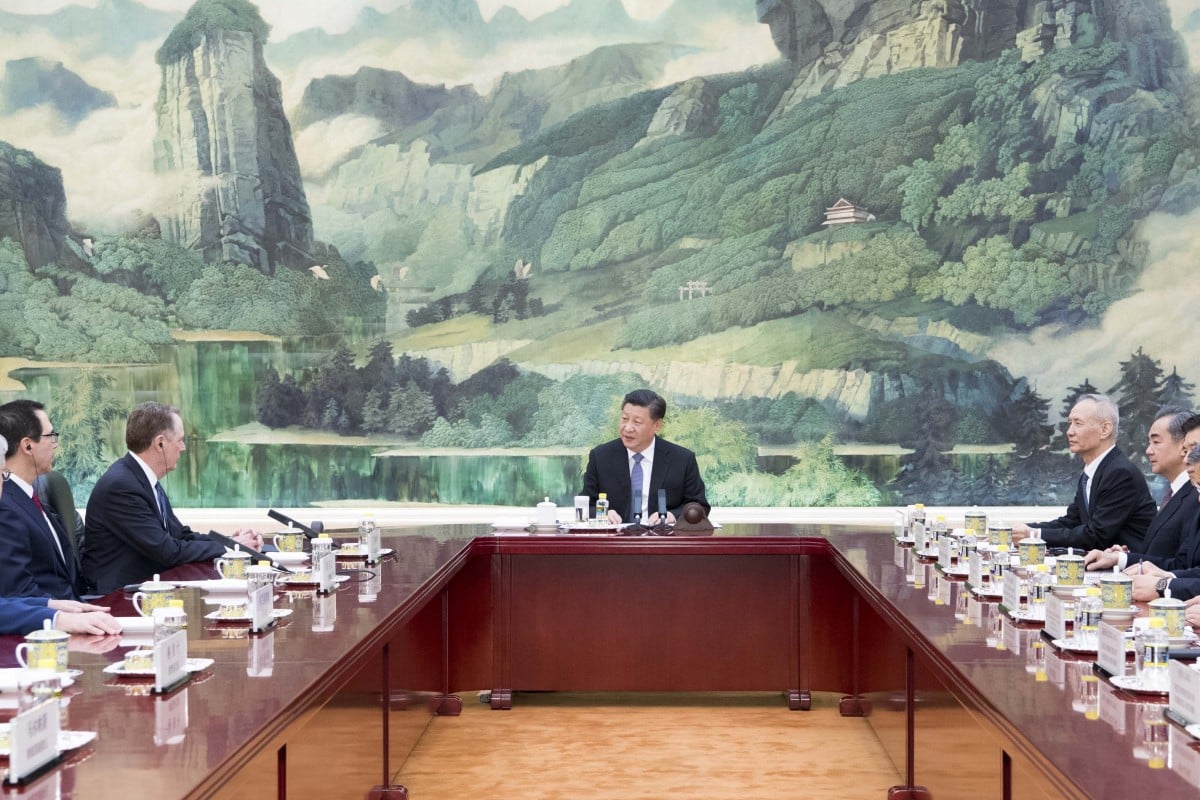
Chinese President Xi Jinping urged for a “mutually beneficial” trade deal in this week’s talks when he met US trade representative Robert Lighthizer and US Treasury Secretary Steven Mnuchin in Beijing on Friday, according to Xinhua. Photo: Xinhua
A tweet by US President Donald Trump on the ongoing trade war is a “positive” signal, brightening prospects of a deal from this week’s talks in Washington, according to an opinion piece published by China’s major state media outlets on Monday.
Monday’s opinion piece was published the day before a Chinese delegation led by Vice-Premier Liu He is expected to leave for talks in Washington.
In the tweet on Sunday, Trump said: “Important meetings and calls on China trade deal, and more, today with my staff. Big progress being made on soooo many different fronts! Our country has such fantastic potential for future growth and greatness on an even higher level!”
The opinion piece, which was published by the official Xinhua news agency, the People’s Daily and the Global Times under the pseudonym Niu Tanqin, is seen to be part of Beijing’s efforts to reassure its citizens that the trade war with the United States will soon be over.
It did contrast previous columns on Trump by the same author, who in March last year argued that China dislikes the American president for his “insatiable demands, greediness and lack of trust worthiness”.
Last week’s trade talks in Beijing produced “progress” ahead of the March 1 deadline, which could see tariffs on US$200 billion worth of Chinese products increased from 10 per cent to 25 per cent if the world’s two largest economies fail to reach a deal.
The outcome of the talks in Washington, which are likely to be the last before March 1, will largely decide whether China and the United States can reach a pact, likely in the form of a memorandum of understanding, to suspend the tariff battle that has been roiling global markets and clouding growth prospects since last year.
According to the opinion piece, Trump’s use of “soooo” instead of “so” indicated that the US president was excited when he heard reports from his trade envoys following the talks in Beijing, which Chinese President Xi Jinping attend on Friday.
Donald J. Trump
✔@realDonaldTrump
Important meetings and calls on China Trade Deal, and more, today with my staff. Big progress being made on soooo many different fronts! Our Country has such fantastic potential for future growth and greatness on an even higher level!
“The US side is attaching great importance [to the trade talks]. Although Trump is on vacation, he listened to relevant reports and he definitely will make specific instructions,” it added.
Trump has been upbeat about the prospects of reaching a trade deal with China, and said on Friday at the White House: “It’s going extremely well.”
Chinese President Xi urged for a “mutually beneficial” trade deal in this week’s talks when he met US trade representative Robert Lighthizer and US Treasury Secretary Steven Mnuchin in Beijing on Friday, according to Xinhua.
Stocks in China and Hong Kong surged on Monday, partly bolstered by the increased likelihood of a trade deal between China and the United States.
Monday’s opinion piece fits into the latest official line that an agreement is very likely to end the tariff war after the Global Times said over the weekend that the bilateral trade talks are “sprinting” towards a positive end.
Donald Trump’s demands ‘good for China’, says economist Jin Keyu
Meanwhile, reports in China suggest differences between Beijing and Washington still remain over forced technology transfer, intellectual property rights, cyber theft as well as a verification system to ensure China keeps its promises.
Xi told the US trade envoys that China is willing to “cooperate” but “cooperation has principals”, a statement showing that Beijing will not entertain US demands if it finds such demands violate China’s principals.
A White House statement on Friday said that “much work remains”, showing gaps still exist.
(Reuters) – British security officials do not support a full ban of Huawei from national telecoms networks despite U.S. allegations the Chinese firm and its products could be used by Beijing for spying, people with knowledge of the matter said.
Huawei, the world’s biggest producer of telecoms equipment, faces intense scrutiny in the West over its relationship with the Chinese government and allegations of enabling state espionage, with the United States calling for its allies not to use its technology.
Although no evidence has been produced publicly and Huawei has denied the claims, the allegations have led several Western countries to restrict its access to their markets.
“We don’t favour a complete ban. It’s not that simple,” one of the sources told Reuters on Monday after a Financial Times report on Sunday said that Britain had decided it could mitigate the risks of using Huawei equipment in 5G networks.
The FT cited two sources familiar with what it said was a conclusion by the government’s National Cyber Security Council (NCSC), which last year said technical and supply-chain issues with Huawei’s equipment had exposed national telecom networks to new security risks. Huawei had no immediate comment.
Any decision to allow Huawei to participate in building next-generation 5G networks would be closely watched by other nations, because of Britain’s membership of the Five Eyes intelligence-sharing group with the United States.
Britain is an important market for Huawei and last month Vodafone, the world’s second-largest mobile operator, said it was “pausing” the deployment of its equipment in core networks until Western governments give the Chinese firm full security clearance.
Other operators in Europe, including Britain’s BT and France’s Orange have already removed Huawei’s equipment or taken steps to limit its future use.
Two sources said the NCSC did not think it was necessary to completely bar Huawei from British networks, believing it could continue to manage any risks by testing the products at a special laboratory overseen by intelligence officials.
Both sources, who spoke on condition of anonymity because of the sensitivity of the matter, said the position was consistent with public statements made by the NCSC and British officials.
“As was made clear in July’s HCSEC oversight board, the NCSC has concerns around Huawei’s engineering and security capabilities. We have set out the improvements we expect the company to make, an NCSC spokeswoman said on Monday.
CONFIDENCE MEASURES
People with knowledge of the matter said the next NCSC report on Huawei’s position in Britain will criticise its slow response to issues raised in last year’s report and detail tense relations with British officials.
The report, which is expected to be released in coming weeks, does not itself set government policy.
The results of a government review of British telecoms infrastructure is expected later in the year and will include recommendations on managing security risks, including in future 5G networks.
Fellow Five Eyes member Australia has banned Huawei from supplying 5G equipment, while New Zealand said on Monday it would make its own independent assessment of the risk of using Huawei equipment in 5G networks.
Huawei has set up security labs in Britain and Germany aimed at building confidence that its equipment does not contain “back doors” for Chinese intelligence services.
It has also offered to build a cyber-security centre in Poland, where authorities have arrested a Chinese Huawei employee along with an ex-Polish security official.
Four soldiers have been killed in Indian-administered Kashmir in a gun battle with militants, police say.
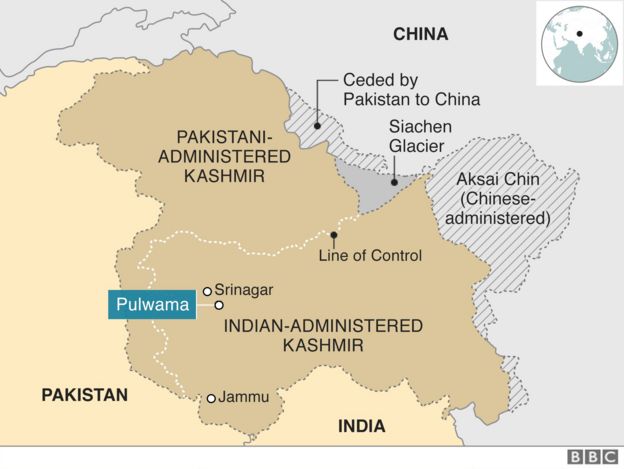
The clash occurred in Pulwama district, where more than 40 Indian paramilitary police were killed in a suicide attack on Thursday, raising tensions between nuclear-armed India and Pakistan.
A civilian and two alleged militants were also killed as Indian troops searched for suspects.
Meanwhile Pakistan recalled its ambassador for consultations.
India had already recalled its top diplomat from Pakistan in the wake of Thursday’s attack – in which it said the Pakistani state was complicit.
Pakistan denies any role in the bombing, which was claimed by a group based on its soil – Jaish-e-Mohammad (JeM)
What’s happening in Pulwama?
Police say two militants who were trapped in Pinglena village were killed in Monday’s operation. Both are JeM members and one is a Pakistani national, authorities said.
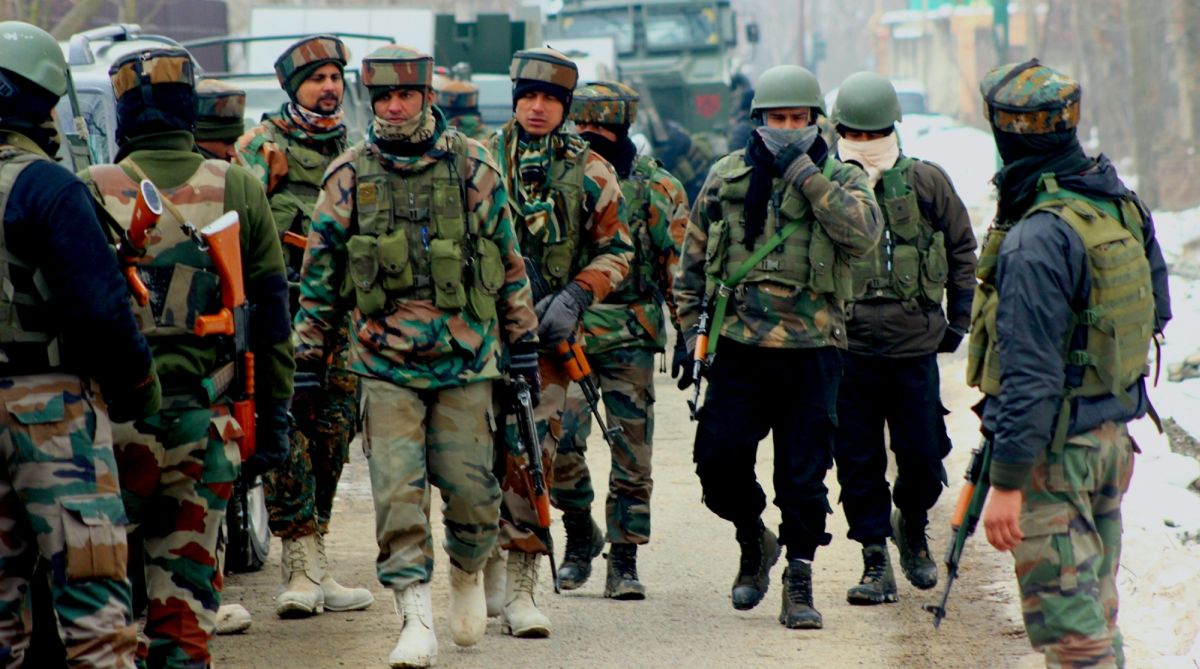
Heavy gunfire has been heard, and Indian security officials are appealing to villagers to stay indoors.
Police told BBC Urdu that when they fired “warning shots” at the house where the alleged militants were hiding, they fired back. One officer critically injured was taken to hospital.
The owner of the house was killed during the exchange of fire, police added.
Indian security forces have been hunting for militants with suspected links to JeM following Thursday’s bombing, which saw a vehicle packed with explosives ram a convoy of 78 buses carrying Indian security forces.
The suicide bomber was identified as a local Kashmiri aged between 19 and 21.
More than 20 people were detained on Sunday, according to police.
How high are tensions?
Kashmir has been a flashpoint between India and Pakistan since independence.
Both countries claim all of Muslim-majority Kashmir but control only parts of it. They have fought two wars and a limited conflict in the region.
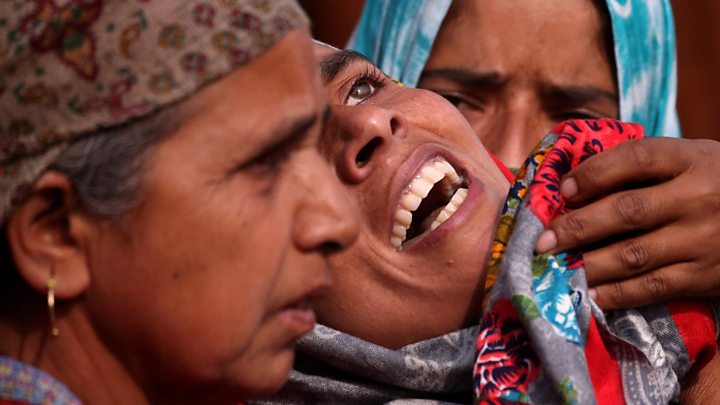
Thursday’s attack was the deadliest attack against Indian forces since an Islamist-led insurgency began in 1989. It sparked anti-Pakistan protests in some Indian cities and angry mobs targeted Kashmiri students and businessmen.
Mobile internet services in Indian-administered Kashmir were cut over the weekend and the Indian government has pulled security normally provided to at least five Kashmiri separatist leaders.
Isolated incidents of students from Kashmir being beaten up or evicted from their accommodation in northern Indian states have also been reported.
India’s Central Reserve Police Force (CRPF) offered help to students in need, but also warned of false reports.
In broader terms, there has has been a spike in violence in Indian-administered Kashmir since Indian forces killed a popular militant in 2016. Significant numbers of young men have joined the insurgency in recent years and the funerals of well-known militants draw huge crowds who want to pay respects to “martyrs”.
India has been accused of using excessive force to control protests with thousands of people suffering eye injuries or being blinded by pellet guns.
How might India retaliate?
Indian Prime Minister Narendra Modi, who is facing an election later this year, has vowed a strong response and says he will give the military free rein.
This time analysts say heavy snow in the region could make that kind of limited ground response impossible. But there are fears that going further, for example with air strikes, could lead to Pakistani retaliation and a significant escalation.
So far India has focused on retaliation by economic and diplomatic means. It has revoked Pakistan’s Most Favoured Nation trading status, raised customs duties to 200% and vowed to isolate it in the international community.
Despite tensions Pakistan is calm
By Secunder Kermani, BBC Pakistan correspondent
The threat of Indian military action has not provoked widespread concern amongst the general public in Pakistan. Previous attacks by militants like JeM, believed to have close links to the intelligence services, have been seen as attempts by the Pakistani military to prevent the civilian government developing too friendly a relationship with India.
However, since Imran Khan was elected as prime minister here, many have begun to believe both the army and his administration were united in wanting to improve cross border ties.
Whether Pakistan was involved in the attack or not, it seems unlikely concerted action will now be taken against JeM. Its leader has been in “protective custody” since another attack in 2016, but still regularly releases audio messages to followers.
The group has in the past been a useful tool for Pakistan’s intelligence services wanting to foment unrest across the border, and authorities may now be reluctant to confront them, in case they turn against the Pakistani state as some of their members have done in the past.
AMSTERDAM (Reuters) – India asked the World Court on Monday to order the release of an Indian national sentenced to death by Pakistan, saying Islamabad had failed to allow him diplomatic assistance before his conviction, as required by an international treaty.
The hearings at the U.N. court, formally known as the International Court of Justice (ICJ), revolve around the case of Kulbhushan Sudhir Jadhav, a former Indian navy commander who was arrested in Pakistan in March 2016 and convicted of spying.
Hearings in the case, which will run for four days, come at a time of intense tension between the nuclear-armed neighbours, as Indian Prime Minister Narendra Modi has warned of a “strong response” to a suicide attack on a convoy in Kashmir last week that killed 44 Indians.
“It would be in the interest of justice, of making human rights a reality, to direct his (Jadhav’s) release,” said Harish Salve, India’s senior counsel.
Pakistan is due to respond at the ICJ on Tuesday. Officials in Islamabad said ahead of the hearing that India was trying to use the court intended to resolve international disputes as a criminal appeals court. They also said the relief sought by India is disproportionate even if the treaty were violated, and at most Jadhav’s case could be reviewed.
India filed a claim against Pakistan before the ICJ in May 2017 arguing Islamabad had breached the 1963 Vienna Convention by not allowing diplomatic assistance to Jadhav during his secretive trial. India won an injunction that ordered Jadhav’s execution stayed while the court looked into the case.
No date has been set for a ruling, which will likely come months after the close of the hearings.
The ICJ is the U.N.’s highest court, and its decisions are binding — though it has no power to enforce them and they have been ignored in rare instances.
The 1963 treaty has been a frequent source of cases before the ICJ. A 2004 ruling led the United States to review the cases of dozens of Mexican citizens on U.S. death row after they were found not to have been granted consular access.
A Pakistani military court sentenced Kulbhushan Jadhav to death in April 2017 on charges of spying and terrorism after having claimed to have arrested him from its restive province Baluchistan in March 2016.
Former Indian navy officer Kulbhushan Sudhir Jadhav is seen on a screen during a news conference at the Ministry of Foreign Affairs in Islamabad, Pakistan on December 25, 2017. (Reuters)
India on Monday said its national Kulbhushan Jadhav was sentenced to death by a farcical trial by a Pakistan military court without giving him consular access to India in breach of international law and convention.
Senior lawyer Harish Salve, appearing for India at the International Court of Justice that will hear the case for four days, said Pakistan has no substantive defence in the case and hadn’t even divulged fundamental details of the so-called offences for which Kulbhushan Jadhav had been convicted.
The face off comes against the backdrop of the Pulwama terror attack last week. Over 40 CRPF jawans were killed in the suicide bombing in south Kashmir that has led to national outrage and provoked Delhi to scrap the most favoured nation status to Pakistan.
The world court had stayed Jadhav’s execution in a unanimous order in May 2017 after it was approached by New Delhi. India and Pakistan have submitted written pleadings on several occasions last year.
Jadhav, a former Navy officer, had started a business and was reported to be in Iran in this connection when, according to India, he was kidnapped in March 2016. He turned up in Pakistan a few weeks later in custody of the Pakistani military that claimed to have arrested him from Baluchistan and accused him of spying and espionage.
Salve, a former solicitor general, told the UN court that India had sent 13 reminders for consular access to Jadhav on various dates but had received no positive response from Pakistan.
He told the court that Pakistan also didn’t share any details of the investigation and the alleged “confession” was obtained from Jadhav even before registering an FIR.
“Considering the trauma he (Jadhav) has been subjected to over the past three years, it would be in the interest of justice of making human rights a reality, to direct his release,” Salve told the 15-judge court.
“India seeks relief in declaring that the trial by the military court in Pakistan… hopelessly fails to satisfy even minimum standards of due process and should be declared unlawful,” he said, attacking the Pakistani government to use the case as a means of propaganda.
Pakistan will present its arguments at the ICJ on February 19. India will reply to Pakistan’s argument on February 20. Pakistan will make its closing submission on February 21.
The ICJ is expected to deliver its judgment a few months later.
Ghazi Abdul Rashid was an aide of the Pakistan-based JeM patron, Masood Azhar, and had infiltrated into India in mid-December to train Kashmiri terrorists in IED blasts, according to authorities
SP Sharma | Jammu | February 18, 2019 4:26 pm
In a major success, security forces in Jammu and Kashmir killed two Pakistani terrorists, including Jaish-e-Mohammad (JeM) top commander Ghazi Abdul Rashid who was the mastermind of the 14 February Pulwama terror attack in which 44 CRPF jawans were martyred, in an encounter in the same of South Kashmir area on Monday. Ghazi, a trusted man of JeM patron Azhar Masood, reportedly motivated and trained a Kashmiri youth, Adil Dar, to ram his explosives-laden car into a convoy of CRPF vehicles. The nearly 10-hour-long Pulwama encounter also left four Army personnel, including a Major, and a civilian killed.
The second slain militant was identified as Bilal Ahmed Naik, who was a local Kashmiri.
The encounter took place after a joint team of the Army, the CRPF and the J&K Police cordoned off the area on Sunday night.
The martyred soldiers are Major Vibhuti Shankar Dhoundiyal, Havaldar Sheo Ram, and Sepoys Ajay Kumar and Hari Singh. After Major Chitresh Singh Bisht, who died while defusing a mine in Rajouri on Saturday, Major Dhoundiyal is the second officer of the rank from Dehradun to be attain martyrdom in Kashmir this month.
MUNICH, Germany, Feb. 16 (Xinhua) — People-to-people and cultural exchanges are thriving, making China and Europe a great example of cultural dialogue and engagement, a senior Chinese official said here Saturday.
Yang Jiechi, a member of the Political Bureau of the Communist Party of China (CPC) Central Committee, said this in his keynote speech themed “Working for a Community with a Shared Future for Mankind by Promoting International Cooperation and Multilateralism” at the 55th Munich Security Conference.
Fifteen years since the establishment of the China-EU comprehensive strategic partnership, the two sides have developed an all-dimensional and multi-tiered framework of exchanges and cooperation covering wide-ranging areas, said Yang, who is also director of the Office of the Foreign Affairs Commission of the CPC Central Committee.
Efforts to build China-EU partnerships for peace, growth, reform and civilization have made substantial progress, Yang noted.
“It is essential that our two sides continue to draw on each other’s strengths, focus on shared interests, remove obstacles and work together to seize the opportunities presented by the Fourth Industrial Revolution and meet our people’s aspirations for a better life,” said the official.
This year marks the 70th anniversary of the founding of the People’s Republic of China. Under the leadership of the Communist Party of China, Yang said, the country has embarked on the right path, one that is suited to its national conditions and follows the trend of the times.
The Chinese economy has entered a new phase of transitioning from high-speed growth to high quality development, operating within a proper range and maintaining overall stability and continued progress, he added.
“Facing lackluster new drivers and mounting downward pressure in the global economic context, China has enough resilience and huge potential to keep the economy on a sound track for a long time to come,” Yang said.
The enormous effective demand being generated by the 1.4 billion Chinese people who are moving up the income ladder will provide the world with even more opportunities in terms of market, investment and cooperation, he reassured.
German Chancellor Angela Merkel makes appeal to Beijing at Munich Security Conference as Washington prepares to leave INF treaty
But China’s top diplomat Yang Jiechi says nation’s missiles are defensive, do not pose a threat
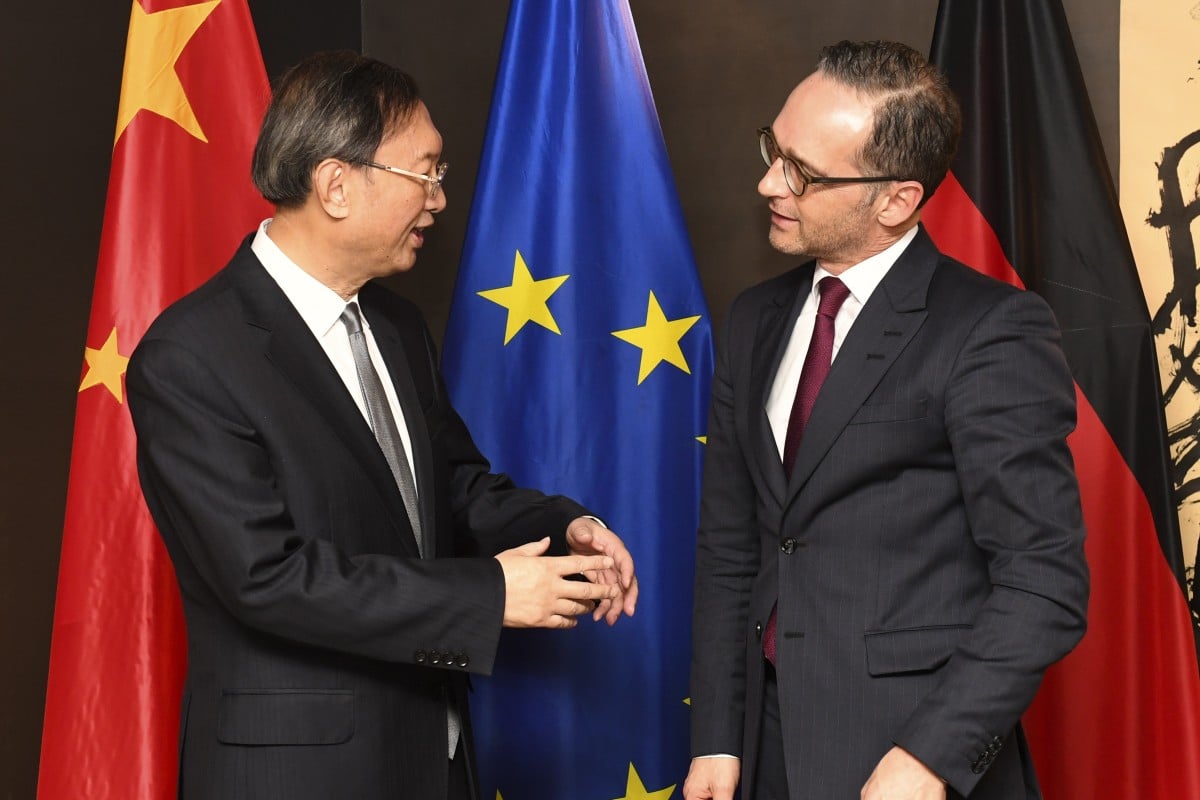
Chinea’s top envoy Yang Jiechi chats to German Foreign Minister Heiko Maas at the Munich Security Conference. Photo: AP
China on Saturday rejected German Chancellor Angela Merkel’s appeal to join a cold war-era arms control treaty that the United States accuses Russia of breaching, saying it would place unfair limits on its military.
Fearing a nuclear arms race between China, Russia and the US after the collapse of the Intermediate-Range Nuclear Forces (INF) treaty, which the US is withdrawing from, Merkel made her call for a global treaty.
“Disarmament is something that concerns us all and we would of course be glad if such talks were held not just between the United States, Europe and Russia but also with China,” she told the Munich Security Conference.
Is China about to abandon its ‘no first use’ nuclear weapons policy?
Russia and the United States are the signatories to the 1987 INF treaty that bans land-based missiles with a range between 500km (310 miles) and 5,500km, and which US President Donald Trump started the six-month withdrawal from this month, blaming Russian violations.
Moscow denies any wrongdoing, but the US and its Nato allies want Russia to destroy its 9M729 nuclear-capable cruise missile system, which Washington says could allow Russia to strike Europe with almost no warning.
Merkel’s suggestion of involving China in a negotiation is seen by European Nato diplomats as a potential way out of the impasse because a new treaty could address American concerns about a growing military threat from China and Russia.
But China’s top diplomat Yang Jiechi, who spoke on a panel in Munich, said that Chinese missiles were defensive.
“China develops its capabilities strictly according to its defensive needs and doesn’t pose a threat to anybody else. So we are opposed to the multilateralisation of the INF,” he said.
China’s stated ambition is to modernise its People’s Liberation Army by 2035, improve its air force and push into new technologies including very high speed cruise missiles and artificial intelligence.
Its defence budget grew nearly 6 per cent between 2017 and 2018, according to the London-based International Institute for Security Studies.
Chinese scientists make progress on nuclear submarine communication
Retired Chinese general Yao Yunzhu told delegates a new arms control agreement would only work if it included sea- and air-launched missiles, as well as land, because most of China’s military technology was ground-based and the country would not want to put itself at a disadvantage.
Cheaper to build, more mobile and easier to hide, ground-based rocket launchers are an attractive option for China as it develops its armed forces, experts said, whereas the United States operates more costly sea-based systems to comply with the INF.
“China is traditionally a land power and the Chinese military is a ground force,” Yao said.
“If China is to enter into these kinds of negotiations, I think it ought to be more comprehensive to include not only land-based but also air and sea-based strike capabilities … and that would be hugely complicated,” she said.







 CHINDIA ALERT: You'll be living in their world, very soon