Chindia Alert: You’ll be Living in their World Very Soon
aims to alert you to the threats and opportunities that China and India present. China and India require serious attention; case of ‘hidden dragon and crouching tiger’.
Without this attention, governments, businesses and, indeed, individuals may find themselves at a great disadvantage sooner rather than later.
The POSTs (front webpages) are mainly 'cuttings' from reliable sources, updated continuously.
The PAGEs (see Tabs, above) attempt to make the information more meaningful by putting some structure to the information we have researched and assembled since 2006.
Image copyright PRESS INFORMATION BUREAUImage caption The area has become a hotspot in part because of a road India has built
The armies of the world’s two most populous nations are locked in a tense face-off high in the Himalayas, which has the potential to escalate as they seek to further their strategic goals.
Officials quoted by the Indian media say thousands of Chinese troops have forced their way into the Galwan valley in Ladakh, in the disputed Kashmir region.
Indian leaders and military strategists have clearly been left stunned.
The reports say that in early May, Chinese forces put up tents, dug trenches and moved heavy equipment several kilometres inside what had been regarded by India as its territory. The move came after India built a road several hundred kilometres long connecting to a high-altitude forward air base which it reactivated in 2008.
The message from China appears clear to observers in Delhi – this is not a routine incursion.
“The situation is serious. The Chinese have come into territory which they themselves accepted as part of India. It has completely changed the status quo,” says Ajai Shukla, an Indian military expert who served as a colonel in the army.
China takes a different view, saying it’s India which has changed facts on the ground.
Reports in the Indian media said soldiers from the two sides clashed on at least two occasions in Ladakh. Stand-offs are reported in at least three locations: the Galwan valley; Hot Springs; and Pangong lake to the south.
India and China share a border more than 3,440km (2,100 miles) long and have overlapping territorial claims. Their border patrols often bump into each other, resulting in occasional scuffles but both sides insist no bullet has been fired in four decades.
Their armies – two of the world’s largest – come face to face at many points. The poorly demarcated Line of Actual Control (LAC) separates the two sides. Rivers, lakes and snowcaps mean the line separating soldiers can shift and they often come close to confrontation.
The current military tension is not limited to Ladakh. Soldiers from the two sides are also eyeball-to-eyeball in Naku La, on the border between China and the north-eastern Indian state of Sikkim. Earlier this month they reportedly came to blows.
And there’s a row over a new map put out by Nepal, too, which accuses India of encroaching on its territory by building a road connecting with China.
Why are tensions rising now?
There are several reasons – but competing strategic goals lie at the root, and both sides blame each other.
“The traditionally peaceful Galwan River has now become a hotspot because it is where the LAC is closest to the new road India has built along the Shyok River to Daulet Beg Oldi (DBO) – the most remote and vulnerable area along the LAC in Ladakh,” Mr Shukla says.
India’s decision to ramp up infrastructure seems to have infuriated Beijing.
Image copyright AFPImage caption There have been protests in Nepal against Indi’s new road link
“According to the Chinese military, India is the one which has forced its way into the Galwan valley. So, India is changing the status quo along the LAC – that has angered the Chinese,” says Dr Long Xingchun, president of the Chengdu Institute of World Affairs (CIWA), a think tank.
Michael Kugelman, deputy director of the Asia programme at the Wilson Center, another think tank, says this face-off is not routine. He adds China’s “massive deployment of soldiers is a show of strength”.
The road could boost Delhi’s capability to move men and material rapidly in case of a conflict.
Differences have been growing in the past year over other areas of policy too.
The new federally-administered Ladakh included Aksai Chin, an area India claims but China controls.
Senior leaders of India’s Hindu-nationalist BJP government have also been talking about recapturing Pakistan-administered Kashmir. A strategic road, the Karakoram highway, passes through this area that connects China with its long-term ally Pakistan. Beijing has invested about $60bn (£48bn) in Pakistan’s infrastructure – the so-called China Pakistan Economic corridor (CPEC) – as part of its Belt and Road Initiative and the highway is key to transporting goods to and from the southern Pakistani port of Gwadar. The port gives China a foothold in the Arabian Sea.
In addition, China was unhappy when India initially banned all exports of medical and protective equipment to shore up its stocks soon after the coronavirus pandemic started earlier this year.
How dangerous could this get?
“We routinely see both armies crossing the LAC – it’s fairly common and such incidents are resolved at the local military level. But this time, the build-up is the largest we have ever seen,” says former Indian diplomat P Stobdan, an expert in Ladakh and India-China affairs.
“The stand-off is happening at some strategic areas that are important for India. If Pangong lake is taken, Ladakh can’t be defended. If the Chinese military is allowed to settle in the strategic valley of Shyok, then the Nubra valley and even Siachen can be reached.”
In what seems to be an intelligence failure, India seems to have been caught off guard again. According to Indian media accounts, the country’s soldiers were outnumbered and surrounded when China swiftly diverted men and machines from a military exercise to the border region.
This triggered alarm in Delhi – and India has limited room for manoeuvre. It can either seek to persuade Beijing to withdraw its troops through dialogue or try to remove them by force. Neither is an easy option.
“China is the world’s second-largest military power. Technologically it’s superior to India. Infrastructure on the other side is very advanced. Financially, China can divert its resources to achieve its military goals, whereas the Indian economy has been struggling in recent years, and the coronavirus crisis has worsened the situation,” says Ajai Shukla.
What next?
History holds difficult lessons for India. It suffered a humiliating defeat during the 1962 border conflict with China. India says China occupies 38,000km of its territory. Several rounds of talks in the last three decades have failed to resolve the boundary issues.
China already controls the Aksai Chin area further east of Ladakh and this region, claimed by India, is strategically important for Beijing as it connect its Xinjiang province with western Tibet.
Image copyright GETTY IMAGESImage caption India and China have a long history of border disputes
In 2017 India and China were engaged in a similar stand-off lasting more than two months in Doklam plateau, a tri-junction between India, China and Bhutan.
This time, too, talks are seen as the only way forward – both countries have so much to lose in a military conflict.
“China has no intention to escalate tensions and I think India also doesn’t want a conflict. But the situation depends on both sides. The Indian government should not be guided by the nationalistic media comments,” says Dr Long Xingchun of the CIWA in Chengdu. “Both countries have the ability to solve the dispute through high-level talks.”
Chinese media have given hardly any coverage to the border issue, which is being interpreted as a possible signal that a route to talks will be sought.
Pratyush Rao, associate director for South Asia at Control Risks consultancy, says both sides have “a clear interest in prioritising their economic recovery” and avoiding military escalation.
“It is important to recognise that both sides have a creditable record of maintaining relative peace and stability along their disputed border.”
WASHINGTON/NEW DELHI (Reuters) – U.S. President Donald Trump said on Wednesday he had offered to mediate a standoff between India and China at the Himalayan border, where soldiers camped out in a high-altitude region have accused each other of trespassing over the disputed border.
“We have informed both India and China that the United States is ready, willing and able to mediate or arbitrate their now raging border dispute,” Trump said in a Twitter post.
The standoff was triggered by India’s construction of roads and air strips in the region as it competes with China’s spreading Belt and Road initiative, involving infrastructure development and investment in dozens of countries, Indian observers said on Tuesday.
Both were digging defences and Chinese trucks have been moving equipment into the area, the officials said, raising concerns about an extended standoff.
There was no immediate response from either India or China to Trump’s offer. Both countries have traditionally opposed any outside involvement in their matters and are unlikely to accept any U.S. mediation, experts said.
China’s ambassador to India, Sun Weidong, struck a conciliatory note, saying the two Asian countries should not let their differences overshadow the broader bilateral relationship.
“We should adhere to the basic judgment that China and India are each other’s opportunities and pose no threat to each other. We need to see each other’s development in a correct way and enhance strategic mutual trust,” he said, speaking in a webinar on China’s experience of fighting COVID-19.
“We should correctly view our differences and never let the differences shadow the overall situation of bilateral cooperation.”
The two countries are engaged in talks to defuse the border crisis, an Indian government source said. “These things take time, but efforts are on at various levels, military commanders as well as diplomats,” the source said.
The Chinese side has been insisting that India stop construction near the Line of Actual Control or the de facto border. India says all the work is being done on its side of the border and that China must pull back its troops.
Trump in January offered to “help” in another Himalayan trouble spot, the disputed region of Kashmir that is at the center of a decades-long quarrel between India and Pakistan.
But the U.S. offer triggered a political storm in India, which has long bristled at any suggestion of third-party involvement in tackling Kashmir which it considers an integral part of the country.
NEW DELHI/SRINAGAR (Reuters) – A Himalayan border standoff between old foes India and China was triggered by India’s construction of roads and air strips in the region as it competes with China’s spreading Belt and Road initiative, Indian observers said on Tuesday.
Soldiers from both sides have been camped out in the Galwan Valley in the high-altitude Ladakh region, accusing each other of trespassing over the disputed border, the trigger of a brief but bloody war in 1962.
About 80 to 100 tents have sprung up on the Chinese side and about 60 on the Indian side where soldiers are billeted, Indian officials briefed on the matter in New Delhi and in Ladakh’s capital, Leh, said.
Both were digging defences and Chinese trucks have been moving equipment into the area, the officials said, raising concerns of a long faceoff.
“China is committed to safeguarding the security of its national territorial sovereignty, as well as safeguarding peace and stability in the China-India border areas,” the Chinese Foreign Ministry spokesperson’s office said in a statement.
“At present, the overall situation in the border areas is stable and controllable. There are sound mechanisms and channels of communication for border-related affairs, and the two sides are capable of properly resolving relevant issues through dialogue and consultation.”
There was no immediate Indian foreign ministry comment. It said last week Chinese troops had hindered regular Indian patrols along the Line of Actual Control (LAC).
But interviews with former Indian military officials and diplomats suggest the trigger for the flare-up is India’s construction of roads and air strips.
“Today, with our infrastructure reach slowly extending into areas along the LAC, the Chinese threat perception is raised,” said former Indian foreign secretary Nirupama Rao.
“Xi Jinping’s China is the proponent of a hard line on all matters of territory, sovereignty. India is no less when it comes to these matters either,” she said.
After years of neglect Prime Minister Narendra Modi’s government has pushed for improving connectivity and by 2022, 66 key roads along the Chinese border will have been built.
One of these roads is near the Galwan valley that connects to Daulat Beg Oldi air base, which was inaugurated last October.
“The road is very important because it runs parallel to the LAC and is linked at various points with the major supply bases inland,” said Shyam Saran, another former Indian foreign secretary.
“It remains within our side of the LAC. It is construction along this new alignment which appears to have been challenged by the Chinese.”
China’s Belt and Road is a string of ports, railways, roads and bridges connecting China to Europe via central and southern Asia and involving Pakistan, China’s close ally and India’s long-time foe.
But trade with partner countries might not be as badly affected as with countries elsewhere in the world, observers say
China’s trade with belt and road countries rose by 3.2 per cent in the January-March period, but second-quarter results will depend on how well they manage to contain the pathogen, academic says
China’s investment in foreign infrastructure as part of its Belt and Road Initiative has been curtailed because of the coronavirus pandemic. Photo: Xinhua
The coronavirus pandemic is set to cause a slump in Chinese investment in its signature
and a dip in trade with partner countries that could take a year to overcome, analysts say.
But the impact of the health crisis on China’s economic relations with nations involved in the ambitious infrastructure development programme might not be as great as on those that are not.
China’s total foreign trade in the first quarter of 2020 fell by 6.4 per cent year on year, according to official figures from Beijing.
Trade with the United States, Europe and Japan all dropped in the period, by 18.3, 10.4 and 8.1 per cent, respectively, the commerce ministry said.
By comparison, China’s trade with belt and road countries increased by 3.2 per cent in the first quarter, although the growth figure was lower than the 10.8 per cent reported for the whole of 2019.
China’s trade with 56 belt and road countries – located across Africa, Asia, Europe and South America – accounts for about 30 per cent of its total annual volume, according to the commerce ministry.
Despite the first-quarter growth, Tong Jiadong, a professor of international trade at Nankai University in Tianjin, said he expected China’s trade with belt and road countries to fall by between 2 and 5 per cent this year.
His predictions are less gloomy than the 13 to 32 per cent contraction in global trade forecast for this year by the World Trade Organisation.
“A drop in [China’s total] first-quarter trade was inevitable but it slowly started to recover as it resumed production, especially with Southeast Asian, Eastern European and Arab countries,” Tong said.
“The second quarter will really depend on how the epidemic is contained in belt and road countries.”
Nick Marro, Hong Kong-based head of global trade at the Economist Intelligence Unit, said he expected China’s total overseas direct investment to fall by about 30 per cent this year, which would be bad news for the belt and road plan.
“This will derive from a combination of growing domestic stress in China, enhanced regulatory scrutiny over Chinese investment in major international markets, and weakened global economic prospects that will naturally depress investment demand,” he said.
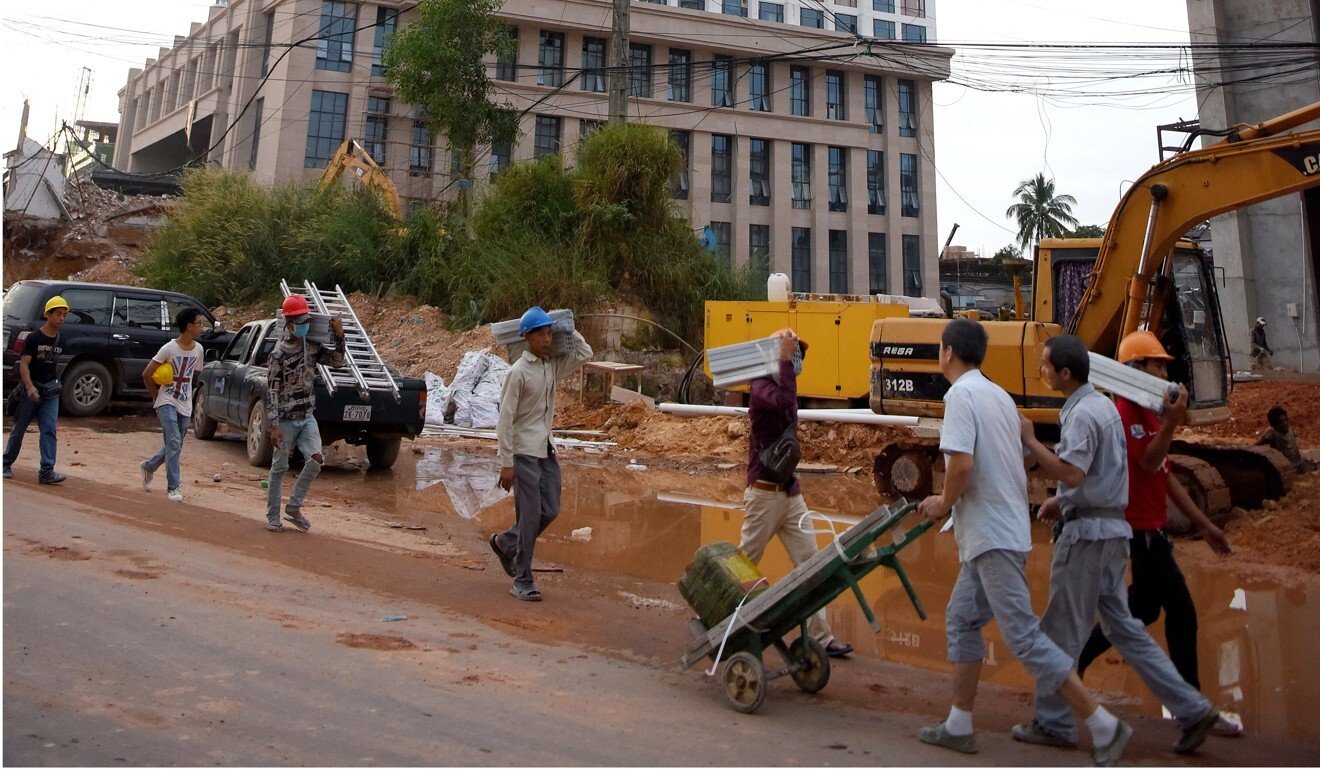
The development of the Chinese built and operated special economic zone in the Cambodian town of Sihanoukville is reported to have slowed, while infrastructure projects in Bangladesh, including the Payra coal-fired power plant, have been put on hold.
The development of the Chinese built and operated special economic zone in the Cambodian town of Sihanoukville is reported to have slowed. Photo: AFP
Marro said the reduction of capital and labour from China might complicate other projects for key belt and road partner, like Pakistan, which is home to infrastructure projects worth tens of billions of US dollars, and funded and built in large part by China.
“Pakistan looks concerning, particularly in terms of how we’ve assessed its sovereign and currency risk,” Marro said.
“Public debt is high compared to other emerging markets, while the coronavirus will push the budget deficit to expand to 10 per cent of GDP [gross domestic product] this year.”
Last week, Pakistan asked China for a 10-year extension to the repayment period on US$30 billion worth of loans used to fund the development of infrastructure projects, according to a report by local newspaper Dawn.
China’s overseas investment has been falling steadily from its peak in 2016, mostly as a result of Beijing’s curbs on capital outflows.
Last year, the direct investment by Chinese companies and organisations other than banks in belt and road countries fell 3.8 per cent from 2018 to US$15 billion, with most of the money going to South and Southeast Asian countries, including Singapore, Vietnam, Indonesia and Pakistan.
Tong said the pandemic had made Chinese investors nervous about putting their money in countries where disease control measures were becoming increasingly stringent, but added that the pause in activity would give all parties time to regroup.
“Investment in the second quarter will decline and allow time for the questions to be answered,” he said.
“Past experience along the belt and road has taught many lessons to both China and its partners, and forced them to think calmly about their own interests. The epidemic provides both parties with a good time for this.”
Dr Frans-Paul van der Putten, a senior research fellow at Clingendael Institute in the Netherlands, said China’s post-pandemic strategy for the belt and road in Europe
might include a shift away from investing in high-profile infrastructure projects like ports and airports.
Investors might instead cooperate with transport and logistics providers rather than invest directly, he said.
“Even though in the coming years the amount of money China loans and invests abroad may be lower than in the peak years around 2015-16, I expect it to maintain the belt and road plan as its overall strategic framework for its foreign economic relations,” he said.
Israeli medical equipment firm IceCure Medical, with an initial US$4 million sales and marketing effort, will open its first Chinese office in Shanghai
English shopping outlet company Value Retail sees the chance to lure consumers who have been under lockdowns aimed at halting the spread of the coronavirus
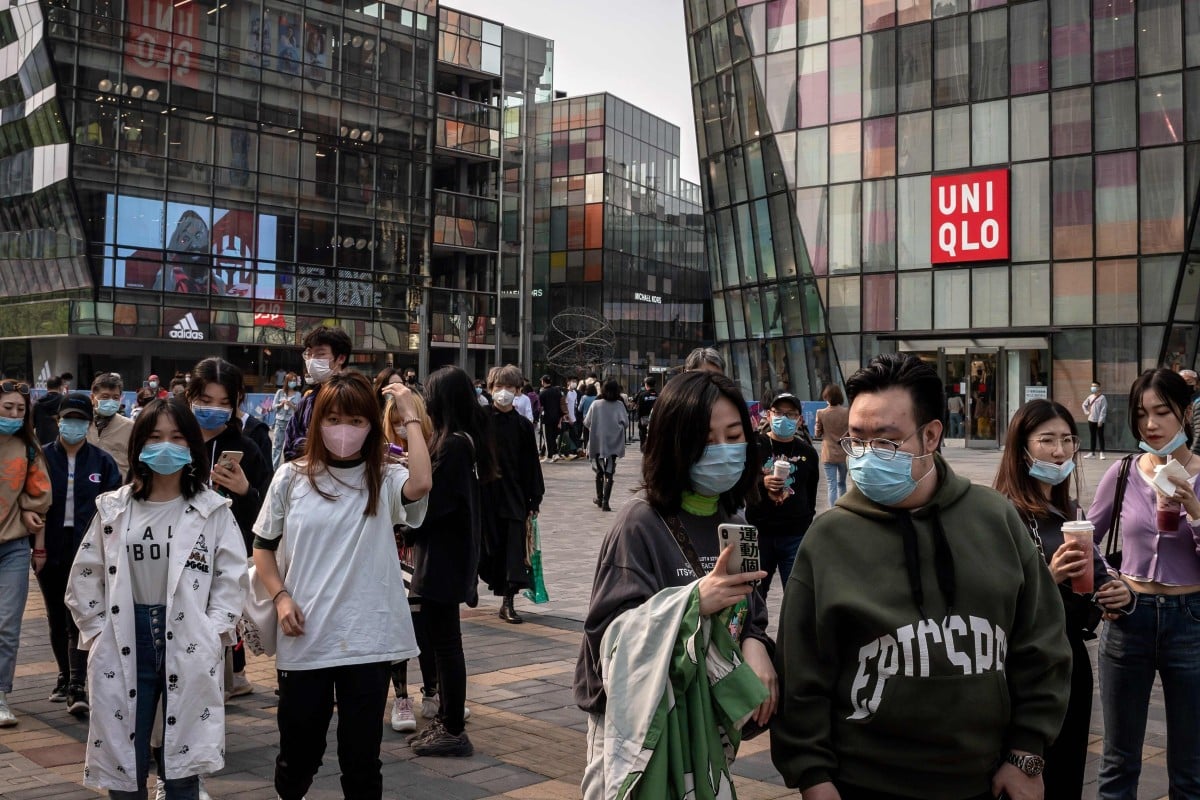
Foreign firms, including Israeli medical equipment maker IceCure Medical and English shopping outlet company Value Retail, still see opportunities in China despite the coronavirus. Photo: AFP
Not only has the coronavirus pandemic not watered down one company’s expansion plans for China, it has given it even greater reason to push forward into the Chinese market.
Israeli company IceCure Medical is forging ahead with opening its first Chinese office in Shanghai, with plans to spend up to US$4 million for the initial sales and marketing effort for its non-surgical breast cancer treatments.
Chief executive Eyal Shamir said he has seen an uptick in Chinese interest in the company’s ProSense product, which allows the freezing of tumours outside a hospital environment, because it can free up facilities badly needed for Covid-19 patients.
The government approval of the company’s Chinese subsidiary is now only days away following a successful product console registration, according to Shamir, and it has already sold two units to the Fudan University Shanghai Cancer Centre for a clinical study.
World Health Organisation warns the ‘worst still ahead’ in coronavirus pandemic
“We are planning a full launch of the product in China for both breast cancer and breast benign tumours as well as other organs,” Shamir said.
“Post Covid-19, there will be a backlog of many surgeries and not only for breast cancer patients.”
IceCure Medical, though, is not the only foreign company eyeing expansion into China despite the risk of secondary outbreaks of coronavirus.
West of Shanghai, English shopping outlet company Value Retail is also expanding its retail space, banking on Chinese shoppers re-emerging from lockdowns to begin
After being cooped at home for weeks, people want to be outdoors to enjoy the beautiful spring weather – Value Retail
Value Retail is proceeding with plans to enlarge its Suzhou Village shopping centre from 35,000 square metres (378,000 sq ft) to over 50,000 square metres, while also increasing the number of shops from 120 to 200, which will make it the largest of the 11 venues its controls globally.
It is working closely with the Yang Cheng Lake Peninsula government on a date for construction to start, after seeing a surprising increase in retail sales at its centres in early April. The company’s Chinese subsidiary, Value Retail China, attributed the rise to an increasing number of consumers wanting to “get outside” of their homes after being isolated for several weeks.
Suzhou Village sales have increased 40 per cent each week since the start of April, the company said.
“Thanks to the positive recovery [in spending] over the past several weeks, we are going ahead with the Suzhou Village expansion,” the company said in a statement. “After being cooped at home for weeks, people want to be outdoors to enjoy the beautiful spring weather. We provide a shopping experience for guests in an outdoor environment … the motivation for such an experience after isolation is huge. [Being] outdoors is seen as a luxury now.”
In addition, customers are flocking to both its Suzhou and Shanghai Village centres as a form of domestic tourism because of the curb on overseas travel, Value Retail China said.
Despite the economic destruction that the coronavirus pandemic has caused in China, it also is opening up expansion opportunities for entrepreneurial firms in several industries, such as e-commerce and online delivery, life sciences and infrastructure construction, said EY Asia-Pacific transaction advisory services leader Harsha Basnayake.
However, while businesses within Asia-Pacific expressed a desire for opportunistic expansions, most companies still held a pessimistic view of economic recovery that would drag on into 2021.
American companies already operating in China were even less optimistic with over 70 per cent of businesses surveyed by the American Chamber of Commerce in March saying they were reluctant about expanding in the coming year.
Although it is too early to say if retail property will rise – particularly when we are seeing new habits forming, going from shopfronts to online and how far this new behaviour will stick. China will gives us lots of lessons on this. – Harsha Basnayake
“We are expecting opportunities in real estate, particularly in commercial property and logistics, and we think industries in life sciences, some parts of health care and infrastructure will be interesting,” Basnayake said.
“Although it is too early to say if retail property will rise – particularly when we are seeing new habits forming, going from shopfronts to online and how far this new behaviour will stick. China will gives us lots of lessons on this.”
The Chinese government’s move to increase infrastructure spending to boost the economy will also benefit certain industries, such as cement production.
Despite suffering a 24 per cent drop in sales in the first quarter due to virus-related delays in construction activities, China’s largest cement manufacturer, Anhui Conch Cement, is likely to move forward with plans to expand in part due to its participation in the Belt and Road Initiative, according to analysts at S&P Global.
Though no one would be able to tell exactly what will happen when the Covid-19 uncertainties are not completely gone, signs of recovery in China have brought encouragement to us – Justin Channe
Desires to expand are also not limited to these industries, and even the hard-hit hotel industry is starting to show green shoots.
International hotel chain IHG said that the coronavirus would not derail its new Regent-branded hotel project in Chengdu, which is expected to start construction later this year.
“Though no one would be able to tell exactly what will happen when the Covid-19 uncertainties are not completely gone, signs of recovery in China have brought encouragement to us,” said Regent Hotels & Resorts managing director Justin Channe.
“While we saw business pickup across China over the past Qing Ming Festival holiday, Chengdu and its nearby destinations were among the leading ones. In the long run, we stay confident of the outlook for the China hotel industry, including the luxury segment.”
Analysing how coronavirus broke China’s historic economic growth run
Beyond the crisis, there will be ample opportunities for new merger and acquisitions (M&A) amid business restructures and failures, particularly in China, Basnayake added.
A new EY survey found 52 per cent of Asia-Pacific businesses planned on pursuing M&A in the next year.
“While the crisis is having a severe impact on M&A sentiment, there’s evidence from the survey that M&A activity intentions remain steady in the long term. There are many who recognise this is a time where valuations will be reset, and there will be stressed and distressed acquisition opportunities,” Basnayake said.
“For example, from our interviews with corporations in China, a majority said that Covid-19 has not impacted their M&A strategies, noting that the situation has not led to any cancellations or withdrawals from deals, but only in delays in closing deals.”
The spring session of China’s Canton Fair has been postponed due to fears about the spread of the coronavirus pandemic, authorities in Guangdong province say
Premier Li Keqiang had insisted early this month that the fair’s spring session would go ahead as it was crucial for efforts to ‘stabilise’ the global economy
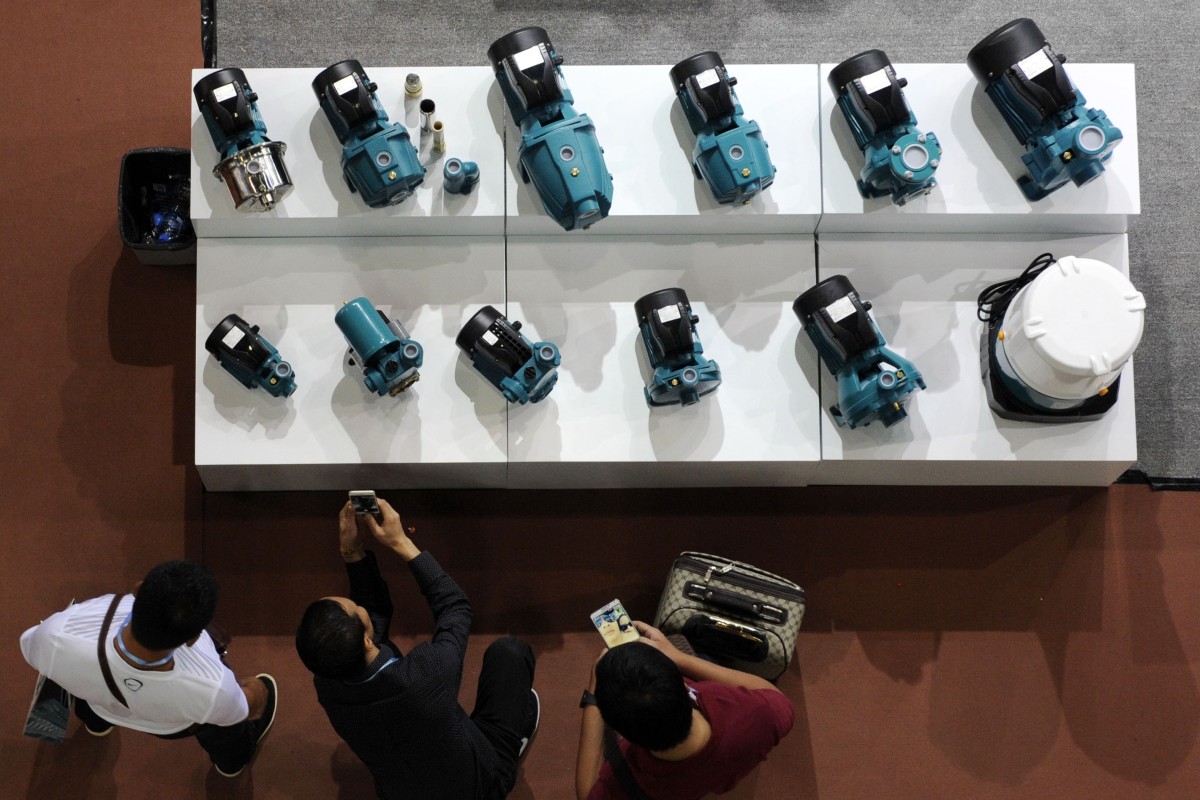
The spring session of China’s Canton Fair has been postponed due to the coronavirus outbreak. Photo: Xinhua
The spring session of China’s largest trade expo, the Canton Fair, has been suspended over concerns about the spread of the coronavirus, Chinese authorities said on Monday.
The announcement comes amid reports that regular foreign buyers were scrapping plans to attend the event, which was due to open on April 15. The fair has held its spring session in Guangzhou, the capital of Guangdong province, between mid-April and early May since 1957.
The decision was made after considering the current development of the pandemic, especially the high risk of imported infections, Ma Hua, deputy director of Guangdong’s department of commerce, was quoted as saying on Monday by the official Nanfang Daily.
Guangdong will assess the epidemic situation and make suggestions to the relevant departments of the central government, Ma said at a press conference.
No new date for the fair was announced, but veteran traders who regularly attend the event said the Guangdong government is talking with Beijing about a new time, possibly in May.
Premier Li Keqiang had insisted early this month that the fair’s spring session would go ahead despite the virus outbreak, as it was an important part of Beijing’s efforts to
Authorities of Guangdong, China’s main export and manufacturing hub, joined other large cities, including Beijing and Shanghai, in introducing new restrictions on Saturday that require all foreign visitors be isolated for 14 days at their own expense.
The containment measures, which come as China braces for a second wave
of imported coronavirus cases, would have applied to tens of thousands of foreign merchants attending the fair.
Coronavirus: Chinese companies cut salaries and staff in industries hit hardest by Covid-19
The Canton Fair occurs twice a year and is China’s oldest and largest exhibition. The spring session last year attracted 195,454 foreign buyers from 213 countries and regions across the world. The top five sources of buyers were from Hong Kong, India, the United States, South Korea and Thailand.
But a growing number of regular attendees have recently cancelled plans to take part in this year’s spring session, Chinese exporters said, as concerns mount about possible infection and extra expenses due to a mandatory two week quarantine after arrival.
“About 80 per cent of our firm’s veteran clients told us last month they won’t come this time,” said Jason Liang, a sales manager at a Guangzhou-based exporter of electronic products, who did not want his company identified. “Plus with this new [quarantine], I think at least 90 per cent or almost all of them would drop the trip.
“The costs – time, security and expense – are totally uncontrollable for international travel currently. We also have no plans to attend any exhibition before the summer.”
About 80 per cent of our firm’s veteran clients told us last month they won’t come this time … The costs – time, security and expense – are totally uncontrollable for international travel currently. Jason Liang
Felly Mwamba, a leader of the Congolese community in Guangzhou who has been in the city since 2003, said China’s quarantine measures made it hard for people to visit Guangzhou.
Xie Jun, a furniture and fabric exporter from Zhejiang, said buyers from developing countries that were part of the Belt and Road Initiative would be hard hit if they were forced to pay for quarantine and treatment.
“In February before the pandemic occurred, to cushion the impact some local governments in China’s exporting trade hubs, such as Yiwu and Jinhua, introduced subsidies to attract foreign merchants,” he said. “But now all the subsidies policies are cancelled from what I know.”
Coronavirus and the ‘war economy’: the US and China bicker as the shop goes down
Chinese exporters, traders, and even local residents in Guangdong, have previously voiced concern about authorities’ decision to press on with the even due to the growing number of imported cases to China.
“We strongly call on the government to cancel the spring session of the Canton Fair,” said Zhu Yinghua, a retired teacher in Guangzhou, said before the announcement.
“It’s too dangerous for us local residents if dozens of thousands of foreigners to flock into Guangzhou.”
Chinese State Councilor and Foreign Minister Wang Yi holds talks with Serbian First Deputy Prime Minister and Foreign Minister Ivica Dacic at the Diaoyutai State Guesthouse in Beijing, capital of China, Feb. 26, 2020. (Xinhua/Huang Jingwen)
BEIJING, Feb. 26 (Xinhua) — Chinese State Councilor and Foreign Minister Wang Yi held talks with Serbian First Deputy Prime Minister and Foreign Minister Ivica Dacic Wednesday in Beijing.
Wang said that China and Serbia are like-minded brothers who stick with each other through thick and thin, good partners in jointly promoting the Belt and Road Initiative and good friends in advancing China-Europe cooperation.
He called on both sides to uphold the open and inclusive multilateralism, oppose any kind of bullying, and work together with the international society to build a community of shared future for mankind.
Noting that the comprehensive strategic partnership between the two countries has been operating at a high level, Dacic said the novel coronavirus epidemic has not affected bilateral pragmatic cooperation in all fields.
The Serbian side openly and firmly supports the one-China principle, as well as China’s core interests and major concerns on Taiwan, Xinjiang and Hong Kong issues, he said.
NAYPYITAW (Reuters) – China and Myanmar inked dozens of deals on Saturday to speed up infrastructure projects in the Southeast Asian nation, as Beijing seeks to cement its hold over a neighbour increasingly isolated by the West.
But no major new projects were agreed during the two-day visit by President Xi Jinping, the first of any Chinese leader in 19 years. Analysts said Myanmar was generally cautious of investments by Beijing and was also being careful ahead of elections later this year.
Still, Xi and Myanmar leader Aung San Suu Kyi signed 33 agreements shoring up key projects that are part of the flagship Belt and Road Initiative, China’s vision of new trade routes described as a “21st century silk road”.
They agreed to hasten implementation of the China Myanmar Economic Corridor, a giant infrastructure scheme worth billions of dollars, with agreements on railways linking southwestern China to the Indian Ocean, a deep sea-port in conflict-riven Rakhine state, a special economic zone on the border, and a new city project in the commercial capital of Yangon.
They did not address a controversial $3.6 billion Beijing-backed mega dam, where work has been stalled since 2011, reflecting the contentiousness of Chinese investment in Myanmar, where many are uncomfortable with the sway Beijing has over its smaller neighbour.
“While a large number of different agreements have been signed, there is no Big Bang here,” said Richard Horsey, a Yangon-based analyst with the International Crisis Group.
“The overall impression is that Myanmar is being cautious about Chinese investment, especially ahead of elections planned later in the year, he said.
“China will be hoping that this is an incremental step towards realizing its mega-infrastructure goals, and that further progress can be locked in over the coming months,” he said.
‘DERAILED’ BY WEST
At a welcoming ceremony on Friday, Xi hailed a “new era” of relations between the countries.
“We are drawing a future roadmap that will bring to life bilateral relations based on brotherly and sisterly closeness in order to overcome hardships together and provide assistance to each other,” Xi said. He was scheduled to leave later on Saturday.
Suu Kyi called China “a great country playing an important role in the international affairs and the world economy” but urged for economic projects that avoid environmental degradation and benefit locals.
Xi also met leaders from political parties in ethnic areas riven with civil conflict where Chinese infrastructure projects are underway.
Sai Kyaw Nyunt, joint-secretary of the Shan Nationalities League for Democracy, one of the ethnic politicians invited to meet Xi, said it was only a handshake.
“Our country is very small and powerless,” he said, “So they treat us that way.”
The two countries have historically had a fraught relationship, but have moved closer since 2017, when Myanmar was internationally condemned for its treatment of minority Rohingya Muslims in Rakhine state.
More than 730,000 Rohingya were forced to flee western Myanmar after a military crackdown that the United Nations has said was executed with “genocidal intent”. China has defended the country on the global stage and is viewed as the biggest obstacle to a prosecution of its leaders at an international war crimes tribunal.
An article in Chinese state media ahead of the state visit said Myanmar had been “derailed” by its engagement with the West and only China was willing to “pull Myanmar from the sludge”.
“But after some turbulence, Myanmar realized there were double standards in the approach Western countries had taken on human rights issues and began to turn to China for diplomatic and economic help,” the article in the Global Times said.
DAKAR, Dec. 27 (Xinhua) — China has continued to be a key partner for Senegal in 2019, supporting its implementation of the Plan for an Emerging Senegal, proposed by Senegalese president Macky Sall.
Fourteen years after the resumption of diplomatic relations between Beijing and Dakar, China occupies an essential place in Senegal’s political and trade relationships.
At the beginning of the year, during a visit of Chinese State Councilor and Foreign Minister Wang Yi, Senegalese president Sall said the Senegal-China relationship is dynamic, practical and effective, hailing it as a model. He said the Senegalese side hopes to further deepen cooperation with China in various fields.
According to the Chinese Embassy in Senegal, trade between the two partners, at 2.27 billion U.S. dollars in 2018, accelerated in 2019, and China has become one of the most popular destinations among Senegalese businesspeople.
The year 2019 was marked also by numerous visits by Chinese businessmen to study the Senegalese market for potential investments opportunities. The return of Chinese traders in the marketing campaign of peanuts has been hailed by many agricultural stakeholders.
Also in 2019, the inauguration of the Chinese-built Diamniadio Industrial Park, about 30 km from Dakar, won positive response from Senegalese authorities.
In terms of infrastructure, cooperation continued in a good momentum after the opening of the Museum of Black Civilizations, the Thies-Touba, Dakar-Mbour and Dakar-Thies highways, the Grand Theater in Dakar, and the Children Hospital in Diamniadio.
Chinese expertise has won acclaim in Senegal in the construction of the first Bus Rapid Transit (BRT) serving the Senegalese capital and its suburbs. China Road and Bridge Corporation (CRBC) won the international tender for the project mostly funded by the World Bank.
Senegal also counts on China for the construction of sports facilities for the organization of the Youth Olympic Games in 2022. China built Senegal’s largest stadium, Leopold Sedar Senghor Stadium, in the 1980s, and three other regional stadiums will be rehabilitated.
In the political field, Senegal is now co-chair of the Forum on China-Africa Cooperation (FOCAC). China and Senegal have worked closely to push forward their comprehensive strategic cooperative partnership, setting a good example of high-quality and sustainable cooperation.
Throughout the year, the two sides have had in-depth exchanges on bilateral ties and other issues of common interest.
Senegalese President Macky Sall reiterated, during the last visit to Senegal by Yang Jiechi, member of the Political Bureau of the Central Committee of the Communist Party of China (CPC), Senegal firmly supports and actively participates in the Belt and Road Initiative, which was launched in 2013 by his Chinese counterpart, Xi Jinping.
On several occasions, the Senegalese authorities have welcomed the support of China for the realization of development projects in the Plan for an Emerging Senegal.
Senegal and China also increased cultural exchanges in 2019. In November, Dakar hosted an international seminar on China-Africa Cooperation and the joint construction of the Belt and Road Initiative. The event was organized by the Chinese Academy of Social Sciences and the National School of Administration of Senegal.
Senegalese Minister of Infrastructure Oumar Youm said the Belt and Road Initiative meets the real needs of China and African countries.
The initiative reflects the “sincere and firm commitment of both parties to building together a common destiny even stronger and more prosperous,” he said.
In 2019, the Chinese Embassy in Senegal granted scholarships to 48 Senegalese students for them to continue their studies in China in various fields.
Local Confucius Institute students competed in the Senegal country final of the 18th edition of the worldwide “Chinese Bridge” contest.
To mark the 70th anniversary of the People’s Republic of China, Hangzhou Art Troupe performed at the Grand Theater in Dakar to showcase Chinese culture.
In the Museum of Black Civilizations, Shanghai University presented an exhibition, “The emergence of the Chinese countryside through development,” to tell the story of China’s development.
For Birane Niang, secretary general of the Senegalese Ministry of Culture and Communication, “cultural dialogue has this ability to bring people together and strengthen their friendship and mutual respect of their differences.”
China and Senegal have also continued to strengthen cooperation in the field of public health. This year, the 17th Chinese medical team, composed of 13 health professionals, treated 76,489 patients, including nearly 200 critically ill ones, performing 5,000 operations, in Senegal.
A further deepening of relations between China and Senegal is expected in 2020.
As US financial support expires in 2023, Beijing could ‘loosen the screws’ on regional alliance with lucrative development deals
Independence vote in Micronesia’s Chuuk state in March could raise the stakes, potentially allowing China access to strategically vital waters
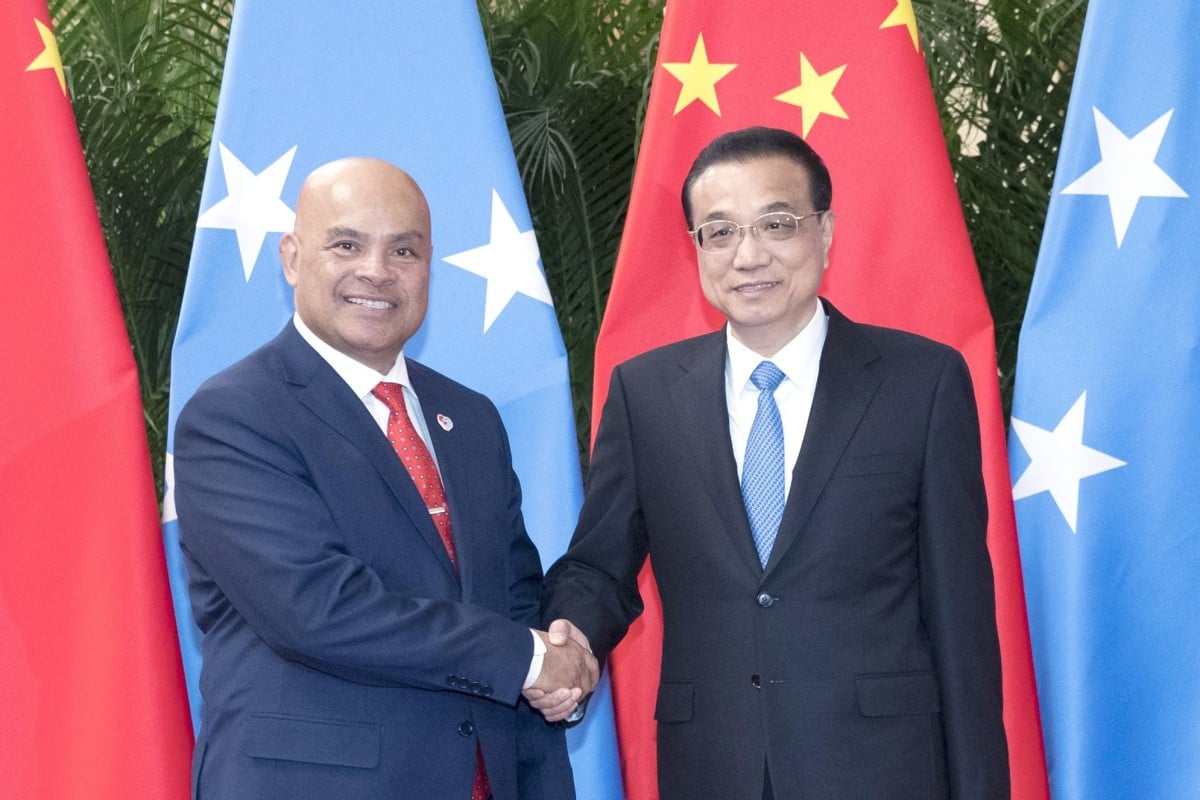
President of the Federated States of Micronesia David Panuelo shakes hands with Chinese Premier Li Keqiang at the Great Hall of the People in Beijing. Photo: Xinhua
In China earlier this month, David Panuelo, the president of the Federated States of Micronesia, climbed the Badaling section of the Great Wall. And, according to Huang Zheng, Beijing’s ambassador to the Pacific nation, the countries’ “great friendship rose to even greater heights” during Panuelo’s visit.
Chinese investment in Micronesia reached similarly lofty levels in conjunction with Panuelo’s trip, which marked three decades of diplomatic ties and included meetings with President Xi Jinping and Premier Li Keqiang. Beijing has committed US$72 million in economic development deals, almost as much as its total investment of the previous three decades.
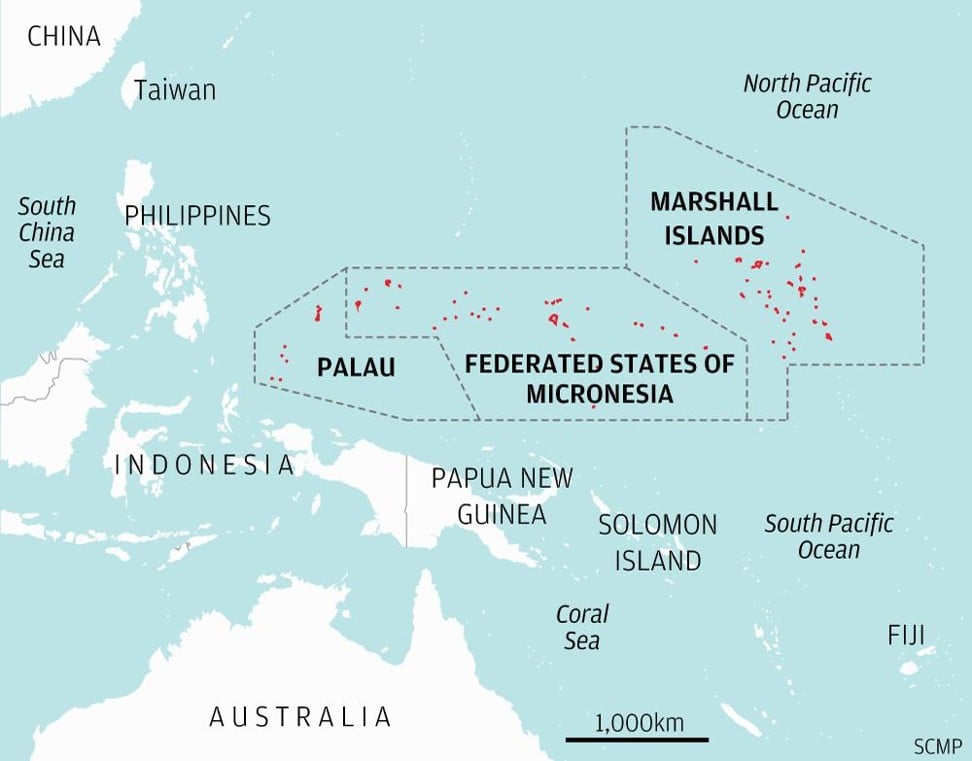
Micronesia is one of three Pacific nations with agreements with Washington, known as the Compact of Free Association (COFA), which allows their citizens to live and work in the US. In exchange, Micronesia, neighbouring Palau and the Marshall Islands grant the US exclusive military and defence access to their territorial waters – more than 2 million square miles of the Pacific that have been an essential element of Washington’s power projection in the region since World War II.
Much of China’s funding has been directed to Micronesia’s Chuuk state, which will in March vote in an independence referendum.
Although Chuuk is home to fewer than 50,000 people, its waters include one of the region’s deepest and most strategically appealing lagoons, creating extra incentive for Beijing and potential concern for Washington as the two countries
With a population of just 113,000 people, Micronesia relies on remittances sent home by citizens working in the US as well as the financial support from Washington under COFA. That assistance is scheduled to expire in 2023, creating uncertainty about the future of the relationship and making Chinese investment even more influential.
“Panuelo’s visit to China is a perfect example of how [the Chinese side] just needs to do a little to get a lot,” said Derek Grossman, senior analyst at Rand Corporation, a Washington think tank. “US$100 million is not very much for them and they can essentially loosen the screws [on COFA] with that.”
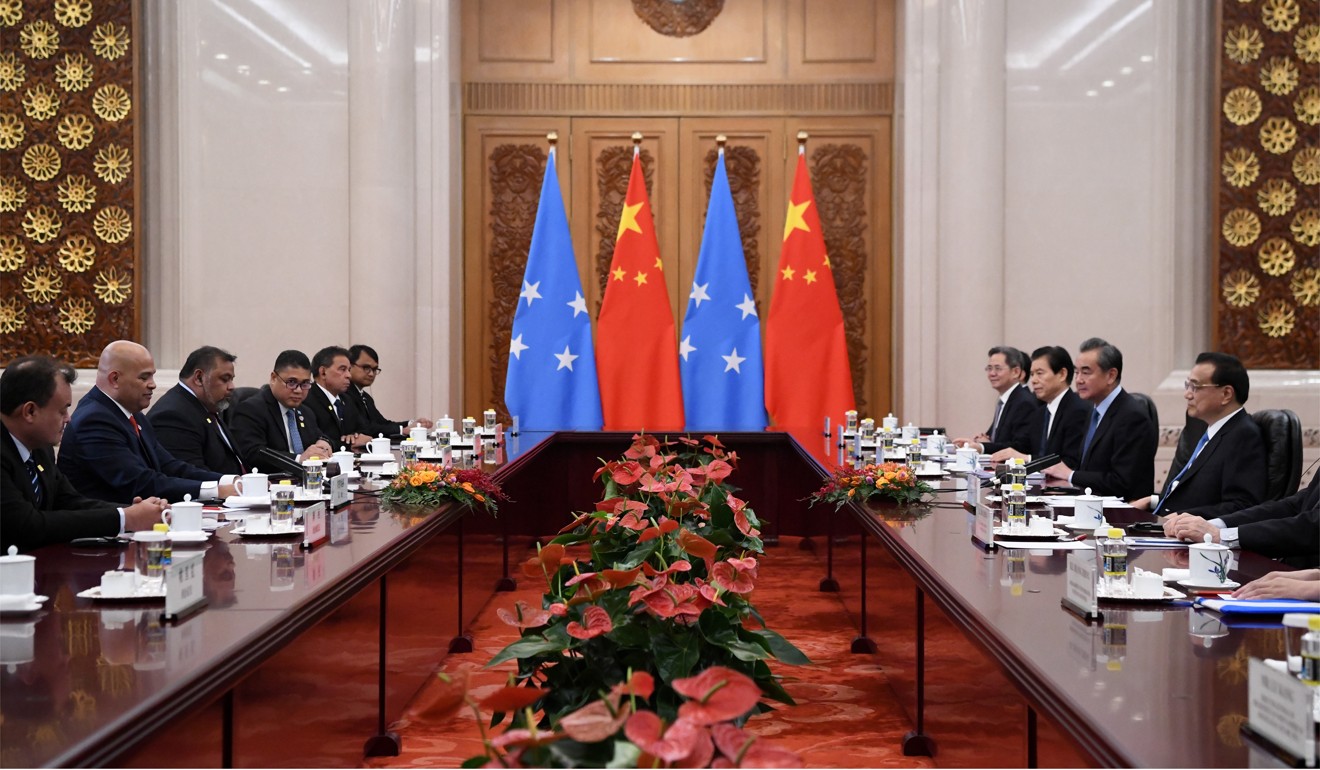
Micronesian President David Panuelo (second on left) and Chinese Premier Li Keqiang (right) during their talks in Beijing. Photo: EPA-EFE
The value of Micronesia’s bilateral trade with China has increased by nearly 30 per cent annually for the past five years, according to Micronesia’s Foreign Ministry. In 2017, the island nation signed onto President Xi’s signature Belt and Road Initiative which aims to build a vast network of strategic investment, trade routes and infrastructure projects across more than 150 countries.
US-China tech war’s new battleground: undersea internet cables14 Dec 2019
In recent years Chinese funding in Micronesia has built office and residential complexes for government officials, a showpiece new convention centre in the capital city Palikir, transport infrastructure and student exchanges, according to a recent report by Rand.
Jian Zhang, associate professor at UNSW Canberra at the Australian Defence Force Academy, said Beijing’s investment reflected a decision to cultivate broader, deeper ties.
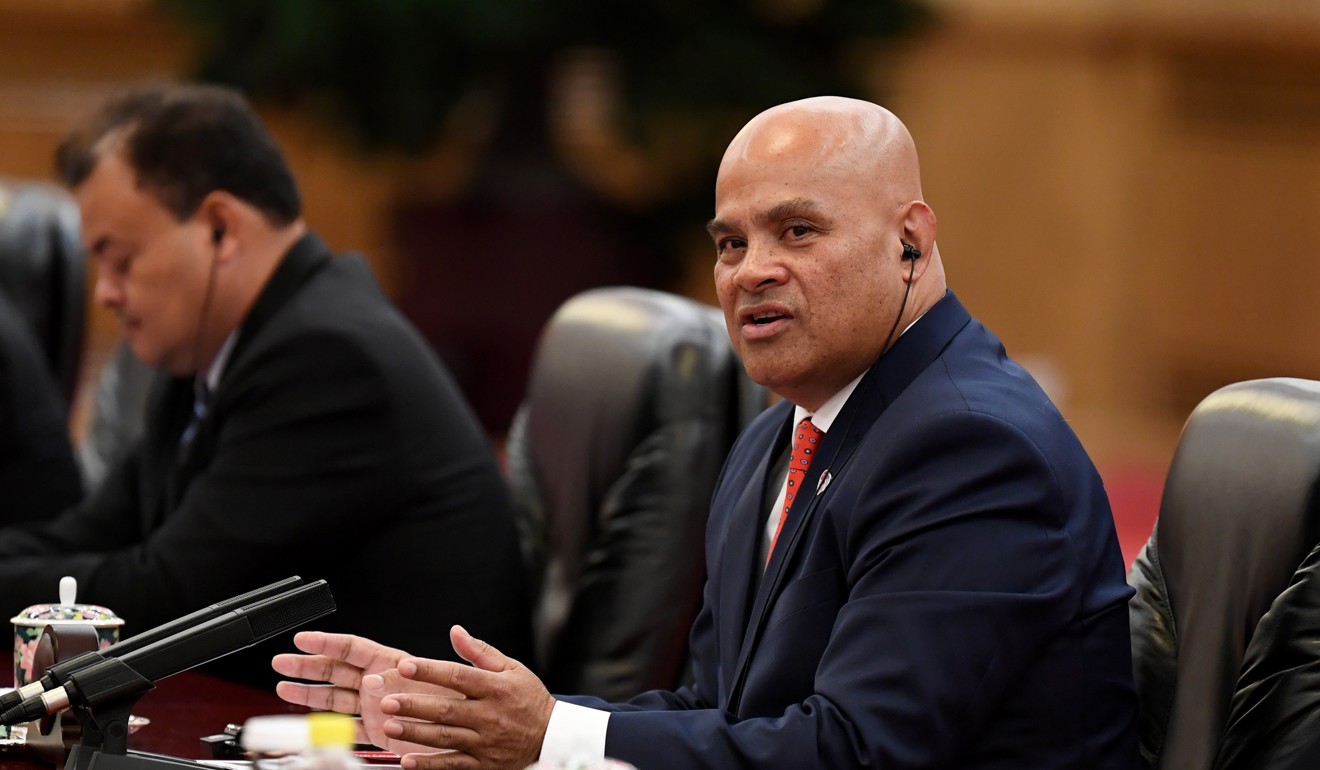
Micronesian President David Panuelo during his meeting with Chinese officials in Beijing. Photo: EPA-EFE
“China’s interest in building the relationship with Micronesia is not just about its diplomatic rivalry with Taiwan or economic interests,” he said. “It has elevated the relationship to a comprehensive strategic partnership which encompasses all areas.”
During his recent visit, Panuelo described China as Micronesia’s top economic partner and the US as its top security partner. Pompeo’s visit to Micronesia highlights US anxiety about rising Chinese influence in Pacific 5 Aug 2019
Gerard Finin, professor of regional planning at Cornell University, who previously worked with the US Department of State in the Pacific, said: “China’s leadership consistently accords large ocean states the full protocol that is expected when a head of state visits.
“In contrast, Washington has only had a limited number of meetings and never hosted an official state visit to Washington for the leader of a Pacific Island nation,” said Finin.
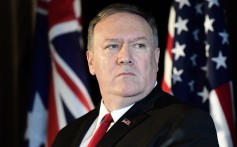
US President Donald Trump in May hosted the leaders of Micronesia, Palau and the Marshall Islands together at the White House. When Mike Pompeo visited Micronesia
in August, he became the only sitting US secretary of state to have done so.
Pompeo said negotiations to update COFA had begun but no details have been made public. Micronesia has assembled a team to conduct the negotiations but the US has not, the Honolulu Civil Beat website reported.
US Secretary of State Mike Pompeo visited Micronesia in August. Photo: AFP
Breakaway vote could raise the stakes
Panuelo’s team met Micronesian students studying in China and representatives of state-owned China Railway Construction Corporation, which will build the roads in Chuuk, funded in part by US$50 million from Beijing. Construction of the Chuuk government complex was also funded by Beijing and the state’s governor joined Panuelo for his visit.
Should Chuuk vote to separate from Micronesia in March, it could also mean breaking from COFA, jeopardising the US work privileges of thousands of Chuukese and opening the state’s waters to other partners, particularly China.
Chuuk is home to one of the deepest lagoons in the Pacific, a geographic rarity of particular value in strategic military operations and submarine navigation.
US Coast Guard looks to bolster Pacific allegiances as Chinese clout grows
22 Oct 2019
Zhang said Beijing would explore any opportunity to build a port with potential military capability.
“China has a long-term need to gain a strategic foothold in the region,” Zhang said. “That is a key part of the Belt and Road Initiative. At the general level it’s an economic initiative but an important aspect of the maritime Silk Road is to develop a network of strategically located port facilities.”
Sabino Asor, chair of the public education committee for the Chuuk Political Status Commission, told Civil Beat seceding from Micronesia would be the best option for Chuuk’s future.
“There is no encouraging prospect if Chuuk remains within the Federation,” he said.
However, Patrick Buchan, at Washington think tank Centre for Strategic and International Studies, said Chuuk’s dependence on remittances from the US made breaking from COFA unlikely.
China courts Pacific island states in pursuit of ‘foothold’ as US risks losing influence
8 Aug 2019
In the meantime, uncertainty over COFA negotiations persists, although there is a chance it will be renewed with few changes.
“There is circulation with people easily coming and going that provides a level of understanding and friendship that does not exist between too many other countries,” Finin said.
However, China’s most attractive feature may be its willingness to at least discuss the most pressing concern of Pacific Island nations: climate change.
“When the Trump administration talks about how it doesn’t believe in climate change, or can’t even say the words – that is really offensive for Pacific nations,” Grossman said. “China knows that, and is taking full advantage of it.”


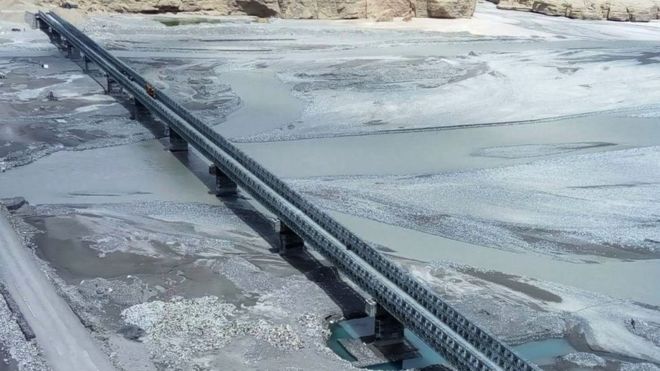 Image copyright PRESS INFORMATION BUREAU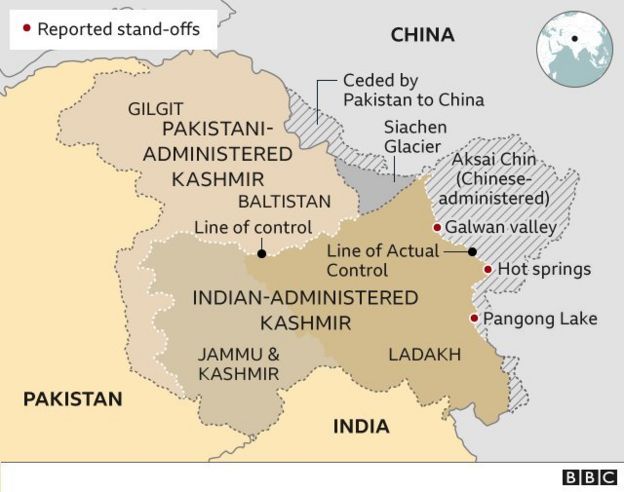
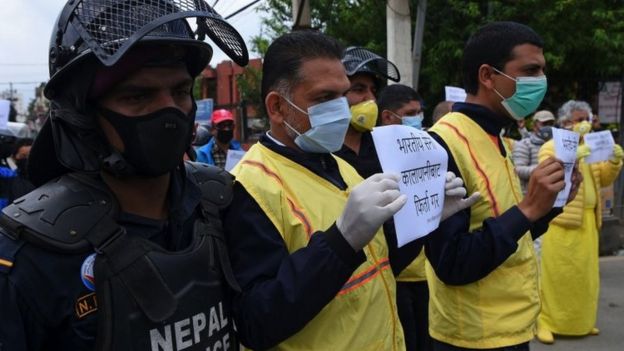 Image copyright AFP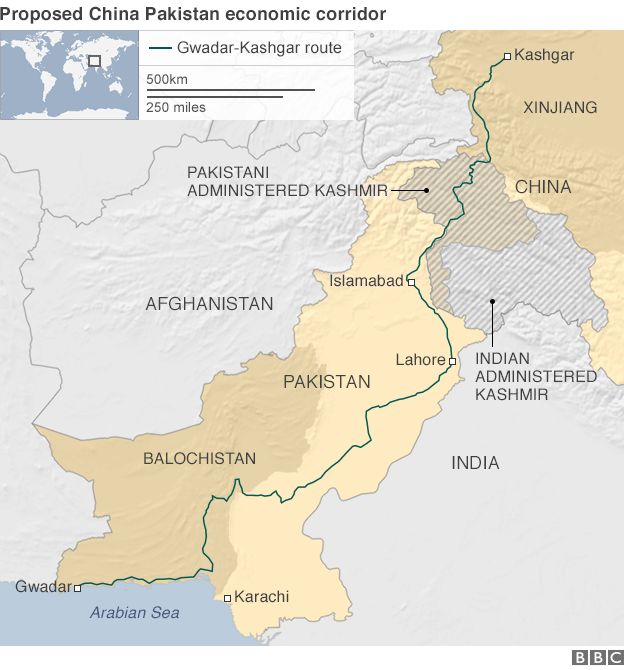
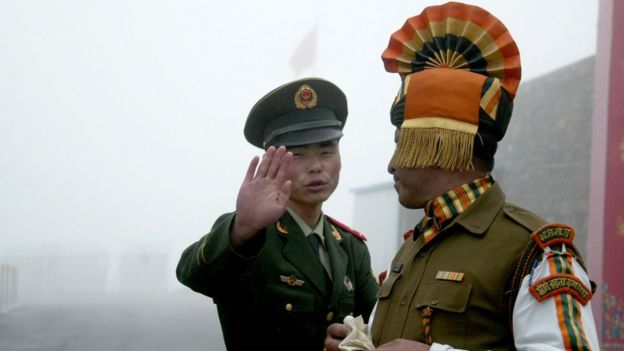 Image copyright GETTY IMAGES






 CHINDIA ALERT: You'll be living in their world, very soon