Chindia Alert: You’ll be Living in their World Very Soon
aims to alert you to the threats and opportunities that China and India present. China and India require serious attention; case of ‘hidden dragon and crouching tiger’.
Without this attention, governments, businesses and, indeed, individuals may find themselves at a great disadvantage sooner rather than later.
The POSTs (front webpages) are mainly 'cuttings' from reliable sources, updated continuously.
The PAGEs (see Tabs, above) attempt to make the information more meaningful by putting some structure to the information we have researched and assembled since 2006.
New system to enable businesses and government agencies to verify mainland-issued travel permits
The new system is expected to expand access to the public transport system on the mainland. Photo: Roy Issa
Hong Kong and Macau residents and “overseas Chinese” may soon be able to have full access to public services on the mainland using their China-issued travel documents, state news agency Xinhua reported.
Xinhua reported on Wednesday that the National Immigration Administration was putting a platform in place to enable government agencies and businesses to verify mainland-issued travel permits for Hong Kong and Macau residents.
“As soon as the platform becomes operational, these overseas travellers can, from October, have access to 35 public services, ranging from transport, to finance, education, communications, medical care and accommodation,” the report said.
According to the report, “overseas travellers” cover Hong Kong and Macau residents and ethnic Chinese living overseas.
But it did not say why the new measures did not apply to people from Taiwan.
The administration did not respond to requests for comment on Thursday.
Will Hong Kong anti-government protests ruin city’s role in Beijing’s Greater Bay Area plan? Depends on whom you ask
The new measure appears to be part of a long-term strategy by Beijing to foster closer ties between the mainland and Hong Kong and Macau.
In the last few years, the central government has launched a host of incentives for Hong Kong and Macau residents and businesses, including opportunities in the Greater Bay Area development plan in southern China.
Ivan Zhai, executive director of the Hong Kong Chamber of Commerce in China-Guangdong, welcomed the new measure.
“If such an arrangement can be fully implemented, Hong Kong businesspeople who operate on the mainland will be thrilled,” Zhai said.
The Hong Kong business community has long lobbied for relaxation over areas such as train ticketing and hotel registration.
Zhai said that although Hong Kong and Macau residents could now book high-speed train tickets with their mainland-issued travel permits, there were few ticket machines that could automatically read the permits, complicating the process.
“There are also hotels on the mainland that can only entertain guests with Chinese identity cards and currently Hong Kong travellers can only go to hotels that are authorised to accept the mainland-issued travel permits,” he said.
China’s regulator relaxes currency conversion rules throughout Shenzhen, sharpening city’s edge in Greater Bay Area
According to the report, there will be stiff penalties for departments or businesses misusing information collected through the platform.
Zhai said Hong Kong businesspeople who travelled to the mainland often were more likely to be concerned about convenience than the risk of invasion of privacy.
“If you are a frequent traveller in China, you would have expected that the relevant departments of the Chinese government already have information about you anyway,” he said.
BEIJING, Sept. 27 (Xinhua) — China has reaped great accomplishments in agriculture and rural development in the past 70 years, successfully feeding a population of 1.4 billion and lifting over 800 million people in rural areas out of poverty.
China’s annual grain output has remained above 650 billion kg for four years in a row, up from 113.2 billion kg in 1949, Han Changfu, minister of agriculture and rural affairs, told a press conference on Friday.
Feeding 20 percent of the world population with 9 percent of the world’s arable land is a miracle in the history of agriculture, said Han.
The country has entered a new phase of development driven by technology and equipment innovation, with the area of high-standard farmland totaling 640 million mu (about 42.7 million hectares), Han added.
Poverty reduction in rural areas has also yielded dazzling results since the country’s opening-up, as more than 800 million people have been lifted out of absolute poverty, according to Liu Yongfu, director of the State Council Leading Group Office of Poverty Alleviation and Development.
By the end of 2018, per capita disposable income of rural residents living in poverty-stricken areas reached 10,371 yuan, equivalent to 71 percent of that for rural residents nationwide.
Liu said 95 percent of the population in poverty under current standards will be lifted out of poverty by the end of this year, while eradication of absolute poverty is expected by the end of 2020.
Legal process under way, Beijing says after Foreign Minister Wang Yi tells United Nations China is committed to defending multilateralism
Any unilateral move to leave weapons control pact will have a ‘negative impact in various areas’, minister says in thinly veiled swipe at United States
China, the world’s fifth-largest weapons supplier, has signed up to a global arms control treaty. Photo: Simon Song
China said it has begun preparations to join an international arms control treaty that the United States has threatened to abandon, while also warning Washington against deploying missiles in the Asia-Pacific region.
Speaking at the United Nations General Assembly in New York on Friday, Chinese Foreign Minister Wang Yi said that signing up to the Arms Trade Treaty (ATT) was further evidence of Beijing’s commitment to defending multilateralism.
said in April that he intended to withdraw from the pact, which regulates the US$70 billion global trade in conventional arms.
The White House said at the time that the ATT “will only constrain responsible countries while allowing the irresponsible arms trade to continue”, as major arms exporters like Russia and China were not part of it.
Wang said on Friday that any unilateral move to leave the treaty would have a “negative impact in various areas”. He stopped short of naming the United States or its president.
China’s foreign ministry said in a statement on Saturday that it had begun the legal process of joining the treaty, adding that it attached great importance to the issues caused by the illegal sale and misuse of arms, and supported the aims of the ATT in seeking to regulate the international weapons trade.
Wang also spoke out against the possible deployment of ground-launched missiles in the Asia-Pacific region.
After withdrawing from the Intermediate-Range Nuclear Forces Treaty in August, the US said it was planning to deploy such weapons in Asia to counter any possible threat from China or Russia.
“[We] urge the country with the largest nuclear weapons to fulfil its special and prior responsibilities on nuclear disarmament,” Wang said, adding that “China will continue to participate in the international arms control process”.
Wang Yi spoke out against the possible deployment of ground-launched missiles in the Asia-Pacific region at the UN General Assembly in New York on Friday. Photo: AFP
According to figures released in May by the Stockholm International Peace Research Institute, the United States is the world’s largest arms exporter, supplying weapons worth 58 per cent more than those of its nearest competitor, Russia.
Together with France, Germany and China, the five nations accounted for 75 per cent of all weapons sold around the world between 2014 and last year, the institute said.
Although China is among the world’s big five arms suppliers, its sales – most of which go to Asia and Oceania – are dwarfed by those of the US, accounting for just 5.2 per cent of the 2014-18 total, compared to America’s 36 per cent.
Several major arms importers, including India, Australia, South Korea and Vietnam, refuse to buy arms from China for political reasons.
Beijing’s decision to join the ATT is in keeping with the image it has sought to present of China as a defender of multilateralism. The stance is also in sharp contrast to the US’ position under Trump, who has repeatedly scrapped multilateral trade agreements in favour of bilateral deals.
Since taking office in 2016, he has withdrawn the US from the Paris climate accord, the Iran nuclear deal and the Trans-Pacific Partnership.
Military observers said Beijing might seek to pressure on Washington to stay in the deal to try to maintain the strategic and military balance in the region.
Song Zhongping, a Hong Kong-based military affairs commentator, said Beijing might be trying to avoid misuse of conventional weapons.
“Beijing may want to press big exporters, such as the US and Russia, to join the deal because without proper regulations, the risk of illegal trade and misuse of conventional weapons could be running high,” he said.
“This could also threaten regional stability or even trigger unnecessary arms races.”
Adam Ni, a China specialist at Sydney’s Macquarie University, said the treaty would put some limits on the arms trade “but it would not mean that China would not be able to do deals. It will still be able to do [most deals]”.
Retired PLA colonel Yue Gang said the strategy could also improve China’s international reputation.
NEW YORK (Reuters) – China and the Pacific island state of Kiribati restored diplomatic ties on Friday after the former diplomatic ally of Taiwan abandoned Taipei.
A poor but strategic country which is home to a mothballed Chinese space tracking station, Kiribati announced last week that it was cutting relations with self-ruled Taiwan in favour of China, which claims Taiwan as a wayward province with no right to state-to-state ties.
China and Kiribati had ties until 2003, when Tarawa established relations with Taipei, causing China to break off diplomatic relations.
Up until that time, China had operated a space tracking station in Kiribati, which played a role in tracking China’s first manned space flight.
The Chinese government’s top diplomat State Councillor Wang Yi and Kiribati’s President Taneti Maamau signed a communique on restoring diplomatic relations at the Chinese mission to the United Nations in New York.
“We highly prize this important and the correct decision,” Wang told a news conference. “Let’s hope for our friendship to last forever. We will work together to grow together towards a bright and prosperous future.”
Speaking alongside Wang, Maamau said there was much to learn from China.
“I do believe that there is much to learn and gain from the People’s Republic of China and the re-establishment of our diplomatic relations is just the beginning,” he said.
There was no mention of the space tracking station at the news conference, nor in the joint communique between the two countries released by China’s Foreign Ministry.
China’s space programme is overseen by the military.
China’s Defence Ministry this week declined comment on the Kiribati facility.
Last week was difficult for Taiwan, as the Solomon Islands also ditched it for Beijing. The Solomon Islands foreign minister signed a deal on diplomatic ties in China last Saturday.
Both the Solomon Islands and Kiribati are small developing nations but lie in strategic waters that have been dominated by the United States and its allies since World War Two. China’s moves to expand its influence in the Pacific have angered Washington.
A former Taiwanese ambassador to Kiribati, Abraham Chu, told Taiwan’s Central News Agency last weekend that China had never fully removed the tracking station in Kiribati and that it “could come back at any time”.
Taiwan now has formal relations with just 15 countries, mostly small and poor nations in Latin America and the Pacific, including Nauru, Tuvalu and Palau. China has signalled it is coming for the rest of Taiwan’s allies.
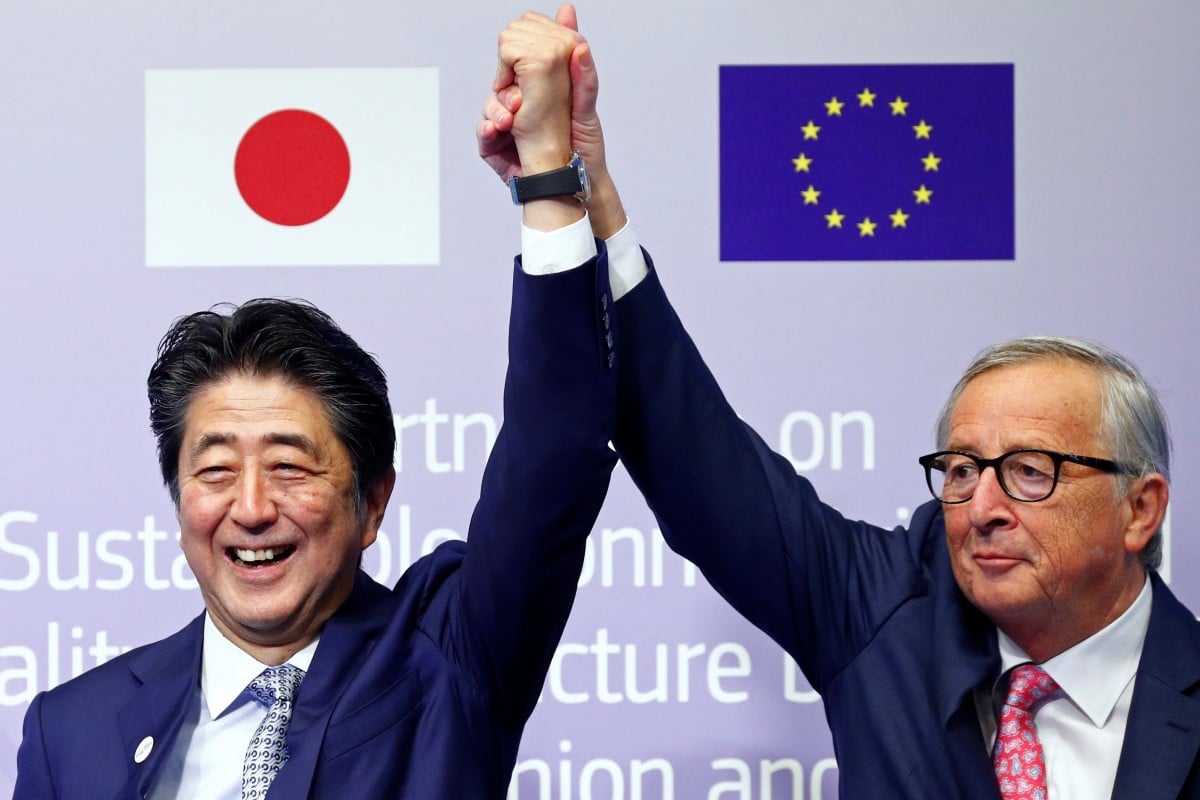
Japan’s Prime Minister Shinzo Abe and EC President Jean-Claude Juncker mark first anniversary of EU-Asia Connectivity scheme with swipes at China
Partners reach out to countries in Balkans and Africa and agree US$65.5 billion development plan
Japan’s Prime Minister Shinzo Abe (left) and European Commission President Jean-Claude Juncker mark the anniversary of the EU-Asia Connectivity scheme in Brussels, Belgium. Photo: Reuters
The European Union and Japan are stepping up their efforts to counter China’s
, with their leaders vowing to be “guardians of universal values” such as democracy, sustainability and good governance.
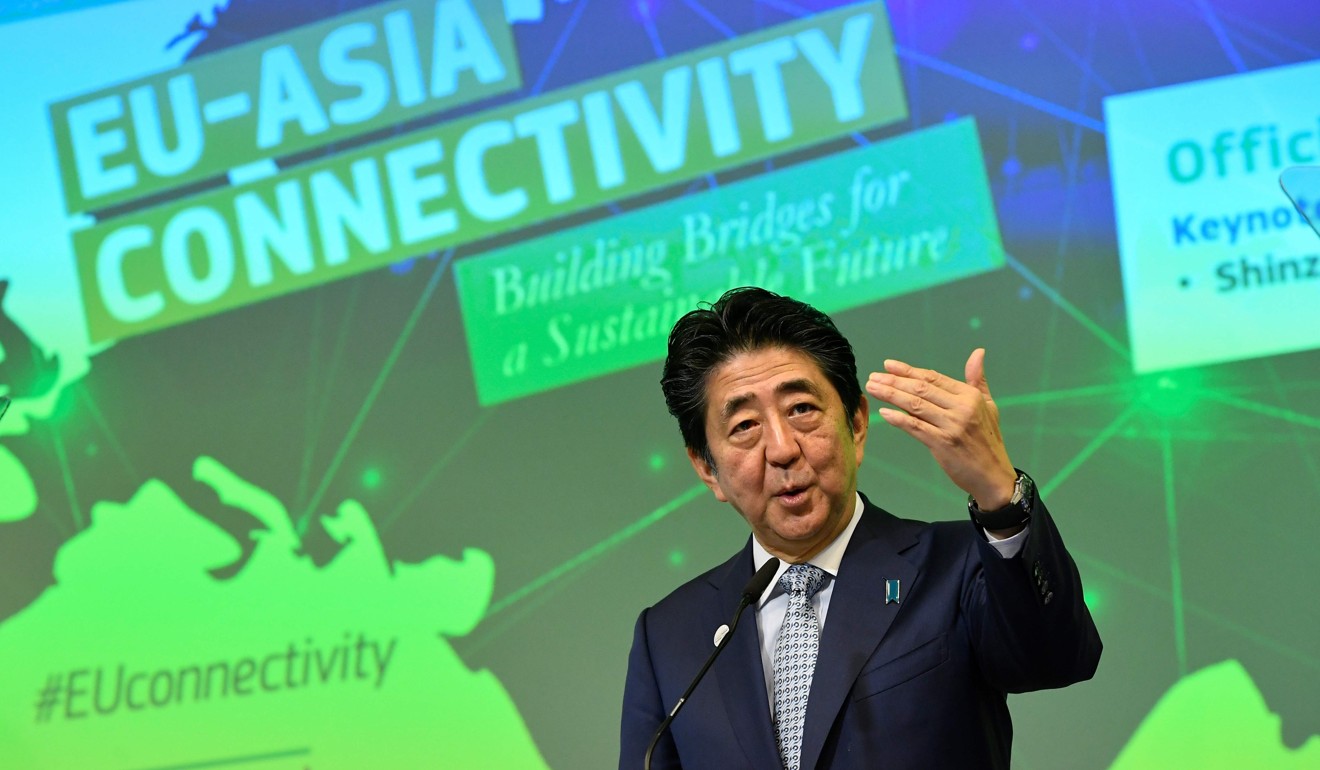
Speaking in Brussels on Friday, Japanese Prime Minister Shinzo Abe said the world’s third-biggest economy would work with the EU to strengthen their transport, energy and digital ties to Africa and the Balkans – key regions for China’s flagship trade and development project.
At a forum to mark the first anniversary of the EU-Asia Connectivity scheme, Abe and European Commission President Jean-Claude Juncker signed an agreement formalising Japan’s involvement in the Europe-Asia plan that will be backed by a €60 billion (US$65.54 billion) EU guarantee fund, development banks and private investors.
Abe said Japan would ensure that officials from 30 African countries would be trained in sovereign debt management over the next three years, a veiled attack on what Western diplomats claim is China’s debt trap for its belt and road partners.
“The EU and Japan are linked through and through,” Abe said. “The infrastructure we build from now on must be [high] quality infrastructure.
“Whether it be a single road or a single port, when the EU and Japan undertake something, we are able to build sustainable, comprehensive and rules-based connectivity, from the Indo-Pacific to the west Balkans and Africa.”
Japan wants to extend its business reach through its alliance with the EU as its economy slows and geopolitical competition from China takes its toll.
Japan indicates China is bigger threat than North Korea in latest defence review
China’s low-key delegation to the forum was led by Guo Xuejun, deputy director general of international affairs at the foreign ministry.
The US was represented by its deputy assistant secretary of state for cyber policy, Robert Strayer, who was in Europe to lobby against Chinese telecoms giant Huawei Technologies and its involvement in fifth-generation telecoms networks.
Abe and Juncker made cybersecurity the highlight of their addresses. Juncker, who will step down from the presidency by the end of October, repeated his attack on China’s trade policies without naming the country.
“Openness is reciprocal, based on high standards of transparency and good governance, especially for public procurement, and equal access to businesses while respecting intellectual property rights,” he said.
Prime Minister Shinzo Abe says Japan will train officials from 30 African countries in sovereign debt management in three years. Photo: AFP
European policymakers and businesses have for years complained about China’s refusal to allow foreign companies in without a Chinese joint venture partner, a practice that critics claimed involved forced transfer of intellectual property to the Chinese side.
“One of the keys to successful connectivity is to respect basic rules and common sense,” Juncker said, stressing that EU-Japanese cooperation focused on the “same commitment to democracy, rule of law, freedom and human dignity”.
European businesses urge EU to take ‘defensive’ measures against China’s state-owned enterprises
When the commission proposed improved transport, energy and digital infrastructure links with Asia last year, it denied it was seeking to stymie Chinese ambitions.
The EU plan, which would be backed by additional funds from the EU’s common budget from 2021, private sector loans and development banks, amounted to a response to China’s largesse in much of central Asia and south-eastern Europe, where Beijing has invested billions of dollars.
Image copyright HAMPSTEAD THEATREImage caption “Speaking out cost me my job, my marriage and my happiness at the time,” Dr Wang said
A whistleblower who exposed HIV and hepatitis epidemics in central China in the 1990s, potentially saving tens of thousands of lives, has died aged 59.
Dr Shuping Wang lost her job, was attacked, and had her clinic vandalised after she spoke out.
She died in Utah in the US, where she moved after the scandal.
A play inspired by her life is currently running in London, with the playwright calling her a “public health hero”.
Dr Wang never returned to China after leaving, saying it did not feel safe.
Why did Dr Wang speak out?
In 1991 in the Chinese province of Henan, Dr Wang was assigned to work at a plasma collection station. At the time, many locals sold their blood to local government-run blood banks.
It wasn’t long before she realised the station posed a huge public health risk.
Poor collection practices, including cross-contamination in blood-drawing, meant many donors were being infected with hepatitis C from other donors.
Undeterred, she reported the issue to the Ministry of Health. As a result, the ministry later announced that all donors would need to undergo hepatitis C screening – reducing the risk of the disease being spread.
But because of her whistleblowing, Dr Wang said, she was forced out of a job.
Her seniors said her actions had “impeded the business”. She was transferred, and assigned to work in a health bureau. But in 1995, she uncovered another scandal.
Image copyright HAMPSTEAD THEATRE
Dr Wang discovered a donor who had tested HIV positive – but had still sold blood in four different areas.
She immediately alerted her seniors to test for HIV in all the blood stations in Henan province. Again, she was told this would be too costly.
She decided to take things into her own hands, buying test kits and randomly collecting over 400 samples from donors.
She found the HIV positive rate to be 13%.
She took her results to officials in the capital, Beijing. But back home, she was targeted. A man she described as a “retired leader of the health bureau” came to her testing centre and smashed her equipment.
When she tried to block him, he hit her with his baton.
‘I’m not a man. I’m a woman’
In 1996, all the blood and plasma collection sites across the country were shut down for “rectification”. When they re-opened, HIV testing was added.
“I felt very gratified, because my work helped to protect the poor,” she said. But others were not happy.
At a health conference later that year, a high-ranking official complained about that “man in a district clinical testing centre [who] dared to report the HIV epidemic directly to the central government”.
“I stood up and said I’m not a man. I’m a woman and I reported this.”
Later that year, she was told by health officials that she ought to stop work. “I lost my job, they asked me to stay home and work for my husband,” Dr Wang said.
Her husband, who worked at the Ministry of Health, was ostracised by his colleagues. Their marriage eventually broke down.
Image copyright HAMPSTEAD THEATREImage caption A scene from The King of Hell’s Palace
In 2001, Dr Wang moved to the US for work, where she took the English name “Sunshine”.
Henan, the province that Dr Wang had worked in, was one of the worst hit.
The government later announced that a special clinic had been set up to care for those suffering from Aids-related illnesses.
Several years later, Dr Wang re-married and moved with her husband Gary Christensen to Salt Lake City, where she began working at the University of Utah as a medical researcher.
But her past followed her. In 2019, she said, Chinese state security officers made threatening visits to relatives and former colleagues in Henan, in an attempt to cancel the production of a play inspired by her life.
She refused, and the play titled “The King of Hell’s Palace” premiered at London’s Hampstead Theatre in September.
Dr Wang died on 21 September while hiking in Salt Lake City with friends and her husband. It’s thought she may have had a heart attack.
Image caption Dr Wang with playwright Frances Ya-Chu
“Speaking out cost me my job, my marriage and my happiness at the time, but it also helped save the lives of thousands and thousands of people,” she had told the Hampstead Theatre website in an interview just one month before her death.
“She was a most determined, relentless optimistic and most loving woman,” wrote her friend David Cowhig after news of her death.
“She chose the English name Sunshine for a reason. Perhaps her exuberance and love for the outrageous – made possible [the] perseverance she had.”
TOKYO (Reuters) – China’s growing military might has replaced North Korean belligerence as the main security threat to Japan, Tokyo’s annual defence review indicated on Thursday, despite signs that Pyongyang could have nuclear-tipped ballistic missiles.
The document’s security assessment on China comes after a section on Japan’s ally, the United States, the first time Beijing has achieved second place in the Defence White Paper and pushing North Korea into third position.
Russia, deemed by Japan as its primary threat during the Cold War, was in fourth place.
“The reality is that China is rapidly increasing military spending, and so people can grasp that we need more pages,” Defence Minister Taro Kono said at a media briefing.
“China is deploying air and sea assets in the Western Pacific and through the Tsushima Strait into the Sea of Japan with greater frequency.”
China’s Foreign Ministry expressed displeasure with the report.
China will not accept Japan’s “groundless criticism” of its normal national defence and military activities, spokesman Geng Shuang said at a press briefing in Beijing.
Japan has raised defence spending by a tenth over the past seven years to counter military advances by Beijing and Pyongyang, including defences against North Korean missiles which may carry nuclear warheads, the paper said.
North Korea has conducted short-range missile launches this year that Tokyo believes show Pyongyang is developing projectiles to evade its Aegis ballistic missile defences.
To stay ahead of China’s modernising military, Japan is buying U.S.-made stealth fighters and other advanced weapons.
In its latest budget request, Japan’s military asked for 115.6 billion yen ($1.1 billion) to buy nine Lockheed Martin (LMT.N) F-35 stealth fighters, including six short take-off and vertical landing (STOVL) variants to operate from converted helicopter carriers.
The stealth jets, U.S.-made interceptor missiles and other equipment are part of a proposed 1.2% increase in defence spending to a record 5.32 trillion yen in the year starting April 1.
By comparison, Chinese military spending is set to rise this year by 7.5% to about $177 billion from 2018, more than three times that of Japan. Beijing is developing weapons such as stealth fighters and aircraft carriers that are helping it expand the range and scope of military operations.
Once largely confined to operating close to the Chinese coast, Beijing now routinely sends its air and sea patrols near Japan’s western Okinawa islands and into the Western Pacific.
China has frequently rebuffed concerns about its military spending and intentions, including an increased presence in the disputed South China Sea, and says it only desires peaceful development.
The Defence White Paper said Chinese patrols in waters and skies near Japanese territory are “a national security concern”.
The paper downgraded fellow U.S. ally, South Korea, which recently pulled out of an intelligence sharing pact with Japan amid a dispute over their shared wartime history. That could weaken efforts to contain North Korean threats, analysts said.
Other allies, including Australia, the Association of Southeast Asian Nations (ASEAN) and India, feature more prominently in the defence paper.
South Korean government officials took issue with the White Paper’s reference to ownership of an island in the Sea of Japan that is also claimed and controlled by South Korea. The outcrop is known as Dokdo in Seoul and Takeshima in Tokyo.
“Our government strongly protests Japan’s repeated claim. The Japanese government should acknowledge that it is not helpful for bilateral relations,” South Korea’s foreign ministry said.
An increasing proportion of young people no longer willing to wait tables in China as restaurant owners look to new technology for answers
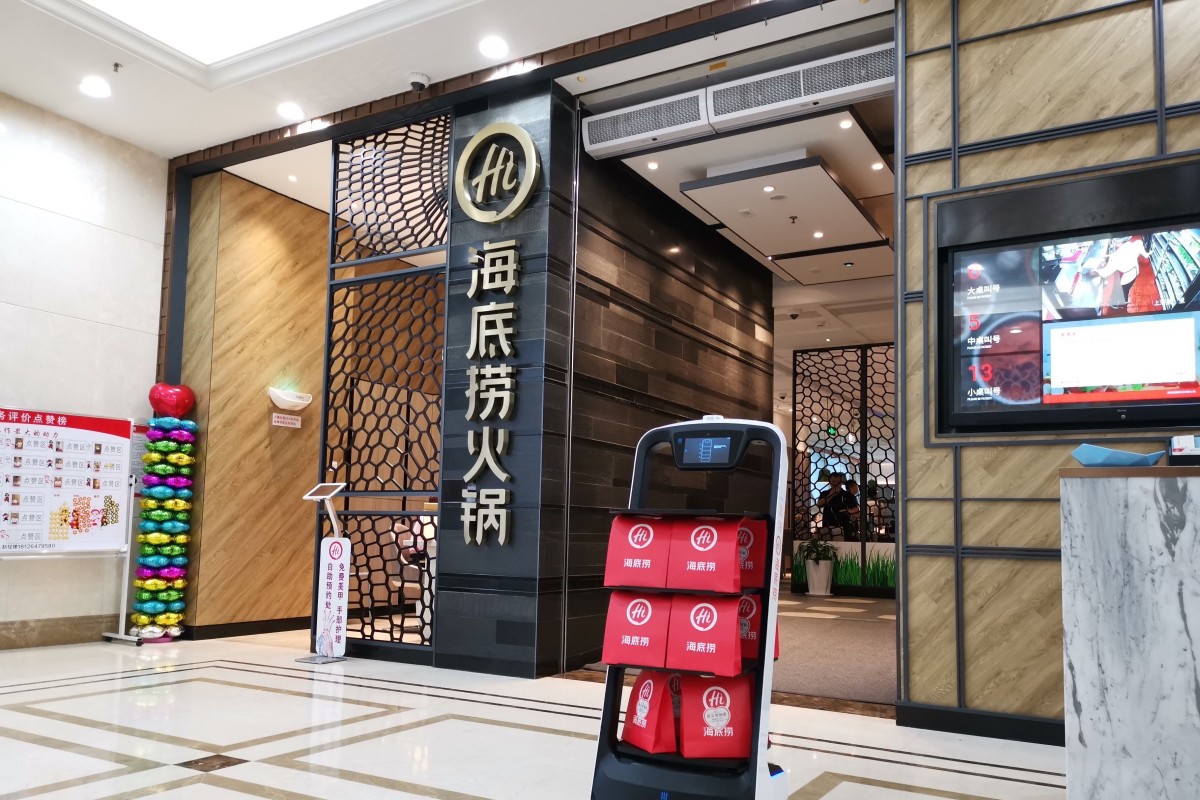
Catering robots developed by Pudu Tech, the three-year-old Shenzhen start-up, have been adopted by thousands of restaurants in China, as well as some foreign countries including Singapore, Korea, and Germany. Photo: Handout
Two years ago, Bao Xiangyi quit school and worked as a waiter in a restaurant for half a year to support himself, and the 19 year-old remembers the time vividly.
“It was crazy working in some Chinese restaurants. My WeChat steps number sometimes hit 20,000 in a day [just by delivering meals in the restaurant],” said Bao.
The WeChat steps fitness tracking function gauges how many steps you literally take and 20,000 steps per day can be compared with a whole day of outdoor activity, ranking you very high in a typical friends circle.
Bao, now a university student in Hangzhou, Zhejiang province, quit the waiter job and went back to school.
“I couldn’t accept that for 365 days a year every day would be the same,” said Bao.
“Those days were filled with complete darkness and I felt like my whole life would be spent as an inferior and insignificant waiter.”
Olivia Niu, a 23-year-old Hong Kong resident, quit her waiter job on the first day. “It was too busy during peak meal times. I was so hungry myself but I needed to pack meals for customers,” said Niu.
Being a waiter has never been a top career choice but it remains a big source of employment in China. Yang Chunyan, a waitress at the Lanlifang Hotel in Wenzhou in southeastern China, has two children and says she chose the job because she needs to make a living.
Catering robots developed by Pudu Tech, the three-year-old Shenzhen start-up. Photo: Handout
Today’s young generation have their sights on other areas though. Of those born after 2000, 24.5 per cent want careers related to literature and art. This is followed by education and the IT industry in second and third place, according to a recent report by Tencent QQ and China Youth Daily.
Help may now be at hand though for restaurants struggling to find qualified table staff who are able to withstand the daily stress of juggling hundreds of orders of food. The answer comes in the form of robots.
Japan’s industrial robots industry becomes latest victim of the trade war
Shenzhen Pudu Technology, a three-year-old Shenzhen start-up, is among the tech companies offering catering robots to thousands of restaurant owners who are scrambling to try to plug a labour shortfall with new tech such as machines, artificial intelligence and online ordering systems. It has deployed robots in China, Singapore, Korea and Germany.
With Pudu’s robot, kitchen staff can put meals on the robot, enter the table number, and the robot will deliver it to the consumer. While an average human waiter can deliver 200 meals per day – the robots can manage 300 to 400 orders.
“Nearly every restaurant owner [in China] says it’s hard to recruit people to [work as a waiter],” Zhang Tao, the founder and CEO of Pudu tech said in an interview this week. “China’s food market is huge and delivering meals is a process with high demand and frequency.”
Pudu’s robots can be used for ten years and cost between 40,000 yuan (US$5,650) and 50,000 yuan. That’s less than the average yearly salary of restaurant and hotel workers in China’s southern Guangdong province, which is roughly 60,000 yuan, according to a report co-authored by the South China Market of Human Resources and other organisations.
As such, it is no surprise that more restaurants want to use catering robots.
According to research firm Verified Market Research, the global robotics services market was valued at US$11.62 billion in 2018 and is projected to reach US$35.67 billion by 2026.
Can robots and virtual fruit help the elderly get well in China?
China’s labour force advantage has also shrank in recent years. The working-age population, people between 16 and 59 years’ old, has reduced by 40 million since 2012 to 897 million, accounting for 64 per cent of China’s roughly 1.4 billion people in 2018, according to the national bureau of statistics.
By comparison, those of working age accounted for 69 per cent of the total population in 2012.
Other Chinese robotic companies are also entering the market. SIASUN Robot & Automation Co, a hi-tech listed enterprise belonging to the Chinese Academy of Sciences, introduced their catering robots to China’s restaurants in 2017. Delivery robots developed by Shanghai-based Keenon Robotics Co., founded in 2010, are serving people in China and overseas markets such as the US, Italy and Spain.
Pudu projects it will turn a profit this year and it is in talks with venture capital firms to raise a new round of funding, which will be announced as early as October, according to Zhang. Last year it raised 50 million yuan in a round led by Shenzhen-based QC capital.
To be sure, the service industry is still the biggest employer in China, with 359 million workers and accounting for 46.3 per cent of a working population of 776 million people in 2018, according to the national bureau of statistics.
And new technology sometimes offers up new problems – in this case, service with a smile.
“When we go out for dinner, what we want is service. It is not as simple as just delivering meals,” said Wong Kam-Fai, a professor in engineering at the Chinese University of Hong Kong and a national expert appointed by the Chinese Association for Artificial Intelligence. “If they [robot makers] can add an emotional side in future, it might work better.”
Technology companies also face some practical issues like unusual restaurant layouts.
“Having a [catering robot] traffic jam on the way to the kitchen is normal. Some passageways are very narrow with many zigzags,” Zhang said. “But this can be improved in future with more standardised layouts.”
Multi-floor restaurants can also be a problem.
Dai Qi, a sales manager at the Lanlifang Hotel, said it is impossible for her restaurant to adopt the robot. “Our kitchen is on the third floor, and we have boxes on the second, third, and fourth floor. So the robots can’t work [to deliver meals tdownstairs/upstairs],” Dai said.
But Bao says he has no plans to return to being a waiter, so the robots may have the edge.
“Why are human beings doing something robots can do? Let’s do something they [robots] can’t,” Bao said.
Cheng Qiang was just 12 when a magnitude 8 tremor destroyed his village, but he never forgot the heroism of the soldiers sent to help and swore one day to join their ranks
Now a squad leader, on October 1 he will also be part of the National Day celebrations in Tiananmen Square
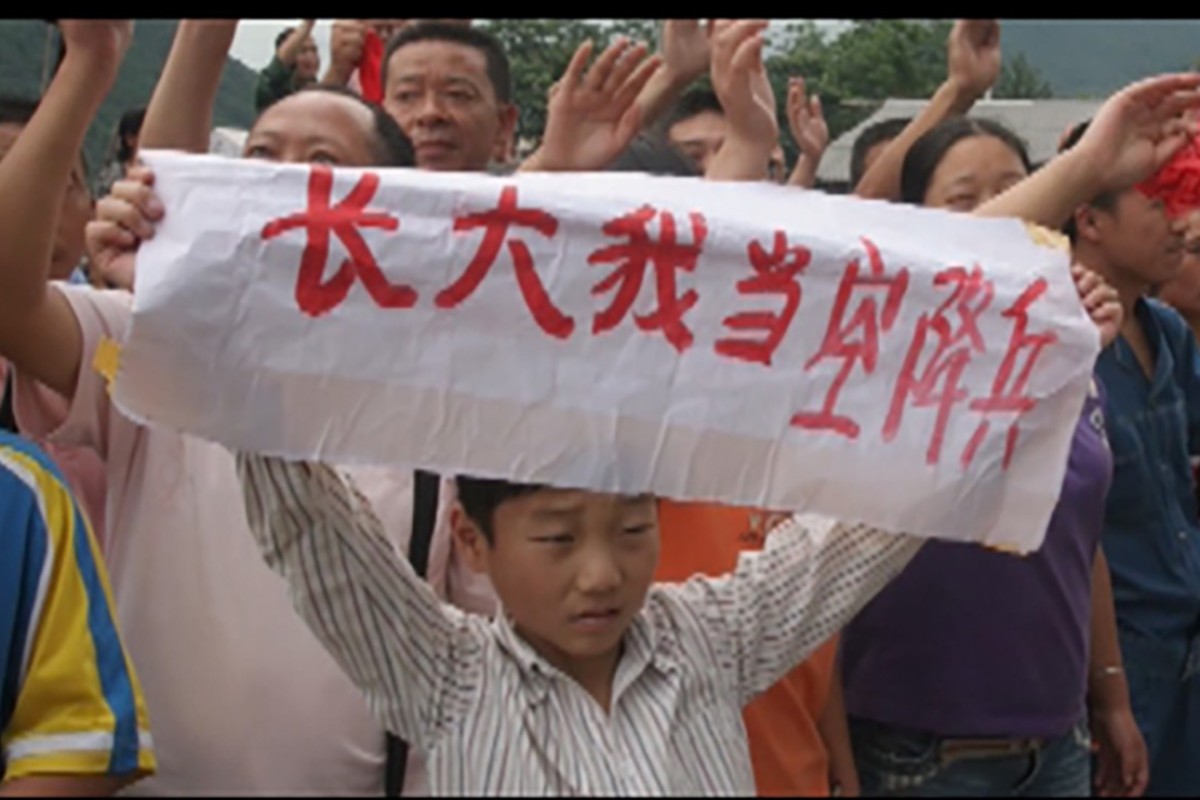
Cheng Qiang was just 12 when his home in Sichuan was hit by a massive earthquake and airborne troops were sent to help. Photo: People.cn
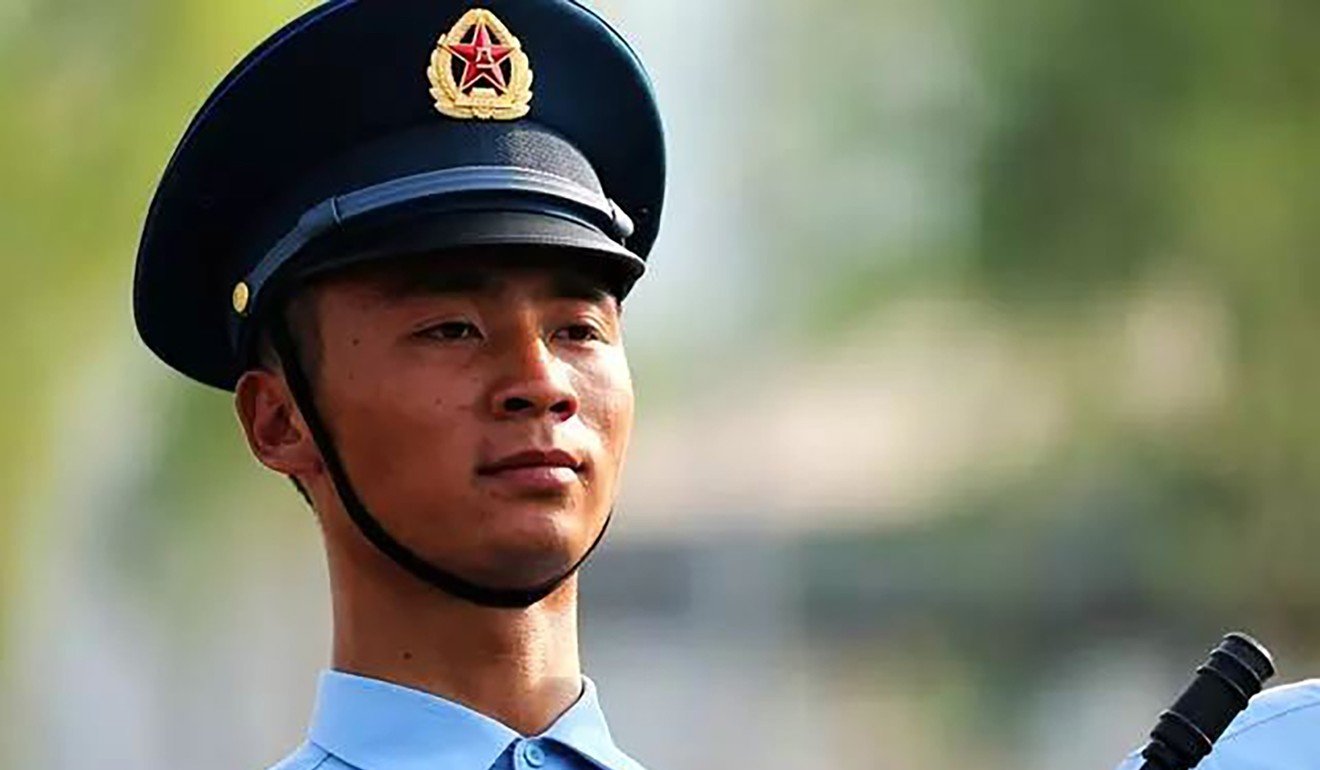
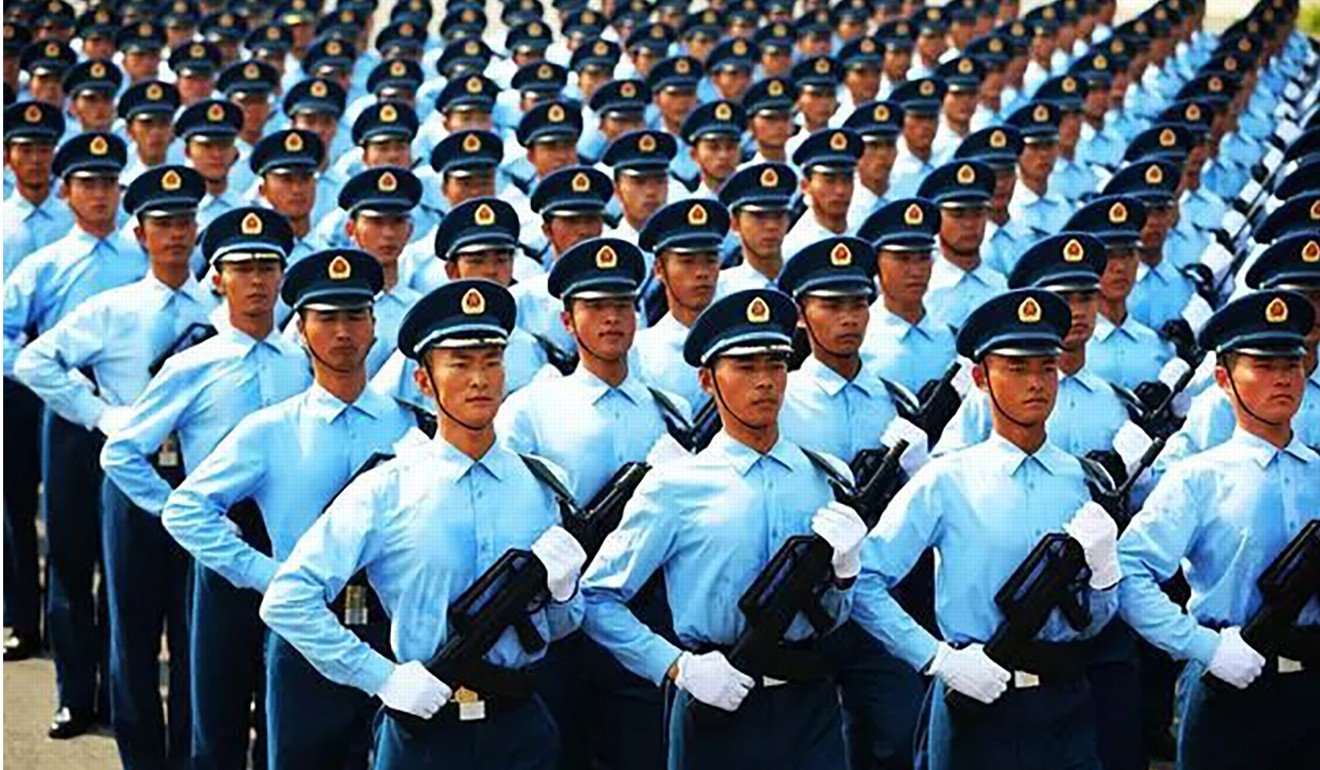
A young man who survived the devastating Sichuan earthquake and vowed to one day join the ranks of the soldiers who spent months rescuing people from the rubble will on Tuesday lead his very own squad of airborne troops in Tiananmen Square as part of the celebrations for the country’s 70th anniversary.
Now 23, Cheng Qiang was just 12 when on May 12, 2008 he and a group of friends played truant from school to go swimming in a local river, Xinhua reported on Thursday.
When the boys had finished their fun they returned to their village in the township of Luoshui to find their school and many other buildings had been razed to the ground. The death toll from the magnitude 8 quake would eventually rise to 87,000, with 370,000 people injured.
Cheng says he is ready to “continue the glory of the airborne troops” at Tuesday’s parade. Photo: Thepaper.cn
In the days and weeks that followed the devastation, tens of thousands of people from around China and the world descended on towns and villages across Sichuan to help with the rescue effort.
But the ones who impressed Cheng the most were the soldiers from the People’s Liberation Army (PLA) with the word “Airborne” printed on the helmets.
“Sometimes they had to remove the debris with their bare hands which were already covered in blood,” he said.
“But they just carried on and eventually pulled dozens of people out of the rubble. I knew then that I wanted to be one of them.”
Cheng said that after the quake having the troops in his village made him feel safe. Photo: People.cn
Having the troops in his village made Cheng feel safe, he said, and he spent his days following them around and doing what he could to help.
Three months later, when the soldiers had completed their work and were preparing to pull out, Cheng said he was determined to show his new heroes just how grateful he was to them.
As the villagers gathered at the roadside to bid farewell to the men who had become their saviours, the young boy held up a handwritten sign. It said simply: “I want to be an airborne soldier when I grow up.”
The moment was captured on camera by a press photographer, and the image soon became a symbol of the gratitude felt by the people who had seen their lives and communities shattered but knew they had not been forsaken.
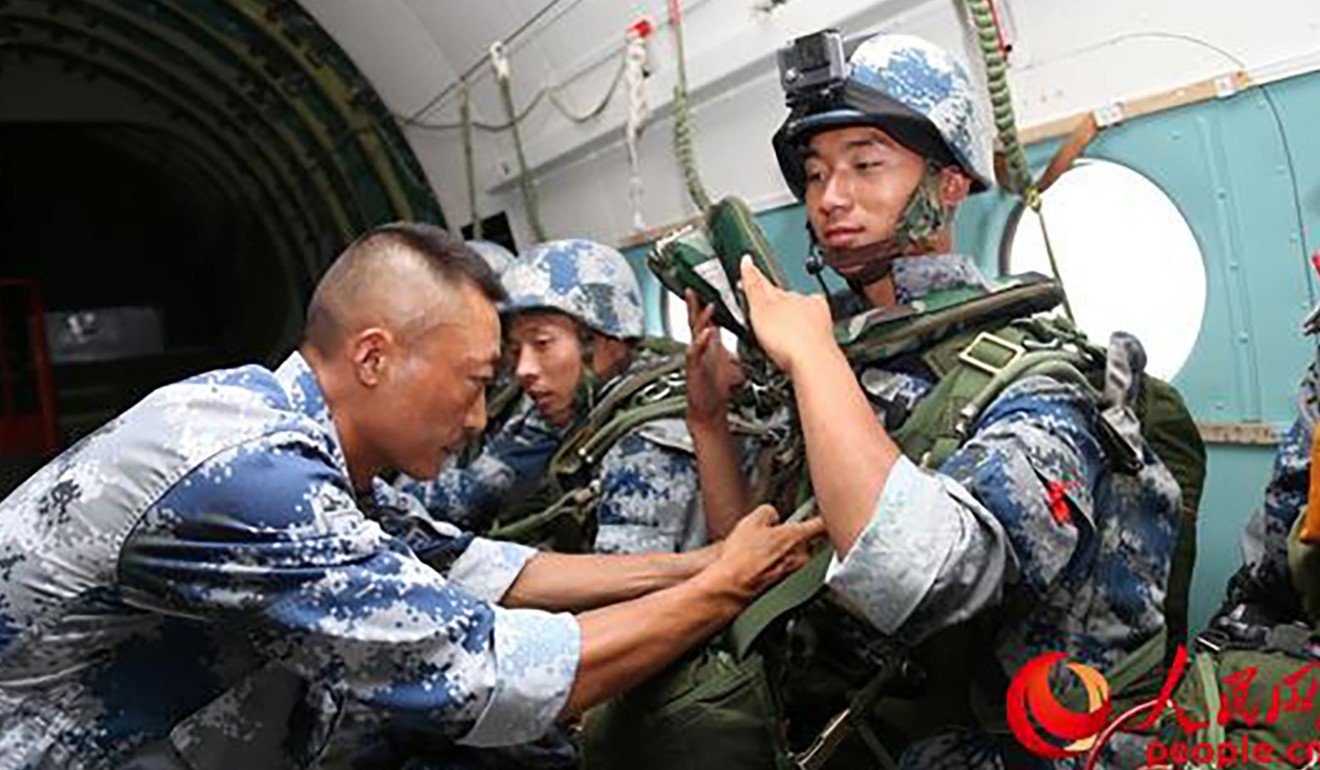
Cheng said he felt dizzy when he first jumped out of a plane. Photo: People.cn
Five years after the troops rolled out, Cheng was preparing to go to college when he heard the PLA was recruiting and that there were places available with the airborne division.
The teenager did not need a second invitation, and after securing a place on a training course and successfully completing it he joined the ranks of his heroes in 2013.
Not that everything was plain sailing, however.
“When I first jumped out of a plane I felt very dizzy and didn’t really know what was going on,” he said.
Thankfully Cheng managed to overcome his vertigo and went on to become a squad leader.
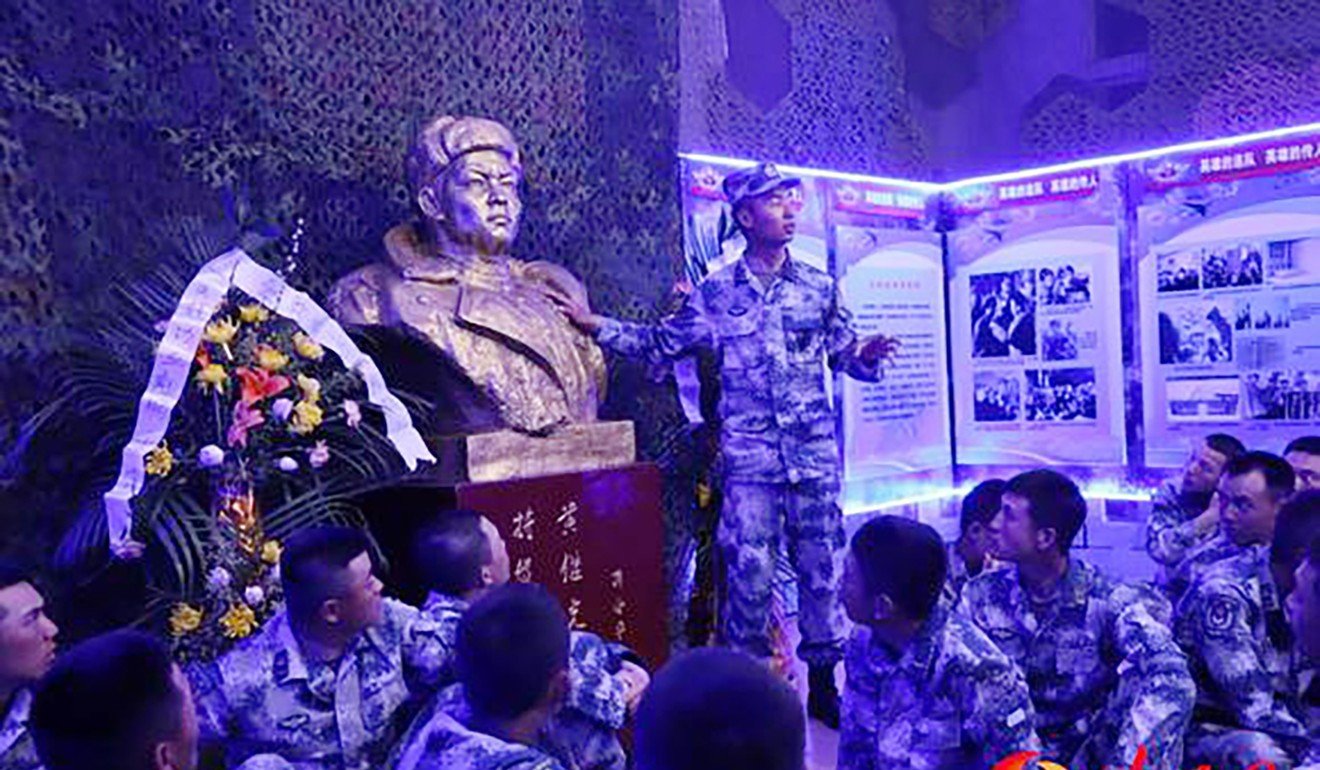
Tens of thousands of troops will take part in China’s National Day parade on October 1. Photo: Thepaper.cn
When the preparations were being made for next week’s anniversary celebrations in Beijing, Cheng said he and his squad were chosen to take part.
He said that during the rehearsals for the grand parade, he was repeatedly reprimanded by his trainer for not keeping his knees close enough together, for lifting his feet too high and for letting his gun slip off shoulder.
But he was determined to get it right, and after weeks of hard work and 11 years on from the tragedy that devastated his world, he said he was now ready to put his best foot forward.
“The nightmare of earthquake has long gone,” he said. “I am here to continue the glory of the airborne troops. I am ready for inspection.”
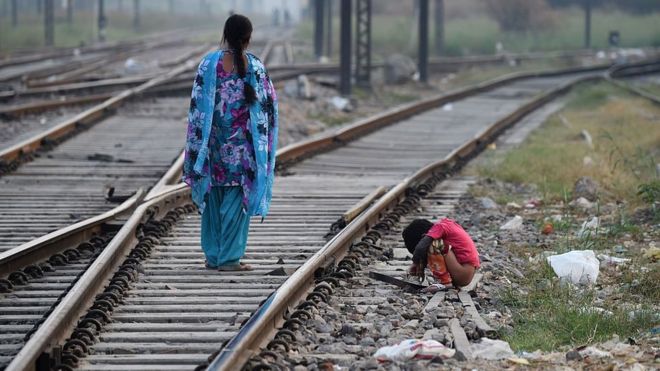
Image copyright GETTY IMAGESImage caption Millions of poor Indians still defecate in the open
Two men in the central Indian state of Madhya Pradesh have been arrested for allegedly killing two Dalit (formerly untouchables) children who were defecating in the open, police say.
Roshni, 12, and Avinash, 10, were attacked on Wednesday while defecating near a village road, they said.
The children’s family told BBC Hindi that they have no toilet at home.
Millions of poor Indians defecate in the open, which especially puts women and children at risk.
Dalits are at the bottom of the Hindu caste system and despite laws to protect them, they still face widespread discrimination in India.
“The two children were beaten to death with sticks,” police superintendent Rajesh Chandel told BBC Hindi’s Shuraih Niazi. “We have registered a murder case against both the accused. They are being questioned.”
Within hours of the attack early on Wednesday morning, police arrested two upper-caste men – Rameshwar Yadav and Hakim Yadav.
Roshni and Avinash were cousins, but Roshni had been brought up by Avinash’s parents and lived with them.
Avinash’s father, Manoj, says that as a daily wage labourer, he cannot afford to build a toilet at his house. He also says he has been unable to access a government subsidy as part of a flagship scheme to build toilets for the poor.
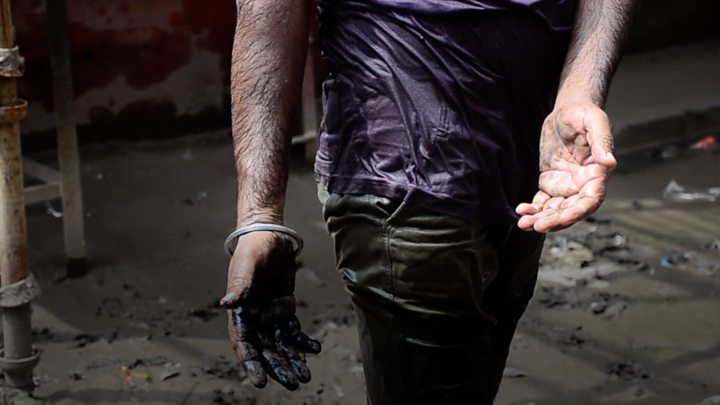
Media caption The Dalits unblocking India’s sewers by hand
The Swachh Bharat Mission or Clean India programme seeks to end open defecation by increasing toilet infrastructure and improving sanitation across the country. When Prime Minister Narendra Modi launched the program in 2014, he vowed to make India “open defecation free” by 2 October 2019.
Manoj’s village – Bhavkhedi – has been declared “open defecation free”, a tag given by the government to villages and cities have successfully ended open defecation.
Image caption Women who go out at night to defecate are often at risk
Research has shown that while the construction of toilets has increased rapidly, lack of water, poor maintenance and slow change in behaviour have stood in the way of ending open defecation.
But many have praised Mr Modi for highlighting the issue and launching a major scheme to address it – the Bill & Melinda Gates Foundation honoured him this week, describing the Swachh Bharat Mission as “a model for other countries around the world that urgently need to improve access to sanitation for the world’s poorest.”








 CHINDIA ALERT: You'll be living in their world, very soon
China set to join Arms Trade Treaty that Donald Trump threatened to abandon
China said it has begun preparations to join an international arms control treaty that the United States has threatened to abandon, while also warning Washington against deploying missiles in the Asia-Pacific region.
Speaking at the United Nations General Assembly in New York on Friday, Chinese Foreign Minister Wang Yi said that signing up to the Arms Trade Treaty (ATT) was further evidence of Beijing’s commitment to defending multilateralism.
said in April that he intended to withdraw from the pact, which regulates the US$70 billion global trade in conventional arms.
The White House said at the time that the ATT “will only constrain responsible countries while allowing the irresponsible arms trade to continue”, as major arms exporters like Russia and China were not part of it.
Wang said on Friday that any unilateral move to leave the treaty would have a “negative impact in various areas”. He stopped short of naming the United States or its president.
China’s foreign ministry said in a statement on Saturday that it had begun the legal process of joining the treaty, adding that it attached great importance to the issues caused by the illegal sale and misuse of arms, and supported the aims of the ATT in seeking to regulate the international weapons trade.
Wang also spoke out against the possible deployment of ground-launched missiles in the Asia-Pacific region.
According to figures released in May by the Stockholm International Peace Research Institute, the United States is the world’s largest arms exporter, supplying weapons worth 58 per cent more than those of its nearest competitor, Russia.
Together with France, Germany and China, the five nations accounted for 75 per cent of all weapons sold around the world between 2014 and last year, the institute said.
Although China is among the world’s big five arms suppliers, its sales – most of which go to Asia and Oceania – are dwarfed by those of the US, accounting for just 5.2 per cent of the 2014-18 total, compared to America’s 36 per cent.
Several major arms importers, including India, Australia, South Korea and Vietnam, refuse to buy arms from China for political reasons.
Beijing’s decision to join the ATT is in keeping with the image it has sought to present of China as a defender of multilateralism. The stance is also in sharp contrast to the US’ position under Trump, who has repeatedly scrapped multilateral trade agreements in favour of bilateral deals.
Since taking office in 2016, he has withdrawn the US from the Paris climate accord, the Iran nuclear deal and the Trans-Pacific Partnership.
Military observers said Beijing might seek to pressure on Washington to stay in the deal to try to maintain the strategic and military balance in the region.
Song Zhongping, a Hong Kong-based military affairs commentator, said Beijing might be trying to avoid misuse of conventional weapons.
“Beijing may want to press big exporters, such as the US and Russia, to join the deal because without proper regulations, the risk of illegal trade and misuse of conventional weapons could be running high,” he said.
“This could also threaten regional stability or even trigger unnecessary arms races.”
Adam Ni, a China specialist at Sydney’s Macquarie University, said the treaty would put some limits on the arms trade “but it would not mean that China would not be able to do deals. It will still be able to do [most deals]”.
Retired PLA colonel Yue Gang said the strategy could also improve China’s international reputation.
Source: SCMP
Posted in abandon, arms importers, Arms Trade Treaty, Asia, Asia-Pacific region, Australia, Beijing, China alert, deploying, dwarfed, Foreign Minister Wang Yi, France, General Assembly, Germany, global arms control treaty, India alert, Intermediate-Range Nuclear Forces Treaty, Iran nuclear deal, join, largest nuclear weapons, Macquarie University, military affairs commentator, Military observers, missiles, New York, Paris climate accord, political reasons, President Donald Trump, Russia, South Korea, Sydney, threatened, Trans-Pacific Partnership (TPP), Uncategorized, United Nations, United States, Vietnam, Washington, White House | Leave a Comment »