Chindia Alert: You’ll be Living in their World Very Soon
aims to alert you to the threats and opportunities that China and India present. China and India require serious attention; case of ‘hidden dragon and crouching tiger’.
Without this attention, governments, businesses and, indeed, individuals may find themselves at a great disadvantage sooner rather than later.
The POSTs (front webpages) are mainly 'cuttings' from reliable sources, updated continuously.
The PAGEs (see Tabs, above) attempt to make the information more meaningful by putting some structure to the information we have researched and assembled since 2006.
(This Feb. 24 story corrects paragraph 12 to show Huawei was world’s third-largest smartphone vendor last year, not second largest)
BARCELONA (Reuters) – China’s Huawei welcomed comments from President Donald Trump about the future of U.S. mobile communications on Sunday and asserted its position as a world-leading smartphone producer as Washington and Beijing seek a trade war ceasefire.
U.S. and Chinese negotiators are set to meet for a sixth straight day of negotiations on Sunday as they work to strike a deal ahead of a March 1 deadline on a trade dispute which has disrupted global commerce and slowed the world economy.
At the center of the imbroglio is Huawei Technologies, accused by Washington of sanctions busting, intellectual property theft and facilitating Chinese state espionage operations.
Speaking ahead of the mobile industry’s biggest global event which begins in Barcelona on Monday, Huawei Chairman Guo Ping reiterated his company’s position that it has never and would never allow any country to spy through its equipment.
Guo, who holds Huawei’s rotating chairmanship, said Trump’s recent assertion that the United States needed to get ahead in mobile communications through competition rather than seeking to block technology was “clear and correct”.
Trump’s tweets on Thursday did not specifically mention Huawei, the world’s largest producer of mobile network equipment, but appeared to soften earlier U.S. statements that it should be barred from Western networks on security grounds.
“I have noticed the president’s Twitter, he said that the U.S. needs faster and smarter 5G, or even 6G in the future, and he has realized that the U.S. is lagging behind in this respect, and I think his message is clear and correct,” Guo said, speaking through an interpreter.
He said the United States did not represent the whole world and called for equipment makers, network operators and governments to work together to devise trustworthy standards to manage cyber security risks.
The Huawei logo is displayed ahead of the Mobile World Congress (MWC 19) in Barcelona, Spain, February 24, 2019. REUTERS/Sergio Perez
“We need to have unified standard that should be verifiable. It should not be based on politics,” Guo said.
FOLDING PHONE, RIGID PRICE TAG
Huawei also sought to reaffirm its position as one of the world’s leading technology companies, unveiling a folding 5G smartphone to an audience of media and analysts in Barcelona.
Huawei, the world’s third-largest smartphone vendor after Samsung and Apple, said it had taken the lead in developing phones for 5G – which promises super-fast internet speeds – because it was also involved in developing the networks.
The new Huawei Mate X will have two back-to-back screens which unfold to become an eight-inch tablet display, and goes on sale later this year priced at 2,299 euros ($2,607), setting a new upper limit for consumer smartphones.
Samsung had unveiled its own folding smartphone last week, priced at nearly $2,000, as part of a bid to top the technology of Chinese rivals and Apple Inc.
Thomas Husson, principal analyst at Forrester Research, said the Mate X showed Huawei was an innovative technology company and no longer trailing American and Korean competitors.
“The fact that Huawei is not just a network equipment provider but also a smartphone manufacturer … gives them a competitive advantage for 5G. It is also a double-edge sword as some argue the security risks are higher,” Husson said.
China’s Xiaomi, the world’s fourth-largest smartphone maker, also unveiled a 5G handset on Sunday, but without the folding screen or high price tags touted by the Huawei and Samsung devices. Xiaomi’s offering will start at 599 euros ($679) when it hits the market in May.
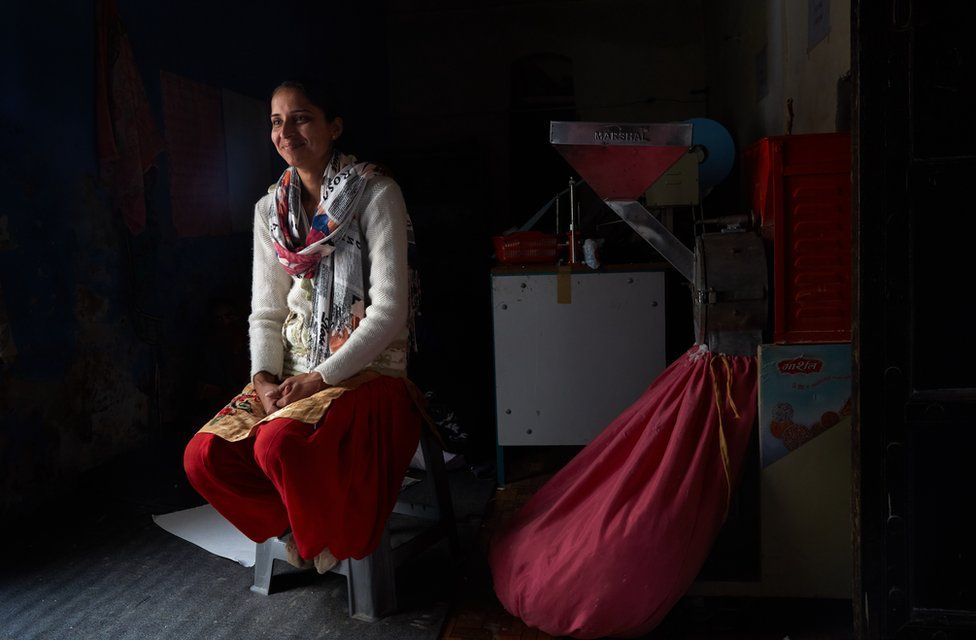
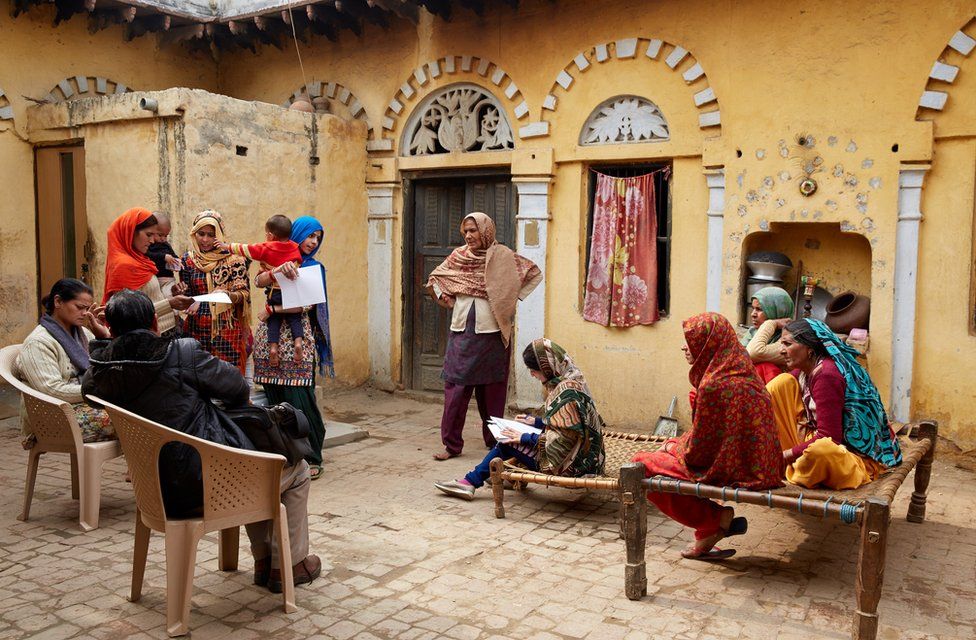
Image captionSneh, 22, attended the awards ceremony where the film won an Oscar
A film based on young women in an Indian village who make sanitary pads has won an Oscar for best documentary short. The BBC’s Geeta Pandey met with the women in their village before the ceremony.
Sneh was 15 when she started menstruating. The first time she bled, she had no idea what was happening to her.
“I was very scared. I thought I was sick with something very serious and began crying,” she told me when I visited her home in Kathikhera village not far from Delhi earlier this week.
“I didn’t have the courage to tell my mother so I confided in my aunt. She said: ‘You’re a grown woman now, don’t cry, it’s normal.’ It was her who told my mother.”
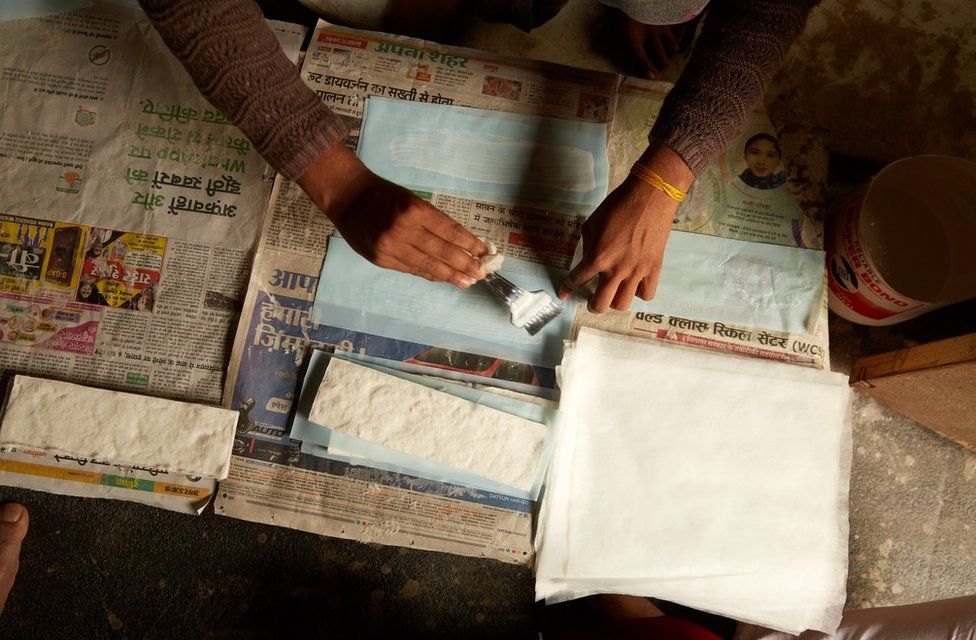
Sneh, now 22, has travelled a long way from that point. She works in a small factory in her village that makes sanitary pads and is the protagonist of Period. End of Sentence., a documentary that has been nominated for an Oscar. She will be attending Sunday’s ceremony in Los Angeles.
The film came about after a student group in North Hollywood used crowdfunding to send a pad-making machine – and Iranian-American filmmaker Rayka Zehtabchi – to Sneh’s village.
Just 115km (71 miles) from Delhi, Kathikhera village in Hapur district is a world far removed from the glitzy malls and high-rises of the Indian capital. Normally, it’s a two-and-a-half-hour drive from Delhi, but construction work on the highway slows it down to four hours for us. And the final 7.5km drive to the village from Hapur town is a crawl, on narrow winding roads lined with open drains on both sides.
The documentary is filmed in the farms and fields – and classrooms – of Kathikhera. Like in the rest of India, periods are a taboo topic; menstruating women are considered impure and barred from entering religious places and often excluded from social events too.
Image captionSneh says that previously, menstruation was not discussed – even among girls
With so much stigma surrounding the issue, it’s no surprise that Sneh had never heard of periods before she started getting them herself.
“It was not a topic that was discussed – even among girls,” she says.
But things began to change when Action India, a charity that works on reproductive health issues, set up a sanitary napkin manufacturing unit in Kathikhera.
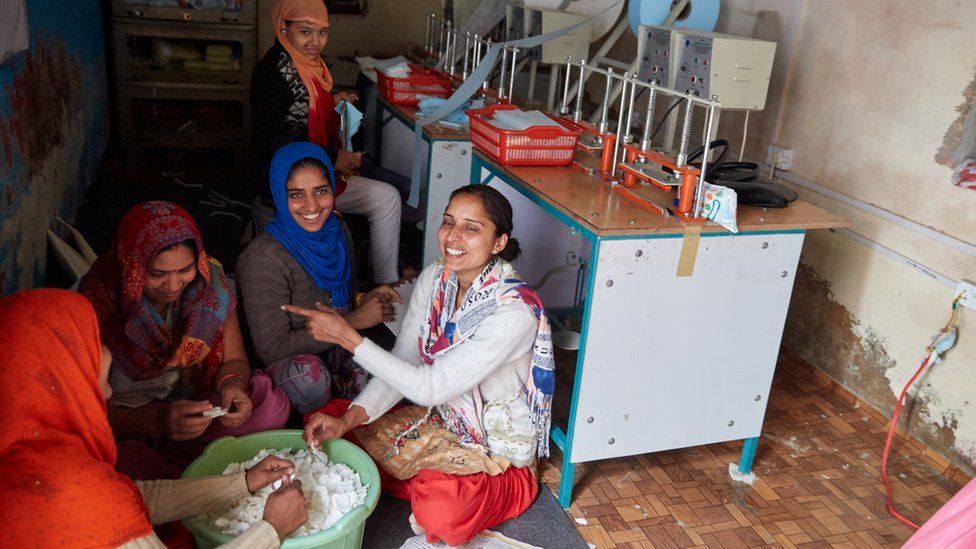
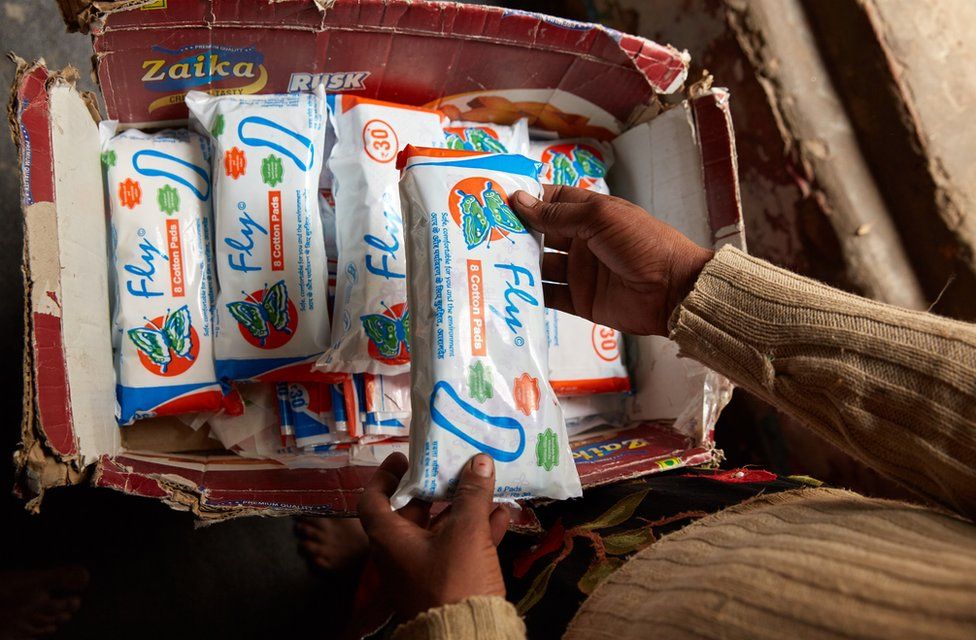
Image captionThe women employees work from 9-5 six days a weekImage captionA pack is priced at 30 rupees ($0.40; £0.30)
In January 2017, Sneh was asked by Suman, a neighbour who works with Action India, if she wanted to work in the factory.
A college graduate who dreams of working for the Delhi police one day, Sneh says she was excited. After all, there were “no other job opportunities” in the village.
“When I sought my mum’s permission, she said, ‘ask your father’. In our families, all important decisions are taken by men.”
She was too embarrassed to tell her father that she was going to be making pads so she told him that she would be making children’s diapers.
“It was two months into the job that mum told him that I was making pads,” she laughs. Much to her relief, he said, “That’s alright, work is work.”
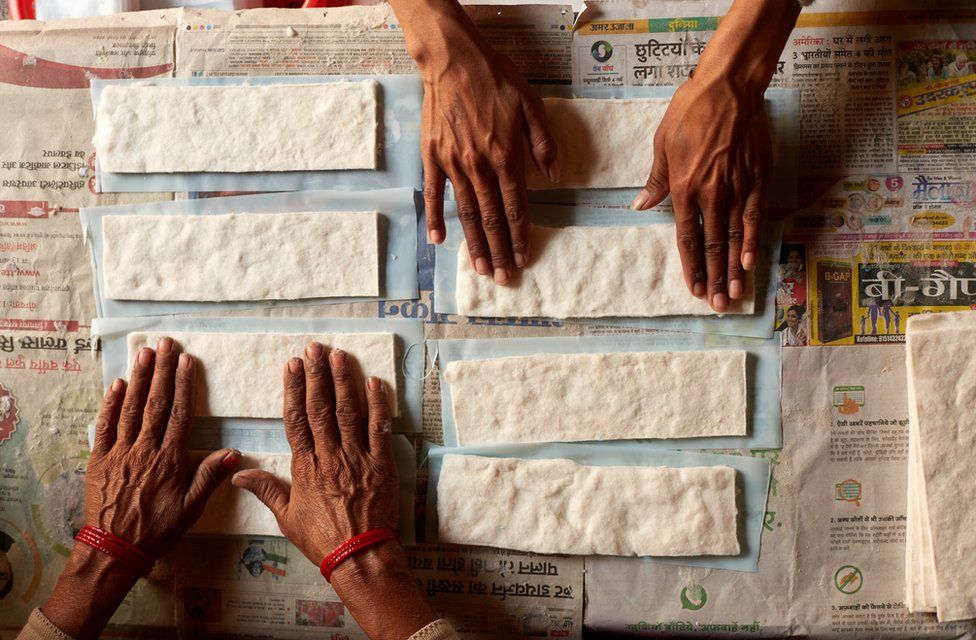
Today, the unit employs seven women, between 18 and 31 years of age. They work from 9-5, six days a week and are paid a monthly salary of 2,500 rupees ($35; £27). The centre produces 600 pads a day and they are sold under the brand name Fly.
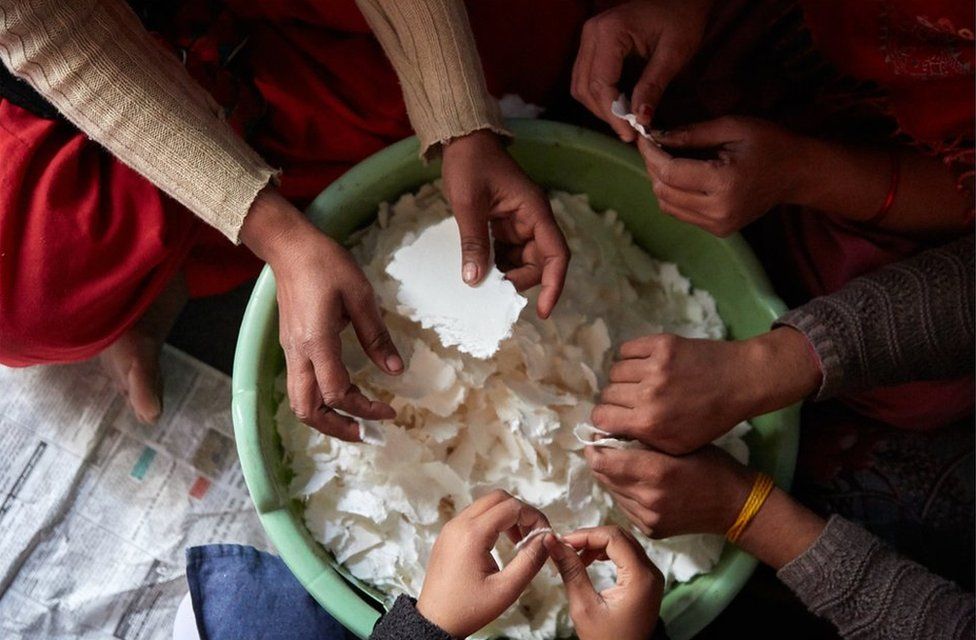
Image captionThe centre produces 600 pads a dayImage captionMost women in the village used to use old clothes when they got their periods, now 70% use pads“The biggest problem we face is power cuts. Sometimes we have to come back at night to work when the power is back to meet the targets,” Sneh says.
This little business, run from two rooms in a village home, has helped improve feminine hygiene. Until it was set up most women in the village were using pieces of cloth cut out from old saris or bedsheets when they had their period, now 70% use pads.
It’s also de-stigmatised menstruation and changed attitudes in a conservative society in ways that were unimaginable just a couple of years ago.
Sneh says menstruation is now discussed openly among women. But, she says, it’s not been an easy ride.
“It was difficult at the start. I had to help my mother with housework, I had to study and do this job. Sometimes during my exams, when the pressure became too much, my mother went to work instead of me,” she says.
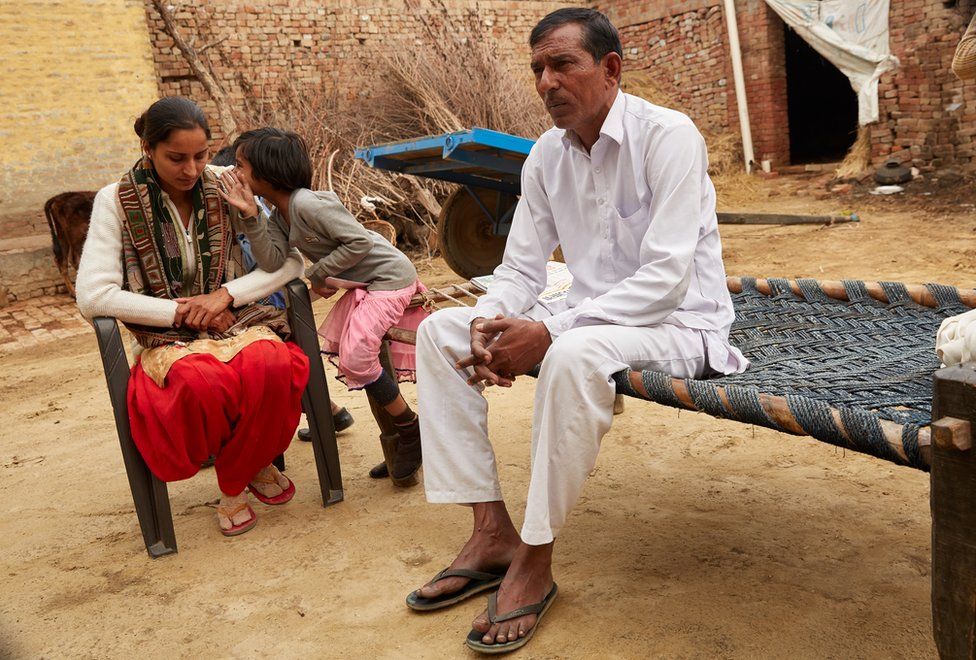
Her father, Rajendra Singh Tanwar, says he is “very proud” of his daughter. “If her work benefits the society, especially women, then I feel happy about it.”
Image captionRajendra Singh Tanwar says he’s proud of what Sneh (left) has doneImage captionSushma Devi’s husband does not want her to work there – but she won’t give it up
Initially, the women faced objections from some villagers who were suspicious about what was happening at the factory. And once the film crew arrived, there were questions about what they were doing.
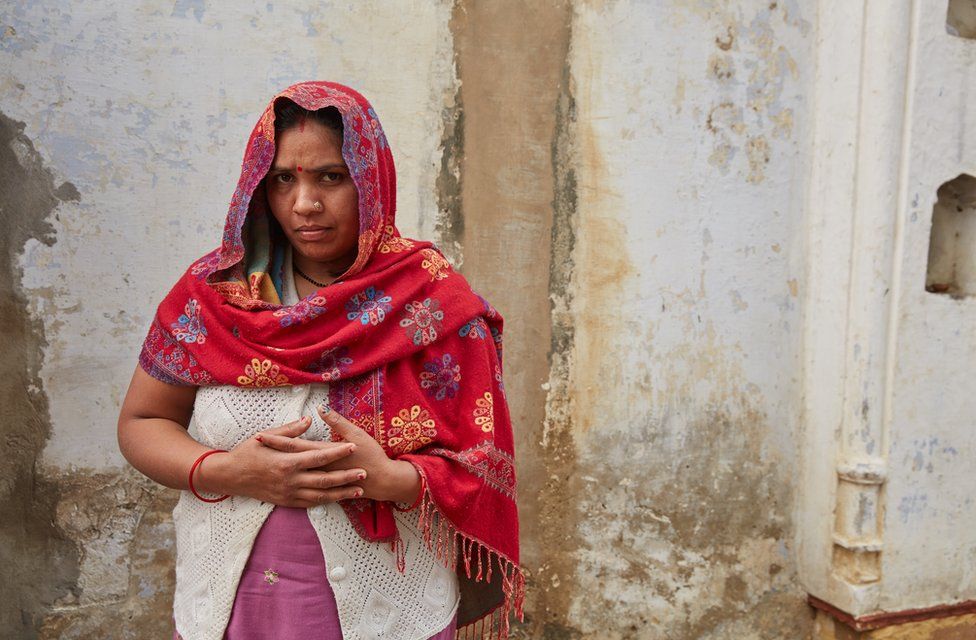
And some, like 31-year-old Sushma Devi, still have to fight daily battles at home.
The mother-of-two says her husband agreed to let her work only after Sneh’s mother spoke to him. He also insisted that she finish all the housework before going to the factory.
“So I wake up at 05:00, clean the house, do the laundry, feed the buffaloes, make dung cakes which we use as cooking fuel, bathe, and make breakfast and lunch before I step out. In the evening, I cook dinner once I get back.”
But her husband is still unhappy with the arrangement. “He often gets angry with me. He says there’s enough work at home, why do you have to go out to work? My neighbours too say it’s not a good job, they also say the salary is low.”
Two of Sushma’s neighbours had worked at the factory too, but left after a few months. Sushma has no intention of doing the same: “Even if my husband beats me up, I will not give up my job. I enjoy working here.”
Image captionAction India, a charity that works on reproductive health issues, set up the manufacturing unit two years ago
In the documentary, Sushma is heard saying she’d spent some of her earnings to buy clothes for her younger brother. “If I’d known this was going to go to Oscars, I would have said something more intelligent,” she says, laughing.
For Sushma, Sneh and their fellow workers, the Oscar nomination has come as a big boost. The film, which is available on Netflix, is nominated in the Best Short Documentary category.
As Sneh prepares to leave for Los Angeles, her neighbours are appreciative of the “prestige and fame” she has brought the village.
“No-one from Kathikhera has ever travelled abroad so I’ll be the first one to do so,” she says. “I’m now recognised and respected in the village, people say they are proud of me.”
Sneh says she had heard of Oscars and knew they were the biggest cinema awards in the world. But she had never watched a ceremony, and certainly didn’t think that one day she would be on the red carpet.
“I never thought I would go to America. Even now I can’t fully process what’s happening. For me, the nomination itself is an award. It’s a dream that I’m dreaming with my eyes open.”
SRINAGAR (Reuters) – Five people were killed in a gun battle between members of a Pakistani militant group and Indian security forces in disputed Kashmir on Sunday as India intensified a security
Indian authorities have killed at least eight JeM militants and detained around 50 militants, sympathizers and their relatives since the bomb attack, which also sparked the roundup of separatists which India says is needed to head off trouble ahead of a general election to be held by May.
Most of those rounded up over the last two days were linked to the Islamist party Jamaat-e-Islami (JeI).
“Since JeI has a wider network across Kashmir and they are mobilising anti-India protests, their arrest could help in curbing such protests ahead of elections,” the senior police officer said.
One well-known separatist leader, Abdul Gani Bhat, was placed under house arrest, according to his political party.
Separatists called a strike to protest against the detentions. Many shops, petrol stations, and businesses closed, with few people and vehicles on streets in sensitive areas, except for troop patrols.
In some areas of the main city of Srinagar, the government limited the movement of people and vehicles.
“The restrictions have been imposed as a precautionary measure to avoid any untoward incident,” the police said.
FUEL SUPPLIES LOW
The government of Jammu and Kashmir said fuel rationing had been introduced in the Kashmir Valley where there was only enough gasoline for one day, diesel for four days and no liquefied petroleum gas (LPG).
The government said it would seek to increase supplies to the region and that shortages are the result of road blockages after the suicide bomb attack.
Indian paramilitary troops in riot gear arrived in strength at first light, said Shakeel Ahmad, a resident of Nowhatta in the Srinagar district.
“At places, they have blocked the main roads with steel barricades and concertina wire,” he said.
State Governor Satya Pal Malik called on residents not to believe “rumours of any extreme nature”. The government said an increase in police numbers was to prevent candidates and voters from being intimidated into not standing or voting in the general election.
Separatist leader Mirwaiz Umar Farooq, who chairs the Hurriyat Conference of separatist groups, said arbitrary arrests and jailing of leaders, activists and young people for their political beliefs had happened across Kashmir for 30 years.
“Intimidating activists and leadership will not deter them from their path, nor will it stop people from demanding the resolution of the Kashmir dispute through self-determination,” he said.
Reuters’ telephone calls to the Indian home ministry to seek comment went unanswered.
TENSIONS RAISED
The suicide bomb attack has raised tensions between India and Pakistan which both claim Kashmir in full but rule it in part. India blames Pakistan for harbouring militant groups operating in Kashmir, which Pakistan denies.
After the attack, India dropped trade privileges for Pakistan and prepared to send as many as 10,000 more troops to the contested area, according to a home ministry letter seen by Reuters.
The Indian army said that early on Sunday evening Pakistan violated the two nations’ ceasefire at the Rajouri area of the border, through shelling from mortars and small arms fire. Defence spokesman Lieutenant Colonel Devender Anand said the Indian army was “retaliating strongly and effectively”.
Ceasefire violations are not unusual along the border.
A Pakistani security official said Pakistani forces had not initiated any action but had responded to Indian firing.
Kashmir is likely to be a key issue in India’s election, distracting from concerns about how Prime Minister Narendra Modi and his Bharatiya Janata Party have managed the economy.
Modi has promised a strong response to the attack, saying in a monthly radio broadcast on Sunday that it had caused anguish to all of India.
Modi added that the army had vowed to destroy the militants and those who helped them.
Islamabad has warned it would respond with “full force” if attacked. On Sunday, Foreign Minister Shah Mehmood Qureshi called on India to show restraint or it would put “the entire region’s peace and security at stake”.
India’s Supreme Court will hear a case this week seeking to drop a constitutional provision that bars non-residents from moving to the state of Jammu and Kashmir that encompasses the Muslim-majority region.
Mamata Banerjee claimed that her party Trinamool Congress(TMC) will win all the 42 Lok Sabha seats in West Bengal in the polls.
INDIAUpdated: Feb 25, 2019 16:35 IST
Press Trust of India
Kolkata
Chief Minister of West Bengal Mamata Banerjee during a press conference at Press Club of India, in New Delhi, on Thursday, Feb. 14, 2019. (HT Photot)
West Bengal chief minister Mamata Banerjee Monday alleged that though the Modi government had intelligence inputs about the Pulwama attack, it did not take any step as it was more keen on “playing politics over the dead bodies of jawans”.
Banerjee, while addressing the Trinamool Congress’s extended core committee meeting in Kolkata, vowed to oust the “dictatorial Narendra Modi government” from power in the upcoming general election.
She claimed that her party Trinamool Congress(TMC) will win all the 42 Lok Sabha seats in West Bengal in the polls.
“The central government was aware that such an attack can take place, there were intelligence inputs. Then why didn’t the government take action to protect our jawans. The government allowed them to die so that they can do politics over the dead body of jawans in the elections,” Banerjee said.
They want to create a “war hysteria” ahead of the Lok Sabha polls, the TMC president alleged.
The central government is functioning in a peculiar way and union ministers are not aware of important decisions, Banerjee claimed.
“This government is being run by two brothers (Prime Minister Narendra Modi and BJP president Amit Shah), who have blood of innocents on their hands,” she said.
“Our party workers and cadre should be cautious as efforts are on to tamper EVMs (electronic voting machines) during the Lok Sabha polls. You all have to thwart those efforts,” she said. On February 14, 40 Central Reserve Police Force (CRPF) personnel were killed in Jammu and Kashmir after a Jaish-e-Mohammed terrorist rammed an explosive-laden vehicle into their bus in Pulwama district.
PM Modi said that he told him ‘let us fight against poverty and illiteracy’ and Khan gave his word saying he is a Pathan’s son, ‘but went back on it’.
SNS Web | New Delhi | February 25, 2019 10:53 am
Pakistan Prime Minister Imran Khan on Sunday asked his Indian counterpart Narendra Modi to “give peace a chance” and assured him that he “stands by” his words and will “immediately act” if New Delhi provides Islamabad with “actionable intelligence” on the Pulwama attack.
Khan’s remarks came a day after PM Modi in a rally in Rajasthan, recalled his conversation with the Pakistan PM during a congratulatory call after he became the country’s premier.
PM Modi had told him “let us fight against poverty and illiteracy” and Khan gave his word saying he is a Pathan’s son “but went back on it”.
“There is consensus in the entire world against terrorism. We are moving ahead with strength to punish the perpetrators of terrorism…The scores will be settled this time, settled for good…This is a changed India, this pain will not be tolerated…We know how to crush terrorism,” PM Modi further said.
A statement released by the Pakistan Prime Minister’s Office said, “PM Imran Khan stand by his words that if India gives us actionable intelligence, we will immediately act.”
PM Modi should “give peace a chance”, Khan said in the statement.
In his first statement issued since the February 14 attack, Pakistani Prime Minister Imran Khan had on Tuesday accused India of blaming his country “without evidence” and warned of retaliation against any military action by India.
However, he assured India that he would act against the perpetrators of the deadly Pulwama terror attack, carried out by Pakistan-based Jaish-e-Mohammad (JeM) terror group and said that the issue between the two countries can be solved through dialogue.
India had called Khan’s offer to investigate the attack if provided proof as a “lame excuse”.
The already sour relations between India and Pakistan have worsened over the past few weeks as New Delhi accused Islamabad of the Pulwama attack.
India has accused Islamabad’s spy agency ISI of being involved in the attack and has maintained that the terror group JeM is a “child of the Pakistan Army”.
Following the attack, India immediately withdrew the ‘Most Favoured Nation’ status granted to Pakistan and initiated steps to isolate the neighbouring country from the international community.
Earlier, India had also announced its decision to stop the flow of its share of water from the Beas, Ravi and Sutlej to Pakistan.
Prime Minister Narendra Modi had in many of his public speeches after the attack, said that the security forces have been given full freedom to decide the future course of action regarding the terrorist attack in Pulwama.
India’s neighbours, including Sri Lanka, Maldives, Nepal, Bangladesh, Afghanistan and Bhutan—and other countries like Saudi Arabia, UAE, Iran, Russia, Germany, Canada, UK, Australia and Canada came out in strong support of New Delhi following the terror attack.
Over 44 CRPF personnel were killed and many injured on February 14 in one of the deadliest terror strikes in Jammu-Kashmir when a Jaish-e-Mohammad (JeM) suicide bomber blew up an explosive-laden vehicle near their bus in Pulwama district.
The bus was part of a convoy of 78 vehicles carrying around 2500 CRPF personnel from Jammu to Srinagar.
BEIJING, Feb. 24 (Xinhua) — China will further enhance physical activities in primary and secondary schools and promote students’ interests, said the Ministry of Education Friday.
Provincial-level regions in China have clearly included physics as a subject scored in senior high school entrance exam, according to the ministry.
Details to evaluate the subject of physics are based on local conditions, it said, adding swimming is used to assess the score in certain regions.
In 2016, the ministry released a guideline aiming to establish a senior high school entrance exam system based on both academic performance and comprehensive quality by 2020.
Aerial photo taken on Feb. 12, 2019 shows emergency worker Dong Jinbing (L) inspecting the high voltage wire with his workmate Wang Wensheng on the power transmission tower in the mountain area of Wuhan, capital of central China’s Hubei Province.
A team of electricians was dispatched to repair a high voltage wire that was broken due to thick layer of ice accumulation. After one day’s work on the over 40-meter-high power transmission tower in bad weather condition, the team succeeded in fixing the failed power system that lowered the trains’ speed causing delay during the post-holiday travel peak. This year’s Spring Festival travel rush started on Jan. 21 and will last till March 1, with railway trips expected to hit 413 million in total, up 8.3 percent. (Xinhua/Xiao Yijiu)
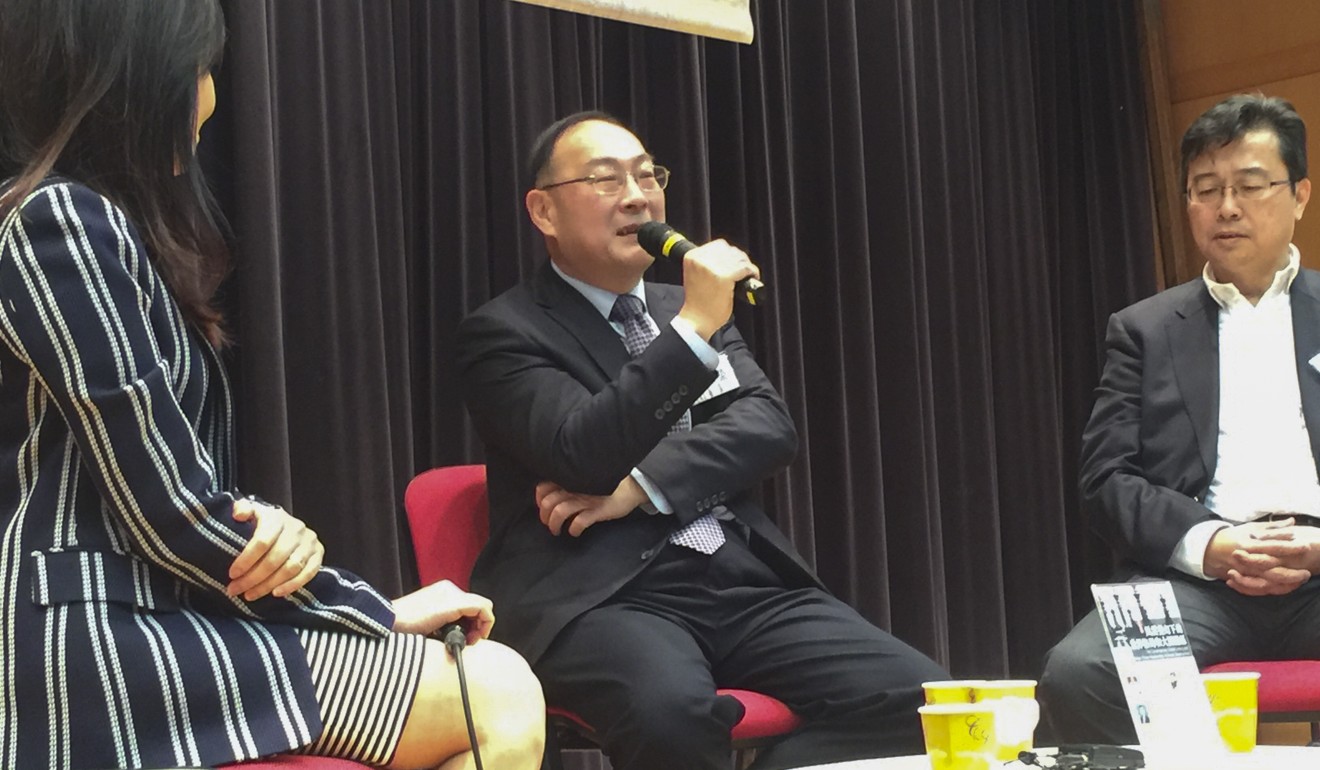
Military watchers can expect ‘something new’ at this year’s National Day parade in October, Professor Jin Canrong tells forum in Hong Kong
As tensions rise over Taiwan, Beijing is building a naval and missile force as powerful as any in the world, he says
Beijing’s military build-up just starting – a lot more to come, expert warns
24 Feb 2019
Submarine arms race seen heating up in Indo-Pacific amid China ‘threat’
16 Feb 2019
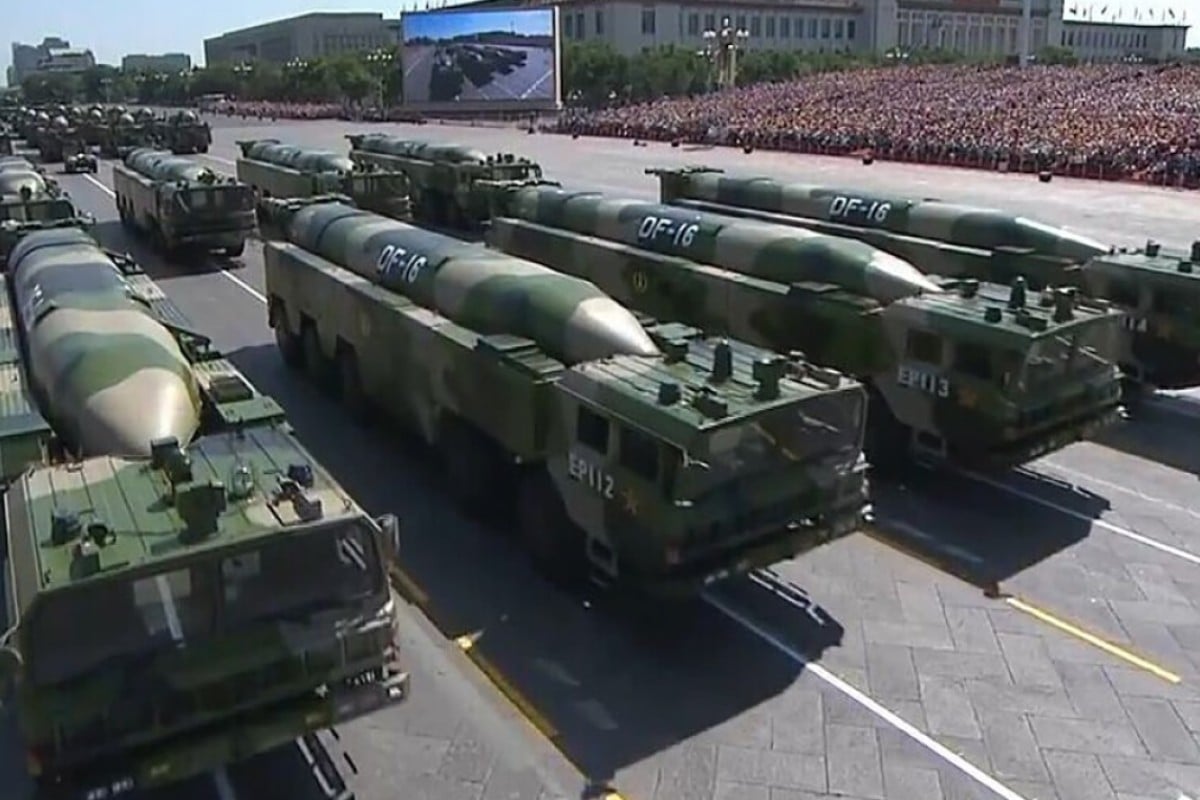
Military vehicles carrying DF-16 ballistic missiles take part in China’s National Day parade. Taiwan says Beijing has such missiles trained on the self-ruled island. Photo: Handout
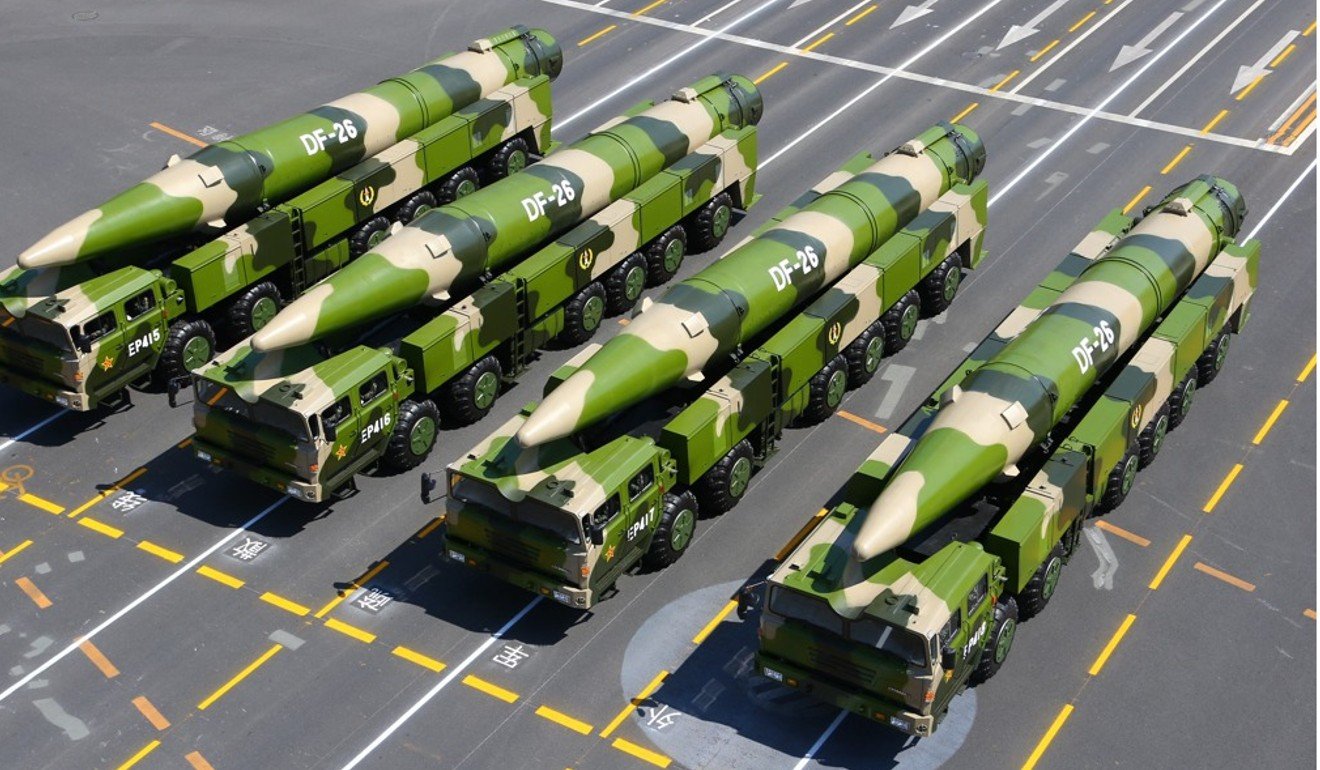
Beijing will show the world “something new” when it rolls out its arsenal of short- to medium-range ballistic missiles at its National Day military parade in October, according to a Chinese expert on international relations.
Speaking at a seminar at the University of Hong Kong on Saturday, Professor Jin Canrong, associate dean of the school of international studies at Renmin University in Beijing, said China had made great strides in expanding its military capability, but there was a lot more to come.
US commander pushes for more funding to counter China’s influence in Indo-Pacific
While he did not elaborate on what the “something new” might be, he said the country was gearing up for a possible conflict over Taiwan, the self-ruled island that Beijing regards as a wayward province awaiting reunification.
Over the next five or 10 years, Taiwan could provide the “biggest uncertainty” for Beijing, he said, especially if the United States decided to “ignite” the situation.
Known for being outspoken on sensitive issues, Jin said that while Beijing wanted a peaceful reunification, it was wary of “pro-independence factions [on the island] and right-wing American [politicians] creating trouble”.
By registering for these newsletters you agree to our T&C and Privacy Policy
In a speech on January 2 to mark the 40th anniversary of Beijing’s call to end military confrontation across the Taiwan Strait, Chinese President Xi Jinping said that “the political division across the strait … cannot be passed on from generation to generation”, apparently signalling his determination to bring it to an end.
Xi said China would not abandon the use of force in reunifying Taiwan, but stressed the military would target only external elements and those seeking independence for the island.
In 2017, Taipei said that it had detected the deployment of DF-16 ballistic missiles on the mainland that were aimed at Taiwan.
Jin said China was rapidly expanding its missile capabilities. The People’s Liberation Army had already stockpiled about 3,000 short- and medium-range missiles, he said, even though it had been using just 15 per cent of its production capacity.
“Just imagine if we were running at 100 per cent,” he said.
Beijing will show the world “something new” when it rolls out its ballistic missiles at its National Day military parade in October, an expert says. Photo: Xinhua
Share:
Under its plan for military modernisation China had achieved “great advancements in space, electronics and cyberwarfare”, the academic said, but its achievements to date were only the beginning.
As well as the expansion of its missile force, Beijing was investing heavily in its navy, he said.
Is China about to abandon its ‘no first use’ nuclear weapons policy?
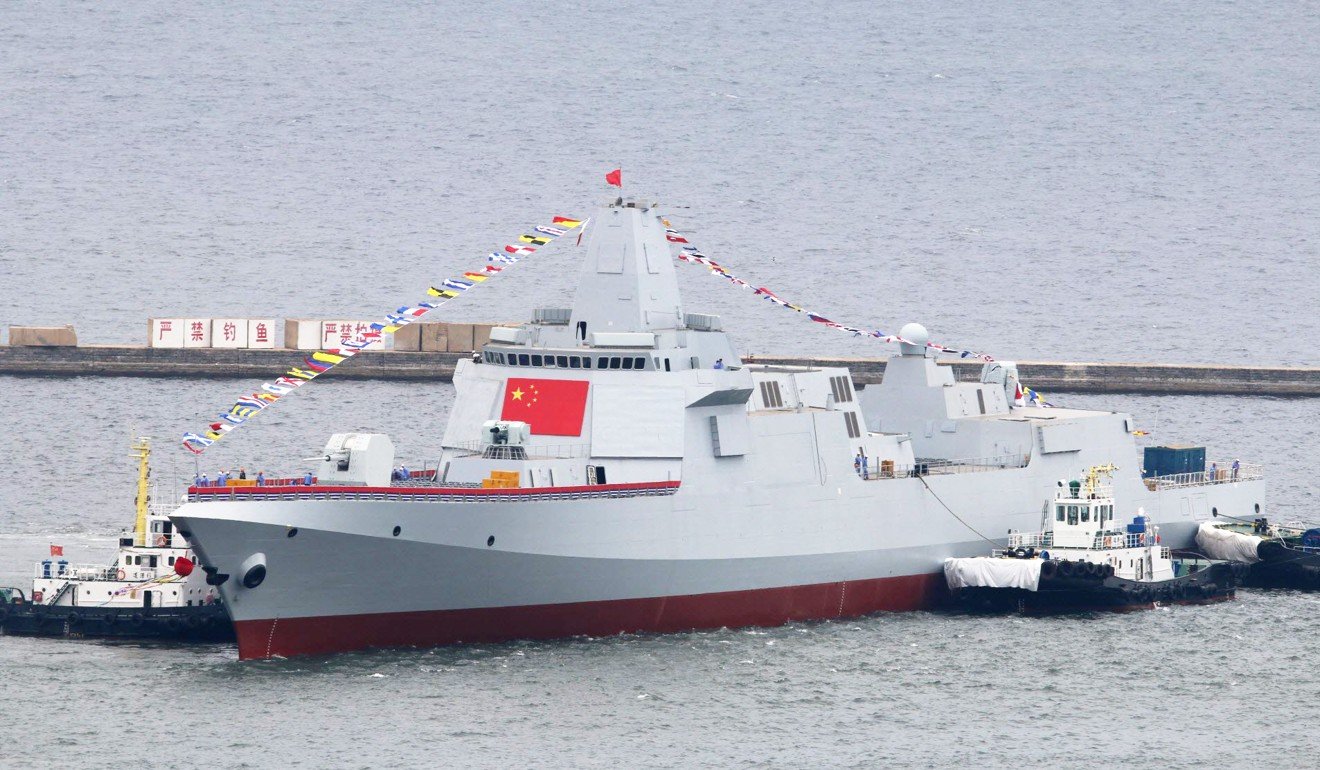
With the deployment of the new Type 055 guided-missile destroyer – which some Chinese military experts have said is as good as anything in the US Navy – the balance of power was shifting, he said.
“For the first time in 500 years, the East has combat equipment that is at least as good as the West’s.”
With the deployment of the new Type 055 guided-missile destroyer, the balance of power between China and the US is shifting, according to Jin Canrong. Photo: Handout
Share:
And as the navy continued to modernise and expand, the US might be forced to rethink its position in the region, he said.
“When we have dozens of destroyers and four or five [aircraft] carriers the US will not be able to meddle in Taiwan.”
China’s first aircraft carrier may become test bed for electromagnetic warplane launcher
Jin said that China would also soon have all the scientific, academic and research personnel it needed to achieve its military ambitions.
“China had nearly 30 million university students in 2018, which is twice as many as the US. More than half of them are studying science or engineering,” he said.
“Every year we produce about 4 million science and engineering graduates, while America produces just 440,000.”
Professor Jin Canrong speaks at a forum in Hong Kong. Photo: Handout
Share:
Beijing also had the money to support its plans, Jin said. Based on his own calculations, he said China allocated about 1.4 per cent of its gross domestic product to military spending, which was lower than “Germany’s 1.5 per cent”, and less than half the “3 per cent in Britain and France”.
“The tax paid by Chinese smokers is more than enough to cover [the country’s] military expenses,” Jin said.
According to figures from Nato, Britain spent 2.1 of its GDP on defence in 2017, France 1.8 per cent and Germany 1.2 per cent. Both the World Bank and the United Nations put China’s military spending in 2017 at 1.9 per cent of its GDP.
SEOUL/HANOI (Reuters) – North Korean leader Kim Jong Un made his way across China by train on Sunday, media reported, bound for a high-stakes second nuclear summit with U.S. President Donald Trump in Vietnam’s capital of Hanoi.
Few details of Kim’s trip have been announced but he left Pyongyang by train on Saturday afternoon for the Feb. 27-28 summit accompanied by senior North Korean officials as well as his influential sister, North Korea’s state media reported.
RELATED COVERAGE
Vietnam relishes role as peace maker as it seeks to balance ties
Vietnam’s Bamboo Airways to buy 10 Boeing planes during Trump-Kim summit
‘Chilling the atmosphere’ – North Korea media condemns U.S. Democrats ahead of summit
Trump and Kim will meet in Hanoi eight months after their historic summit in Singapore, the first between a sitting U.S. president and a North Korean leader, where they pledged to work towards the complete denuclearisation of the Korean peninsula.
With little progress since then, the two leaders are expected to focus on what elements of North Korea’s nuclear programme it might begin to give up, in exchange for U.S. concessions.
In rare, revealing coverage of Kim’s travel, while it is still going on, the North’s Rodong Sinmun newspaper featured photographs of him getting a red-carpet send-off in Pyongyang and waving from a train carriage door while holding a cigarette.
He was accompanied by top officials also involved in the Singapore summit, including Kim Yong Chol, a former spy chief and Kim’s top envoy in negotiations with the United States, as well as senior party aide Ri Su Yong, Foreign Minister Ri Yong Ho and defence chief No Kwang Chol.
The North Korean leader’s sister, Kim Yo Jong, who acted as a close aide in Singapore, is again part of the delegation, the North’s KCNA news agency reported. It made no mention of his wife, Ri Sol Ju.
The extensive coverage in the secretive North’s official media was a contrast to the limited reporting that has traditionally prevailed during his foreign trips.
Other senior officials, such as his de facto chief of staff Kim Chang Son and Kim Hyok Chol, negotiations counterpart to U.S. envoy Stephen Biegun, were already in Hanoi to prepare for the summit.
With scant progress since the June summit, the two leaders are likely to try to build on their personal connection to push things forward in Hanoi, even if only incrementally, analysts said.
Both sides are under pressure to forge more specific agreements than were reached in Singapore, which critics, especially in the United States, said lacked detail.
“They will not make an agreement which breaks up the current flow of diplomacy. (President Trump) has mentioned that they’ll meet again; even if there is a low-level agreement, they will seek to keep things moving,” said Shin Beom-chul, a senior fellow at the Asan Institute for Policy Studies.
LEARNING FROM VIETNAM
The Trump administration has pressed the North to give up its nuclear weapons programme, which, combined with its missile capabilities, poses a threat to the United States, before it can expect any concessions.
North Korea wants an easing of punishing U.S.-led sanctions, security guarantees and a formal end of the 1950-1953 Korean War, which ended in a truce, not a treaty.
Few details of summit arrangements have been released.
Some lamp posts on Hanoi’s tree-lined streets are decked with North Korean, U.S. and Vietnamese flags fluttering above a handshake design, and security has been stepped up at locations that could be the summit venue, or where the leaders might stay.
It could take Kim at least 2-1/2 days to travel to Vietnam by train.
Some carriages of a green train were spotted at Beijing’s station on Sunday, but it was not confirmed it was Kim’s.
South Korea’s Yonhap news agency said Kim’s train had passed through a station in China’s port city of Tianjin, southeast of Beijing, at around 1 p.m. (0500 GMT).
China has given no details of his trip. Its foreign ministry did not immediately respond to a request for comment.
Two top North Korean officials who were not in Singapore but will be in Hanoi are Kim Phyong Hae and O Su Yong, vice chairmen of the party’s Central Committee, respectively in charge of personnel management and industrial affairs, KCNA reported.
O is a former minister of electronics and vice minister of metals and machine building. He might try to learn about Vietnam’s development of manufacturing, analysts said.
Kim Jong Un may tour some economic facilities while in Vietnam.
Vietnam, like North Korea, fought a war against the United States and keeps tight control over its people and economy. It has been touted as a model for North Korea’s development.
Vietnamese media reported that a North Korean cargo plane arrived on Sunday carrying personnel who appeared to be Kim’s security guards and state media workers. They were driven under police escort to a downtown hotel.
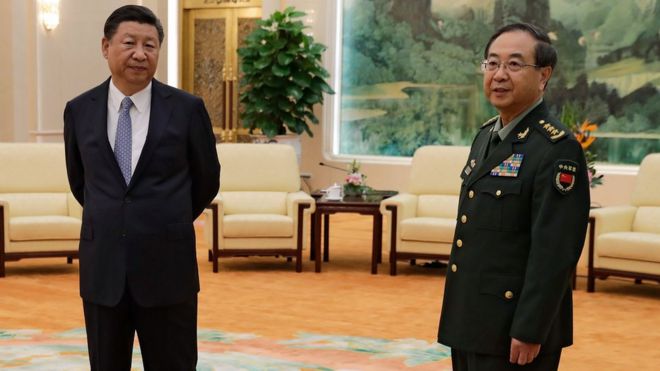
Image copyrightAFPImage captionFang Fenghui with President Xi Jinping in 2017
A former high-ranking Chinese general has been sentenced to life in jail for corruption, state media reports.
Fang Fenghui, ex-chief of joint staff of the People’s Liberation Army, was found guilty of bribery and having huge wealth that he had been unable to account for, according to Xinhua.
The 67-year-old accompanied President Xi Jinping in his first meeting with US President Donald Trump in 2017.
Many officials have been jailed in what Mr Xi says is an anti-corruption drive.
The efforts have had a particular focus on the country’s military, which is the world’s largest and is undergoing a modernisation campaign.
Fang Fenghui lost his post with no explanation in 2017 and disappeared from public view. The government later confirmed he was under investigation for alleged corruption.
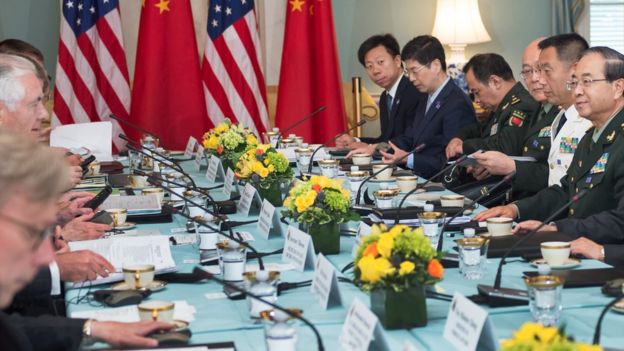
Image copyrightAFPImage captionFang Fenghui in a meeting with US officials, including former Secretary of State Rex Tillerson, in Washington in 2017
He was also a member of the powerful Central Military Commission, China’s supreme military body, and was close to Zhang Yang, who also served on the commission and was found dead in 2017 while being investigated for corruption.
Fang was expelled from the Communist Party last year ahead of his trial at a military court.
All his assets have been confiscated, Xinhua adds, without mentioning how much money was involved.
It is unclear whether he was allowed to retain a lawyer, Reuters news agency reports.
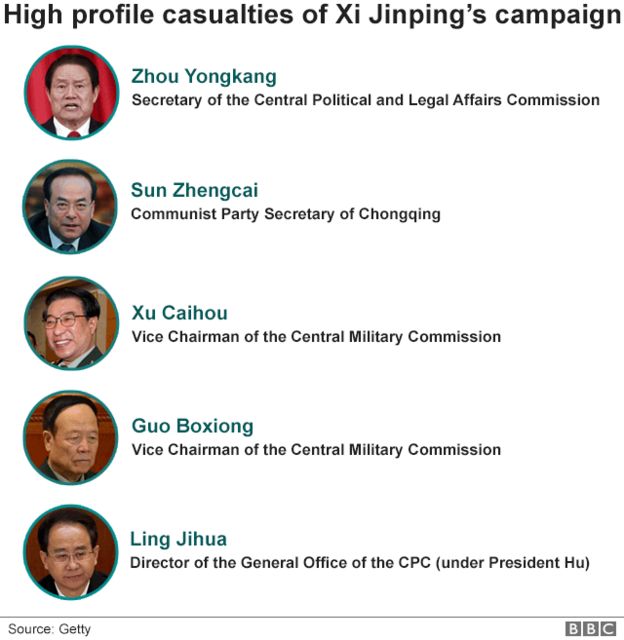
More than one million officials have been punished in the anti-corruption drive started by Mr Xi when he took power in 2012, the government says.
They include Xu Caihou and Guo Boxiong, both former vice chairman of the Central Military Commission. Xu died of cancer in 2015 before he could face trial while Guo was sentenced to life in prison for bribery in 2016.
The anti-corruption campaign has been described by some as a massive internal purge of opponents, on a scale not seen since the days of Mao Zedong, in whose Cultural Revolution many top officials were purged.