27/05/2020
NEW DELHI/SRINAGAR (Reuters) – A Himalayan border standoff between old foes India and China was triggered by India’s construction of roads and air strips in the region as it competes with China’s spreading Belt and Road initiative, Indian observers said on Tuesday.
Soldiers from both sides have been camped out in the Galwan Valley in the high-altitude Ladakh region, accusing each other of trespassing over the disputed border, the trigger of a brief but bloody war in 1962.
About 80 to 100 tents have sprung up on the Chinese side and about 60 on the Indian side where soldiers are billeted, Indian officials briefed on the matter in New Delhi and in Ladakh’s capital, Leh, said.
Both were digging defences and Chinese trucks have been moving equipment into the area, the officials said, raising concerns of a long faceoff.
“China is committed to safeguarding the security of its national territorial sovereignty, as well as safeguarding peace and stability in the China-India border areas,” the Chinese Foreign Ministry spokesperson’s office said in a statement.
“At present, the overall situation in the border areas is stable and controllable. There are sound mechanisms and channels of communication for border-related affairs, and the two sides are capable of properly resolving relevant issues through dialogue and consultation.”
There was no immediate Indian foreign ministry comment. It said last week Chinese troops had hindered regular Indian patrols along the Line of Actual Control (LAC).
But interviews with former Indian military officials and diplomats suggest the trigger for the flare-up is India’s construction of roads and air strips.
“Today, with our infrastructure reach slowly extending into areas along the LAC, the Chinese threat perception is raised,” said former Indian foreign secretary Nirupama Rao.
“Xi Jinping’s China is the proponent of a hard line on all matters of territory, sovereignty. India is no less when it comes to these matters either,” she said.
After years of neglect Prime Minister Narendra Modi’s government has pushed for improving connectivity and by 2022, 66 key roads along the Chinese border will have been built.
One of these roads is near the Galwan valley that connects to Daulat Beg Oldi air base, which was inaugurated last October.
“The road is very important because it runs parallel to the LAC and is linked at various points with the major supply bases inland,” said Shyam Saran, another former Indian foreign secretary.
“It remains within our side of the LAC. It is construction along this new alignment which appears to have been challenged by the Chinese.”
China’s Belt and Road is a string of ports, railways, roads and bridges connecting China to Europe via central and southern Asia and involving Pakistan, China’s close ally and India’s long-time foe.
Source: Reuters
Posted in air strips, Belt and Road Initiative, border, bridges, camped, central, China, China-India border areas, Chinese foreign ministry, connecting, Construction, Daulat Beg Oldi, Europe, faceoff, Galwan Valley, Government, Himalayan border, India, India’s, Indian, Indian Foreign Secretary, Ladakh region, Line of Actual Control (LAC), national territorial sovereignty,, new, New Delhi, observers, old foes, Pakistan, peace and stability, ports, Prime Minister Narendra Modi’s, railways, region, roads, Safeguarding, soldiers, southern Asia, sparked, Srinagar, standoff, triggered, Uncategorized, Xi Jinping’s |
Leave a Comment »
13/10/2019
- The leaders agreed to set up a mechanism to boost economic ties and tackle India’s trade deficit with China after their second informal summit
- As 2020 is the 70th anniversary of diplomatic ties between both countries, India and China will hold 70 events next year to promote relations
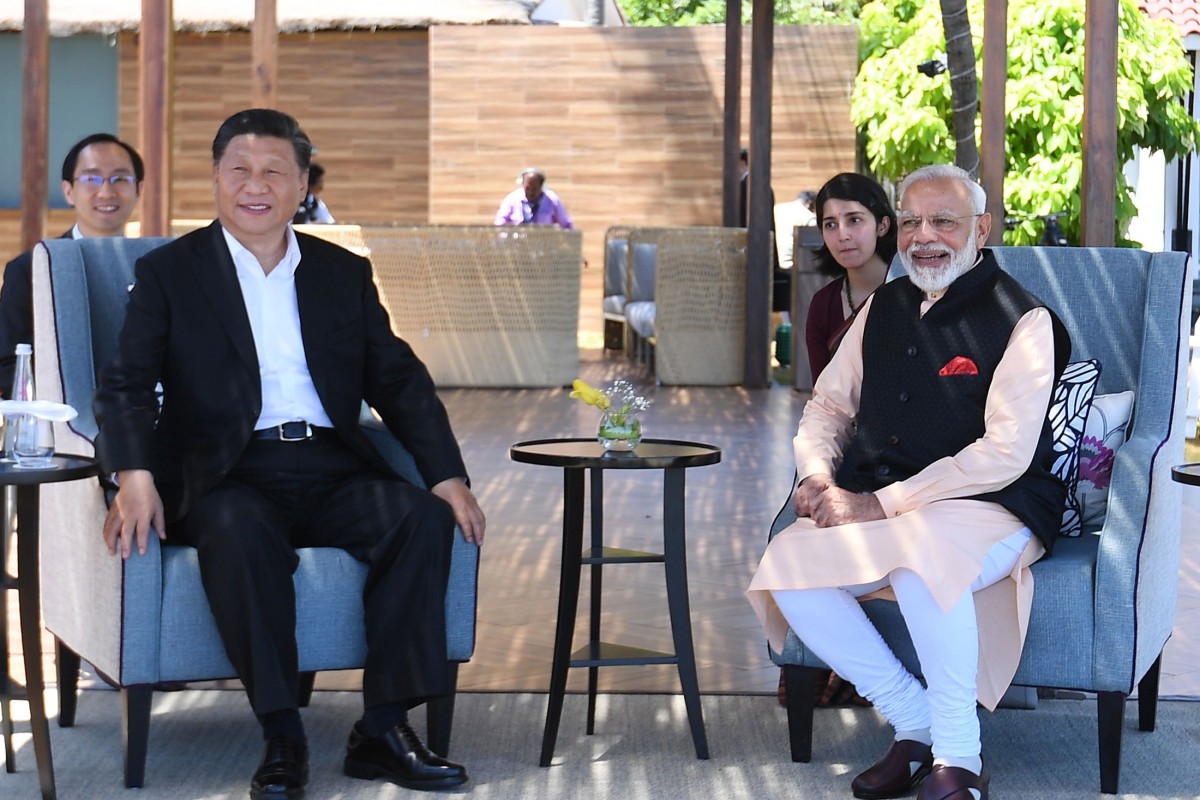
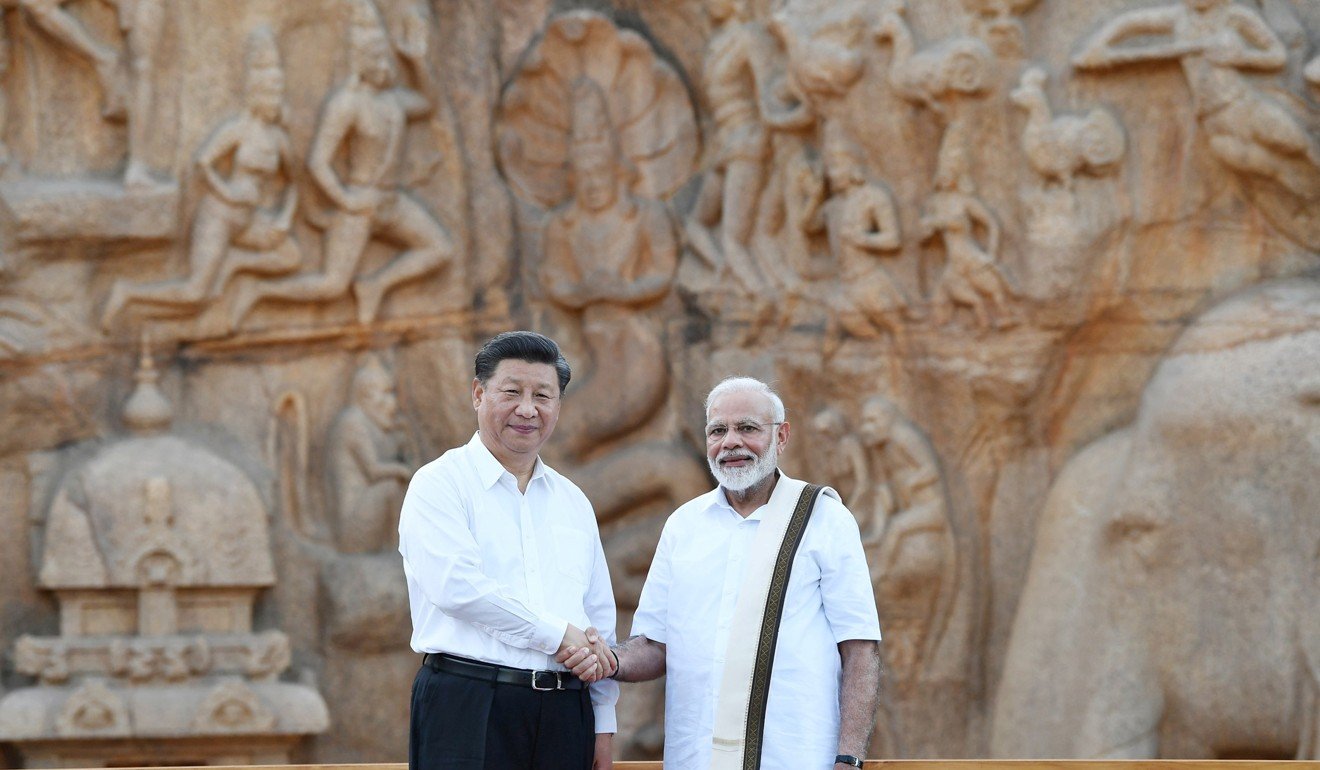
Indian Prime Minister Narendra Modi and Chinese President Xi Jinping during their meeting in Mamallapuram, Chennai. Photo: EPA
Chinese President
Xi Jinping and Indian Prime Minster
Narendra Modi concluded their second informal summit on Saturday by pledging to overcome trade differences and appreciate “each other’s autonomous foreign policies”, signalling an effort to focus on mutual interests rather than on long-standing contentious issues.
Modi remarked that both sides had agreed to be “sensitive” to each other’s concerns and not let differences escalate into disputes, while Xi called for communication to “alleviate suspicions” and for India and China to enhance strategic mutual trust, according to state news broadcaster CCTV.
Their desire to look beyond irritants in diplomatic ties, including a decades-long border row and China’s close military ties with India’s arch rival, Pakistan, comes as Beijing is embroiled in a tariff war with Washington that has rocked the global economy.
In a sign of China’s willingness to address India’s trade deficit with it, the leaders agreed to launch a “High Level Economic and Trade Dialogue”.
As Xi meets Modi, Chinese in Chennai hope to witness the ‘Wuhan spirit’
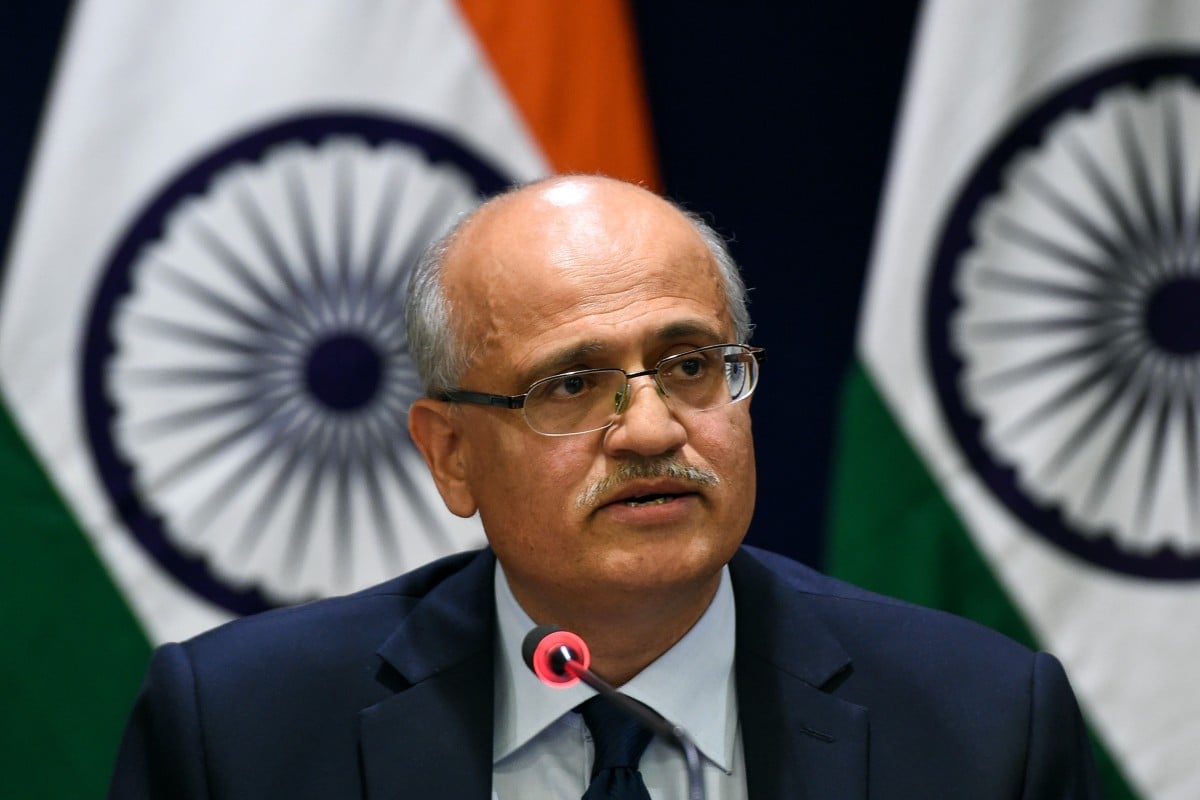
Chinese Vice-Premier Hu Chunhua and Indian Finance Minister Nirmala Sitharaman will meet regularly to discuss ways to boost two-way trade and investments, Indian foreign secretary Vijay Gokhale said in a media briefing.
India has a US$53 billion trade deficit with China, which makes up almost a third of its total trade deficit. It is also facing pressure to decide if it will commit to the China-led
(RCEP), which aims to create the world’s largest trading bloc involving 16 countries before the end of the year.
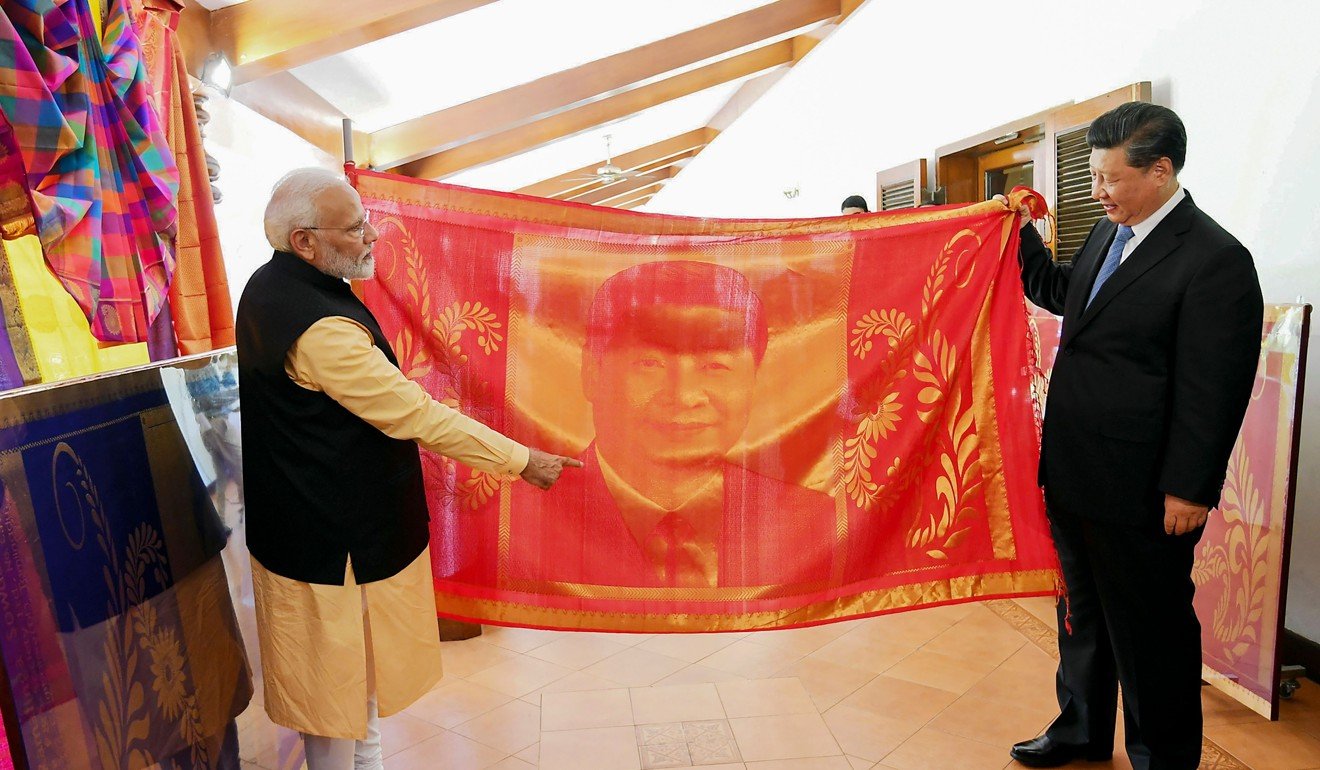
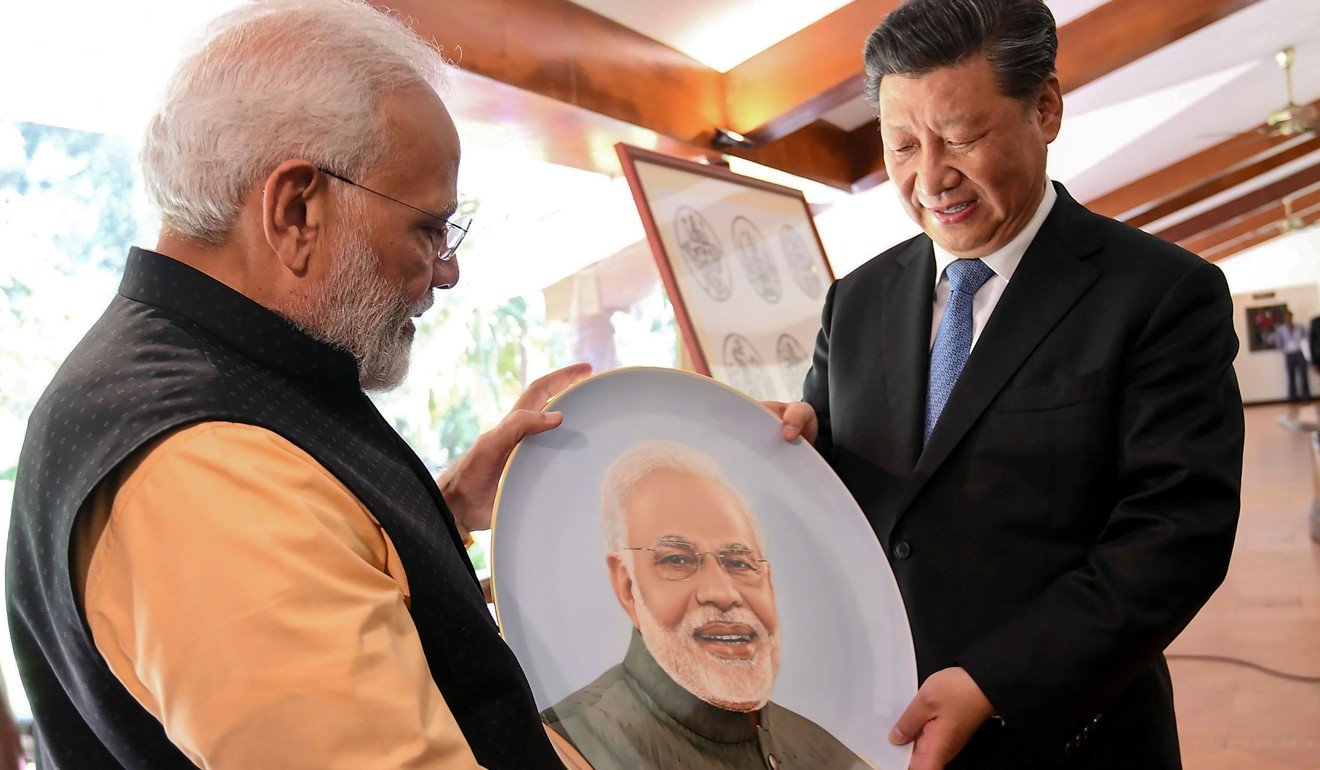
Narendra Modi exchanges gifts with Xi Jinping. Photo: AFP
Negotiations are ongoing with talks taking place in Bangkok this week, but India’s domestic producers have opposed the agreement over fears of a flood of Chinese imports. On Friday, the Indian government rejected clauses in the agreement related to e-commerce, according to reports.
Gokhale told the media briefing that both leaders, who met in the coastal town of Mamallapuram about 50km away from Chennai, briefly discussed the RCEP.
“PM Modi said India was looking forward to the RCEP but it is important that RCEP is balanced, that a balance is maintained in trade in goods, trade in services and investments,” he said, adding that Xi agreed to further discussions of India’s concerns on the issue.
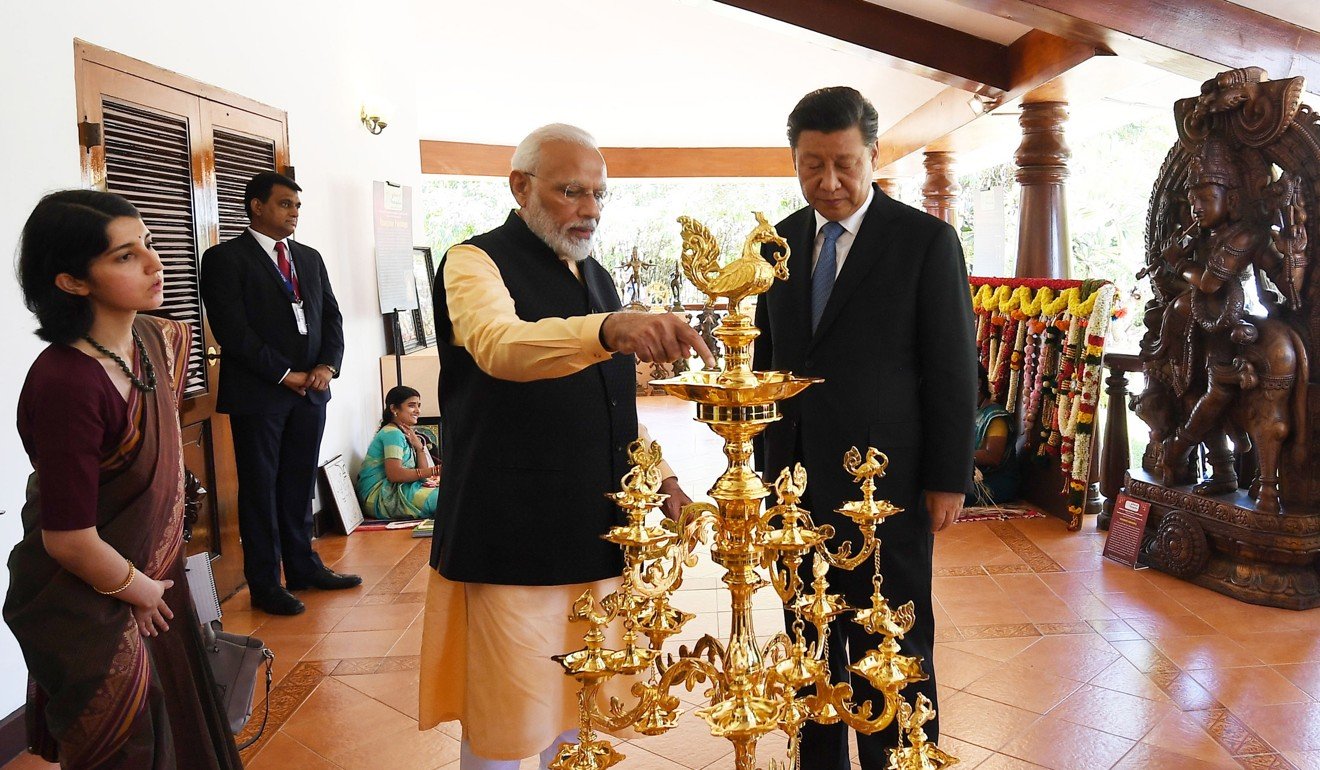
Narendra Modi with Xi Jinping in Mamallapuram. Photo: EPA
CCTV said Xi had six suggestions for how China and India could further improve ties, including assessing each other correctly and stepping up cooperation between their militaries. Besides economic and trade dialogue, China welcomed Indian pharmaceutical and IT companies to invest there, he said.
“We should look at disputes with a correct mind, and not let disputes affect cooperation.
“Both sides should properly and fairly get a solution for border disputes that are acceptable to each other … [and] cautiously handle each other’s core interests, and take proper measures to control issues that cannot be resolved immediately,” the president reportedly said.
Gokhale told reporters that both countries had agreed to pursue, through special representatives, an ongoing dialogue on their disputed border. China and India have held more than 20 rounds of talks to resolve their boundary dispute, over which they went to war in 1962. Different mechanisms have been set up to maintain peace along the 4,000-kilometre (2,485-mile) so-called Line of Actual Control.
Xi and Modi bank on chemistry as they talk trade and terrorism
Gokhale confirmed that the leaders – who met for a total of seven hours over Friday and Saturday, with the bulk of their time spent in one-on-one talks – did not discuss
, a region that is currently divided between India and Pakistan but which both nuclear-armed rivals claim in full.
Since India revoked the autonomy of the area it controls in August and imposed a lockdown,
has lobbied its allies – including its all-weather friend China – to support its opposition to the move. New Delhi had reacted sharply to Beijing’s move to take the matter to the United Nations, insisting that it was a purely bilateral issue. Two days before the summit, Xi had hosted Pakistan Prime Minister Imran Khan and had assured him of China’s support on all core issues, a statement that had irked India.
Gokhale said both leaders “emphasised the importance of having independent and autonomous foreign policies”.
“President Xi said that the two countries needed to have more extensive dialogue in order to understand each other’s perspectives on major global and regional issues,” he added.
Narendra Modi exchanges gifts with Xi Jinping. Photo: AFP
The leaders also discussed terrorism, with a statement issued later by New Delhi saying both sides would make efforts to ensure the international community strengthened its framework “against training, financing and supporting terrorist groups throughout the world and on a non-discriminatory basis”.
The China-led multilateral Financial Action Task Force, which has been investigating Pakistan’s efforts to stamp out the financing of terrorism, is expected to decide soon if it would add Islamabad to its blacklist along with Iran and North Korea, a move that could invite stringent economic sanctions and drive away international financial institutions, both of which could affect Pakistan’s already-indebted economy adversely.
Gokhale added that as 2020 is the 70th anniversary of diplomatic ties between both countries, India and China will hold 70 events next year to promote people-to-people ties, with Modi accepting an invitation by Xi for the next informal summit to be held in China.
Both leaders had struck positive notes on the summit – with Xi describing their discussions as “candid” and between friends and Modi hailing the “Chennai Connect” meeting as marking a new era of cooperation between both countries.
War games, Kashmir and a US$57b question: the issues as Xi meets Modi
But analysts said they would be looking to see how the newly-announced high-level mechanism on trade panned out.
Narayani Basu, a New Delhi-based author, foreign policy analyst and China watcher felt the summit had achieved its purpose of bagging small wins for both sides.
“Discussing contentious issues would have defeated the purpose of the summit. The idea behind such a summit must be that despite the overarching posturing on different divergent issues, the two countries can achieve the easily-achievable wins. That is what the summit seems to have tried doing.”
But in terms of actual outcomes, she said she remained sceptical.
“I don’t think there has been much progress in the ties between the two countries since the last summit in Wuhan. Hence, this time, there is a lot more caution and scepticism towards such a summit,” she said, referring to the first summit last year in the Chinese city of Wuhan.
During Xi’s visit to southern India, which lasted 24 hours in all, Modi took him on a personal tour of temple monuments dating back to the seventh and eighth century in Mamallapuram when regional leaders had trade ties with Chinese provinces. He was also shown local artisan handicrafts and art forms, and gifted a handwoven silk portrait, a lamp and a painting.
Xi gave Modi a porcelain plate with the image of the prime minister’s face printed on it.
Xi Jinping with Narendra Modi in Mamallapuram. Photo: Reuters
On Friday, New Delhi announced that visa rules for Chinese nationals visiting India would be relaxed, with multiple-entry visas with a validity period of five years available from this month onwards. At present, most visas are single-entry and usually for between 30 and 60 days. Visa fees would also be reduced, the government said, with the multiple-entry visa costing US$80.
This was aimed at further enhancing “people-to-people exchanges between the two countries and [encouraging] more Chinese tourists to choose India as a destination for tourism purposes,” it said in a statement.
Xi left Chennai on Saturday afternoon and arrived in Nepal, which lies in between India and China. He will be the first Chinese president to visit Nepal in 22 years and is expected to sign a slew of deals with Nepal’s Prime Minister K.P. Sharma Oli, including the planned extension of the rail link from remote, mountainous Tibet to Nepal’s capital, Kathmandu.
The link will be part of Beijing’s ambitious infrastructure project to boost trade, the
(BRI), that Nepal joined two years ago.
More than 120 countries have signed on to the BRI, including Pakistan, where a series of projects worth US$46 billion are being constructed under the China-Pakistan Economic Corridor (CPEC). India has snubbed the BRI and questioned the transparency of funding agreements.
Source: SCMP
Posted in 70th anniversary, ambitious infrastructure project, autonomous foreign policies, “High Level Economic and Trade Dialogue”, Bangkok, Beijing, Belt and Road Initiative (BRI), BRI, CCTV, chemistry, Chennai, China-Pakistan Economic Corridor (CPEC), Chinese President Xi Jinping, Chinese Vice-Premier, Chinese Vice-Premier Hu Chunhua, diplomatic ties, economic and trade dialogue, Financial Action Task Force, global economy, Imran Khan, India alert, India’s trade deficit, Indian Finance Minister, Indian Foreign Secretary, Indian Prime Minister Narendra Modi, informal summit, iran, IT companies, Kashmir, Kathmandu, major global and regional issues, Mamallapuram, Nepal, Nepal’s Prime Minister, New Delhi, Nirmala Sitharaman, North Korea, Pakistan, Pakistan Prime Minister, pharmaceutical companies, Prime Minister Imran Khan, Prime Minister K.P. Sharma Oli, rail link from remote, mountainous Tibet, Regional Comprehensive Economic Partnership, Regional Comprehensive Economic Partnership (RCEP), seventh and eighth century, tariff war, temple monuments, terrorism, trade and terrorism, Uncategorized, United Nations, Vijay Gokhale, Washington, Wuhan Spirit |
Leave a Comment »
20/04/2019
- Vijay Keshav Gokhale is expected to meet Chinese deputy foreign minister Kong Xuanyou and Foreign Minister Wang Yi during two-day visit
- Beijing’s refusal to sanction a Pakistani militant leader and its belt and road push in the disputed Kashmir region have strained ties
Indian Foreign Secretary Vijay Keshav Gokhale will visit China as part of “regular exchanges” between the two countries. Photo: AFP
Indian Foreign Secretary Vijay Keshav Gokhale will travel to Beijing on Sunday amid tensions between India and China over Beijing’s refusal to sanction a Pakistani militant leader and its infrastructure push in the disputed Kashmir region.
Gokhale’s two-day visit is part of “regular exchanges” between the two nations, the Indian embassy in Beijing said on Saturday.
During his stay, Gokhale is expected to meet Chinese deputy foreign minister Kong Xuanyou and Foreign Minister Wang Yi.
He will return to India on Monday, three days before the second Belt and Road Forum begins in the Chinese capital. Forty foreign leaders will attend the summit on Beijing’s global trade and infrastructure scheme, the “Belt and Road Initiative”, but India is not taking part.
Wang on Friday called on India, and other countries sceptical of the initiative, to join up, dismissing claims that it is a geopolitical tool. He also said China was ready to hold a leaders’ summit with India like the informal meeting held between Chinese President Xi Jinping and Indian Prime Minister Narendra Modi in Wuhan, Hubei province last year.
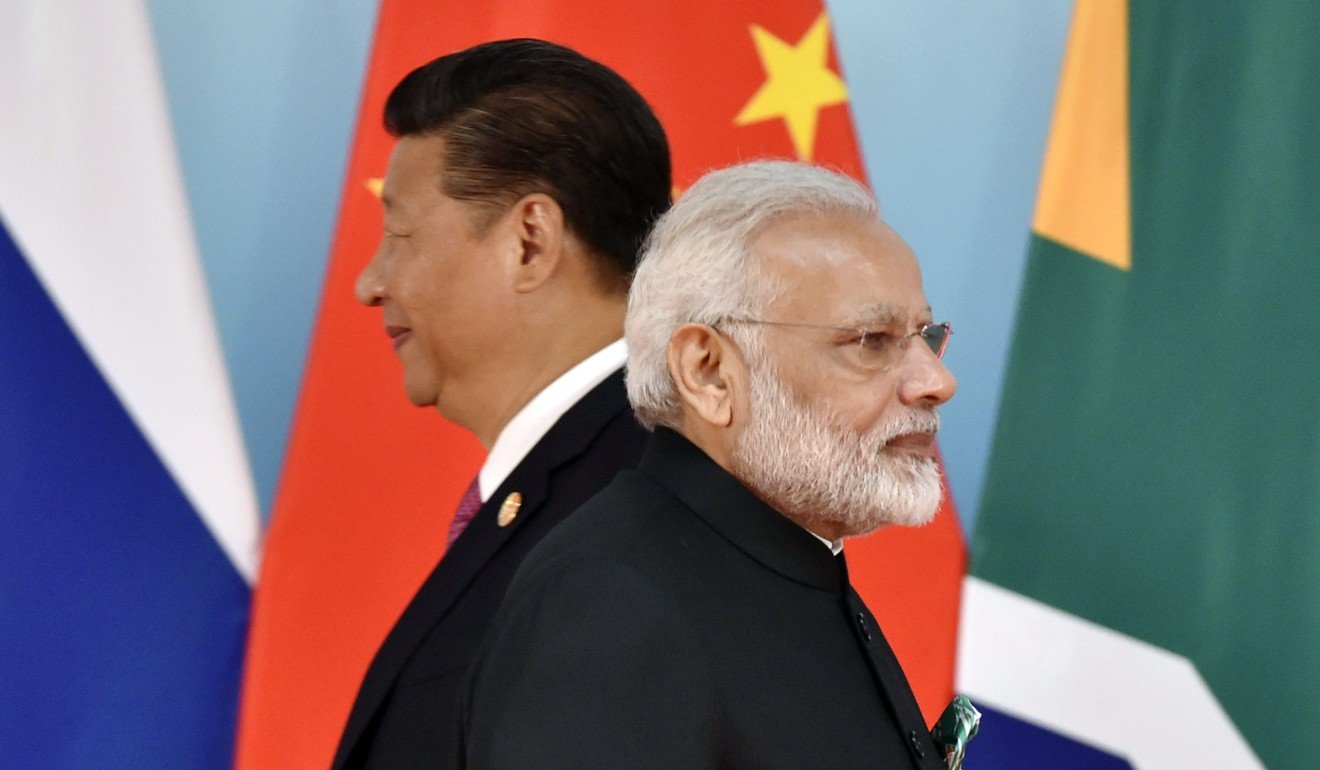
A summit between Xi Jinping (left) and Narendra Modi in Wuhan last year was seen as a breakthrough in China-India relations after the Doklam border dispute. Photo: AFP
Gokhale visited Beijing in February last year, and the Wuhan summit happened two months later. That meeting was seen as a breakthrough in the
after a 73-day military stand-off over the Doklam plateau.
But the progress was overshadowed in February after a terror strike on Indian security forces in the Jammu and Kashmir province, which killed 40 Indian soldiers. The Pakistan-based Jaish-e-Mohammed group claimed responsibility for the attack. India has long wanted to designate its leader, Masood Azhar, as a terrorist under international law, but China has opposed the move.
During a visit to Pakistan in March, Kong said Beijing and Islamabad were all-weather strategic partners and would support each other on issues to do with their core interests.
What ‘Wuhan spirit’? Kashmir suicide attack reopens Modi’s China wound
Wang Dehua, head of the Institute for South and Central Asia Studies at the Shanghai Municipal Centre for International Studies, said China and India were looking to prevent their bilateral relations from deteriorating further.
“Both nations will elaborate on their stance on this matter, and China will probably deliver a message that the China-India relationship should not be affected by the dispute over Masood Azhar,” he said. “The positive sentiment out of Wuhan has been affected, and the two sides are seeking ways to continue the spirit of that informal summit.”
Du Youkang, director of Fudan University’s Pakistan Study Centre in Shanghai, said preparations for another informal summit of the nations’ leaders would only begin after India’s general election was over. Polling is being held in seven phases ending on May 19.
Gokhale’s trip would mainly be a chance to see how the two nations can push forward bilateral ties amid their disputes, Du said.
In addition to Azhar, India is also dismayed that some of China’s belt and road projects pass through the Pakistan-administered section of the disputed Kashmir region.
But Wang told reporters on Friday that the initiative did not target any third country, and that relations between China and India had improved after the Wuhan summit.
Source: SCMP
Posted in Belt and Road Initiative (BRI), belt and road push, China alert, Chinese deputy foreign minister, Chinese President Xi Jinping, Doklam plateau, Du Youkang, foreign minister, Fudan University’s Pakistan Study Centre, head of the Institute for South and Central Asia Studies, hubei province, India alert, Indian Foreign Secretary, Indian Prime Minister Narendra Modi, Islamabad, Kashmir, Kong Xuanyou, Masood Azhar, Pakistani militant leader, Shanghai, Shanghai Municipal Centre for International Studies, Uncategorized, Vijay Keshav Gokhale, Wang Dehua, Wang Yi, Wuhan |
Leave a Comment »
11/03/2019
SRINAGAR, India (Reuters) – India should talk to Pakistan and separatists in Kashmir to defuse tension raised by a suicide attack on an Indian paramilitary convoy that was claimed by Pakistan-based militants, a former chief minister of the state said.
Mehbooba Mufti, who was the chief minister of Jammu and Kashmir from early 2014 to June last year when Prime Minister Narendra Modi’s Hindu nationalist party withdrew support for her regional party, said an ongoing crackdown on militants and those supporting secession could further alienate the people.
India has vowed to kill all the militants in the country’s only Muslim-majority state if they don’t give up arms, after a 20-year-old local man killed 40 paramilitary troopers in a suicide attack last month.
The attack nearly led to another war between the arch rivals India and Pakistan, which both claim the Himalayan region in full but rule in part.
“I strongly feel that there has to be a dialogue process internally as well as externally, with Pakistan,” Mufti said in an interview on Friday. “The situation is going to get worse if some kind of political process is not initiated on the ground now.”
Indian officials have repeatedly ruled out talks with Pakistan unless it acts on militant groups based there. India says its warplanes late last month bombed a militant camp in Pakistan, which responded with an aerial attack the next day.
Indian Foreign Secretary Vijay Gokhale said on the day of the strike that it had killed many Jaish-e-Mohammed “terrorists”. Pakistan said no one was killed.
Pakistan Prime Minister Imran Khan, who has sought to speak with Modi amid the hostility, said no militant group would be allowed to operate from his country to carry out attacks abroad, days after his government announced a sweeping crackdown against Islamist militant organisations.
“This confrontational attitude – no talks, no discussion -has an impact,” Mufti said. “Whatever relationship we have with Pakistan, it has a direct impact on Jammu and Kashmir and we are the worst sufferers of this animosity.”
Indian authorities have arrested many separatist leaders in Kashmir in the past few weeks, and the chief of Modi’s ruling Bharatiya Janata Party (BJP) said recently that the government had made it clear to them that “if they want to live in India, they will have to speak the language of India, not Pakistan’s”.
Mufti, whose father was also a chief minister of Jammu and Kashmir, said the tough stance by Indian authorities would only lead to “some calm on the surface” that won’t last. India killed 248 militants in Kashmir in 2018 – the highest in a decade.
“Once you start choking the space for dissent in a democracy, people feel pushed to the wall and then it leads to further dissent and alienation,” she said.
Mufti said India’s general election – starting April 11 and whose results will be declared on May 23 – could delay the process of any inter-party talks on Kashmir.
Source: Reuters
Posted in Bharatiya Janata Party (BJP), Chief Minister, chief minister of Jammu and Kashmir, crackdown, Democracy, former ally, general election, Imran Khan, India alert, Indian Foreign Secretary, Islamist militant organisations, Jaish-e-Mohammed, Jammu and Kashmir, Mehbooba Mufti, militants, Muslim-majority state, Pakistan, paramilitary convoy, paramilitary troopers, PM Modi, Prime minister, Prime Minister Narendra Modi, separatists, suicide attack, terrorists, Uncategorized, Vijay Gokhale |
Leave a Comment »



 CHINDIA ALERT: You'll be living in their world, very soon