Chindia Alert: You’ll be Living in their World Very Soon
aims to alert you to the threats and opportunities that China and India present. China and India require serious attention; case of ‘hidden dragon and crouching tiger’.
Without this attention, governments, businesses and, indeed, individuals may find themselves at a great disadvantage sooner rather than later.
The POSTs (front webpages) are mainly 'cuttings' from reliable sources, updated continuously.
The PAGEs (see Tabs, above) attempt to make the information more meaningful by putting some structure to the information we have researched and assembled since 2006.
Image copyright AFPImage caption Embankments have been washed away in Bangladesh
Millions of people across Bangladesh and eastern India are taking stock of the devastation left by Cyclone Amphan.
A massive clean-up operation has begun after the storm left 84 dead and flattened homes, uprooted trees and left cities without power.
India’s Prime Minister Narendra Modi has arrived in West Bengal state to conduct an aerial survey.
Authorities in both countries had evacuated millions of people before the storm struck.
Covid-19 and social-distancing measures made mass evacuations more difficult, with shelters unable to be used to full capacity.
Officials also said people were afraid and reluctant to move to shelters for fear of contracting the virus.
The cyclone arrived with winds gusting up to 185km/h (115mph) and waves as high as 15ft.
Image copyright REUTERSImage caption Roads have been blocked by falling trees in BangladeshImage copyright AFPImage caption Many people have been injured in wall collapses in Bengal
It is the first super cyclone to form in the Bay of Bengal since 1999. Though its winds had weakened by the time it struck, it was still classified as a very severe cyclone.
Three districts in India’s West Bengal – South and North 24 Parganas and East Midnapore – were very badly hit.
In Bangladesh, there are reports of tens of thousands of homes damaged or destroyed and many villages submerged by storm surges in low-lying coastal areas like Khulna and Satkhira.
The affected areas include the Sunderbans, mangroves spread over an area of more than 10,000 square kilometres that spans both India and Bangladesh – the swampy islands are home to more than four million of the world’s poorest people.
Image copyright MUKTIImage caption Many homes, built of brick and mud, have been washed away
Those in the Sunderbans say it is too early to estimate casualties in the area, which is now cut-off from the mainland by the storm.
“There are houses which have collapsed and people could be trapped in them but we don’t know yet,” Debabrat Halder, who runs an NGO in one of the villages, told the BBC.
He recalls cyclone Bulbul in November 2019, which was followed by a huge incidence of fever, diarrhoea and flu, and is afraid that that the same may happen again.
And worse, he adds, is that the flooding from contaminated sea water, has likely destroyed the soil.
“Nothing will grow in this soil,” he says, adding that it will likely take years to convert it into fertile land again.
Image copyright MUKTIImage caption The Sunderbans delta is frequently hit by severe stormsImage copyright MUKTIImage caption Crops have all been destroyed by the flooding
Kolkata, the capital of West Bengal, and one of India’s biggest cities has been devastated. Its roads are flooded and the city was without power for more than 14 hours.
The state’s chief minister, Mamata Banerjee, said the devastation in Kolkata was “a bigger disaster than Covid-19”.
But assessment of the damage is being hampered by blocked roads and flooding in all these areas.
KOLKATA (Reuters) – Indian and Chinese troops on border patrol duties had a brief skirmish in Sikkim, a northeastern Indian state bordering China, the Indian Defence Ministry said on Sunday, blaming both sides for the incident.
“Aggressive behaviour by the two sides resulted in minor injuries to troops. The two sides disengaged after dialogue and interaction at the local level,” the ministry said in a statement.
The Indian daily Hindustan Times, citing a military source, said four Indian soldiers and seven Chinese troops were injured when some of the soldiers exchanged blows during the confrontation, which it said took place on Saturday and involved some 150 soldiers.
The Defence Ministry said the incident took place in the Nakula area but did not give details of how it started, or what caused the injuries.
China’s Ministry of Defense could not be immediately reached for comment on Sunday.
India and China have often accused each other of intrusions into each other’s territories, but clashes are rare.
There is still deep mistrust between the two countries over their festering border dispute, which triggered a brief war in 1962.
Hundreds of troops from both sides were deployed in 2017 on the Doklam plateau, near the borders of India, Bhutan, and China after India objected to Chinese construction of a road in the Himalayan area, in the most serious standoff in years.
NEW DELHI (Reuters) – Violent clashes erupted in Delhi between police and hundreds of university students on Friday over the enactment of a new citizenship law that critics say undermines India’s secular foundations.
The unrest has already led Japanese Prime Minister Shinzo Abe to cancel a planned visit to India from Sunday.
The new law offers a way to Indian citizenship for six minority religious groups from neighbouring Bangladesh, Pakistan and Afghanistan including Hindus and Christians, but not Muslims.
RELATED COVERAGE
Explainer: What does India’s new citizenship law mean?
Clashes erupt in New Delhi between students, police over citizenship law
See more stories
Police fired tear gas and used baton charges to disperse scores of students demonstrating at Jamia Millia Islamia university in the heart of Delhi over the law.
Protesters attacked cars in the capital, and several people were injured and taken to hospital.
Zakir Riyaz, a PhD student in social work, said the new law made a mockery of India’s religious openness.
“It goes against the whole idea of a secular India,” he said, speaking by phone from the Holy Family Hospital in New Delhi where 15 of his fellow students were admitted after being injured in a police baton charge.
Police barricades were knocked down and streets were strewn with shoes and broken bricks. An official at the university dispensary said that more than 100 students had been brought in with injuries but all had been discharged.
Parvez Hashmi, a local politician who went to the protest site to speak to police, said about 50 students had been detained.
Students said it was meant to be a peaceful protest, with them trying to go from Jamia University to Parliament Street to show their opposition to the legislation. But police pushed them back, leading to clashes.
Critics of Prime Minister Narendra Modi’s government say it is promoting a Hindu-first agenda for India and that the citizenship law excluding Muslims showed a deep-seated bias against India’s 170 million Muslims.
Imran Chowdhury, a researcher, said “either give citizenship to refugees of all religions or none at all. The constitution is being tampered with in the name of religion.”
Modi’s ruling Bharatiya Janata Party denies any religious bias but says it is opposed to the appeasement of one community. It says the new law is meant to help minority groups facing persecution in the three nearby Muslim countries.
ABE CANCELS
The United Nations human rights office voiced concern that the new law is “fundamentally discriminatory in nature”, and called for it to be reviewed.
Two people were killed in India’s Assam state on Thursday when police opened fire on mobs torching buildings and attacking railway stations in protest at the new citizenship rules signed into law on Thursday.
Japan’s Prime Minister Shinzo Abe cancelled a trip to Assam for a summit with his Indian counterpart Narendra Modi that had been due to begin on Sunday.
Japan has stepped up infrastructure development work in Assam in recent years, which the two sides were expected to highlight during the summit. Abe had also planned to visit a memorial in the nearby state of Manipur where Japanese soldiers were killed in World War Two.
“With reference to the proposed visit of Japanese PM Abe Shinzo to India, both sides have decided to defer the visit to a mutually convenient date in the near future,” Indian foreign ministry spokesman Raveesh Kumar said in a tweet.
Japan’s Chief Cabinet Secretary Yoshihide Suga said both countries would decide on the appropriate timing for the visit although nothing has been decided yet.
A movement against immigrants from Bangladesh has raged in Assam for decades. Protesters there say granting Indian nationality to more people will further strain the state’s resources and lead to the marginalisation of indigenous communities.
Thirty-six others were hurt, with nine being treated for serious injuries
Bus had a tyre blowout and collided with road divider before slamming into truck in the opposite lane in Yixing, Jiangsu province, police say
The expressway reopened after a rescue operation of more than eight hours. Photo: Weibo
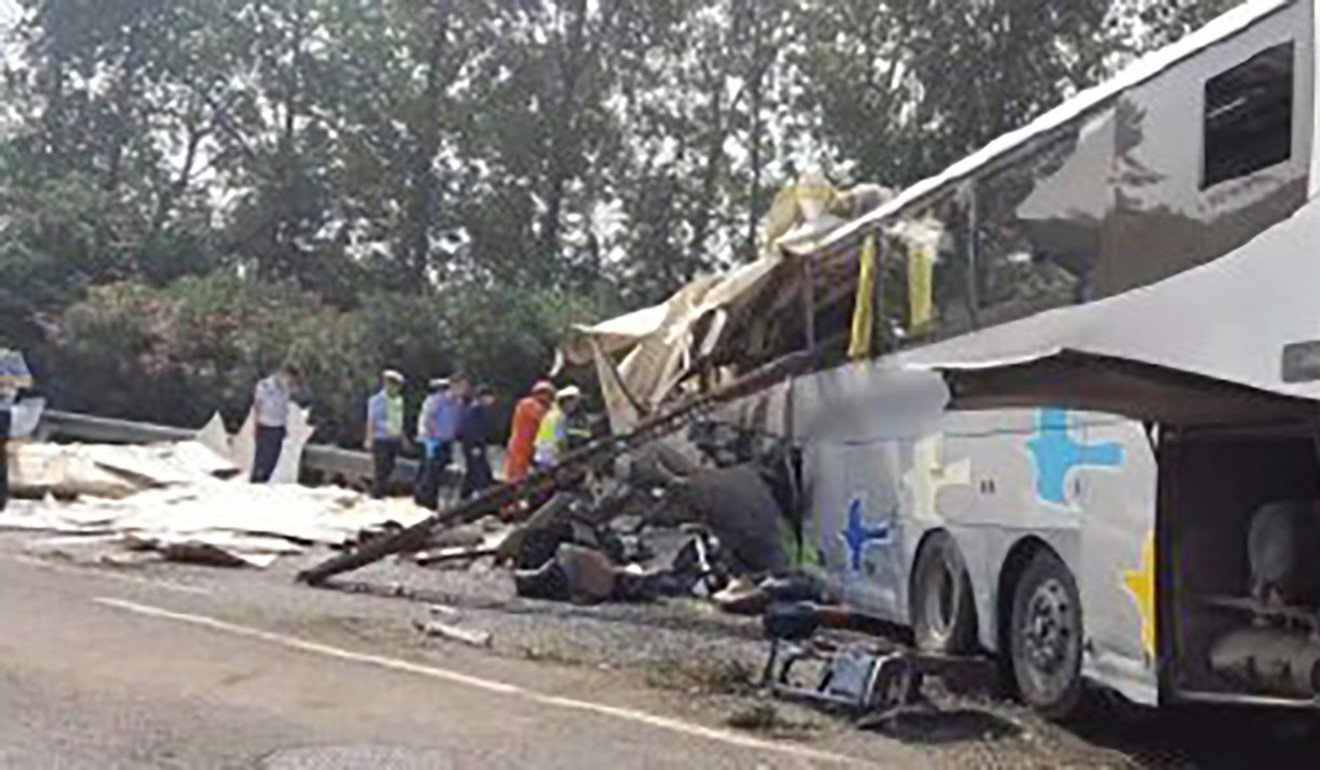
Thirty-six people were killed and another 36 injured when a coach had a tyre blowout and crashed into a truck on an expressway in eastern China on Saturday.
The coach, which had 69 passengers on board, collided with a road divider before slamming into a truck in the opposite lane at about 7am, the Yixing municipal police department said in a statement on Sunday.
There were three people in the truck.
The accident happened on the Yixing section of the Changchun-Shenzhen Expressway in Jiangsu province.
A rescue operation took more than eight hours, and the injured were taken to hospitals in nearby Yibing.
Nine people were seriously injured, 26 were being treated for minor injuries and one had been discharged from hospital, according to the statement.
A tyre blowout may have caused the accident on Saturday morning. Photo: Weibo
Police are still looking into the crash but said “according to our preliminary investigation, the accident was caused by a blowout of one of the coach’s front tyres”.
ahead of National Day and the week-long holiday marking it, as all levels of government try to make sure nothing goes wrong.
This month, local governments were told to check factories, restaurants, rental accommodation, scenic spots close to water and roads for safety hazards and to take measures to prevent fire, crashes or other accidents, according to media reports.
Traffic accidents are common in China, where about 200,000 people lose their lives on the roads every year, according to the World Health Organisation.
NEW DELHI (Reuters) – At least 12 people were killed and around 50 injured after a series of explosions at a chemical factory in the western Indian state of Maharashtra on Saturday, hospital officials and police said.
An official at Shirpur’s sub-district hospital in Dhule district said that 12 people had died in the explosion. “There are around 37 injured admitted here, and we have transferred another 12 patients,” D.N. Wagh told Reuters.
The first explosion at the factory took place around 9.30 a.m. (0400 GMT), police officer Sanjay Ahire said. Videos from the incident on local news channels showed thick black smoke billowing out of the factory.
“There was a 200 litre chemical barrel that exploded first, then the fire spread to other parts of the factory and there were more blasts,” Ahire said.
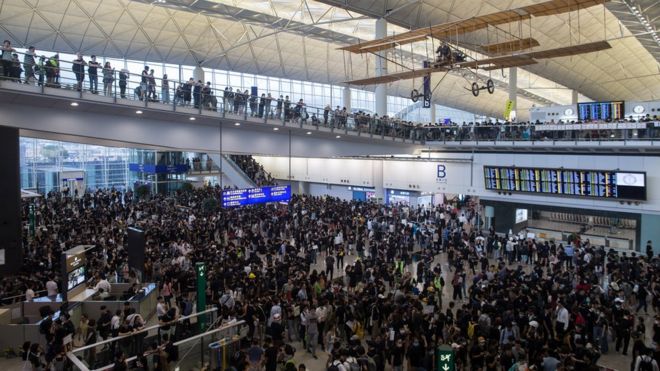
Image copyright EPAImage caption Officials say about 5,000 gathered for the fourth day of protests at the airport
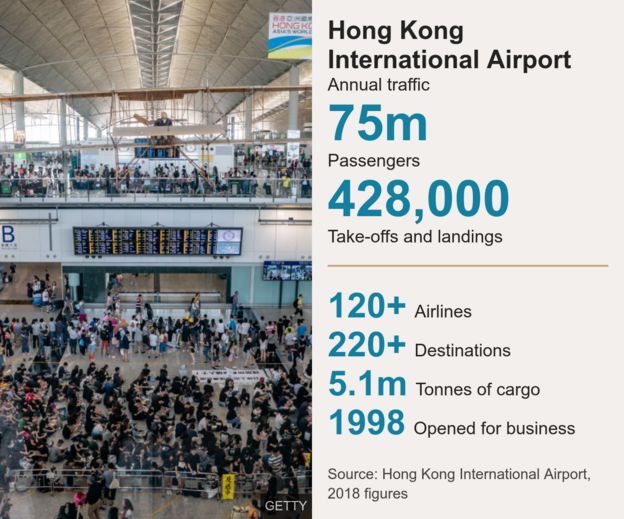
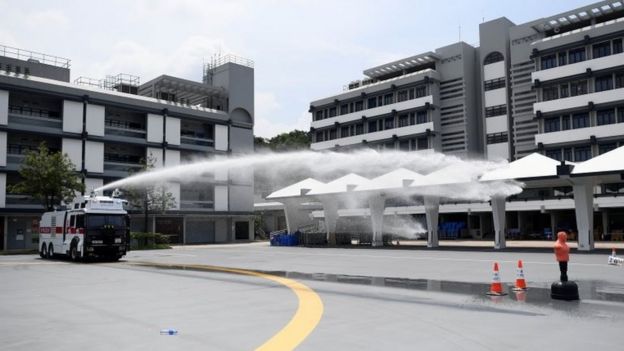
Hong Kong International Airport cancelled all departures on Monday, as thousands of anti-government protesters occupied and caused disruption.
Passengers have been told not to travel to the airport, which is one of the world’s busiest transport hubs.
In a statement, officials blamed “seriously disrupted” operations.
Many of those protesting are critical of the actions of police, who on Sunday were filmed firing tear gas and rubber bullets at close range.
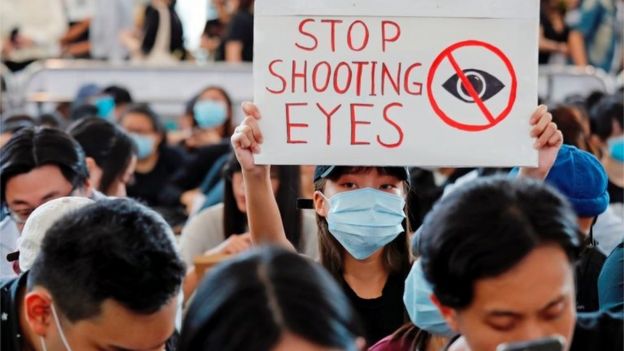
Some protesters wore bandages over their eyes in response to images of a woman bleeding heavily from her eye on Sunday, having reportedly been shot by a police projectile.
In a statement on Monday afternoon, Hong Kong’s Airport Authority said they were cancelling all flights that were not yet checked in.
More than 160 flights scheduled to leave after 18:00 local time (10:00 GMT) will now not depart.
Arrivals already heading into Hong Kong will still be allowed to land, but other scheduled flights have been cancelled.
Officials are now working to reopen the airport by 06:00 on Tuesday, a statement said.
Some passengers expressed annoyance at the disruption. “It’s very frustrating and scary for some people,” one man from Pakistan told the BBC. “We’ll just have to wait for our next flight.”
Helena Morgan, from the UK, said she was set to return to the UK to get her exam results on Thursday. “I’m hoping we get back for them and we’re not on a flight,” she said.
But others were more understanding of the protests. “I was expecting something, given all the news,” one arrival, Gurinda Singh, told Reuters news agency.
As rumours spread that police plan to move in on protesters on Monday evening, thousands opted to leave on foot. There are large backlogs for transport back into the centre, local reports say.
The BBC’s Stephen McDonell, who is at the scene, says the airport has effectively shut down while authorities work out how to deal with the crisis.
Hong Kong’s mass demonstrations and unrest show no sign of abating, more than two months after they were sparked by a controversial extradition bill.
Beijing officials have strongly condemned Sunday’s violence and linked violent protesters to “terrorism”.
Image copyright REUTERSImage caption Many of those who gathered carried signs condemning police conduct
What happened on Sunday?
On Sunday afternoon, a peaceful rally in the city’s Victoria Park led to clashes when protesters moved out of the area and marched along a major road despite a police ban.
There were confrontations in several central districts and police used rubber bullets in an attempt to disperse the demonstrators.
In the bustling central Wan Chai district, petrol bombs and bricks were thrown at police, who responded by charging at protesters.
A number of people, including a police officer, were injured in the clashes.
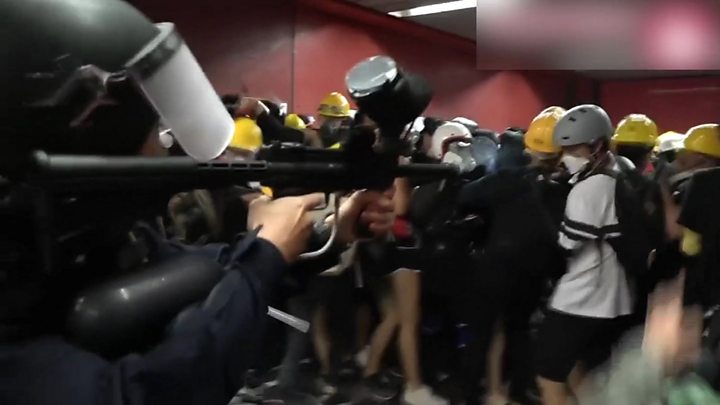
Videos on social media also showed officers storming enclosed railway stations and firing tear gas.
Footage inside another station showed officers firing what appeared to be rubber bullets at close range and several police officers beating people with batons.
Media caption Violence erupts in HK train stations
Local media outlets reported that suspected undercover police officers had dressed-up as protesters to make surprise arrests.
While protests in the city have turned increasingly violent, there were no reports of arrests during the three previous days of the airport sit-in.
What has the reaction been?
On Monday the Chinese authorities, who have not yet physically intervened to quell the unrest, used their strongest language yet to condemn violent protesters.
“Hong Kong’s radical demonstrators have repeatedly used extremely dangerous tools to attack police officers, which already constitutes a serious violent crime, and also shows the first signs of terrorism emerging,” Yang Guang, a spokesman for the Hong Kong and Macau Affairs Office (HKMAO), said at a press briefing.
“This wantonly tramples on Hong Kong’s rule of law and social order.”
Demonstrations started in June in opposition to a proposed extradition bill, which would have allowed suspected criminals to be sent to mainland China for trial.
Critics said it would undermine Hong Kong’s legal freedoms, and could be used to silence political dissidents.
Although the government has now suspended the bill, demonstrators want it to be fully withdrawn.
Their demands have broadened to include calls for an independent inquiry into alleged police brutality, and an amnesty for all arrested protesters.
Hong Kong is part of China but its citizens have more autonomy than those on the mainland.
It has a free press and judicial independence under the so-called “one country, two systems” approach – freedoms which activists fear are being increasingly eroded.
Authorities report roads closed and 10,000 buildings damaged after magnitude 6.0 quake on Monday night
More than 100,000 people affected
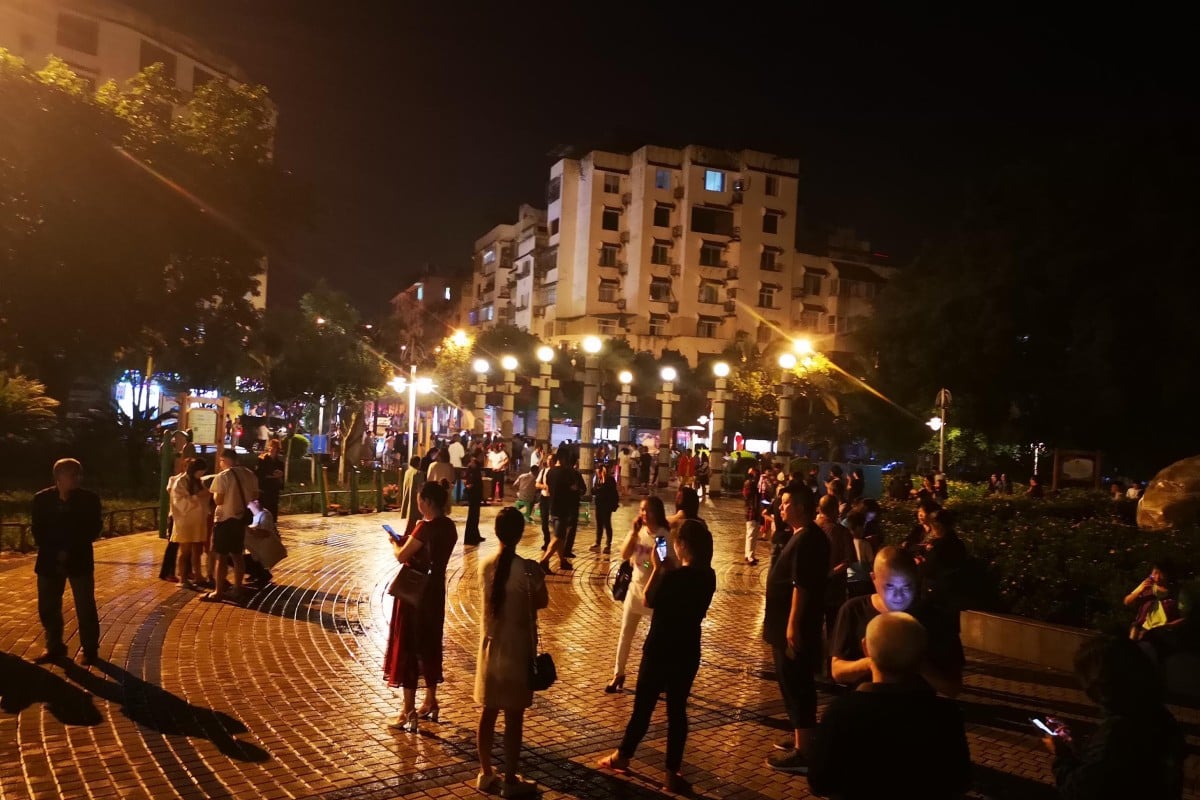
Residents gather in the open in Changning county on Monday night after a magnitude 6.0 hit the area. Photo: Xinhua
The death toll from a strong earthquake which hit the southern Chinese province of Sichuan late on Monday night has risen to 12, with 134 people injured.
More than 100,000 people were affected – mostly in the epicentre at Changning county in Yibin, while more than 10,000 buildings were damaged, according to a statement by the local government on Tuesday.
Land subsidence and a landslide caused by the magnitude 6.0 quake, blocked a highway, several major roads and numerous village roads, the statement said, while a major bridge in the area was also at risk.
The Yixu highway in Changning had been closed and authorities were assessing the Dongdi Bridge. The Yibin government statement also said workers had been sent to clear the affected village roads.
According to the US Geological Survey, the earthquake was centred at a fairly shallow depth of 10km (6 miles). Shallow earthquakes tend to cause more damage to buildings and infrastructure.
An aftershock measuring magnitude 5.2 later hit the same area, the USGS said.
More than 300 firefighters were sent to the scene overnight, as well as rescue personnel with 5,000 tents, 10,000 folding cots and other emergency supplies, according to state news agency Xinhua.
In 2008, China’s worst earthquake in recent years struck the mountainous western portion of Sichuan province, leaving 87,000 dead, 370,000 injured and 5 million people homeless. That earthquake was about 400km (249 miles) from Monday’s earthquake.
A 1976 earthquake centred in the northeastern city of Tangshan killed at least 250,000 people.
The incident comes less than a month after over 44 CRPF personnel were killed and many injured on February 14 in Jammu and Kashmir’s Pulwama.
SNS Web | New Delhi | March 7, 2019 12:47 pm
Security personnel carry out investigation at the site where a blast took place after a grenade attack by militants at the busy main bus terminus in Jammu and Kashmir, on March 7, 2019. (Photo: IANS)
One person was killed and 29, including a woman injured in a blast after a grenade was tossed at a bus in the general bus stand in the heart of Jammu on Thursday. The condition of five injured is said to be serious.
The killed youth has been identified as a 17-year-old Mohammad Sharik of Haridwar in Uttrakhand.
Minister of State for Defence Subhash Bhamre said a local investigation has been initiated into the incident. He further said the government has given complete liberty to the forces to take all necessary steps.
The Jammu and Kashmir Police has been rushed to the site of the blast.
The Chinese grenade exploded in the bus at about 12 noon. The driver and conductor were among the injured rushed to the Government Medical College, Jammu. The injured include passengers belonging to Bihar, Punjab, Haryana, Uttrakhand, Jammu and the Kashmir valley.
Visuals from the blast site showed the damaged bus of the J&K Road Transport Corporation (JKSRTC) in which the grenade exploded.
The area has been cordoned off by the security personnel. Nature and the cause is being ascertained, police said.
Fifteen suspects have been rounded up for interrogation.
The grenade attack has coincided with the shifting of detained separatist Yasin Malik to the Jammu’s Kot-Bhalwal jail.
Police suspected the JeM outfit behind the attack. Some radicals had threatened of revenge during the recent communal tension here when about six cars were burnt.
K Vijay Kumar and KK Sharma, both advisors to the Governor, visited the spot to take stock of the situation. The divisional commissioner, deputy commissioner and senior police and civil officers also visited the spot.
This is the third grenade attack in the bus stand during the past few months.
The blast comes at a time when Jammu and Kashmir is on a high alert following the heightened tensions between India and Pakistan in the wake of the Pulwama terror attack.
Former chief minister Mehbooba Mufti condemned the incident and called for unity to defeat terror elements in the state.
“I condemn this act of terror in the strongest possible terms. My prayers for speedy recovery of those injured. The perpetrators are out there to inflict pain and divide us. Our unity has to be our tool to defeat them,” Mufti tweeted.
The provincial president of National Conference, Devender Rana, visited the hospital to inquire about the wellbeing of injured persons.
The incident comes less than a month after over 44 CRPF personnel were killed and many injured on February 14 in one of the deadliest terror strikes in Jammu-Kashmir when a Jaish-e-Mohammad (JeM) suicide bomber blew up an explosive-laden vehicle near their bus in Pulwama district.
The bus was part of a convoy of 78 vehicles carrying around 2500 CRPF personnel from Jammu to Srinagar.
This is the worst terror attack on security personnel since the Uri incident in September 2016 which left 18 soldiers dead.
SNS Web | New Delhi | February 14, 2019 4:52 pm
At least 13 jawans were killed on the spot and others succumbed in the hospital.
At least 20 security force personnel were killed and over 45 seriously injured in suicide blast when an explosive-laden car rammed into a bus in which they were travelling near Letapora of Pulwama in South Kashmir.
According to news agency ANI, gunshots were heard from the area following the high-intensity blast.
CRPF DG RR Bhatnagar said the convoy carrying the soldiers was travelling from Jammu to Srinagar when the attack occurred. Terrorists continued to fire at the convoy even after the bus was completely charred. The convoy consisted of 70 vehicles carrying about 2500 soldiers. Two CRPF vehicles were damaged in the attack.
The attack has reportedly happened on a heavily guarded highway.
The attack is being taken seriously as the highway particularly in South Kashmir is properly sanitised before movement of convoys of security forces. The Road Opening Parties (ROPs) also conduct thorough checking of the road for possible IEDs.
The DGP of J-K Police, Dilbag Singh, confirmed that it was a suicide attack in which an explosive-laden car was rammed into the CRPF bus.
The bus was completely destroyed and mutilated bodies of the jawans lay scattered on the road that also bore blood stains.
At least 13 jawans were killed on the spot and others succumbed in the hospital.
The injured jawans have been rushed to the 92 Base hospital of the Military and CRPF hospital.
Pakistan backed Jaish-e-Mohammed has claimed responsibility for the Pulwama terror attack, in a text message to Kashmiri News Agency GNS.
A spokesman of JeM claimed that the attack was carried out by their activist Aadil Ahmad of Gundi Bagh in Pulwama.
Former chief minister Mehbooba Mufti condemned the gruesome attack.Former chief minister Omar Abdullah also condemned the attack and extended his condolences to the families of the bereaved.
He further said the Jaish has claimed the blast as a suicide (fidayeen) attack reminiscent of the dark days of militancy pre-2004-05.
Army and CRPF jawans have cordoned off the area and launched search operations in the nearby residential locality.
The convoy was held up in Jammu for the past six days due to the closure of the Jammu-Srinagar highway because of snow and landslides and proceeded to Srinagar this morning only after the highway was opened for one way traffic.
The National Investigation Agency (NIA) is likely to be assigned the investigation of the attack.
This is the worst terror attack on security personnel since the Uri incident in September 2016.
Eighteen soldiers were killed and several others injured when heavily-armed militants stormed a battalion headquarters of the Indian Army in North Kashmir’s Uri town.
One of the injured students at the hospital in Pulwama on February 13.(ANI/Twitter Photo)
Twelve students were injured in an explosion at a private school in south Kashmir’s Pulwama on Wednesday. The blast took place around 2.30pm.
The injured are students of class 10 of the Falah-i-Millat school in Pulwama’s Narbal town. Seven of them have been referred to Srinagar Hospital for further treatment.
They have been rushed to the government district hospital in Pulwama for treatment.
“I was teaching and then suddenly an explosion occurred. I can’t say how many students are injured,” Jawed Ahmed, a teacher at the school where the blast took place told news agency ANI.
The police have lodged a case and are investigating the nature of the blast.


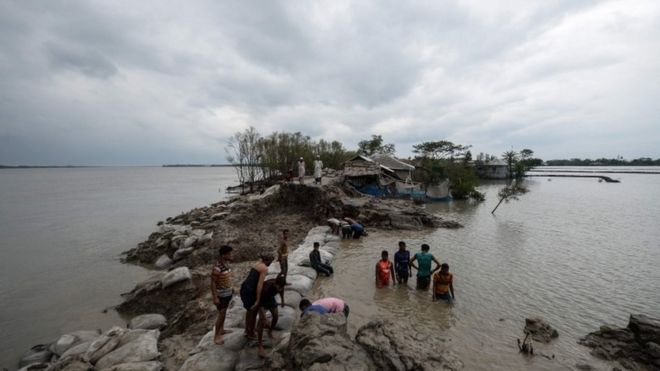 Image copyright AFP
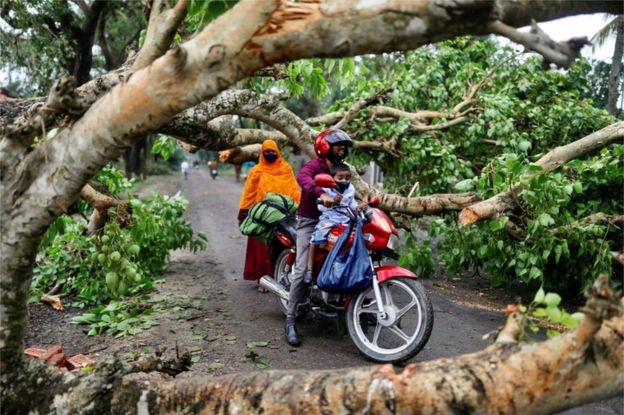 Image copyright REUTERS
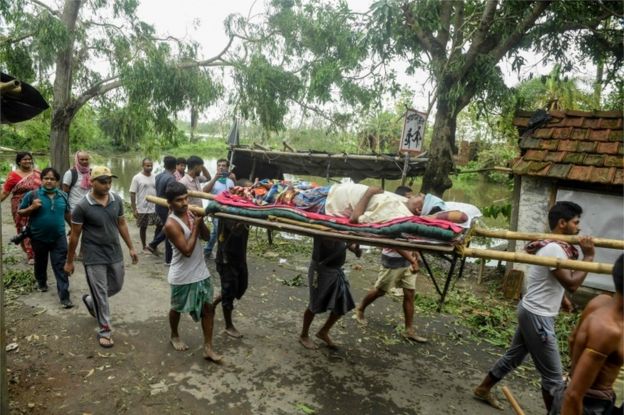 Image copyright AFP
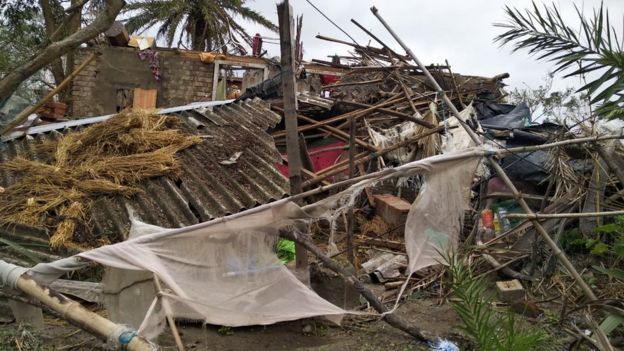 Image copyright MUKTI
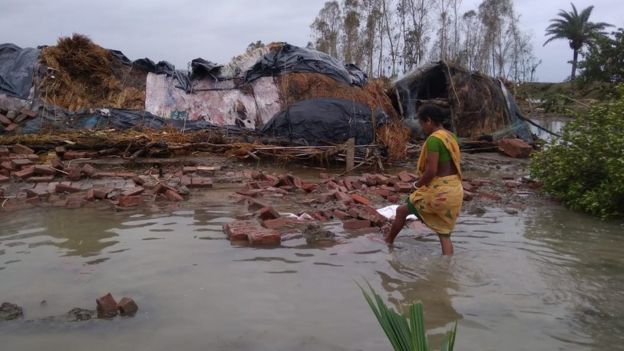 Image copyright MUKTI
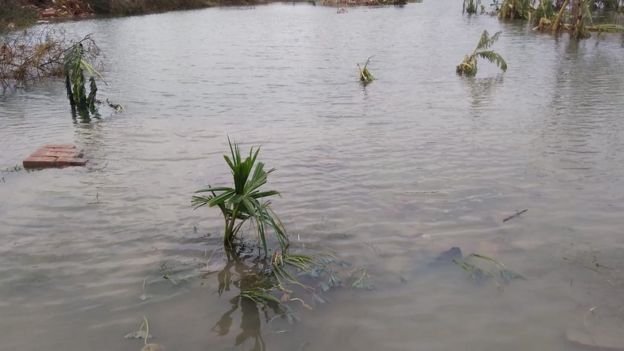 Image copyright MUKTI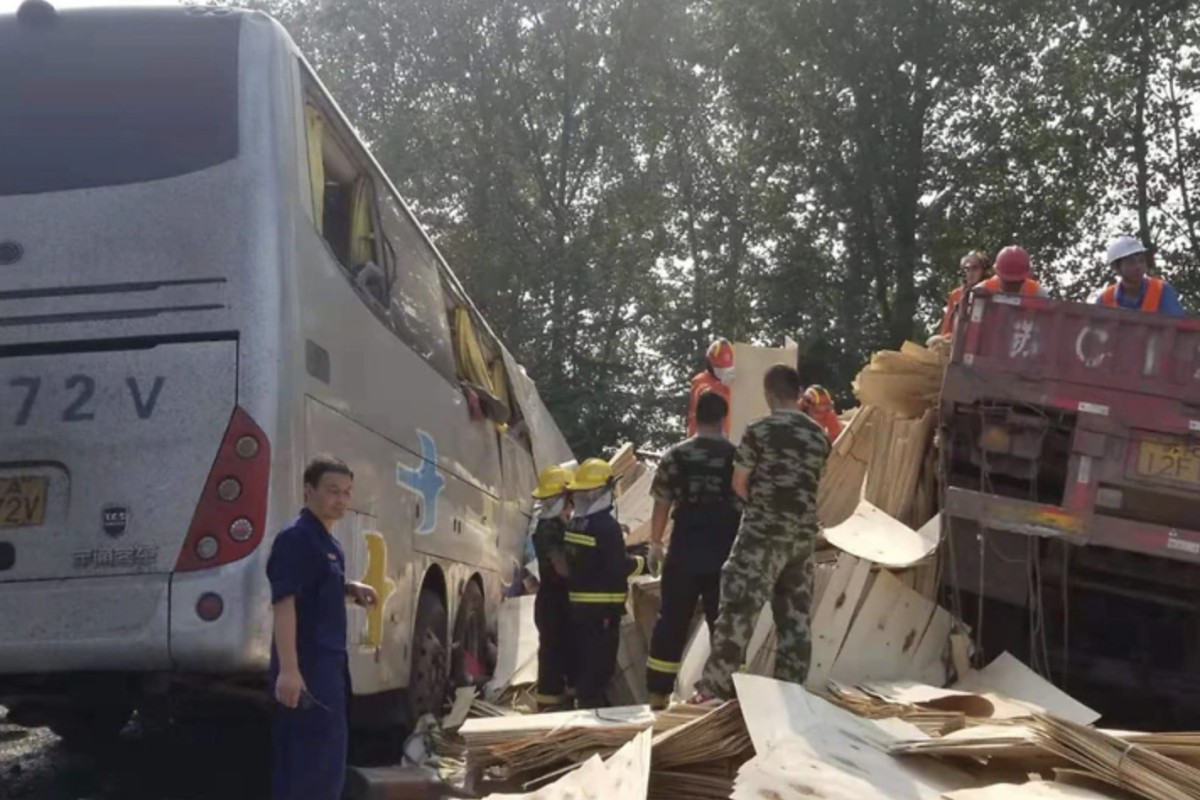


 CHINDIA ALERT: You'll be living in their world, very soon
Indian, Chinese border troops in brief skirmish on northeast Indian border, India says
KOLKATA (Reuters) – Indian and Chinese troops on border patrol duties had a brief skirmish in Sikkim, a northeastern Indian state bordering China, the Indian Defence Ministry said on Sunday, blaming both sides for the incident.
“Aggressive behaviour by the two sides resulted in minor injuries to troops. The two sides disengaged after dialogue and interaction at the local level,” the ministry said in a statement.
The Indian daily Hindustan Times, citing a military source, said four Indian soldiers and seven Chinese troops were injured when some of the soldiers exchanged blows during the confrontation, which it said took place on Saturday and involved some 150 soldiers.
The Defence Ministry said the incident took place in the Nakula area but did not give details of how it started, or what caused the injuries.
China’s Ministry of Defense could not be immediately reached for comment on Sunday.
India and China have often accused each other of intrusions into each other’s territories, but clashes are rare.
There is still deep mistrust between the two countries over their festering border dispute, which triggered a brief war in 1962.
Hundreds of troops from both sides were deployed in 2017 on the Doklam plateau, near the borders of India, Bhutan, and China after India objected to Chinese construction of a road in the Himalayan area, in the most serious standoff in years.
Source: Reuters
Posted in 1962, 2017, accused, aggressive, behaviour, Bhutan, blaming, border, bordering, both, brief, China, China’s, Chinese, citing, clashes, comment, confrontations, Construction, countries, daily, deep, defence ministry, deployed, details, dialogue, disengaged, dispute, duties, festering, four, Himalayan, Hindustan Times, hundreds, immediately, incident, India, Indian, Indian soldiers, injured, injuries, interaction, intrusions, involved, Kolkata, level, local, Military, ministry, Ministry of Defense, minor, mistrust, Nakula, Northeast, Northeastern, patrol, rare, reached, resulted, roads, Saturday, serious, seven, sides, Sikkim, skirmish, source, standoff, state, statement, Sunday, territories, triggered, troops, two, Uncategorized, war, years | Leave a Comment »