Chindia Alert: You’ll be Living in their World Very Soon
aims to alert you to the threats and opportunities that China and India present. China and India require serious attention; case of ‘hidden dragon and crouching tiger’.
Without this attention, governments, businesses and, indeed, individuals may find themselves at a great disadvantage sooner rather than later.
The POSTs (front webpages) are mainly 'cuttings' from reliable sources, updated continuously.
The PAGEs (see Tabs, above) attempt to make the information more meaningful by putting some structure to the information we have researched and assembled since 2006.
Chinese President Xi Jinping, also general secretary of the Communist Party of China Central Committee and chairman of the Central Military Commission, takes part in a deliberation with his fellow deputies from the delegation of Inner Mongolia Autonomous Region at the third session of the 13th National People’s Congress (NPC) in Beijing, capital of China, May 22, 2020. (Xinhua/Ju Peng)
BEIJING, May 23 (Xinhua) — “What is people first?” Chinese President Xi Jinping asked, before offering his own answer when he was talking with lawmakers at the ongoing national legislative session.
“So many people worked together to save a single patient. This, in essence, embodies doing whatever it takes (to save lives),” he said.
Xi, also general secretary of the Communist Party of China Central Committee and chairman of the Central Military Commission, is a deputy to the 13th National People’s Congress.
During his deliberations with fellow deputies from Inner Mongolia Autonomous Region on Friday, “people” was a keyword.
Xi referred to a story told by another deputy that morning. Luo Jie, from the COVID-19 hard-hit province of Hubei, told reporters at the session how medical workers in his hospital spent 47 days saving an 87-year-old COVID-19 patient.
“About 10 medical workers meticulously took care of the patient for dozens of days, and finally saved the patient’s life,” Xi said. “I am really impressed.”
In the COVID-19 pandemic, health workers around the world got to know the elderly are the most difficult to treat and require the most sophisticated medical resources. China has given every patient equal treatment irrespective of their age or wealth.
Chinese President Xi Jinping, also general secretary of the Communist Party of China Central Committee and chairman of the Central Military Commission, takes part in a deliberation with his fellow deputies from the delegation of Inner Mongolia Autonomous Region at the third session of the 13th National People’s Congress (NPC) in Beijing, capital of China, May 22, 2020. (Xinhua/Huang Jingwen)
In Hubei alone, more than 3,600 COVID-19 patients over the age of 80 have been cured. In the provincial capital Wuhan, seven centenarian patients have been cured.
“We mobilized from around the nation the best doctors, the most advanced equipment and the most needed resources to Hubei and Wuhan, going all out to save lives,” Xi said during the deliberations, adding that the eldest patient cured is 108 years old.
“We are willing to save lives at all costs. No matter how old the patients are and how serious their conditions have become, we never give up,” Xi said.
Xi joined political advisors and lawmakers on Thursday and Friday in paying silent tribute to the lives lost to COVID-19 as the top political advisory body and the national legislature opened their annual sessions.
This year’s government work report said China’s economy posted negative growth in the first quarter of this year, but it was “a price worth paying” to contain COVID-19 as life is invaluable.
“As a developing country with 1.4 billion people, it is only by overcoming enormous difficulties that China has been able to contain COVID-19 in such a short time while also ensuring our people’s basic needs,” the report said.
Epidemic response is a reflection of China’s governing philosophy.
The fundamental goal for the Party to unite and lead the people in revolution, development and reform is “to ensure a better life for them,” Xi said.
The nation’s average life expectancy reached 77 years in 2018, more than double that in 1949, when the people’s republic was founded.
Chinese people are not just living longer but better lives, with more material wealth and broader choices to pursue individual dreams. All rural poor will bid farewell to poverty this year as part of the goal of building a moderately prosperous society in all respects.
The Party’s long-term governance, Xi said, rests on “always maintaining close bond with the people.”
“We must always remain true to the people’s aspiration and work in concert with them through thick and thin,” Xi said.
Chinese President Xi Jinping, also general secretary of the Communist Party of China Central Committee and chairman of the Central Military Commission, takes part in a deliberation with his fellow deputies from the delegation of Inner Mongolia Autonomous Region at the third session of the 13th National People’s Congress (NPC) in Beijing, capital of China, May 22, 2020. (Xinhua/Huang Jingwen)
BEIJING, May 22 (Xinhua) — President Xi Jinping stressed acting on the people-centered philosophy in every aspect of work when he participated in a deliberation on the first day of the annual session of the National People’s Congress (NPC), China’s national legislature.
Xi, also general secretary of the Communist Party of China (CPC) Central Committee and chairman of the Central Military Commission, made the remarks Friday when joining in discussions with fellow lawmakers from north China’s Inner Mongolia Autonomous Region.
Xi, an NPC deputy himself, exchanged views with other deputies on a wide range of topics including poverty eradication, grassland ecological conservation, and ethnic unity.
The fundamental goal for the Party to unite and lead the people in revolution, development and reform is to ensure a better life for them, Xi said, adding that the CPC will never waver in pursuing such a goal.
He particularly stressed adhering to “people first” in coordinating epidemic control and economic and social development.
In the face of the spread of COVID-19, the CPC has, from the very beginning, stated clearly that people’s life and health should be considered as the top priority. “We are willing to protect people’s life and health at all costs,” he said.
Xi stressed improving the regular epidemic response mechanisms to prevent a resurgence of the outbreak.
Commending the people as the main source of confidence for the Party, Xi said the masses have been the fundamental strength in the country’s epidemic response.
China’s socialist democracy is the broadest, most genuine, and most effective democracy to safeguard the fundamental interests of the people, he said.
Noting that the epidemic has brought relatively huge impact to China’s economic and social development, the president said it has also led to new opportunities for development.
He urged targeted efforts in mapping out major plans, reforms and policies that will serve as locomotives in the country’s high-quality development and high-efficiency governance.
Authorities must make working for the people their primary political achievements, Xi said.
He also highlighted efforts to consolidate and expand the progress in using industrial development and employment as poverty-alleviation methods, and doing a good job in facilitating employment for graduating college students, migrant workers, and demobilized military personnel.
Xi voiced his complete support for a government work report submitted to the NPC deputies for deliberation. He also expressed full acknowledgment of the work of Inner Mongolia over the past year, stressing the importance of upholding and improving the system of regional ethnic autonomy.
He called for maintaining the strategic resolve of building an ecological civilization, noting that the green ecological barrier in Inner Mongolia should be further fortified.
Xi also called for firm efforts to combat corruption and oppose the practice of formalities for formalities’ sake and bureaucratism.
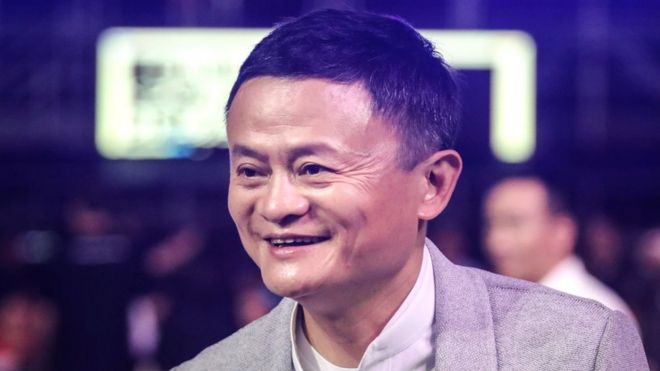
The richest man in China opened his own Twitter account last month, in the middle of the Covid-19 outbreak. So far, every one of his posts has been devoted to his unrivalled campaign to deliver medical supplies to almost every country around the world.
“One world, one fight!” Jack Ma enthused in one of his first messages. “Together, we can do this!” he cheered in another.
The billionaire entrepreneur is the driving force behind a widespread operation to ship medical supplies to more than 150 countries so far, sending face masks and ventilators to many places that have been elbowed out of the global brawl over life-saving equipment.
But Ma’s critics and even some of his supporters aren’t sure what he’s getting himself into. Has this bold venture into global philanthropy unveiled him as the friendly face of China’s Communist Party? Or is he an independent player who is being used by the Party for propaganda purposes? He appears to be following China’s diplomatic rules, particularly when choosing which countries should benefit from his donations, but his growing clout might put him in the crosshairs of the jealous leaders at the top of China’s political pyramid.
Other tech billionaires have pledged more money to fight the effects of the virus – Twitter’s Jack Dorsey is giving $1bn (£0.8bn) to the cause. Candid, a US-based philanthropy watchdog that tracks private charitable donations, puts Alibaba 12th on a list of private Covid-19 donors. But that list doesn’t include shipments of vital supplies, which some countries might consider to be more important than money at this stage in the global outbreak.
The world’s top coronavirus financial donors
How Alibaba compares to the top five. No one else other than the effervescent Ma is capable of dispatching supplies directly to those who need them. Starting in March, the Jack Ma foundation and the related Alibaba foundation began airlifting supplies to Africa, Asia, Europe, Latin America and even to politically sensitive areas including Iran, Israel, Russia and the US.
Ma has also donated millions to coronavirus vaccine research and a handbook of medical expertise from doctors in his native Zhejiang province has been translated from Chinese into 16 languages. But it’s the medical shipments that have been making headlines, setting Ma apart.
“He has the ability and the money and the lifting power to get a Chinese supply plane out of Hangzhou to land in Addis Ababa, or wherever it needs to go,” explains Ma’s biographer, Duncan Clark. “This is logistics; this is what his company, his people and his province are all about.”
A friendly face
Jack Ma is famous for being the charismatic English teacher who went on to create China’s biggest technology company. Alibaba is now known as the “Amazon of the East”. Ma started the company inside his tiny apartment in the Chinese coastal city of Hangzhou, in the centre of China’s factory belt, back in 1999. Alibaba has since grown to become one of the dominant players in the world’s second largest economy, with key stakes in China’s online, banking and entertainment worlds. Ma himself is worth more than $40bn.
Officially, he stepped down as Alibaba’s chairman in 2018. He said he was going to focus on philanthropy. But Ma retained a permanent seat on Alibaba’s board. Coupled with his wealth and fame, he remains one of the most powerful men in China.
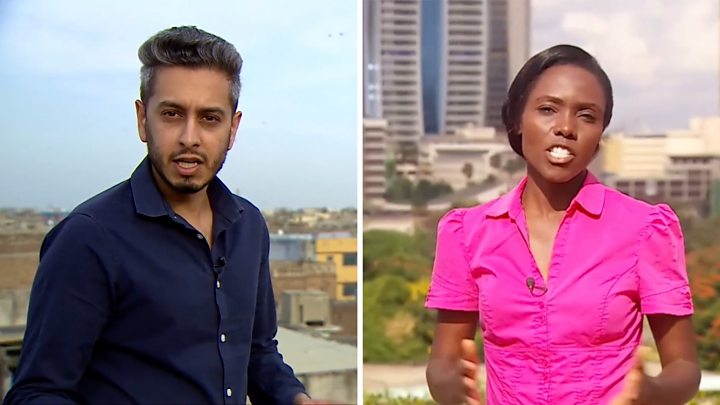
Media caption The BBC’s Secunder Kermani and Anne Soy compare how prepared Asian and African countries are
It appears that Ma’s donations are following Party guidelines: there is no evidence that any of the Jack Ma and Alibaba Foundation donations have gone to countries that have formal ties with Taiwan, China’s neighbour and diplomatic rival. Ma announced on Twitter that he was donating to 22 countries in Latin America. States that side with Taiwan but who have also called for medical supplies – from Honduras to Haiti – are among the few dozen countries that do not appear to be on the list of 150 countries. The foundations repeatedly refused to provide a detailed list of countries that have received donations, explaining that “at this moment in time, we are not sharing this level of detail”.
However, the donations that have been delivered have certainly generated a lot of goodwill. With the exception of problematic deliveries to Cuba and Eritrea, all of the foundations’ shipments dispatched from China appear to have been gratefully received. That success is giving Ma even more positive attention than usual. China’s state media has been mentioning Ma almost as often as the country’s autocratic leader, Xi Jinping.
AFP
So far…
Over 150 countries have received donations from Jack Ma, including about:
120.4mface masks
4,105,000testing kits
3,704ventilators
Source: Alizila
It’s an uncomfortable comparison. As Ma soaks up praise, Xi faces persistent questions about how he handled the early stages of the virus and where, exactly, the outbreak began.
The Chinese government has dispatched medical teams and donations of supplies to a large number of hard-hit countries, particularly in Europe and South-East Asia.
However, those efforts have sometimes fallen flat. China’s been accused of sending faulty supplies to several countries. In some cases, the tests it sent were being misused but in others, low-quality supplies went unused and the donations backfired.
In contrast, Jack Ma’s shipments have only boosted his reputation.
“It’s fair to say that Ma’s donation was universally celebrated across Africa,” says Eric Olander, managing editor of the China Africa Project website and podcast. Ma pledged to visit all countries in Africa and has been a frequent visitor since his retirement.
“What happens to the materials once they land in a country is up to the host government, so any complaints about how Nigeria’s materials were distributed are indeed a domestic Nigerian issue,” Olander adds. “But with respect to the donation itself, the Rwandan leader, Paul Kagame, called it a “shot in the arm” and pretty much everyone saw it for what it was which was: delivering badly-needed materials to a region of the world that nobody else is either willing or capable of helping at that scale.”
Walking the tightrope
But is Ma risking a backlash from Beijing? Xi Jinping isn’t known as someone who likes to share the spotlight and his government has certainly targeted famous faces before. In recent years, the country’s top actress, a celebrated news anchor and several other billionaire entrepreneurs have all “disappeared” for long periods. Some, including the news anchor, end up serving prison sentences. Others re-emerge from detention, chastened and pledging their allegiance to the Party.
“There’s a rumour that [Jack Ma] stepped down in 2018 from being the chairman of the Alibaba Group because he was seen as a homegrown entrepreneur whose popularity would eclipse that of the Communist Party,” explains Ashley Feng, research associate at the Centre for New American Security in Washington DC. Indeed, Ma surprised many when he suddenly announced his retirement in 2018. He has denied persistent rumours that Beijing forced him out of his position.
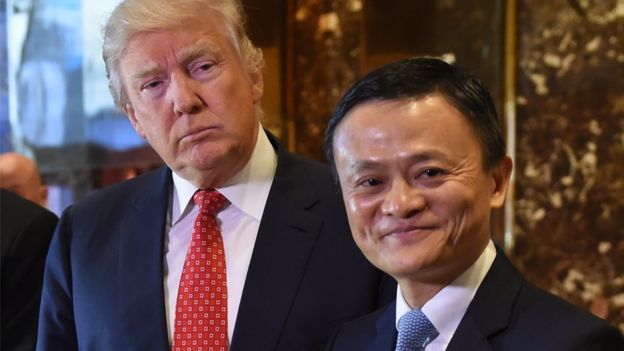
Image copyright GETTY IMAGESImage caption Ma discussed trade with then-President-elect Donald Trump in January 2017
Duncan Clark, Ma’s biographer, is also aware of reports that Ma was nudged away from Alibaba following a key incident in January 2017. The Chinese billionaire met with then-President-elect Donald Trump in Trump Tower, ostensibly to discuss Sino-US trade. The Chinese president didn’t meet with Trump until months later.
“There was a lot of speculation of time that Jack Ma had moved too fast,” Clark says. “So, I think there’s lessons learned from both sides on the need to try to coordinate.”
“Jack Ma represents a sort of entrepreneurial soft power,” Clark adds. “That also creates challenges though, because the government is quite jealous or nervous of non-Party actors taking that kind of role.”
Technically, Ma isn’t a Communist outsider: China’s wealthiest capitalist has actually been a member of the Communist Party since the 1980s, when he was a university student.
But Ma’s always had a tricky relationship with the Party, famously saying that Alibaba’s attitude towards the Party was to “be in love with it but not to marry it”.
Even if Ma and the foundations connected to him are making decisions without Beijing’s advance blessing, the Chinese government has certainly done what it can to capitalise on Ma’s generosity. Chinese ambassadors are frequently on hand at airport ceremonies to receive the medical supplies shipped over by Ma, from Sierra Leone to Cambodia.
China has also used Ma’s largesse in its critiques of the United States. “The State Department said Taiwan is a true friend as it donated 2 million masks,” the Chinese Foreign Ministry tweeted in early April. “Wonder if @StateDept has any comment on Jack Ma’s donation of 1 million masks and 500k testing kits as well as Chinese companies’ and provinces’ assistance?”
Perhaps Ma can rise above what’s happened to so many others who ran afoul of the Party. China might just need a popular global Chinese figure so much that Ma has done what no one else can: make himself indispensable.
“Here’s the one key takeaway from all that happened with Jack Ma and Africa: he said he would do something and it got done,” explains Eric Olander. “That is an incredibly powerful optic in a place where foreigners often come, make big promises and often fail to deliver. So, the huge Covid-19 donation that he did fit within that pattern. He said he would do it and mere weeks later, those masks were in the hands of healthcare workers.”
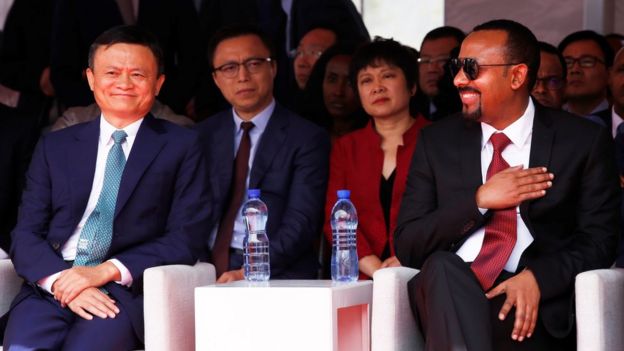
Image copyright GETTY IMAGESImage caption Ma at an Electronic World Trade Platform event with Ethiopian Prime Minister Abiy Ahmed last year
Duncan Clark argues that Ma already had a seat at China’s high table because of Alibaba’s economic heft. However, his first-name familiarity with world leaders makes him even more valuable to Beijing as China tries to repair its battered image.
“He has demonstrated the ability, with multiple IPOs under his belt, and multiple friendships overseas, to win friends and influence people. He’s the Dale Carnegie of China and that certainly, we’ve seen that that’s irritated some in the Chinese government but now it’s almost an all hands on deck situation,” Clark says.
There’s no doubt that China’s wider reputation is benefiting from the charitable work of Ma and other wealthy Chinese entrepreneurs. Andrew Grabois from Candid, the philanthropic watchdog that’s been measuring global donations in relation to Covid-19, says that the private donations coming from China are impossible to ignore.
“They’re taking a leadership role, the kind of thing that used to be done by the United States,” he says. “The most obvious past example is the response to Ebola, the Ebola outbreak in 2014. The US sent in doctors and everything to West Africa to help contain that virus before it left West Africa.”
Chinese donors are taking on that role with this virus.
“They are projecting soft power beyond their borders, going into areas, providing aid, monetary aid and expertise,” Grabois adds.
So, it’s not the right time for Beijing to stand in Jack Ma’s way.
“You know, this is a major crisis for the world right now,” Duncan Clark concludes. “But obviously, it’s also a crisis for China’s relationship with the rest of the world. So they need anybody who can help dampen down some of these those pressures.”
NEW DELHI (Reuters) – India’s ruling party was projected to lose a key state election on Tuesday, the vote count showed, in its first electoral test since deadly anti-government protests erupted nearly two months ago.
The Hindu-nationalist Bharatiya Janata Party (BJP) led by Prime Minister Narendra Modi won a bigger majority in a general election in May, but it has lost a string of state elections since then.
The protests, in which at least 25 people have been killed, erupted across the country in mid-December, after the BJP passed a new citizenship law critics say violates India’s secular constitution and discriminates against minority Muslims.
In counting for state polls held in India’s capital New Delhi, data from India’s Election Commission showed the liberal Aam Aadmi Party, led by the city’s chief minister, Arvind Kejriwal, leading 57 out of 70 seats.
The BJP ran a campaign accusing protesters of supporting India’s arch-rival Pakistan and was projected to win 13 seats, up from three in 2015 but far below its own expectations. The party’s local chief Manoj Tiwari had predicted it would win a majority.
AAP activists in distinctive white boat-shaped caps danced outside party headquarters in New Delhi as the result became clear, TV channels showed.
Neelanjan Sircar, an assistant professor at Ashoka University near New Delhi, said that local issues, including delivery of basic services like education and health, appeared to sway voters towards the AAP, even as the BJP ran a polarising campaign on the back of Modi’s image.
“Modi is a larger than life character at the national level, which obviously gives the BJP a huge advantage in national politics,” Sircar said.
“But it doesn’t translate to state level politics, where the BJP often doesn’t have a charismatic face.”
Bespectacled former bureaucrat Kejriwal, 51, formed AAP in 2012 amid an anti-corruption movement that swept India.
The party won a stunning victory in 2015 state elections in the capital, wiping out the BJP and Congress, the party that has ruled India for half its post-independence history.
The Congress – the main opposition at national level – was projected to win no seats in Delhi on Tuesday, data showed, reflecting the deep decline in its fortunes.
Image copyright GETTY IMAGESImage caption China’s version of its past is a story of prosperity, progress and sacrifice for the common good
China’s extraordinary rise was a defining story of the 20th Century, but as it prepares to mark its 70th anniversary, the BBC’s John Sudworth in Beijing asks who has really won under the Communist Party’s rule.
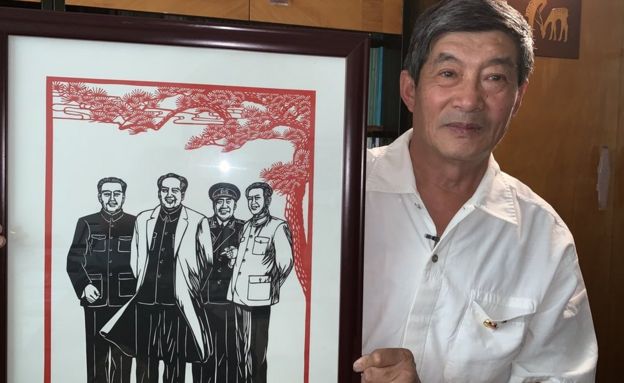
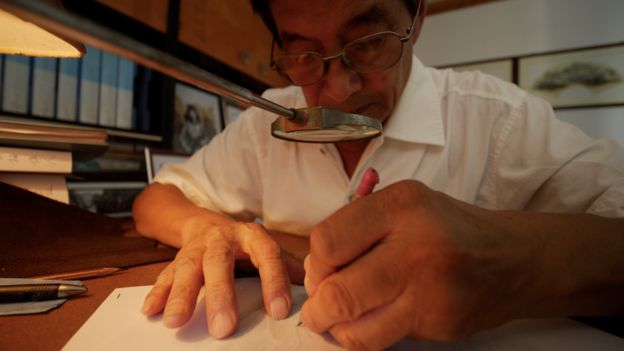
Sitting at his desk in the Chinese city of Tianjin, Zhao Jingjia’s knife is tracing the contours of a face.
Cut by delicate cut, the form emerges – the unmistakable image of Mao Zedong, founder of modern China.
The retired oil engineer discovered his skill with a blade only in later life and now spends his days using the ancient art of paper cutting to glorify leaders and events from China’s communist history.
“I’m the same age as the People’s Republic of China (PRC),” he says. “I have deep feelings for my motherland, my people and my party.”
Image caption For people like Zhao Jingjia, China’s success outweighs the “mistakes” of its leaders
Born a few days before 1 October 1949 – the day the PRC was declared by Mao – Mr Zhao’s life has followed the dramatic contours of China’s development, through poverty, repression and the rise to prosperity.
Now, in his modest but comfortable apartment, his art is helping him make sense of one of the most tumultuous periods of human history.
“Wasn’t Mao a monster,” I ask, “responsible for the deaths of tens of millions of his countrymen?”
“I lived through it,” he replies. “I can tell you that Chairman Mao did make some mistakes but they weren’t his alone.”
“I respect him from my heart. He achieved our nation’s liberation. Ordinary people cannot do such things.”
On Tuesday, China will present a similar, glorious rendering of its record to the world.
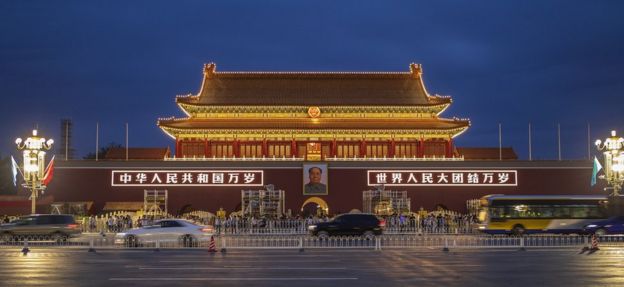
Beijing will tremble to the thunder of tanks, missile launchers and 15,000 marching soldiers, a projection of national power, wealth and status watched over by the current Communist Party leader, President Xi Jinping, in Tiananmen Square.
An incomplete narrative of progress
Like Mr Zhao’s paper-cut portraits, we’re not meant to focus on the many individual scars made in the course of China’s modern history.
It is the end result that matters.
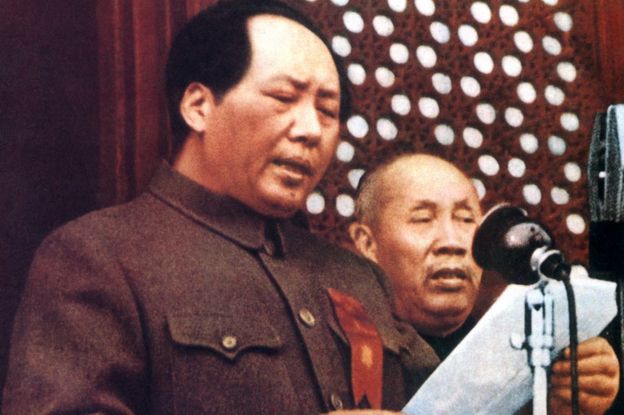
Image copyright XINHUA/AFPImage caption Mao Zedong pronounces the dawn of the People’s Republic of China on 1 October 1949
And, on face value, the transformation has been extraordinary.
On 1 October 1949, Chairman Mao stood in Tiananmen Square urging a war-ravaged, semi-feudal state into a new era with a founding speech and a somewhat plodding parade that could muster only 17 planes for the flyby.
This week’s parade, in contrast, will reportedly feature the world’s longest range intercontinental nuclear missile and a supersonic spy-drone – the trophies of a prosperous, rising authoritarian superpower with a 400 million strong middle class.
It is a narrative of political and economic success that – while in large part true – is incomplete.
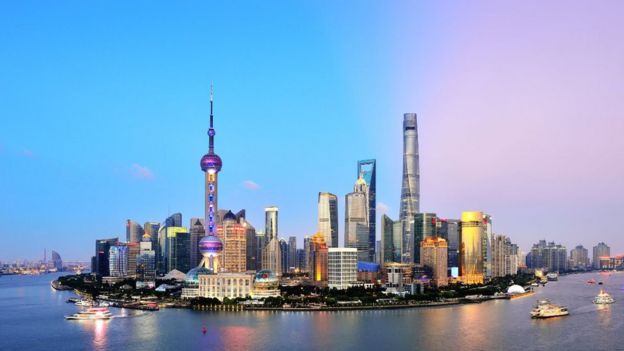
New visitors to China are often, rightly, awe-struck by the skyscraper-festooned, hi-tech megacities connected by brand new highways and the world’s largest high-speed rail network.
Image copyright GETTY IMAGESImage caption Those in China’s glittering cities may accept the trade-off of political freedom for economic growth
They see a rampant consumer society with the inhabitants enjoying the freedom and free time to shop for designer goods, to dine out and to surf the internet.
“How bad can it really be?” the onlookers ask, reflecting on the negative headlines they’ve read about China back home.
The answer, as in all societies, is that it depends very much on who you are.
Many of those in China’s major cities, for example, who have benefited from this explosion of material wealth and opportunity, are genuinely grateful and loyal.
In exchange for stability and growth, they may well accept – or at least tolerate – the lack of political freedom and the censorship that feature so often in the foreign media.
For them the parade could be viewed as a fitting tribute to a national success story that mirrors their own.
But in the carving out of a new China, the knife has cut long and deep.
The dead, the jailed and the marginalised
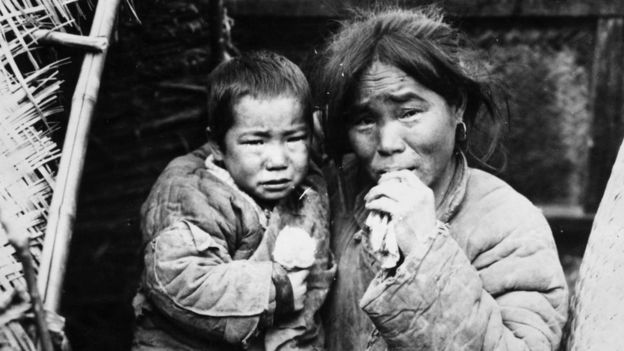
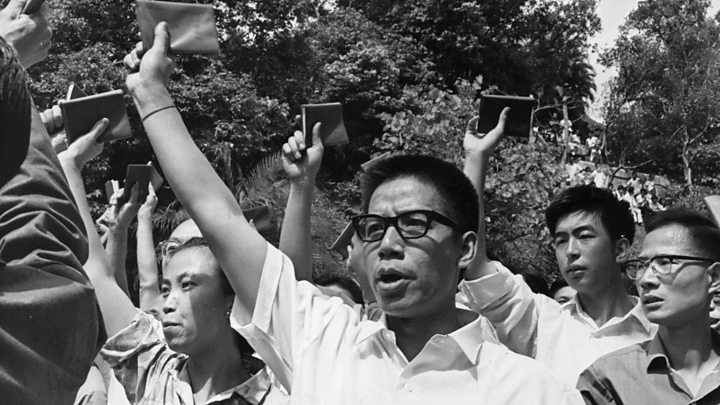
Mao’s man-made famine – a result of radical changes to agricultural systems – claimed tens of millions of lives and his Cultural Revolution killed hundreds of thousands more in a decade-long frenzy of violence and persecution, truths that are notably absent from Chinese textbooks.
Image copyright GETTY/TOPICALImage caption Tens of millions starved to death under Mao, as China radically restructured agriculture and society
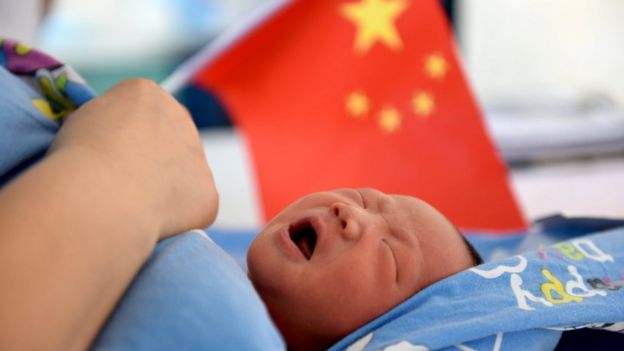
After his death, the demographically calamitous One Child Policy brutalised millions over a 40-year period.
Still today, with its new Two Child Policy, the Party insists on violating that most intimate of rights – an individual’s choice over her fertility.
The list is long, with each category adding many thousands, at least, to the toll of those damaged or destroyed by one-party rule.
Image copyright GETTY IMAGESImage caption Beijing still regulates how many children families can have
There are the victims of religious repression, of local government land-grabs and of corruption.
There are the tens of millions of migrant workers, the backbone of China’s industrial success, who have long been shut out of the benefits of citizenship.
A strict residential permit system continues to deny them and their families the right to education or healthcare where they work.
And in recent years, there are the estimated one and a half million Muslims in China’s western region of Xinjiang – Uighurs, Kazakhs and others – who have been placed in mass incarceration camps on the basis of their faith and ethnicity.
China continues to insist they are vocational schools, and that it is pioneering a new way of preventing domestic terrorism.
The stories of the dead, the jailed and the marginalised are always much more hidden than the stories of the assimilated and the successful.
Viewed from their perspective, the censorship of large parts of China’s recent history is not simply part of a grand bargain to be exchanged for stability and prosperity.
Getty
Timeline of modern China
1949 Mao declares the founding of the People’s Republic of China
1966-76 Cultural Revolution brings social and political upheaval
1977 Deng Xiaoping initiates major reforms of China’s economy
1989 Army crushes Tiananmen Square pro-democracy protests
2010 China becomes the world’s second-largest economy
2018 Xi Jinping is cleared to be president for life
It is something that makes the silence of their suffering all the more difficult to penetrate.
It is the job of foreign journalists, of course, to try.
‘Falsified, faked and glorified’
But while censorship can shut people up, it cannot stop them remembering.
Prof Guo Yuhua, a sociologist at Beijing’s Tsinghua University, is one of the few scholars left trying to record, via oral histories, some of the huge changes that have affected Chinese society over the past seven decades.
Her books are banned, her communications monitored and her social media accounts are regularly deleted.
“For several generations people have received a history that has been falsified, faked, glorified and whitewashed,” she tells me, despite having been warned not to talk to the foreign media ahead of the parade.
“I think it requires the entire nation to re-study and to reflect on history. Only if we do that can we ensure that these tragedies won’t be repeated.”
Image copyright GETTY IMAGESImage caption Can progress really be attributed to the leadership?
A parade, she believes, that puts the Communist Party at the front and centre of the story, misses the real lesson, that China’s progress only began after Mao, when the party loosened its grip a bit.
“People are born to strive for a better, happier and more respectful life, aren’t they?” she asks me.
“If they are provided with a tiny little space, they’ll try to make a fortune and solve their survival problems. This shouldn’t be attributed to the leadership.”
‘Our happiness comes from hard work’
As if to prove the point about how the unsettled, censored pasts of authoritarian states continue to impact the present, the parade is for invited guests only.
Image copyright GETTY IMAGESImage caption Mao’s portrait will, as it always is, be watching over the events in Tiananmen Square
Another anniversary, of which Tiananmen Square is the centrepiece, is also being measured in multiples of 10 – it is 30 years since the bloody suppression of the pro-democracy protests that shook the foundations of Communist Party rule.
The troops will be marching – as they always do on these occasions – down the same avenue on which the students were gunned down.
The risk of even a lone protester using the parade to mark a piece of history that has largely been wiped from the record is just too great.
With central Beijing sealed off, ordinary people in whose honour it is supposedly being held, can only watch it on TV.
Back in his Tianjin apartment, Zhao Jingjia shows me the intricate detail of a series of scenes, each cut from a single piece of paper, depicting the “Long March”, a time of hardship and setback for the Communist Party long before it eventually swept to power.
“Our happiness nowadays comes from hard work,” he tells me.
It is a view that echoes that of the Chinese government which, like him, has at least acknowledged that Mao made mistakes while insisting they shouldn’t be dwelt on.
“As for the 70 years of China, it’s extraordinary,” he says. “It can be seen by all. Yesterday we sent two navigation satellites into space – all citizens can enjoy the convenience that these things bring us.”
Media caption What was China’s Cultural Revolution?
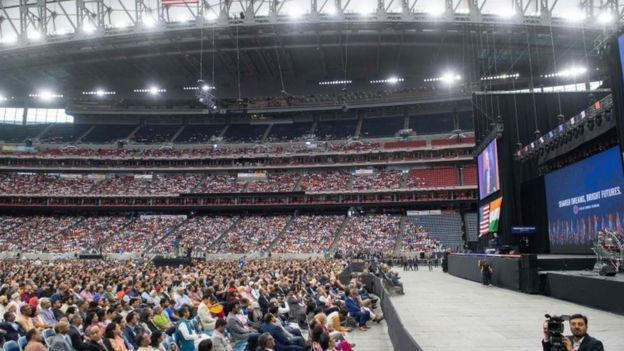
US President Donald Trump and Indian Prime Minister Narendra Modi exchanged warm words of friendship in Texas at a rare mass rally for a foreign leader.
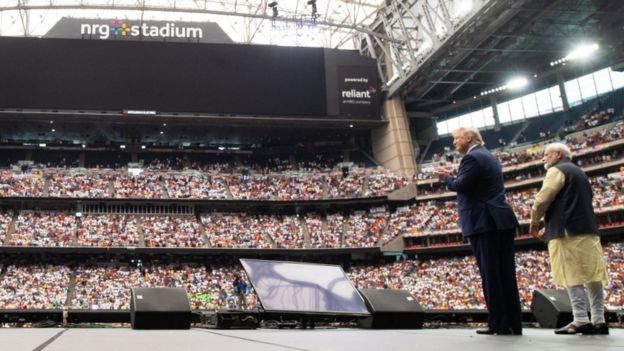
Around 50,000 people gathered for what Mr Trump called a “profoundly historic event” on Sunday in Houston.
The “Howdy, Modi!” event was billed as one of the largest ever receptions of a foreign leader in the US.
Mr Modi, however, may face a frostier reception at the UN General Assembly.
He is likely to face criticism over tensions in Indian-administered Kashmir, which he stripped of its special status last month, promising to restore the region to its “past glory”.
The region has been in lockdown for more than a month with thousands of activists, politicians and business leaders detained.
Trade talks and the UN General Assembly are on the Indian prime minister’s agenda during his week-long visit to the United States.
Pakistani Prime Minister Imran Khan, who has been the most vocal international leader to oppose India’s Kashmir move, is also in the US for the UN conference. Like Mr Modi, he will have a one-on-one meeting with Mr Trump on the sidelines of the summit.
A 90-minute show, featuring 400 performers, warmed up the crowd before Mr Modi and Mr Trump shared the stage.
“I’m so thrilled to be here in Texas with one of America’s greatest, most devoted and most loyal friends, Prime Minister Modi of India,” Mr Trump told the crowd.
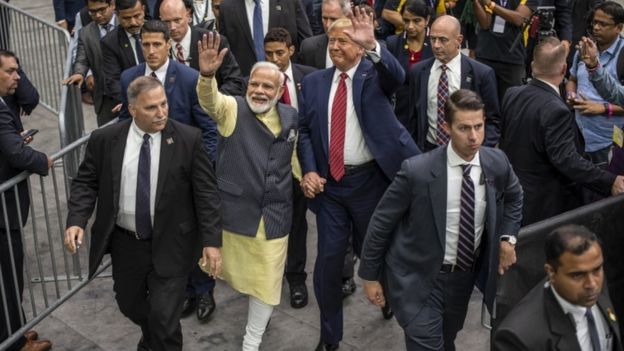
Image copyright GETTY IMAGESImage caption Narendra Modi and Donald Trump leave the stage holding hands at Houston’s NRG Stadium
In his speech, Mr Modi said India has a “true friend” in the White House, describing Mr Trump as “warm, friendly, accessible, energetic and full of wit”.
“From CEO to commander-in-chief, from boardrooms to the Oval Office, from studios to the global stage… he has left a lasting impact everywhere,” Mr Modi said.
Personal-touch diplomacy played to perfection
Brajesh Upadhyay, BBC News, Houston
This was exactly the kind of crowd size and energy President Trump loves at his rallies.
Only here the chants were for Indian Prime Minister Narendra Modi and Mr Trump was the superstar invited to the party. But the crowd did not disappoint him either and greeted him with chants of “USA!”, most heard at Trump rallies.
The personal-touch diplomacy with Mr Modi’s trademark bear hugs was played to perfection.
This rally has been called a win-win for both the leaders. For President Trump, it was a chance to court Indian-Americans for the 2020 presidential election race where Texas could emerge as a battleground state. For Mr Modi, a PR triumph and picture with the president of the United States may help him shrug off the criticism over his recent strong-arm policies at home.
Houston’s NRG Stadium, where the event was hosted, was the first stop for Mr Modi, whose Hindu nationalist Bharatiya Janata Party (BJP) won a landslide victory in this year’s Indian elections.
Greeted by a standing ovation, Mr Trump used his speech to heap praise on Mr Modi, who he said was doing a “truly exceptional job for India” and its people.
Mr Trump also paid tribute to the Indian-American community, telling them “we are truly proud to have you as Americans”.
The US has a population of about 4 million Indians who are seen as an increasingly important vote bank in the country.
Apart from Mr Trump, organisers also invited Democrats to the event – House Majority Leader Steny Hoyer was among those who spoke.
The 2010 US census shows that Texas is home to the fourth-largest Indian-American population in the country after California, New York and New Jersey.
Analysis of voting patterns shows the community tends overwhelmingly to support the Democrat party.
Image copyright GETTY IMAGESImage caption The event, dubbed “Howdy, Modi!”, was attended by an estimated 50,000 people
No stranger to nationalist rhetoric himself, Mr Trump compared security at the US-Mexico border to the tensions between India and Pakistan in the tinderbox Kashmir region.
“Both India and US also understand that to keep our communities safe, we must protect our borders,” Trump said.
Image copyright GETTY IMAGESImage caption Donald Trump described Narendra Modi as one of America’s most “loyal friends”
In India, the rally was closely watched, with most mainstream media outlets running live news updates of what was transpiring on stage.
The event had been making headlines for days before as well.
On Twitter, many people shared instant analysis and opinions of what was taking place on the stage with the sentiment being overwhelmingly positive. Many praised Mr Modi for what they saw as his statesmanship and diplomatic acumen with a lot of praise coming in for the US president as well.






 CHINDIA ALERT: You'll be living in their world, very soon