Chindia Alert: You’ll be Living in their World Very Soon
aims to alert you to the threats and opportunities that China and India present. China and India require serious attention; case of ‘hidden dragon and crouching tiger’.
Without this attention, governments, businesses and, indeed, individuals may find themselves at a great disadvantage sooner rather than later.
The POSTs (front webpages) are mainly 'cuttings' from reliable sources, updated continuously.
The PAGEs (see Tabs, above) attempt to make the information more meaningful by putting some structure to the information we have researched and assembled since 2006.
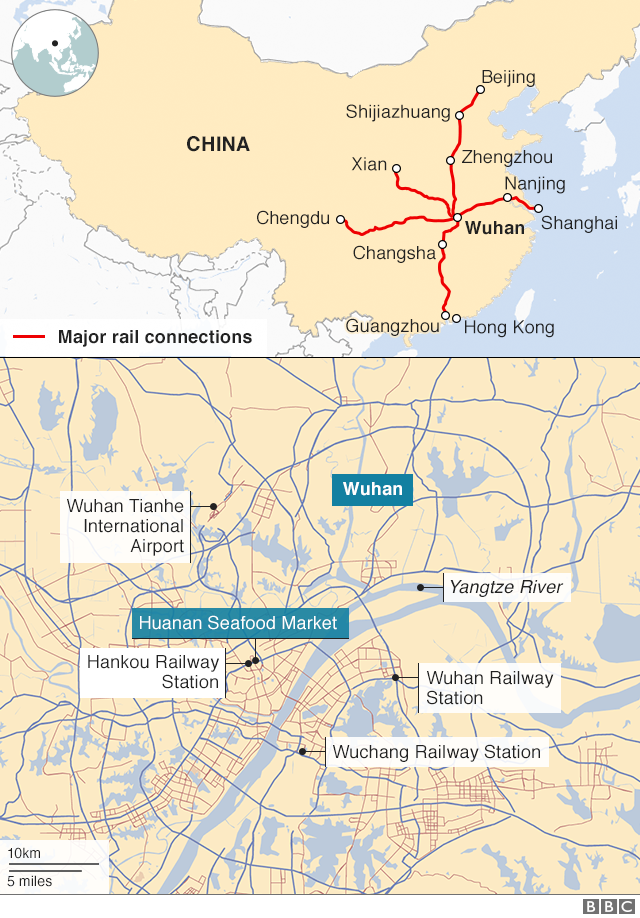
Wuhan, a Chinese city of eleven million people, has temporarily shut down its public transport as it tries to halt the outbreak of a new strain of virus.
Those living in the city have been advised not to leave, in a week when millions of Chinese are travelling for the upcoming Lunar New Year holiday.
The respiratory illness has spread to other parts of China, with some cases in other countries including the US.
There are more than 500 confirmed cases and 17 people have died.
Known for now as 2019-nCoV, the virus is understood to be a new strain of coronavirus not previously identified in humans. The Sars (severe acute respiratory syndrome) virus that killed nearly 800 people globally in the early 2000s was also a coronavirus, as is the common cold.
All the fatalities so far have been in Hubei, the province around Wuhan.
Meanwhile, after a day of discussions in Geneva, the World Health Organization’s (WHO) emergency committee has announced it will not yet declare a “global emergency” over the new virus.
Director general Dr Tedros Ghebreyesus said more information was needed about the spread of the infection. The committee of health experts will meet again on Thursday.
A global emergency is the highest level of alarm the WHO can sound and has previously been used in response to swine flu, Zika virus and Ebola.
What measures have been announced?
From Thursday, all flights and passenger train services out of Wuhan have been stopped.
Bus, subway and ferry services all shut down from 10:00 local time (02:00 GMT).
A special command centre in Wuhan set up to contain the virus said the move was meant to “resolutely contain the momentum of the epidemic spreading”.
Those living in Wuhan had already been told to avoid crowds and minimise public gatherings.
State news agency Xinhua said tourist attractions and hotels in the city had been told to suspend large-scale activities while libraries, museums and theatres were cancelling exhibitions and performances.
A Lunar New Year prayer-giving ceremony at the city’s Guiyuan Temple, which attracted 700,000 people last year, has also been cancelled.
The hashtag “Wuhan is sealed off” was trending on Chinese social media website Weibo.
One user said worries about food and disinfectant made it feel like “the end of the world”, while another said they were on the “verge of tears” when Chinese officials announced the shut-down.
The WHO’s Dr Ghebreyesus described the latest measures as “very strong” and said they would “not only control the outbreak, they will minimise spread internationally”.
Chinese officials said the country was now at the “most critical stage” of prevention and control.
“Basically, do not go to Wuhan. And those in Wuhan please do not leave the city,” said National Health Commission vice-minister Li Bin in one of the first public briefings since the beginning of the outbreak.
Like shutting down London before Christmas
By James Gallagher, BBC health and science correspondent
Wuhan is starting to look like a city in quarantine.
Officials had already warned residents not to leave the city and visitors not to come.
Now the reported public transport ban – which includes flights – slams many of the routes in and out of the city shut.
Image copyright GETTY IMAGESImage caption Subways in Wuhan will be temporarily shut
It is a significant attempt to stop the spread of this new virus, which we now know can spread from person to person.
Limiting transport will cut the chance of the virus reaching other cities in China and other countries around the world.
This all comes just as millions of people are travelling across China for the week-long holiday that is Lunar New Year.
If you’re struggling for context – imagine shutting down London in the week before Christmas.
The big question left is the roads – and whether any of Wuhan’s 11 million inhabitants will be able to simply drive away.
The patient in Macau is said to be a businesswoman who arrived from Wuhan over the weekend.
The first US case was confirmed on Tuesday. President Donald Trump said the situation was “totally under control” and that he trusted the information being provided by Chinese authorities.
There have been three cases in Thailand, one in Korea, one in Japan and one in Taiwan.
Although only about 500 cases have been confirmed, calculations by scientists at the MRC Centre for Global Infectious Disease Analysis at Imperial College London suggest there are 4,000 people sick with the virus in Wuhan.
Our estimate at 4,000 cases is more than double the past estimate due to increase of number of cases outside China. This should not be interpreted as implying the outbreak has doubled in size.
The virus originated in a seafood market in Wuhan that “conducted illegal transactions of wild animals”, authorities said. The market has since been shut down.
HONG KONG (Reuters) – China’s People’s Liberation Army (PLA) soldiers in shorts and t-shirts made a surprising appearance in some Hong Kong streets on Saturday, briefly helping residents clean up debris after anti-government protests blocked roads, witnesses said.
The presence of PLA troops on the streets, even to help clean up roads near their base, could stoke further controversy over the Chinese-ruled territory’s autonomous status.
Hong Kong has been rocked by more than five months of demonstrations by protesters angry at perceived Communist Party meddling in the former British colony, which was guaranteed its freedoms when it returned to Chinese rule in 1997.
Beijing denies interfering and has blamed the unrest on foreign influences.
Clashes between protesters and police have become increasingly violent. China has warned that any attempt at independence for Hong Kong will be crushed, but troops have remained inside their base.
RELATED COVERAGE
China’s PLA soldiers seen helping clean up streets after Hong Kong protests – RTHK
Saturday’s clean up followed some of the worst violence seen this year, after a police operation against protesters at the Chinese University of Hong Kong on Tuesday.
The authorities have since largely stayed away from at least five university campuses that had been barricaded by thousands of students and activists who stockpiled petrol bombs, catapults, bows and arrows and other weapons.
Many protesters appeared to have left the campuses by late Saturday, though some remained behind to man makeshift barricades. Hong Kong’s Cross-Harbour Tunnel was still blocked by protesters occupying Polytechnic University.
Earlier, hundreds of pro-China demonstrators gathered by the city’s legislature and police headquarters, waving Chinese and Hong Kong flags. Some held up posters reading “Police we stand with you”, while others chanted “Support the police”.
Pro-China protests have so far attracted much smaller numbers than those angry at Beijing.
RARE TROOP PRESENCE
By late afternoon, the PLA soldiers had left the streets outside Baptist University, beside their barracks in leafy Kowloon Tong.
Chinese troops have appeared on local streets only once since the 1997 handover, to help with cleanup operations after a typhoon in late 2018. It was not immediately clear how many were involved on Saturday.
Calls to the PLA Hong Kong garrison office and a media liaison officer went unanswered.
Demosistō, a pro-democracy organisation, said Saturday’s cleanup operation could set a “grave precedent” if the city’s government invites the military to deal with internal problems.
In August, Beijing moved thousands of troops across the border into Hong Kong in what state news agency Xinhua described as a routine “rotation”.
Foreign envoys and security analysts estimate up to 12,000 troops are now based across Hong Kong — more than double the usual garrison number.
Standing beside a black flag with the slogan “Liberate Hong Kong, Revolution of our Times,” James Wong, 23, was among a handful of protesters still manning a bridge at Baptist University.
“We didn’t want to confront the people and the PLA troops directly,” he told Reuters. “We are not directly against the PLA, but rather the government. But the PLA should not leave their base because this is Hong Kong territory.”
Wong said even after the campus fortifications have been dismantled “Hong Kong will keep resisting until the government responds to our demands”.
Hundreds of residents moved in to help clear barricaded roads near several universities.
Clashes on Saturday saw at least one petrol bomb thrown before anti-government protesters at the campuses retreated. No soldiers appeared to have been involved in the confrontations.
“We just want our lives to continue,” said one resident who was helping clear streets near HKU. “There are many elderly who need to go the hospital and children who need to go to school. I am very sad to see what is happening in my community.”
PRO-POLICE DEMONSTRATION
Saturday’s rally to denounce the anti-government violence drew a mix of young and elderly.
“From the bottom of our hearts, we believe it is the correct thing to support the police in fighting the rioters for Hong Kong citizens,” said a 49-year-old housewife surnamed Kong.
“A lot of people keep silent, afraid of the rioters. It’s time for all the people who are silent to step up and say that’s enough.”
A 70-year-old street cleaner died on Thursday after being hit on the head by one of several bricks police said had been thrown by “masked rioters”. On Monday, police blamed a “rioter” for dousing a man in petrol and setting him on fire. The victim is in critical condition.
On the same day, police shot a protester in the abdomen. He was in a stable condition.
Many pro-police protesters laid white flowers outside the government office to pay their respects to the cleaner. Others applauded and cheered the police, some bowing and giving thumbs up as they walked past riot police on duty.
Authorities said on Saturday that a highway blocked by anti-government protesters on Friday had reopened after being cleared of debris and petrol bombs.
Train services suspended earlier in the week were gradually resuming, metro operator MTR Corp (0066.HK) said.
MANILA, Nov. 3 (Xinhua) — Chinese State Councilor and Foreign Minister Wang Yi has offered condolences for the people killed in the series of strong earthquakes that devastated central and eastern Mindanao in the southern Philippines last month, saying China is ready to help the Philippine government in its efforts to rehabilitate the region.
In a message of sympathy sent to Philippine Foreign Secretary Teodoro Locsin on Saturday, Wang said he was shocked to learn that strong earthquakes had hit Mindanao, resulting in casualties and property damage.
“He (Wang) would like to extend sincere sympathy to the victims and the bereaved families,” the Chinese Embassy in the Philippines said in a statement.
“China is willing to offer assistance to the Philippines within our capacity, and believes that under the strong leadership of the Philippine government, the Philippine people will overcome the disaster and return to normal life at an early date,” it quoted Wang as saying.
On Friday, China announced a donation of 3 million yuan (about 434,896 U.S. dollars) to help the quake victims, mostly poor farmers.
The Philippine National Disaster Risk Reduction and Management Council (NDRRMC) said in an updated report on Sunday that the Oct. 29 6.6-magnitude and the Oct. 31 6.5-magnitude earthquakes that hit several central and eastern Mindanao provinces had killed 21 people and injured more than 400 others.
Rescuers were still looking for two missing villagers, the country’s disaster agency said.
The agency said the two tremors also affected more than 178,000 people in 200 villages in the region. Nearly 22,000 displaced people were staying in makeshift tents, it added.
The agency said the quakes also damaged nearly 29,000 infrastructures in the region, mostly houses, school buildings, hospitals, roads and bridges.
Thirty-six others were hurt, with nine being treated for serious injuries
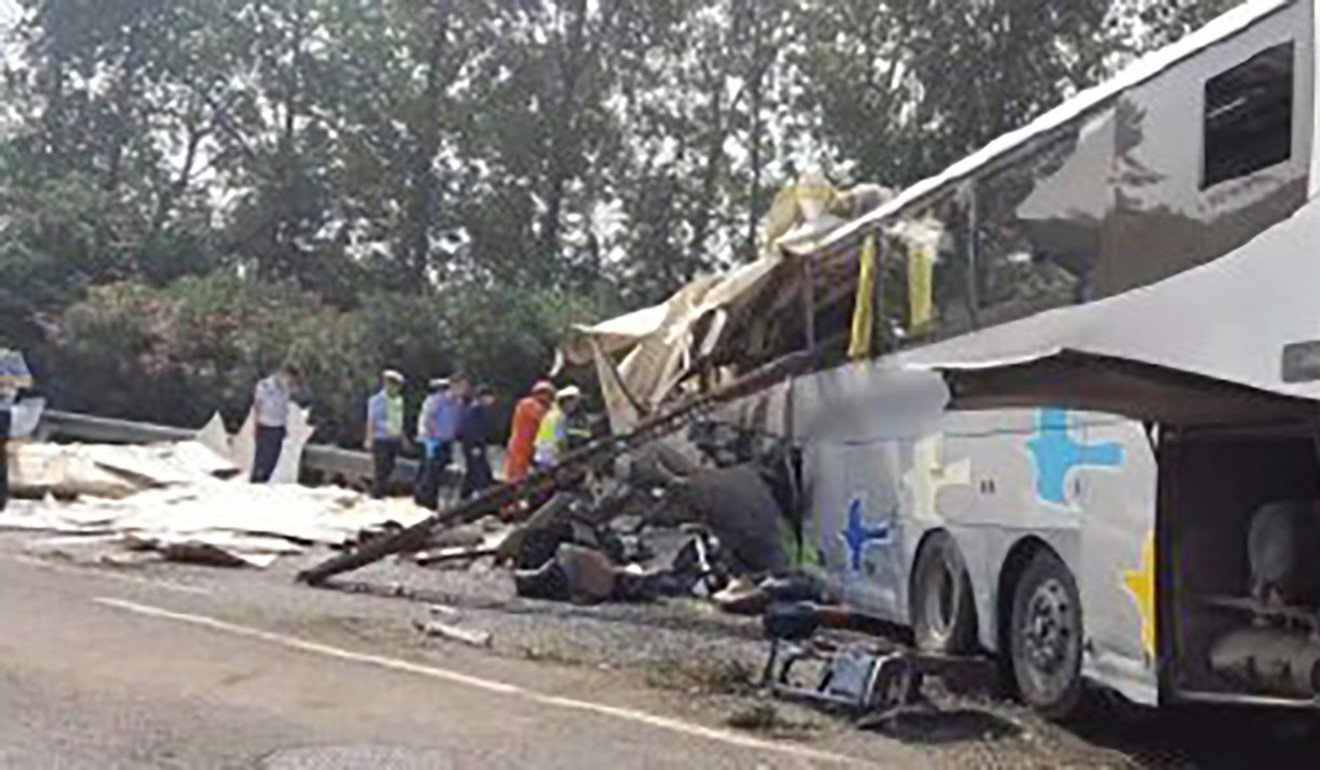
Bus had a tyre blowout and collided with road divider before slamming into truck in the opposite lane in Yixing, Jiangsu province, police say
The expressway reopened after a rescue operation of more than eight hours. Photo: Weibo
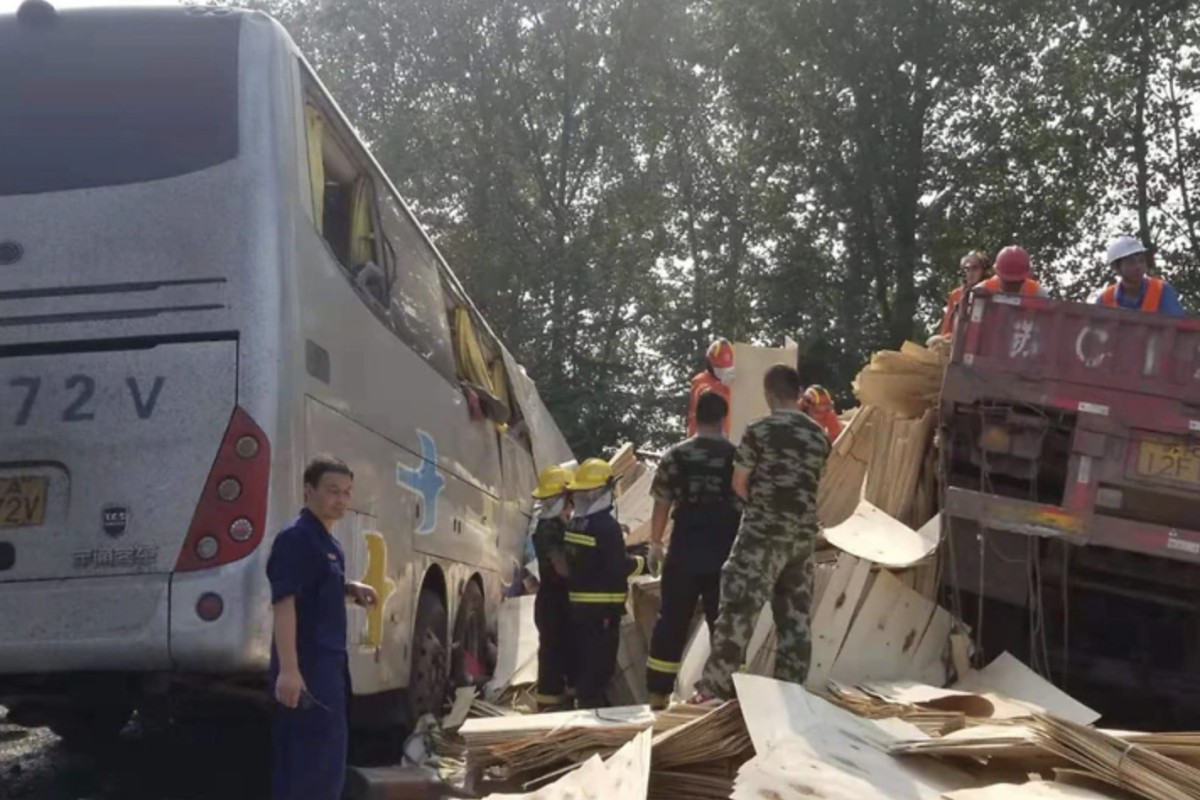
Thirty-six people were killed and another 36 injured when a coach had a tyre blowout and crashed into a truck on an expressway in eastern China on Saturday.
The coach, which had 69 passengers on board, collided with a road divider before slamming into a truck in the opposite lane at about 7am, the Yixing municipal police department said in a statement on Sunday.
There were three people in the truck.
The accident happened on the Yixing section of the Changchun-Shenzhen Expressway in Jiangsu province.
A rescue operation took more than eight hours, and the injured were taken to hospitals in nearby Yibing.
Nine people were seriously injured, 26 were being treated for minor injuries and one had been discharged from hospital, according to the statement.
A tyre blowout may have caused the accident on Saturday morning. Photo: Weibo
Police are still looking into the crash but said “according to our preliminary investigation, the accident was caused by a blowout of one of the coach’s front tyres”.
ahead of National Day and the week-long holiday marking it, as all levels of government try to make sure nothing goes wrong.
This month, local governments were told to check factories, restaurants, rental accommodation, scenic spots close to water and roads for safety hazards and to take measures to prevent fire, crashes or other accidents, according to media reports.
Traffic accidents are common in China, where about 200,000 people lose their lives on the roads every year, according to the World Health Organisation.
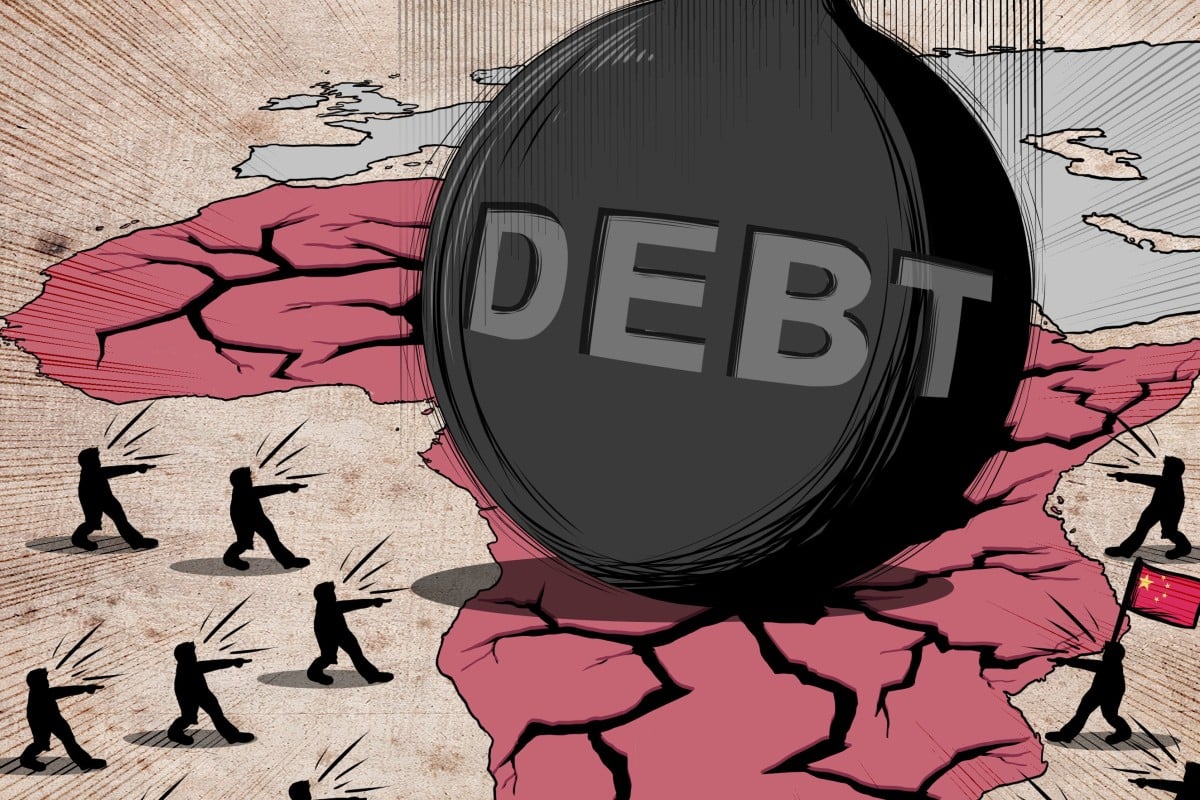
Beijing has lent billions of dollars to countries on the continent to build railways, highways and airports but critics say the borrowings are unsustainable
Chinese officials say the projects will pay off in the long run and host nations are well aware of their limits and needs
Illustration: Lau Kakuen
When Clement Mouamba went to Beijing last year, he had two main tasks.
The prime minister of the Republic of Congo needed to find out exactly how much his country owed to China, a number the struggling, oil-rich central African nation had until then not been able to provide the International Monetary Fund (IMF) to qualify for a bailout. He also needed to convince Beijing to restructure its debt to ensure sustainability.
The IMF had put talks for further loans on hold until Mouamba’s administration could say exactly how much it had to repay to the country’s external creditors, including China – the republic’s single largest bilateral lender – and oil multinationals such as Glencore and Trafigura.
The country, which heavily depends on oil revenue, turned to China and private oil majors for funding to run the government when in 2014 oil prices fell from a high of US$100 per barrel to as low as US$30.
The Republic of Congo has since restructured its borrowings from China, which holds about a third, or US$2.5 billion, of the Congolese debt, by extending the repayment period by an additional 15 years.
A number of other African countries struggling to service their loans from Beijing have also pursued concessions. Ethiopia has had part of its Chinese debt written off and terms relaxed for the US$3.3 billion loan it took to build its railway, while Zambia is seeking similar adjustments for its borrowings used to build airports and highways.
Critics say countries on the continent are being burdened with unrealistic levels of debt for inviable infrastructure backed and built by China without adequate transparency and scrutiny.
The biggest concern is that several African countries will be left with huge debts and grandiose infrastructure that they cannot maintain and run profitably. I liken it to borrowing money to buy a Tesla when you don’t have adequate access to electricity: Obert Hodzi of the University of Helsinki in Finland
But Chinese observers say the West must take some of the blame for the countries’ debt problems and that the support China offers will benefit the host countries in the long run.
In the early 1990s, when China began to embrace Africa again after years of isolation from the outside world, the aspiring manufacturer was at a serious disadvantage in the race for raw materials and markets for its industrial goods.
The former colonial powers of the West had already sewn up deals for many of the continent’s most lucrative and readily exploitable reserves, from fossil fuels to minerals.
China needed new strategies to convince African governments to allow it access raw materials for its industries and markets for its products to a largely unfamiliar partner.
China also wanted to challenge the dominance of the US in global trade and politics so it courted allies in Africa to help it push for political legitimacy in international institutions.
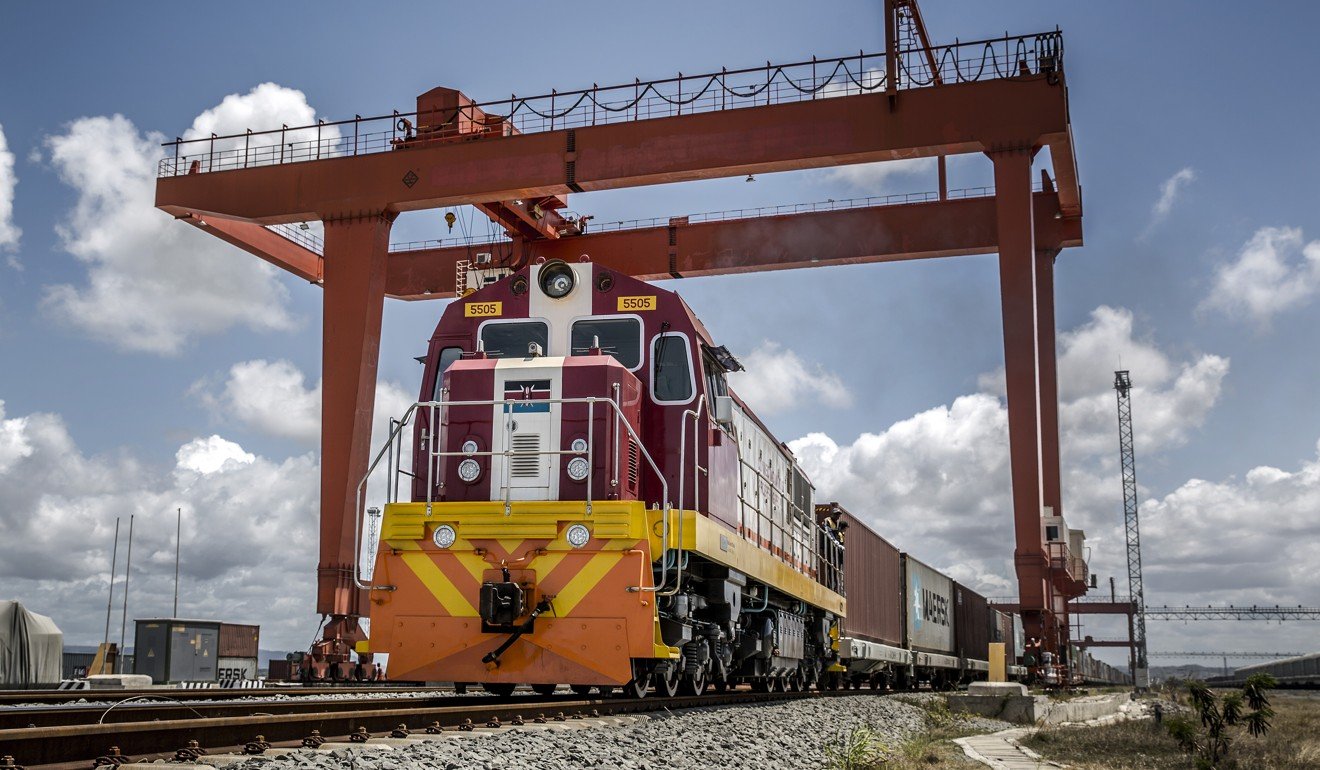
A Kenya Railways freight train leaves the port station on the Mombasa-Nairobi railway in Mombasa, Kenya, a huge project backed by China. Photo: Bloomberg
At the time, many African leaders were under fire to liberalise their economies. China’s approach was to promise not to meddle in individual country’s internal affairs and assure African countries that they could get billions in exchange for future delivery of minerals through resource-backed deals.
Beijing sold its policies that it had no conditions attached to its development finance. In the drive to drum up business, China promised affordable loans for African countries to build roads, bridges, highways, airports and power dams.
Is Kenya’s Chinese-built railway a massive white elephant?
But Beijing also pursued tied finance, ensuring that countries borrowing from China used Chinese contractors to implement the projects rather than open them up to outside bids.
In addition, many of the deals were built on weak financial, technical and environmental conditions, with Chinese state firms conducting the technical feasibility, environmental impact assessment and financial viability studies for free for projects that they also build.
For example, in Kenya, the China Road and Bridge Corporation conducted a free feasibility study that was used in the construction of the railway.
The same company was handed the contract to implement the project and is operating both the passenger and cargo train service for a fee.
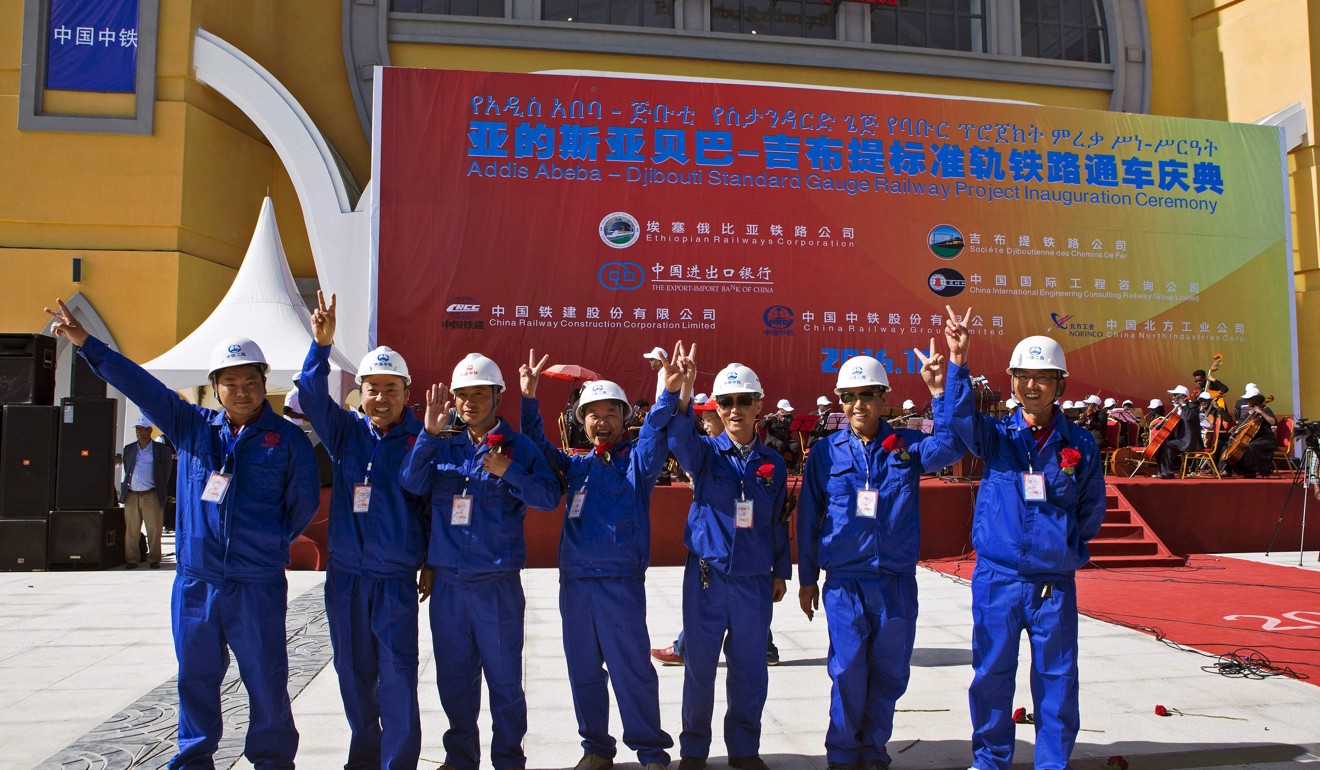
Chinese companies were responsible for the construction of a rail line between Addis Ababa and Djibouti. Photo: AFP
In contrast, the World Bank and its partner institution, the IMF, demand that such studies be done by an independent consultant and not by the company that implements the project.
According to data compiled by the China-Africa Research Initiative, at the Johns Hopkins University School of Advanced International Studies, Beijing has advanced loans worth US$143 billion to African countries since 2000, levels that some critics say are unsustainable for the borrowers.
China meets resistance over Kenya coal plant, in test of its African ambitions
For many of China’s new African partners, these arrangements – from easy lending terms, to non-competitive bidding and opaque contract details – have led to new problems – problems that corrupt or poorly managed governments now share substantial responsibility.
Some critics, both in the West and in host countries, suggest there is a “debt-trap strategy” at the heart of Beijing’s push for international business and influence, but there is no evidence that China deliberately pushes other countries into debt to seize their assets or gain sway.
However, the drive for overseas contracts and big business has led some countries into difficulties with new debts, and there are question marks over the viability of many of the projects the money is funding.
Obert Hodzi, an international relations expert at the University of Helsinki in Finland, said the Addis Ababa-Djibouti railway and the Mombasa-Nairobi railway were good examples of huge projects that were financed by easy borrowing terms from China but were not sustainable and that had in turn forced the African partners to seek further Chinese help.
“The biggest concern is that several African countries will be left with huge debts and grandiose infrastructure that they cannot maintain and run profitably,” Hodzi said. “I liken it to borrowing money to buy a Tesla when you don’t have adequate access to electricity.”
Ken Opalo, a Kenyan scholar at Georgetown University in Washington, said the key issue was the inability of African countries to design projects that were actually needed for the local economies.
A road is not just a means of transport but an economic belt or corridor that will catalyse the development of the whole region: Huang Xueqing, spokeswoman for the Chinese embassy in Nairobi
“Most African countries have been willing to accept projects designed, financed, and implemented by Chinese firms,” Opalo said.
“It would be better to decouple the feasibility studies and design phases of projects from the financing. That way African governments can ensure that they are truly getting value for money.”
But Chinese officials said Beijing had invested in infrastructure largely at the request of the host countries, adding that it could take time to yield returns on the projects.
Huang Xueqing, spokeswoman for the Chinese embassy in Nairobi, said the projects were valid assets with value that would grow in time.
“So, in the long run, it is beneficial to the host countries. Just like when young people buy a house with a mortgage, they may take some debts, but they have a place to live in and have their own assets,” Huang said.
“Underdeveloped infrastructure is the bottleneck that has been holding back Africa’s development. Up to today, many African countries, although in the same continent, are not connected with direct flights, railways or even roads. You have to fly to Paris or Zurich in order to get to some African countries.
“A road is not just a means of transport but an economic belt or corridor that will catalyse the development of the whole region.”
Huang said Beijing had advised the countries to act within their means and not to overstretch themselves when they considered projects that might not be in line with local conditions.
“When making investment decisions, the Chinese side, along with the recipient countries, carry out rigorous feasibility studies and evaluations. We do things according to our ability,” she said.
China’s leadership has also said it is paying close attention to the fiscal and financial difficulties faced by some African countries.
“As a good friend and good brother … the Chinese side is willing to lend a helping hand when needed by the African people to help them overcome temporary difficulties,” State Councillor and Foreign Minister Wang Yi said in January while on a trip to Ethiopia, adding that the debt situation in Africa is also a legacy issue.
China must allay any debt-trap fears in its dealings with Africa
“The African debt issue does not come up today, still less is it caused by the Chinese side. The African people know who are the initiators of African debt.”
The West should take a lot of the blame for worsening debt problems in some African countries, according to Li Anshan, from Peking University’s Centre for African Studies.
He cited the cases of Liberia and the Democratic Republic of Congo, two countries that have had close relations with the West for many years but remain ravaged by war and poverty despite immense natural resources.
“China-Africa relations have been going on for quite some time. Is there any African country which has got poorer because of its deal with China?” Li said.
Gyude Moore, a former Liberian minister of public works whose department oversaw construction and maintenance of various public infrastructure funded and built by China, said it would be difficult to imagine that China would knowingly ensnare its partners in debt.
“China attempts to differentiate itself from Western donors by limiting non loan-related conditionality. China also practices non-interference, so how a country manages its resources, treats its people or deploy its finances were considered ‘internal’,” he said.
“So, Chinese loans are negotiated faster and place less emphasis on public financial management.”
Moore, now a visiting fellow at the Centre for Global Development, said there were trade-offs in such situations.
China focuses on sustainable projects to dismiss fears of African debt trap
“If the loans are going to be fast – the due diligence will not be as rigorous. Chinese project selection mixes political with economic considerations. So, while a project may not make as much economic sense, it may pay political dividends,” he said.
He said non-transparent processes would invite abuse, be they Chinese, Western or African.
Other observers say the question of opacity is more directly related to China’s own economic system.
Howard French, author of China’s Second Continent: How a Million Migrants are Building a New Empire in Africa, said China has very limited transparency and public accountability in its own domestic processes.
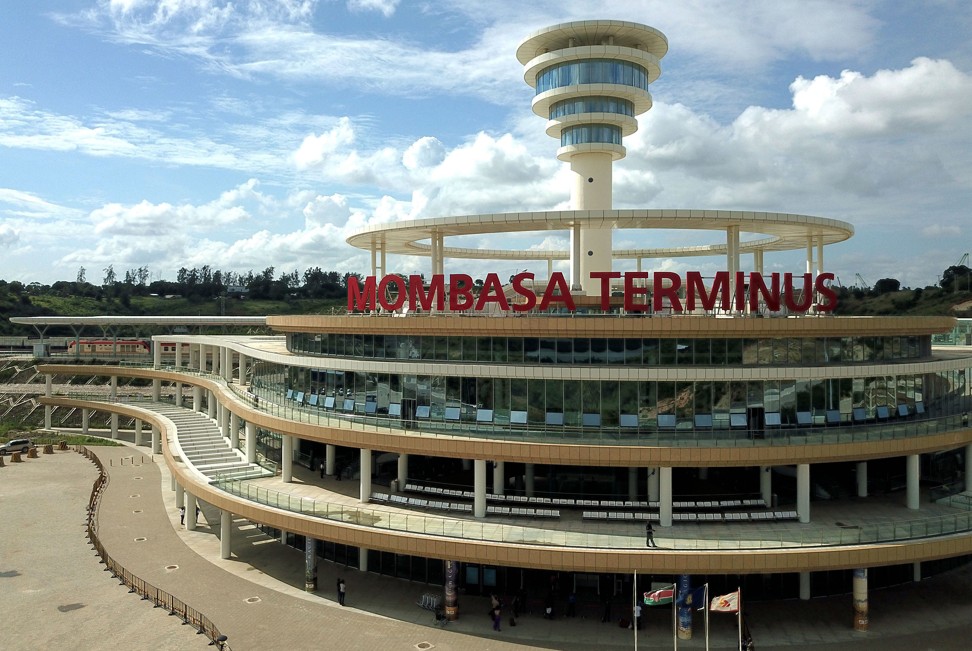
The Mombasa railway station is seen in Mombasa, Kenya, in 2018. Photo: Xinhua
“So it would be unusual to expect that China would introduce greater transparency and accountability in its dealings with African countries than it is used to at home – that is, unless African governments insist on it,” French said.
“And this is where African governance comes in. African states should insist on contract transparency but often don’t do so because that offers leaders plentiful opportunities for graft.”
David Shinn, professor of international relations at George Washington University in Washington, agreed that China’s lack of loan transparency was a huge problem and increased the risk of corruption on both the African and Chinese sides. But he also said that in some cases, African governments might have negotiated poorly.
“This is, however, the responsibility of the African government. I don’t think China is purposely trying to encourage African debts in order to gain leverage,” Shinn said.
“In fact, China is becoming more careful about its lending because it is concerned it has made too much credit available to some African countries.”
China ‘ready to talk’ about trade deal with East Africa bloc
Huang Hongxiang, director of China House, a Nairobi-based consultancy that helps Chinese in Africa integrate better, agreed, saying the Chinese government needs to communicate more about projects in Africa but African countries also have a bigger part to play in ensuring better deals.
“On commercial viability, accountability, transparency and governance, I believe the responsibility does not lie with China, the US or the West but in the hands of African countries,” he said.
Wherever the fault lies, one thing is clear when money is wasted on ill-designed projects that have little to no economic return, according to Opalo.
“The lack of planning and transparency creates default risks … [and] African taxpayers will be left holding the bag.”
This article is the third in a series examining the local impact of Chinese investment and infrastructure projects in Africa. Read part one here and part two
But a selfie with a sapling does not guarantee one of the much sought after licences. It merely means the application will be “considered” for processing.
The order was issued on 5 June to coincide with world environment day, but has only now picked up traction in local media as more people have started complying.
Mr Gaind says they have received at least 100 applications – along with selfies – since the order was passed.
But simply planting saplings and taking selfies with them is not enough – applicants also have to submit follow-up selfies a month later, proving that they are nurturing the plants.
NEW DELHI (Reuters) – India warned of severe heat in northern and central areas on Monday, following similar extreme weather on Sunday.
Of the 15 hottest places in the world in the past 24 hours, eight were in India with the others in neighbouring Pakistan, according to weather monitoring website El Dorado.
Churu, a city in the west of the northern state of Rajasthan, recorded the country’s highest temperature of 48.9 Celsius (120 Fahrenheit) on Monday, according to the Meteorological Department.
Churu has issued a heat wave advisory and government hospitals have prepared emergency wards with extra air conditioners, coolers and medicines, said Ramratan Sonkariya, additional district magistrate for Churu.
Water is also being poured on the roads of Churu, known as the gateway to the Thar desert, to keep the temperature down and prevent them from melting, Sonkariya added.
A farmer from Sikar district in Rajasthan died on Sunday due to heatstroke, state government officials said.
Media reported on Friday that 17 had died over the past three weeks due to a heatwave in the southern state of Telangana. A state official said it would confirm the number of deaths only after the causes had been ascertained.
The temperature in New Delhi touched 44.6C (112.3F) on Sunday. One food delivery app, Zomato, asked its customers to greet delivery staff with a glass of cold water.
Heat wave warnings were issued on Monday for some places in western Rajasthan and Madhya Pradesh state.
The monsoon, which brings down the heat, is likely to begin on the southern coast on June 6, the weather office said last month.
The three-month, pre-monsoon season, which ended on May 31, was the second driest in the last 65 years, India’s only private forecaster, Skymet, said, with a national average of 99 mm of rain against the normal average of 131.5 mm for the season.
JINAN, March 13 (Xinhua) — Transport authorities in east China’s Shandong Province announced that it plans to invest 162.2 billion yuan (about 24.2 billion U.S. dollars) on roads, railways, ports and airports this year.
The investment is aimed at building an integrated infrastructure network in the province, said Jiang Cheng, head of the provincial transport department.
Last year, fixed asset investment in Shandong’s transportation sector reached 160 billion yuan, among which 115.8 billion yuan was spent on roads, highways and waterways, up 28 percent year on year.
This year, 61 percent of the investment will be on roads, Jiang said.
Shandong has set a target for its expressway mileage to reach 7,400 km by 2020. By the end of this year, the total will hit 6,400 km, he said.
More roads, bridges, and stations will be built in rural areas, he added.
About 10 railway projects are under construction in the province this year, with a total planned investment of 32 billion yuan (4.7 billion dollars). Upon completion, the province will be better connected with big cities such as Beijing, Shanghai and Tianjin.
Shandong had a permanent population of 100.4 million at the end of 2018. It is one of the most populous provinces in China. An improved infrastructure network will better meet economic and social needs.
BEIJING, March 6 (Xinhua) — Chinese companies operating in Africa have created huge opportunities for the continent’s development, a senior political advisor said Wednesday at a press conference on the sidelines of the annual sessions of the top legislative and political advisory bodies.
There are more than 10,000 Chinese companies in Africa and over 90 percent of them are private businesses, said Nan Cunhui, a member of the Standing Committee of the Chinese People’s Political Consultative Conference National Committee, citing a recent survey.
These companies have built roads, railways, airports, ports and other infrastructure projects in Africa, addressing the bottleneck in development, said Nan, also a vice chairman of the All-China Federation of Industry and Commerce. They have also invested in green energy development, including photovoltaic power stations, to boost local power supply.
The Chinese companies have also brought advanced technologies, development concepts and management to the continent, Nan said.
Citing the operation of an industrial park in Egypt as an example, Nan said over 95 percent of the employees are locals who develop professional skills and gain managerial know-how through their work.
“Chinese companies in Africa have contributed a lot to the local economic development through infrastructure construction, job creation and tax payment,” Nan said. “I believe China-Africa cooperation will go from strength to strength.”


 Those living in Wuhan had already been told to avoid crowds and minimise public gatherings.
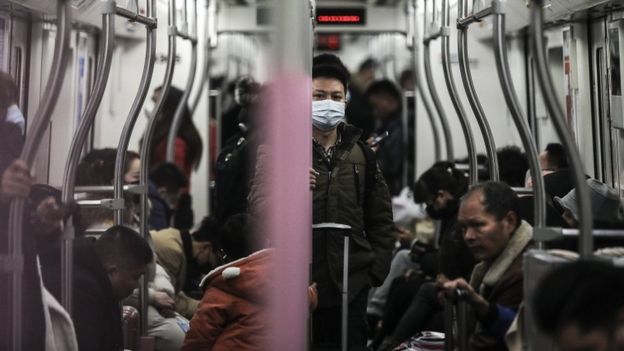 Image copyright GETTY IMAGES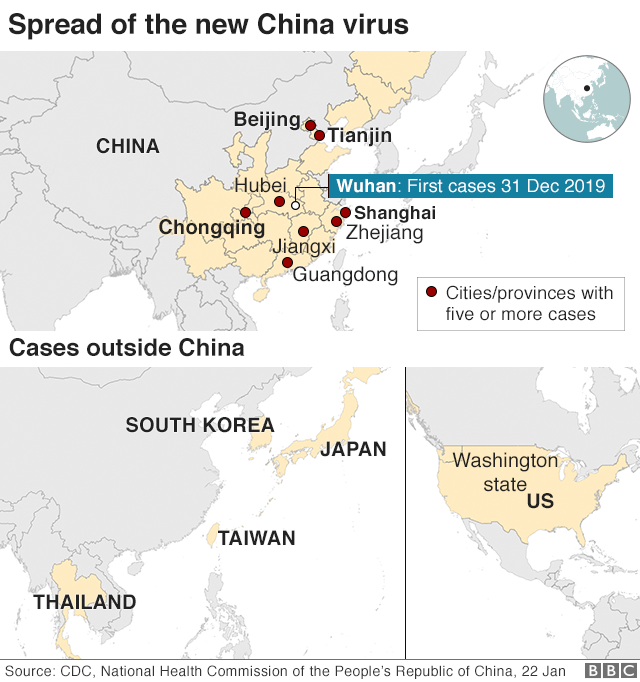
 MRC Centre for Global Infectious Disease Analysis@MRC_Outbreak
https://www.imperial.ac.uk/mrc-global-infectious-disease-analysis/news–wuhan-coronavirus/ …



 CHINDIA ALERT: You'll be living in their world, very soon