Chindia Alert: You’ll be Living in their World Very Soon
aims to alert you to the threats and opportunities that China and India present. China and India require serious attention; case of ‘hidden dragon and crouching tiger’.
Without this attention, governments, businesses and, indeed, individuals may find themselves at a great disadvantage sooner rather than later.
The POSTs (front webpages) are mainly 'cuttings' from reliable sources, updated continuously.
The PAGEs (see Tabs, above) attempt to make the information more meaningful by putting some structure to the information we have researched and assembled since 2006.
Indian security forces have killed a prominent militant leader in disputed Kashmir, officials say.
Riyaz Naikoo had taken over command of the banned Hizbul Mujahideen group, succeeding Burhan Wani who was killed by security forces in 2016.
Wani’s death triggered massive protests in the region, which is claimed in its entirety by both India and Pakistan.
The region has seen an armed insurgency against Indian rule since 1989, which has flared following Wani’s killing.
Naikoo was shot dead in his home village of Beigh Pora in Pulwama district after militants killed eight security personnel in two separate attacks, part of a recent surge of violence in Indian-administered Kashmir.
Locals said the militant leader had been trapped in a joint siege laid by army, paramilitary and police forces. He had been on the run for eight years.
“At least 76 militants including Naikoo have been killed since January this year. But we also lost 20 soldiers including senior army and police officers,” a security official told BBC Urdu on condition of anonymity.
Under a new policy, militants who are killed are not identified and their bodies are not handed over to their families.
Officials had accused Riyaz Naikoo of plotting attacks against the security establishment in the valley.
Disputed Kashmir has been a flashpoint for more than 60 years, sparking two wars between India and Pakistan.
In August 2019, the Indian government stripped the region of its semi-autonomous status and split it into two federally-run territories.
Thousands of people were detained and the region remains under severe security restrictions.
SRINAGAR (Reuters) – Five people were killed in a gun battle between members of a Pakistani militant group and Indian security forces in disputed Kashmir on Sunday as India intensified a security
Indian authorities have killed at least eight JeM militants and detained around 50 militants, sympathizers and their relatives since the bomb attack, which also sparked the roundup of separatists which India says is needed to head off trouble ahead of a general election to be held by May.
Most of those rounded up over the last two days were linked to the Islamist party Jamaat-e-Islami (JeI).
“Since JeI has a wider network across Kashmir and they are mobilising anti-India protests, their arrest could help in curbing such protests ahead of elections,” the senior police officer said.
One well-known separatist leader, Abdul Gani Bhat, was placed under house arrest, according to his political party.
Separatists called a strike to protest against the detentions. Many shops, petrol stations, and businesses closed, with few people and vehicles on streets in sensitive areas, except for troop patrols.
In some areas of the main city of Srinagar, the government limited the movement of people and vehicles.
“The restrictions have been imposed as a precautionary measure to avoid any untoward incident,” the police said.
FUEL SUPPLIES LOW
The government of Jammu and Kashmir said fuel rationing had been introduced in the Kashmir Valley where there was only enough gasoline for one day, diesel for four days and no liquefied petroleum gas (LPG).
The government said it would seek to increase supplies to the region and that shortages are the result of road blockages after the suicide bomb attack.
Indian paramilitary troops in riot gear arrived in strength at first light, said Shakeel Ahmad, a resident of Nowhatta in the Srinagar district.
“At places, they have blocked the main roads with steel barricades and concertina wire,” he said.
State Governor Satya Pal Malik called on residents not to believe “rumours of any extreme nature”. The government said an increase in police numbers was to prevent candidates and voters from being intimidated into not standing or voting in the general election.
Separatist leader Mirwaiz Umar Farooq, who chairs the Hurriyat Conference of separatist groups, said arbitrary arrests and jailing of leaders, activists and young people for their political beliefs had happened across Kashmir for 30 years.
“Intimidating activists and leadership will not deter them from their path, nor will it stop people from demanding the resolution of the Kashmir dispute through self-determination,” he said.
Reuters’ telephone calls to the Indian home ministry to seek comment went unanswered.
TENSIONS RAISED
The suicide bomb attack has raised tensions between India and Pakistan which both claim Kashmir in full but rule it in part. India blames Pakistan for harbouring militant groups operating in Kashmir, which Pakistan denies.
After the attack, India dropped trade privileges for Pakistan and prepared to send as many as 10,000 more troops to the contested area, according to a home ministry letter seen by Reuters.
The Indian army said that early on Sunday evening Pakistan violated the two nations’ ceasefire at the Rajouri area of the border, through shelling from mortars and small arms fire. Defence spokesman Lieutenant Colonel Devender Anand said the Indian army was “retaliating strongly and effectively”.
Ceasefire violations are not unusual along the border.
A Pakistani security official said Pakistani forces had not initiated any action but had responded to Indian firing.
Kashmir is likely to be a key issue in India’s election, distracting from concerns about how Prime Minister Narendra Modi and his Bharatiya Janata Party have managed the economy.
Modi has promised a strong response to the attack, saying in a monthly radio broadcast on Sunday that it had caused anguish to all of India.
Modi added that the army had vowed to destroy the militants and those who helped them.
Islamabad has warned it would respond with “full force” if attacked. On Sunday, Foreign Minister Shah Mehmood Qureshi called on India to show restraint or it would put “the entire region’s peace and security at stake”.
India’s Supreme Court will hear a case this week seeking to drop a constitutional provision that bars non-residents from moving to the state of Jammu and Kashmir that encompasses the Muslim-majority region.
Four soldiers have been killed in Indian-administered Kashmir in a gun battle with militants, police say.
The clash occurred in Pulwama district, where more than 40 Indian paramilitary police were killed in a suicide attack on Thursday, raising tensions between nuclear-armed India and Pakistan.
A civilian and two alleged militants were also killed as Indian troops searched for suspects.
Meanwhile Pakistan recalled its ambassador for consultations.
India had already recalled its top diplomat from Pakistan in the wake of Thursday’s attack – in which it said the Pakistani state was complicit.
Pakistan denies any role in the bombing, which was claimed by a group based on its soil – Jaish-e-Mohammad (JeM)
What’s happening in Pulwama?
Police say two militants who were trapped in Pinglena village were killed in Monday’s operation. Both are JeM members and one is a Pakistani national, authorities said.
Heavy gunfire has been heard, and Indian security officials are appealing to villagers to stay indoors.
Police told BBC Urdu that when they fired “warning shots” at the house where the alleged militants were hiding, they fired back. One officer critically injured was taken to hospital.
The owner of the house was killed during the exchange of fire, police added.
Indian security forces have been hunting for militants with suspected links to JeM following Thursday’s bombing, which saw a vehicle packed with explosives ram a convoy of 78 buses carrying Indian security forces.
The suicide bomber was identified as a local Kashmiri aged between 19 and 21.
More than 20 people were detained on Sunday, according to police.
How high are tensions?
Kashmir has been a flashpoint between India and Pakistan since independence.
Both countries claim all of Muslim-majority Kashmir but control only parts of it. They have fought two wars and a limited conflict in the region.
Thursday’s attack was the deadliest attack against Indian forces since an Islamist-led insurgency began in 1989. It sparked anti-Pakistan protests in some Indian cities and angry mobs targeted Kashmiri students and businessmen.
Mobile internet services in Indian-administered Kashmir were cut over the weekend and the Indian government has pulled security normally provided to at least five Kashmiri separatist leaders.
Isolated incidents of students from Kashmir being beaten up or evicted from their accommodation in northern Indian states have also been reported.
India’s Central Reserve Police Force (CRPF) offered help to students in need, but also warned of false reports.
In broader terms, there has has been a spike in violence in Indian-administered Kashmir since Indian forces killed a popular militant in 2016. Significant numbers of young men have joined the insurgency in recent years and the funerals of well-known militants draw huge crowds who want to pay respects to “martyrs”.
India has been accused of using excessive force to control protests with thousands of people suffering eye injuries or being blinded by pellet guns.
How might India retaliate?
Indian Prime Minister Narendra Modi, who is facing an election later this year, has vowed a strong response and says he will give the military free rein.
This time analysts say heavy snow in the region could make that kind of limited ground response impossible. But there are fears that going further, for example with air strikes, could lead to Pakistani retaliation and a significant escalation.
So far India has focused on retaliation by economic and diplomatic means. It has revoked Pakistan’s Most Favoured Nation trading status, raised customs duties to 200% and vowed to isolate it in the international community.
Despite tensions Pakistan is calm
By Secunder Kermani, BBC Pakistan correspondent
The threat of Indian military action has not provoked widespread concern amongst the general public in Pakistan. Previous attacks by militants like JeM, believed to have close links to the intelligence services, have been seen as attempts by the Pakistani military to prevent the civilian government developing too friendly a relationship with India.
However, since Imran Khan was elected as prime minister here, many have begun to believe both the army and his administration were united in wanting to improve cross border ties.
Whether Pakistan was involved in the attack or not, it seems unlikely concerted action will now be taken against JeM. Its leader has been in “protective custody” since another attack in 2016, but still regularly releases audio messages to followers.
The group has in the past been a useful tool for Pakistan’s intelligence services wanting to foment unrest across the border, and authorities may now be reluctant to confront them, in case they turn against the Pakistani state as some of their members have done in the past.
Congress leader Ghulam Nabi Azad stated that the Opposition parties have informed the home minister that they would stand with the government to end terror in the country.
SNS Web | New Delhi | February 16, 2019 2:41 pm
A resolution adopted by the all-party meeting chaired by Union Home Minister Rajnath Singh on Saturday condemned the cowardly terrorist attack on the CRPF convoy in Pulwama that left at least 44 jawans dead and over 45 seriously wounded.
The meeting was attended by leaders of the BJP government as well as opposition parties who unitedly expressed grief with the families of the bereaved.
The resolution also condemned terrorism in all forms as well as the support it was getting from across the border.
It further went on to say that “India has during the past three decades faced the menace of cross-border terrorism.”
In a direct attack at Pakistan, the resolution said, “terrorism in India has been actively encouraged by the forces across the border adding that India has displayed both firmness and resilience in dealing with these challenges”.
It said the entire nation speaks in one voice to express its determination to fight against terrorism.
“Today, we stand united in solidarity with our security forces in fighting terrorism and in defending the unity and integrity of India,” the resolution added.
The all-party meeting was held to brief top leaders of different parties on steps being taken by it to meet the challenge.
The meeting comes a day after Home Minister Rajnath Singh went to Kashmir to take stock of the situation.
The meeting was attended by Ghulam Nabi Azad, Anand Sharma and Jyotiraditya Scindia of the Congress, Sudip Bandyopadhyay and Derek O’Brien of the TMC, Sanjay Raut of the Shiv Sena, Jithendra Reddy of the TRS, D Raja of the CPI, Farooq Abdullah of the National Conference, Ram Vilas Paswan of the LJP among others.
Naresh Gujral of the Akali Dal, Upendra Kushwaha of the RLSP and Jai Prakash Narayan Yadav are among others who are attending the meeting.
Addressing the media after the meet, senior Congress leader Ghulam Nabi Azad stated that the Opposition parties have informed the home minister that they would stand with the government to end terror in the country.
“We stand with the government for unity and security of the nation and security forces. Be it Kashmir or any other part of the nation, Congress party gives its full support to the government in the fight against terrorism,” he said.
The opposition parties also requested the Home Minister to request the PM to meet the presidents of all national and regional parties, Azad said.
This was supported by other parties too, he added.
“We have also decided that there are many disagreements with the government, but for the sake of our country, security of all, we will stand with the government to end terror. The government has our support,” Azad said.
The Pakistan-based Jaish-e-Mohammad (JeM) had claimed responsibility for the suicide attack.
A suicide bomber had rammed an SUV carrying 350 kg of explosives into a bus carrying the CRPF troopers in the deadliest attack in decades on security forces in Jammu and Kashmir.
India had earlier rejected Pakistan Foreign Secretary Tehmina Janjua’s claims denying her country’s links to the Pulwama terror attack, saying that JeM, which claimed responsibility for the attack on Thursday, is based in Pakistan, and the “links are clear and evident and for all to see”.
The External Affairs Ministry spokesperson on Friday termed as “preposterous” the demand for an investigation, saying there is a video of the suicide bomber declaring himself a member of the terror group Jaish-e-Mohammed (JeM).
The spokesperson said India has not seen any constructive approach from Pakistan on bilateral relations and it has been sheltering terrorists and terror organisations such as JeM. He said Islamabad has not taken any action against such groups despite international demands.
India also demanded that Pakistan take immediate and verifiable action against terrorists and terror groups operating from territories under its control to create a conducive atmosphere in the region free of terror.
Political parties have closed ranks following the attack and have offered their support to the NDA government on its response on the matter.
Expressing solidarity with the Government of India and the security forces, Congress president Rahul Gandhi on Friday condemned the dastardly attack.
Addressing a press conference, Rahul Gandhi said the type of violence unleashed against the soldiers was “disgusting”.
Refusing to comment on any other issue, Rahul Gandhi said this was a time of mourning, sadness and respect adding that the Congress is fully supporting the Government and the security forces.


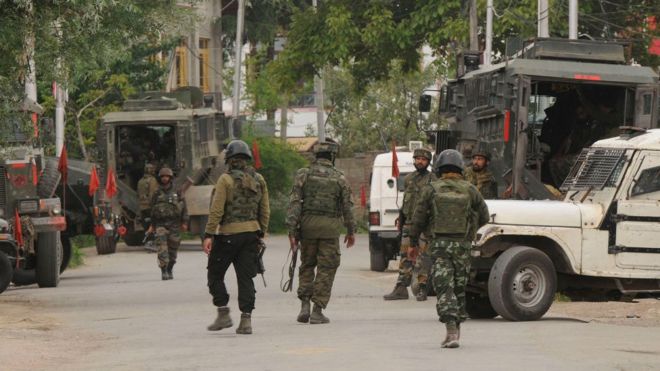 Image copyright GETTY IMAGES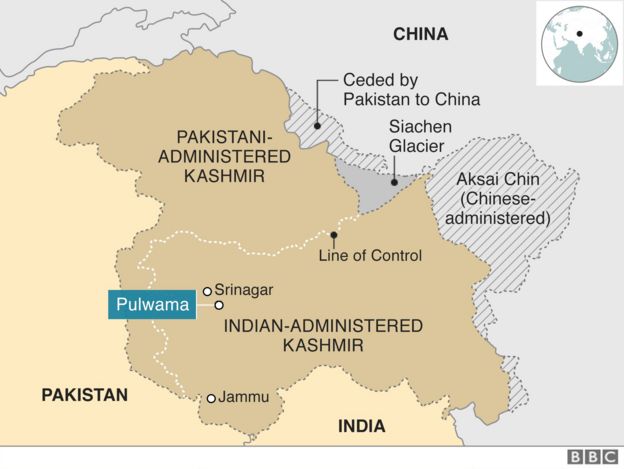


 CHINDIA ALERT: You'll be living in their world, very soon