Chindia Alert: You’ll be Living in their World Very Soon
aims to alert you to the threats and opportunities that China and India present. China and India require serious attention; case of ‘hidden dragon and crouching tiger’.
Without this attention, governments, businesses and, indeed, individuals may find themselves at a great disadvantage sooner rather than later.
The POSTs (front webpages) are mainly 'cuttings' from reliable sources, updated continuously.
The PAGEs (see Tabs, above) attempt to make the information more meaningful by putting some structure to the information we have researched and assembled since 2006.
SRINAGAR, India (Reuters) – Indian police have released a pigeon belonging to a Pakistani fisherman after a probe found that the bird, which had flown across the contentious border between the nuclear-armed nations, was not a spy, two officials said on Friday.
“The pigeon was set free yesterday (May 28) after nothing suspicious was found,” said Shailendra Mishra, a senior police official in Indian-administered Kashmir. It was unclear where the bird was released and whether it flew back to its owner.
The Pakistani owner of the pigeon had urged India to return his bird, which Indian villagers turned over to police after discovering it.
“It’s just an innocent bird,” Habibullah, the owner of the bird, who goes by just one name, told Reuters on Friday.
He rejected allegations that the numbers inscribed on a ring on the pigeon’s leg were codes meant for militant groups operating in the disputed region of Kashmir.
Habibullah, who lives in a village near the Kashmir border, one of the most militarised zones in the world, said the bird had participated in a pigeon racing contest and the digits on the bird’s leg were his mobile phone number.
The sport is especially popular in the border villages, said Yasir Khalid of the Shakar Garh Pigeon Club, adding such races are held in India too, and it is not unusual to lose a bird on either side. Owners identify their birds with stamps on the wings, paint and rings on the feet.
“We had to take the bird into our custody to probe if it was being using for spying,” a senior Indian border security officer said requesting anonymity, while explaining this was part of the drill given border sensitivities.
In 2016, a pigeon was taken into Indian custody after it was found with a note threatening Indian Prime Minister Narendra Modi.
NEW DELHI/SRINAGAR (Reuters) – A Himalayan border standoff between old foes India and China was triggered by India’s construction of roads and air strips in the region as it competes with China’s spreading Belt and Road initiative, Indian observers said on Tuesday.
Soldiers from both sides have been camped out in the Galwan Valley in the high-altitude Ladakh region, accusing each other of trespassing over the disputed border, the trigger of a brief but bloody war in 1962.
About 80 to 100 tents have sprung up on the Chinese side and about 60 on the Indian side where soldiers are billeted, Indian officials briefed on the matter in New Delhi and in Ladakh’s capital, Leh, said.
Both were digging defences and Chinese trucks have been moving equipment into the area, the officials said, raising concerns of a long faceoff.
“China is committed to safeguarding the security of its national territorial sovereignty, as well as safeguarding peace and stability in the China-India border areas,” the Chinese Foreign Ministry spokesperson’s office said in a statement.
“At present, the overall situation in the border areas is stable and controllable. There are sound mechanisms and channels of communication for border-related affairs, and the two sides are capable of properly resolving relevant issues through dialogue and consultation.”
There was no immediate Indian foreign ministry comment. It said last week Chinese troops had hindered regular Indian patrols along the Line of Actual Control (LAC).
But interviews with former Indian military officials and diplomats suggest the trigger for the flare-up is India’s construction of roads and air strips.
“Today, with our infrastructure reach slowly extending into areas along the LAC, the Chinese threat perception is raised,” said former Indian foreign secretary Nirupama Rao.
“Xi Jinping’s China is the proponent of a hard line on all matters of territory, sovereignty. India is no less when it comes to these matters either,” she said.
After years of neglect Prime Minister Narendra Modi’s government has pushed for improving connectivity and by 2022, 66 key roads along the Chinese border will have been built.
One of these roads is near the Galwan valley that connects to Daulat Beg Oldi air base, which was inaugurated last October.
“The road is very important because it runs parallel to the LAC and is linked at various points with the major supply bases inland,” said Shyam Saran, another former Indian foreign secretary.
“It remains within our side of the LAC. It is construction along this new alignment which appears to have been challenged by the Chinese.”
China’s Belt and Road is a string of ports, railways, roads and bridges connecting China to Europe via central and southern Asia and involving Pakistan, China’s close ally and India’s long-time foe.
SRINAGAR, India (Reuters) – Shelling across the border between India and Pakistan killed three Indian civilians and wounded two Pakistani civilians, military officials from the two sides said on Sunday.
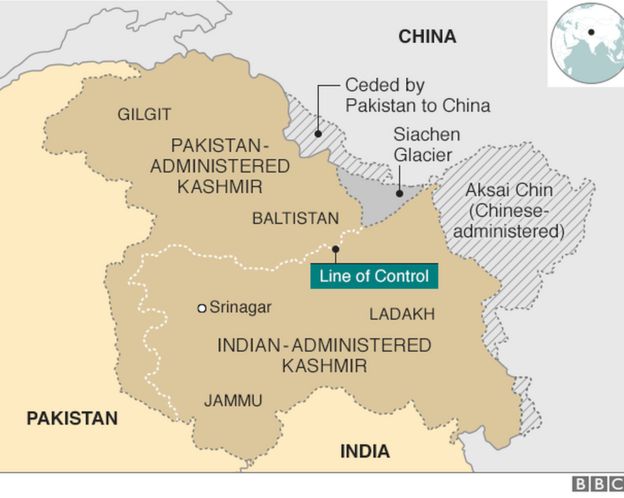
Indian and Pakistani troops exchanged mortar and artillery shelling along the de facto border known as the Line of Control (LoC) that divides the disputed Kashmir region. The sporadic exchanges began on Saturday and continued into Sunday.
Both countries claim the region in full, but rule only parts, and often accuse each other of breaching a 2003 ceasefire pact by shelling and firing across the LoC.
Pakistani troops targeted civilians living near the LoC, killing three people, including a child and a woman, and wounding five, Vijay Kumar, police chief of Kashmir, told Reuters.
Pakistan blames Indian troops for ceasefire violations and targeting civilians in Kashmir.
Two Pakistani civilians were injured due to shelling from India, Major-General Babar Iftikhar of the public relations wing of the Pakistan Army, said in a Tweet.
Tension between the two countries was renewed when New Delhi withdrew the autonomy of the Kashmir region in 2019 and split it into territories federally administered by India. Until then, it had had autonomy over all matters except defence, communications and foreign affairs.
India accuses its neighbour of training and then sending militants across the border to launch attacks and support a separatist movement against Indian rule.
Pakistan denies giving material support to militants in Kashmir but says it provides moral and diplomatic backing for the self-determination of Kashmiri people.
SRINAGAR/NEW DELHI, India (Reuters) – More than two dozen diplomats are visiting Indian-administered Kashmir, New Delhi said on Wednesday, as the country tries to reassure foreign allies following several months of unrest in the contested territory.
The group includes European diplomats, some of whom declined a previous invitation from New Delhi to visit the region. A proposed vote in the European Union parliament next month could chastise India for its actions in Kashmir.
The Muslim-majority Himalayan region is claimed by India and arch-rival Pakistan and has been in turmoil since New Delhi stripped it of special status and clamped down on communication and freedom of movement in August.
India has since eased those restrictions, and restored limited internet connectivity last month, ending one of the world’s longest such shutdowns in a democracy.
But many political leaders, including three former chief ministers of Jammu & Kashmir state, are still in detention without charge six months after the crackdown, and foreign journalists have so far been denied permission to visit the region.
Representatives from countries including Germany, Canada, France, New Zealand, Mexico, Italy, Afghanistan and Austria are on a two-day visit to “witness for themselves the progressive normalisation of the situation,” India’s foreign ministry said in a statement on Wednesday.
Representatives from several countries, including Germany’s ambassador Walter Lindner, were pictured on a traditional wooden shikara boat on Dal Lake, in Kashmir’s main city of Srinagar.
“We are interacting with the traders, businesswomen and entrepreneurs in Srinagar about the status of business and tourism,” Afghanistan’s envoy Tahir Qadiry said in a tweet on Wednesday.
Sources familiar with the itinerary said the trip will also include meetings with the Indian army and government officials, as well as journalists and civil society groups selected by the security services.
Last month fifteen foreign envoys visited Kashmir – a trip participants characterised as tightly-choreographed with no room for independent meetings.
“Things looked calm, but we only had a very short time out the window of the car to assess the situation,” said a diplomat who attended the previous trip.
“They told the truth, but not necessarily the whole truth,” he added of his meetings with delegates.
SRINAGAR, India (Reuters) – India and Pakistan blamed one another for cross-border shelling in the disputed Kashmir region which killed and injured soldiers and civilians on both sides and made it one of the deadliest days since New Delhi revoked Kashmir’s special status in August.
India said there was heavy shelling by Pakistan across the border in northern Kashmir’s Tangdhar region late on Saturday night, killing two Indian soldiers and one civilian. Islamabad said one of its soldiers and three civilians died after India violated the ceasefire, according to the spokesman for the Pakistani Armed Forces.
Kashmir has been a disputed subject between the two nuclear-armed neighbours since they both got independence in 1947, and they have fought two of their three wars over the region.
Tensions between the two countries have flared and there has been intermittent cross-border firing since Aug. 5 when New Delhi flooded Indian Kashmir with troops to quell unrest after it revoked the region’s special autonomous status.
Islamabad has warned that changing Kashmir’s status would escalate tensions but India says the withdrawal of special status is an internal affair and is aimed at faster economic development of the territory.
Reuters was unable to independently verify the claims made by both sides on the shelling, which marks an escalation from the small arms fire usually exchanged by the two armies.
There was an unprovoked ceasefire violation by Pakistan, said Indian defence spokesman Colonel Rajesh Kalia.
“Our troops retaliated strongly causing heavy damage and casualties to the enemy,” Kalia said.
An Indian army source said the shelling was cover to assist militants enter India because of which a “calibrated escalation of area weapons was undertaken”. The Indian army “retains the right to respond at a time and place of it’s choosing” if the Pakistani army continues to do this, he said.
Pakistan, meanwhile, also claimed that India’s attack was unprovoked and deliberately targeted at civilians.
Major General Asif Ghafoor, a spokesman for the Pakistan Armed Forces, said Pakistan responded “effectively,” killing 9 Indian soldiers, injuring several others and destroying 2 bunkers.
“The Indian army shall always get a befitting response,” he said.
Indian forces in Kashmir have gone “berserk”, Raja Farooq Haider, prime minister of Pakistan’s Azad Kashmir region, said, adding that six civilians died and 8 were injured.
“This is the height of savagery. The world must not stay silent over it. #KashmirNeedsAttention,” he said in a tweet.
The lockdown in Indian-administered Kashmir has cost the region’s economy more than $1bn in two months, according to industry experts. BBC Hindi’s Vineet Khare reports.
Mushtaq Chai recalls the afternoon of 2 August when he received a “security advisory” from the administration. A prominent local businessman, he owns several hotels across the Muslim-majority valley in Indian-administered Kashmir.
The note warned of “terror threats” and advised that tourists and Hindu pilgrims should “curtail their visit… and return as soon as possible”.
Mr Chai, like many others, took the advisory seriously. Two years before, seven Hindu pilgrims were killed in a militant attack while returning from the Amarnath cave, a major Hindu shrine in Kashmir’s Anantnag district.
“This was the first time in Kashmir’s history that tourists and pilgrims were asked to leave,” Mr Chai says.
Image copyright GETTY IMAGESImage caption Tourists left Kashmir amid a curfew in August
Soon officials arrived to enforce the order, and Mr Chai and his staff made arrangements for all of the guests to leave immediately.
Days later, on 5 August, the federal government stripped the region of its special status and placed it under a communications lockdown.
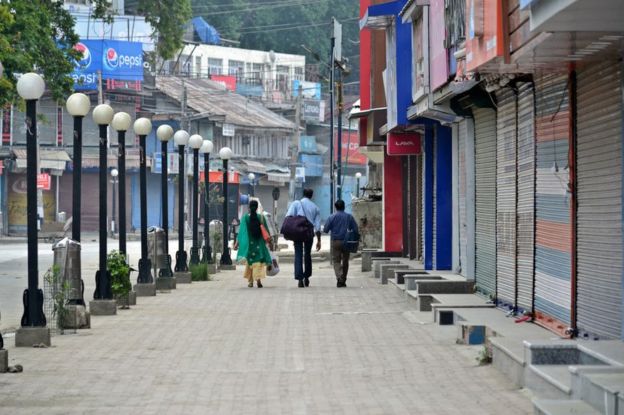
Two months on, the situation is far from normal. Internet and mobile phone connections remain suspended, public transport is not easily available, and most businesses are shut – some in protest against the government, and others for fear of reprisals from militants opposed to Indian rule.
There is also a shortage of skilled labour, as some 400,000 migrants have left since the lockdown began.
What’s more, the streets are deserted and devoid of the tourist business which had supported up to 700,000 people.
A government official, who did not wish to be named, says they are “awaiting a financial package” from the federal government. But the Kashmir Chamber of Commerce and Industry estimates the shutdown has already cost the region more than $1.4bn (£1.13bn), and thousands of jobs have been lost.
“There are around 3,000 hotels in the valley and they are all empty. They have loans to pay off and daily expenses to bear,” says Mr Chai, sitting in his mostly empty hotel in the capital, Srinagar.
Only a handful of his 125 staff are at work. Many haven’t returned because of lack of transport – or fear. Tensions have been high in the region, and there have been a number of protests in the city.
But the situation may improve in the coming days as the government has announced that tourists will allowed in the state from Thursday.
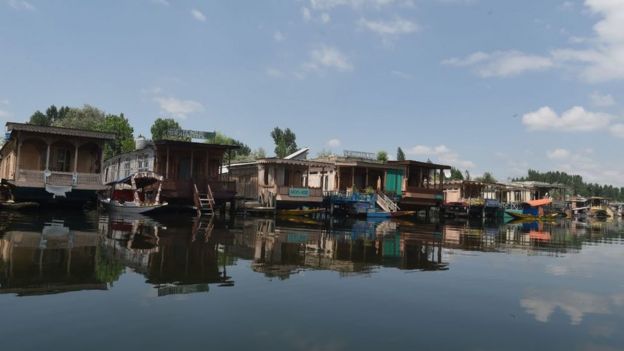
Image copyright GETTY IMAGESImage caption Hundreds of houseboats have been lying vacant
But it isn’t just the hotels which have suffered.
“No internet has meant more than 5,000 travel agents have lost work,” says Javed Ahmed, a travel agent himself. “The government says give jobs to the youth. We are young but jobless. We have nothing to do with politics. We want jobs.”
Srinagar’s almost 1,000 iconic houseboats have also been running empty.
“Every houseboat needs up to $7,000 a year for maintenance,” says Hamid Wangnoo from the Kashmir Houseboats Owners Association. “For many, this is the only source of livelihood.”
And it isn’t just tourism.
“More than 50,000 jobs have been lost in the carpet industry alone,” according to Shiekh Ashiq, president of the chamber of industry.
He says July to September is when carpet makers usually receive orders for export – especially overseas, so they can deliver by Christmas.
But they are unable to contact importers, or even their own employees, because of the communications lockdown.
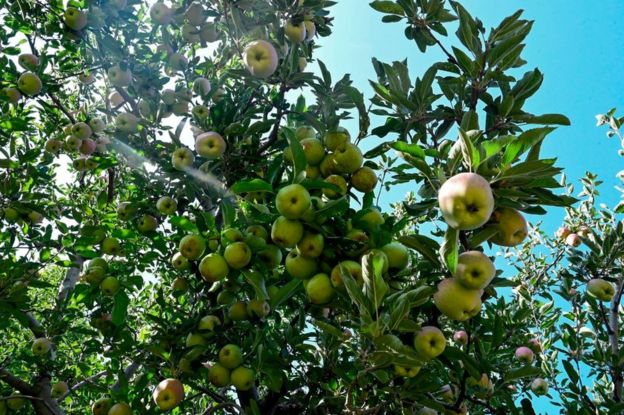
Image copyright GETTY IMAGESImage caption Kashmir’s famous apple orchards have also been hit hard
In southern Kashmir, the region’s famous apples are still waiting to be plucked from the trees. But shops and cold storage units are shut, and the main apple market is empty. Last year, it did business worth $197m, local farmers say.
“I feel so much pain seeing my apples hanging from the trees that I don’t go to the orchard anymore,” says a worried apple grower, who did not wish to be named.
“Apples account for 12–15% of Kashmir’s economy, but more than half of this year’s produce has not been plucked,” says economic journalist Masood Hussain. “If this continues through October, it will have devastating consequences.”
In Srinagar, some shop owners wait outside their stores and open them for a customer before closing them hurriedly – until the next customer arrives.
One such owner says he is unhappy with the government’s decision, but he is also scared of angry locals who want him to keep his business closed.
“But how do I survive without my daily earnings?” he asked.
Media caption Two wars, a 60-year dispute – a history of the Kashmir conflict
SRINAGAR/NEW DELHI (Reuters) – Authorities in Indian Kashmir have arrested nearly 4,000 people since the scrapping of its special status last month, government data shows, the most clear evidence yet of the scale of one of the disputed region’s biggest crackdowns.
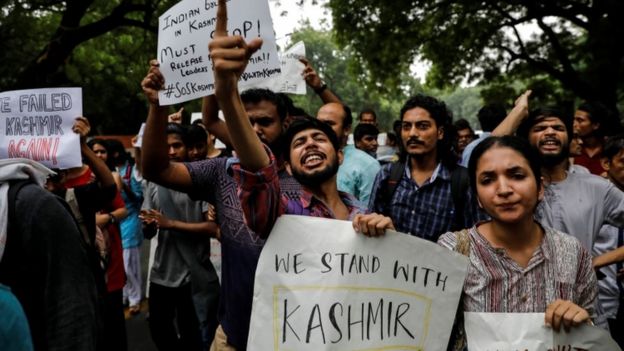
Muslim-majority Kashmir, claimed by both India and Pakistan, has been in turmoil since India stripped its portion of the region of its autonomy and statehood on Aug. 5, leading to clashes between security forces and residents and inflaming tension with Pakistan.
India said the removal of the status that its part of Kashmir has held since independence from Britain in 1947 would help integrate it into the Indian economy, to the benefit of all.
In an attempt to stifle the protests that the reform sparked in Kashmir, India cut internet and mobile services and imposed curfew-like restrictions in many areas.
It has also arrested more than 3,800 people, according to a government report dated Sept. 6 and seen by Reuters, though about 2,600 have since been released.
A spokeswoman for India’s interior ministry did not respond to a request for comment. Neither did Jammu and Kashmir police.
It was not clear on what basis most of the people were being held but an Indian official said some were held under the Public Safety Act, a law in Jammu and Kashmir state that allows for detention for up to two years without charge.
The data for the first time shows the extent of the detentions, as well as indicating who was picked up and where.
More than 200 politicians, including two former chief ministers of the state were arrested, along with more than 100 leaders and activists from an umbrella organisation of pro-separatist political groups.
The bulk of those arrested – more than 3,000 – were listed as “stone pelters and other miscreants”. On Sunday, 85 detainees were shifted to a prison in Agra in northern India, a police source said.
Rights group Amnesty International said the crackdown was “distinct and unprecedented” in the recent history of the region and the detentions had contributed to “widespread fear and alienation”.
“The communication blackout, security clampdown and detention of the political leaders in the region has made it worse,” said Aakar Patel, head of Amnesty International India.
‘RIGHT TO LIFE’
India says the detentions are necessary to maintain order and prevent violence, and points to the relatively limited number of casualties compared with previous bouts of unrest.
The government says only one person is confirmed to have died compared with dozens in 2016, when the killing of a militant leader sparked widespread violence.
“The right to life is the most important human right,” India’s national security adviser Ajit Doval told reporters recently.
The report contains data from the 13 police districts that make up the Kashmir Valley, the most populous part of the Himalayan region where the main city of Srinagar is located.
The largest number of arrests have been in Srinagar, the data shows, at nearly 1,000. Earlier unrest often centred in rural areas.
Of the detained political leaders, more than 80 were from the People’s Democratic Party, formerly in coalition in Jammu and Kashmir state with the ruling Bharatiya Janata Party.
About 70 are from the National Conference, which has for years dominated politics in Indian Kashmir, and more than a dozen from India’s main opposition Congress party.
Police also arrested more than 150 people accused of association with militant groups fighting Indian rule.
An Indian official said it was likely that more than 1,200 people were still held, including all the high-profile politicians and separatists mentioned in the report, while dozens more are being arrested every day.
In the 24 hours before the report was compiled, more than two dozen people were arrested, mainly on suspicion of throwing stones at troops, the data showed.
The data did not include those under informal house arrest, nor people detained in a round-up of separatists that began in February after a bomb attack by a Pakistan-based militant group on Indian troops.
Days before India’s move to strip Kashmir of special status, one prominent separatist leader told Reuters that more than 250 people with links to the movement were already in detention.
SRINAGAR, India (Reuters) – Schools reopened in Indian Kashmir’s main city on Monday but most classrooms were empty as parents kept their children home, fearing unrest over the government’s decision two weeks ago to revoke the region’s autonomy.
Some 190 primary schools were set open in Srinagar as a sign of normalcy returning to Muslim majority Jammu and Kashmir as authorities ease a clampdown aimed at preventing mass protests.
Parents said their children would stay home until cellular networks are restored and they can be in contact with them.
“How can we risk the lives of our children?” said Gulzar Ahmad, a father of two who are enrolled in a school in the city’s Batamallo district where protests have occurred.
“Troops have arrested minor children in the last two weeks and several children were injured in clashes,” he said. “Our children are safe inside their homes. If they go to school who can guarantee their safety?”
Authorities were not immediately available for comment, but have previously denied reports of mass arrests.
Protests began after the Aug. 5 decision by Prime Minister Narendra Modi’s government to withdraw Kashmir’s special status and integrate it fully into India, with equal rights for all Indians to buy property there and compete for government jobs.
Critics said the decision will alienate many Kashmiris and add fuel to a 30-year armed revolt in the Himalayan territory that Pakistan also lays claim to.
On the weekend, residents of Srinagar – the hotbed of the separatist revolt – threw stones and clashed with police. Dozens of people were injured, two senior officials and witnesses said.
Reuters journalists visited two dozen schools in Srinagar on Monday. Some schools were lightly staffed and classrooms deserted. Gates at other schools were locked.
Only one student showed up at Presentation Convent Higher Secondary School, which has an enrolment of 1,000 pupils, and went home, said a school official.
A handful of teachers but no students turned up at the barricaded Burn Hall school in one of the city’s high security zones.
“How can students come to classes in such a volatile situation? The government is turning these little children into cannon fodder,” a teacher said, adding that schools should stay closed until the situation is normal.
CROSS BORDER FIRING
New Delhi’s decision on Kashmir has heightened tensions with its neighbour and rival nuclear power, Pakistan, and triggered cross-border exchanges of fire.
In the latest incident, two civilians were killed in Pakistan-controlled Kashmir by Indian soldiers firing across the disputed border, Pakistan’s foreign ministry said, adding that it had summoned India’s deputy commissioner in Islamabad to protest.
“The ceasefire violations by India are a threat to regional peace and security and may lead to a strategic miscalculation,” the foreign ministry said.
There was no immediate comment from India which has previously accused Pakistan of trying to whip up tensions to draw global attention.
More than 50,000 people have died in the revolt that erupted against Indian rule in Kashmir in 1989. India blames Pakistan for giving material support to the militants and helping them cross into its part of the mountainous region.
Pakistan denies the allegation and says it only gives moral and diplomatic support to the Kashmiri people in their struggle for self determination.
Image copyright AFPImage caption India has deployed tens of thousands of troops to Indian-administered Kashmir in recent days
India’s government has revoked part of the constitution that gives Indian-administered Kashmir special status, in an unprecedented move likely to spark unrest.
Article 370 is sensitive because it is what guarantees significant autonomy for the Muslim-majority state.
There has been a long-running insurgency on the Indian side.
Nuclear powers India and Pakistan have fought two wars and a limited conflict over Kashmir since 1947.
The BBC’s Geeta Pandey in Delhi says that for many Kashmiris, Article 370 was the main justification for being a part of India and by revoking it, the BJP has irrevocably changed Delhi’s relationship with the region.
Pakistan condemned India’s decision to revoke the special status of its part of Kashmir as illegal, saying it would “exercise all possible options” to counter it.
“India is playing a dangerous game which will have serious consequences for regional peace and stability,” said Foreign Minister Shah Mehmood Qureshi.
But an Indian government source said there was no external implication as the Line of Control, the de facto border, and boundaries of Kashmir had not been altered.
Why are there tensions over Kashmir?
During the partition of the Indian subcontinent in 1947, some expected Jammu and Kashmir, like other Muslim-majority regions, to go to Pakistan.
But the ruler of the princely state, who had initially wanted Jammu and Kashmir to become independent, joined India in return for help against an invasion of tribesmen from Pakistan.
War broke out between India and Pakistan, and Kashmir effectively became partitioned.
The region, which remains one of the most militarised zones in the world, has been a flashpoint between India and Pakistan for more than six decades.
Atmosphere of fear
By Aamir Peerzada, BBC News, Srinagar
By the time we woke up this morning, the internet was gone and we now have no mobile connectivity.
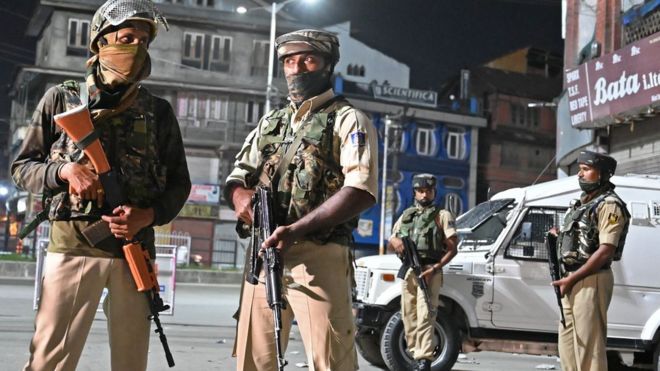
If people step out of their homes, they see paramilitary forces on every street. Almost every major road is shut – we are hearing that more troops are being deployed.
No-one knows what is happening in other parts of the state – we can’t talk to anyone else.
People are concerned – they don’t know what is happening, they don’t know what is going to happen.
It’s an atmosphere of fear. People are scared to come out, they have stockpiled food for months.
Kashmiris have always been willing to defend the state’s special status. It looks like a long road ahead, and no-one knows what’s next.
What is Article 370?
In 1949, a special provision was added to India’s constitution providing autonomy to Jammu and Kashmir.
Article 370 allows the state to have its own constitution, a separate flag and independence over all matters except foreign affairs, defence and communications.
Another provision later added under Article 370 – 35A – gives special privileges to permanent residents, including state government jobs and the exclusive right to own property in the state.
It is seen as protecting the state’s distinct demographic character as the only Muslim-majority state in India.
So why is India’s move controversial?
The move by the Hindu nationalist BJP government prompted outrage in parliament, and some legal experts have called it an attack on the constitution.
Critics fear the move is designed to change the demographic make-up of India-administered Kashmir – by giving people from the rest of the country to right to acquire property and settle there permanently.
“They just want to occupy our land and want to make this Muslim-majority state like any other state and reduce us to a minority and disempower us totally.”
She added Article 370 was not given to the people of the state as a “gift”, but “a matter of constitutional guarantees given by the very same Indian parliament to the people of Jammu and Kashmir”.
Why is the government doing this?
The ruling BJP made revoking Article 370 part of the party’s 2019 election manifesto – and it won a landslide victory earlier this year.
It has argued that Article 370 has prevented the region’s development and its integration with India.
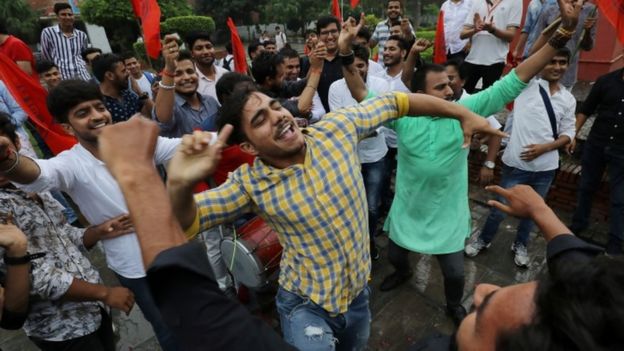
Image copyright REUTERSImage caption Supporters of India’s ruling BJP have been celebrating the move
An Indian government source said on Monday that the region’s special status had discouraged outside investment and affected its economy, while terrorism and smuggling were rife.
“A set of anachronistic provisions were not allowing the progress of Kashmir,” the source said. “The huge sum of money and resources which were going into the state were not being optimised.”
How did the government make the change?
India’s government announced a presidential order revoking all of Article 370 apart from one clause which says that the state is an integral part of India.
The order was met by massive protests from the opposition – but has now been signed into law by President Ram Nath Kovind.
The government also proposed dividing the state into two regions ruled by the central government, and a bill to that effect passed the upper house on Monday and will now go to the lower house where the BJP has a majority.
Image copyright REUTERSImage caption Opponents of the move have also been out in the streets of Delhi
Changing Article 370 also requires the assent of the state government, but Jammu and Kashmir has been under the rule of a governor since June 2018 when the BJP pulled out of a state government coalition with the regional People’s Democratic Party (PDP).
This effectively means the state has been ruled directly by Delhi through a governor, who has agreed to the bills.
What has been happening in Kashmir?
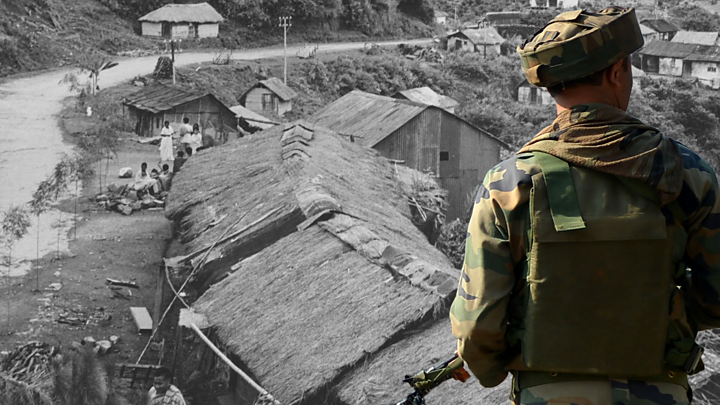
Indian-administered Kashmir is in a state of lockdown.
Curfew-like conditions have been imposed, and orders preventing the assembly of more than four people have been introduced.
Tens of thousands of Indian troops were deployed to the region ahead of Monday’s announcement and tourists were told to leave under warnings of a terror threat.
Media caption In December Yogita Limaye examined why there had been a rise in violence in Kashmir
In the hours before Monday’s announcement, two of the state’s former chief ministers – Omar Abdullah and Mehbooba Mufti – were placed under house arrest.
SRINAGAR (Reuters) – Police arrested the publisher of one of the most widely read newspapers in Indian-controlled Kashmir in a midnight raid over a decades-old case, the police and his brother said on Tuesday, highlighting the difficulties facing media in the region.
Tension has run high in the Himalayan region since more than 40 Indian police were killed in a February suicide car bomb attack by a militant group based in Pakistan.
Muslim-majority Kashmir is at the heart of more than seven decades of hostility between nuclear archrivals India and Pakistan. Each claims it in full but rules only a part.
Ghulam Jeelani Qadri, 62, a journalist and the publisher of the Urdu-language newspaper Daily Afaaq, was arrested at his home in the region’s main city of Srinagar, half an hour before midnight on Monday.
“It is harassment,” his brother, Mohammad Morifat Qadri, told Reuters. “Why is a 1993 arrest warrant executed today? And why against him only?”
Qadri was released on bail after a court appearance on Tuesday.
The case dates from 1990, when Qadri was one of nine journalists to publish a statement by a militant group fighting against Indian rule in Kashmir. An arrest warrant for Qadri was issued in 1993, but it was never served.
Qadri had visited the police station involved in the arrest multiple times since the warrant was issued, most recently in 2017 to apply for a passport, his brother added.
Asked why Qadri was arrested at night, Srinagar police chief Haseeb Mughal told Reuters, “Police were busy during the day.”
The Kashmir Union of Working Journalists condemned the arrest, saying it seemed to be aimed at muzzling the press.
“Qadri was attending the office on a daily basis and there was absolutely no need for carrying out a midnight raid at his residence,” it said in a statement.
Journalists in Kashmir find themselves caught in the crossfire between the Indian government and militant groups battling for independence.
Both sides are stepping up efforts to control the flow of information, with the situation at its worst in decades, dozens of journalists have told Reuters.
India is one of the world’s worst places to be a journalist, ranked 138th among 180 countries on the press freedom index of international monitor Reporters Without Borders, with conditions in Kashmir cited as a key reason.




 CHINDIA ALERT: You'll be living in their world, very soon