Chindia Alert: You’ll be Living in their World Very Soon
aims to alert you to the threats and opportunities that China and India present. China and India require serious attention; case of ‘hidden dragon and crouching tiger’.
Without this attention, governments, businesses and, indeed, individuals may find themselves at a great disadvantage sooner rather than later.
The POSTs (front webpages) are mainly 'cuttings' from reliable sources, updated continuously.
The PAGEs (see Tabs, above) attempt to make the information more meaningful by putting some structure to the information we have researched and assembled since 2006.
GUBEI WATER TOWN, China (Reuters) – The mock Qing dynasty village nestled below the Great Wall would normally be teeming with tourists on Labour Day, but the thin crowds on Friday showed that while China’s coronavirus epidemic has subsided, people’s fears could take longer to fade.
During holidays, some 100,000 visitors a day would traipse round the quaint stone-paved streets of Gubei Water Town, 110 kilometres (68 miles) northeast of Beijing. Its marketing manager reckoned on getting just a tenth of that number this year.
“People have concerns about the virus and are unwilling to travel long distances,” said Guo Baorong. For a start, there will be no international tourists this time, he said, noting foreigners would normally make up around 15% of visitors.
About 70% of China’s tourist attractions had reopened as of Thursday, according to China’s Ministry of Culture and Tourism, but all sites have had to cap visitors to 30% of designed capacity.
More sites, including the Forbidden City in Beijing, were set to reopen Friday.
Staff at the entrance to Gubei Water Town checked visitors’ temperatures and health tracking codes. And inside, lines on the ground directed tourists to stand one meter apart and stores used ropes to keep crowds from forming. Like everywhere in China since the lockdowns were imposed to stem the epidemic, everyone wore masks.
Still, in places where tourists squeezed together as the streets narrowed, staff shouted at them to spread out.
Some tourists enjoyed the smaller crowds.
Xiao Chen, a 24-year-old student wearing traditional Chinese garb known as “Hanfu” came to Gubei to take pictures around ancient architecture.
“It’s good to come out of the city. There was barely anyone in Gubei Water Town yesterday, and even today, it’s not crowded,” she said.
The tranquility may not last. Room bookings jumped on Thursday after Beijing and nearby areas began easing coronavirus restrictions, with about 90% of accommodation now reserved.
“We were not expecting that many people to come in,” said Guo.
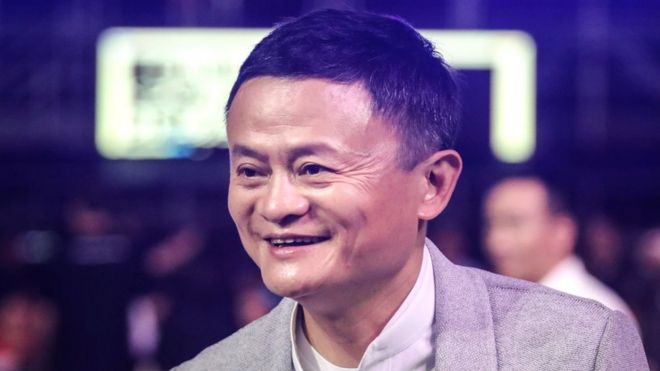
The richest man in China opened his own Twitter account last month, in the middle of the Covid-19 outbreak. So far, every one of his posts has been devoted to his unrivalled campaign to deliver medical supplies to almost every country around the world.
“One world, one fight!” Jack Ma enthused in one of his first messages. “Together, we can do this!” he cheered in another.
The billionaire entrepreneur is the driving force behind a widespread operation to ship medical supplies to more than 150 countries so far, sending face masks and ventilators to many places that have been elbowed out of the global brawl over life-saving equipment.
But Ma’s critics and even some of his supporters aren’t sure what he’s getting himself into. Has this bold venture into global philanthropy unveiled him as the friendly face of China’s Communist Party? Or is he an independent player who is being used by the Party for propaganda purposes? He appears to be following China’s diplomatic rules, particularly when choosing which countries should benefit from his donations, but his growing clout might put him in the crosshairs of the jealous leaders at the top of China’s political pyramid.
Other tech billionaires have pledged more money to fight the effects of the virus – Twitter’s Jack Dorsey is giving $1bn (£0.8bn) to the cause. Candid, a US-based philanthropy watchdog that tracks private charitable donations, puts Alibaba 12th on a list of private Covid-19 donors. But that list doesn’t include shipments of vital supplies, which some countries might consider to be more important than money at this stage in the global outbreak.
The world’s top coronavirus financial donors
How Alibaba compares to the top five. No one else other than the effervescent Ma is capable of dispatching supplies directly to those who need them. Starting in March, the Jack Ma foundation and the related Alibaba foundation began airlifting supplies to Africa, Asia, Europe, Latin America and even to politically sensitive areas including Iran, Israel, Russia and the US.
Ma has also donated millions to coronavirus vaccine research and a handbook of medical expertise from doctors in his native Zhejiang province has been translated from Chinese into 16 languages. But it’s the medical shipments that have been making headlines, setting Ma apart.
“He has the ability and the money and the lifting power to get a Chinese supply plane out of Hangzhou to land in Addis Ababa, or wherever it needs to go,” explains Ma’s biographer, Duncan Clark. “This is logistics; this is what his company, his people and his province are all about.”
A friendly face
Jack Ma is famous for being the charismatic English teacher who went on to create China’s biggest technology company. Alibaba is now known as the “Amazon of the East”. Ma started the company inside his tiny apartment in the Chinese coastal city of Hangzhou, in the centre of China’s factory belt, back in 1999. Alibaba has since grown to become one of the dominant players in the world’s second largest economy, with key stakes in China’s online, banking and entertainment worlds. Ma himself is worth more than $40bn.
Officially, he stepped down as Alibaba’s chairman in 2018. He said he was going to focus on philanthropy. But Ma retained a permanent seat on Alibaba’s board. Coupled with his wealth and fame, he remains one of the most powerful men in China.
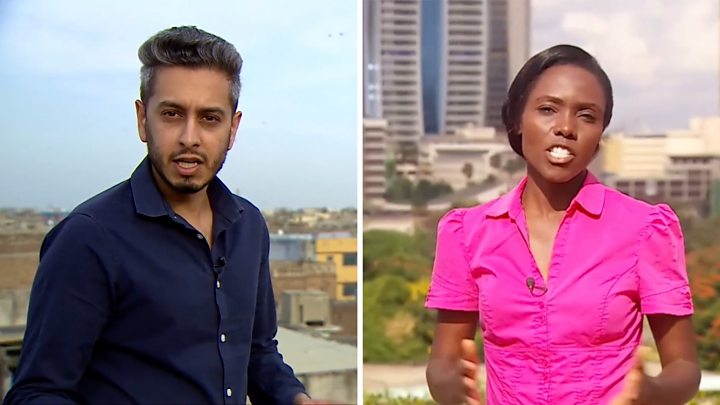
Media caption The BBC’s Secunder Kermani and Anne Soy compare how prepared Asian and African countries are
It appears that Ma’s donations are following Party guidelines: there is no evidence that any of the Jack Ma and Alibaba Foundation donations have gone to countries that have formal ties with Taiwan, China’s neighbour and diplomatic rival. Ma announced on Twitter that he was donating to 22 countries in Latin America. States that side with Taiwan but who have also called for medical supplies – from Honduras to Haiti – are among the few dozen countries that do not appear to be on the list of 150 countries. The foundations repeatedly refused to provide a detailed list of countries that have received donations, explaining that “at this moment in time, we are not sharing this level of detail”.
However, the donations that have been delivered have certainly generated a lot of goodwill. With the exception of problematic deliveries to Cuba and Eritrea, all of the foundations’ shipments dispatched from China appear to have been gratefully received. That success is giving Ma even more positive attention than usual. China’s state media has been mentioning Ma almost as often as the country’s autocratic leader, Xi Jinping.
AFP
So far…
Over 150 countries have received donations from Jack Ma, including about:
120.4mface masks
4,105,000testing kits
3,704ventilators
Source: Alizila
It’s an uncomfortable comparison. As Ma soaks up praise, Xi faces persistent questions about how he handled the early stages of the virus and where, exactly, the outbreak began.
The Chinese government has dispatched medical teams and donations of supplies to a large number of hard-hit countries, particularly in Europe and South-East Asia.
However, those efforts have sometimes fallen flat. China’s been accused of sending faulty supplies to several countries. In some cases, the tests it sent were being misused but in others, low-quality supplies went unused and the donations backfired.
In contrast, Jack Ma’s shipments have only boosted his reputation.
“It’s fair to say that Ma’s donation was universally celebrated across Africa,” says Eric Olander, managing editor of the China Africa Project website and podcast. Ma pledged to visit all countries in Africa and has been a frequent visitor since his retirement.
“What happens to the materials once they land in a country is up to the host government, so any complaints about how Nigeria’s materials were distributed are indeed a domestic Nigerian issue,” Olander adds. “But with respect to the donation itself, the Rwandan leader, Paul Kagame, called it a “shot in the arm” and pretty much everyone saw it for what it was which was: delivering badly-needed materials to a region of the world that nobody else is either willing or capable of helping at that scale.”
Walking the tightrope
But is Ma risking a backlash from Beijing? Xi Jinping isn’t known as someone who likes to share the spotlight and his government has certainly targeted famous faces before. In recent years, the country’s top actress, a celebrated news anchor and several other billionaire entrepreneurs have all “disappeared” for long periods. Some, including the news anchor, end up serving prison sentences. Others re-emerge from detention, chastened and pledging their allegiance to the Party.
“There’s a rumour that [Jack Ma] stepped down in 2018 from being the chairman of the Alibaba Group because he was seen as a homegrown entrepreneur whose popularity would eclipse that of the Communist Party,” explains Ashley Feng, research associate at the Centre for New American Security in Washington DC. Indeed, Ma surprised many when he suddenly announced his retirement in 2018. He has denied persistent rumours that Beijing forced him out of his position.
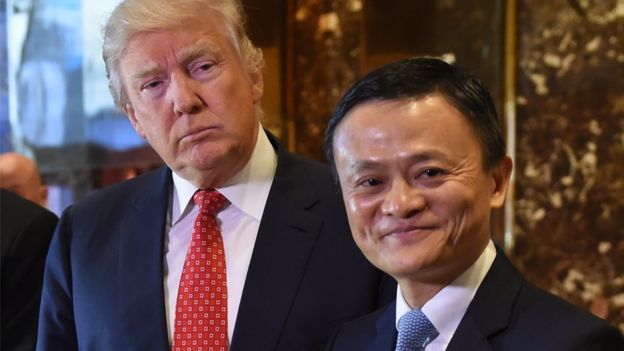
Image copyright GETTY IMAGESImage caption Ma discussed trade with then-President-elect Donald Trump in January 2017
Duncan Clark, Ma’s biographer, is also aware of reports that Ma was nudged away from Alibaba following a key incident in January 2017. The Chinese billionaire met with then-President-elect Donald Trump in Trump Tower, ostensibly to discuss Sino-US trade. The Chinese president didn’t meet with Trump until months later.
“There was a lot of speculation of time that Jack Ma had moved too fast,” Clark says. “So, I think there’s lessons learned from both sides on the need to try to coordinate.”
“Jack Ma represents a sort of entrepreneurial soft power,” Clark adds. “That also creates challenges though, because the government is quite jealous or nervous of non-Party actors taking that kind of role.”
Technically, Ma isn’t a Communist outsider: China’s wealthiest capitalist has actually been a member of the Communist Party since the 1980s, when he was a university student.
But Ma’s always had a tricky relationship with the Party, famously saying that Alibaba’s attitude towards the Party was to “be in love with it but not to marry it”.
Even if Ma and the foundations connected to him are making decisions without Beijing’s advance blessing, the Chinese government has certainly done what it can to capitalise on Ma’s generosity. Chinese ambassadors are frequently on hand at airport ceremonies to receive the medical supplies shipped over by Ma, from Sierra Leone to Cambodia.
China has also used Ma’s largesse in its critiques of the United States. “The State Department said Taiwan is a true friend as it donated 2 million masks,” the Chinese Foreign Ministry tweeted in early April. “Wonder if @StateDept has any comment on Jack Ma’s donation of 1 million masks and 500k testing kits as well as Chinese companies’ and provinces’ assistance?”
Perhaps Ma can rise above what’s happened to so many others who ran afoul of the Party. China might just need a popular global Chinese figure so much that Ma has done what no one else can: make himself indispensable.
“Here’s the one key takeaway from all that happened with Jack Ma and Africa: he said he would do something and it got done,” explains Eric Olander. “That is an incredibly powerful optic in a place where foreigners often come, make big promises and often fail to deliver. So, the huge Covid-19 donation that he did fit within that pattern. He said he would do it and mere weeks later, those masks were in the hands of healthcare workers.”
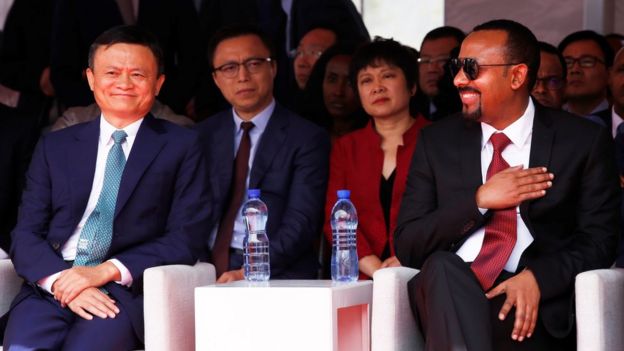
Image copyright GETTY IMAGESImage caption Ma at an Electronic World Trade Platform event with Ethiopian Prime Minister Abiy Ahmed last year
Duncan Clark argues that Ma already had a seat at China’s high table because of Alibaba’s economic heft. However, his first-name familiarity with world leaders makes him even more valuable to Beijing as China tries to repair its battered image.
“He has demonstrated the ability, with multiple IPOs under his belt, and multiple friendships overseas, to win friends and influence people. He’s the Dale Carnegie of China and that certainly, we’ve seen that that’s irritated some in the Chinese government but now it’s almost an all hands on deck situation,” Clark says.
There’s no doubt that China’s wider reputation is benefiting from the charitable work of Ma and other wealthy Chinese entrepreneurs. Andrew Grabois from Candid, the philanthropic watchdog that’s been measuring global donations in relation to Covid-19, says that the private donations coming from China are impossible to ignore.
“They’re taking a leadership role, the kind of thing that used to be done by the United States,” he says. “The most obvious past example is the response to Ebola, the Ebola outbreak in 2014. The US sent in doctors and everything to West Africa to help contain that virus before it left West Africa.”
Chinese donors are taking on that role with this virus.
“They are projecting soft power beyond their borders, going into areas, providing aid, monetary aid and expertise,” Grabois adds.
So, it’s not the right time for Beijing to stand in Jack Ma’s way.
“You know, this is a major crisis for the world right now,” Duncan Clark concludes. “But obviously, it’s also a crisis for China’s relationship with the rest of the world. So they need anybody who can help dampen down some of these those pressures.”
KATHMANDU, April 19 (Xinhua) — A German scholar has recently found that the right to education for Uygurs and people of other ethnic groups is well protected in China’s Xinjiang region, as young people there enjoy increasingly better opportunities.
Michael Heinrich, who has been teaching German in Minzu University of China for more than five years, said in an article published on Online Khabar news website in March that he has “paid close attention to the development of Chinese education in recent years, especially the education situation in ethnic minority areas.”
Heinrich said he has taught a Xinjiang Uygur student, who often talks with him about the education situation in her hometown and appreciates government policies on education.
The Uygur student has told Heinrich that she lives in a place where she receives Islamic religious education and China’s nine-year compulsory education, and the Uygur students in Xinjiang can enjoy preferential policies, such as extra points in college entrance examination, special policies for college admissions, and employment policy support.
In recent years, the Chinese government has intensified policy support on education in Xinjiang Uygur Autonomous Region, and increased investment in educational resources, especially those on vocational education, the article read.
“Through vocational education, more Uyghur Muslim students can enhance their survival skills and work harder by themselves and improve their living standards with these hands,” it said.
For some time, Xinjiang has been plagued by terrorism, religious extremism and separatism, according to the passage, and carrying out vocational education and training in Xinjiang is an effective measure to promote the rule of law and a practical action to protect the vital interests of people of all ethnic groups there.
It is also a just move in fighting extremism and terrorism to contribute to the stability in Xinjiang, it added.
Some Western media outlets as well as some U.S. politicians often slander the Chinese government under the guise of “human rights,” which does not only disregard the facts but also interferes with China’s sovereignty, Heinrich pointed out.
The situation in Xinjiang that they saw was completely different from the stories told by some Western politicians and media, Heinrich quoted some people who have visited Xinjiang and witnessed its development as saying.
The rights to life and development of people of all ethnic groups in Xinjiang are protected to the largest extent, Heinrich added.
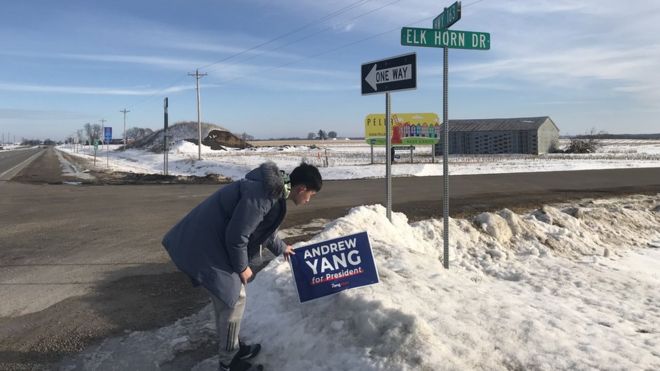
Image copyright SWALLOW YANImage caption A Chinese student puts up a yard sign of presidential candidate Andrew Yang in Des Moines, Iowa.
To some Americans, Iowa, a rural state in the middle of the US, is dismissively thought of as “fly-over country”.
Yet the Hawkeye state is well-known in China. Chinese President Xi Jinping has visited twice – before he took office in 2012, and in an earlier stay as a low-level local official on a 1985 trip to study farming technology.
Iowa was once again a destination for Chinese visitors last week, though those who descended upon the state were not there to study soybeans, but democracy in America.
Amid its chaos, young “democracy tourists” learnt first-hand that it can be a messy way to govern.
The results of Iowa’s caucuses were delayed for days because of a technical failure, causing political uproar in the US.
But the Chinese students didn’t seem to mind.
Over the weekend leading up to the 3 February contest – the first step in selecting the candidates who will stand in the November presidential election – they could be spotted at a rally for Andrew Yang, a Democratic hopeful.
The students, aged about 16, were part of a winter break tour of the US that included stops in Iowa to see democracy in action.
The trip cost $7,000 (£5,428) – a huge sum for the average Chinese household – but Liu Junhao, 16, thought it had been money well spent.
He’d experienced something unique and meaningful, unlike his classmates’ visits to typical American tourist attractions, he said.
“If I could vote, I would vote for Andrew Yang,” he said. Mr Liu could only hear half of the candidate’s speech, but stared at him awe, star-struck, for the whole event.
Some 360,000 Chinese students now study in the US. In the UK, the figure is more than 100,000. As Chinese people become more affluent and international education more accessible to them, an increasing number of young Chinese want to study in the West.
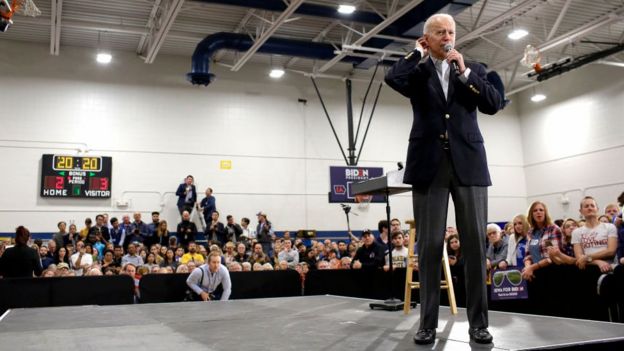
Image copyright GETTY IMAGESImage caption Chinese students attend multiple campaign rallies in Iowa, including former Vice-President Joe Biden’s event
Understanding democracy has now become part of that education.
Steven Hu, a Hubei native who attends high school in Boston, has canvassed for six months for Joe Biden, working for his campaign in Iowa and New Hampshire, the first two states to vote in the primaries.
Mr Hu, 17, had ambitions beyond promoting democracy, though.
He arrived at a Biden rally in Des Moines armed with a university recommendation letter- and hopes that the former vice-president would sign it for him.
“Steven has been very proactive in making a positive impact on my campaign,” said the letter, written by the student for Mr Biden to sign.
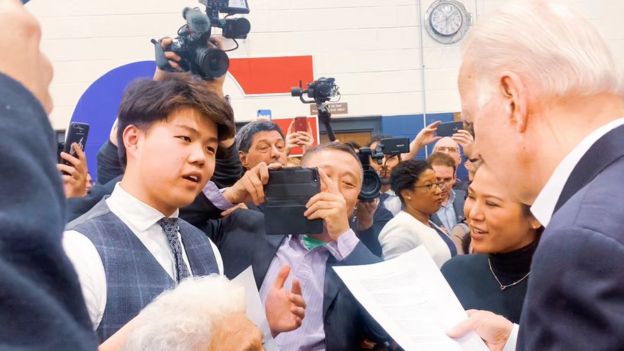
Image copyright STEVEN HUImage caption Chinese student Steven Hu meets presidential hopeful Joe Biden
Dressed up in a three-piece suit, the college hopeful stood waiting next to the aisle, poised to pounce when Mr Biden was to pass through after his speech.
The moment came. The silver-haired politician approached. Mr Hu seized the chance to tell Mr Biden about his canvassing work, and asked him to sign the letter.
“Thank you,” Mr Biden responded. Though he appeared to be puzzled by the paper presented to him, he signed it after taking a glimpse.
However, before Mr Hu could get the letter back, a Biden aide seized it and explained the candidate was in no position to sign such a document.
A disappointed Mr Hu took it in his stride. “I didn’t expect such a letter would be accepted by colleges anyway,” he said.
He said he just wanted proof that he had participated in the campaign.
Mr Hu viewed politics as a game that everyone in the US plays – a game with high participation but low efficiency, given America’s partisan gridlock.
But he still appreciates it. “The US is a great country,” he said, “because it successfully created a system that lets everyone be a part of it.”
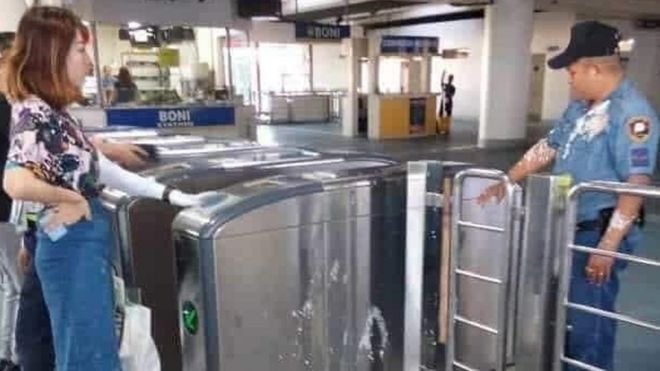
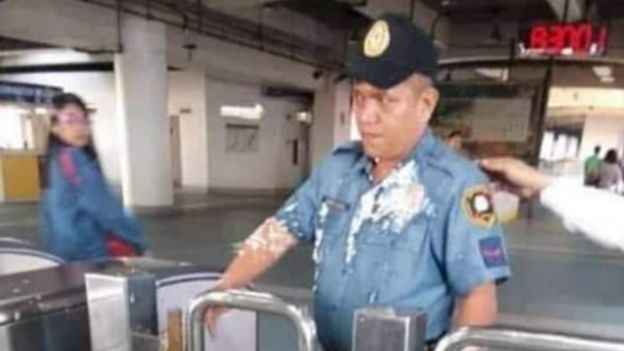
Image copyrightMANDALUYONG POLICE/FACEBOOKImage captionPhotos of Ms Zhang at a train station in Manila later went viral
A Chinese student who threw her cup of soybean pudding at a police officer in the Philippines has been charged with assault and disobedience.
Zhang Jiale was at a train station in Manila when she was stopped and told she had to finish her dessert before she could enter the station.
She responded by throwing the treat at the officer, and was later detained.
Ms Zhang could face deportation and eventual blacklisting from the Philippines.
‘I was in a bad mood’
The incident took place on 9 February at the Metro Rail Transit (MRT) in the Philippines’ capital of Manila.
The 23-year-old is currently a fashion design student in the Philippines.
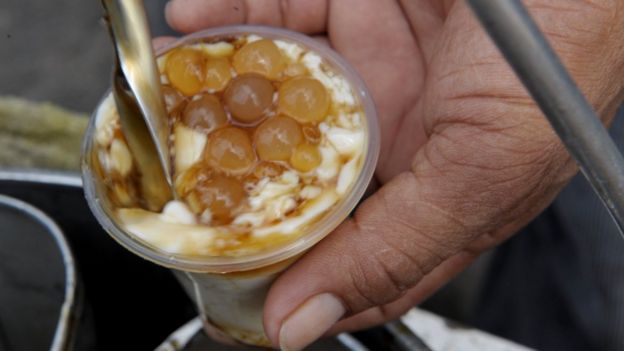
According to local media outlets, she was stopped by police officer William Cristobal from going onto the MRT station in Manila as she was holding a cup of “taho” – a local dessert of soybean pudding.
Image copyrightJAY DIRECTOImage captionTaho is a popular sweet dessert in the Philippines
Bottled drinks, water and liquid substances are banned from MRT stations in Manila.
Mr Cristobal told her she would have to finish her dessert or throw it away before she would be allowed to enter the platform.
Image copyrightMANDALUYONG POLICE/FACEBOOKImage captionMr Cristobal had a cup of taho thrown at him
Ms Zhang was later charged by the Mandaluyong City prosecutor’s office for direct assault, disobedience to an agent of a person in authority and unjust vexation.
The Mandaluyong City Police told the BBC that they were unable to comment on what punishment Ms Zhang would face if found guilty.
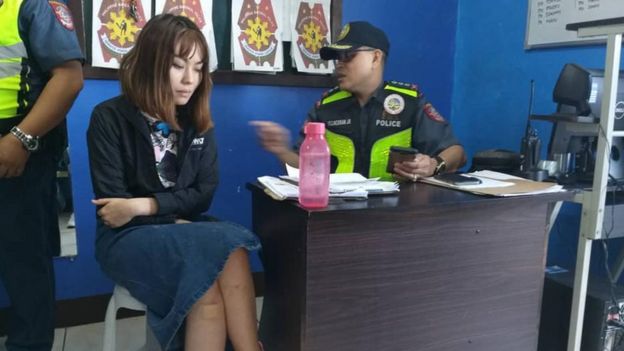
She posted bail but was later detained again by the Bureau of Immigration on a separate charge of violating immigration laws. She now remains in detention in Manila.
Image copyrightMANDALUYONG POLICE/FACEBOOKImage captionMs Zhang was later brought in by Mandaluyong police
“The incident showed her disrespect towards persons of authority which in turn shows her disrespect to the country.”
Ms Sandoval said Zhang may face deportation and eventually be blacklisted from the country altogether, adding that the court case would run “independent” from her immigration case.
“If found deportable, we will wait for the resolution of her court case before implementing the deportation.”
An enterprising student is creating a buzz at a university campus in southwest China, where his cheap and reliable haircuts are in demand.
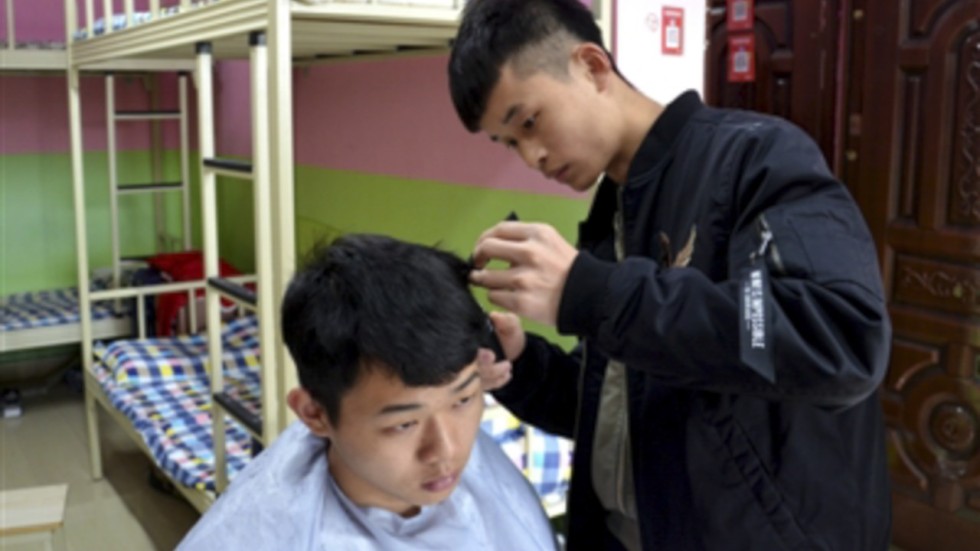
Ding Weijie, 19, opened an “express hairdressing salon” in his dormitory at the Sichuan Hope Automotive Vocational College in early November, Chengdu Economic Dailyreported on Friday.
Although Ding is self-taught, his hairdressing skills have already turned heads on the campus in Ziyang. His 5 to 6 yuan (73 to 87 US cents) cuts for men have become so popular that appointments need to be booked a few days in advance.
The first-year student, whose major is new energy vehicles, said he had been looking for a way to make some extra cash.
“After I started university, I wanted to find a part-time job to earn some money for my living costs,” Ding, who is from Yibin in Sichuan province, told the newspaper.
ADVERTISEMENT
He initially took a job as a dishwasher in the university canteen, but it did not pay well and left him with little time for studying.





 CHINDIA ALERT: You'll be living in their world, very soon