Chindia Alert: You’ll be Living in their World Very Soon
aims to alert you to the threats and opportunities that China and India present. China and India require serious attention; case of ‘hidden dragon and crouching tiger’.
Without this attention, governments, businesses and, indeed, individuals may find themselves at a great disadvantage sooner rather than later.
The POSTs (front webpages) are mainly 'cuttings' from reliable sources, updated continuously.
The PAGEs (see Tabs, above) attempt to make the information more meaningful by putting some structure to the information we have researched and assembled since 2006.
BEIJING (Reuters) – China’s factory activity likely rose for a second straight month in April as more businesses re-opened from strict lockdowns implemented to contain the coronavirus outbreak, which has now paralysed the global economy.
The official manufacturing Purchasing Manager’s Index (PMI), due for release on Thursday, is forecast to fall to 51 in April, from 52 in March, according to the median forecast of 32 economists polled by Reuters. A reading above the 50-point mark indicates an expansion in activity.
While the forecast PMI would show a slight moderation in China’s factory activity growth, it would be a stark contrast to recent PMIs in other economies, which plummeted to previously unimaginable lows.
That global slump, caused by heavy government-ordered lockdowns, as well as the cautious resumption of business in China, suggests any recovery in the world’s second-largest economy is likely to be some way off.
“The recovery so far has been led by a bounce-back in production, however, the growth bottleneck has decisively shifted to the demand side, as global growth has weakened and consumption recovery has lagged amid continued social distancing,” Morgan Stanley said in a note.
“The expected slump in external demand has likely capped further recovery in industrial production.”
The latest official data showed 84% of mid-sized and small business had reopened as of April 15, compared with 71.7% on March 24.
Hobbled by the coronavirus, China’s economy shrank 6.8% in the first quarter from a year earlier, the first contraction since current quarterly records began.
That has left Chinese manufacturers with reduced export orders and a logistics logjam, as many exporters grapple with rising inventory, high costs and falling profits. Some have let workers go as part of the cost-cutting efforts.
A China-based brokerage Zhongtai Securities estimated that the country’s real unemployment rate, measured using international standards, could exceed 20%, equal to more than 70 million job losses and much higher than March’s official reading of 5.9%.
Sheng Laiyun, deputy head at the statistics bureau, said on Sunday migrant workers and college graduates are facing increasing pressures to secure jobs, while official jobless surveys show nearly 20% of employed workers not working in March.
Chinese authorities have rolled out more support to revive the economy. The People’s Bank of China earlier in April cut the amount of cash banks must hold as reserves and reduced the interest rate on lenders’ excess reserves.
BEIJING, April 23 (Xinhua) — China decided to donate another 30 million U.S. dollars to the World Health Organization (WHO) in support of global efforts to fight COVID-19 and the construction of public health systems in developing countries, a Foreign Ministry spokesperson said here Thursday.
Spokesperson Geng Shuang told a news briefing that the WHO, led by Director-General Tedros Adhanom Ghebreyesus, had actively fulfilled its duties with objective, science-based and fair position and played an important role in assisting countries in responding to the outbreak and boosting international cooperation on COVID-19.
Geng said to support the WHO is to defend the principles of multilateralism and safeguard the status and authority of the United Nations at a crucial time of the battle against the pandemic, adding that the virus is the common enemy of humankind, and the international community can only defeat it through unity and cooperation.
In March, China donated 20 million dollars to the WHO to support the global fight against COVID-19.
The spokesperson said China’s donations to the WHO reflected the support and trust of the Chinese government and people in the organization, and China also made its own contributions to global public health and the fight against the pandemic.
“China will continue to stand in solidarity and render mutual assistance with other countries to jointly overcome the pandemic, safeguard regional and global public health and build a community with a shared future for mankind,” he said.
BEIJING, April 19 (Xinhua) — China will step up efforts to expedite technological research on the construction and application of digital infrastructure, according to the Ministry of Industry and Information Technology (MIIT).
More support should be provided to the research and development of 5G enhancement technology and 6G technology, while the accurate matching of innovation, industrial, capital and policy chains should be promoted, said Chen Zhaoxiong, vice minister of the MIIT.
Chen also stressed the importance of emphasizing the huge demand for digital transformation and improving new digital infrastructure to facilitate economic and social upgrade of the country.
The MIIT will take a string of measures to optimize industrial development, such as expediting construction of 5G and industrial internet connecting people, machine and things, developing new types of intelligent computing facilities, advancing orderly construction and application of large data centers while upgrading micro and small data centers, enriching application scenarios and building a network security system.
BEIJING/SHANGHAI (Reuters) – Chinese President Xi Jinping told U.S. President Donald Trump during a phone call on Friday that he would have China’s support in fighting the coronavirus, as the United States faces the prospect of becoming the next global epicentre of the pandemic.
The United States now has the most coronavirus cases of any country, with 84,946 infections and 1,259 deaths. Hospitals in cities like New York and New Orleans struggle to cope with the wave of patients.
Xi’s offer of assistance came amid a long-running war of words between Beijing and Washington over various issues including the coronavirus epidemic.
Trump and some U.S. officials have accused China of a lack of transparency on the virus, and Trump has at times called the coronavirus a “China virus” as it originated there, angering Beijing.
RELATED COVERAGE
Foreigners face suspicion in China as coronavirus worsens overseas
In the call, Xi reiterated to Trump that China had been open and transparent about the epidemic, according to an account of the conversation published by the Chinese foreign ministry.
Trump said on Twitter that he discussed the coronavirus outbreak “in great detail” with Xi.
“China has been through much & has developed a strong understanding of the virus,” Trump said. “We are working closely together. Much respect!”.
The World Health Organization has said the United States, which saw 17,099 new coronavirus cases and 281 deaths in the past 24 hours, is expected to become the epicentre of the pandemic.
CHINA CUTS FLIGHTS
Like U.S. hospitals now, China’s medical system struggled to contain the coronavirus just two months ago, but draconian city lockdowns and severe travel restrictions has seen China dramatically ease the epidemic.
Mainland China on Friday reported its first local coronavirus case in three days and 54 new imported cases, as Beijing ordered airlines to sharply cut international flights, for fear travellers could reignite the coronavirus outbreak.
The 55 new cases detected on Thursday were down from 67 a day earlier, the National Health Commission said on Friday, taking the tally of infections to 81,340. China’s death toll stood at 3,292 as of Thursday, up by five from a day earlier.
The central province of Hubei, with a population of about 60 million, reported no new cases on Thursday, a day after lifting a lockdown and reopening its borders as the epidemic eased there.
The commercial capital of Shanghai reported the most new imported cases with 17, followed by 12 in the southern province of Guangdong and four each in the capital Beijing and the nearby city of Tianjin.
Shanghai now has 125 patients who arrived from overseas, including 46 from Britain and 27 from the United States.
In effect from Sunday, China has ordered its airlines to fly only one route to any country, on just one flight each week. Foreign airlines must comply with similar curbs on flights to China, although many had already halted services.
About 90% of current international flights into China will be suspended, cutting arrivals to 5,000 passengers a day, from 25,000, the civil aviation regulator said late on Thursday.
From Saturday, China will temporarily suspend entry for foreigners with valid visas and residence permits, in an interim measure, the foreign ministry added.
Before the new curbs, foreign nationals made up about a tenth of the roughly 20,000 travellers arriving on international flights every day, an official of China’s National Immigration Administration said last week.
As commercial flights dwindle, Chinese students from wealthy families are paying tens of thousands of dollars to fly home on private jets.
International demand for chartered and private flights into China increased 227% in March from a year earlier, said Shanghai-based private jet service provider iFlyPlus.
Notably, requests for flights from the United States to China rose 10-fold in late March, iFlyPlus told Reuters.
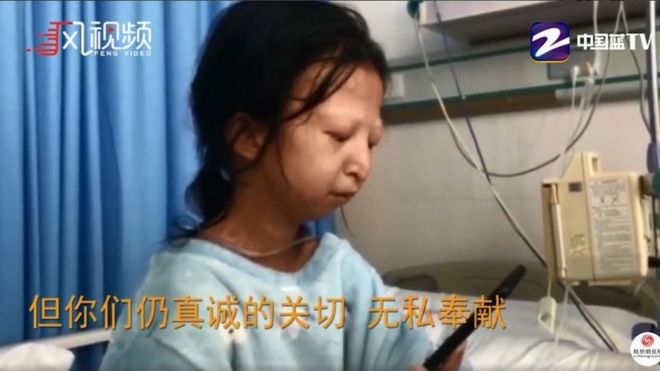
Image copyright FENG VIDEOImage caption Wu Huayan ate only rice and chillies in order to save money to help her ill brother
Well-wishers have donated almost a million yuan to a Chinese student who was hospitalised after living on 2 yuan ($0.30, £0.20) a day for five years.
The case of Wu Huayan shocked Chinese people after it hit the headlines earlier this week.
The 24-year old woman became seriously malnourished while struggling to study and support her sick brother.
Ms Wu’s story also sparked anger at authorities for failing to recognise her plight and help her much earlier.
After the story was reported, donations began pouring in for the college student in the city of Guiyang – reportedly totalling some 800,000 yuan ($114,000, £88,000).
What is Wu Huayan’s story?
Earlier, this month, the young woman went into hospital after having difficulty breathing, according to Chinese media.
She was only 135cm (4ft 5ins) tall, weighing barely more than 20kg (43 pounds; three stones).
The doctors found she was suffering from heart and kidney problems due to five years spent eating minimal amounts of food. She said she needed to save money to support her sick brother.
Wu Huayan lost her mother when she was four and her father died when she was in school.
She and her brother were then supported by their grandmother, and later by an uncle and aunt who could only support them with 300 yuan ($42, £32) each month.
Most of that money went on the medical bills of her younger brother, who had mental health problems.
This meant Ms Wu spent only 2 yuan a day on herself, surviving largely off chillies and rice.
The siblings are from Guizhou, one of the poorest provinces in China.
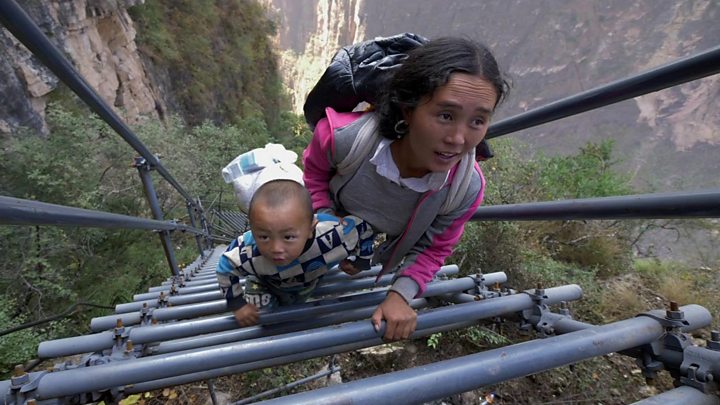
Media caption China’s uphill struggle fighting extreme poverty
What has the reaction been?
The case sparked an outpouring of concern – and anger at authorities.
Many people on social media said they wanted to help with donations, and many voiced concern about her college not helping her.
One user called her situation “worse than that of refugees in Afghanistan”, while another pointed to the extravagant cost of China’s 70th anniversary celebrations, saying the money could have been better spent.
Others expressed their admiration at her efforts to help her brother, while also persevering with her studies in college.
Aside from the donations on crowd funding platforms, her teachers and classmates donated 40,000 yuan ($5,700; £4,400), while local villagers collected 30,000 yuan to help her.
Officials released a statement saying Ms Wu had been receiving the minimum government subsidy – thought to be between 300 and 700 yuan a month – and was now getting an emergency relief fund of 20,000 yuan.
“We will keep following the case of this strong-minded and kind girl,” the Tongren City Civil Affairs Bureau said.
“We will actively co-operate with other relevant departments to solve the problem according to the minimum living standard and temporary assistance responsibility that the civil affairs department bears.”
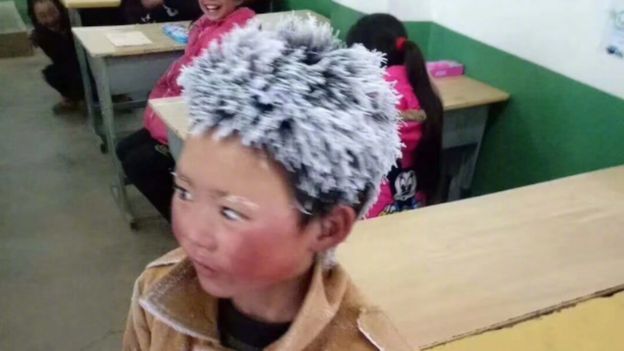
Dubbed “Little Wang”, his story also went viral, leading to international donations from people impressed by his resilience, and shocked at his poverty.
Image copyright PEOPLE’S DAILY
While China’s economy has skyrocketed over the past decades, poverty has not disappeared, and inequality has grown.
One major reason cited is the huge divide between rural and urban areas.
As a point of comparison, in rural region of Guizhou where Ms Wu lives, that figure is around 16,703 yuan.
China has moved from being “moderately unequal in 1990 to being one of the world’s most unequal countries,” according to a 2018 report by the International Monetary Fund.
According to the National Bureau of Statistics in 2017, 30.46 million rural people were still living below the national poverty line of $1.90 a day.
China has previously pledged to “eliminate” poverty by 2020.
Top law enforcement body starts campaign to rally mainland support for officers amid anti-government protests
Maxim’s described as ‘company that loves the country and loves Hong Kong’ after condemnation of unrest by daughter of founder
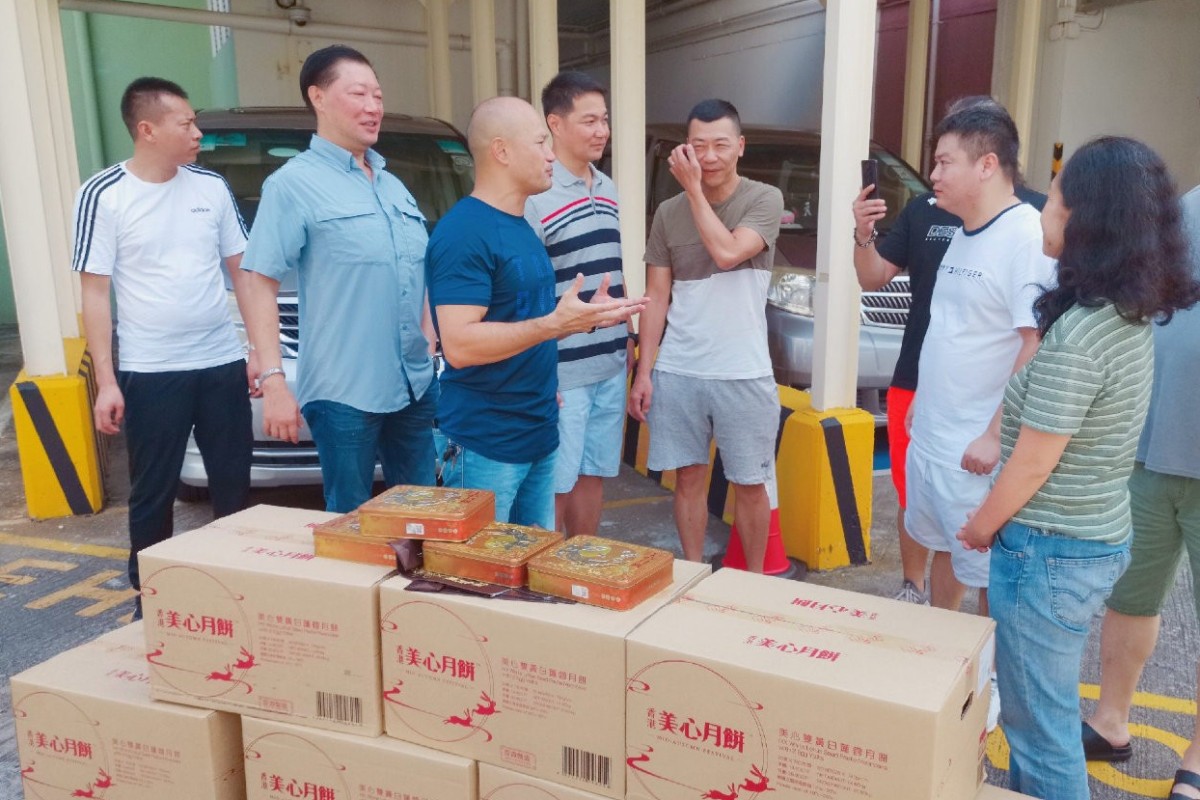
Officer Lau (third from left) and police colleagues receive a delivery of mooncakes. Photo: Weibo
China’s top law enforcement agency has shown its support for Hong Kong’s embattled police by delivering 650 boxes of mooncakes to the force’s dormitories and stations ahead of Friday’s Mid-Autumn Festival.
The festive gifts were sent after an online campaign titled “I want to send hometown delicacies to Hong Kong Police”, launched last Friday by Chang An Jian, an official social media account of the Central Political and Legal Affairs Commission, Beijing’s top political body responsible for law and order.
The commission – a Communist Party organ, rather than a government body that police report to – said in a blog post that seven people had donated about 150,000 yuan (US$21,000) between them.
The campaign represents the latest display of mainland support for the force, with no end in sight to mass protests in Hong Kong triggered in June by opposition to an
that would have allowed the transfer of criminal suspects to mainland China. Hong Kong police have faced numerous accusations of excessive use of force during the unrest.
But the mooncake delivery was complicated by customs regulations, with most major Chinese courier services unwilling to take deliveries containing processed meat and egg yolk across the border with Hong Kong.
“[We] were panicking because a lot of enthusiastic netizens had their salted duck and mooncake deliveries to Hong Kong rejected by couriers!” a Chang An Jian blog post said on Wednesday night.
In the end, 650 boxes of mooncakes that were bought from Hong Kong were sent to police dormitories and stations on Wednesday evening.
Mid-Autumn Festival is the second most important traditional Chinese holiday after Lunar New Year.
“[The mooncakes] were from Maxim’s, a company that loves the country and loves Hong Kong!” the blog post also said.
Annie Wu Suk-ching, whose father co-founded the Maxim’s chain, last week
She was lauded by Communist Party mouthpiece People’s Daily for “clearly adhering to the one country principle” – referring to “one country, two systems”, the principle under which Hong Kong was guaranteed a high degree of autonomy after it was handed over from British to Chinese rule in 1997.
One of Maxim’s biggest rival mooncake manufacturers in Hong Kong, Taipan Bread and Cake, had its products removed from shops across the Chinese mainland and from its biggest e-commerce sites, Tmall.com and JD.com, after the son of its founder was vilified by People’s Daily for a Facebook post that the newspaper said showed he backed the protests.
Recipients of the mooncakes included a police officer who in July was hailed as a hero by Chinese state media and nicknamed “bald sergeant Lau Sir” after pointing a shotgun at protesters who had besieged a police station. Lau has since been invited by Beijing to attend a grand celebration on October 1 for the 70th anniversary of the founding of the People’s Republic of China.
Mooncake importer says stock will be destroyed after mainland backlash
Beijing has focused attention on the violent elements of the Hong Kong protests in its social media posts and media coverage, while businesses have been carefully monitored and expected to toe Beijing’s line on condemning violence and supporting one country, two systems.
“Hong Kong Police have been having a very difficult time,” said one mainlander, surnamed Lu, in a video posted by Chang An Jian. “We want to cheer them up.”
GENEVA, July 27 (Xinhua) — Ambassadors from 50 countries to the United Nations Office at Geneva (UNOG) have co-signed a letter to the President of the UN Human Rights Council (HRC) and the High Commissioner for Human Rights to voice their support for China’s position on issues related to its Xinjiang Uygur Autonomous Region.
Earlier on July 12, a number of ambassadors in Geneva sent the joint letter to show their support for China, and as of Friday evening, more ambassadors had joined, the Chinese Mission to the UNOG revealed.
In a statement issued on Friday night, the Chinese mission said that some other countries had also expressed their support in separate letters or press statements.
In the joint letter, the ambassadors commend China for its economic and social progress, effective counter-terrorism and de-radicalization measures, and strong guarantee of human rights.
They appreciate the opportunities provided by China for diplomatic envoys, officials of international organizations, and media professionals to visit Xinjiang, and point to the contrast between Xinjiang in the eyes of those who have visited it and the one portrayed by some western media.
The ambassadors also urge a certain group of countries to stop using uncorroborated information to make unfounded accusations against China.
“I was surprised that some people call these vocational training and education centers concentration or internment camps,” Vadim Pisarevich, deputy permanent representative of Belarus to the UNOG, told Xinhua.
“They’re nothing of the kind. They look like ordinary educational facilities and even I said that they are more than this because they provide life skills training to the students,” Pisarevich said.
They are “very useful institutions for addressing the problems of terrorism, extremism and separatism,” he said.
“Terrorism and extremism are an intractable challenge across the world. In the face of its grave threat, Xinjiang Uygur Autonomous Region responded with a number of lawful steps, including setting up vocational education and training centers, to prevent and combat terrorism and extremism,” the Chinese Mission to the UNOG said in its statement.
“Facts speak louder than words, and justice cannot be overshadowed. The great diversity of countries co-signing the letter — from Asia, Africa, Latin America, and Europe, especially the OIC (Organization of Islamic Cooperation) — makes it clear that the international community has drawn a fair conclusion about Xinjiang’s human rights achievement and counter-terrorism and de-radicalization outcome,” the statement said.
“Those that seek to use human rights as an excuse to slander and pressure China have only themselves to deceive,” it added.
“We oppose any attempt to use human rights issues as a cover for interference in a country’s internal affairs. We urge those who are doing so to change course, refrain from politicization and double standards, and stop interfering in the internal affairs of other countries under the pretext of human rights,” it said.
At a press conference on Friday, China’s Ambassador to the UNOG Chen Xu also rebuked some Western nations for slandering China over Xinjiang, noting that China doesn’t accept these “groundless accusations.”
Jamshed Khamidov, head of Tajikistan’s mission in Geneva, said his government opposes any attempts to use the Human Rights Council for particular political purposes, and efforts should be made to avoid any politicization of the Human Rights Council.
“We know the situation in the Xinjiang region. We know how much the government of China is doing … and what kind of measures were implemented in this region to support its peace, security and development,” he said.
In visits to the vocational training and education centers in Xinjiang’s Urumqi and Kashi, Zenon Mukongo Ngay, head of the Democratic Republic of Congo’s mission in Geneva, said he was impressed with the “level of development” in Xinjiang and how the people in the centers receive education for getting a job.
The Chinese mission also said that together with all parties, China is committed to promoting the healthy development of the international human rights cause by encouraging multilateral human rights institutions to stick to the purpose and principles of the UN Charter, handle human rights issues in an objective, impartial and non-selective manner, and engage in constructive dialogues and cooperation.
President Xi Jinping will meet Russian counterpart Vladimir Putin next month and address economic summit in St Petersburg
Diplomatic flurry will also include regional security forums in Kyrgyzstan and Tajikistan
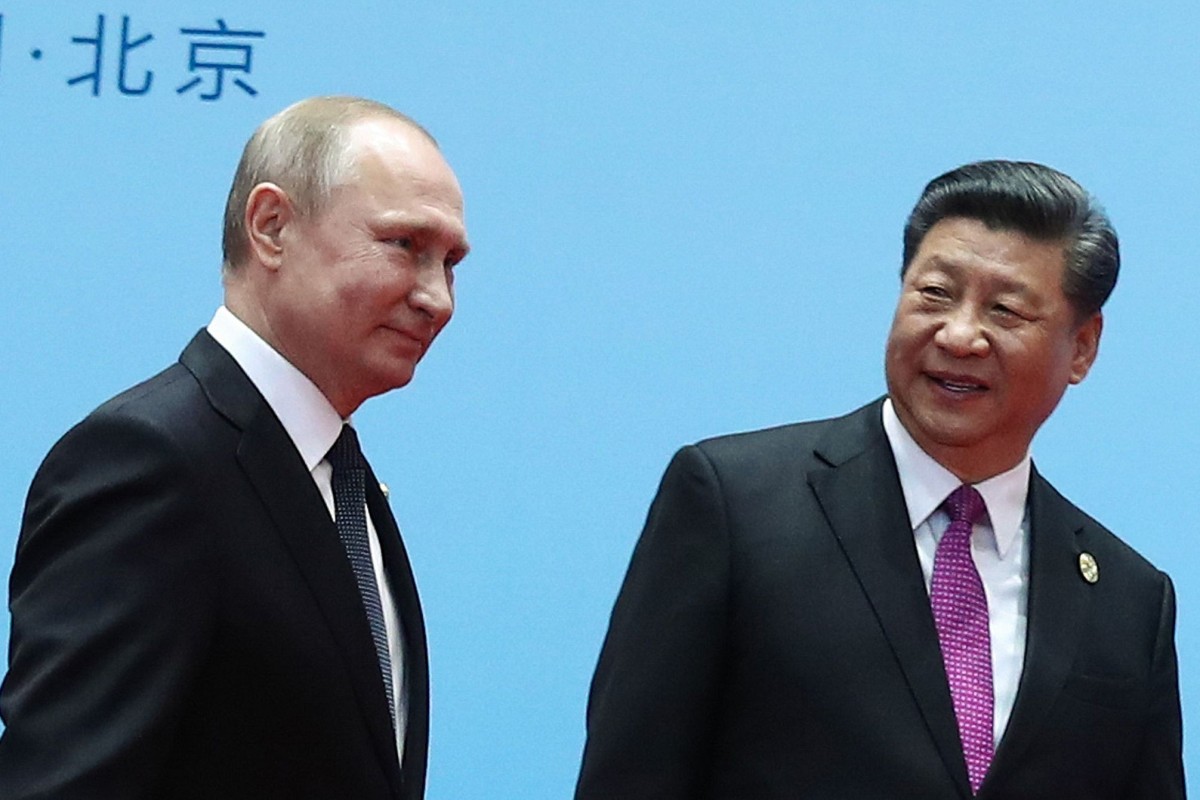
Xi Jinping has met Vladimir Putin more times than any other foreign leader since he took power in 2013. Photo: AFP
Beijing is stepping up efforts to seek support from regional and global players such as Russia and Central Asian nations as its geostrategic rivalry with Washington heats up.
President Xi Jinping is expected to meet his Russian counterpart Vladimir Putin next month, when he will also address the St Petersburg International Economic Summit,
The Chinese president will also visit the Kyrgyzstan capital Bishkek for the Shanghai Cooperation Organisation (SCO) summit in June, as well as another regional security forum in Dushanbe, Tajikistan.
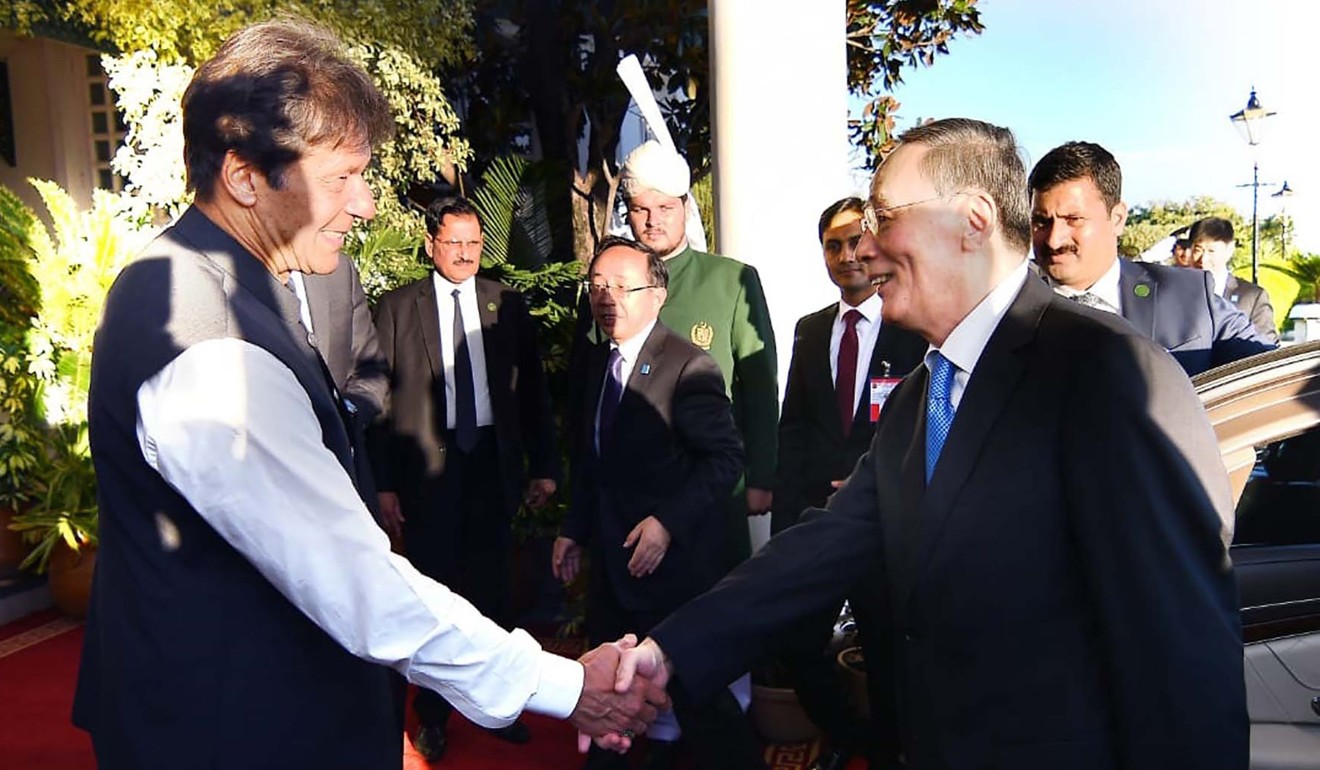
Meanwhile, Vice-PresidentWang Qishan is visiting Pakistan before he heads to the Netherlands and Germany, according to the Chinese foreign ministry.
Pakistani Prime Minister Imran Khan meets Chinese Vice-President Wang Qishan in Islamabad on Sunday. Photo: AFP
The latest flurry of diplomatic activity comes as competition between China and the US intensifies on several fronts including trade and technology, the South China Sea and the Arctic, where Beijing’s partnership with Moscow –
It will be Xi’s second time at the St Petersburg forum, and observers expect the Chinese leader will reaffirm Beijing’s commitment to multilateralism and promote the nation as a champion of openness and cooperation.
China-Russia ties unrivalled, Beijing warns before Pompeo meets Putin
It will also be his second meeting with Putin in two months, after talks on the sidelines of the Belt and Road Forum in Beijing in late April, when the Russian president
for the controversial China-led infrastructure and investment initiative.
With China and Russia edging closer, the latest meeting is likely to see efforts to coordinate their strategies on a range of issues – including Venezuela, North Korea, nuclear weapons and arms control, according to observers. Xi has met Putin more times than any other foreign leader since he took power in 2013.
“This time it is very likely that the latest anti-China moves by the US, such as new tariffs and the Huawei ban, will feature prominently in their conversations,” said Artyom Lukin, an associate professor at Far Eastern Federal University in Vladivostok.
Lukin said Russia’s stagnating economy and sanctions imposed by the West limited its role as a substitute for the foreign markets and technologies China could lose access to because of the US crusade. But he said Putin would “provide political and moral support to Xi”.
“That is also significant as Russia has been withstanding intense US-led sanctions pressure for more than five years already,” Lukin said, referring to sanctions imposed after Russia’s annexation of Crimea in 2014.
Xi and Putin are also expected to talk about Venezuela, where US-backed opposition leader Juan Guaido is attempting to oust socialist President Nicolas Maduro, who has the support of China and Russia.
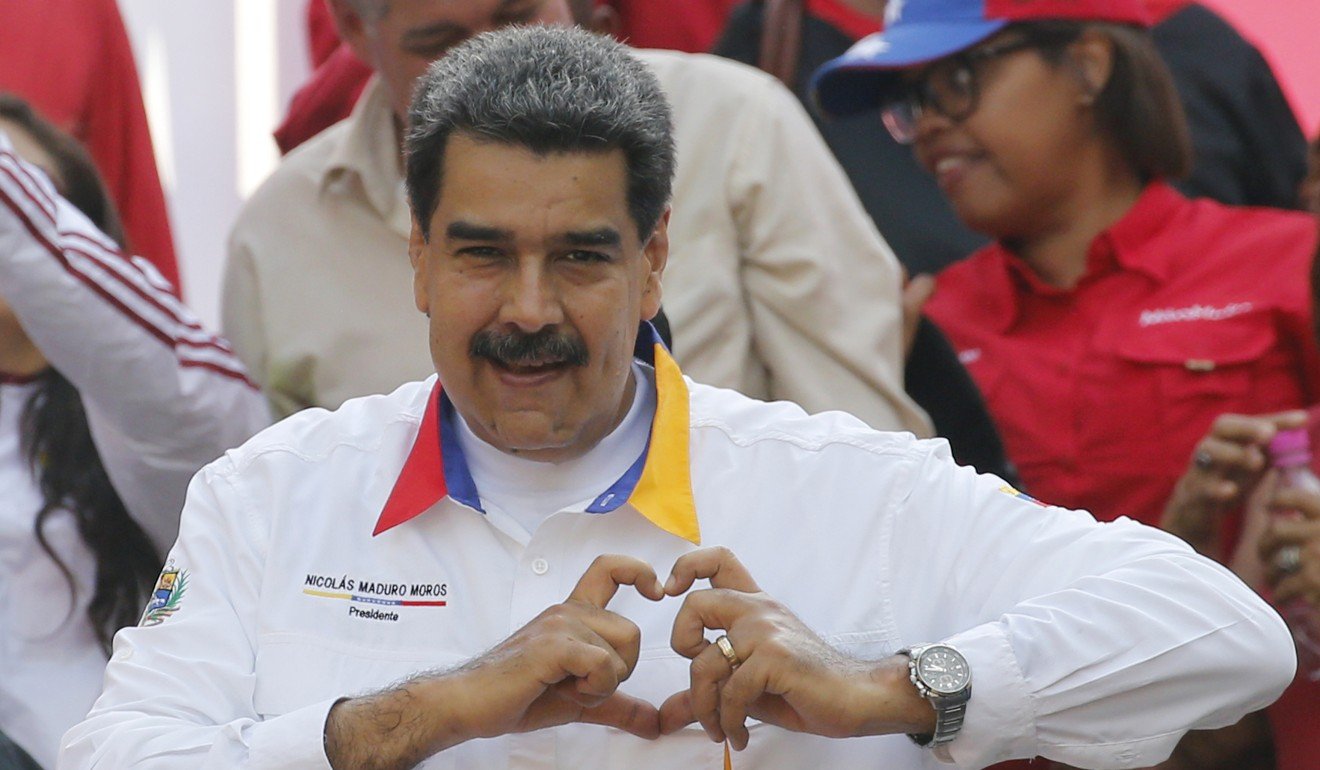
Venezuelan President Nicolas Maduro has the backing of China and Russia. Photo: AP
“Moscow and Beijing are not able to seriously hurt Washington by raising tariffs or denying access to high technology. However, there are plenty of areas where coordinated Sino-Russian policies can damage US interests in the short term or in the long run,” Lukin said. “For example, Moscow and Beijing could intensify their joint support for the Venezuelan government of Nicolas Maduro, frustrating Washington’s efforts to dislodge him.”
China and Russia would also be seeking to boost economic ties. Bilateral trade, dominated by Chinese imports of gas and oil, reached US$108 billion last year – falling far short of the target set in 2011 by Xi’s predecessor, Hu Jintao, of US$200 billion by 2020.
China and Russia to forge stronger Eurasian economic ties
Li Lifan, an associate research professor at the Shanghai Academy of Social Sciences, said bilateral trade was a sticking point. “This is one of the potential hindrances in China-Russia relations and Beijing is hoping to [address this] … in the face of a possible global economic slowdown,” Li said.
Given the escalating trade war with Washington, he said China would seek to diversify its investments and markets to other parts of the world, particularly Russia and Europe.
“China will step up its investment cooperation with Europe and Russia and focus more on multilateral investment,” Li said.
But Beijing was not expected to do anything to worsen tensions with Washington.
“China is currently taking a very cautious approach towards the US, trying to avoid heating up the confrontation and further aggravation of the situation,” said Danil Bochkov, a contributing author with the Russian International Affairs Council. “For China it is important to demonstrate that it has a reliable friend – Russia – but that should not be done in an openly provocative manner.”
Stephen Blank, a senior fellow at the American Foreign Policy Council in Washington, said Beijing and Moscow would also seek to contain US influence “as far as possible” from Central Asia, where China has increased its engagement through infrastructure building under the “Belt and Road Initiative”.
Leaders from the region will gather in Bishkek next month for the SCO summit, a security bloc set up in 2001 that now comprises China, Russia, Kazakhstan, Kyrgyzstan, Tajikistan, Uzbekistan, India and Pakistan. Those members account for about 23 per cent of the world’s land mass, 45 per cent of its population, and 25 per cent of global GDP.
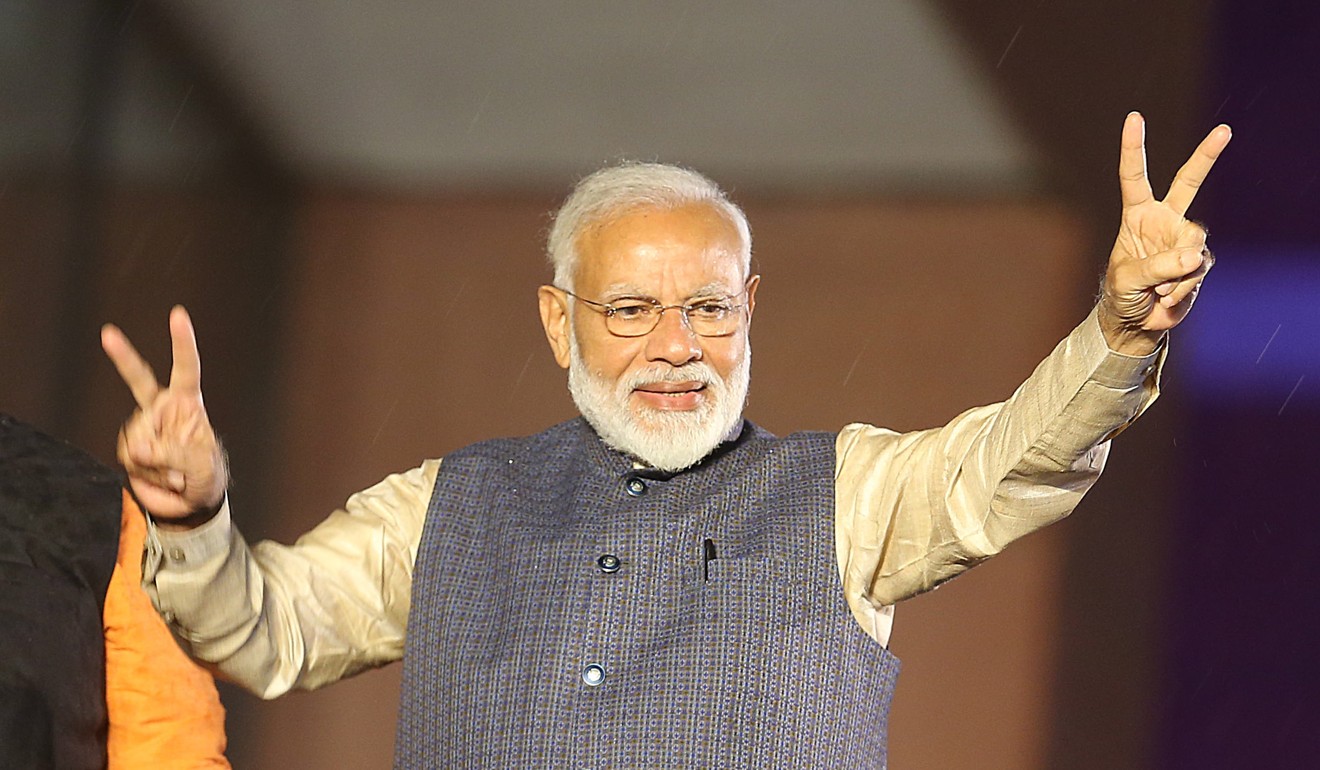
Newly re-elected Indian Prime Minister Narendra Modi could meet the Chinese president for talks in Bishkek next month. Photo: EPA-EFE
There is growing speculation that Xi will meet newly re-elected Indian Prime Minister Narendra Modi on the sidelines of that summit.
Independent analyst and author Namrata Goswami said India would be seeking a commitment to a WTO-led and rules-based multilateral trading system during the SCO talks.
“This is interesting and significant given the current US tendencies under President Donald Trump focused on ‘America first’ and the US-China trade war,” Goswami said.
Counterterrorism will again be a top priority at the SCO summit, amid concerns among member states about the rising number of Islamic State fighters returning from Syria and Iraq. Chinese scholars estimated last year that around 30,000 jihadists who had fought in Syria had gone back to their home countries, including China.
Alexander Bortnikov, chief of the main Russian intelligence agency FSB, said earlier that 5,000 fighters from a group affiliated with Isis had gathered in areas bordering former Soviet states in Central Asia, saying most of them had fought alongside Isis in Syria.
War-torn Afghanistan, which shares a border with four SCO member states – China, Pakistan, Tajikistan and Uzbekistan – is also likely to be high on the agenda at the Bishkek summit.
“With the Trump administration drafting plans to withdraw troops from Afghanistan, the SCO will assess the security situation there and decide whether to provide training for Afghan troops,” Li said.
Eva Seiwert, a doctoral candidate at the Free University of Berlin, expected the security bloc would also discuss Iran after the US withdrew from the 2015 nuclear deal and ordered new sanctions against the country.
Iran, which has observer status with the SCO, was blocked from becoming a full member in 2008 because it was subject to UN sanctions at the time. But its membership application could again be up for discussion.
Iran presses China and Russia to save nuclear deal
“The Trump administration’s unilateral withdrawal from the Iran nuclear deal in 2018 made it easy for China and Russia to present themselves as the proponents of peaceful settlement of conflicts,” Seiwert said. “Discussing the possibility of admitting Iran as a full member state would help the SCO members demonstrate their support of multilateral and peaceful cooperation.
“This would be a strong signal to the US and enhance the SCO’s standing in the international community,” she said.
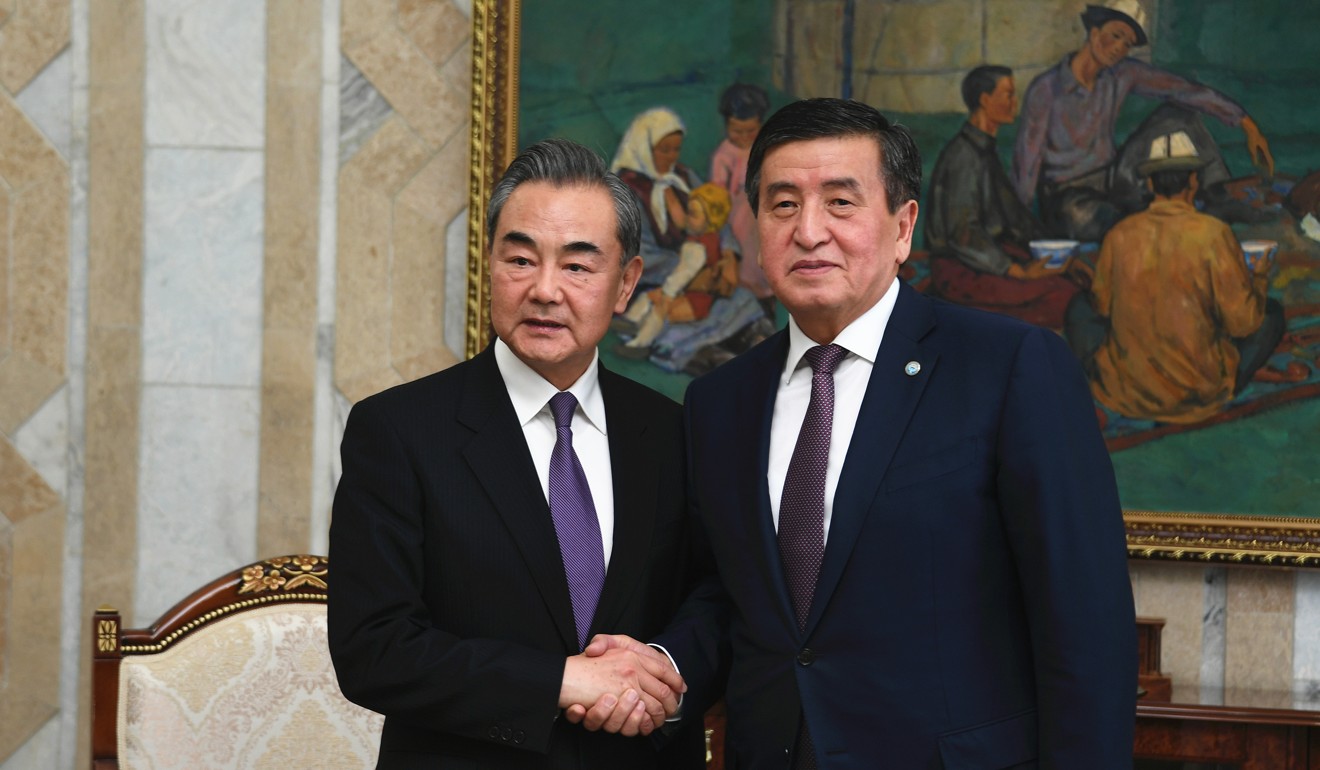
Kyrgyz President Sooronbay Jeenbekov (right) meets Chinese Foreign Minister Wang Yi in Bishkek on Tuesday last week. Photo: Xinhua
As well as security, Xi’s visit to Central Asia is also likely to focus on economic ties. Meeting Kyrgyz President Sooronbay Jeenbekov in Bishkek last week, Chinese Foreign Minister Wang Yi said Beijing would continue to “provide support and help national development and construction in Kyrgyzstan”.
Li said China may increase investment in the Central Asian region, especially in greenfield projects.
“China will continue to buy agriculture products from Central Asia, such as cherries from Uzbekistan, and build hydropower projects to meet local energy demand,” Li said. “Investment in solar and wind energy projects is also expected to increase too.”
YANGON, Dec. 7 (Xinhua) — China will continue its support for Myanmar government’s process of restoring peace and stability as well as promoting development in western Rakhine state, Chinese Ambassador Hong Liang said on Friday.
Hong made the remarks at a donation ceremony to Myanmar’s Union Enterprise for Humanitarian Assistance, Resettlement and Development (UEHRD).
China encourages the Myanmar government’s efforts on the repatriation process of displaced persons, he said.
Myanmar Minister of Social Welfare, Relief and Resettlement Dr Win Myat Aye thanked the Chinese Embassy for the prompt donation, saying that it will help build houses for the returnees and will also take the lead to bring about more donation from others.
Myanmar formed the UEHRD in Oct. last year for the effective performance of a long-term project of freedom from conflict in Rakhine state.
It also established nine private sector task forces to join the mechanism of UEHRD.



 CHINDIA ALERT: You'll be living in their world, very soon