Chindia Alert: You’ll be Living in their World Very Soon
aims to alert you to the threats and opportunities that China and India present. China and India require serious attention; case of ‘hidden dragon and crouching tiger’.
Without this attention, governments, businesses and, indeed, individuals may find themselves at a great disadvantage sooner rather than later.
The POSTs (front webpages) are mainly 'cuttings' from reliable sources, updated continuously.
The PAGEs (see Tabs, above) attempt to make the information more meaningful by putting some structure to the information we have researched and assembled since 2006.
Three films that opened on Monday morning rake in US$76.6 million by midday
Palme d’Or winner Chen Kaige heads bill with ensemble that has movie-goers in tears
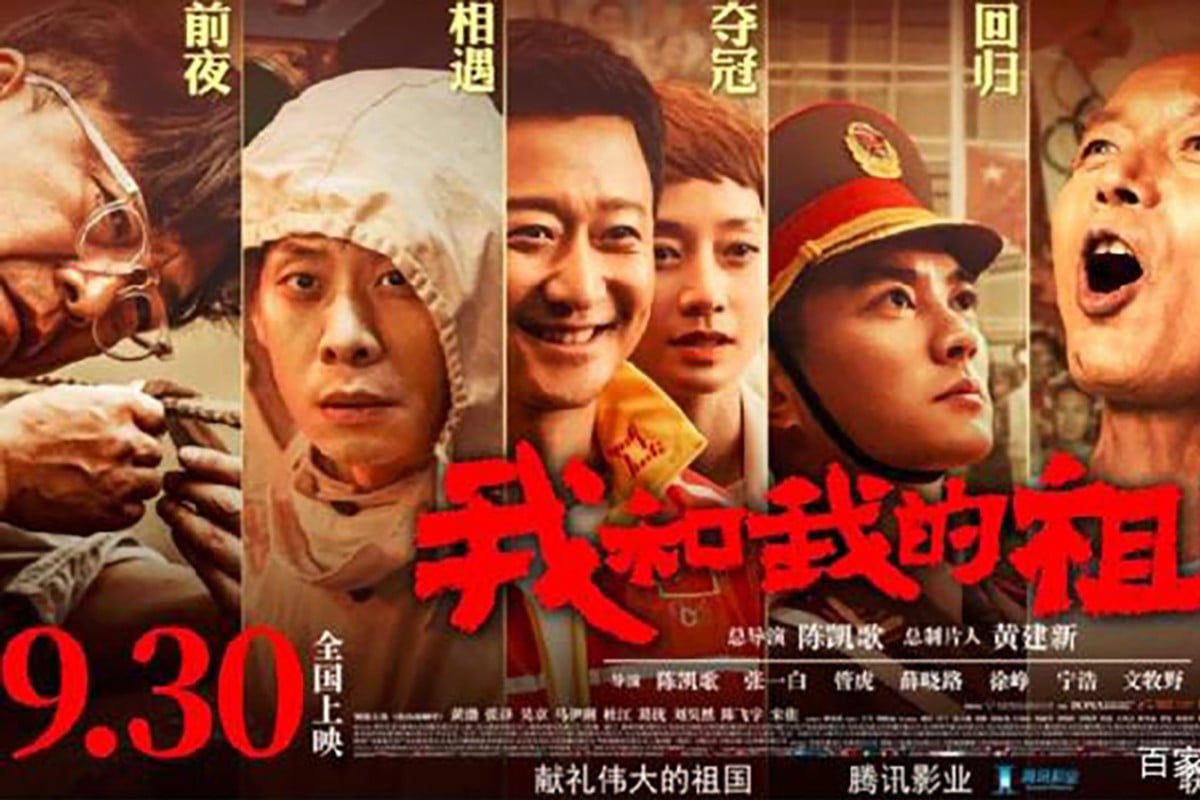
My People, My Country looks at seven events in the past 70 years through the eyes of seven Chinese directors. Photo: Baidu
Three films that paid tribute to the People’s Republic of China on the eve of its 70th anniversary grossed a total of 546 million yuan (US$76.6 million) at the box offices hours after opening on Monday, Maoyan Entertainment, China’s largest movie ticketing app, said.
My People, My Country, consisting of seven short stories by seven directors led by Cannes Palme d’Or winner Chen Kaige, recounted major events since 1949. It took in 225 million yuan.
Milestones including the detonation of China’s atomic bomb in 1964; the handover of Hong Kong from the UK to China in 1997, and the staging of the Summer Olympics in Beijing in 2008, brought back many memories and stirred feelings of national pride, film-goers said.
“I went to see the movie today and saw many primary school students with their parents. Tears welled in my eyes, and I felt touched and proud at the same time. Go China!” one Weibo user wrote.
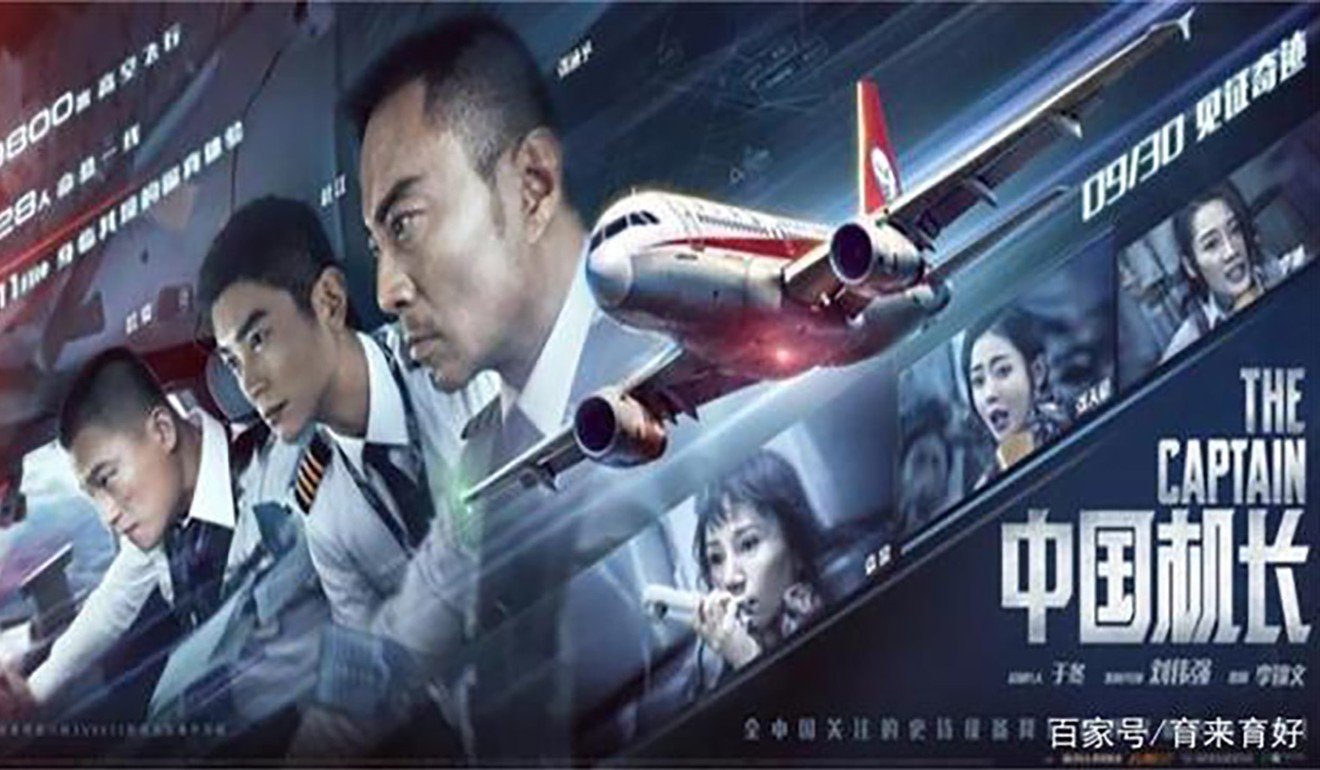
True-life drama The Captain has proved to a big screen hit with mainland cinema-goers. Photo: Baidu
“This movie used directors of commercial movies, and most of those born in the 1960s and 1970s lived through these moments. I think young people will bring their parents to see the film,” another Weibo user wrote.
True-life drama The Captain, directed by Hong Kong director Andrew Lau Wai-Keung, ran in second with a box office take of 175 million yuan by noon on Monday. The film was based on events in May 2018, when the cockpit window of a Sichuan Airlines flight was shattered at 30,000 feet over the Tibetan Plateau in western China. The decompression pulled the co-pilot halfway out of the cabin as the pilot fought to land the flight safely.
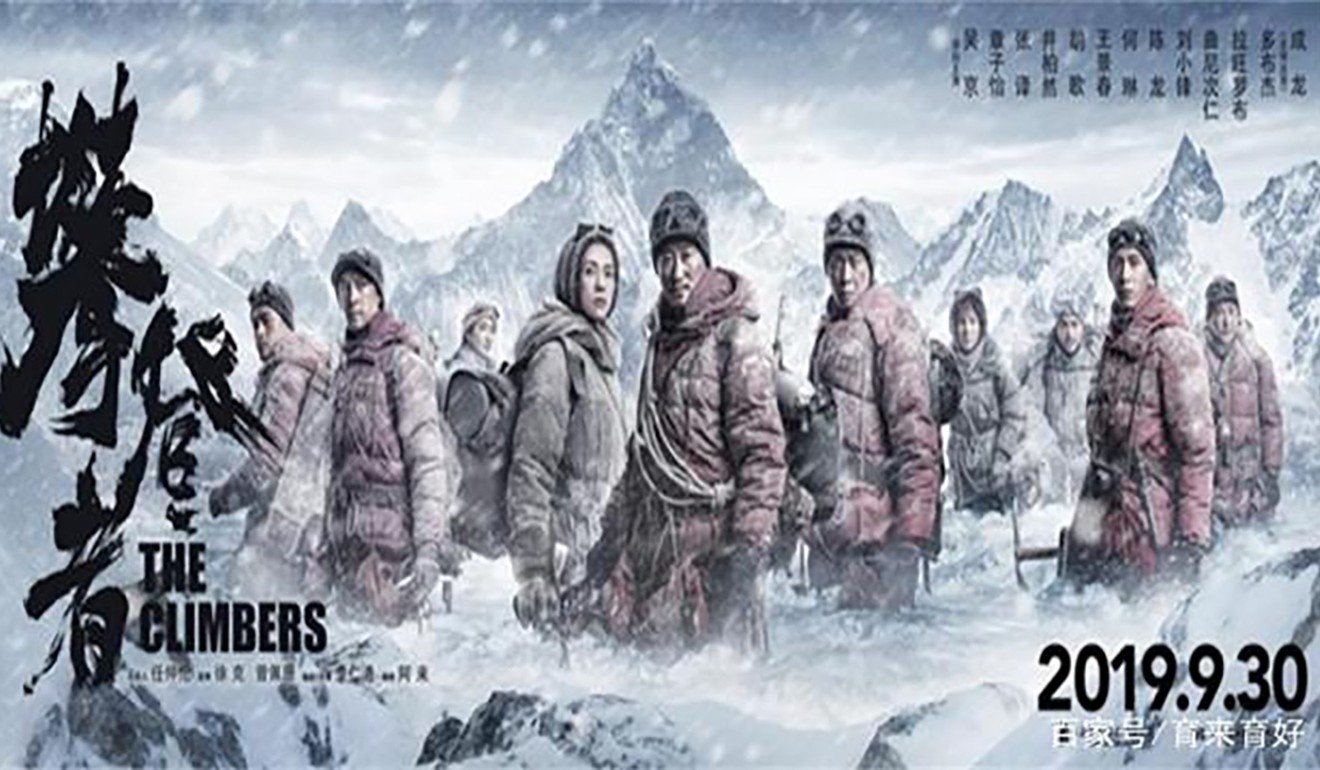
Big-budget film The Climbers, directed by Hong Kong’s Daniel Lee Yan-Kong and featuring stars such as Wu Jing and Zhang Ziyi, retraced the steps of two generations of Chinese mountaineers who scaled Mount Everest by the perilous North Ridge in 1960 and 1975. The film posted earnings of 146 million yuan.
Tencent’s homage to modern China tops gaming charts on eve of 70th anniversary celebrations
Patriotic feelings have been running high this week as the celebration of the 70th anniversary draws near.
My People, My Country’s theme song, Me and My Mother Country, an oldie recorded by Hong Kong’s Faye Wang, has been heard in shops, restaurants and workplaces all across the mainland.
The Climbers was directed by Hong Kong’s Daniel Lee Yan-Kong. Photo: Baidu
Last week, 200 million WeChat users responded to a campaign by internet company Tencent to add a national flag or Happy National Day sticker to their social media profile picture, The Beijing News reported. Demand was so heavy Tencent’s servers were overwhelmed for a short time.
LUCKNOW, India (Reuters) – Heavy rains have killed at least 113 people in India’s Uttar Pradesh and Bihar states over the past three days, officials said on Monday, as flood waters swamped a major city, inundated hospital wards and forced the evacuation of inmates from a jail.
India’s monsoon season that begins in June usually starts to retreat by early September, but heavy rains have continued across parts of the country this year, triggering floods.
An official said that at least 93 people had died in most populous Uttar Pradesh since Friday after its eastern areas were lashed by intense monsoon showers.
Rising water levels forced authorities to shift 900 inmates from a prison in eastern Ballia district, police officer Santosh Verma said.
In neighbouring Bihar, an impoverished agrarian region that was hit by floods earlier this year, the death toll from the latest bout of rain had reached 20 on Monday, a state government official said.
Bihar’s capital city of Patna, home to around 2 million, has been badly hit, with waist-deep flood waters across many streets, and entering homes, shops, and even the wards of a major hospital. In some parts, authorities deployed boats to rescue residents.
“The rains have stopped but there is waterlogging in many areas,” Bihar’s Additional Secretary in the Disaster Relief Department Amod Kumar Sharan said.
In its bulletin on Monday, India’s Meteorological Department said the intensity of rainfall over Bihar was very likely to reduce. Showers in Uttar Pradesh are also expected to abate this week.
Weather department officials said this month that monsoon rains were likely to be above average for the first time in six years. [nL3N26B1MD]
BEIJING, Sept. 28 (Xinhua) — The resumption of diplomatic ties between the governments of China and Kiribati fully demonstrates that the one-China principle meets the shared aspiration of the people and constitutes an irresistible trend of the times, Foreign Ministry Spokesperson Geng Shuang said Saturday.
Chinese State Councilor and Foreign Minister Wang Yi and Kiribati’s President and Foreign Minister Taneti Mamau on Friday signed a communique on resuming diplomatic relations at the ambassadorial level between the two countries at the Chinese Permanent Mission to the United Nations in New York.
Geng stressed that there is but one China in the world, that the government of the People’s Republic of China is the sole legitimate government that represents the whole of China and that Taiwan is an inalienable part of China’s territory.
“This is an objective fact, a universally recognized norm of international relations and a general consensus of the international community,” Geng said.
The government of the Republic of Kiribati recognizes and undertakes to stay committed to the one-China principle, sever the so-called “diplomatic relations” with Taiwan authorities and resume diplomatic relations with China. “We support this important decision which Kiribati government has made on its own as an independent sovereign state,” Geng said.
“This again fully demonstrates that the one-China principle meets the shared aspiration of the people and constitutes an irresistible trend of the times,” Geng added.
Relations between China and Pacific island nations are maintaining rapid growth. People of the two countries hold amicable feelings toward each other, he said. “It is the common expectation of all sectors of Kiribati to resume diplomatic relations and strengthen cooperation with China. It is in the fundamental and long-term interests of the two countries and peoples.”
China stands ready to strengthen pragmatic cooperation and friendly exchanges with Kiribati in various fields on the basis of the one-china principle and the Five Principles of Peaceful Coexistence to benefit the two countries and peoples, said the spokesperson.
Li Zhanshu, chairman of the Standing Committee of the National People’s Congress of China, meets with Russian President Vladimir Putin in Moscow, Russia, Sept. 25, 2019. Li paid an official goodwill visit to Russia from Sept. 25 to 28. (Xinhua/Pang Xinglei)
MOSCOW, Sept. 28 (Xinhua) — China’s top legislator Li Zhanshu and top Russian officials have agreed to further strengthen bilateral comprehensive cooperation and continue to promote legislative coordination for stronger ties.
Li, chairman of the Standing Committee of the National People’s Congress of China, on Saturday completed an official visit to Russia, during which he held talks with Russian President Vladimir Putin and the heads of both houses of the Russian parliament.
The Russian leaders congratulated China on the 70th anniversary of the founding of the People’s Republic of China and hailed the great achievements China has made in the past seven decades. The two sides also exchanged congratulations on the 70th anniversary of the establishment of diplomatic relations between China and Russia.
When meeting Putin, Li said, under the strategic guidance of the heads of state of the two countries, China-Russia relations have hit an unprecedented high and entered a new era of higher level and greater development.
Under the current international situation, China and Russia should strengthen mutual support, jointly build strategic support and security barriers between the two countries, and promote the construction of a new type of international relations and a community with a shared future for mankind, Li said.
He called on the two sides to bring their political mutual trust and strategic cooperation to a new height, and push economic and trade cooperation to a new level, so as to move forward their comprehensive strategic partnership of coordination for a new era.
For his part, Putin lauded Russia-China ties as a model of relations between the world’s major countries.
He said the comprehensive strategic partnership of coordination for a new era between the two countries, built in compliance with the international law, is in the interests of the two countries and the two peoples.
Noting that the current bilateral cooperation in various areas is steadily advancing towards the established goals, Putin urged the two countries to further strengthen all-round cooperation and develop their ties on the basis of existing achievements.
Li also met with Valentina Matviyenko, speaker of the Russian Federation Council, or the upper house of parliament, and Vyacheslav Volodin, speaker of the Russian State Duma, or the lower house of parliament.
During his talks with the heads of Russian parliament, Li said the cooperation between legislative bodies, as an important part of the China-Russia comprehensive strategic partnership of coordination for a new era, is expected to prioritize the implementation of the consensus reached by the two heads of state.
According to him, the two sides should promote communication and collaboration for the sake of the development of bilateral ties and, in particular, strengthen the exchanges of experience on foreign-related legal construction, so as to effectively deal with unilateralism and protectionism as well as defend the national sovereignty, security and interests of the two countries.
Li also called for better synergy between the China-proposed Belt and Road Initiative and the Russia-led Eurasian Economic Union, further cooperation in high-tech fields as well as sub-national cooperation and people-to-people exchanges.
For her part, Matviyenko said China’s development has proved to the world that a country can follow its own development path in line with its national conditions.
She said the people of the two countries work closely together and respect each other’s national interests, adding that no matter how the international situation changes, the long-term friendly cooperation between the two countries will remain unchanged.
The legislative bodies of the two countries should provide legal support and guarantee for the development of bilateral relations, Matviyenko said.
Volodin also urged the legislative bodies to make good use of existing cooperation mechanisms in a bid to promote cooperation in various fields, resist external interference and safeguard a fair and just international order.
Li and Volodin also attended the fifth meeting of the China-Russia committee for parliamentary cooperation.
In his speech, Li talked about China’s historic achievements in the past 70 years and spoke highly of the contribution of legislative cooperation to the development of bilateral relations.
He expressed hopes that both sides, after thorough studies, will come up with new ideas and new measures for legislative cooperation in a new era, better use the committee for parliamentary cooperation as a platform, and further enrich China-Russia relations.
While in Moscow, the top Chinese legislator also visited the Tomb of the Unknown Soldier and inspected the Moscow metro project of the China Railway Construction Corporation.
He also exchanged views on strengthening local cooperation with Rustam Minnikhanov, president of Russia’s Tatarstan Republic, in its capital of Kazan and visited the Kazan Helicopter Plant and Kazan Federal University.
Photo taken on Sept. 28, 2019 shows a flowerbed titled “Story of Spring” in Beijing, capital of China. Flowerbeds were built along the Chang’an Avenue to celebrate the 70th anniversary of the founding of the People’s Republic of China. (Xinhua/Wang Quanchao)
New system to enable businesses and government agencies to verify mainland-issued travel permits
The new system is expected to expand access to the public transport system on the mainland. Photo: Roy Issa
Hong Kong and Macau residents and “overseas Chinese” may soon be able to have full access to public services on the mainland using their China-issued travel documents, state news agency Xinhua reported.
Xinhua reported on Wednesday that the National Immigration Administration was putting a platform in place to enable government agencies and businesses to verify mainland-issued travel permits for Hong Kong and Macau residents.
“As soon as the platform becomes operational, these overseas travellers can, from October, have access to 35 public services, ranging from transport, to finance, education, communications, medical care and accommodation,” the report said.
According to the report, “overseas travellers” cover Hong Kong and Macau residents and ethnic Chinese living overseas.
But it did not say why the new measures did not apply to people from Taiwan.
The administration did not respond to requests for comment on Thursday.
Will Hong Kong anti-government protests ruin city’s role in Beijing’s Greater Bay Area plan? Depends on whom you ask
The new measure appears to be part of a long-term strategy by Beijing to foster closer ties between the mainland and Hong Kong and Macau.
In the last few years, the central government has launched a host of incentives for Hong Kong and Macau residents and businesses, including opportunities in the Greater Bay Area development plan in southern China.
Ivan Zhai, executive director of the Hong Kong Chamber of Commerce in China-Guangdong, welcomed the new measure.
“If such an arrangement can be fully implemented, Hong Kong businesspeople who operate on the mainland will be thrilled,” Zhai said.
The Hong Kong business community has long lobbied for relaxation over areas such as train ticketing and hotel registration.
Zhai said that although Hong Kong and Macau residents could now book high-speed train tickets with their mainland-issued travel permits, there were few ticket machines that could automatically read the permits, complicating the process.
“There are also hotels on the mainland that can only entertain guests with Chinese identity cards and currently Hong Kong travellers can only go to hotels that are authorised to accept the mainland-issued travel permits,” he said.
China’s regulator relaxes currency conversion rules throughout Shenzhen, sharpening city’s edge in Greater Bay Area
According to the report, there will be stiff penalties for departments or businesses misusing information collected through the platform.
Zhai said Hong Kong businesspeople who travelled to the mainland often were more likely to be concerned about convenience than the risk of invasion of privacy.
“If you are a frequent traveller in China, you would have expected that the relevant departments of the Chinese government already have information about you anyway,” he said.
Millions of Chinese children are raised by their grandparents but some seniors are demanding compensation
For generations in China grandparents have provided childcare, but some are no longer willing to do so for free. Photo: Shutterstock
The traditional role of grandparents in caring for China’s children has been called into question with two recent lawsuits sparking debate about whether seniors should be paid for their efforts.
Two grandmothers took their demands for compensation to court in separate cases which have highlighted the reliance of Chinese workers on their parents to provide childcare while they pursue professional advancement.
A woman in Mianyang, in the southwestern province of Sichuan, was awarded more than 68,000 yuan (US$9,500) by a local court after she sued her son and daughter-in-law for the costs of raising her nine-year-old grandchild, according to Red Star News.
The woman, identified only by her surname Wang, had been the child’s full-time carer for eight years after his parents left home to seek better-paid jobs elsewhere. Wang said she had taken care of most of her grandson’s living expenses and had decided to seek compensation when his parents said they were considering a divorce.
They should respect our contribution. Grandmother Wang, Sichuan province
“I only want to let them know through this lawsuit that it’s their obligation to raise their children,” she was reported as saying. “The young ones should not take it for granted that old people ought to look after their grandchildren. They should respect our contribution.”
Despite winning the case, she has not received a penny and the boy still lives with her.
In another case, three months ago, a Beijing court supported a woman’s demand for compensation for helping to raise her granddaughter since her birth in 2002.
The stories of the two women generated a public reflection on the Chinese way of childcare which, for generations, has involved leaving most – if not all – of the burden on grandparents.
One of 60 million: life as a ‘left-behind’ child in China
From a cultural perspective, it has been a matter of course in a country with a long history of several generations living under one roof, for grandparents to participate in child rearing, according to Xu Anqi, a researcher specialising in family studies at the Shanghai Academy of Social Sciences.
“Today, as people face fierce competition and great pressure from work, it’s still common to rely on their old parents to look after their children,” she said.
While rapid urbanisation in recent decades has broken up multi-generational households, Chinese elderly still take an active role in child rearing, with many relocating to their children’s cities to take on the job.
Millions more families do it the other way round – with parents leaving children in their hometown with the grandparents while they seek better paying jobs in the cities. In August last year, according to the Ministry of Civil Affairs, China had nearly 7 million “left behind kids”, as they are known.
My little granddaughter is adorable, and generally I enjoy doing all this.Li Xiujuan, grandmother
“Many grandmothers like me would joke that we are ‘unpaid nannies’, but at the same time we feel it’s our responsibility to help them out – they would be in financial stress if one of them quit or they hired a nanny,” said Li Xiujuan, who relocated from her hometown in the central province of Henan to Shanghai two years ago to help look after her granddaughter.
“I’m a 24-hour nanny for my grandkid. I prepare food for her, wash her clothes, attend early childhood classes with her, take her for a walk in the park twice a day, sleep beside her at noon and night …” she said.
“I never cared for my daughter when she was little like I do her daughter now. You know, it was also her grandmother who mainly took care of her daily life when she was young,” Li said, laughing.
“My little granddaughter is adorable, and generally I enjoy doing all this. The hard part is that I miss my friends and relatives back home. We don’t have friends here. I have plenty of things to do at home, but here, nothing but babysitting. People are polite, but it’s difficult to make new friends,” she said.
‘Left behind’ sisters cry when parents leave home to go to work
In a 2017 study of about 3,600 households in six major cities including Beijing and Guangzhou, the Chinese Society of Education found almost 80 per cent of surveyed households had at least one grandparent as carer before children began primary school.
The study also showed that 60 per cent of parents still relied on help from grandparents after children were old enough for primary school at the age of six.
Whether grandparents should be compensated for their efforts split a poll of 49,000 users conducted by social media platform Weibo in late June, with half believing that the older generation should be paid for raising their grandchildren. Only 2.3 per cent said babysitting grandchildren was “an unalterable principle” for the elderly.
“This arrangement could be well managed and improve blood ties if children reward the elderly in their own ways, such as sending gifts on holidays and taking them on trips,” Shanghai researcher Xu said.
I think what they need more is words of appreciation, which many of us have neglected. David Dai, Beijing parent
Grandmother Li agreed: “I think regular payment is a little awkward, but I do expect some kind of reward, like cash gifts on festivals and daily necessities as presents.”
David Dai, a 30-year-old white collar worker in Beijing, said how to reward grandparents for their contribution depended on the financial situation of each household.
“My parents are farmers – they are in good shape and not so old – in their late 50s, and if they didn’t come all the way from my hometown in Anhui to Beijing to look after my son, they would still be taking some odd jobs,” he said.
“Therefore, besides covering their living costs at my place, I give them cash gifts on their birthdays, the Spring Festival and other important occasions, because babysitting their grandchild means they lose the opportunity to work,” he added.
“In some families, the grandparents might have retired and have a good pension. They don’t lack money and enjoy spending time with their grandkids. I don’t think they need to be paid. I think what they need more is words of appreciation, which many of us have neglected,” Dai said.
China boosts childcare and maternal health services in bid to lift birth rate
But for those who never show any gratitude, their parents have every reason not to offer child rearing help or to demand payment, Xu said.
Zhang Tao, a lawyer at the Hiways Law Firm in Shanghai, noted that as long as at least one parent of a child was living, the grandparents had no obligation to help with childcare.
“The grandparents should be compensated for the money they have paid for the child’s education, medical fees, and accommodation from the beneficiary,” he said.
But whether they should be paid has become the latest controversy as more grandparents find it a burden.
Thirty-six others were hurt, with nine being treated for serious injuries
Bus had a tyre blowout and collided with road divider before slamming into truck in the opposite lane in Yixing, Jiangsu province, police say
The expressway reopened after a rescue operation of more than eight hours. Photo: Weibo
Thirty-six people were killed and another 36 injured when a coach had a tyre blowout and crashed into a truck on an expressway in eastern China on Saturday.
The coach, which had 69 passengers on board, collided with a road divider before slamming into a truck in the opposite lane at about 7am, the Yixing municipal police department said in a statement on Sunday.
There were three people in the truck.
The accident happened on the Yixing section of the Changchun-Shenzhen Expressway in Jiangsu province.
A rescue operation took more than eight hours, and the injured were taken to hospitals in nearby Yibing.
Nine people were seriously injured, 26 were being treated for minor injuries and one had been discharged from hospital, according to the statement.
A tyre blowout may have caused the accident on Saturday morning. Photo: Weibo
Police are still looking into the crash but said “according to our preliminary investigation, the accident was caused by a blowout of one of the coach’s front tyres”.
ahead of National Day and the week-long holiday marking it, as all levels of government try to make sure nothing goes wrong.
This month, local governments were told to check factories, restaurants, rental accommodation, scenic spots close to water and roads for safety hazards and to take measures to prevent fire, crashes or other accidents, according to media reports.
Traffic accidents are common in China, where about 200,000 people lose their lives on the roads every year, according to the World Health Organisation.
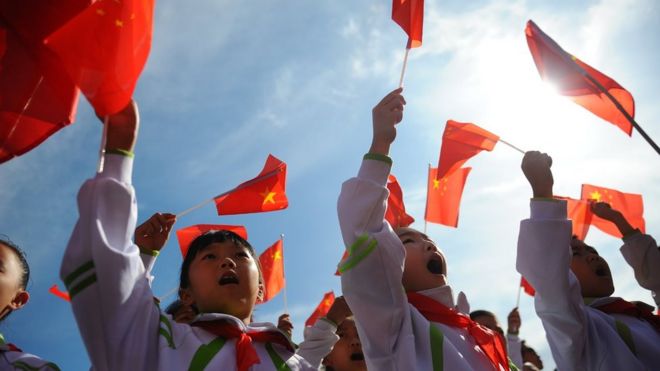
Image copyright GETTY IMAGESImage caption China’s version of its past is a story of prosperity, progress and sacrifice for the common good
China’s extraordinary rise was a defining story of the 20th Century, but as it prepares to mark its 70th anniversary, the BBC’s John Sudworth in Beijing asks who has really won under the Communist Party’s rule.
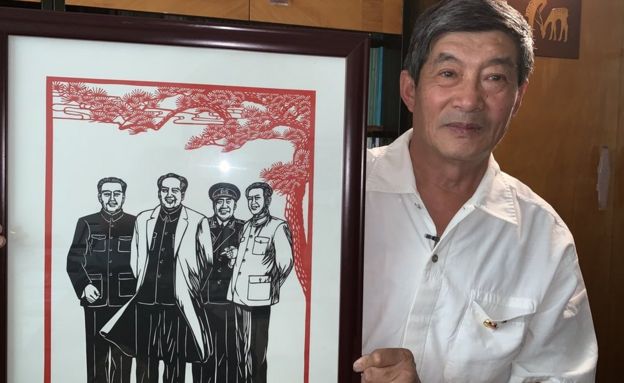
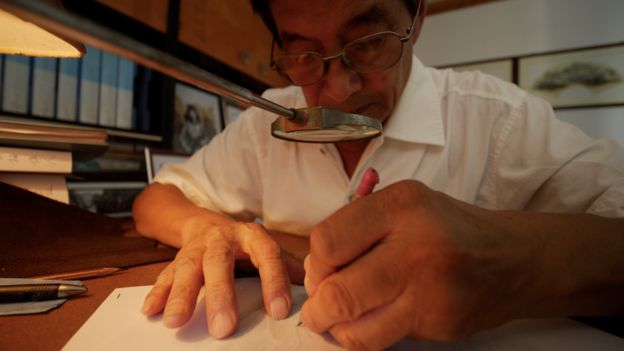
Sitting at his desk in the Chinese city of Tianjin, Zhao Jingjia’s knife is tracing the contours of a face.
Cut by delicate cut, the form emerges – the unmistakable image of Mao Zedong, founder of modern China.
The retired oil engineer discovered his skill with a blade only in later life and now spends his days using the ancient art of paper cutting to glorify leaders and events from China’s communist history.
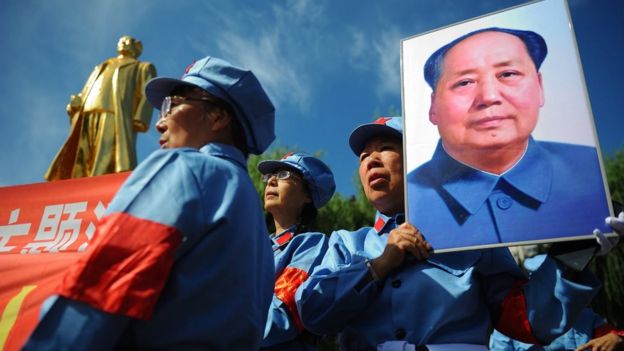
“I’m the same age as the People’s Republic of China (PRC),” he says. “I have deep feelings for my motherland, my people and my party.”
Image caption For people like Zhao Jingjia, China’s success outweighs the “mistakes” of its leaders
Born a few days before 1 October 1949 – the day the PRC was declared by Mao – Mr Zhao’s life has followed the dramatic contours of China’s development, through poverty, repression and the rise to prosperity.
Now, in his modest but comfortable apartment, his art is helping him make sense of one of the most tumultuous periods of human history.
“Wasn’t Mao a monster,” I ask, “responsible for the deaths of tens of millions of his countrymen?”
“I lived through it,” he replies. “I can tell you that Chairman Mao did make some mistakes but they weren’t his alone.”
“I respect him from my heart. He achieved our nation’s liberation. Ordinary people cannot do such things.”
On Tuesday, China will present a similar, glorious rendering of its record to the world.
Beijing will tremble to the thunder of tanks, missile launchers and 15,000 marching soldiers, a projection of national power, wealth and status watched over by the current Communist Party leader, President Xi Jinping, in Tiananmen Square.
An incomplete narrative of progress
Like Mr Zhao’s paper-cut portraits, we’re not meant to focus on the many individual scars made in the course of China’s modern history.
It is the end result that matters.
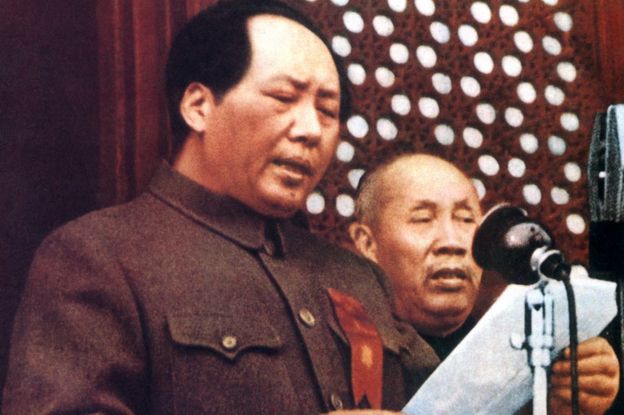
Image copyright XINHUA/AFPImage caption Mao Zedong pronounces the dawn of the People’s Republic of China on 1 October 1949
And, on face value, the transformation has been extraordinary.
On 1 October 1949, Chairman Mao stood in Tiananmen Square urging a war-ravaged, semi-feudal state into a new era with a founding speech and a somewhat plodding parade that could muster only 17 planes for the flyby.
This week’s parade, in contrast, will reportedly feature the world’s longest range intercontinental nuclear missile and a supersonic spy-drone – the trophies of a prosperous, rising authoritarian superpower with a 400 million strong middle class.
It is a narrative of political and economic success that – while in large part true – is incomplete.
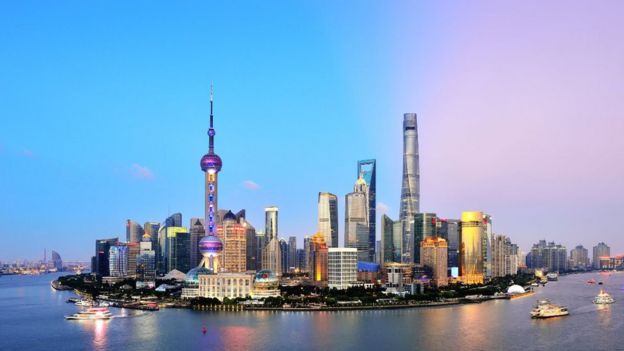
New visitors to China are often, rightly, awe-struck by the skyscraper-festooned, hi-tech megacities connected by brand new highways and the world’s largest high-speed rail network.
Image copyright GETTY IMAGESImage caption Those in China’s glittering cities may accept the trade-off of political freedom for economic growth
They see a rampant consumer society with the inhabitants enjoying the freedom and free time to shop for designer goods, to dine out and to surf the internet.
“How bad can it really be?” the onlookers ask, reflecting on the negative headlines they’ve read about China back home.
The answer, as in all societies, is that it depends very much on who you are.
Many of those in China’s major cities, for example, who have benefited from this explosion of material wealth and opportunity, are genuinely grateful and loyal.
In exchange for stability and growth, they may well accept – or at least tolerate – the lack of political freedom and the censorship that feature so often in the foreign media.
For them the parade could be viewed as a fitting tribute to a national success story that mirrors their own.
But in the carving out of a new China, the knife has cut long and deep.
The dead, the jailed and the marginalised
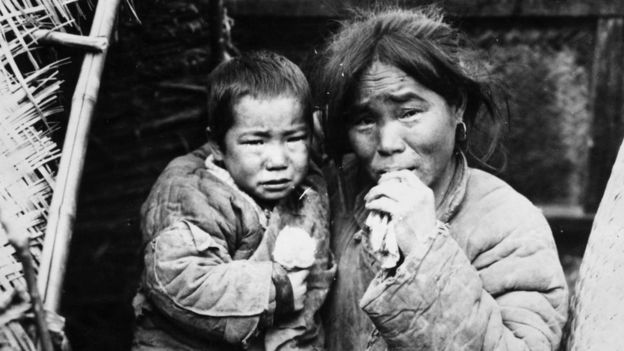
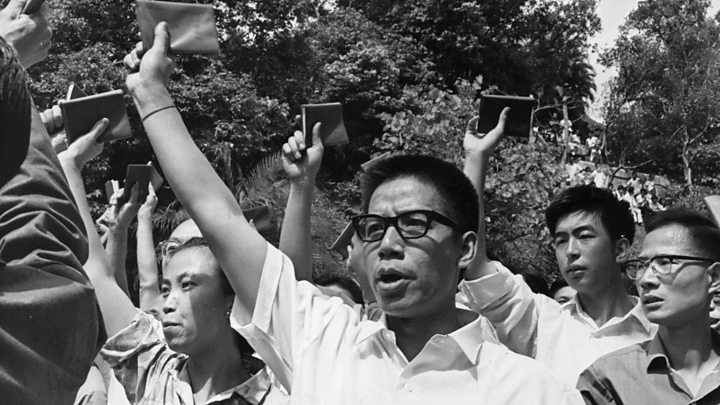
Mao’s man-made famine – a result of radical changes to agricultural systems – claimed tens of millions of lives and his Cultural Revolution killed hundreds of thousands more in a decade-long frenzy of violence and persecution, truths that are notably absent from Chinese textbooks.
Image copyright GETTY/TOPICALImage caption Tens of millions starved to death under Mao, as China radically restructured agriculture and society
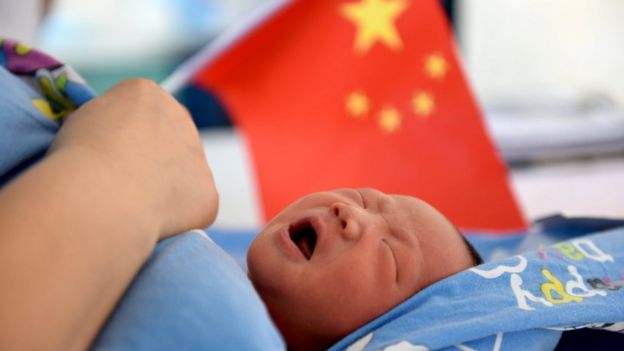
After his death, the demographically calamitous One Child Policy brutalised millions over a 40-year period.
Still today, with its new Two Child Policy, the Party insists on violating that most intimate of rights – an individual’s choice over her fertility.
The list is long, with each category adding many thousands, at least, to the toll of those damaged or destroyed by one-party rule.
Image copyright GETTY IMAGESImage caption Beijing still regulates how many children families can have
There are the victims of religious repression, of local government land-grabs and of corruption.
There are the tens of millions of migrant workers, the backbone of China’s industrial success, who have long been shut out of the benefits of citizenship.
A strict residential permit system continues to deny them and their families the right to education or healthcare where they work.
And in recent years, there are the estimated one and a half million Muslims in China’s western region of Xinjiang – Uighurs, Kazakhs and others – who have been placed in mass incarceration camps on the basis of their faith and ethnicity.
China continues to insist they are vocational schools, and that it is pioneering a new way of preventing domestic terrorism.
The stories of the dead, the jailed and the marginalised are always much more hidden than the stories of the assimilated and the successful.
Viewed from their perspective, the censorship of large parts of China’s recent history is not simply part of a grand bargain to be exchanged for stability and prosperity.
Getty
Timeline of modern China
1949 Mao declares the founding of the People’s Republic of China
1966-76 Cultural Revolution brings social and political upheaval
1977 Deng Xiaoping initiates major reforms of China’s economy
1989 Army crushes Tiananmen Square pro-democracy protests
2010 China becomes the world’s second-largest economy
2018 Xi Jinping is cleared to be president for life
It is something that makes the silence of their suffering all the more difficult to penetrate.
It is the job of foreign journalists, of course, to try.
‘Falsified, faked and glorified’
But while censorship can shut people up, it cannot stop them remembering.
Prof Guo Yuhua, a sociologist at Beijing’s Tsinghua University, is one of the few scholars left trying to record, via oral histories, some of the huge changes that have affected Chinese society over the past seven decades.
Her books are banned, her communications monitored and her social media accounts are regularly deleted.
“For several generations people have received a history that has been falsified, faked, glorified and whitewashed,” she tells me, despite having been warned not to talk to the foreign media ahead of the parade.
“I think it requires the entire nation to re-study and to reflect on history. Only if we do that can we ensure that these tragedies won’t be repeated.”
Image copyright GETTY IMAGESImage caption Can progress really be attributed to the leadership?
A parade, she believes, that puts the Communist Party at the front and centre of the story, misses the real lesson, that China’s progress only began after Mao, when the party loosened its grip a bit.
“People are born to strive for a better, happier and more respectful life, aren’t they?” she asks me.
“If they are provided with a tiny little space, they’ll try to make a fortune and solve their survival problems. This shouldn’t be attributed to the leadership.”
‘Our happiness comes from hard work’
As if to prove the point about how the unsettled, censored pasts of authoritarian states continue to impact the present, the parade is for invited guests only.
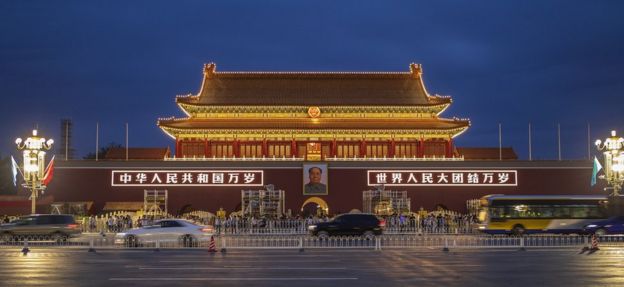
Image copyright GETTY IMAGESImage caption Mao’s portrait will, as it always is, be watching over the events in Tiananmen Square
Another anniversary, of which Tiananmen Square is the centrepiece, is also being measured in multiples of 10 – it is 30 years since the bloody suppression of the pro-democracy protests that shook the foundations of Communist Party rule.
The troops will be marching – as they always do on these occasions – down the same avenue on which the students were gunned down.
The risk of even a lone protester using the parade to mark a piece of history that has largely been wiped from the record is just too great.
With central Beijing sealed off, ordinary people in whose honour it is supposedly being held, can only watch it on TV.
Back in his Tianjin apartment, Zhao Jingjia shows me the intricate detail of a series of scenes, each cut from a single piece of paper, depicting the “Long March”, a time of hardship and setback for the Communist Party long before it eventually swept to power.
“Our happiness nowadays comes from hard work,” he tells me.
It is a view that echoes that of the Chinese government which, like him, has at least acknowledged that Mao made mistakes while insisting they shouldn’t be dwelt on.
“As for the 70 years of China, it’s extraordinary,” he says. “It can be seen by all. Yesterday we sent two navigation satellites into space – all citizens can enjoy the convenience that these things bring us.”
Media caption What was China’s Cultural Revolution?