Chindia Alert: You’ll be Living in their World Very Soon
aims to alert you to the threats and opportunities that China and India present. China and India require serious attention; case of ‘hidden dragon and crouching tiger’.
Without this attention, governments, businesses and, indeed, individuals may find themselves at a great disadvantage sooner rather than later.
The POSTs (front webpages) are mainly 'cuttings' from reliable sources, updated continuously.
The PAGEs (see Tabs, above) attempt to make the information more meaningful by putting some structure to the information we have researched and assembled since 2006.
Tense relations with the US and the question of whether armed confrontation can be avoided will loom large when China’s political elites meet
Structural shifts in balance of power have brought the countries closer to the brink, analyst says, with the South China Sea the most likely flashpoint
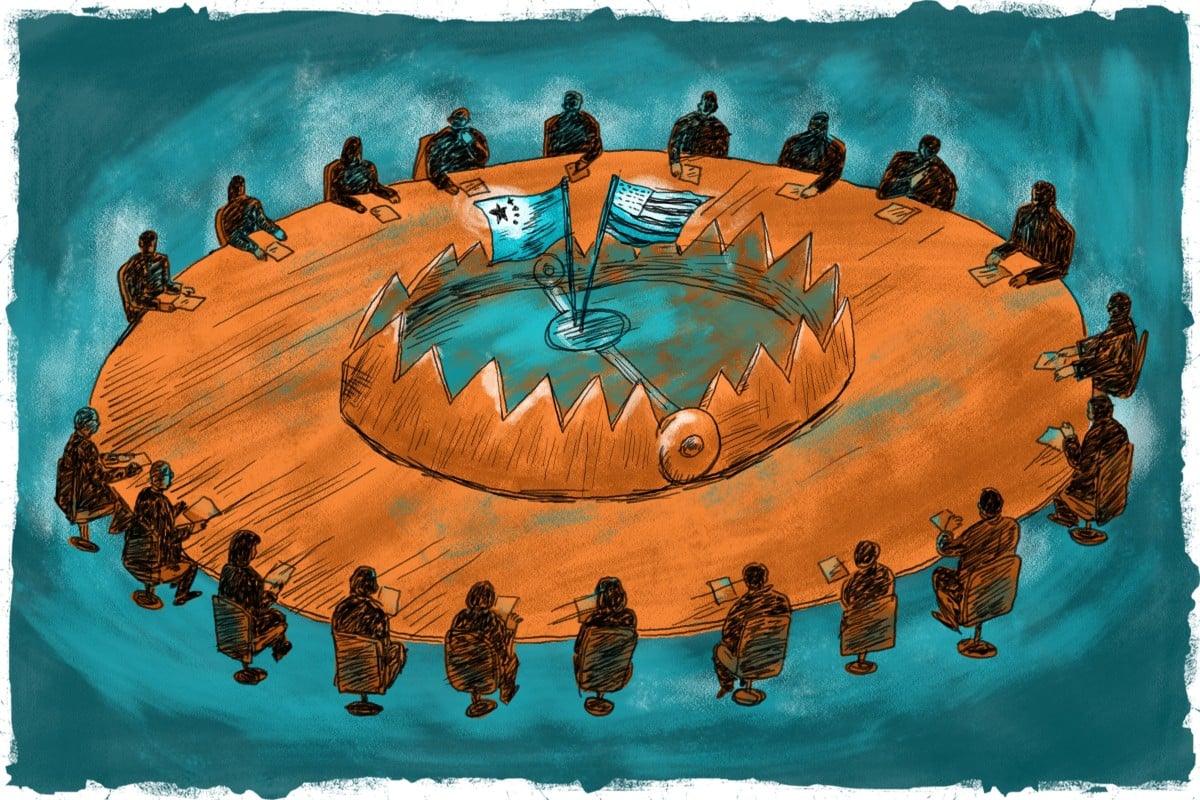
Illustration: Brian Wang
This is the fifth in a nine-part series examining the issues Chinese leaders face as they gather for their annual “two sessions” of the National People’s Congress and Chinese People’s Political Consultative Conference this week. This story looks at the sharp decline of US-China ties, and where it may lead.
When thousands of China’s elites flock to Beijing for the delayed national legislative session starting on Friday they will face a renewed debate about relations with the US. Specifically, can armed conflict between the two economic superpowers be avoided?
The question is not new, but it has taken on a new urgency as the acrimony escalates between Washington and Beijing amid the Covid-19 pandemic, exposing growing cracks in the current global order.
Harvard professor Graham Allison raised the question in a 2017 book, Destined for War: Can America and China Escape Thucydides’ Trap? The reference being to the Greek historian of 2,500 years ago and the conundrum named after him on the likelihood of armed conflict when a rising power challenges a ruling power.
President Xi Jinping has shown personal interest in the Thucydides trap concept, which Allison first posed in a 2012 newspaper article, referencing it on at least three occasions, including the eve of the swearing-in ceremony of US President Donald Trump three years ago.
Speaking at the World Economic Forum in Davos in January 2017, Xi said the Thucydides trap “can be avoided … as long as we maintain communication and treat each other with sincerity”.
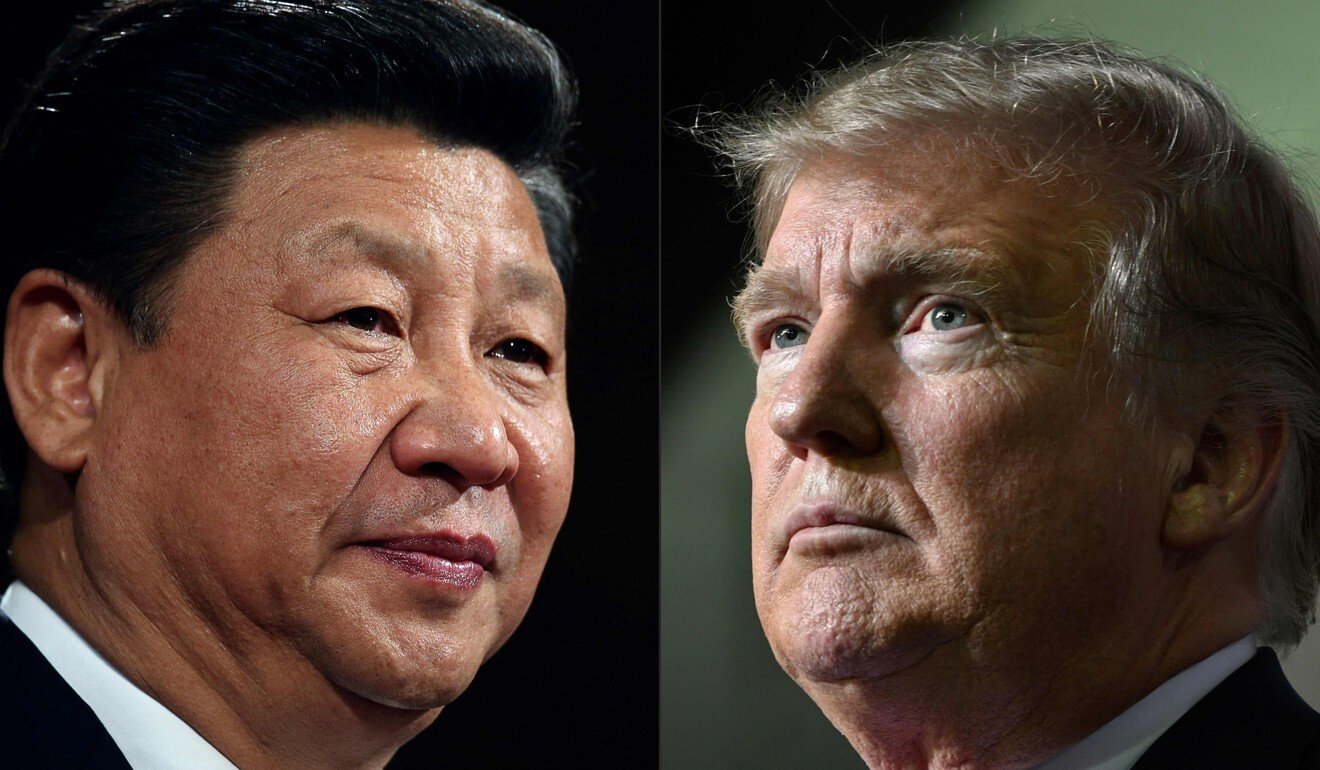
Xi Jinping referenced the Thucydides trap concept on the eve of Donald Trump’s swearing-in ceremony. Photos: AFP
But since then, the devastating Covid-19 pandemic has driven the deeply fraught US-China relations to the brink of an all-out confrontation as a result of strategic distrust and misperception, said Wang Jisi, president of Peking University’s Institute of International and Strategic Studies.
“China and the US are shifting from an all-around competition to a full-scale confrontation, with little room for compromise and manoeuvring,” Wang said in a speech in late March. “We cannot rule out the possibility that the two powers may fall into the Thucydides trap.”
That seems to sum up the tone of recent communications from the US side. Trump has vowed to “take whatever actions that are necessary” to seek reparations and hold China accountable for the Covid-19 disease that was first identified in the city of Wuhan at the end of last year. His top aides, especially Secretary of State Mike Pompeo and Defence Secretary Mark Esper, have been particularly blunt.
During the Munich Security Conference in February, Esper described China as a rising threat to the world order and urged countries to side with the US in preparing for “high intensity conflict against China”.
The prospects for bilateral ties are deeply worrying and we are just one step away from a new cold warZhu Feng, Nanjing University
Mainland authorities are usually reluctant to play up sensitive diplomatic topics during the annual gatherings of the National People’s Congress and the Chinese People’s Political Consultative Conference, known as the “two sessions”.
Domestic concerns, especially the socio-economic upheaval wrought by the pandemic, will no doubt dominate the week-long meetings as the country faces the deepest economic contraction in decades, mass unemployment, and a possible manufacturing exodus from China.
However, the sharp decline in relations with the US in recent months and its possible consequences are expected to loom large in the minds of over 5,000 participants at the two sessions, according to Gu Su, a political scientist at Nanjing University.
“Considering the boiling tensions with the US over Covid-19 and the resulting scrutiny of China’s global ambitions – which have dealt a heavy blow to the economy, especially at local levels, and left the country increasingly isolated – it may be hard to suppress such discussions,” Gu said.
Given the widespread public interest in these contentious topics, Xi and other top leaders may need to weigh in personally and set the tone for the national debate, especially on the future of China and US relations, he said.
But it would be unrealistic to expect major policy decisions on diplomacy, as “the two sessions are not usually known for substantial foreign policy deliberations”, said Zhu Feng, an international affairs expert at Nanjing University.
Paramilitary police officers patrol in Tiananmen Square near the Great Hall of the People in Beijing, where China’s political elites are about to meet for the “two sessions”. Photo: Reuters
‘Worst-case scenarios’
The deterioration of US-China ties has clearly alarmed Xi and his top aides. On April 8, the Chinese leader issued an unusually stark warning that “we must get ready for the worst-case scenarios” in light of unprecedented external adversity and challenges, according to Xinhua.
While the state news agency did not elaborate on what Xi meant by worst-case scenarios, a recent study by a Chinese government-backed think tank offered some hints.
The China Institutes of Contemporary International Relations (CICIR), affiliated with the Ministry of State Security, said Beijing may need to prepare for armed confrontation with Washington amid the worst anti-China backlash since the Tiananmen crackdown in 1989, according to Reuters, which cited an internal report.
The report warned that China’s overseas investments, especially the ambitious Belt and Road Initiative, could fall victim to rising anti-Chinese sentiments, while the US may accelerate efforts to counter Beijing’s expanding clout by increasing financial and military support for regional allies.
While the think tank declined to confirm the Reuters story, many international relations analysts shared similar bleak assessments of US-China relations.
“We are already in an all-around confrontation with the US, which sees both sides at odds on almost every front – from trade and tech tensions, military, ideological and geopolitical rivalry, to political and legal battles over the coronavirus,” Zhu said. “The prospects for bilateral ties are deeply worrying and we are just one step away from a new cold war.”
With much of the world still in the grip of the Covid-19 pandemic, Beijing’s critics and opponents, led by the US, have upped the ante in the blame-shifting game as they line up to pursue an international investigation into the origins of the deadly virus.
The coronavirus has also derailed most of China’s diplomatic agenda for the first half of the year, with Xi’s planned state visits to Japan and South Korea postponed.
Meanwhile, China’s relations with the European Union have become more tense, though Beijing managed to dodge a bullet at this week’s World Health Assembly, which adopted a mildly worded resolution drafted by the EU to carry out an independent inquiry into different countries’ response to the outbreak at “an appropriate time”.
But a growing number of European countries have pushed back against China’s diplomatic assertiveness and followed Washington’s lead to press Beijing for greater transparency over the coronavirus.
Shelley Rigger, a political science professor at Davidson College in North Carolina, said the CICIR report, if confirmed, offered a clear-eyed assessment of the situation and did not have the usual triumphalist tone present in many papers on international relations from China.
“That’s a good thing. Everyone needs to be realistic, and not indulge in wishful thinking or overconfidence,” she said.
The ‘two sessions’ explained: China’s most important political meetings of the year
Seth Jaffe, assistant professor of political science and international affairs at John Cabot University in Rome and an expert on Greek history, said the Chinese think tank report was “profoundly concerning”.
“The acrimonious narratives surrounding Covid-19 are currently reshaping the attitudes of leaders and populations alike, which is leading to harder-line strategic postures, as evidenced by the hawkish CICIR report,” he said. “In this way, the virus blame game is stirring up nationalistic pride and grievance, narrowing the space for political leaders to manoeuvre, and creating zero-sum dynamics that invite future conflict – a vicious cycle.”
According to Jaffe, the author of Thucydides on the Outbreak of War: Character and Contest, although the temperaments of Trump and Xi would matter enormously in any actual crisis, it was the structural shifts in the balance of power in recent years that had brought the two sides closer to the brink.
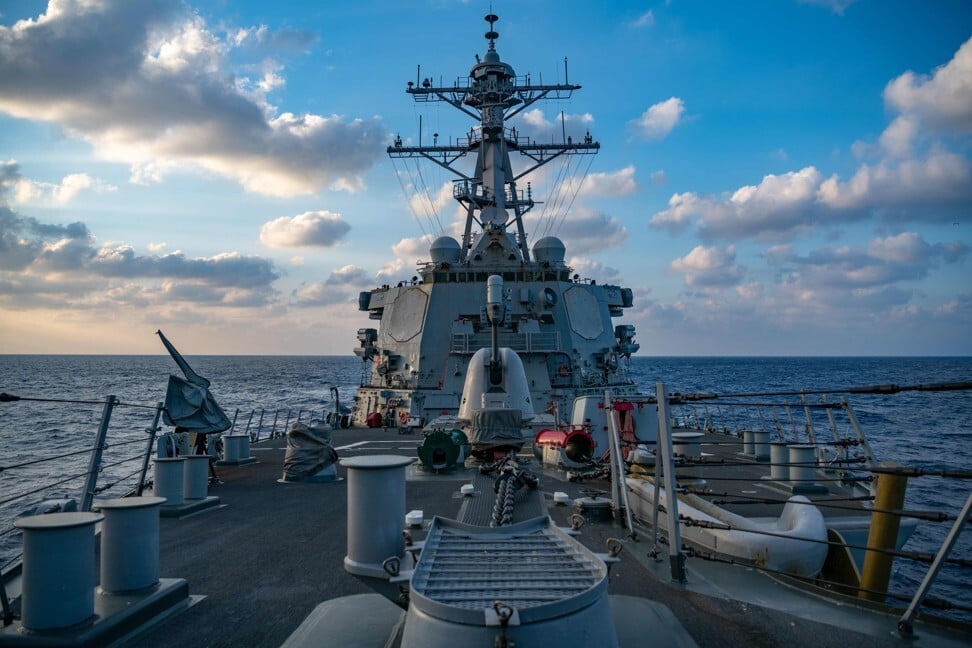
The most likely collision scenario, he said, would be in the South China Sea.
“I still worry most about military close encounters associated with American freedom of navigation operations, which could rapidly escalate in unintended but dangerous directions, for example, in the direction of a serious naval conflict.”
Guided-missile destroyer the USS Barry sails in the South China Sea last month. Photo: AFP
He said an international incident would put Trump and Xi on a reputational collision course, with each leader facing pressure to stand up to the other and not back down, given the mistrust and heated rhetoric.
“The danger, then, is an unforeseen spark, which could set off a frightening movement up the escalation ladder,” he added.
Zhao Tong, a senior fellow at the Carnegie-Tsinghua Centre for Global Policy in Beijing, also expressed concern that military incidents and conflicts with the US had become “less unimaginable given how quickly mutual animosity is building”.
Nationalist sentiment
In recent months, many senior Chinese diplomats have risen to Xi’s hardline, nationalist call and displayed their “fighting spirit”, often at the expense of the country’s global image.
“In future crises, if People’s Liberation Army officers, like some Chinese diplomats, calculate that it is in their personal interests to act extra tough, even if they know their aggression could cause war and cost China dearly, they might still feel incentivised to do so,” Zhao said.
To make things worse, according to Zhang Tuosheng, a security analyst from the China Foundation for International and Strategic Studies, Beijing and Washington had yet to set up an operational crisis management mechanism.
The Chinese leadership surely understands the massive costs of military action against TaiwanShelley Rigger, Davidson College
“One of the major lessons is that we’ve paid scant attention to the establishment of a series of mechanisms that have proven necessary during the Cold War era in preventing tensions spiralling out of control in the event of emergencies or a real crisis,” he said.
Beijing made clear its resentment over the warming ties between Washington and Taipei ahead of and during Taiwanese President Tsai Ing-wen’s inauguration on Wednesday, but a military confrontation over the self-ruled island in the near term was not likely, according to Rigger.
“The Chinese leadership surely understands the massive costs – in blood, treasure and reputation – of military action against Taiwan. They are way too smart to count on the US not intervening,” she said.
Rigger noted several retired PLA officers, including
, had unusually toned down their hawkish stance on seeking reunification with Taiwan by force.
“That is a frustrating message for many Chinese to hear, but war is very costly and very unpredictable – something the US has learned through painful experience,” she said.
While experts called for efforts to lower tensions in the lead-up to the US presidential election in November, most said that would largely hinge on Trump.
“Anything is possible with Trump,” Rigger said. “If he thinks better relations with China will help him win re-election, he will do whatever it takes to turn the relationship around. I’d be really surprised if the Chinese leadership didn’t respond positively to such an opportunity.”
But Zhu said it would be naive to pin hopes on Trump, who was desperate to play the China card in his re-election campaign.
“Beijing should be particularly cautious on Taiwan and the South China Sea disputes and should not engage in rhetorical tit-for-tat with Washington,” he said. “We need to look beyond the Trump presidency and prioritise the steady development of bilateral relations over the need to outcompete Trump.”
China will not set an economic growth goal for this year as it deals with the fallout from the coronavirus pandemic.
It is the first time Beijing has not had a gross domestic product (GDP) target since 1990 when records began.
The announcement was made by Premier Li Keqiang at the start of the country’s annual parliament meeting.
The world’s second largest economy shrank by 6.8% in the first quarter from a year ago as lockdowns paralysed businesses.
“This is because our country will face some factors that are difficult to predict in its development due to the great uncertainty regarding the Covid-19 pandemic and the world economic and trade environment,” Premier Li said.
The country’s leadership has promised to boost economic support measures amid growing concerns that rising unemployment could threaten social stability.
The move comes as tensions between Beijing and Washington are becoming increasingly strained over the coronavirus pandemic, trade and Hong Kong.
On Thursday, President Donald Trump stepped up his attacks on China, suggesting that the country’s leader, Xi Jinping, is behind a “disinformation and propaganda attack on the United States and Europe.”
It came as Mr Trump and other Republicans have escalated their criticism of Beijing’s handling of the early stages of the outbreak.
Also on Thursday, China announced plans to impose new national security legislation on Hong Kong after last year’s pro-democracy protests.
The announcement was met with a warning from Mr Trump that the US would react “very strongly” against any attempt to gain more control over the former British colony.
Separately, two US senators have proposed legislation to punish Chinese entities involved in enforcing the planned new laws and penalise banks that do business with them.
Earlier this week, the US Senate unanimously passed a proposal to delist Chinese companies from American stock exchanges if they fail to comply with US financial reporting standards.
US-listed Chinese companies have come under increasing scrutiny in recent weeks after Luckin Coffee revealed that an internal investigation found hundreds of millions of dollars of its sales last year were “fabricated”.
The third session of the 13th National Committee of the Chinese People’s Political Consultative Conference (CPPCC) opens at the Great Hall of the People in Beijing, capital of China, May 21, 2020. (Xinhua/Li Tao)
BEIJING, May 21 (Xinhua) — China’s top political advisory body started its annual session Thursday afternoon in Beijing.
Xi Jinping and other Chinese leaders attended the opening meeting of the third session of the 13th National Committee of the Chinese People’s Political Consultative Conference (CPPCC), held at the Great Hall of the People.
Attendees at the meeting paid a silent tribute to martyrs who died fighting COVID-19 and compatriots who lost their lives in the epidemic.
The agenda for the session was reviewed and approved at the meeting.
Wang Yang, chairman of the CPPCC National Committee, delivered a work report of the Standing Committee of the CPPCC National Committee to the session.
The report noted the role of political advisors in the fight against the COVID-19 epidemic, saying that they have submitted more than 1,300 reports and suggestions on preventing and controlling the epidemic, resuming work and production, stabilizing public expectations and strengthening law-based governance.
Giving full play to role of the CPPCC as a specialist consultative body, 71 consultation meetings, 97 research trips as well as online consultations were organized in the past year, it said.
The report made arrangements for the CPPCC’s work in 2020 in six aspects, urging political advisors to fulfil their duties around achieving a moderately prosperous society in all respects.
Attendees were also briefed on the handling of proposals submitted since the previous annual session of the top political advisory body.
TAIYUAN, May 11 (Xinhua) — Xi Jinping, general secretary of the Communist Party of China Central Committee, on Monday inspected north China’s Shanxi Province.
On Monday afternoon, Xi visited an organic daylily farm in Yunzhou District of Datong City, and a village in the city’s Xiping Township to learn about poverty alleviation efforts.
He then went to the Yungang Grottoes to learn about historical and cultural heritage protection efforts.
In his “verbal message of thanks”, Mr Xi said he highly appreciated Mr Kim’s support during China’s outbreak and “showed his personal attention to the situation of the pandemic and people’s health” in North Korea, according to state media.
Mr Xi called for more efforts to strengthen co-operation in preventing the spread of the coronavirus, and said China was “willing to continue to provide assistance within its own capacity for [North Korea] in the fight against Covid-19”.
On Friday, North Korean state media reported that Mr Kim had sent a verbal message to the president that “congratulated him, highly appreciating that he is seizing a chance of victory in the war against the unprecedented epidemic”.
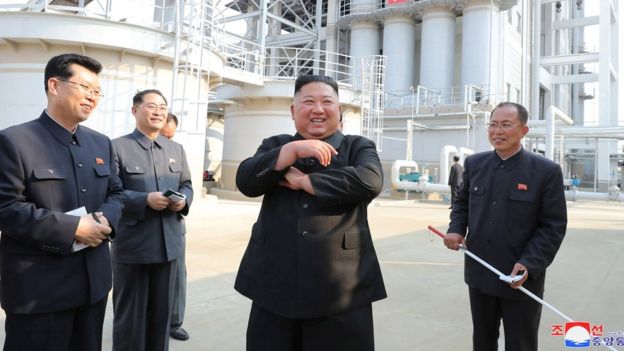
Image copyright REUTERSImage caption Kim Jong-un disappeared from public view for 20 days, before visiting a factory on 2 May
Mr Kim recently went 20 days without appearing in public, and missed the celebration of his grandfather’s birthday – one of the biggest events of the year.
Some media reports claimed he was “gravely ill”, or even dead.
But he then appeared at a fertiliser factory on 2 May – apparently in good health.
On Wednesday, South Korea’s National Intelligence Service told a parliamentary committee that there had been no signs the health rumours were true.
“He was performing his duties normally when he was out of the public eye,” a member of the committee, Kim Byung-kee, told reporters afterwards.
The lawmaker said the North Korean leader’s absence could have been down to a Covid-19 outbreak that the authorities in Pyongyang had not reported.
Analysis
By Celia Hatton, Asia Pacific Editor, BBC World Service
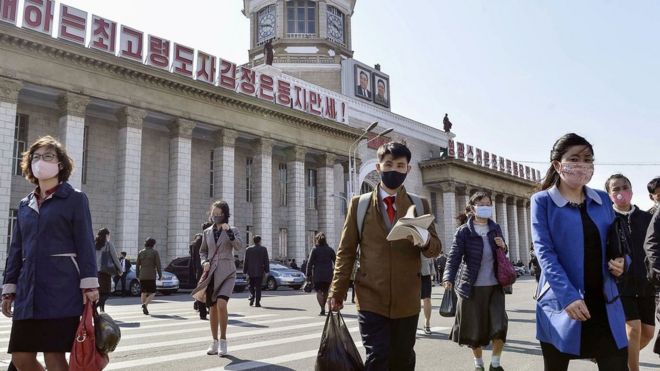
For months, North Korea-watchers have questioned Pyongyang’s claims that it has managed to isolate itself from Covid-19.
Admittedly, North Korea was the first country to suspend travel in response to the virus. There are unconfirmed reports that North Korean guards have been ordered to shoot at those who try to cross the lengthy border the North shares with China. However, it will be difficult to completely seal that dividing line for long. North Korea’s underground economy relies on illicit trade with Chinese entrepreneurs.
Beijing has a few good reasons for wanting to help North Korea. On a practical level, China needs to suppress a possible Covid-19 outbreak there if it wants to keep its own population healthy. Beijing also worries about what might happen inside North Korea if the virus takes hold. The North’s decrepit health system would quickly be overwhelmed by an outbreak of Covid-19, and that could threaten the fragile Kim Jong-un regime. Beijing has been Pyongyang’s biggest aid donor for decades, and it will continue to do what it can to keep Mr Kim in power. The alternatives to Kim Jong-un are much riskier for China, which does not want change on its doorstep.
China’s global political interests are also at play. Diplomatically, Mr Xi’s public exchange with Kim Jong-un underlines the seemingly close ties between China and North Korea. Pyongyang has been slow to accept public offers of help from the United States, and peace talks with Washington have stalled. If North Korea appeared to accept Beijing’s help, China would reassert itself as North Korea’s “true” ally in a time of need.
South Korea itself reported 18 new confirmed cases of Covid-19 on Saturday.
Seventeen of them are linked to a 29-year-old man who tested positive after spending time at five nightclubs and bars in Seoul’s Itaewon leisure district last weekend, the Yonhap news agency said.
Mayor Park Won-soon ordered nightclubs, bars and hostess venues across the capital to suspend business in response.
“Carelessness can lead to an explosion in infections – we clearly realised this through the group infections seen in the Itaewon club case,” Mr Park said.
Health officials have urged people who have visited the five venues in Itaewon to self-isolate and get tested to prevent additional transmissions. At least 1,500 people signed their entry logs, according to Yonhap.
The new infections brought the nationwide total to 10,840, while the death toll remained unchanged at 256.
Defence spending could show the effect of economic headwinds but is still expected to increase
PLA’s modernisation and strategic priorities demand spending is maintained even after GDP’s first contraction since records began, observers say
China has made modernising its military and expanding its weaponry a priority. Photo: Xinhua
China’s upcoming defence budget will be only slightly hit by the economic downturn that followed the coronavirus outbreak, and a modest increase is still expected as it continues to develop its military capability, analysts said.
The government’s military budget is expected to be revealed, as is the norm, at this year’s session of the National People’s Congress (NPC), China’s legislative body. Delayed by over two months because of the pandemic, it will finally be convened on May 22.
Last year the defence expenditure announced at the NPC session was
China has said its military expenditure has always been kept below 2 per cent of its GDP over the past 30 years, although its official figures have long been described by Western observers as opaque, with significant omissions of important items.
The South China Sea dispute explained
In a report earlier this week, the Stockholm International Peace Research Institute estimated that China’s actual military spending in 2019 was US$261 billion, the world’s second highest, after the United States’ US$732 billion.
John Lee, adjunct professor at the University of Sydney and senior fellow at the Hudson Institute in Washington, estimated that this year the Chinese defence budget would remain roughly the same or increase modestly, in line with growth levels of recent years.
“In the current environment, Beijing is keen to emphasise that China has recovered substantially from Covid-19 and that its power trajectory is unaffected by recent events,” Lee said. “At the same time, it would be aware of the anger towards the Communist Party for allowing the virus to become a pandemic.
“Regardless of what the reality might be, I would be surprised if there were a dramatic increase or a significant cut.”
First made-in-China aircraft carrier, the Shandong, enters service
China’s GDP suffered a 6.8 per cent decline in the first quarter, the first contraction since quarterly records began in 1992, after an extensive shutdown while it contained its coronavirus outbreak. However, the official increases in the military budget have since 2011 always exceeded overall GDP growth.
The Chinese government may focus more on job creation, social welfare and poverty alleviation, but not at the expense of military investment, according to Collin Koh, research fellow from the S Rajaratnam School of International Studies at Singapore’s Nanyang Technological University in Singapore.
“I tend to think it will be more or less the same,” Koh said. “To reduce [the budget] may send the wrong signal to would-be adversaries, both domestic and external: that Beijing has lost the will to keep up its military modernisation to assert core national interests.”
PLA flexes military muscle near Taiwan ‘in show of Covid-19 control’
15 Apr 2020
The People’s Liberation Army (PLA) began a massive – and costly – reform in 2015, with a personnel reshuffle, change in structure, upgraded equipment and enhanced training to better resemble battle scenarios. That was supposed to be complete this year.
Given the deteriorating relationship with the United States and rising tensions in the Taiwan Strait and South China Sea, the PLA faces challenges requiring a steady increase in investment, according to Hong Kong-based military commentator Song Zhongping.
Taiwan shows off its military power after presidential election
Macau-based military expert Antony Wong Dong predicted there would still be about 6-7 per cent growth in the budget “no matter what”.
“The PLA played an important role in the fight against the contagion, so a decrease in spending would not be accepted,” Wong said.
That role included the deployment of more than 4,000 military medics to help treat Covid-19 patients, and helping to transport medical supplies.
Wong said it would be a crucial year for the PLA in completing its preparation for potential military action against Taiwan, which would be so strategically important that “[President] Xi Jinping himself would never allow it to be affected by a shortage of funding”.
China’s military draws on 6G dream to modernise its fighting forces
18 Apr 2020
But a slight increase in budget would be sufficient to meet defence needs and maintain a deterrence against potential threats, including preventing self-ruled Taiwan taking the opportunity to declare independence, naval expert Li Jie said.
Beijing views Taiwan as a breakaway province to be reunified with the mainland, by force if necessary. Its relationship with Taipei has been strained, and dialogue halted, since Tsai Ing-wen, of the pro-independence Democratic Progressive Party, was elected the island’s president in 2016. Tsai was re-elected for a second term in January.
Li estimated that the budget would probably be kept at the same level or show a “slight” increase from last year.
“It would feed the ‘China threat’ theory and raise international concerns if the Chinese government expands military spending too much,” he said.
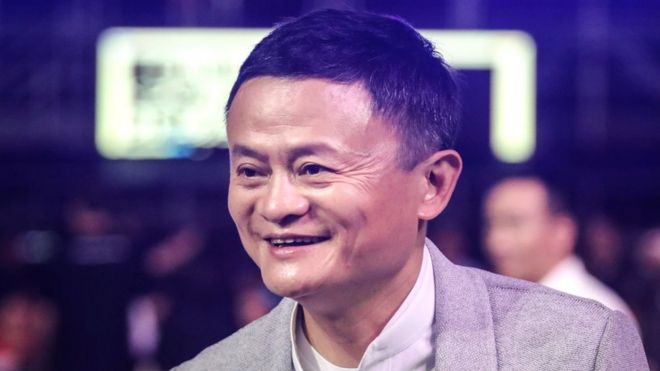
The richest man in China opened his own Twitter account last month, in the middle of the Covid-19 outbreak. So far, every one of his posts has been devoted to his unrivalled campaign to deliver medical supplies to almost every country around the world.
“One world, one fight!” Jack Ma enthused in one of his first messages. “Together, we can do this!” he cheered in another.
The billionaire entrepreneur is the driving force behind a widespread operation to ship medical supplies to more than 150 countries so far, sending face masks and ventilators to many places that have been elbowed out of the global brawl over life-saving equipment.
But Ma’s critics and even some of his supporters aren’t sure what he’s getting himself into. Has this bold venture into global philanthropy unveiled him as the friendly face of China’s Communist Party? Or is he an independent player who is being used by the Party for propaganda purposes? He appears to be following China’s diplomatic rules, particularly when choosing which countries should benefit from his donations, but his growing clout might put him in the crosshairs of the jealous leaders at the top of China’s political pyramid.
Other tech billionaires have pledged more money to fight the effects of the virus – Twitter’s Jack Dorsey is giving $1bn (£0.8bn) to the cause. Candid, a US-based philanthropy watchdog that tracks private charitable donations, puts Alibaba 12th on a list of private Covid-19 donors. But that list doesn’t include shipments of vital supplies, which some countries might consider to be more important than money at this stage in the global outbreak.
The world’s top coronavirus financial donors
How Alibaba compares to the top five. No one else other than the effervescent Ma is capable of dispatching supplies directly to those who need them. Starting in March, the Jack Ma foundation and the related Alibaba foundation began airlifting supplies to Africa, Asia, Europe, Latin America and even to politically sensitive areas including Iran, Israel, Russia and the US.
Ma has also donated millions to coronavirus vaccine research and a handbook of medical expertise from doctors in his native Zhejiang province has been translated from Chinese into 16 languages. But it’s the medical shipments that have been making headlines, setting Ma apart.
“He has the ability and the money and the lifting power to get a Chinese supply plane out of Hangzhou to land in Addis Ababa, or wherever it needs to go,” explains Ma’s biographer, Duncan Clark. “This is logistics; this is what his company, his people and his province are all about.”
A friendly face
Jack Ma is famous for being the charismatic English teacher who went on to create China’s biggest technology company. Alibaba is now known as the “Amazon of the East”. Ma started the company inside his tiny apartment in the Chinese coastal city of Hangzhou, in the centre of China’s factory belt, back in 1999. Alibaba has since grown to become one of the dominant players in the world’s second largest economy, with key stakes in China’s online, banking and entertainment worlds. Ma himself is worth more than $40bn.
Officially, he stepped down as Alibaba’s chairman in 2018. He said he was going to focus on philanthropy. But Ma retained a permanent seat on Alibaba’s board. Coupled with his wealth and fame, he remains one of the most powerful men in China.
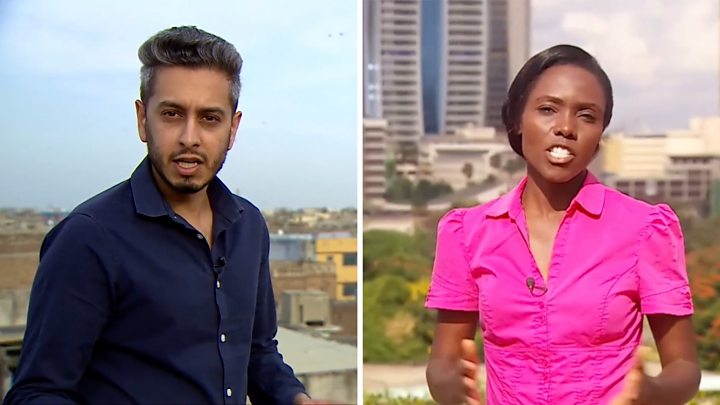
Media caption The BBC’s Secunder Kermani and Anne Soy compare how prepared Asian and African countries are
It appears that Ma’s donations are following Party guidelines: there is no evidence that any of the Jack Ma and Alibaba Foundation donations have gone to countries that have formal ties with Taiwan, China’s neighbour and diplomatic rival. Ma announced on Twitter that he was donating to 22 countries in Latin America. States that side with Taiwan but who have also called for medical supplies – from Honduras to Haiti – are among the few dozen countries that do not appear to be on the list of 150 countries. The foundations repeatedly refused to provide a detailed list of countries that have received donations, explaining that “at this moment in time, we are not sharing this level of detail”.
However, the donations that have been delivered have certainly generated a lot of goodwill. With the exception of problematic deliveries to Cuba and Eritrea, all of the foundations’ shipments dispatched from China appear to have been gratefully received. That success is giving Ma even more positive attention than usual. China’s state media has been mentioning Ma almost as often as the country’s autocratic leader, Xi Jinping.
AFP
So far…
Over 150 countries have received donations from Jack Ma, including about:
120.4mface masks
4,105,000testing kits
3,704ventilators
Source: Alizila
It’s an uncomfortable comparison. As Ma soaks up praise, Xi faces persistent questions about how he handled the early stages of the virus and where, exactly, the outbreak began.
The Chinese government has dispatched medical teams and donations of supplies to a large number of hard-hit countries, particularly in Europe and South-East Asia.
However, those efforts have sometimes fallen flat. China’s been accused of sending faulty supplies to several countries. In some cases, the tests it sent were being misused but in others, low-quality supplies went unused and the donations backfired.
In contrast, Jack Ma’s shipments have only boosted his reputation.
“It’s fair to say that Ma’s donation was universally celebrated across Africa,” says Eric Olander, managing editor of the China Africa Project website and podcast. Ma pledged to visit all countries in Africa and has been a frequent visitor since his retirement.
“What happens to the materials once they land in a country is up to the host government, so any complaints about how Nigeria’s materials were distributed are indeed a domestic Nigerian issue,” Olander adds. “But with respect to the donation itself, the Rwandan leader, Paul Kagame, called it a “shot in the arm” and pretty much everyone saw it for what it was which was: delivering badly-needed materials to a region of the world that nobody else is either willing or capable of helping at that scale.”
Walking the tightrope
But is Ma risking a backlash from Beijing? Xi Jinping isn’t known as someone who likes to share the spotlight and his government has certainly targeted famous faces before. In recent years, the country’s top actress, a celebrated news anchor and several other billionaire entrepreneurs have all “disappeared” for long periods. Some, including the news anchor, end up serving prison sentences. Others re-emerge from detention, chastened and pledging their allegiance to the Party.
“There’s a rumour that [Jack Ma] stepped down in 2018 from being the chairman of the Alibaba Group because he was seen as a homegrown entrepreneur whose popularity would eclipse that of the Communist Party,” explains Ashley Feng, research associate at the Centre for New American Security in Washington DC. Indeed, Ma surprised many when he suddenly announced his retirement in 2018. He has denied persistent rumours that Beijing forced him out of his position.
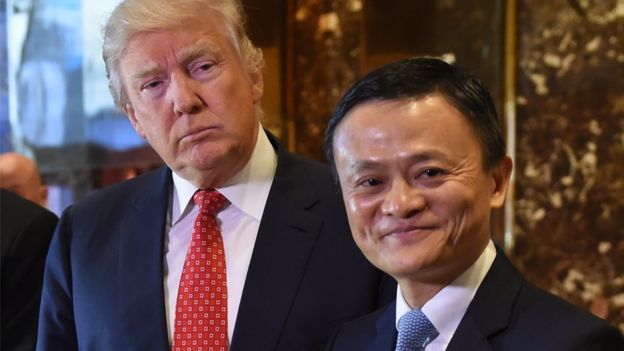
Image copyright GETTY IMAGESImage caption Ma discussed trade with then-President-elect Donald Trump in January 2017
Duncan Clark, Ma’s biographer, is also aware of reports that Ma was nudged away from Alibaba following a key incident in January 2017. The Chinese billionaire met with then-President-elect Donald Trump in Trump Tower, ostensibly to discuss Sino-US trade. The Chinese president didn’t meet with Trump until months later.
“There was a lot of speculation of time that Jack Ma had moved too fast,” Clark says. “So, I think there’s lessons learned from both sides on the need to try to coordinate.”
“Jack Ma represents a sort of entrepreneurial soft power,” Clark adds. “That also creates challenges though, because the government is quite jealous or nervous of non-Party actors taking that kind of role.”
Technically, Ma isn’t a Communist outsider: China’s wealthiest capitalist has actually been a member of the Communist Party since the 1980s, when he was a university student.
But Ma’s always had a tricky relationship with the Party, famously saying that Alibaba’s attitude towards the Party was to “be in love with it but not to marry it”.
Even if Ma and the foundations connected to him are making decisions without Beijing’s advance blessing, the Chinese government has certainly done what it can to capitalise on Ma’s generosity. Chinese ambassadors are frequently on hand at airport ceremonies to receive the medical supplies shipped over by Ma, from Sierra Leone to Cambodia.
China has also used Ma’s largesse in its critiques of the United States. “The State Department said Taiwan is a true friend as it donated 2 million masks,” the Chinese Foreign Ministry tweeted in early April. “Wonder if @StateDept has any comment on Jack Ma’s donation of 1 million masks and 500k testing kits as well as Chinese companies’ and provinces’ assistance?”
Perhaps Ma can rise above what’s happened to so many others who ran afoul of the Party. China might just need a popular global Chinese figure so much that Ma has done what no one else can: make himself indispensable.
“Here’s the one key takeaway from all that happened with Jack Ma and Africa: he said he would do something and it got done,” explains Eric Olander. “That is an incredibly powerful optic in a place where foreigners often come, make big promises and often fail to deliver. So, the huge Covid-19 donation that he did fit within that pattern. He said he would do it and mere weeks later, those masks were in the hands of healthcare workers.”
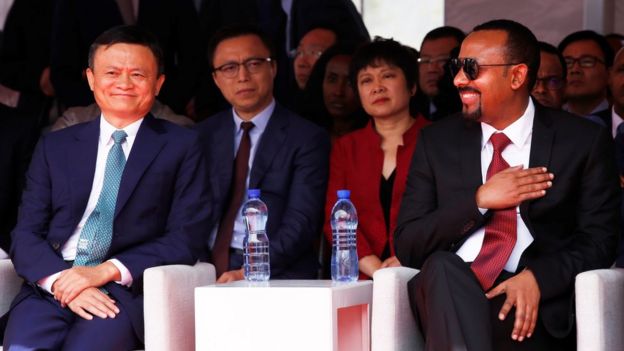
Image copyright GETTY IMAGESImage caption Ma at an Electronic World Trade Platform event with Ethiopian Prime Minister Abiy Ahmed last year
Duncan Clark argues that Ma already had a seat at China’s high table because of Alibaba’s economic heft. However, his first-name familiarity with world leaders makes him even more valuable to Beijing as China tries to repair its battered image.
“He has demonstrated the ability, with multiple IPOs under his belt, and multiple friendships overseas, to win friends and influence people. He’s the Dale Carnegie of China and that certainly, we’ve seen that that’s irritated some in the Chinese government but now it’s almost an all hands on deck situation,” Clark says.
There’s no doubt that China’s wider reputation is benefiting from the charitable work of Ma and other wealthy Chinese entrepreneurs. Andrew Grabois from Candid, the philanthropic watchdog that’s been measuring global donations in relation to Covid-19, says that the private donations coming from China are impossible to ignore.
“They’re taking a leadership role, the kind of thing that used to be done by the United States,” he says. “The most obvious past example is the response to Ebola, the Ebola outbreak in 2014. The US sent in doctors and everything to West Africa to help contain that virus before it left West Africa.”
Chinese donors are taking on that role with this virus.
“They are projecting soft power beyond their borders, going into areas, providing aid, monetary aid and expertise,” Grabois adds.
So, it’s not the right time for Beijing to stand in Jack Ma’s way.
“You know, this is a major crisis for the world right now,” Duncan Clark concludes. “But obviously, it’s also a crisis for China’s relationship with the rest of the world. So they need anybody who can help dampen down some of these those pressures.”
Chinese President Xi Jinping, also general secretary of the Communist Party of China Central Committee and chairman of the Central Military Commission, visits Xi’an Jiaotong University in Xi’an, capital of northwest China’s Shaanxi Province, April 22, 2020. Xi on Wednesday inspected the city of Xi’an during his trip to northwest China’s Shaanxi Province. (Xinhua/Ju Peng)
XI’AN, April 23 (Xinhua) — Xi Jinping, general secretary of the Communist Party of China Central Committee, on Wednesday visited an exhibition on the relocation of Jiaotong University from Shanghai to Xi’an and its development and achievements at the Xi’an Jiaotong University museum.
He met with 14 professors, who had been relocated along with the university decades ago
Chinese President Xi Jinping, also general secretary of the Communist Party of China Central Committee and chairman of the Central Military Commission, inspects the local poverty alleviation work in Jinping Community of Laoxian Township, Pingli County of the city of Ankang, northwest China’s Shaanxi Province, April 21, 2020. (Xinhua/Zhai Jianlan)
XI’AN, April 21 (Xinhua) — Xi Jinping, general secretary of the Communist Party of China Central Committee, on Tuesday inspected the local poverty alleviation work in northwest China’s Shaanxi Province.
Xi visited a community, a township hospital, a primary school and a tea farm in Laoxian Township, Pingli County of the city of Ankang.
Chinese President Xi Jinping, also general secretary of the Communist Party of China Central Committee and chairman of the Central Military Commission, visits the Xixi National Wetland Park during an inspection in Hangzhou, east China’s Zhejiang Province, March 31, 2020. (Xinhua/Yan Yan)
HANGZHOU, March 31 (Xinhua) — Xi Jinping, general secretary of the Communist Party of China Central Committee, on Tuesday inspected wetland conservation and technology-based urban management in the city of Hangzhou, east China’s Zhejiang Province.
During the inspection, Xi visited the Xixi National Wetland Park and the City Brain, a smart city platform aiming to improve urban management.
Hangzhou’s City Brain project was launched in 2016 to help the city make plans in areas including public security, transport and healthcare with the use of big data, cloud computing and artificial intelligence, among other cutting-edge technologies.
With a total area of 11.5 square kilometers, the Xixi National Wetland Park is the first national wetland park in the country.











 CHINDIA ALERT: You'll be living in their world, very soon