Chindia Alert: You’ll be Living in their World Very Soon
aims to alert you to the threats and opportunities that China and India present. China and India require serious attention; case of ‘hidden dragon and crouching tiger’.
Without this attention, governments, businesses and, indeed, individuals may find themselves at a great disadvantage sooner rather than later.
The POSTs (front webpages) are mainly 'cuttings' from reliable sources, updated continuously.
The PAGEs (see Tabs, above) attempt to make the information more meaningful by putting some structure to the information we have researched and assembled since 2006.
The move comes three days after 157 people were killed after an Ethiopian Airlines Boeing 737 MAX 8 crashed 6 minutes after take-off from Ethiopian capital Addis Ababa on Sunday.
SNS Web | New Delhi | March 13, 2019 9:37 am
The Directorate General of Civil Aviation (DGCA) on Wednesday informed that all Boeing 737 Max aircraft will be grounded before 4 pm today. This is to cater to situations where aircraft are to fly back to India or go to maintenance facility for parking.
Boeing 737 Max operations will stop from/to all Indian airports. Additionally no Boeing 737 Max aircraft will be allowed to enter or transit the Indian airspace effective 1600 hrs Indian time or 1030 UTC, the DGCA ordered.
The timeline is to cater to situations where aircraft can be positioned at maintenance facilities and international flights can reach their destinations.
Earlier on Tuesday, India grounded Boeing 737 Max 8 aircraft used by the country’s airline companies in light of the Ethiopian Airlines crash that killed 157 people.
SpiceJet has around 12 ‘737 Max 8’ planes in its fleet, while Jet Airways has five.
“DGCA has taken the decision to ground the Boeing 737-Max planes immediately. These planes will be grounded till appropriate modifications and safety measures are undertaken to ensure their safe operations,” the Ministry of Civil Aviation said in a tweet.
“As always, passenger safety remains our top priority. We continue to consult closely with regulators around the world, airlines, and aircraft manufacturers to ensure passenger safety,” it added.
Following the DGCA decision, SpiceJet suspended Boeing 737 Max operations. “Safety and security of our passengers, crew and operations are of utmost importance to us,” the airline informed.
The move comes three days after 157 people were killed after an Ethiopian Airlines Boeing 737 Max 8 crashed 6 minutes after take-off from Ethiopian capital Addis Ababa on Sunday.
Meanwhile, the Civil Aviation Secretary has called an emergency meeting of all airlines at 4 pm today in Delhi.
Earlier, the DGCA had issued additional safety instructions to the two Indian carriers that operate the Boeing 737 Max aircraft. Pilots of SpiceJet and Jet Airways should have at least 1,000 hours of flying experience to command these planes, the regulator ordered.
A total of 149 passengers and 8 crew members from 35 countries were on board the Ethiopian Airlines flight ET 302 when it ploughed into a field in Bishoftu (formerly Debre Zeit), a town located 48 kilometres south east of Addis Ababa.
Four Indians, including a UNDP consultant attached to India’s Environment Ministry, lost their lives in the crash.
This was second such crash involving the 737 Max 8 aircraft in less than five months.
In October last year, an aircraft operated by Lion Air crashed killing over 180 people in Indonesia.
Following Sunday’s accident, Ethiopian Airlines grounded its entire Boeing 737 Max 8 fleet until further notice.
European Union and many countries across the world have already banned the use of 737 Max 8 aircraft in their respective airspace.
On Monday, China, too, grounded all of its Boeing 737 Max 8 jets. Australia too followed the suit on Tuesday.
Ecology and Environment Minister Li Ganjie attends a press conference on “fighting resolutely to prevent and control pollution” for the second session of the 13th National People’s Congress (NPC) in Beijing, capital of China, March 11, 2019. (Xinhua/Shen Bohan)
BEIJING, March 11 (Xinhua) — China has made sound progress in addressing the prominent problems over environmental protection along the Yangtze River Economic Belt, the country’s Ecology and Environment Minister Li Ganjie said Monday.
After two years of work, 99.9 percent of the 1,474 drinking water sources in cities above the county-level along the Yangtze River Economic Belt, stringing up 11 provinces and municipalities from west to east, have had their problems resolved, Li told a news conference on the sidelines of the annual legislative session.
Meanwhile, over 90 percent of the 12 “black and malodorous water bodies” in the provincial capital cities have been cleaned up, while prefecture-level cities are catching up on this front, Li said.
A special campaign targeting illegal disposal of solid and hazardous waste along the Yangtze, China’s longest river, has also been successful, the minister said, adding that the country has made notable progress in enhancing protection of the nature reserves in the Yangtze River basin.
The country will continue to improve the supervision system for Yangtze protection, Li said.
China has made the “defense of lucid waters” a primary task in the battle against pollution for 2019. Research will be conducted for the drafting of laws on bio-security and Yangtze River conservation this year, according to the work report of the Standing Committee of the 13th National People’s Congress.
BEIJING, March 11 (Xinhua) — Chinese President Xi Jinping on Monday sent messages of condolence respectively to his Ethiopian and Kenyan counterparts, Sahle-Work Zewde and Uhuru Kenyatta, over the plane crash that killed 157 people on Sunday.
In his messages, Xi said he was shocked to hear about the crash of the Ethiopian Airlines plane and the massive casualties it caused, including Ethiopian, Kenyan and Chinese victims.
On behalf of the Chinese government, the Chinese people and in his own name, he expressed deep mourning for the victims and extended his condolences to the bereaved families.
Xi said that he believes the Ethiopian government is capable of properly handling the aftermath of the tragedy. He added that China would provide any necessary support and assistance.
Also on Monday, Chinese Premier Li Keqiang sent a message to his Ethiopian counterpart, Abiy Ahmed, offering his condolences over the plane crash.
No other injuries reported following accident on southern island of Hainan
Military is currently intensifying training for pilots as it looks to strengthen capabilities
Mobile phone footage believed to be taken from the crash site. Photo: Handout
A Chinese navy plane crashed in Hainan province on Tuesday killing two crew members, the military said.
A short statement said the crash happened during a training exercise over rural Ledong county in the southern island province.
No one else was reported to have been injured after the plane hit the ground and the cause of the incident is being investigated.
Footage that purported to be taken from the crash site started circulating on social media after the accident.
The mobile phone footage, which news portal 163.com said was taken in Hainan, showed smoke rising from piles of wreckage next to a damaged water tower as bystanders gathered at the site.
Footage apparently taken at the crash site. Photo: Handout
The person who uploaded the footage said the plane had hit the water tower before crashing into the ground.
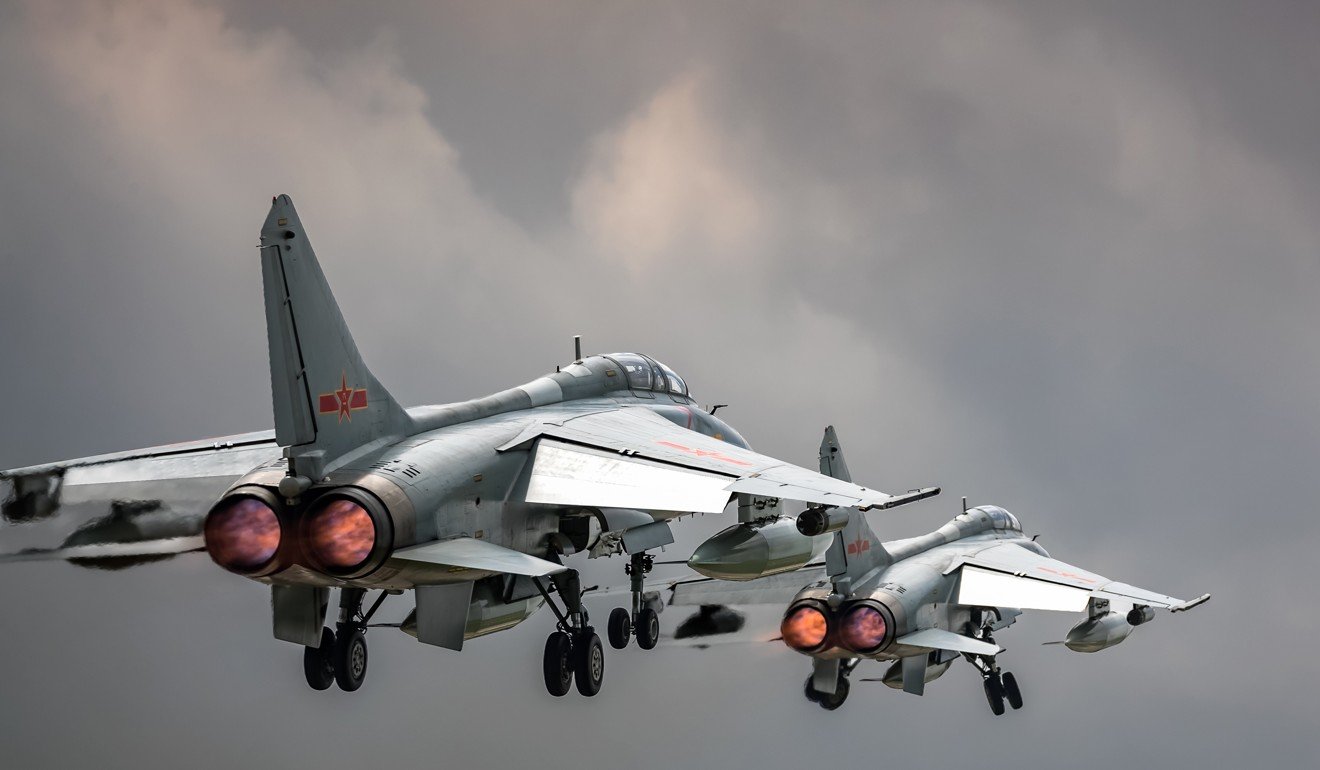
The PLA’s official statement did not specify the type plane that crashed, although unverified witness account online said it was a twin-seat Xian JH-7 “Flying Leopard”.
The JH-7, which entered service with the navy and air force in the 1990s, has been involved in a number of fatal accidents over the years.
The country’s worst military air accident in recent years happened in January 2018. At least 12 crew members died when a PLA Air Force plane, believed to be an electronic reconnaissance aircraft, crashed in Guizhou in the southwest of the country.
Between 2016 and 2017, there were at least four accidents involving the navy’s J-15 “Flying Sharks”, one of them resulting in the death of the pilot.
Military commentators have previously said that China’s drive to improve its combat readiness, which includes the building of new aircraft carriers and warplanes, has resulted in a serious shortage of qualified pilots.
To fill the vacancies the Chinese military has started a major recruitment drive and intensive training programme for pilot pilots.
One unverified report said the plane that crashed was a JH-7 “Flying Leopard”. Photo. Xinhua
Currently China has one aircraft carrier, the Liaoning, in service, which can carry a maximum of 24 J-15s as well as other aircraft.
Meanwhile, the new home-grown carrier Type 001A will soon be commissioned, which is designed to accommodate to carry eight more fighters.
In addition, construction is believed to have started on another carrier that will be able to carry heavier and more advanced warplanes.
According to figures from the end of 2016, there were only 25 pilots qualified to fly the J-15 while 12 others were in training.
Most of the Chinese navy’s pilots have been redeployed from the air force, which is itself in need of more trained pilots.
This year the navy for the first time began a nation-wide programme to scout out potential pilots.
Speaking on the sidelines of the ongoing legislative meeting in Beijing Feng Wei, a PLA pilot from the Western Theatre, said the military was currently intensifying its pilots’ training as increasing amounts of new equipment entered service.
“Personnel quality is the key to everything,” he added.
WASHINGTON (Reuters) – White House national security adviser John Bolton said on Monday Pakistan’s foreign minister has assured him Islamabad is committed to de-escalating tensions with India and dealing “firmly” with terrorists.
Bolton’s comments follow a Feb. 14 suicide bombing, claimed by Pakistan-based militants, which killed at least 40 Indian paramilitary police.
“Spoke with Pakistani FM (Shah Mehmood) Qureshi to encourage meaningful steps against JeM (Jaish-e-Mohammed) and other terrorist groups operating from Pakistan,” Bolton said on Twitter.
“The FM assured me that Pakistan would deal firmly with all terrorists and will continue steps to deescalate tensions with India,” Bolton added.
Pakistan, which denies Indian accusations of aiding militant groups, last week announced a crackdown against all proscribed outfits.
Pakistan’s foreign ministry late on Monday said Qureshi informed Bolton “about the de-escalatory measures taken by Pakistan” in the wake of the aerial bombing missions carried out by both countries in late February.
Qureshi told Bolton that Pakistan’s strike in Kashmir on Feb. 27 was in self-defence and retaliation to India’s raid on its territory a day earlier. New Delhi said it hit a JeM training camp in Pakistan, but Islamabad denies any such camp exists.
The two countries fought an aerial dogfight over Kashmir on Feb. 27, and a couple of days later Pakistan returned a downed Indian pilot in a gesture that appeared to de-escalate the crisis.
German Foreign Minister Heiko Maas, in a joint conference with Qureshi, commended Pakistan on Tuesday for returning the pilot and offering talks with India. But he also urged Islamabad to stamp out militant groups which attack neighbouring countries.
“We both agreed that cross-border terrorism has to be permanently stopped and there too there have been positive signs in the past few days that we welcome very much,” Maas said. “Ultimately it’s about fighting any kind of terrorism and extremism.”
BEIJING, March 10 (Xinhua) — China has made substantial progress in renovating the dilapidated houses in rural areas, said the Ministry of Housing and Urban-Rural Development (MOHURD).
Over 6 million registered poor households have seen their dilapidated houses renovated since the country launched the “three tough battles” against major risks, poverty and pollution in November 2015, the MOHURD said.
In 2018 alone, 1.57 million registered rural poor households saw their dilapidated houses renovated, according to the National Bureau of Statistics.
China plans to renovate another 15 million units of shanty houses from 2018 to 2020 to speed up its urbanization drive and improve people’s livelihood.
Chinese President Xi Jinping, also general secretary of the Communist Party of China Central Committee and chairman of the Central Military Commission, joins deliberation with deputies from Fujian Province at the second session of the 13th National People’s Congress in Beijing, capital of China, March 10, 2019. (Xinhua/Li Xueren)
BEIJING, March 10 (Xinhua) — President Xi Jinping on Sunday afternoon joined deliberation with deputies from Fujian Province at the second session of the 13th National People’s Congress, China’s national legislature.
“[We] should create a favorable development environment for innovation, entrepreneurship and creativity,” said Xi, also general secretary of the Communist Party of China Central Committee and chairman of the Central Military Commission.
China should seek momentum from reform and opening up, unleash to the maximum the whole society’s power for innovation, entrepreneurship and creativity, and keep improving the country’s influence and competitiveness in a world that is undergoing profound changes, Xi said.
Xi stressed creating favorable conditions for the development of small and medium-sized enterprises and young people, and establishing an acceleration mechanism for high-tech companies.
He urged solid implementation of the policies and measures to encourage, guide and support the development of the private sector.
Fujian must leverage the combined strengths of the special economic zone, pilot free trade zone, comprehensive experimental zone and the core zone of the 21st Century Maritime Silk Road, and keep exploring new approaches, Xi said.
Xi called for efforts to explore new ways for integrated development across the Taiwan Strait.
The two sides of the Taiwan Strait should enhance economic and trade cooperation, infrastructure connectivity, energy and resource exchanges, and shared industry standards, he said.
Cross-Strait cooperation and cultural exchanges should be strengthened, he added.
Xi stressed the importance of implementing the people-centered development concept in the work on Taiwan, urging efforts to benefit Taiwan compatriots in the same way as people on the mainland are served.
He encouraged listening to the voice of Taiwan compatriots and research on what other policies and measures can be introduced to bring them benefits.
Xi said that this year marks the 70th anniversary of the founding of New China, and it is necessary to ensure that no one in the country’s old revolutionary base areas falls behind in the process of building a moderately prosperous society in all respects.
He called for adherence to targeted poverty alleviation and efforts to identify the root causes of poverty to enhance the effectiveness of anti-poverty measures.
More efforts should be put into coordinating economic development with ecological protection, Xi said.
SRINAGAR, India (Reuters) – India should talk to Pakistan and separatists in Kashmir to defuse tension raised by a suicide attack on an Indian paramilitary convoy that was claimed by Pakistan-based militants, a former chief minister of the state said.
Mehbooba Mufti, who was the chief minister of Jammu and Kashmir from early 2014 to June last year when Prime Minister Narendra Modi’s Hindu nationalist party withdrew support for her regional party, said an ongoing crackdown on militants and those supporting secession could further alienate the people.
India has vowed to kill all the militants in the country’s only Muslim-majority state if they don’t give up arms, after a 20-year-old local man killed 40 paramilitary troopers in a suicide attack last month.
The attack nearly led to another war between the arch rivals India and Pakistan, which both claim the Himalayan region in full but rule in part.
“I strongly feel that there has to be a dialogue process internally as well as externally, with Pakistan,” Mufti said in an interview on Friday. “The situation is going to get worse if some kind of political process is not initiated on the ground now.”
Indian officials have repeatedly ruled out talks with Pakistan unless it acts on militant groups based there. India says its warplanes late last month bombed a militant camp in Pakistan, which responded with an aerial attack the next day.
Indian Foreign Secretary Vijay Gokhale said on the day of the strike that it had killed many Jaish-e-Mohammed “terrorists”. Pakistan said no one was killed.
Pakistan Prime Minister Imran Khan, who has sought to speak with Modi amid the hostility, said no militant group would be allowed to operate from his country to carry out attacks abroad, days after his government announced a sweeping crackdown against Islamist militant organisations.
“This confrontational attitude – no talks, no discussion -has an impact,” Mufti said. “Whatever relationship we have with Pakistan, it has a direct impact on Jammu and Kashmir and we are the worst sufferers of this animosity.”
Indian authorities have arrested many separatist leaders in Kashmir in the past few weeks, and the chief of Modi’s ruling Bharatiya Janata Party (BJP) said recently that the government had made it clear to them that “if they want to live in India, they will have to speak the language of India, not Pakistan’s”.
Mufti, whose father was also a chief minister of Jammu and Kashmir, said the tough stance by Indian authorities would only lead to “some calm on the surface” that won’t last. India killed 248 militants in Kashmir in 2018 – the highest in a decade.
“Once you start choking the space for dissent in a democracy, people feel pushed to the wall and then it leads to further dissent and alienation,” she said.
Mufti said India’s general election – starting April 11 and whose results will be declared on May 23 – could delay the process of any inter-party talks on Kashmir.
China’s Chang’e-4 lunar exploration mission was the first one to land on the far side of the moon – the side that’s not visible from earth – on January 3.
INDIAUpdated: Mar 11, 2019 13:47 IST
Sutirtho Patranobis
Hindustan Times, Beijing
The top space agencies – the China National Space Administration (CNSA) and Indian Space Research Organisation (ISRO) – confirmed the information but did not share details why the cooperation failed to take off.(Corbis via Getty Images)
A rare opportunity for India and China to cooperate in a high-profile space mission fell through after the two countries disagreed on the nature of the Indian payload to be carried on the Chang’e-4 lunar mission, it has emerged.
China’s Chang’e-4 lunar exploration mission was the first one to land on the far side of the moon – the side that’s not visible from earth – on January 3. Since landing, the mission has sent back stunning first-time images from the moon’s surface. It has been carrying out a series of scientific research tasks involving multiple countries and organisations.
China’s lunar exploration chief Wu Weiren called the mission a “huge stride” for China.
It could have been a breakthrough stride for Sino-India cooperation in space – both countries have successful space programs – as well had Chang’e-4 carried the Indian payload.
The top space agencies – the China National Space Administration (CNSA) and Indian Space Research Organisation (ISRO) – confirmed the information but did not share details why the cooperation failed to take off.
“In April 2015, Xu Dazhe, the incumbent administrator of CNSA wrote a letter to the heads of the world’s major space agencies, invited them to participate in the piggy-back cooperation of Chang’ e-4 mission, which received positive responses from more than a dozen national space agencies,” the Chinese agency told HT over email.
“China also received applications from India for the piggy-back cooperation. However, due to the different nature of the missions of the two sides, the Indian payload on Chang’ e-4 could not be carried through (after) the evaluation,” the agency said.
The payload in this context could have been a satellite or space probe equipment.
“No, we will not be able to comment on that … Yes, we will not comment on that,” an ISRO spokesperson said.
Several countries including Germany, Sweden, the Netherlands, and Russia have cooperated in the ongoing mission.
India and China formally established the Sino-Indian Joint Committee on Space Cooperation in 2015. In the same year, the first meeting of the joint committee was held in Beijing, and the outline of Sino-Indian space cooperation was signed.
“The outline includes 19 projects in seven areas: Remote sensing satellites, space-based meteorology, space science and lunar and deep space exploration, education and training, piggy-back launch services, satellite navigation, and space components,” CNSA said.
“The MoUs signed have provided a platform (for the two countries) to work but there is nothing as of now; all at dialogue stage. There are international forums where they are there and we are there but nothing (bilateral),” ISRO’s spokesperson said.
Last year, the then Indian ambassador to China Gautam Bambawale visited CNSA twice in half a year and exchanged views with Zhang Kejian, the CNSA head, on promoting Sino-Indian space cooperation.
“The two sides reviewed the course of Sino-Indian space cooperation in recent years, agreed to further promote the process of Sino-Indian space cooperation with an active and open attitude of cooperation, and agreed to convene the second meeting of the Sino-Indian Space Joint Committee in 2019,” CNSA said.
The Chinese space agency said it is open to cooperating with India.
“CNSA is open to international cooperation in lunar and deep space exploration… and international cooperation for a series of deep space exploration activities, such as Chang’ e 6 sampling return, the Mars exploration, and asteroid exploration, Jupiter galaxy, and planetary crossing exploration,” it said.
“We are willing to work hand in hand with space agencies, space institutions, and foreign space exploration enthusiasts to explore the mysteries of the universe.”
Mudasir Ahmed Khan alias ‘Mohd Bhai’, the mastermind of the 14 February Pulwama terror attack, was killed in an encounter earlier today in South Kashmir.
Mudasir was a Jaish-e-Mohammed (JeM) terrorist and the one who arranged the vehicle and the explosives for Adil Ahmed Dar, the suicide bomber who attacked a CRPF convoy killing 44 troopers.
He was among three terrorists killed in Tral in south Kashmir’s Pulwama district by security forces an overnight encounter, which began after the terrorists opened fire during a cordon and search operation in Pinglish area.
Police said that among the three terrorists neutralised at Pinglish in Tral, two were locals and one was Pakistani national.
Bodies of all three terrorists are charred beyond recognition and police have sought assistance of their family members for DNA test to establish their identity.
Mobile phone record indicates that Mudasir was in constant touch with Adil after providing the van to him.
Mudasir was a 23-year-old resident of Mir Mohalla of Tral in Pulwama. The son of a labourer, Mudasir was an electrician with a graduate degree.
He joined the JeM sometime in 2017 as an overground worker and was later drawn into the terror outfit by Noor Mohammed Tantrey, alias ‘Noor Trali’, who is believed to have helped the terror group’s revival in the Kashmir Valley.
Mudasir disappeared from his home on 14 January 2018 following the killing of Tantray in December 2017. The same month, his role came under lens in the Lethpora attack on a CRPF camp that left five personnel dead.
Officials believe that Mudasir was also involved in the terror strike at the army camp in Sunjawan in February 2018, in which six personnel and a civilian were killed.
The National Investigation Agency (NIA), which is probing the 14 February terror attack, had carried out searches at Mudasir’s residence on 27 February.
Authorities are also looking for another JeM operative, identified as Sajjad Bhat, a resident of Bijbehara in south Kashmir, who was one who bought the vehicle used in the attack on the CRPF convoy.






 CHINDIA ALERT: You'll be living in their world, very soon