Chindia Alert: You’ll be Living in their World Very Soon
aims to alert you to the threats and opportunities that China and India present. China and India require serious attention; case of ‘hidden dragon and crouching tiger’.
Without this attention, governments, businesses and, indeed, individuals may find themselves at a great disadvantage sooner rather than later.
The POSTs (front webpages) are mainly 'cuttings' from reliable sources, updated continuously.
The PAGEs (see Tabs, above) attempt to make the information more meaningful by putting some structure to the information we have researched and assembled since 2006.
Image copyright GETTY IMAGESImage caption Chief Executive Carrie Lam said the majority of Hong Kong’s cases had been imported
Hong Kong will quarantine all people arriving from abroad for 14 days, its leader Carrie Lam has said.
The restrictions, which will kick in on Thursday, will not apply to those from Macau or Taiwan. Entrants from mainland China already had to self-isolate.
Ms Lam said the majority of Hong Kong’s cases had been imported, adding that “strict measures” were needed.
Hong Kong has seen 57 new infections over the past two weeks, 50 of which were imported, said Ms Lam.
“If we exclude these imported, we only have seven local cases in the past week,” she said.
“If we do not impose strict measures, our previous efforts could be wasted.”
Ms Lam also advised residents to avoid all non-essential travel.
There are at least 155 confirmed cases in the territory, which detected its first cases in January.
The territory – a special administrative region of China – has so far been able to avoid the contagion seen elsewhere, thanks partly to a quick government response.
In January, cross-border travel with mainland China was slashed. Soon afterwards, health workers went on strike to demand a total border shutdown.
Some of the restrictions in the Asia-Pacific region, as of 17 March:
Australia – All travellers will have to self-isolate for 14 days. Foreign nationals who have been to China, Iran, Korea and Italy not allowed in
New Zealand – Everyone entering the country will have to self-isolate for 14 days. This excludes those from small Pacific islands with no confirmed virus cases
South Korea – Travellers from China’s Hubei province not allowed in. International arrivals from certain countries will need to submit papers on their health condition
Singapore – All visitors with travel history to France, Germany, Italy, Spain, South Korea and China banned from entering or transiting. Residents with recent history to these countries will have to self-isolate for 14 days. All those entering from Japan, Switzerland, the UK and Asean countries will have to self-isolate for 14 days
Malaysia – All foreign visitors have been banned, all Malaysians will not be allowed to travel overseas until 31 March. All returning Malaysians will have to self quarantine for 14 days
Japan – Ban on entry to travellers who have been to parts of China, South Korea, Iran or Italy in 14 days before arrival
The number of confirmed coronavirus cases and deaths outside China has now surpassed the number inside.
More than 100,000 people have been infected outside China, while just over 80,000 cases have been reported inside.
There have been more than 182,000 confirmed cases of coronavirus globally and over 7,000 deaths, according to a tally from Johns Hopkins University.
Media caption Steps the NHS says you should take to protect yourself from Covid-19
Around 200 Shincheonji Church of Jesus members continued to meet in the Chinese city amid rumours of virus, but ‘no one took [claims] seriously’ at first
Around half the Covid-19 cases in South Korea have been linked to members of the religious group
The Shincheonji church in Daegu has been linked to a cluster of infections. Photo: Yonhap via AP
Members of the Christian sect linked to a cluster of coronavirus cases in South Korea held meetings in Wuhan until December, only stopping when they realised that their community had been hit by Covid-19, the previously unknown disease caused by the virus.
The South China Morning Post has learned that the Shincheonji Church of Jesus in Wuhan, the Chinese city at the centre of the epidemic, has around 200 members, most of whom are currently under quarantine outside the city.
“Rumours about a virus began to circulate in November but no one took them seriously,” said one member, a 28-year-old kindergarten teacher.
“I was in Wuhan in December when our church suspended all gatherings as soon as we learned about [the coronavirus],” said the woman, who declined to be named because of the sensitivity of the matter.
She said the group was continuing to share sermons and teachings online, but most members had returned home at the start of the Lunar New Year holiday in late January.
The 250,000-member Shincheonji Church of Jesus is regarded by mainstream Christian groups as a secretive and unorthodox sect. Its founder, Lee Man-hee, has claimed that he is the second coming of Jesus Christ.
Around half the Covid-19 infections in South Korea have been linked to a branch of the church in Daegu.
Coronavirus spreads through Europe from Italy to Austria, Croatia, Tenerife
26 Feb 2020
According to the Korea Centres for Disease Control and Prevention, there were 977 confirmed cases as of Tuesday – the second highest number outside China – and 11 deaths.
Of the 84 new cases reported on Tuesday, over half were recorded in Daegu city.
Coronavirus: Churches on high alert as South Korea confirms huge rise in infections
A member of the church from Daegu reportedly visited China in January, and health officials in South Korea are investigating whether a cluster of infections in Cheongdo city is linked to a three-day funeral ceremony held at a local hospital.
Chinese sources said that the Shincheonji church has about 20,000 members in China – most of whom live in major cities such as Beijing, Shanghai, Dalian, Changchun and Shenyang.
One Christian pastor in Hubei province, who declined to be named, said that Shincheonji church members were hard-working and some continued to proselytise even during the outbreak.
Chinese cities quarantine travellers from South Korea amid spike in coronavirus cases
25 Feb 2020
The Wuhan kindergarten teacher said she was confident that the recent mass outbreaks in South Korea were not linked to Shincheonji church members from the city.
“I don’t think the virus came from us because none of our brothers and sisters in Wuhan have been infected. I don’t know about members in other places but at least we are clean. None of us have reported sick,” she said.
“There are so many Chinese travelling to South Korea, it’s quite unfair to pin [the disease] on us.”
Coronavirus: China reports 508 new Covid-19 cases, with only nine outside outbreak epicentre
She sidestepped questions on whether church members had travelled from Wuhan to South Korea after the outbreak.
The teacher said that in 2018 the Wuhan group’s “holy temple” in Hankou district had been raided by police “who branded us a cult”, but members continued to worship in small groups.
“We are aware of all the negative reporting out there after the outbreak in South Korea, but we do not want to defend ourselves in public because that will create trouble with the government,” she said. “We just want to get through the crisis first.”
Airfares from South Korea to China shoot up amid Covid-19 fears
25 Feb 2020
Bill Zhang, a 33-year-old Shanghai resident and a former missionary with Shincheonji, said the group’s secretive nature made it hard for the authorities to effectively crackdown on its activities.
He said the Shanghai branch held its main meetings on Wednesdays and Saturdays, attracting 300 to 400 people at a time.
“The Shincheonji church in Shanghai has been raided many times and police spoke to church leaders regularly.
“But the church members simply continued their meetings in smaller groups of eight-to-10 people and regrouped when the surveillance was relaxed.”
Zhang continued: “Shincheonji holds that it is the only real church that upholds the biblical truth and all other churches – mainstream or cults – are evil.”
BEIJING/SEOUL (Reuters) – Italy, South Korea and Iran reported sharp rises in coronavirus infections on Monday, triggering concern from the World Health Organization (WHO), but China relaxed some curbs on movement, including in Beijing, as the rate of new infections there eased.
The virus has put Chinese cities into lockdown, disrupted air traffic to the workshop of the world and blocked global supply chains for everything from cars and car parts to smartphones.
The surge of cases outside mainland China triggered steep falls in global share markets and Wall Street stock futures as investors fled to safe havens. Gold soared to a seven-year high, oil tumbled nearly 4% and the Korean won KRW= fell to its lowest level since August.[MKTS/GLOB]
But U.S. Treasury Secretary Steven Mnuchin cautioned against jumping to conclusions about the impact on the global economy or supply chains, saying it was simply too soon to know.
RELATED COVERAGE
Ireland cautions against travel to coronavirus-hit areas of Italy
France blocks passengers on board bus from Italy after one falls ill
The World Health Organization (WHO) said it no longer had a process for declaring a pandemic, but that the coronavirus outbreak remained an international emergency.
“We are specially concerned about the rapid increase in cases in … Iran, Italy and the Republic of Korea,” WHO head Tedros Adhanom Ghebreyesus told a news conference in Sweden via video link from Geneva.
South Korea reported 231 new cases, taking its total to 833. Many are in its fourth-largest city, Daegu, which became more isolated with Asiana Airlines (020560.KS) and Korean Air (003490.KS) suspending flights there until next month.
Iran, which announced its first two cases last Wednesday, said it had confirmed 43 cases and eight deaths. Most of the infections were in the Shi’ite Muslim holy city of Qom.
Elsewhere in the Middle East, Bahrain and Iraq reported their first cases and Kuwait reported three cases involving people who had been in Iran.
Saudi Arabia, Kuwait, Iraq, Turkey, Pakistan and Afghanistan imposed restrictions on travel and immigration from Iran. Afghanistan also reported its first case, officials said.
The WHO has been saying for weeks that it dreads the disease reaching countries with weak health systems.
Europe’s biggest outbreak is in Italy, with some 150 infections – compared with just three before Friday – and a fifth death.
‘SEVERE AND COMPLEX’
Scientists around the world are scrambling to analyze the virus, but a vaccine is probably more than a year away.
“Worryingly, it seems that the virus can pass from person to person without symptoms, making it extremely difficult to track, regardless of what health authorities do,” said Simon Clarke, an expert in cellular microbiology at the University of Reading in Britain.
China postponed the annual meeting of its parliament in Beijing.
But there was a measure of relief for the world’s second-largest economy as more than 20 province-level jurisdictions, including Beijing and Shanghai, reported zero new infections, the best showing since the outbreak began.
President Xi Jinping urged businesses to get back to work, though he said the epidemic was still “severe and complex, and prevention and control work is in the most difficult and critical stage”.
Excluding the central Hubei province, center of the outbreak, mainland China reported 11 new cases, the lowest since the national health authority started publishing nationwide daily figures on Jan. 20.
The coronavirus has infected nearly 77,000 people and killed more than 2,500 in China, most in Hubei.
Overall, China reported 409 new cases on the mainland, down from 648 a day earlier, taking the total number of infections to 77,150 cases as of Feb. 23. The death toll rose by 150 to 2,592.
Outside mainland China, the outbreak has spread to about 29 countries and territories, with a death toll of about two dozen, according to a Reuters tally.
Xi said on Sunday the outbreak would have a relatively big, but short-term, impact on the economy and the government would step up policy adjustments to help cushion the blow.
Mnuchin, speaking to Reuters in the Saudi city of Riyadh, said he did not expect the coronavirus to have a material impact on the Phase 1 U.S.-China trade deal.
“Obviously that could change as the situation develops,” he added.
In northern Italy, authorities sealed off the worst-affected towns and banned public gatherings across a wide area, halting the carnival in Venice, where there were two cases.
Austria briefly suspended train services over the Alps from Italy after two travelers coming from Italy showed symptoms of fever.
Both tested negative for the new coronavirus but Austrian Interior Minister Karl Nehammer said a task force would meet on Monday to discuss whether to introduce border controls.
Japan had 773 cases as of late Sunday, mostly on a cruise ship quarantined near Tokyo. A third passenger, a Japanese man in his 80s, died on Sunday.
In South Korea, authorities reported a seventh death and dozens more cases on Monday. Of the new cases, 115 were linked to a church in the city of Daegu.
Drone footage showed what appeared to be hundreds of people queuing in a neat line outside a Daegu supermarket under the winter sunshine to buy face masks. ( tmsnrt.rs/37WP6lA )
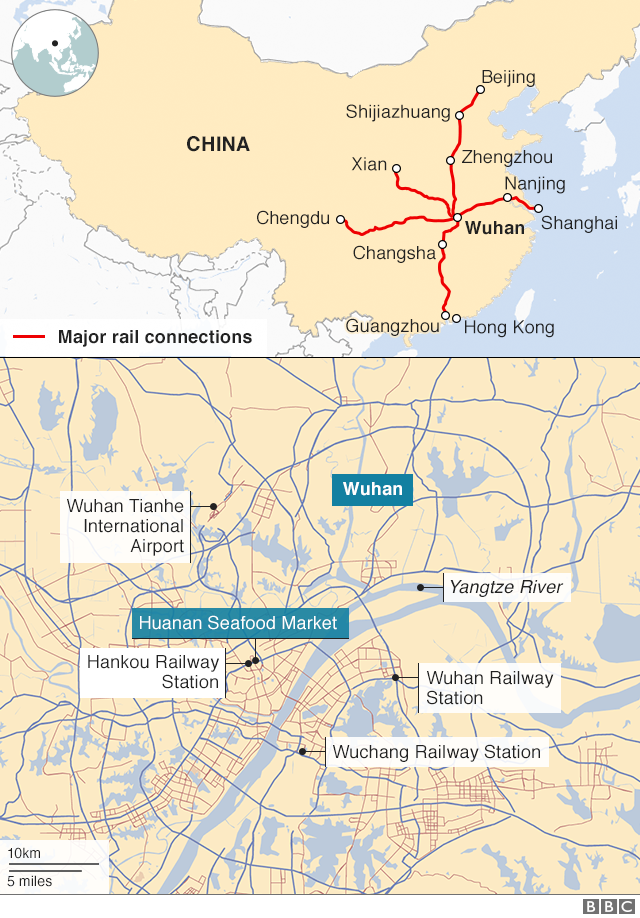
Wuhan, a Chinese city of eleven million people, has temporarily shut down its public transport as it tries to halt the outbreak of a new strain of virus.
Those living in the city have been advised not to leave, in a week when millions of Chinese are travelling for the upcoming Lunar New Year holiday.
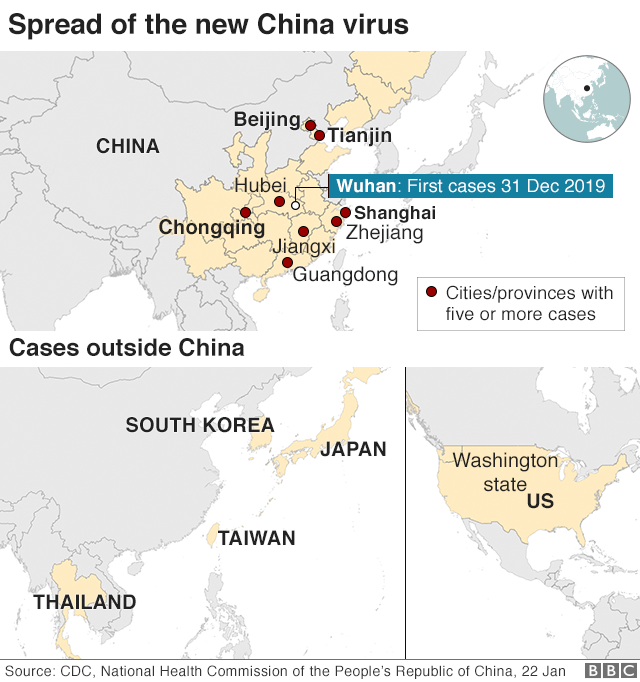
The respiratory illness has spread to other parts of China, with some cases in other countries including the US.
There are more than 500 confirmed cases and 17 people have died.
Known for now as 2019-nCoV, the virus is understood to be a new strain of coronavirus not previously identified in humans. The Sars (severe acute respiratory syndrome) virus that killed nearly 800 people globally in the early 2000s was also a coronavirus, as is the common cold.
All the fatalities so far have been in Hubei, the province around Wuhan.
Meanwhile, after a day of discussions in Geneva, the World Health Organization’s (WHO) emergency committee has announced it will not yet declare a “global emergency” over the new virus.
Director general Dr Tedros Ghebreyesus said more information was needed about the spread of the infection. The committee of health experts will meet again on Thursday.
A global emergency is the highest level of alarm the WHO can sound and has previously been used in response to swine flu, Zika virus and Ebola.
What measures have been announced?
From Thursday, all flights and passenger train services out of Wuhan have been stopped.
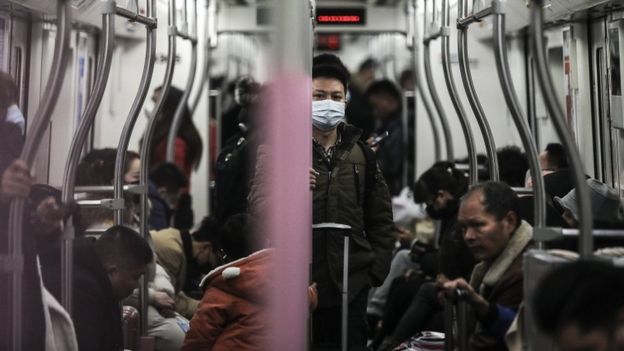
Bus, subway and ferry services all shut down from 10:00 local time (02:00 GMT).
A special command centre in Wuhan set up to contain the virus said the move was meant to “resolutely contain the momentum of the epidemic spreading”.
Those living in Wuhan had already been told to avoid crowds and minimise public gatherings.
State news agency Xinhua said tourist attractions and hotels in the city had been told to suspend large-scale activities while libraries, museums and theatres were cancelling exhibitions and performances.
A Lunar New Year prayer-giving ceremony at the city’s Guiyuan Temple, which attracted 700,000 people last year, has also been cancelled.
The hashtag “Wuhan is sealed off” was trending on Chinese social media website Weibo.
One user said worries about food and disinfectant made it feel like “the end of the world”, while another said they were on the “verge of tears” when Chinese officials announced the shut-down.
The WHO’s Dr Ghebreyesus described the latest measures as “very strong” and said they would “not only control the outbreak, they will minimise spread internationally”.
Chinese officials said the country was now at the “most critical stage” of prevention and control.
“Basically, do not go to Wuhan. And those in Wuhan please do not leave the city,” said National Health Commission vice-minister Li Bin in one of the first public briefings since the beginning of the outbreak.
Like shutting down London before Christmas
By James Gallagher, BBC health and science correspondent
Wuhan is starting to look like a city in quarantine.
Officials had already warned residents not to leave the city and visitors not to come.
Now the reported public transport ban – which includes flights – slams many of the routes in and out of the city shut.
Image copyright GETTY IMAGESImage caption Subways in Wuhan will be temporarily shut
It is a significant attempt to stop the spread of this new virus, which we now know can spread from person to person.
Limiting transport will cut the chance of the virus reaching other cities in China and other countries around the world.
This all comes just as millions of people are travelling across China for the week-long holiday that is Lunar New Year.
If you’re struggling for context – imagine shutting down London in the week before Christmas.
The big question left is the roads – and whether any of Wuhan’s 11 million inhabitants will be able to simply drive away.
The patient in Macau is said to be a businesswoman who arrived from Wuhan over the weekend.
The first US case was confirmed on Tuesday. President Donald Trump said the situation was “totally under control” and that he trusted the information being provided by Chinese authorities.
There have been three cases in Thailand, one in Korea, one in Japan and one in Taiwan.
Although only about 500 cases have been confirmed, calculations by scientists at the MRC Centre for Global Infectious Disease Analysis at Imperial College London suggest there are 4,000 people sick with the virus in Wuhan.
Our estimate at 4,000 cases is more than double the past estimate due to increase of number of cases outside China. This should not be interpreted as implying the outbreak has doubled in size.
The virus originated in a seafood market in Wuhan that “conducted illegal transactions of wild animals”, authorities said. The market has since been shut down.
The likes of Saudi Arabia also saw an upswing in travellers from the mainland after the release of its new visa programme
But fewer Chinese tourists went abroad this year, with a 15 per cent drop from 2018 attributed to more opting to visit local historical sites
Chinese tourists take photos in front of the Imperial Palace in Tokyo, Japan. Photo: Reuters
Fewer Chinese travellers went overseas during “golden week” this year – but for those who did, Japan, Thailand and Singapore were the top-ranked destinations as tourists from the mainland gave Hong Kong a miss, according to China’s largest travel company Ctrip.
Chinese government data showed only 6.07 million people travelled during the national holiday between October 1-6, a 15.1 per cent drop from the corresponding period last year. Analysts attributed this to Chinese tourists opting for a “staycation”, as 782 million people – a 7 per cent increase from last year – chose to celebrate the 70th anniversary of the People’s Republic of China by visiting local historical sites.
How a new wave of Indian travellers are transforming tourism in Southeast Asia
For those who did venture abroad, Japan, Thailand and Singapore ranked as the top three most-booked countries in Asia during the week, according to Chinese travel firm Ctrip, as tourists from the mainland skipped protest-hit Hong Kong for other destinations.
The city, now in its 19th week of anti-government protests, over the week saw a 50 per cent overall drop in tourism from last year, as well as a 47.8 per cent reduction in border crossings at the Luohu border checkpoint, according to government figures.
Japan remained the most popular destination for Chinese tourists. In the first half of 2019, the nation saw 4.5 million visitors from China, up 11.7 per cent from the same period in 2018. In order of popularity, the top-visited cities were Osaka, Tokyo, Kyoto, Sapporo and Nagoya, according to Japanese media.
Over the same week, Japan increased its sales tax from 8 to 10 per cent, but Chinese shoppers – who accounted for 37 per cent, or US$15.4 billion, of the spending by international visitors to the nation last year – were undeterred.
Japan saw the highest volume of overseas transactions over the week, according Alipay Mobile, the world’s largest mobile payment platform. The firm declined to share the exact amount Chinese tourists had spent in Japan, but reported average spending per international traveller during golden week had increased by 15 per cent to 2,500 yuan (US$350).
From Nissan sales to Tsushima tourism, trade spat with Korea hits Japan in the pocket
Alipay is operated by Ant Financial, an affiliate of Alibaba Group Holding, which owns the Post.
Japanese department stores such as Sogo and Seibu celebrated the Chinese national holiday by holding golden week events and sales at 15 different branches across the nation, with food and arts promotions targeting Chinese shoppers.
Chinese travellers to Japan want cultural experiences involving local customs such as temple tours, heritage sites and cultural events, according to Emily Guo, a researcher at Hong Kong-based marketing research firm Cherry Blossoms.
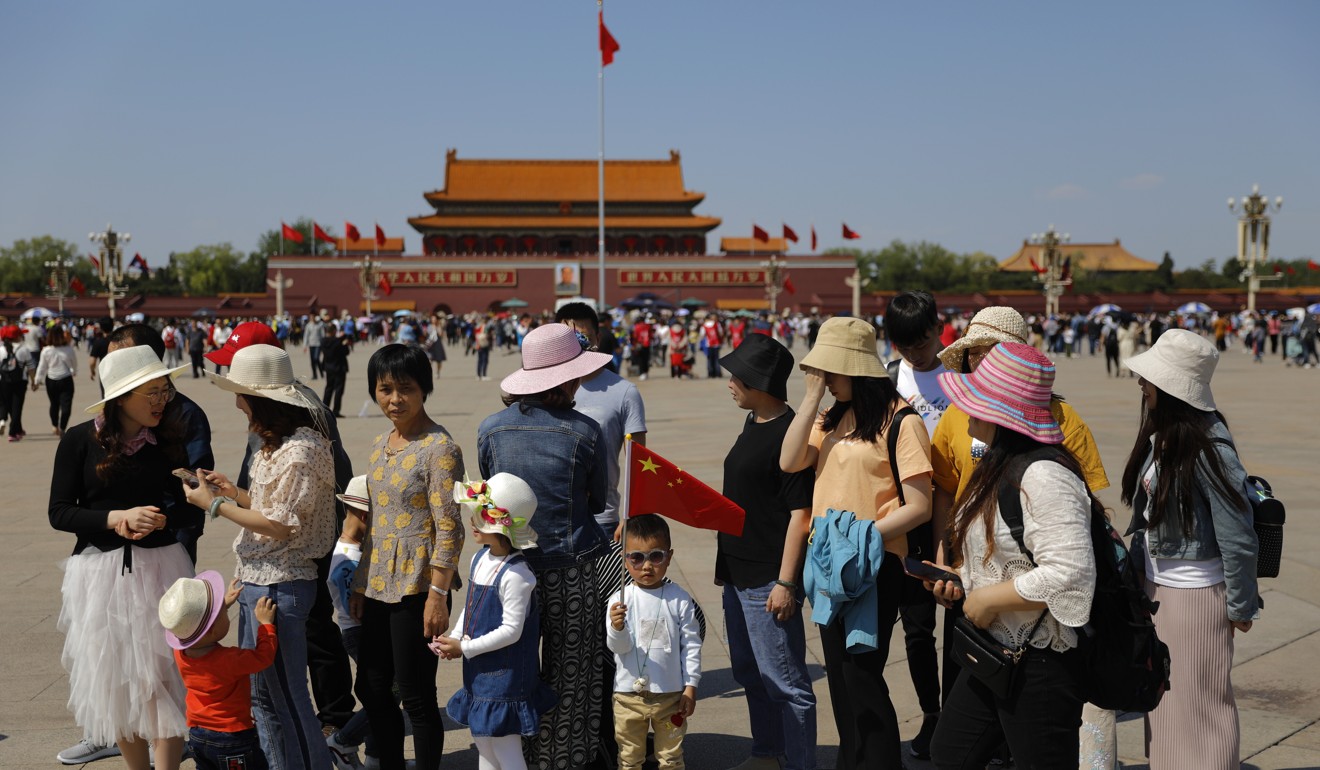
Chinese tourists visit Tiananmen Square in Beijing. Analysts say 782 million people opted for “staycations” at local historical sites over golden week this year. Photo: EPA
Experts say Thailand – the second-most booked country during golden week, according to Ctrip – saw many repeat travellers return to the country. The nation saw 1.03 million arrivals from China in August, up 19 per cent from 2018.
Guo said these travellers were more budget-conscious than those who travelled to Japan, and enjoyed the good value and picturesque scenery for sharing on social media.
“They have already travelled to Southeast Asia before, and are therefore looking for personalised and local experiences like interacting with Thai residents, jungle treks and food tours,” she said, adding that many are willing to spend extra on immersive experiences such as a hotel in the countryside, or on a room with a forest view.
Thailand’s tourism industry gets jitters after currency surges, visitor numbers from China fall
According to Alipay Mobile, the sale of “durian experience” packages for Chinese tourists looking to taste the spiky, pungent fruit at local farms increased by 60 per cent in Thailand and Malaysia from last year.
Shopping remained on the agenda, too. Thailand ranked second for the highest volume of overseas transactions during the week, according to data from Alipay Mobile. Most Chinese shoppers frequented duty-free shops, convenience stores and local malls, according to local press.
Singapore remained a destination of choice for tourists from the mainland. The city was among the most popular “traditional destinations” for them, according to China’s culture and tourism ministry, with others including Malaysia, Thailand, Japan, Australia, France, Italy, and Russia.
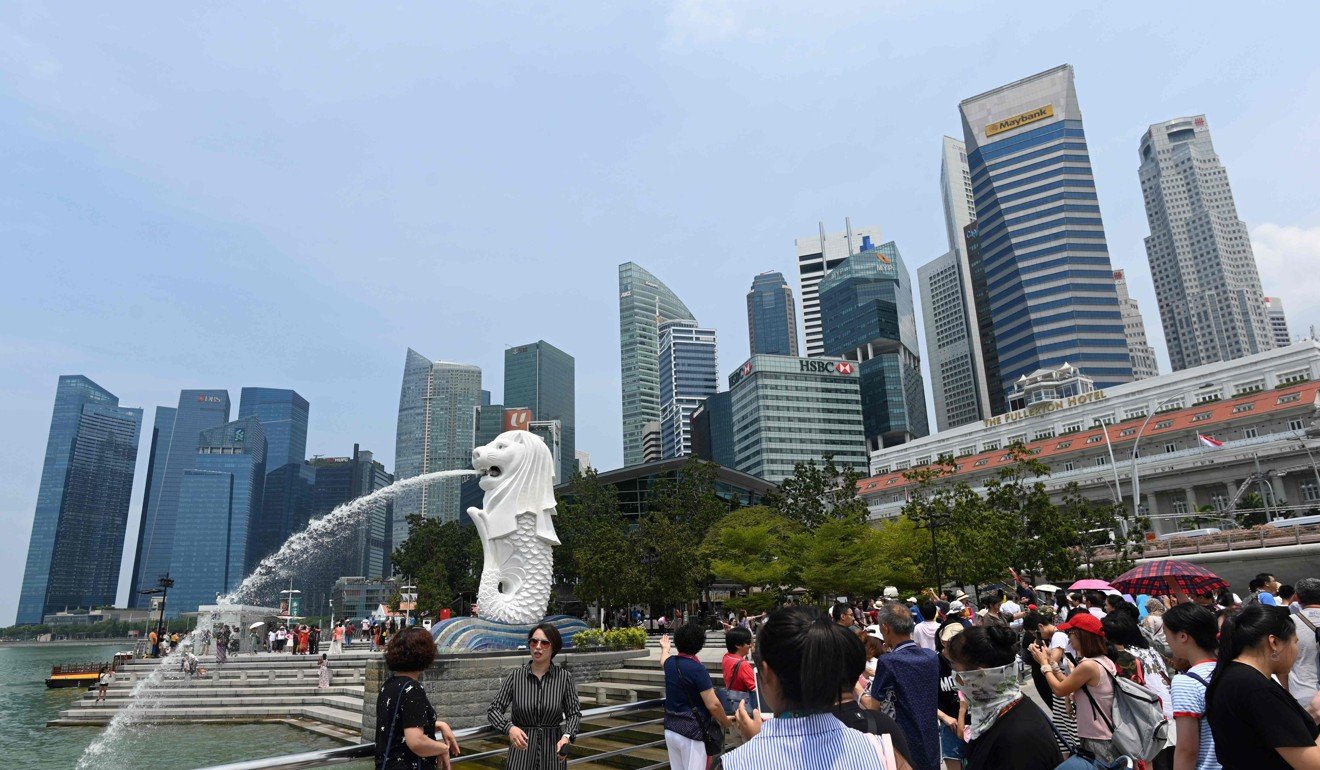
Chinese tourists visiting Singapore over golden week also seized the opportunity to check out property in the Lion City. Photo: AFP
July saw the Lion City break its record for the number of Chinese arrivals, at close to 390,000, an unprecedented 46 per cent jump from the previous month.
Analysts have attributed this to a diversion of tourists from Hong Kong, but property agents such as Clarence Foo, associate deputy group director at OrangeTee & Tie, said some of these Chinese tourists were using the golden week as a chance to eye Singaporean real estate.
“Compared to a normal week, there were probably 15 to 20 per cent more Chinese visitors who viewed property,” said Foo, who counts Singaporean and international buyers among his clients.” They are certainly more keen on Singapore [property] now as there isn’t another comparable investment destination in Asia.”
Meanwhile, the Middle East is emerging as a popular shopping destination for Chinese tourists. According to Ctrip, Dubai saw 501,000 travellers from the mainland in the first half of 2019, an 11 per cent increase from last year.
Saudi Arabia has also experienced a surge in Chinese tourists, with 7,931 heading to the country since it launched its new instant tourist visa programme on September 27. With the new visa, which can be obtained online or upon arrival, tourists can stay in the country for up to 90 days, and unwed foreign men and women can for the first time share hotel rooms.
“Saudi Arabia has the potential to become very popular with Chinese tourists,” said Guo from Cherry Blossoms, adding that travellers from the mainland are increasingly looking for exciting new adventures. “It’s a status symbol for them to visit a country others haven’t visited before.”
An increasing proportion of young people no longer willing to wait tables in China as restaurant owners look to new technology for answers
Catering robots developed by Pudu Tech, the three-year-old Shenzhen start-up, have been adopted by thousands of restaurants in China, as well as some foreign countries including Singapore, Korea, and Germany. Photo: Handout
Two years ago, Bao Xiangyi quit school and worked as a waiter in a restaurant for half a year to support himself, and the 19 year-old remembers the time vividly.
“It was crazy working in some Chinese restaurants. My WeChat steps number sometimes hit 20,000 in a day [just by delivering meals in the restaurant],” said Bao.
The WeChat steps fitness tracking function gauges how many steps you literally take and 20,000 steps per day can be compared with a whole day of outdoor activity, ranking you very high in a typical friends circle.
Bao, now a university student in Hangzhou, Zhejiang province, quit the waiter job and went back to school.
“I couldn’t accept that for 365 days a year every day would be the same,” said Bao.
“Those days were filled with complete darkness and I felt like my whole life would be spent as an inferior and insignificant waiter.”
Olivia Niu, a 23-year-old Hong Kong resident, quit her waiter job on the first day. “It was too busy during peak meal times. I was so hungry myself but I needed to pack meals for customers,” said Niu.
Being a waiter has never been a top career choice but it remains a big source of employment in China. Yang Chunyan, a waitress at the Lanlifang Hotel in Wenzhou in southeastern China, has two children and says she chose the job because she needs to make a living.
Catering robots developed by Pudu Tech, the three-year-old Shenzhen start-up. Photo: Handout
Today’s young generation have their sights on other areas though. Of those born after 2000, 24.5 per cent want careers related to literature and art. This is followed by education and the IT industry in second and third place, according to a recent report by Tencent QQ and China Youth Daily.
Help may now be at hand though for restaurants struggling to find qualified table staff who are able to withstand the daily stress of juggling hundreds of orders of food. The answer comes in the form of robots.
Japan’s industrial robots industry becomes latest victim of the trade war
Shenzhen Pudu Technology, a three-year-old Shenzhen start-up, is among the tech companies offering catering robots to thousands of restaurant owners who are scrambling to try to plug a labour shortfall with new tech such as machines, artificial intelligence and online ordering systems. It has deployed robots in China, Singapore, Korea and Germany.
With Pudu’s robot, kitchen staff can put meals on the robot, enter the table number, and the robot will deliver it to the consumer. While an average human waiter can deliver 200 meals per day – the robots can manage 300 to 400 orders.
“Nearly every restaurant owner [in China] says it’s hard to recruit people to [work as a waiter],” Zhang Tao, the founder and CEO of Pudu tech said in an interview this week. “China’s food market is huge and delivering meals is a process with high demand and frequency.”
Pudu’s robots can be used for ten years and cost between 40,000 yuan (US$5,650) and 50,000 yuan. That’s less than the average yearly salary of restaurant and hotel workers in China’s southern Guangdong province, which is roughly 60,000 yuan, according to a report co-authored by the South China Market of Human Resources and other organisations.
As such, it is no surprise that more restaurants want to use catering robots.
According to research firm Verified Market Research, the global robotics services market was valued at US$11.62 billion in 2018 and is projected to reach US$35.67 billion by 2026.
Can robots and virtual fruit help the elderly get well in China?
China’s labour force advantage has also shrank in recent years. The working-age population, people between 16 and 59 years’ old, has reduced by 40 million since 2012 to 897 million, accounting for 64 per cent of China’s roughly 1.4 billion people in 2018, according to the national bureau of statistics.
By comparison, those of working age accounted for 69 per cent of the total population in 2012.
Other Chinese robotic companies are also entering the market. SIASUN Robot & Automation Co, a hi-tech listed enterprise belonging to the Chinese Academy of Sciences, introduced their catering robots to China’s restaurants in 2017. Delivery robots developed by Shanghai-based Keenon Robotics Co., founded in 2010, are serving people in China and overseas markets such as the US, Italy and Spain.
Pudu projects it will turn a profit this year and it is in talks with venture capital firms to raise a new round of funding, which will be announced as early as October, according to Zhang. Last year it raised 50 million yuan in a round led by Shenzhen-based QC capital.
To be sure, the service industry is still the biggest employer in China, with 359 million workers and accounting for 46.3 per cent of a working population of 776 million people in 2018, according to the national bureau of statistics.
And new technology sometimes offers up new problems – in this case, service with a smile.
“When we go out for dinner, what we want is service. It is not as simple as just delivering meals,” said Wong Kam-Fai, a professor in engineering at the Chinese University of Hong Kong and a national expert appointed by the Chinese Association for Artificial Intelligence. “If they [robot makers] can add an emotional side in future, it might work better.”
Technology companies also face some practical issues like unusual restaurant layouts.
“Having a [catering robot] traffic jam on the way to the kitchen is normal. Some passageways are very narrow with many zigzags,” Zhang said. “But this can be improved in future with more standardised layouts.”
Multi-floor restaurants can also be a problem.
Dai Qi, a sales manager at the Lanlifang Hotel, said it is impossible for her restaurant to adopt the robot. “Our kitchen is on the third floor, and we have boxes on the second, third, and fourth floor. So the robots can’t work [to deliver meals tdownstairs/upstairs],” Dai said.
But Bao says he has no plans to return to being a waiter, so the robots may have the edge.
“Why are human beings doing something robots can do? Let’s do something they [robots] can’t,” Bao said.
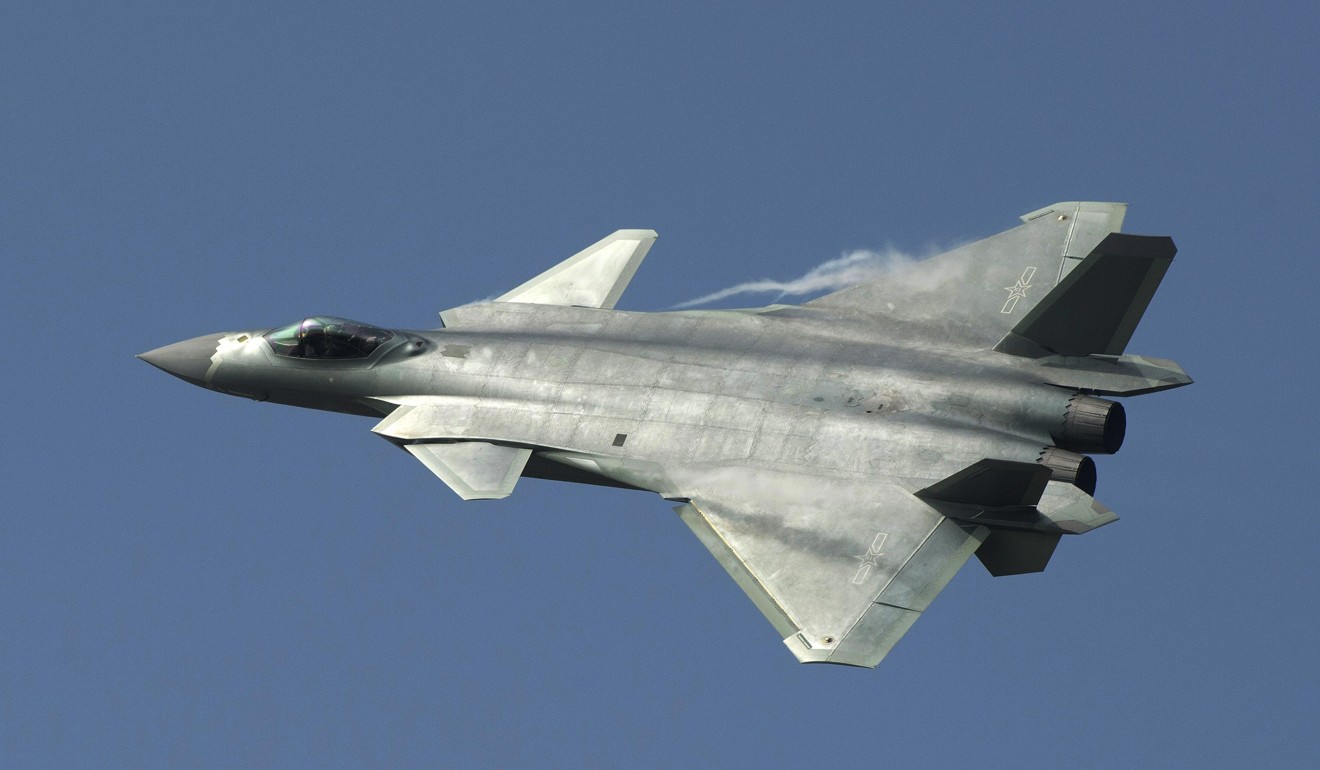
October 1 event is intended to be a showcase for military’s progress under Xi Jinping, with J-20 stealth fighters set to take pride of place
Domestically developed weapons are main focus of event despite long-standing problems in building aircraft engines
Chinese J-10 jets perform at the Dubai air show in 2017. Photo: AFP
China has stepped up intensive rehearsals for the upcoming National Day parade, which military insiders say is designed to showcase the achievements of Chinese President Xi Jinping’s modernisation drive.
The parade on October 1 will mark the 70th anniversary of the founding of the People’s Republic and will focus on weapons developed since Xi came to power in late 2012, despite long-standing problems in aircraft engine development.
Video clips circulating on mainland social media in recent days have shown at least seven types of aircraft – including the KJ-2000 airborne early warning and control aircraft and J-10 and J-11B fighter jets – taking part in rehearsals over the countryside around Beijing.
A military insider said the country’s first stealth fighter jet, the J-20, had been rehearsing over the western suburbs of the capital since April.
“There will be up to seven J-20 displayed in the military parade, which is the largest formation since its formal deployment to the Chinese air force in 2017,” the military insider said.
“The J-20 has entered mass production. So far at least 70 J-20s have been made, even though all of them are still equipped with Russian AL-31 engines.”
Earlier this month, the People’s Liberation Army Air Force released a video of a flight of seven J-20s, the largest formation seen so far, suggesting that the fifth-generation warplane has gone into mass production as an arms race with the United States mounts in the region.
The second-largest J-20 formation was shown in an air force video for PLA Day on August 1, when five of the jets were shown.
China has been forced to deploy the J-20 ahead of its schedule since the US has increased the deployment of its fifth-generation stealth fighter jets like the F-22 and F-35s in the Asia-Pacific region.
The US and its allies, including Japan and South Korea, will have more than 200 F-35s by 2025, which means China also needs a similar number of stealth fighters.
To meet demand, China has been working on the development of a purpose-built thrust engine for its stealth fighter since the early 2000s, but has yet to achieve international quality control standards due to problems that include single-crystal turbine blade technology.
China’s air force spreads its wings in 70th anniversary video
Hong Kong-based military commentator Song Zhongping said aircraft engine development had been a long-standing shortcoming but it would not affect the practical fighting capacity of the J-20, which currently uses Russian engines.
“The J-20 hasn’t used the domestic engines so far because it wants a better one, and it still has time,” Song said.
“Other [Chinese-developed] warplanes like the J-10, J-11 and multipurpose attack helicopters are all modified and advanced types, indicating comprehensive achievements amid China’s military modernisation over the past years.”
A Chinese J-20 stealth fighter has entered mass production. Photo: EPA-EFE
Besides the domestically developed aircraft, Beijing is going to display its strategic nuclear missiles, such as the DF-41 intercontinental ballistic missile and the JL-2 submarine-launched ballistic missile, as centrepieces of its National Day military parade, according to a Beijing-based military source.
Xi, who also chairs the powerful Central Military Commission, inspected the country’s biggest military parade at the Zhurihe Combined Tactics Training Base in Inner Mongolia in 2017 to celebrate the 90th anniversary of the PLA, but the source said the weapons displayed in Zhurihe had been developed under the leadership of Xi’s predecessor, Hu Jintao.
“Xi needs to highlight his personal achievements in his era, that’s why this year’s parade has political aims more than military significance,” the source said.
The source also highlighted the significance of the People’s Republic marking its 70th anniversary because the Soviet Union did not survive for that length of time.
“Xi is attempting to tell the outside world that Chinese communist regime has been consolidated under his leadership.”
TOKYO (Reuters) – China, Japan and South Korea have set ambitious targets to put millions of hydrogen-powered vehicles on their roads by the end of the next decade at a cost of billions of dollars.
But to date, hydrogen fuel cell vehicles (FCVs) have been upstaged by electric vehicles, which are increasingly becoming a mainstream option due to the success of Tesla Inc’s (TSLA.O) luxury cars as well as sales and production quotas set by China.
Critics argue FCVs may never amount to more than a niche technology. But proponents counter hydrogen is the cleanest energy source for autos available and that with time and more refueling infrastructure, it will gain acceptance.
AMBITIOUS TARGETS
China, far and away the world’s biggest auto market with some 28 million vehicles sold annually, is aiming for more than 1 million FCVs in service by 2030. That compares with just 1,500 or so now, most of which are buses.
Japan, a market of more than 5 million vehicles annually, wants to have 800,000 FCVs sold by that time from around 3,400 currently.
South Korea, which has a car market just one third the size of Japan, has set a target of 850,000 vehicles on the road by 2030. But as of end-2018, fewer than 900 have been sold.
WHY HYDROGEN?
Hydrogen’s proponents point to how clean it is as an energy source as water and heat are the only byproducts and how it can be made from a number of sources, including methane, coal, water, even garbage. Resource-poor Japan sees hydrogen as a way to greater energy security.
They also argue that driving ranges and refueling times for FCVs are comparable to gasoline cars, whereas EVs require hours to recharge and provide only a few hundred kilometers of range.
Many backers in China and Japan see FCVs as complementing EVs rather than replacing them. In general, hydrogen is seen as the more efficient choice for heavier vehicles that drive longer distances, hence the current emphasis on city buses.
THE MAIN PLAYERS
Only a handful of automakers have made fuel cell passenger cars commercially available.
Toyota Motor Corp (7203.T) launched the Mirai sedan at the end of 2014, but has sold fewer than 10,000 globally. Hyundai Motor Co (005380.KS) has offered the Nexo crossover since March last year and has sold just under 2,900 worldwide. It had sales of around 900 for its previous FCV model, the Tucson.
Honda Motor Co Ltd’s (7267.T) Clarity Fuel Cell is available for lease, while Daimler AG’s GLC F-CELL has been delivered to a handful of corporate and public sector clients.
Buses are seeing more demand. Both Toyota and Hyundai have offerings and have begun selling fuel cell components to bus makers, particularly in China.
Several Chinese manufacturers have developed their own buses, notably state-owned SAIC Motor (600104.SS), the nation’s biggest automaker, and Geely Auto Group, which also owns the Volvo Cars and Lotus brands.
WHY HAVEN’T FUEL CELL CARS CAUGHT ON YET?
A lack of refueling stations, which are costly to build, is usually cited as the biggest obstacle to widespread adoption of FCVs. At the same time, the main reason cited for the lack of refueling infrastructure is that there are not enough FCVs to make them profitable.
Consumer worries about the risk of explosions are also a big hurdle and residents in Japan and South Korea have protested against the construction of hydrogen stations. This year, a hydrogen tank explosion in South Korea killed two people, which was followed by a blast at a Norway hydrogen station.
Then there’s the cost. Heavy subsidies are needed to bring prices down to levels of gasoline-powered cars. Toyota’s Mirai costs consumers just over 5 million yen ($46,200) after subsidies of 2.25 million yen. That’s still about 50% more than a Camry.
Automakers contend that once sales volumes increase, economies of scale will make subsidies unnecessary.
An increasing proportion of young people no longer willing to wait tables in China as restaurant owners look to new technology for answers
Catering robots developed by Pudu Tech, the three-year-old Shenzhen start-up, have been adopted by thousands of restaurants in China, as well as some foreign countries including Singapore, Korea, and Germany. Photo: Handout
Two years ago, Bao Xiangyi quit school and worked as a waiter in a restaurant for half a year to support himself, and the 19 year-old remembers the time vividly.
“It was crazy working in some Chinese restaurants. My WeChat steps number sometimes hit 20,000 in a day [just by delivering meals in the restaurant],” said Bao.
The WeChat steps fitness tracking function gauges how many steps you literally take and 20,000 steps per day can be compared with a whole day of outdoor activity, ranking you very high in a typical friends circle.
Bao, now a university student in Hangzhou, Zhejiang province, quit the waiter job and went back to school.
“I couldn’t accept that for 365 days a year every day would be the same,” said Bao. “Those days were filled with complete darkness and I felt like my whole life would be spent as an inferior and insignificant waiter.”
Olivia Niu, a 23-year-old Hong Kong resident, quit her waiter job on the first day. “It was too busy during peak meal times. I was so hungry myself but I needed to pack meals for customers,” said Niu.
Being a waiter has never been a top career choice but it remains a big source of employment in China. Yang Chunyan, a waitress at the Lanlifang Hotel in Wenzhou in southeastern China, has two children and says she chose the job because she needs to make a living.
Catering robots developed by Pudu Tech, the three-year-old Shenzhen start-up. Photo: Handout
Today’s young generation have their sights on other areas though. Of those born after 2000, 24.5 per cent want careers related to literature and art. This is followed by education and the IT industry in second and third place, according to a recent report by Tencent QQ and China Youth Daily.
Help may now be at hand though for restaurants struggling to find qualified table staff who are able to withstand the daily stress of juggling hundreds of orders of food. The answer comes in the form of robots.
Japan’s industrial robots industry becomes latest victim of the trade war
Shenzhen Pudu Technology, a three-year-old Shenzhen start-up, is among the tech companies offering catering robots to thousands of restaurant owners who are scrambling to try to plug a labour shortfall with new tech such as machines, artificial intelligence and online ordering systems. It has deployed robots in China, Singapore, Korea and Germany.
With Pudu’s robot, kitchen staff can put meals on the robot, enter the table number, and the robot will deliver it to the consumer. While an average human waiter can deliver 200 meals per day – the robots can manage 300 to 400 orders.
“Nearly every restaurant owner [in China] says it’s hard to recruit people to [work as a waiter],” Zhang Tao, the founder and CEO of Pudu tech said in an interview this week. “China’s food market is huge and delivering meals is a process with high demand and frequency.”
Pudu’s robots can be used for ten years and cost between 40,000 yuan (US$5,650) and 50,000 yuan. That’s less than the average yearly salary of restaurant and hotel workers in China’s southern Guangdong province, which is roughly 60,000 yuan, according to a report co-authored by the South China Market of Human Resources and other organisations.
As such, it is no surprise that more restaurants want to use catering robots.
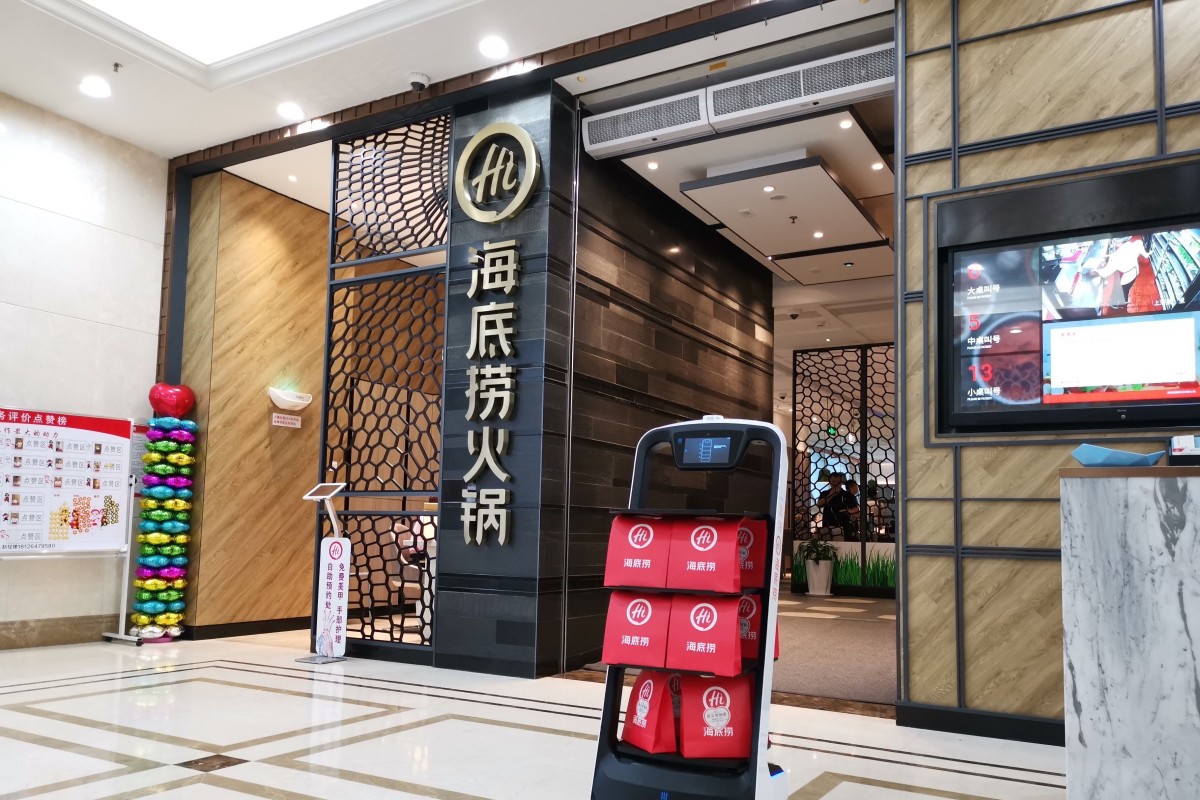
According to research firm Verified Market Research, the global robotics services market was valued at US$11.62 billion in 2018 and is projected to reach US$35.67 billion by 2026. Haidilao, China’s top hotpot restaurant, has not only adopted service robots but also introduced a smart restaurant with a mechanised kitchen in Beijing last year. And in China’s tech hub of Shenzhen, it is hard to pay without an app as most of the restaurants have deployed an online order service.
Can robots and virtual fruit help the elderly get well in China?
China’s labour force advantage has also shrank in recent years. The working-age population, people between 16 and 59 years’ old, has reduced by 40 million since 2012 to 897 million, accounting for 64 per cent of China’s roughly 1.4 billion people in 2018, according to the national bureau of statistics.
By comparison, those of working age accounted for 69 per cent of the total population in 2012.
Other Chinese robotic companies are also entering the market. SIASUN Robot & Automation Co, a hi-tech listed enterprise belonging to the Chinese Academy of Sciences, introduced their catering robots to China’s restaurants in 2017. Delivery robots developed by Shanghai-based Keenon Robotics Co., founded in 2010, are serving people in China and overseas markets such as the US, Italy and Spain.
Pudu projects it will turn a profit this year and it is in talks with venture capital firms to raise a new round of funding, which will be announced as early as October, according to Zhang. Last year it raised 50 million yuan in a round led by Shenzhen-based QC capital.
To be sure, the service industry is still the biggest employer in China, with 359 million workers and accounting for 46.3 per cent of a working population of 776 million people in 2018, according to the national bureau of statistics.
And new technology sometimes offers up new problems – in this case, service with a smile.
“When we go out for dinner, what we want is service. It is not as simple as just delivering meals,” said Wong Kam-Fai, a professor in engineering at the Chinese University of Hong Kong and a national expert appointed by the Chinese Association for Artificial Intelligence. “If they [robot makers] can add an emotional side in future, it might work better.”
Technology companies also face some practical issues like unusual restaurant layouts.
“Having a [catering robot] traffic jam on the way to the kitchen is normal. Some passageways are very narrow with many zigzags,” Zhang said. “But this can be improved in future with more standardised layouts.”
Multi-floor restaurants can also be a problem.
Dai Qi, a sales manager at the Lanlifang Hotel, said it is impossible for her restaurant to adopt the robot. “Our kitchen is on the third floor, and we have boxes on the second, third, and fourth floor. So the robots can’t work [to deliver meals to downstairs/upstairs],” Dai said.
But Bao says he has no plans to return to being a waiter, so the robots may have the edge.
“Why are human beings doing something robots can do? Let’s do something they [robots] can’t,” Bao said.
Han costumes are enjoying a renaissance across China, buoyed by a call to nationalism backed by President Xi Jinping
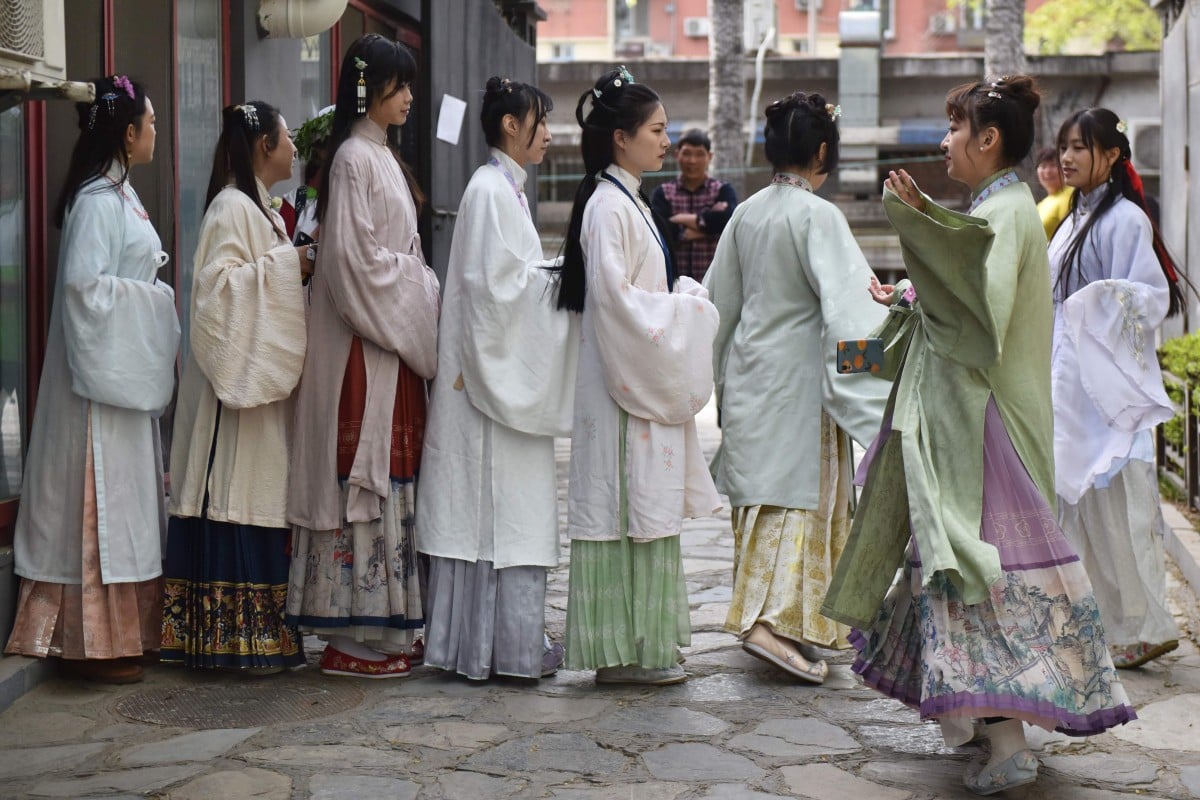
Women wear Han-style clothing in Beijing as part of April’s Traditional Chinese Costume Day celebration. Photo: AFP
Dressed in a flowing robe adorned with beaded floral embroidery from a bygone era, stylist Xiao Hang looks like she emerged from a time machine as she strides across the bustling Beijing metro, attracting curious glances and questions.
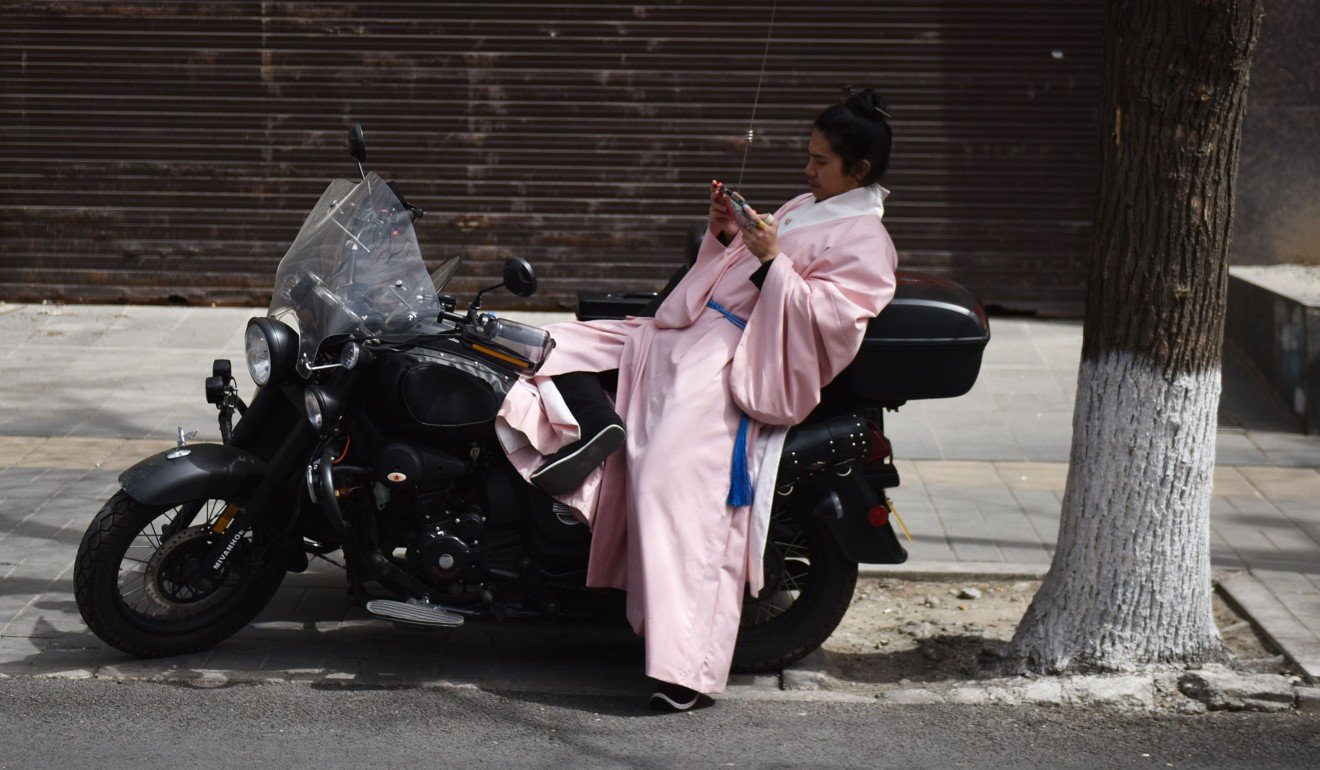
While China embraced Western fashion as its economy boomed in recent decades, now a growing number of young people like Xiao look to the past for their sartorial choices and have adopted hanfu, or Han clothing.
The costumes of the Han ethnic majority are enjoying a renaissance in part because the government is promoting traditional culture in an effort to boost patriotism and national identity.
Like the film, television and comic book productions that have inspired cosplay fans in the West, period dramas on Chinese TV have contributed to the surge in interest in traditional clothing. The Story of Minglan, a series set during the Song dynasty, attracted more than 400 million viewers over three days when it was first shown this year.
The success of television drama The Story Of Minglan this year reflects China’s interest in its Han heritage. Photo: Baidu
While each Han-dominated dynasty had its own style, hanfu outfits were generally characterised by loose, flowing robes with sleeves that reached the knees.
“When we were little, we would drape sheets and duvets around ourselves to pretend we were wearing beautiful clothes,” Xiao said.
Once a worker at a state-owned machine manufacturing company, Xiao now runs her own hanfu business, where she dresses customers for photo shoots and plans hanfu-style weddings.
The Hanfu fashion revival: ancient Chinese dress finds a new following
In modern China, the hanfu community includes history enthusiasts and anime fans, students and young professionals.
Yang Jiaming, a high school pupil in Beijing, wears his outfit under his school uniform.
“Two-thirds of my wardrobe are hanfu,” he said, decked out in a Tang-style beige gown and black boots, adding that his classmates and teachers were supportive of his fashion choices.
A government-supported revival in Chinese culture has energised the hanfu community. Since he entered office in 2012, President Xi Jinping has supported the promotion of a Han-centric vision of Chinese heritage.
Fans of traditional Chinese clothing dare to mix old and new, and hanfu is not the preserve of women. Photo: AFP
In April, the Communist Youth League of China launched a two-day conference celebrating traditional Chinese garb, which included hanfu and took in Traditional Chinese Costume Day.
A live broadcast of the event drew about 20 million viewers, alongside an outpouring of emotions.
“Chinese people have abandoned their own culture and chosen Western culture. The red marriage gown has now become a wedding dress,” wrote a user of Bilibili, a video-streaming platform popular among young anime, comic and gaming fans in China.
Clothes were the “foundation of culture”, said Jiang Xue, who is part of Beijing-based hanfu club Mowutianxia, which has received funding from the Communist Youth League.
“If we as a people and as a country do not even understand our traditional clothing or do not wear them, how can we talk about other essential parts of our culture?” she said.
Forget K-pop and US missiles, Korea is back in fashion with China thanks to live-stream shopping
The style has not yet gained mainstream acceptance in China.
In March, two students in Shijiazhuang Medical College, in northern Hebei province, were reportedly threatened with expulsion for wearing the outfits to class.
Others said they were put off by the reaction they got while wearing hanfu in public.
“I used to be very embarrassed to wear [hanfu] out,” screenwriter Cheng Xia said.
The 37-year-old said she overcame her reservations after going out dressed in a full outfit last year.
Meanwhile, the movement to revive Han ethnic clothing has prompted questions about nationalism and Han-ethnocentrism – a sensitive issue in China, where the government is wary of conflict between ethnic groups.
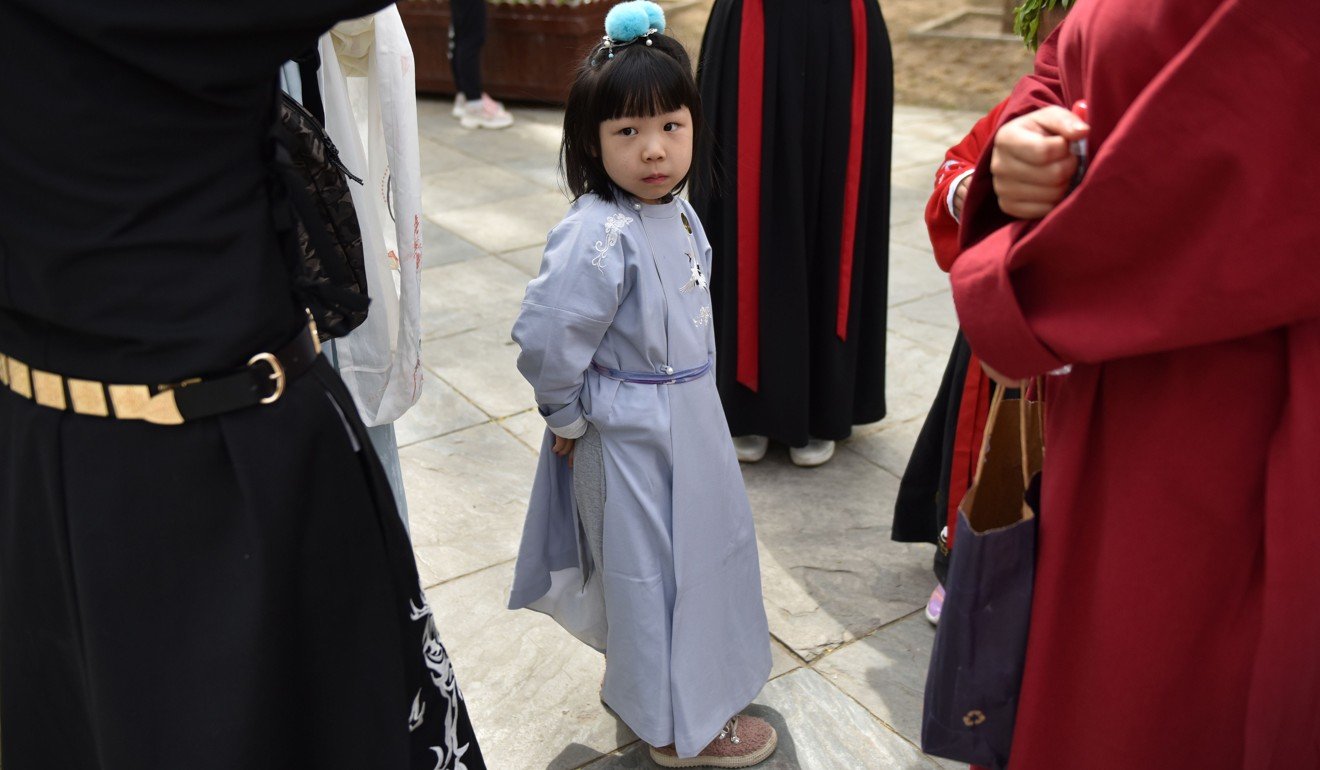
High school pupils and young children are drawn to China’s hanfu trend. Photo: AFP
For instance, within the hanfu community there is long-running opposition towards the qipao, the high-collared, figure-hugging garment that was once a staple of women’s wardrobes.
Known as cheongsam in Cantonese, the qipao – meaning “Qi robe” – began as a long, loose dress worn by the Manchu, or Qi people, who ruled China from the 17th century until the early 1900s.
Its popularity took off in 1920s Shanghai, when it was refashioned into a fitted must-have, favoured by actresses and intellectuals as a symbol of femininity and refinement.
“Some people … think that the cheongsam was inspired by the Qing dynasty, which is not enough to represent China. There are nationalist undertones in this issue,” Chinese culture scholar Gong Pengcheng said.
Master of a dying art: traditional dressmaker recalls golden era of cheongsam in Hong Kong
“It is a good trend to explore traditional culture and clothing culture … There are many things we can talk about, and we need not shrink to nationalist confrontation.”
Yang, the high school pupil, was more upbeat. He said: “At the very least, we can wear our own traditional clothes, just like the ethnic minorities.”


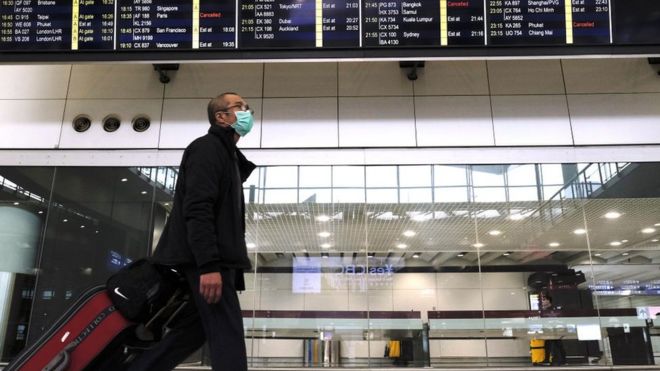 Image copyright GETTY IMAGES














 CHINDIA ALERT: You'll be living in their world, very soon