Chindia Alert: You’ll be Living in their World Very Soon
aims to alert you to the threats and opportunities that China and India present. China and India require serious attention; case of ‘hidden dragon and crouching tiger’.
Without this attention, governments, businesses and, indeed, individuals may find themselves at a great disadvantage sooner rather than later.
The POSTs (front webpages) are mainly 'cuttings' from reliable sources, updated continuously.
The PAGEs (see Tabs, above) attempt to make the information more meaningful by putting some structure to the information we have researched and assembled since 2006.
WASHINGTON (Reuters) – President Donald Trump said on Wednesday he believes China’s handling of the coronavirus is proof that Beijing “will do anything they can” to make him lose his re-election bid in November.
In an interview with Reuters in the Oval Office, Trump talked tough on China and said he was looking at different options in terms of consequences for Beijing over the virus. “I can do a lot,” he said.
Trump has been heaping blame on China for a global pandemic that has killed at least 60,000 people in the United States according to a Reuters tally, and thrown the U.S. economy into a deep recession, putting in jeopardy his hopes for another four-year term.
The Republican president, often accused of not acting early enough to prepare the United States for the spread of the virus, said he believed China should have been more active in letting the world know about the coronavirus much sooner.
Asked whether he was considering the use of tariffs or even debt write-offs for China, Trump would not offer specifics. “There are many things I can do,” he said. “We’re looking for what happened.”
RELATED COVERAGE
China says it has no interest in meddling in U.S. election
“China will do anything they can to have me lose this race,” said Trump. He said he believes Beijing wants his Democratic opponent, Joe Biden, to win the race to ease the pressure Trump has placed on China over trade and other issues.
“They’re constantly using public relations to try to make it like they’re innocent parties,” he said of Chinese officials.
He said the trade deal that he concluded with Chinese President Xi Jinping aimed at reducing chronic U.S. trade deficits with China had been “upset very badly” by the economic fallout from the virus.
A senior Trump administration official, speaking on condition of anonymity, said on Wednesday that an informal “truce” in the war of words that Trump and Xi essentially agreed to in a phone call in late March now appeared to be over.
The two leaders had promised that their governments would do everything possible to cooperate to contain the coronavirus. In recent days, Washington and Beijing have traded increasingly bitter recriminations over the origin of the virus and the response to it.
However, Trump and his top aides, while stepping up their anti-China rhetoric, have stopped short of directly criticizing Xi, who the U.S. president has repeatedly called his “friend.”
Trump also said South Korea has agreed to pay the United States more money for a defense cooperation agreement but would not be drawn out on how much.
“We can make a deal. They want to make a deal,” Trump said. “They’ve agreed to pay a lot of money. They’re paying a lot more money than they did when I got here” in January 2017.
The United States stations roughly 28,500 troops in South Korea, a legacy of the 1950-53 Korean War that ended in an armistice, rather than a peace treaty.
Trump is leading a triage effort to try to keep the U.S. economy afloat through stimulus payments to individuals and companies while nudging state governors to carefully reopen their states as new infections decline.
Trump sounded wistful about the strong economy that he had enjoyed compared with now, when millions of people have lost their jobs and GDP is faltering.
“We were rocking before this happened. We had the greatest economy in history,” he said.
He said he is happy with the way many governors are operating under the strain of the virus but said some need to improve. He would not name names.
Trump’s handling of the virus has come under scrutiny. Forty-three percent of Americans approved of Trump’s handling of the coronavirus, according to the Reuters/Ipsos poll from April 27-28.
But there was some good coronavirus news, as Gilead Sciences Inc said its experimental antiviral drug remdesivir was showing progress in treating virus victims.
Trump has also seeking an accelerated timetable on development of a vaccine.
“I think things are moving along very nicely,” he said.
At the end of the half-hour interview, Trump offered lighthearted remarks about a newly released Navy video purportedly showing an unidentified flying object.
“I just wonder if it’s real,” he said. “That’s a hell of a video.”
The richest man in China opened his own Twitter account last month, in the middle of the Covid-19 outbreak. So far, every one of his posts has been devoted to his unrivalled campaign to deliver medical supplies to almost every country around the world.
“One world, one fight!” Jack Ma enthused in one of his first messages. “Together, we can do this!” he cheered in another.
The billionaire entrepreneur is the driving force behind a widespread operation to ship medical supplies to more than 150 countries so far, sending face masks and ventilators to many places that have been elbowed out of the global brawl over life-saving equipment.
But Ma’s critics and even some of his supporters aren’t sure what he’s getting himself into. Has this bold venture into global philanthropy unveiled him as the friendly face of China’s Communist Party? Or is he an independent player who is being used by the Party for propaganda purposes? He appears to be following China’s diplomatic rules, particularly when choosing which countries should benefit from his donations, but his growing clout might put him in the crosshairs of the jealous leaders at the top of China’s political pyramid.
Other tech billionaires have pledged more money to fight the effects of the virus – Twitter’s Jack Dorsey is giving $1bn (£0.8bn) to the cause. Candid, a US-based philanthropy watchdog that tracks private charitable donations, puts Alibaba 12th on a list of private Covid-19 donors. But that list doesn’t include shipments of vital supplies, which some countries might consider to be more important than money at this stage in the global outbreak.
The world’s top coronavirus financial donors
How Alibaba compares to the top five. No one else other than the effervescent Ma is capable of dispatching supplies directly to those who need them. Starting in March, the Jack Ma foundation and the related Alibaba foundation began airlifting supplies to Africa, Asia, Europe, Latin America and even to politically sensitive areas including Iran, Israel, Russia and the US.
Ma has also donated millions to coronavirus vaccine research and a handbook of medical expertise from doctors in his native Zhejiang province has been translated from Chinese into 16 languages. But it’s the medical shipments that have been making headlines, setting Ma apart.
“He has the ability and the money and the lifting power to get a Chinese supply plane out of Hangzhou to land in Addis Ababa, or wherever it needs to go,” explains Ma’s biographer, Duncan Clark. “This is logistics; this is what his company, his people and his province are all about.”
A friendly face
Jack Ma is famous for being the charismatic English teacher who went on to create China’s biggest technology company. Alibaba is now known as the “Amazon of the East”. Ma started the company inside his tiny apartment in the Chinese coastal city of Hangzhou, in the centre of China’s factory belt, back in 1999. Alibaba has since grown to become one of the dominant players in the world’s second largest economy, with key stakes in China’s online, banking and entertainment worlds. Ma himself is worth more than $40bn.
Officially, he stepped down as Alibaba’s chairman in 2018. He said he was going to focus on philanthropy. But Ma retained a permanent seat on Alibaba’s board. Coupled with his wealth and fame, he remains one of the most powerful men in China.
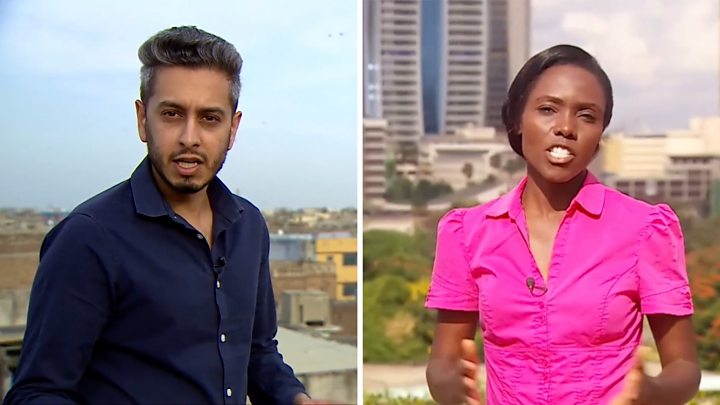
Media caption The BBC’s Secunder Kermani and Anne Soy compare how prepared Asian and African countries are
It appears that Ma’s donations are following Party guidelines: there is no evidence that any of the Jack Ma and Alibaba Foundation donations have gone to countries that have formal ties with Taiwan, China’s neighbour and diplomatic rival. Ma announced on Twitter that he was donating to 22 countries in Latin America. States that side with Taiwan but who have also called for medical supplies – from Honduras to Haiti – are among the few dozen countries that do not appear to be on the list of 150 countries. The foundations repeatedly refused to provide a detailed list of countries that have received donations, explaining that “at this moment in time, we are not sharing this level of detail”.
However, the donations that have been delivered have certainly generated a lot of goodwill. With the exception of problematic deliveries to Cuba and Eritrea, all of the foundations’ shipments dispatched from China appear to have been gratefully received. That success is giving Ma even more positive attention than usual. China’s state media has been mentioning Ma almost as often as the country’s autocratic leader, Xi Jinping.
AFP
So far…
Over 150 countries have received donations from Jack Ma, including about:
120.4mface masks
4,105,000testing kits
3,704ventilators
Source: Alizila
It’s an uncomfortable comparison. As Ma soaks up praise, Xi faces persistent questions about how he handled the early stages of the virus and where, exactly, the outbreak began.
The Chinese government has dispatched medical teams and donations of supplies to a large number of hard-hit countries, particularly in Europe and South-East Asia.
However, those efforts have sometimes fallen flat. China’s been accused of sending faulty supplies to several countries. In some cases, the tests it sent were being misused but in others, low-quality supplies went unused and the donations backfired.
In contrast, Jack Ma’s shipments have only boosted his reputation.
“It’s fair to say that Ma’s donation was universally celebrated across Africa,” says Eric Olander, managing editor of the China Africa Project website and podcast. Ma pledged to visit all countries in Africa and has been a frequent visitor since his retirement.
“What happens to the materials once they land in a country is up to the host government, so any complaints about how Nigeria’s materials were distributed are indeed a domestic Nigerian issue,” Olander adds. “But with respect to the donation itself, the Rwandan leader, Paul Kagame, called it a “shot in the arm” and pretty much everyone saw it for what it was which was: delivering badly-needed materials to a region of the world that nobody else is either willing or capable of helping at that scale.”
Walking the tightrope
But is Ma risking a backlash from Beijing? Xi Jinping isn’t known as someone who likes to share the spotlight and his government has certainly targeted famous faces before. In recent years, the country’s top actress, a celebrated news anchor and several other billionaire entrepreneurs have all “disappeared” for long periods. Some, including the news anchor, end up serving prison sentences. Others re-emerge from detention, chastened and pledging their allegiance to the Party.
“There’s a rumour that [Jack Ma] stepped down in 2018 from being the chairman of the Alibaba Group because he was seen as a homegrown entrepreneur whose popularity would eclipse that of the Communist Party,” explains Ashley Feng, research associate at the Centre for New American Security in Washington DC. Indeed, Ma surprised many when he suddenly announced his retirement in 2018. He has denied persistent rumours that Beijing forced him out of his position.
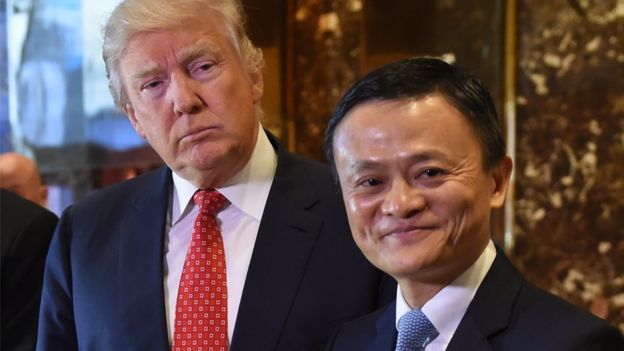
Image copyright GETTY IMAGESImage caption Ma discussed trade with then-President-elect Donald Trump in January 2017
Duncan Clark, Ma’s biographer, is also aware of reports that Ma was nudged away from Alibaba following a key incident in January 2017. The Chinese billionaire met with then-President-elect Donald Trump in Trump Tower, ostensibly to discuss Sino-US trade. The Chinese president didn’t meet with Trump until months later.
“There was a lot of speculation of time that Jack Ma had moved too fast,” Clark says. “So, I think there’s lessons learned from both sides on the need to try to coordinate.”
“Jack Ma represents a sort of entrepreneurial soft power,” Clark adds. “That also creates challenges though, because the government is quite jealous or nervous of non-Party actors taking that kind of role.”
Technically, Ma isn’t a Communist outsider: China’s wealthiest capitalist has actually been a member of the Communist Party since the 1980s, when he was a university student.
But Ma’s always had a tricky relationship with the Party, famously saying that Alibaba’s attitude towards the Party was to “be in love with it but not to marry it”.
Even if Ma and the foundations connected to him are making decisions without Beijing’s advance blessing, the Chinese government has certainly done what it can to capitalise on Ma’s generosity. Chinese ambassadors are frequently on hand at airport ceremonies to receive the medical supplies shipped over by Ma, from Sierra Leone to Cambodia.
China has also used Ma’s largesse in its critiques of the United States. “The State Department said Taiwan is a true friend as it donated 2 million masks,” the Chinese Foreign Ministry tweeted in early April. “Wonder if @StateDept has any comment on Jack Ma’s donation of 1 million masks and 500k testing kits as well as Chinese companies’ and provinces’ assistance?”
Perhaps Ma can rise above what’s happened to so many others who ran afoul of the Party. China might just need a popular global Chinese figure so much that Ma has done what no one else can: make himself indispensable.
“Here’s the one key takeaway from all that happened with Jack Ma and Africa: he said he would do something and it got done,” explains Eric Olander. “That is an incredibly powerful optic in a place where foreigners often come, make big promises and often fail to deliver. So, the huge Covid-19 donation that he did fit within that pattern. He said he would do it and mere weeks later, those masks were in the hands of healthcare workers.”
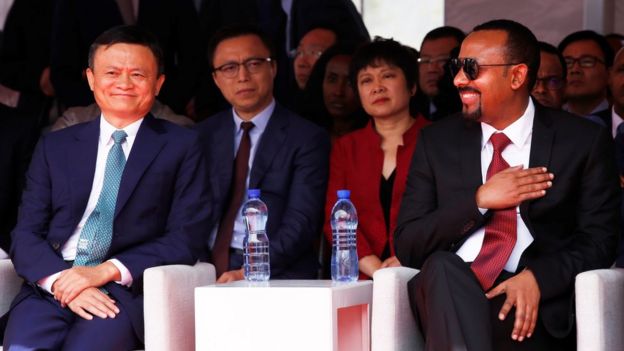
Image copyright GETTY IMAGESImage caption Ma at an Electronic World Trade Platform event with Ethiopian Prime Minister Abiy Ahmed last year
Duncan Clark argues that Ma already had a seat at China’s high table because of Alibaba’s economic heft. However, his first-name familiarity with world leaders makes him even more valuable to Beijing as China tries to repair its battered image.
“He has demonstrated the ability, with multiple IPOs under his belt, and multiple friendships overseas, to win friends and influence people. He’s the Dale Carnegie of China and that certainly, we’ve seen that that’s irritated some in the Chinese government but now it’s almost an all hands on deck situation,” Clark says.
There’s no doubt that China’s wider reputation is benefiting from the charitable work of Ma and other wealthy Chinese entrepreneurs. Andrew Grabois from Candid, the philanthropic watchdog that’s been measuring global donations in relation to Covid-19, says that the private donations coming from China are impossible to ignore.
“They’re taking a leadership role, the kind of thing that used to be done by the United States,” he says. “The most obvious past example is the response to Ebola, the Ebola outbreak in 2014. The US sent in doctors and everything to West Africa to help contain that virus before it left West Africa.”
Chinese donors are taking on that role with this virus.
“They are projecting soft power beyond their borders, going into areas, providing aid, monetary aid and expertise,” Grabois adds.
So, it’s not the right time for Beijing to stand in Jack Ma’s way.
“You know, this is a major crisis for the world right now,” Duncan Clark concludes. “But obviously, it’s also a crisis for China’s relationship with the rest of the world. So they need anybody who can help dampen down some of these those pressures.”
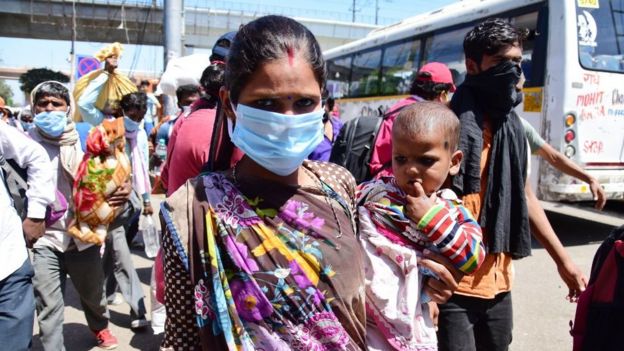
Image copyright GETTY IMAGESImage caption Millions are workers are defying a curfew and returning home
When I spoke to him on the phone, he had just returned home to his village in the northern state of Rajasthan from neighbouring Gujarat, where he worked as a mason.
In the rising heat, Goutam Lal Meena had walked on macadam in his sandals. He said he had survived on water and biscuits.
In Gujarat, Mr Meena earned up to 400 rupees ($5.34; £4.29) a day and sent most of his earnings home. Work and wages dried up after India declared a 21-day lockdown with four hours notice on the midnight of 24 March to prevent the spread of coronavirus. (India has reported more than 1,000 Covid-19 cases and 27 deaths so far.) The shutting down of all transport meant that he was forced to travel on foot.
“I walked through the day and I walked through the night. What option did I have? I had little money and almost no food,” Mr Meena told me, his voice raspy and strained.
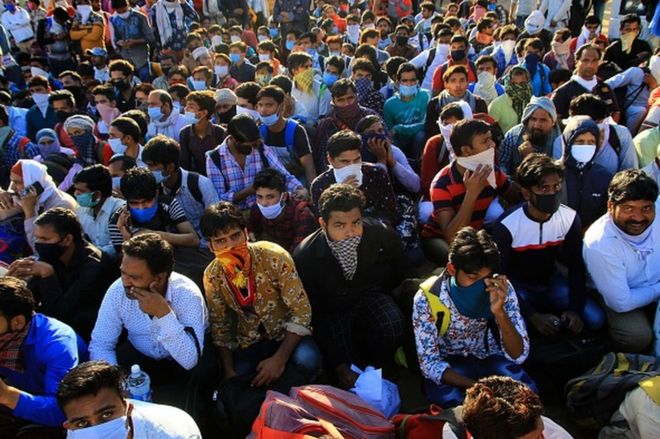
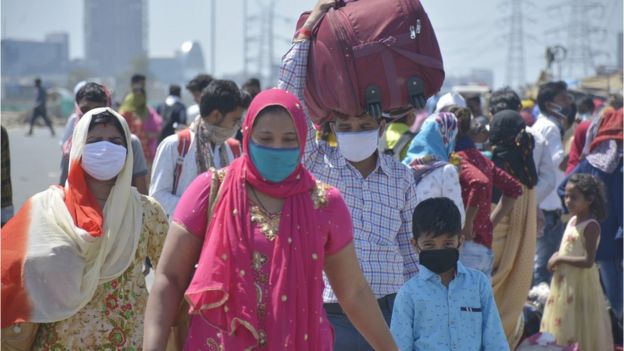
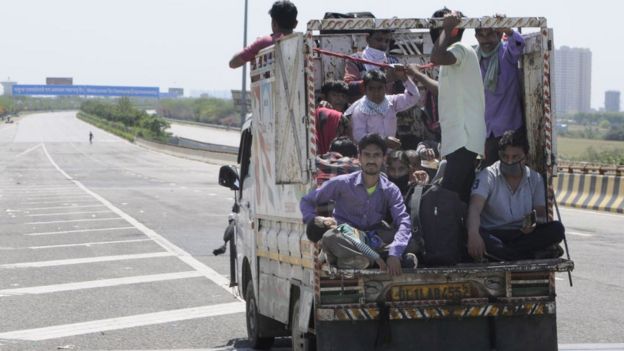
He was not alone. All over India, millions of migrant workers are fleeing its shuttered cities and trekking home to their villages.
These informal workers are the backbone of the big city economy, constructing houses, cooking food, serving in eateries, delivering takeaways, cutting hair in salons, making automobiles, plumbing toilets and delivering newspapers, among other things. Escaping poverty in their villages, most of the estimated 100 million of them live in squalid housing in congested urban ghettos and aspire for upward mobility.
Image copyright GETTY IMAGESImage caption Informal workers are the backbone of India’s big city economies
Last week’s lockdown turned them into refugees overnight. Their workplaces were shut, and most employees and contractors who paid them vanished.
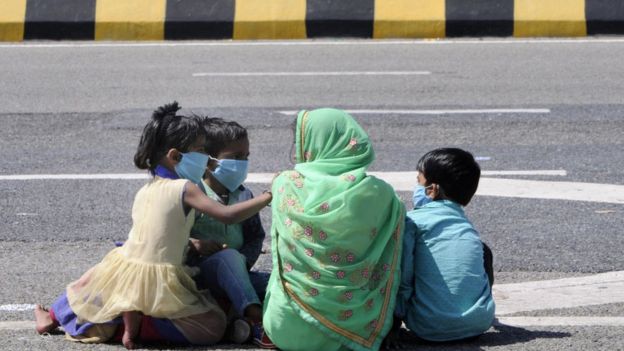
Sprawled together, men, women and children began their journeys at all hours of the day last week. They carried their paltry belongings – usually food, water and clothes – in cheap rexine and cloth bags. The young men carried tatty backpacks. When the children were too tired to walk, their parents carried them on their shoulders.
They walked under the sun and they walked under the stars. Most said they had run out of money and were afraid they would starve. “India is walking home,” headlined The Indian Express newspaper.
The staggering exodus was reminiscent of the flight of refugees during the bloody partition in 1947. Millions of bedraggled refugees had then trekked to east and west Pakistan, in a migration that displaced 15 million people.
Image copyright GETTY IMAGESImage caption Migrant labourers feel they have more social security in their villages
This time, hundreds of thousands of migrant workers are desperately trying to return home in their own country. Battling hunger and fatigue, they are bound by a collective will to somehow get back to where they belong. Home in the village ensures food and the comfort of the family, they say.
Clearly, a lockdown to stave off a pandemic is turning into a humanitarian crisis.
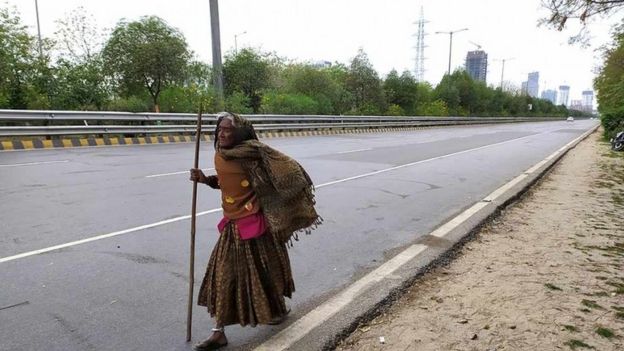
Among the teeming refugees of the lockdown was a 90-year-old woman, whose family sold cheap toys at traffic lights in a suburb outside Delhi.
Kajodi was walking with her family to their native Rajasthan, some 100km (62 miles) away. They were eating biscuits and smoking beedis, – traditional hand-rolled cigarettes – to kill hunger. Leaning on a stick, she had been walking for three hours when journalist Salik Ahmed met her. The humiliating flight from the city had not robbed her off her pride. “She said she would have bought a ticket to go home if transport was available,” Mr Ahmed told me.
Others on the road included a five-year-old boy who was on a 700km (434 miles) journey by foot with his father, a construction worker, from Delhi to their home in Madhya Pradesh state in central India. “When the sun sets we will stop and sleep,” the father told journalist Barkha Dutt. Another woman walked with her husband and two-and-a-half year old daughter, her bag stuffed with food, clothes and water. “We had a place to stay but no money to buy food,” she said.
Then there was Rajneesh, a 26-year-old automobile worker who walking 250km (155 miles) to his village in neighbouring Uttar Pradesh. It would take him four days, he reckoned. “We will die walking before coronavirus hits us,” the man told Ms Dutt.
He was not exaggerating. Last week, a 39-year-old man on a 300km (186 miles) trek from Delhi to Madhya Pradesh complained of chest pain and exhaustion and died; and a 62-year-old man, returning from a hospital by foot in Gujarat, collapsed outside his house and died. Four other migrants, turned away at the borders on their way to Rajasthan from Gujarat, were mowed down by a truck on a dark highway.
As the crisis worsened, state governments scrambled to arrange transport, shelter and food.
Image copyright SALIK AHMED/OUTLOOKImage caption Ninety-year-old Kajodi Devi is walking from Delhi to her village
But trying to transport them to their villages quickly turned into another nightmare. Hundreds of thousands of workers were pressed against each other at a major bus terminal in Delhi as buses rolled in to pick them up.
Delhi chief minister Arvind Kejriwal implored the workers not to leave the capital. He asked them to “stay wherever you are, because in large gatherings, you are also at risk of being infected with the coronavirus.” He said his government would pay their rent, and announced the opening of 568 food distribution centres in the capital. Prime Minister Narendra Modi apologised for the lockdown “which has caused difficulties in your lives, especially the poor people”, adding these “tough measures were needed to win this battle.”
Whatever the reason, Mr Modi and state governments appeared to have bungled in not anticipating this exodus.
Mr Modi has been extremely responsive to the plight of Indian migrant workers stranded abroad: hundreds of them have been brought back home in special flights. But the plight of workers at home struck a jarring note.
“Wanting to go home in a crisis is natural. If Indian students, tourists, pilgrims stranded overseas want to return, so do labourers in big cities. They want to go home to their villages. We can’t be sending planes to bring home one lot, but leave the other to walk back home,” tweeted Shekhar Gupta, founder and editor of The Print.
Image copyright GETTY IMAGESImage caption There is a precedent for this kind of exodus during crisis
The city, says Chinmay Tumbe, author of India Moving: A History of Migration, offers economic security to the poor migrant, but their social security lies in their villages, where they have assured food and accommodation. “With work coming to a halt and jobs gone, they are now looking for social security and trying to return home,” he told me.
Also there’s plenty of precedent for the flight of migrant workers during a crisis – the 2005 floods in Mumbai witnessed many workers fleeing the city. Half of the city’s population, mostly migrants, had also fled the city – then Bombay – in the wake of the 1918 Spanish flu.
When plague broke out in western India in 1994 there was an “almost biblical exodus of hundreds of thousands of people from the industrial city of Surat [in Gujarat]”, recounts historian Frank Snowden in his book Epidemics and Society.
Half of Bombay’s population deserted the city, during a previous plague epidemic in 1896. The draconian anti-plague measures imposed by the British rulers, writes Dr Snowden, turned out to be a “blunt sledgehammer rather than a surgical instrument of precision”. They had helped Bombay to survive the epidemic, but “the fleeing residents carried the disease with them, thereby spreading it.”
More than a century later, that same fear haunts India today. Hundreds of thousands of the migrants will eventually reach home, either by foot, or in packed buses. There they will move into their joint family homes, often with ageing parents. Some 56 districts in nine Indian states account for half of inter-state migration of male workers, according to a government report. These could turn out to be potential hotspots as thousands of migrants return home.
Image copyright GETTY IMAGESImage caption The fleeing migrants could spread the disease all over the country
Partha Mukhopadhyay, a senior fellow at Delhi’s Centre for Policy Research, suggests that 35,000 village councils in these 56 potentially sensitive districts should be involved to test returning workers for the virus, and isolate infected people in local facilities.
In the end, India is facing daunting and predictable challenges in enforcing the lockdown and also making sure the poor and homeless are not fatally hurt. Much of it, Dr Snowden told me, will depend on whether the economic and living consequences of the lockdown strategy are carefully managed, and the consent of the people is won. “If not, there is a potential for very serious hardship, social tension and resistance.” India has already announced a $22bn relief package for those affected by the lockdown.
The next few days will determine whether the states are able to transport the workers home or keep them in the cities and provide them with food and money. “People are forgetting the big stakes amid the drama of the consequences of the lockdown: the risk of millions of people dying,” says Nitin Pai of Takshashila Institution, a prominent think tank.
“There too, likely the worst affected will be the poor.”
Matriarchal and matrilineal communities centred around women have existed for centuries in China, India and Indonesia
But a recent influx of tourism, technology and mainstream patriarchal ideas is rapidly changing their way of life
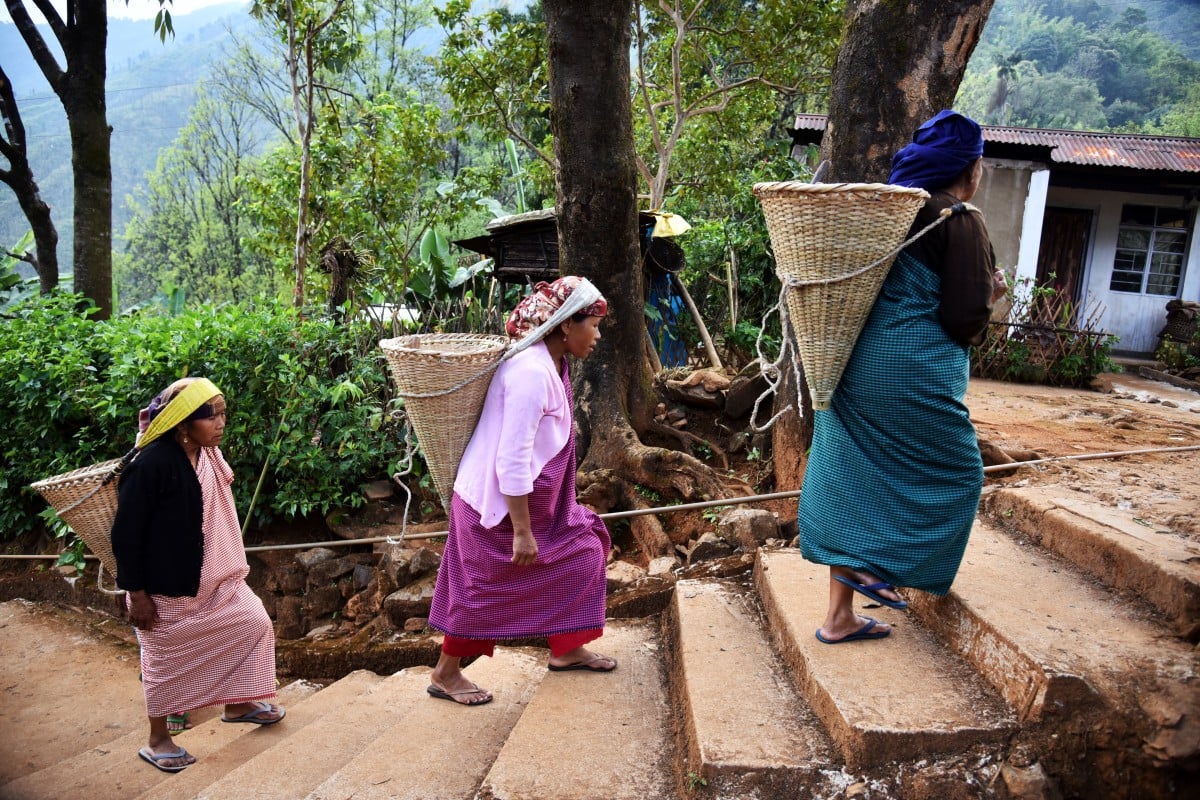
Khasi women leave their village of Nongtraw in India’s northeastern Meghalaya state to collect herbs from the fields. Photo: AFP
While women’s rights may have become a major topic of discussion around the world in recent years, there are female-centric communities that for centuries have distinguished themselves by carving out their own feminist traditions in places such as China, India
and Indonesia.
But many of these matriarchal and matrilineal societies are now struggling to survive, amid threats posed by the modern world such as mass tourism, technology and the infiltration of ideas from mainstream patriarchal society.
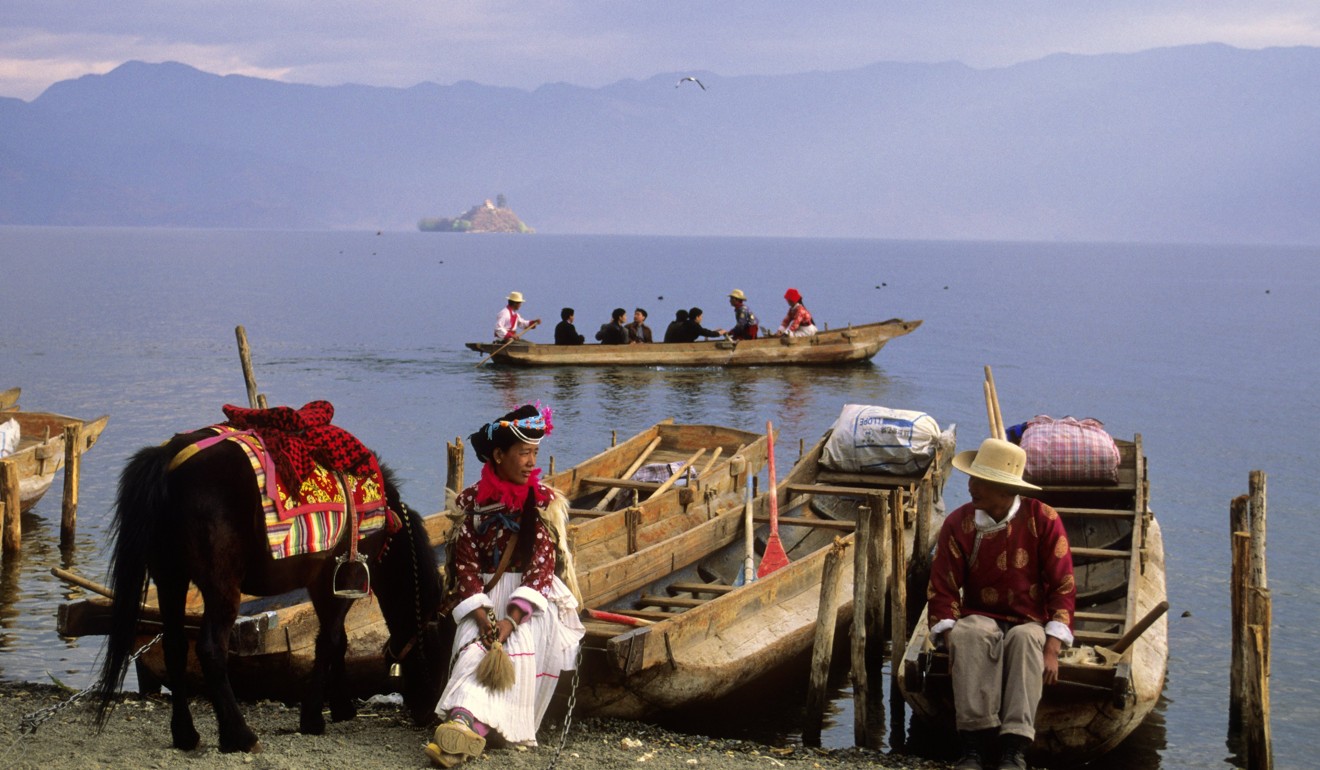
In China, for instance, there is a small Mosuo tribe known as the “kingdom of women”.
“Key to the Mosuo culture is their matrilineal family structure, with a basic building block of only members sharing the same female bloodline making up the family … Any male bloodline is not taken into account,” says Choo Waihong, a former Singaporean corporate lawyer who has researched the community for the past decade.
Lugu Lake in China’s Yunnan province is home to the Mosuo tribe. Photo: hemis.fr
At the top of the hierarchy is the grandmother, who is the head of the household. “Her daughters run the home and look after all the children of the female siblings … The sons and grandsons are expected in their supporting role to shoulder the manual tasks required to maintain the farmstead,” Choo says.
Researchers say that there are about 30,000 to 40,000 Mosuo people – most of whom live in the far eastern foothills of the Himalayas in Yunnan, southwest China. This unique community has come together in a series of villages dotted around a mountain and Lugu Lake, while growing numbers have moved out to work in larger towns and cities elsewhere in the country.
According to Choo, author of the book The Kingdom of Women: Life, Love and Death in China’s Hidden Mountains, the most distinctive facet of this community that sets it apart from mainstream society is the absence of formal marriage arrangements between men and women. Instead, they have “walking marriages”, where the man goes to the woman’s home, spends the night with her and then leaves the following morning.
The Kingdom of Women: China’s ‘lost tribe’ of matriarchs, the Mosuo
15 Mar 2017
The couple can choose to have a temporary or even a permanent arrangement as partners, but they are not bound by marriage ties. If they have children, the baby belongs to the woman’s household. “In fact, the man is not considered part of the matrilineal family and his ties to the baby do not determine the social place of the baby,” the researcher says.
Such a society, where women are not subjected to men and sexual freedom is an intrinsic part of their culture, is so radically different from mainstream patriarchal family structures that the Mosuo tribe has been examined and studied over time. More recently, its unique features have also become an eye-catching selling point for the local tourism industry.
TOURISM INDUSTRY
The Mosuo tribe used to live off the land by farming, herding and hunting. But many families now rely on tourism after the tribe’s culture and Lugu Lake became more popular and widely known.
“Tour buses on fancy freeways and planes arriving at a new airport bring more and more tourists daily to turn the whole area into a busy travel playground,” Choo says. “Every household around the lake is involved one way or another with the hotel, restaurant and tour guide industries.”
While the tourism industry has brought money and better food for most families as well more access to educational opportunities for their children, it is also posing a serious threat to their culture and traditional ways of life.
“The greatest challenge for the tribe is their rapid transition from living a rudimentary subsistence farming way of life right into a burgeoning modern middle-class existence within a short span of 20 or so years,” Choo says.
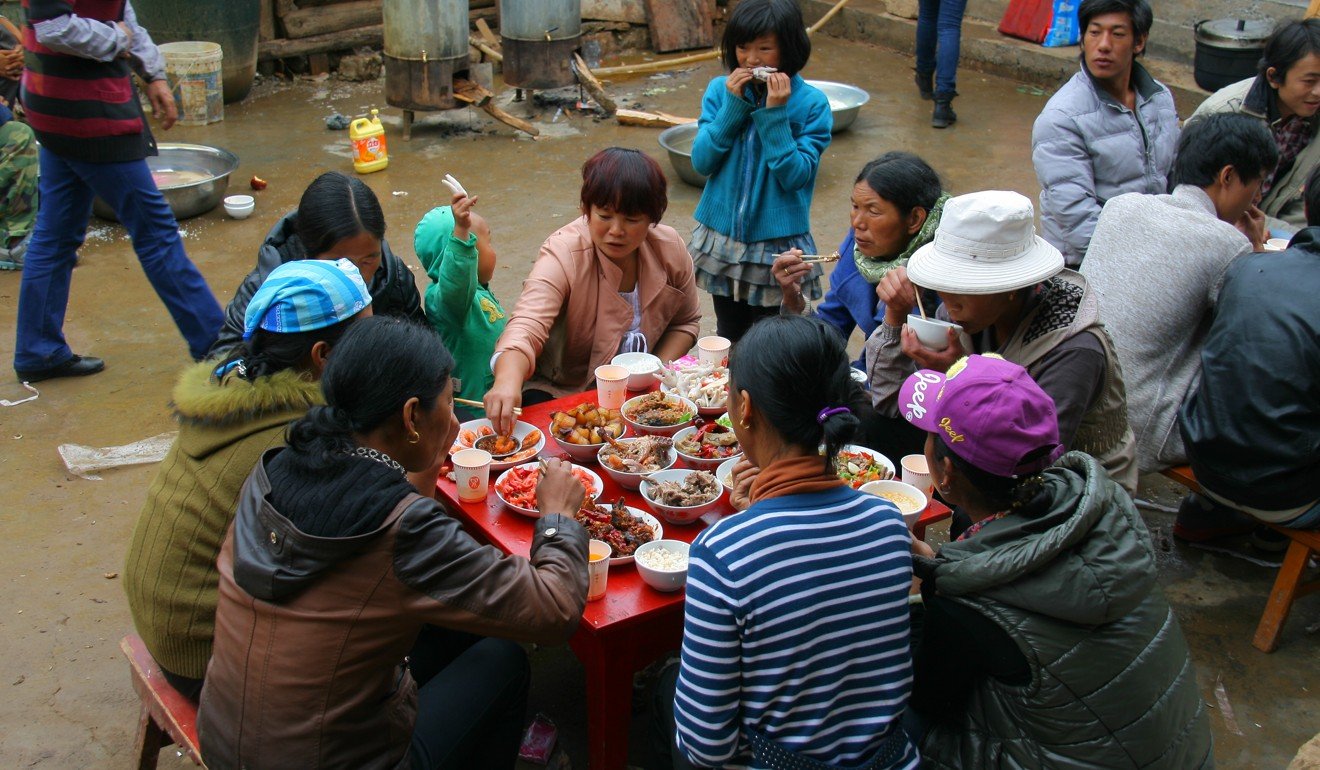
Mosuo people pictured at a wedding ceremony with an all-meat feast in 2013. Photo: Shutterstock
The Mosuo are now being bombarded not only by mainstream traditional Chinese values, but also by new economic values connected to money and the digital economy. “That is a lot to take in for people who had no writing to support their oral language … and only had primary schools for their children not so long ago,” she says.
Older Mosuo are now being pushed to learn Mandarin in order to keep up with the younger generations.
At the same time, the researcher says, “their long-held cultural beliefs and principles are evolving as the young generation gets exposed to the outside world and start to question the old ways of doing things.”
How life is changing for Thailand’s Karen tribe
17 Mar 2017
Walking marriages are not as common, with more youngsters getting married and forming nuclear families. “Large matrilineal families which were the norm are now breaking up into smaller nuclear families. All this dilutes the traditional matrilineal Mosuo family structure,” Choo says.
“The central place of the female in old Mosuo society is slowly being affected, as the male Mosuo are beginning to entertain some patriarchal outlook in the face of outside cultural influences.”
China may have radically reinvented itself in recent decades, but the changes to the Mosuo tribe have been nearly as dramatic. “The world of the Mosuo when I first ventured into their midst 12 years ago is a distant past as I look [today in 2020] at how they have changed,” Choo says.
PATRIARCHY IN DISGUISE
There are dozens of female-centric communities scattered around the world. The Garo and Khasi tribes, which are also traditionally matrilineal societies, can be found mostly in India.
In a Khasi family, the youngest daughter inherits the ancestral property, while in the Garo community, women also inherit property, but don’t necessarily have to be the youngest daughter of the family.
Caroline Marak, former head of the Garo Department at the North Eastern Hill University in India, says that the Garo are female-oriented, but not female-dominated. Women “have no part in the field of administration decision-making”, she wrote in an academic paper.
In recent years, the husbands of Garo women who are property owners have had a greater say over land deals, such as with government. “We are now trying to reclaim our rights from the males,” says Sume Sangma, secretary of the Garo Mothers Union NGO. “Women in the community are self-reliant and we are fighting for their real power.”
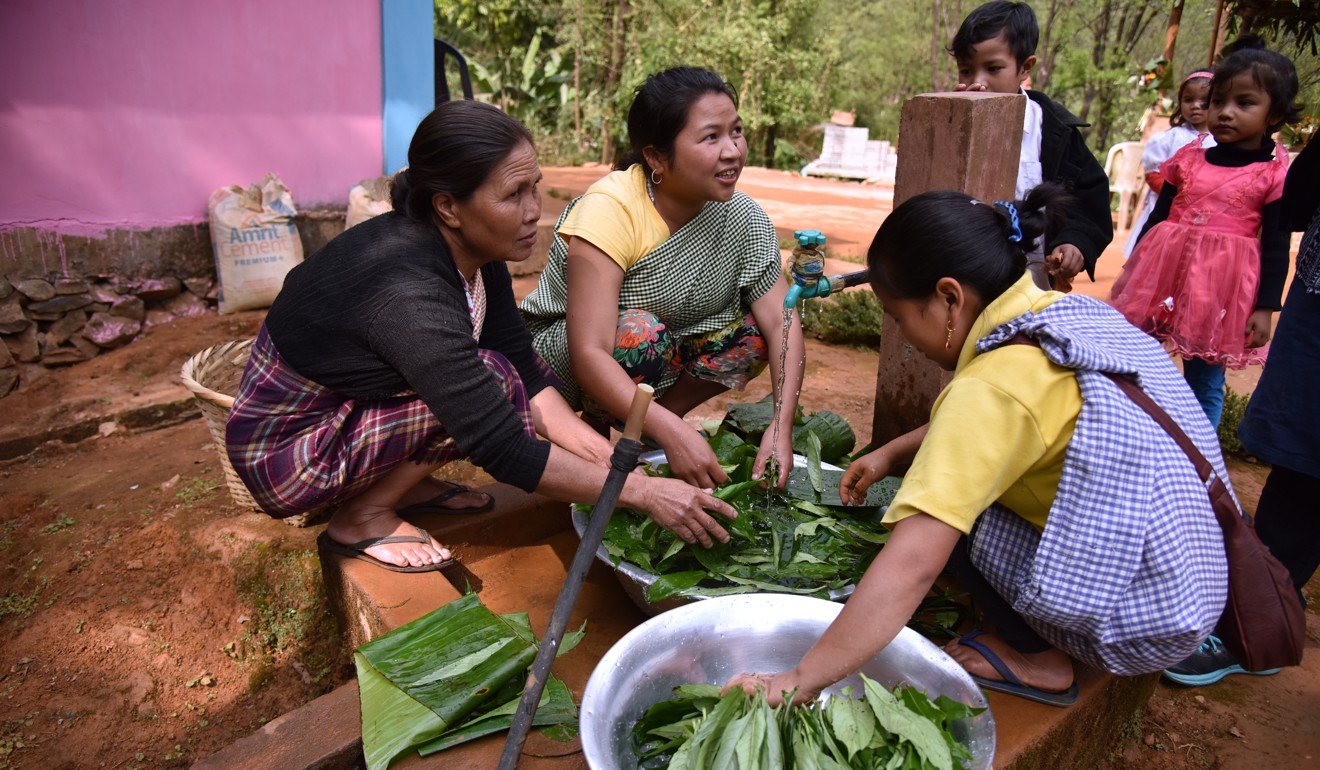
Khasi women wash leaves for cooking in the village of Nongtraw in India’s north-eastern Meghalaya state. Photo: AFP
Tiplut Nongbri, from the Centre for North East Studies and Policy Research at the Jamia Millia Islamia in New Delhi, also says women don’t have much authority in Garo and Khasi societies. “Patriarchy is in disguise in both the communities. The societies are matrilineal only as far as descent, residence and inheritance of property are concerned,” she says. “Women are not allowed to take part in politics.”
RG Lyngdoh, former home minister of Meghalaya – the hilly state in north-eastern India where both communities are based – says inward migration and the presence of Christian missionaries in the state have affected traditional lifestyles. “The old practices of equity between males and females have eroded,” Lyngdoh says.
“This has led to a perception of inadequacy among the males, [creating] discord within the family, which found expression in many negative ways, such as domestic violence and abandonment of wives, which never existed within the Khasi community.”
Gertrude Lamare, a member of the Khasi-Jaintia community now pursuing her PhD in anthropology at the London School of Economics and Political Science, argues that “with families becoming more nuclear, women do have a huge role in the decision-making process”.
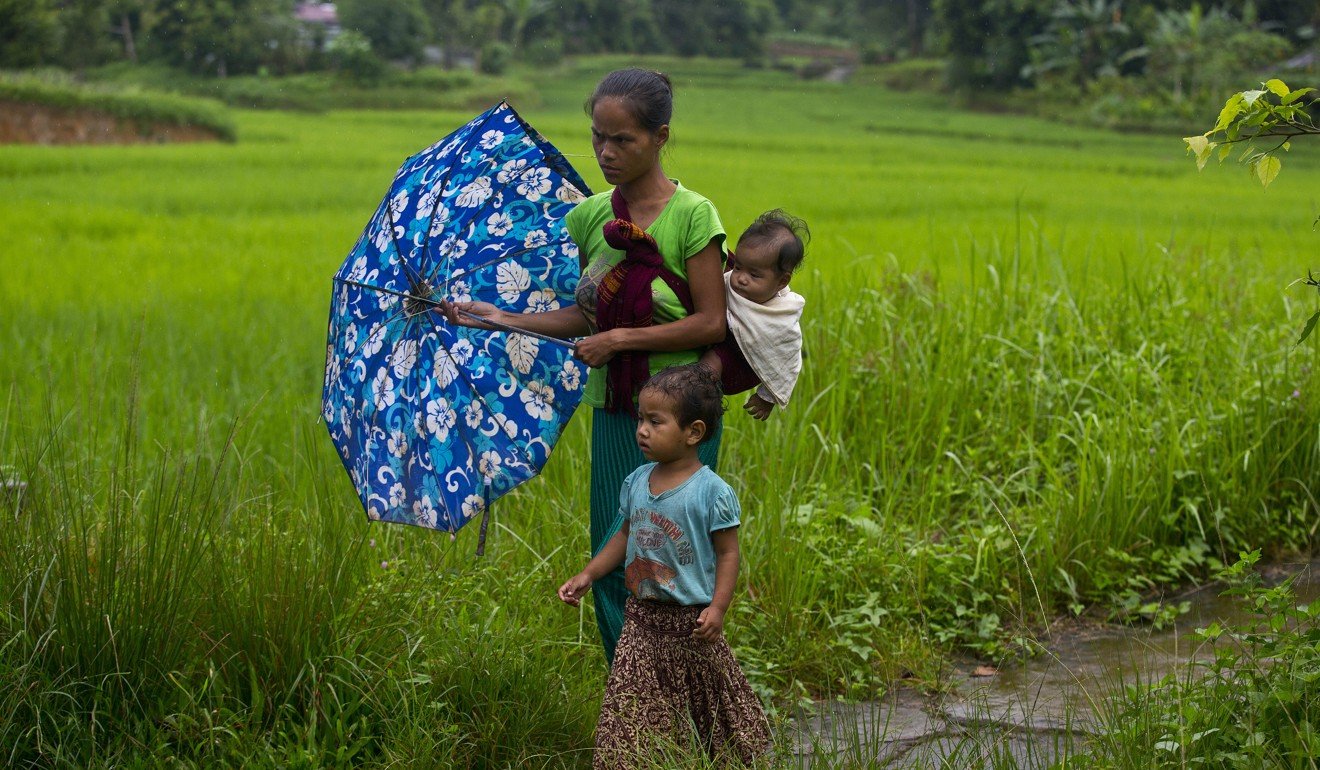
A Khasi woman walks in the rain with children past a paddy field along the Assam-Meghalaya state border in India. Photo: AP
Researchers have estimated that there are 1 million Garo in India and
, and 1.7 million Khasi in the Khasi and Jaintia Hills.
Some of them have become increasingly wary of outsiders preying on their natural resources, which are dwindling, thanks to deforestation and climate change.
Another challenge these communities are facing has to do with the growing trend of mixed marriages. “In recent years, children of a Khasi or Garo mother and non-tribal father [have] not [been] welcomed. The males in the family want their women to marry within the tribal community,” researcher Nongbri says, noting that younger generations are going through an identity crisis.
STILL PROUD
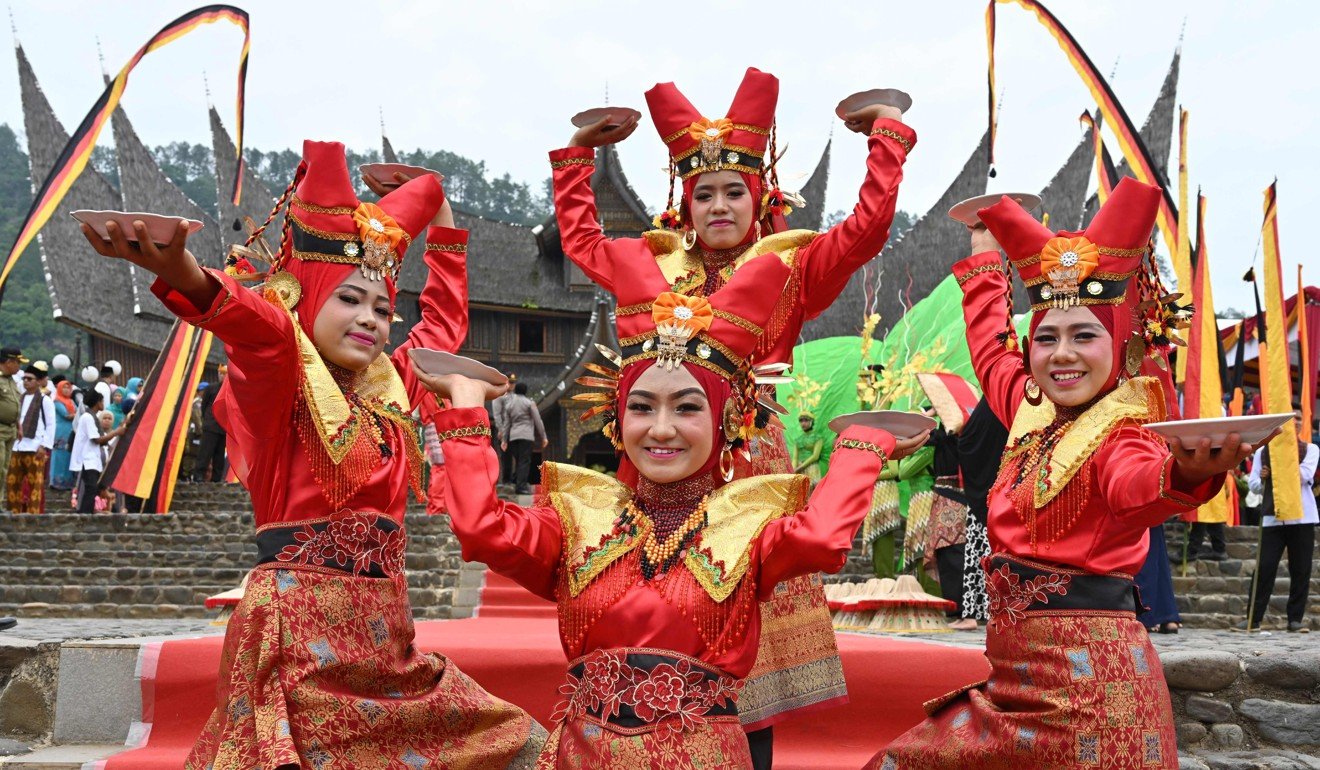
The world’s largest known matrilineal society today is believed to be in Indonesia: the Minangkabau, also known as Minang. Their community of about 8 million is scattered around the world, but most are in Indonesia’s West Sumatra province. While traditionally animist, they were later influenced by Hinduism and Buddhism, and most have since embraced Islam.
But much like the others, their community is also changing.
Nursyirwan Effendi, dean of the Faculty of Social and Political Science at Andalas University, says that many of those who remain in villages and rural areas still hold tight to the tribe’s values.
“Women are central in the distribution of assets, such as rice fields, gardens and [houses], from their ancestors,” he says.
Dancers pose during the 2018 Minangkabau art and culture festival in Batusangkar, West Sumatra. Photo: AFP
Traditionally, Minangkabau women play an essential role in their children’s education and hold inheritance rights, while men are expected to take jobs elsewhere and occupy political and religious positions. When they do get married, the man moves to the woman’s house.
But Nursyirwan, who is of Minangkabau descent, notes that many have left for bigger cities, where they do not closely follow the community’s traditions.
An example of this is Afrianto Sikumbang, a 53-year-old businessman who was born to Minangkabau parents in West Sumatra province but now lives in the capital, Jakarta. Although he married a Minangkabau woman, he says they “don’t really apply” the tribe’s values in their daily life.
Sonya Anggraini, 35, who also works in the capital, has got used to city life, but remains proud of her ancestral roots and hopes that Minangkabau culture will persist for years to come.
“I am a member of my mother’s family, not of my father’s,” she says. ■
AHMEDABAD, India (Reuters) – U.S. President Donald Trump will be shielded from the sight of slums by a newly built wall when he visits the city of Ahmedabad during a visit to India this month.
A senior government said the wall was being built for security reasons, not to conceal the slum district.
But the contractor building it told Reuters the government “did not want the slum to be seen” when Trump passes by on the ride in from Ahmedabad’s airport.
“I’ve been ordered to build a wall as soon as possible, over 150 masons are working round-the-clock to finish the project,” the contractor said, speaking on condition of anonymity.
The government official conceded that the wall was part of a “beautification and cleanliness” drive.
Whatever the reason, the 400-meter-long and seven-feet-high wall will prevent the U.S. leader from getting a glimpse of a slum district that houses an estimated 800 families.
Trump, who has made his pledge to build a wall along the United States’ border with Mexico a feature of his presidency, will visit India on Feb. 24-25 to reaffirm strategic ties that have been buffeted by trade disputes.
He is expected to attend an event dubbed “Kem Chho Trump” (“How are you, Trump”) at a stadium in Ahmedabad along the lines of the “Howdy Modi” extravaganza he hosted for Indian Prime Minister Narendra Modi in Houston last September.
Speaking at the White House on Tuesday, Trump quoted Modi as saying “millions and millions of people” would attend the rally.
The event provides Trump, who was impeached in December, with the opportunity to woo the support of hundreds of thousands of Indian-American voters ahead of the U.S. presidential election in November.
But some slum dwellers whose homes will be cordoned off by the wall in Ahmedabad – the largest city in Modi’s home state of Gujarat – said the government was wasting tax-payer money to hide the poor.
“Poverty and slums are the reality of our life, but Modi’s government wants to hide the poor,” said Parvatbhai Mafabhai, a day worker who has lived there with his family for more than three decades.
Teams from Shanghai, Guangdong – including experts who helped tackle Sars – arrive in Wuhan to lend their support
Tencent, JD.com, Lenovo among raft of private firms offering financial aid to those battling deadly outbreak
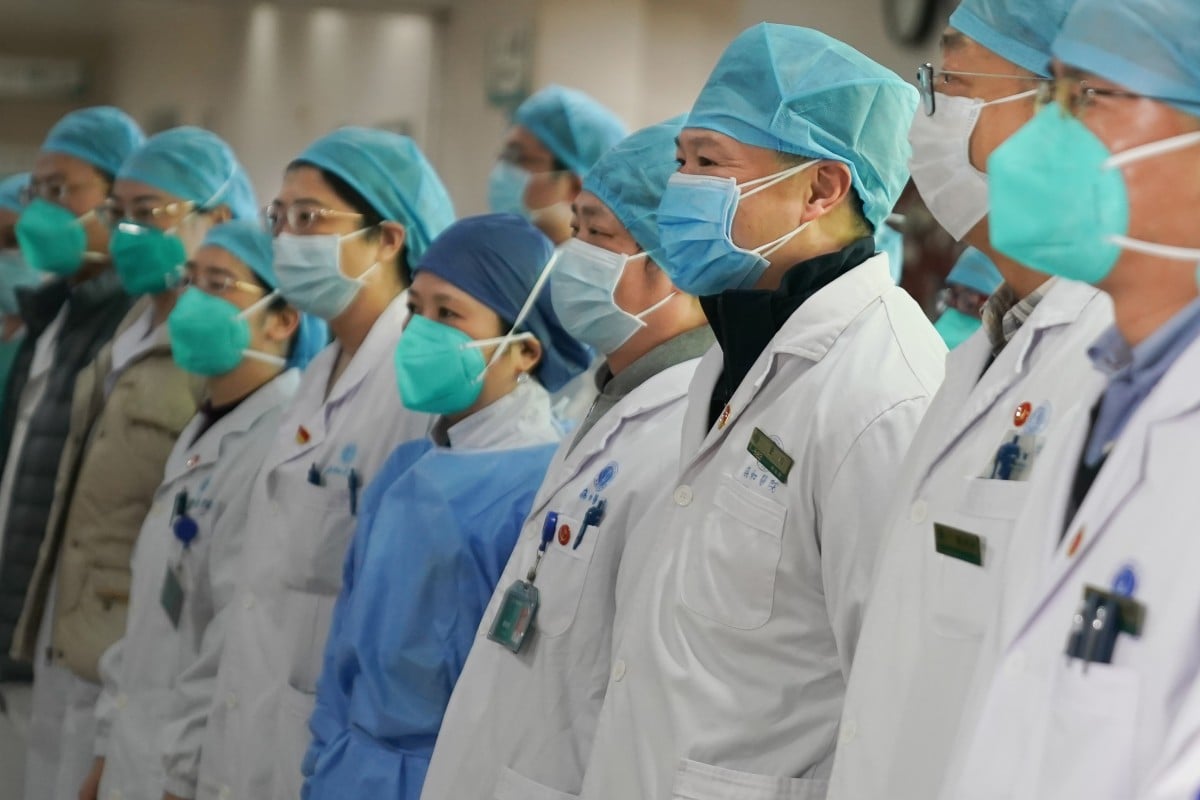
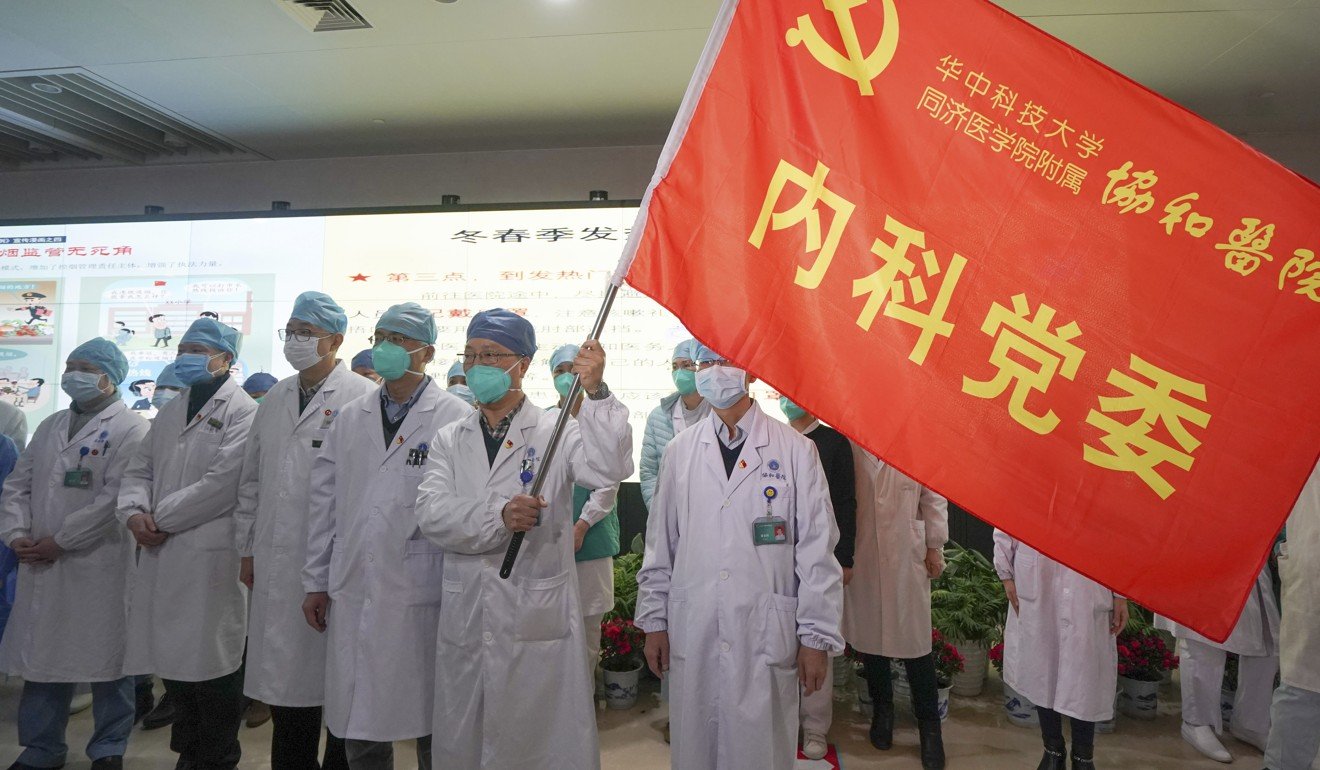
Doctors and nurses from across China are being dispatched to help tackle the coronavirus epidemic in Hubei province. Photo: Xinhua
Chinese authorities and private enterprises are stepping up their support for embattled medical teams in Hubei province as they continue to fight the coronavirus epidemic, while neighbouring governments ramp up their efforts to prevent its further spread.
Hospitals across Wuhan – the city at the centre of the outbreak – have been overwhelmed by the flood of patients and doctors are becoming increasingly frustrated at the lack of support, both in terms of supplies and personnel, they have received.
But national bodies say they are responding to the crisis.
On Saturday, China’s National Health Commission (NHC) said that six medical teams comprising 1,230 staff had been set up and dispatched to help fight the deadly virus in Hubei.
Three medical units from Shanghai, Guangdong and the armed forces had already arrived in the province, it said, though did not make clear if they were in addition to or part of the six teams.
Chen Dechang, a doctor from Ruijin Hospital in Shanghai who is among those sent to Hubei, said it was important there were more medical staff on the scene.
“We can help save more patients in the intensive care unit if we are on the front line,” he said.
Authorities in Shanghai have also sent 81 ECMO (extracorporeal membrane oxygenation) life-support machines to Jinyintan Hospital, which is one of the designated facilities treating patients in Wuhan.
The ECMO technique – which involves removing blood from a person’s body, removing the carbon dioxide and oxygenating red blood cells before pumping them back into the patient – has already been used on one critically ill patient at Wuhan University’s Zhongnan Hospital, according to Shanghai-based news outlet Thepaper.cn.
Though the report did not say how effective the treatment had been.
Medical teams in Wuhan have been under huge pressure since the outbreak began. Photo: Xinhua
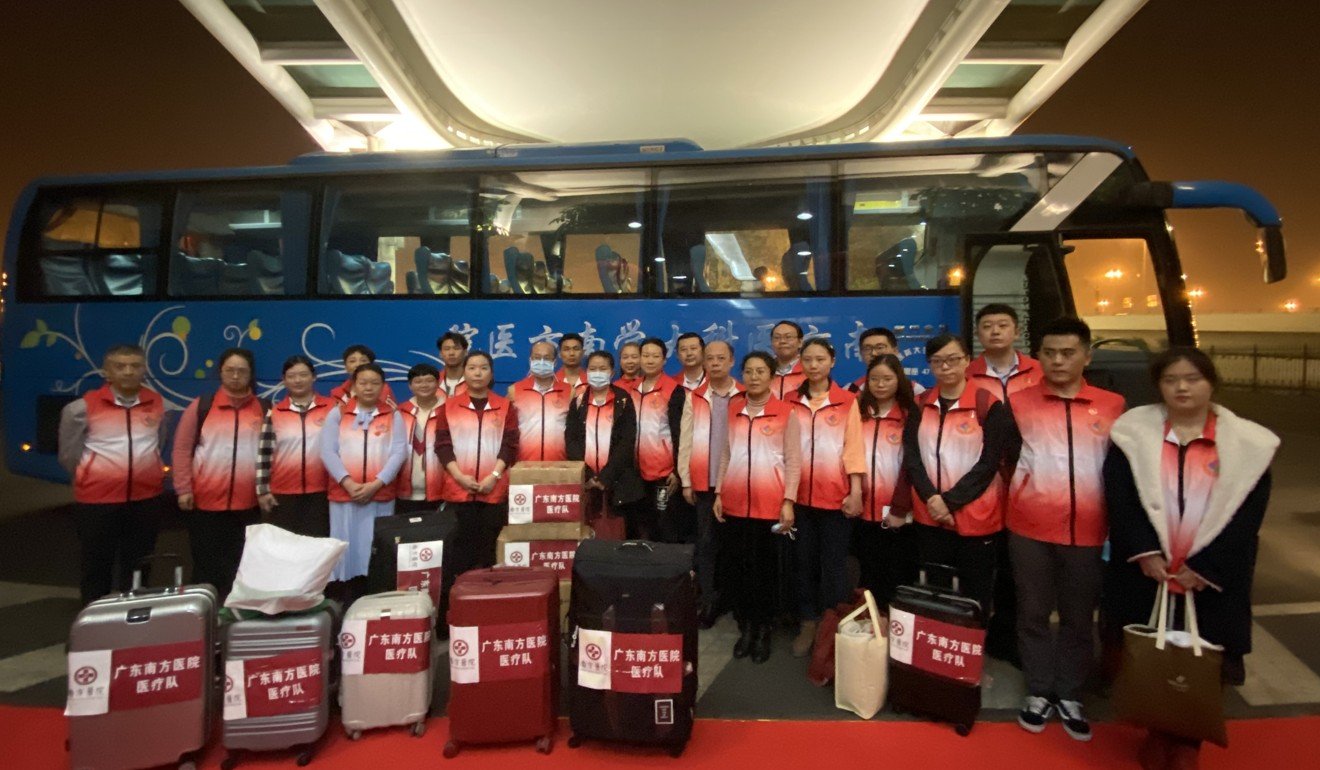
The team from Guangdong comprised 42 doctors and 93 nurses, the NHC said. The deployment came after a group of current and former medical staff from Southern Medical University in Guangzhou – who had helped tackle the Sars (severe acute respiratory syndrome) outbreak in 2002-03 – signed a petition saying they were willing to help in Wuhan.
“We are a team of experienced practitioners who fought Sars,” they said in the petition, a copy of which was posted on the social media accounts of Communist Party mouthpiece People’s Daily.
“We cannot back away from our responsibility to help 17 years later as people are facing the outbreak of a new coronavirus. We are willing to be deployed to the front line to make our contributions.”
A team of 135 doctors from Chongqing arrived in Wuhan on Friday evening, the NHC said, without elaborating.
A medical team from Guangdong province prepares to travel to Wuhan. Photo: Xinhua
As well as the wave of medical support, several private companies said they had provided financial support to help fight the epidemic.
According to Chinese media reports, Shanghai Ocean Forest Assets has donated 10 million yuan (US$1.4 million) to the cause, while Shanghai-based asset management firm, Jinglin Assets is coordinating efforts to buy urgently needed medical supplies from South Korea and Japan.
Shenzhen’s Fantasia Holdings said it would donate 6 million yuan and send medical supplies, including surgical masks, to Wuhan, while tech giant Tencent said it would donate 300 million yuan from its charity. E-commerce platform JD.com said it had donated 1 million surgical masks and 60,000 other medical items.
Chinese smartphone manufacturer Xiaomi said on Friday it had sent a first batch of medical equipment – masks and thermometers worth more than 300,000 yuan – to Wuhan, while tech firm Lenovo said on Saturday it would donate all of the IT equipment required by the new specialist treatment centre being built in the city.
Authorities set a target to have the 1,000-bed facility up and running within six days of starting construction.
Aside from the support from the private sector, state lender China Development Bank on Friday issued a 2 billion yuan emergency loan to Wuhan, while a day earlier, China’s finance ministry said it had allocated 1 billion yuan to authorities in Hubei to help tackle the epidemic.
Across the country, authorities have introduced a number of measures to help prevent the further spread of the coronavirus, including the closure of all cinemas in Shanghai.
Wuhan residents stockpile food, medical supplies
25 Jan 2020
Also on Saturday it was reported that Liang Wudong, a doctor at Xinhua Hospital in Wuhan, had become the first medical professional to die after treating people infected with the virus.
Liang, 62, was suspected of having contracted the virus last week and had been transferred to Jinyintan Hospital for treatment. He died at 7am on Saturday, Thepaper.cn reported.
According to official figures, 41 people have been killed by the coronavirus and there have been more than 1,280 confirmed cases. The vast majority are in the Chinese mainland, but there have also been confirmed cases in Hong Kong, Macau, Taiwan and eight other countries, including the United States and Europe.
Tens of millions of people in cities across Hubei are effectively on lockdown after the introduction of travel bans to help control the spread of the virus.
Families appeal to city authorities and toy company for help to recover fees already paid for classes
Four outlets shut their doors in aftermath of contract dispute
Families in Shanghai are appealing to authorities for help to recover money paid for lessons at closed Lego Education Learning Centres. Photo: Weibo
Hundreds of Shanghai parents are appealing to Danish toy company Lego for help after four of its authorised learning centres suddenly closed their doors, leaving families tens of thousands of yuan out of pocket.
Shanghai Jixiao Information Science and Technology, which ran three Lego Education Learning Centres in the city, said in an online statement on Monday that it was left with no choice but to close the centres after Lego Education in China ended its agreement with its Chinese partner, Beijing-based Semia.
The closure of the centres – the Ruihong, Jinqiao and Haiwaitan branches – came just weeks after the Lego centre in Nanxiang shut down.
Semia was authorised by Lego Education to operate learning branches across mainland China and authorisation third parties to do as well, according to Shanghai-based Jfdaily.com.
Rachel Wang, a mother of a six-year-old boy, said that in various online forums about 650 families had reported losing a combined 5.2 million yuan (US$742,000) in prepaid classes at the three stores. Another 130 families whose children were enrolled at the Nanxiang store were seeking 900,000 yuan in refunds, she said.
Wang said the parents had appealed to the Shanghai municipal government to pressure Lego to look at the case.
“We are planning to sue the learning centre, and in the meantime we hope Lego Group can pay attention to this case and help us. Many of the parents chose these centres as we saw on Lego’s website they were listed as among the company’s authorised stores,” she said.
“We are angry and very disappointed with Lego.
“It made a lot of money in China because we trusted it.”
Lego and Tencent will develop games and videos for kids in China
20 Sep 2019
Tao Lina said everything appeared fine when he took his five-year-old daughter to the Haiwaitan centre on Sunday.
“But the next day, we were told that the store had closed. I was so surprised,” Tao said.
“We had never heard of Semia and we were not aware of its existence. We all thought that the learning centres was franchised directly by Lego.”
He said he had paid for 144 classes at the centre and his daughter had attended about 60 of them, each costing 160 yuan. Tao said he hoped his daughter could continue attending the classes – which use Lego products to teach children about subjects such as robotics – but had not been able to contact the centre’s managers.
Shanghai Jixiao said the termination of the Semia-Lego Education agreement had scared off parents, cutting cash flow and forcing it to close the centres.
In its online statement, the company said its troubles started in September, when it received a lawyer’s letter from both Semia and Lego Education.
“It required us to promise not to use the [Lego Education] logo after December 31, 2019 and to stop teaching Lego courses after August of next year,” Shanghai Jixiao said.
On October 11, Lego Education said on WeChat that it had terminated its cooperation with Semia. Most of the 137 Lego learning centres in China would be allowed to use the Lego brand until December 31 and continue teaching Lego courses until July 31 next year.
But after the announcement, many parents sought refunds, causing a cash-flow crisis for the Shanghai company.
Shanghai Jixiao also said that the lawyer’s letter sent in September required all learning centres to sign an agreement absolving Semia of all responsibility.
If it signed the agreement, it would have three months to change the brand and products, which Shanghai Jixiao said was impossible. If it did not sign it, it would have to stop using the Lego brand at once.
Shutting the centres down was the only option after their various efforts, including joint appeals with other mainland learning stores to Lego, visiting Lego headquarters in Denmark and calling Lego’s executives, were unsuccessful, the Shanghai company said.
Chinese teens put to the information age test in global Pisa education study
5 Dec 2019
It offered two mobile phone numbers for parents to contact them but the phones were powered off on Wednesday and Thursday.
Lego did not respond to a request for comment from the South China Morning Post.
But on Wednesday, Lego said it ended the contract with Semia to improve the company’s learning centres, adding that it had no business relations with the closed stores, Thepaper.cn reported.
A manager at Semia’s franchising department identified only as Wei was quoted by Jfdaily.com as saying that the authorisation contract for the three stores owned by Shanghai Jixiao actually ended between October 2018 and February this year.
“They were waiting for us to renew the authorisation contract with Lego, but we failed to reach an agreement with Lego. So these learning centres lost their authorisation,” she was quoted as saying.
Wei said all the authorised stores operated independently.
“Legally speaking, their problems should be solved by themselves,” she said, adding that she could not contact Shanghai Jixiao’s owner either.
There are 19 Lego Education branches across Shanghai, according to Lego Education’s WeChat account.
Market regulation authorities in Pudong and Huangpu districts had started to look at the case, Jfdaily.com reported.
Wang Fuman became an internet sensation after he was pictured with his head encrusted in ice after freezing trek to school
Life has improved since then, but his dad says they are still struggling to make ends meet
Nine-year-old Wang Fuman’s family has now moved from their mud hut to a two-storey home. Photo: AFP
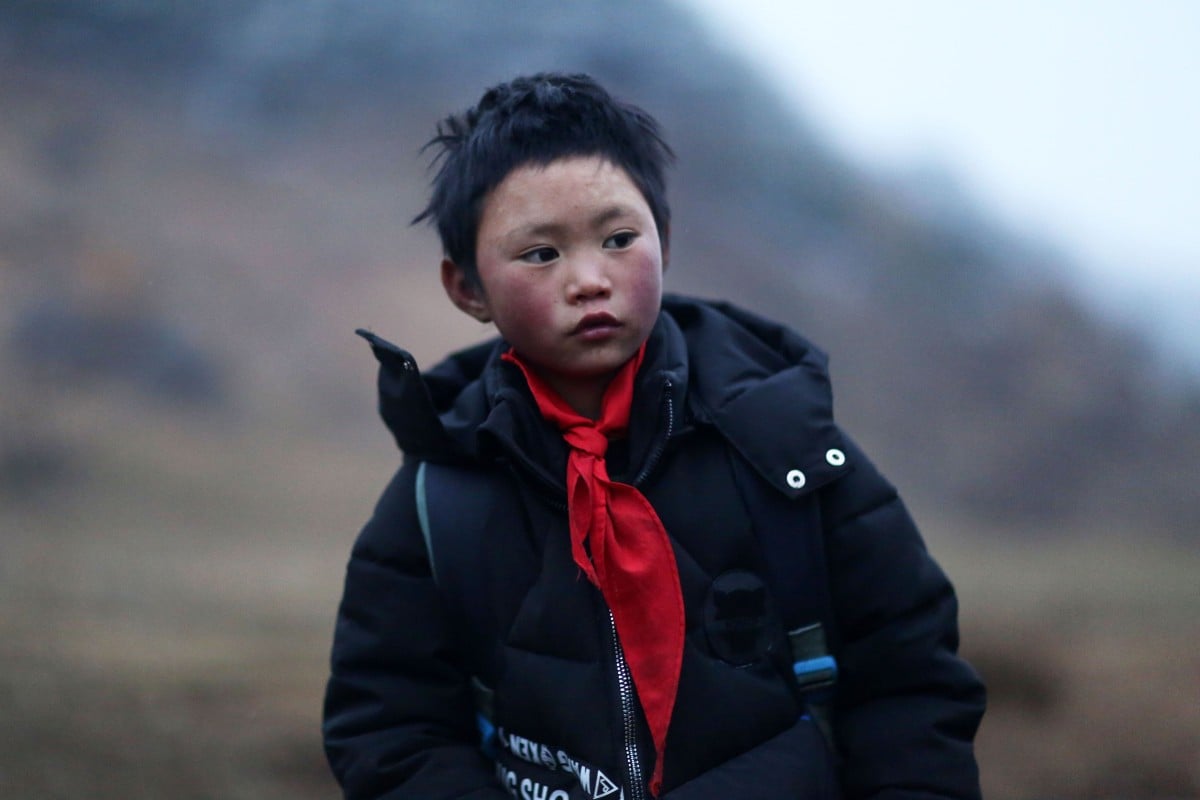
The father of the “Ice Boy” – who became an internet sensation after he was pictured with his head covered in icicles following a freezing trek to school in southwest China – has spoken out about being rejected for a poverty alleviation scheme.
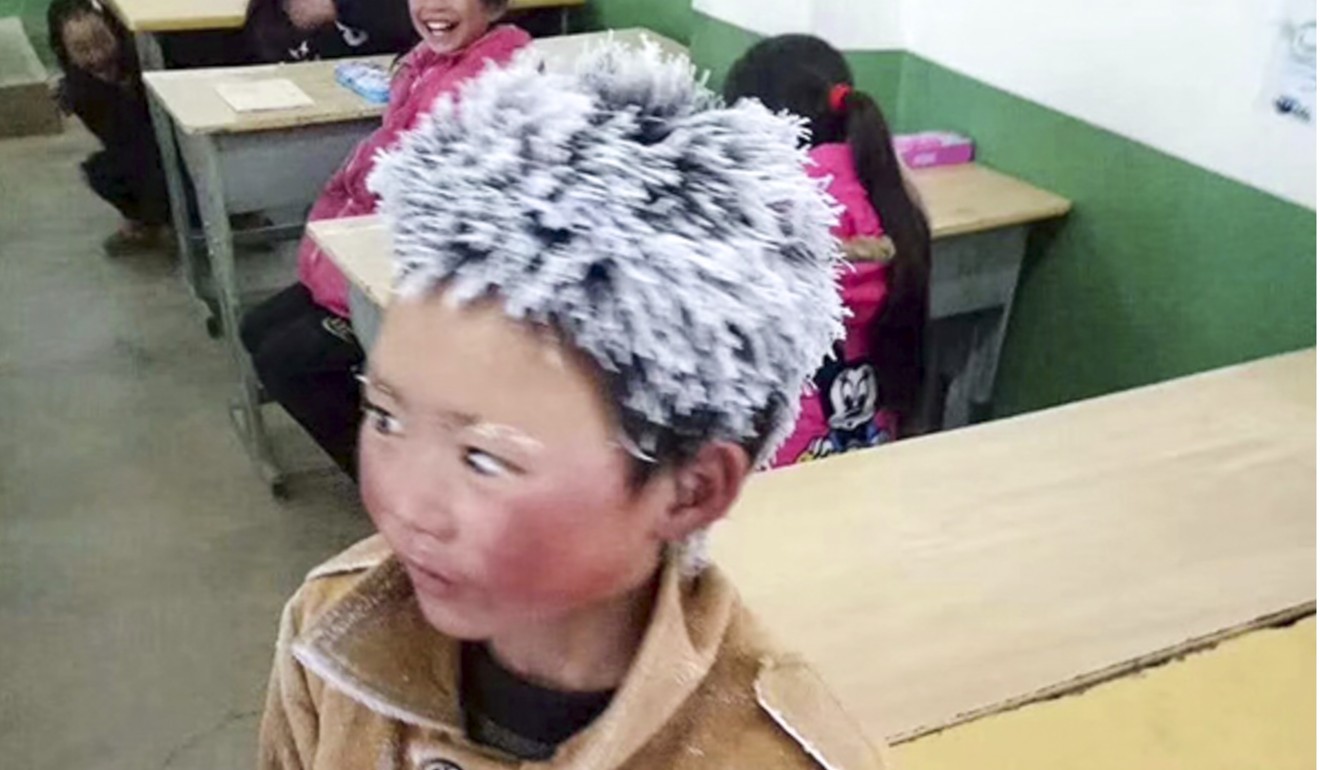
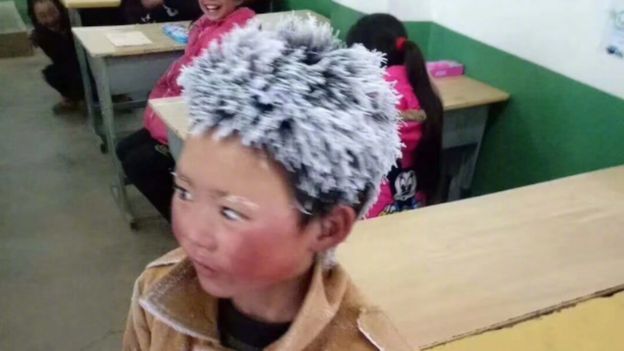
Wang Gangkui’s son, Wang Fuman, was eight when a photo of him taken by a teacher went viral on social media in January last year. It showed the little boy with his hair and eyebrows covered in ice and his cheeks ruddy from the cold after he had walked for over an hour from his home in thin clothing and no hat along treacherous mountain paths.
The plight of the impoverished primary school pupil from Ludian county, a poor area in Zhaotong, Yunnan province, touched hearts across China, with many people expressing sympathy online for the hardships the boy, and other children like him, endured to get to school. Donations of money, warm clothes and heating flooded in.
The photo of Wang Fuman arriving at school with his hair and eyebrows covered in ice went viral last year. Photo: news.163.com
But according to his 30-year-old father, the family is still struggling to make ends meet. He said his application for the assistance scheme had been turned down for the past five years without a satisfactory explanation.
“It’s unfair and unjust that my application wasn’t approved,” Wang Gangkui said on Thursday. “There are allegations in media reports that I have various assets, and they’re just not true. And neither am I trying to take advantage of my son’s fame,” he said.
Families approved for the means-tested scheme, a nationwide programme that is administered at the local level, are given benefits ranging from subsidies to vocational training and job opportunities.
Geng Tao, the party secretary of Zhuanshanbao village, told China News Service on Monday that the Wang family did not meet the eligibility criteria for the programme, citing their two-storey house with a total area of 160 sq metres.
Wang was responding to criticism from internet users after he posted his complaint on social media app Jinri Toutiao on Sunday, a post he later deleted. Some accused him of taking advantage of his son’s fame to get access to government aid, claiming the family was being “greedy” as they were already doing better than others in the region because of the donations they received last year.
State media also weighed in, with Beijing News saying in an editorial on Tuesday that “the authorities should not be influenced by public sentiment towards the Ice Boy and should look at the family’s real situation when assessing if they are in need or not”.
Wang acknowledged that the media attention and subsequent donations from the public had eased the family’s situation, but said they only received a small share.
“There were a lot of donations, but most of them went to the school and were shared among all the pupils and their families here,” he said. “Our family only received a small amount of money.”
After Fuman’s photo went viral, the Ludian county education authorities said there were many “Ice Boys” in the area, and all donations received had been distributed to local families in need, according to China News Service.
A local charity organisation received more than 300,000 yuan (US$42,500) in donations from the public, and said the money was shared among pupils at the Zhuanshanbao primary school, with Fuman receiving just 500 yuan.
Life has improved for Fuman and his family since the photo was taken. He was a
– a term used to describe youngsters from poor families whose parents work in cities away from home, leaving them in the care of relatives. His parents have now returned to their hometown and his father works nearby at a construction site in Zhaotong, earning 3,000 yuan a month – a relatively high salary for the area. But he is the breadwinner for the family of five – his wife, Lu Dafeng, and their two children, Fuman and their 11-year-old daughter Wang Fumei, as well as his mother.
They moved out of their mud hut into the two-storey home, and with the donated funds, Fuman’s primary school was renovated and now has a dormitory equipped with heating. Fuman stays at the school during the week and returns to his home – a 20-minute walk away – on the weekend.
Wang Gangkui said his wife and mother could not apply for jobs designated as “public welfare” positions – such as a street cleaner post offering 500 yuan a month – because they were not recognised as a family in need under the scheme.
He also dismissed media reports that he had two cars, saying he had a second-hand van worth no more than 3,000 yuan. He said reports that his family also had cattle were not true.
Instead, he said he was paying off a loan of tens of thousands of yuan that he took out to build the family’s new house.
There were an estimated 16.6 million people living in poverty in rural China at the end of 2018, about 14 million fewer than a year earlier, according to official data. The ruling Communist Party set the ambitious target of eliminating extreme poverty in China by the end of 2020, and claims that more than 700 million people have already been lifted out of poverty over the past four decades.
Image copyright FENG VIDEOImage caption Wu Huayan ate only rice and chillies in order to save money to help her ill brother
Well-wishers have donated almost a million yuan to a Chinese student who was hospitalised after living on 2 yuan ($0.30, £0.20) a day for five years.
The case of Wu Huayan shocked Chinese people after it hit the headlines earlier this week.
The 24-year old woman became seriously malnourished while struggling to study and support her sick brother.
Ms Wu’s story also sparked anger at authorities for failing to recognise her plight and help her much earlier.
After the story was reported, donations began pouring in for the college student in the city of Guiyang – reportedly totalling some 800,000 yuan ($114,000, £88,000).
What is Wu Huayan’s story?
Earlier, this month, the young woman went into hospital after having difficulty breathing, according to Chinese media.
She was only 135cm (4ft 5ins) tall, weighing barely more than 20kg (43 pounds; three stones).
The doctors found she was suffering from heart and kidney problems due to five years spent eating minimal amounts of food. She said she needed to save money to support her sick brother.
Wu Huayan lost her mother when she was four and her father died when she was in school.
She and her brother were then supported by their grandmother, and later by an uncle and aunt who could only support them with 300 yuan ($42, £32) each month.
Most of that money went on the medical bills of her younger brother, who had mental health problems.
This meant Ms Wu spent only 2 yuan a day on herself, surviving largely off chillies and rice.
The siblings are from Guizhou, one of the poorest provinces in China.
Media caption China’s uphill struggle fighting extreme poverty
What has the reaction been?
The case sparked an outpouring of concern – and anger at authorities.
Many people on social media said they wanted to help with donations, and many voiced concern about her college not helping her.
One user called her situation “worse than that of refugees in Afghanistan”, while another pointed to the extravagant cost of China’s 70th anniversary celebrations, saying the money could have been better spent.
Others expressed their admiration at her efforts to help her brother, while also persevering with her studies in college.
Aside from the donations on crowd funding platforms, her teachers and classmates donated 40,000 yuan ($5,700; £4,400), while local villagers collected 30,000 yuan to help her.
Officials released a statement saying Ms Wu had been receiving the minimum government subsidy – thought to be between 300 and 700 yuan a month – and was now getting an emergency relief fund of 20,000 yuan.
“We will keep following the case of this strong-minded and kind girl,” the Tongren City Civil Affairs Bureau said.
“We will actively co-operate with other relevant departments to solve the problem according to the minimum living standard and temporary assistance responsibility that the civil affairs department bears.”
Dubbed “Little Wang”, his story also went viral, leading to international donations from people impressed by his resilience, and shocked at his poverty.
Image copyright PEOPLE’S DAILY
While China’s economy has skyrocketed over the past decades, poverty has not disappeared, and inequality has grown.
One major reason cited is the huge divide between rural and urban areas.
As a point of comparison, in rural region of Guizhou where Ms Wu lives, that figure is around 16,703 yuan.
China has moved from being “moderately unequal in 1990 to being one of the world’s most unequal countries,” according to a 2018 report by the International Monetary Fund.
According to the National Bureau of Statistics in 2017, 30.46 million rural people were still living below the national poverty line of $1.90 a day.
China has previously pledged to “eliminate” poverty by 2020.
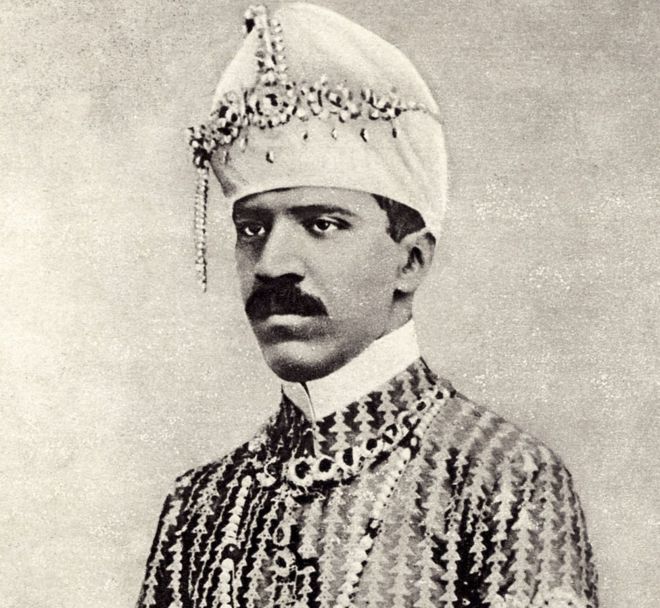
Image copyright GETTY IMAGESImage caption Mir Osman Ali Khan was once the world’s richest man
A London court has ruled that £35m ($42m) held in a UK bank account must go to the descendants of an Indian royal, and not to Pakistan.
The dispute began in 1948 when the last Nizam (king) of Hyderabad deposited £1m in the UK account, held by the then Pakistan high commissioner. With interest, the sum has grown to £35m.
The judge ruled there was no evidence to back Pakistan’s claims to the money.
The origins of the dispute go back to the 1947 partitioning of British India.
Hyderabad, which was a princely state, was annexed by India in 1948 in a military operation – the cash transfer had been made shortly before that.
The Nizam, Mir Osman Ali Khan, had not been able to decide whether his state should be in Pakistan or India.
His descendants alleged that he had asked for the money to be returned weeks after the annexation by India took place, but then Pakistan refused to give it back.
The court case had been fought by his family together with the Indian state.
National Westminster Bank, in which the money had been deposited, refused to release the funds to either party until the case was resolved by the courts.
The interest on the original deposit saw the money grow to £35m by 2019.
Pakistan argued it had been given the money in order to procure arms but the court determined it had the right to rule in the case, given that the money had been deposited in a British bank account.
“The court today made it clear that it did not think the money was handed to Pakistan outright. There is overwhelming evidence that Pakistan only held the money as a trustee and it actually belonged to the Nizam,” Paul Hewitt, the lawyer for one of the grandsons, told the BBC’s Gaggan Sabherwal.
Mr Hewitt said the case, which had begun when his client was a child, was finally being resolved when he was in his 80s.
“We welcome the judgment of Justice Marcus Smith,” Najaf Ali Khan, one of the Nizam’s grandsons, told BBC Telugu.
“The High Court has rightly rejected Pakistan’s claim. The family has long awaited this judgement.”
India’s foreign ministry also welcomed the verdict in a press statement.
Pakistan could seek to appeal, but otherwise the money will be given to the Nizam’s grandsons and the state of India.











 CHINDIA ALERT: You'll be living in their world, very soon