Chindia Alert: You’ll be Living in their World Very Soon
aims to alert you to the threats and opportunities that China and India present. China and India require serious attention; case of ‘hidden dragon and crouching tiger’.
Without this attention, governments, businesses and, indeed, individuals may find themselves at a great disadvantage sooner rather than later.
The POSTs (front webpages) are mainly 'cuttings' from reliable sources, updated continuously.
The PAGEs (see Tabs, above) attempt to make the information more meaningful by putting some structure to the information we have researched and assembled since 2006.
Image copyright AFP / GETTYImage caption The P4 laboratory (centre) in Wuhan is among a handful around the world cleared to handle viruses that pose a high risk of person-to-person transmission
Chinese state media has accused US Secretary of State Mike Pompeo of lying, after he said there was “enormous evidence” the coronavirus emanated from a laboratory in Wuhan.
Mr Pompeo made the claim on Sunday, without going into specifics.
In an editorial on Tuesday, the hawkish Global Times newspaper said Mr Pompeo was “degenerate”.
The World Health Organization says the US claims are “speculative”, and that it has seen no “specific evidence”.
What did Chinese media say?
Editorials in Chinese state media often given an insight into the direction of government thinking, but there has been no official response to Mr Pompeo’s comments as yet.
“Pompeo aims to kill two birds with one stone by spewing falsehoods,” it said.
“First, he hopes to help Trump win re-election this November…second, Pompeo hates socialist China and, in particular, cannot accept China’s rise.”
Media caption “The Chinese Communist Party has refused to co-operate with world health experts” – Mike Pompeo
The editorial admitted there were “initial problems” in China’s response to the outbreak, but claimed “the overall performance is bright enough to outweigh the flaws”.
It also said it was “conceivable that the virus first contacted humans in other places [than Wuhan]”.
The Global Times is not the only Chinese outlet to take aim at Mr Pompeo and the US.
The People’s Daily said Mr Pompeo had “no evidence”, while a piece on the CCTV site accused US politicians of “nefarious plotting”.
What did Mike Pompeo say?
In an interview with ABC on Sunday, Mr Pompeo said there was “enormous evidence” that the virus had emerged from the Wuhan Institute of Virology.
“Remember, China has a history of infecting the world, and they have a history of running sub-standard laboratories,” he said.
Mr Pompeo – a former director of the Central Intelligence Agency (CIA) – said he did not think the virus was man-made or genetically modified.
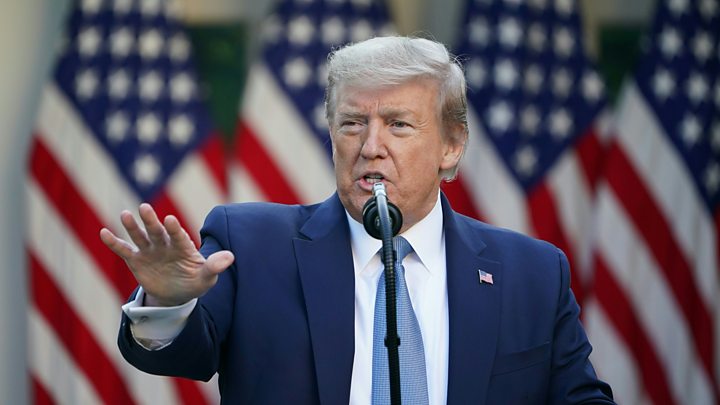
The Wuhan laboratory is known to study coronaviruses in bats. In April, President Trump was asked whether “lax safety protocols” allowed such a virus to escape via an intern and her boyfriend.
Mr Trump did not confirm the theory, but said: “More and more we’re hearing the story.”
Media caption Donald Trump was recently asked if the virus emanated in a laboratory, rather than a market
Last week, he was asked if he had seen evidence that gave him a “high degree of confidence” that the virus emerged in the Wuhan laboratory.
“Yes I have,” he replied – but said he could not go into specifics.
On Monday, World Health Organization emergencies director Michael Ryan said it had received “no data or specific evidence” from the US about the virus origins.
“So from our perspective, this remains speculative,” he said.
Last week, the US intelligence community said it “concurred” that the virus “was not man-made or genetically modified”.
But it said it would “continue to examine” whether the outbreak began via “contract with infected animals, or if it was the result of an an accident at a laboratory in Wuhan”.
Australian Prime Minister Scott Morrison said on Tuesday that the most likely source of the virus was a wildlife market. However he said he would not rule out the theory that it originated in a lab.
“What’s really important is that we have a proper review, an independent review which looks into the sources of these things in a transparent way so we can learn the lessons,” he told reporters.
Meanwhile, Western “intelligence sources” have told several news outlets there is “no evidence” to suggest the virus leaked from a laboratory.
BEIJING/SHANGHAI (Reuters) – A northeastern Chinese city of 10 million people struggling with currently the country’s biggest coronavirus cluster shut dine-in services on Saturday, as the rest of China eases restrictions designed to hamper the spread of the disease.
Harbin, the provincial capital of Heilongjiang and its biggest city, said it temporarily suspended dine-in services for all eateries, reported the official CCTV citing an emergency epidemic prevention notice.
Catering services operating in the city, such as barbecue eateries and those selling skewers, shabu shabu, and stew, shall suspend dine-in meals until further notice and in accordance with changes in the epidemic situation, the notice said.
While mainland China reported only one case on Saturday and crowds returned to some of its most famous tourist attractions for the 5-day May holiday, the northern province of Heilongjiang is hunkering down to prevent further clusters from forming.
Of the 140 local transmissions in mainland China, over half have been reported as from Heilongjiang, according to a Reuters tally.
Heilongjiang province borders Russia and has become the frontline in the fight against a resurgence of the coronavirus epidemic, with many new infections from citizens entering from Russia.
The province has already banned entry to residential zones by non-locals and vehicles registered elsewhere. It had also ordered isolation for those arriving from outside China or key epidemic areas.
On the back of the outbreak, deputy secretary of the Provincial Party Committee Wang Wentao said at a Friday meeting “we deeply blame ourselves”, according to local media.
“We had an inadequate understanding of epidemic prevention and control,” said Wang, adding that the failure to carry out testing in a timely manner contributed to the clusters.
BEIJING (Reuters) – China’s parliament and its top political consultative body are both considering delaying annual meetings set for March, state media said on Monday, as the country battles a coronavirus outbreak that has killed more than 1,700 people.
The meetings of the parliament, or National People’s Congress (NPC), and the Chinese People’s Political Consultative Conference (CPPCC) were both due to begin early next month.
The gatherings see more than 5,000 delegates descend on Beijing, the capital, from all over China, for at least 10 days, to pass legislation and unveil the year’s key economic targets.
A postponement would be the first since China adopted the current March schedule in 1995 for the meeting of parliament.
The standing committee of the NPC will meet on Feb. 24 in Beijing, the official Xinhua news agency said.
“The upcoming session is … expected to deliberate a draft decision on postponing the third annual session of the 13th NPC,” it said. The session was due to have begun on March 5.
The proposal was made in the belief it was important to focus on reining in the epidemic, Xinhua said. China has imposed transport curbs to halt the spread of the virus, which has killed 1,770 and infected nearly 71,000 in mainland China.
The CPPCC is also studying whether to postpone its annual meeting, state-run CCTV said, due to have begun two days earlier, on March 3.
Five people familiar with the matter told Reuters this month that China was considering delaying the meetings as Beijing grapples with the epidemic.
The parliamentary committee will also consider a proposed law banning wildlife trade and discuss government changes, Xinhua said, without elaborating.
The 39 people found dead in a refrigerated trailer in Essex were Chinese nationals, it is understood.
Police are continuing to question lorry driver Mo Robinson, 25, who was arrested on suspicion of murder.
Officers in Northern Ireland have raided two houses and the National Crime Agency said it was working to identify “organised crime groups who may have played a part”.
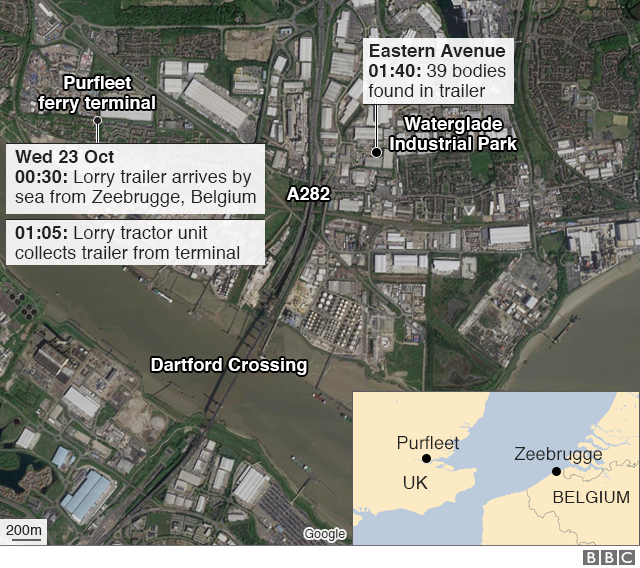
The trailer arrived in Purfleet on the River Thames from Zeebrugge in Belgium.
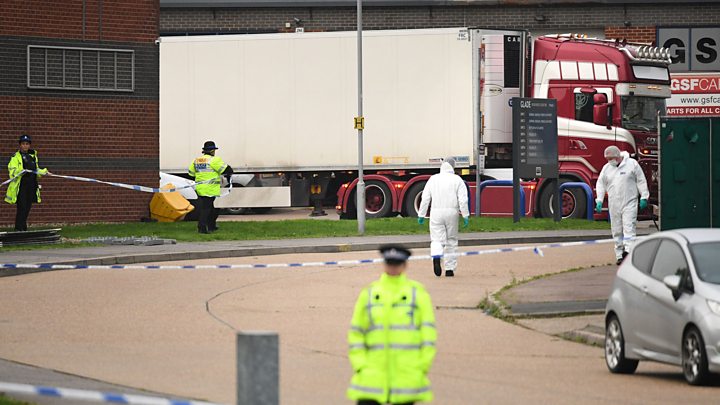
Ambulance staff discovered the bodies of the 38 adults and one teenager in the container at Waterglade Industrial Park in Grays just after 01:30 BST on Wednesday.
The lorry and trailer left the port at Purfleet shortly after 01:05.
Police said the tractor unit – the front part of the lorry – came from Northern Ireland and picked up the trailer from Purfleet.
Image copyright FACEBOOKImage caption The lorry driver has been named locally as Mo Robinson, from County Armagh
Councillor Paul Berry said the village of Laurelvale in County Armagh, where the Robinson family live, was in “complete shock”.
He said he had been in contact with Mr Robinson’s father, who had learned of his son’s arrest on Wednesday through social media.
“The local community is hoping that he [Mo Robinson] has been caught up innocently in this matter but that’s in the hands of Essex Police, and we will leave it in their professional hands to try to catch the perpetrators of this,” he said.
The Belgian Federal Public Prosecutor’s Office said it had opened a case which would focus on the organisers and others involved in the transport.
A spokesman said the container arrived in Zeebrugge at 14:29 on Tuesday and left the port later that afternoon before arriving in Purfleet in the early hours of Wednesday.
It was not clear when the victims were placed in the container or if this happened in Belgium, he said.
Media caption Essex lorry deaths: CCTV shows arrival at industrial park
St Peter and St Paul’s Church in Grays will be open for people to light candles and say prayers between 12:00 and 14:00.
A vigil is being held at 18:00 outside the Home Office to “call for urgent action to ensure safe passage” for people fleeing war and poverty.
The lorry was moved to a secure site at Tilbury Docks on Wednesday so the bodies could be “recovered while preserving the dignity of the victims”.
Essex Police initially suggested the lorry could be from Bulgaria, but later said officers believed it entered the UK from Belgium.
The force said formal identification of the 39 bodies “could be a lengthy process”.
A spokesman for the Bulgarian foreign affairs ministry said the truck was registered in the country under the name of a company owned by an Irish citizen.
He said it was “highly unlikely” the deceased were Bulgarians.
Shaun Sawyer, the National Police Chiefs Council lead for modern slavery and human trafficking, said while forces had prevented thousands of deaths, “tragically, for 39 people that didn’t work yesterday”.
He told BBC Radio 4’s Today programme even if there were routes perceived as easier to get through, organised criminals would still exploit people who could not access those.
“You can’t turn the United Kingdom into a fortress,” added Mr Sawyer, who is the Chief Constable of Devon and Cornwall Police.
Media caption I’ve seen people running out of a lorry’
Thurrock’s Conservative MP Jackie Doyle-Price said there needed to be an international response.
“We have partnerships in place but those efforts need to be rebooted, this is an international criminal world where many gangs are making lots of money and until states act collectively to tackle that it is going to continue,” she said.
Richard Burnett, chief executive of the Road Haulage Association, said temperatures in refrigerated trailers could be as low as -25C.
He described conditions for anyone inside as “absolutely horrendous”.
Prime Minister Boris Johnson said it was an “unimaginable tragedy and truly heartbreaking”.
In 2015, the bodies of 71 people were found in an abandoned lorry on an Austrian motorway. Police suspected the vehicle was part of a Bulgarian-Hungarian human trafficking operation.
The leaders agreed to set up a mechanism to boost economic ties and tackle India’s trade deficit with China after their second informal summit
As 2020 is the 70th anniversary of diplomatic ties between both countries, India and China will hold 70 events next year to promote relations
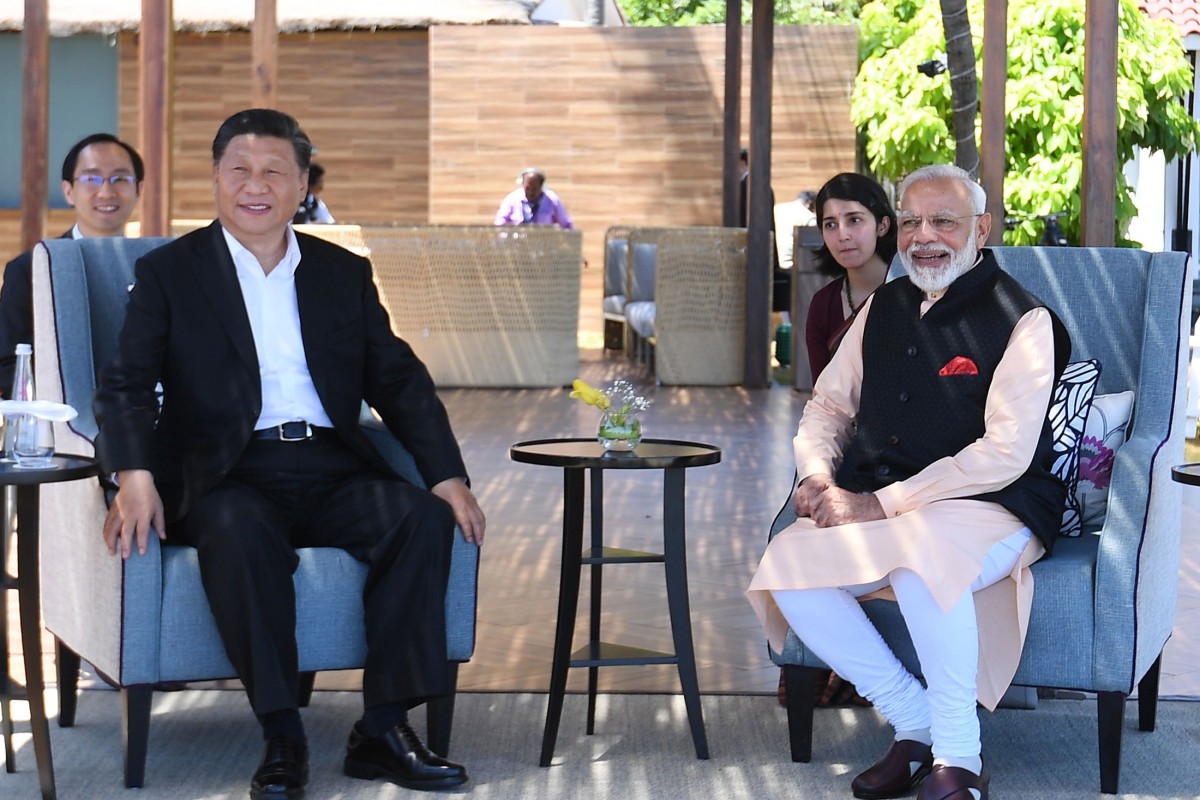
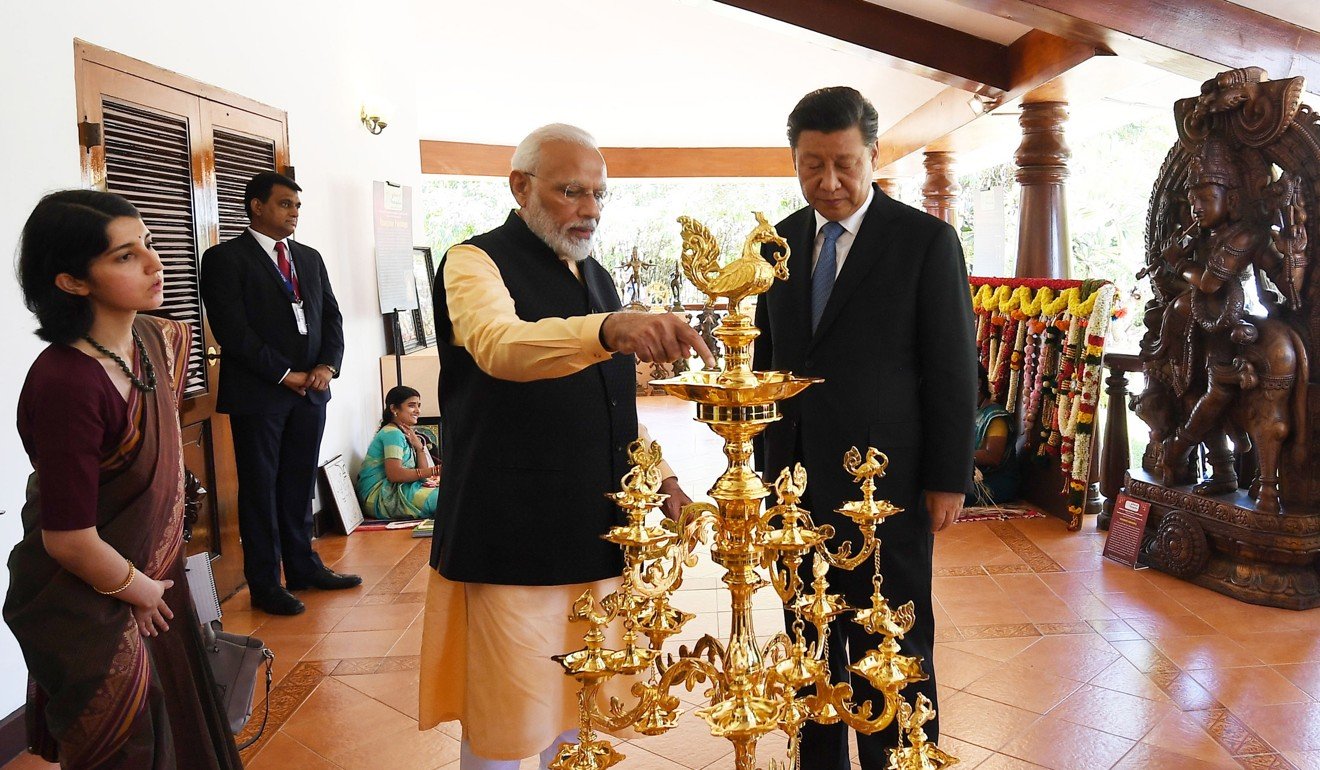
Indian Prime Minister Narendra Modi and Chinese President Xi Jinping during their meeting in Mamallapuram, Chennai. Photo: EPA
Chinese President Xi Jinping and Indian Prime Minster Narendra Modi concluded their second informal summit on Saturday by pledging to overcome trade differences and appreciate “each other’s autonomous foreign policies”, signalling an effort to focus on mutual interests rather than on long-standing contentious issues.
Modi remarked that both sides had agreed to be “sensitive” to each other’s concerns and not let differences escalate into disputes, while Xi called for communication to “alleviate suspicions” and for India and China to enhance strategic mutual trust, according to state news broadcaster CCTV.
Their desire to look beyond irritants in diplomatic ties, including a decades-long border row and China’s close military ties with India’s arch rival, Pakistan, comes as Beijing is embroiled in a tariff war with Washington that has rocked the global economy.
In a sign of China’s willingness to address India’s trade deficit with it, the leaders agreed to launch a “High Level Economic and Trade Dialogue”.
As Xi meets Modi, Chinese in Chennai hope to witness the ‘Wuhan spirit’
Chinese Vice-Premier Hu Chunhua and Indian Finance Minister Nirmala Sitharaman will meet regularly to discuss ways to boost two-way trade and investments, Indian foreign secretary Vijay Gokhale said in a media briefing.
India has a US$53 billion trade deficit with China, which makes up almost a third of its total trade deficit. It is also facing pressure to decide if it will commit to the China-led
(RCEP), which aims to create the world’s largest trading bloc involving 16 countries before the end of the year.
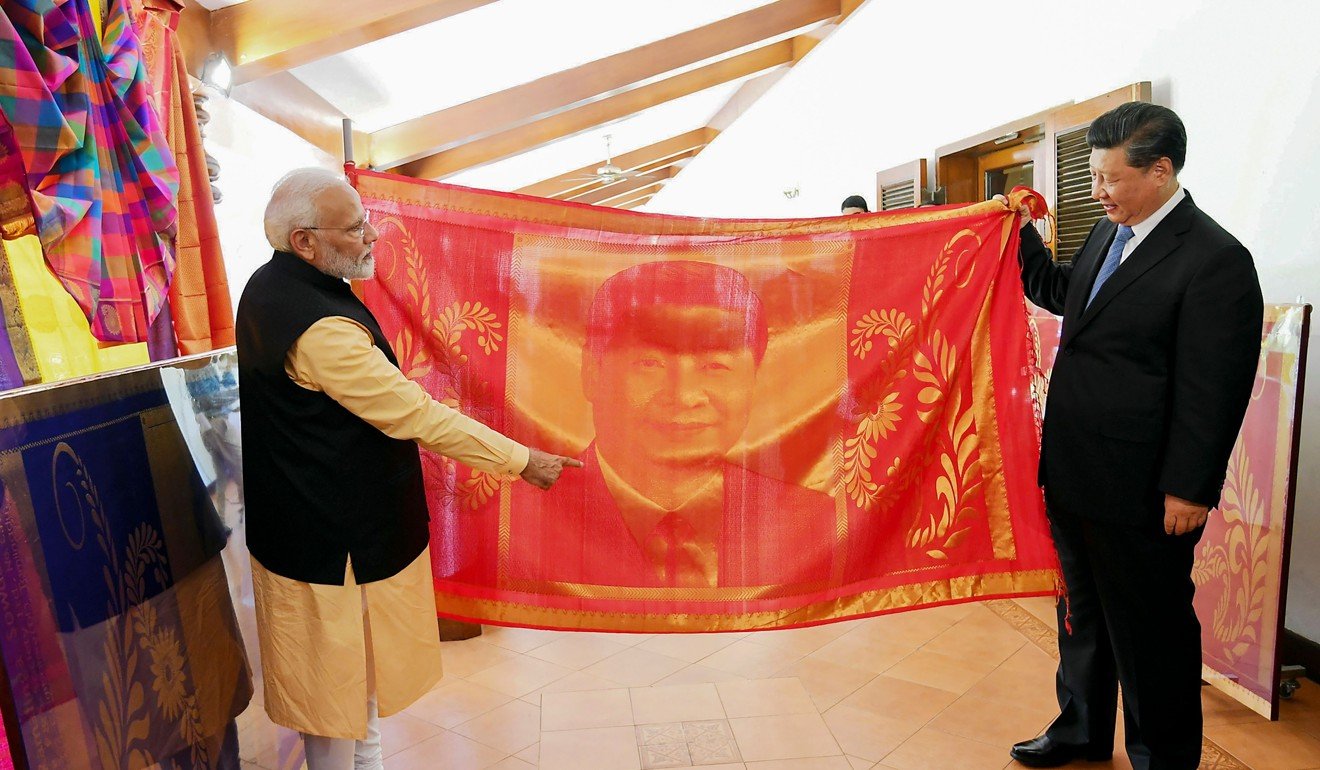
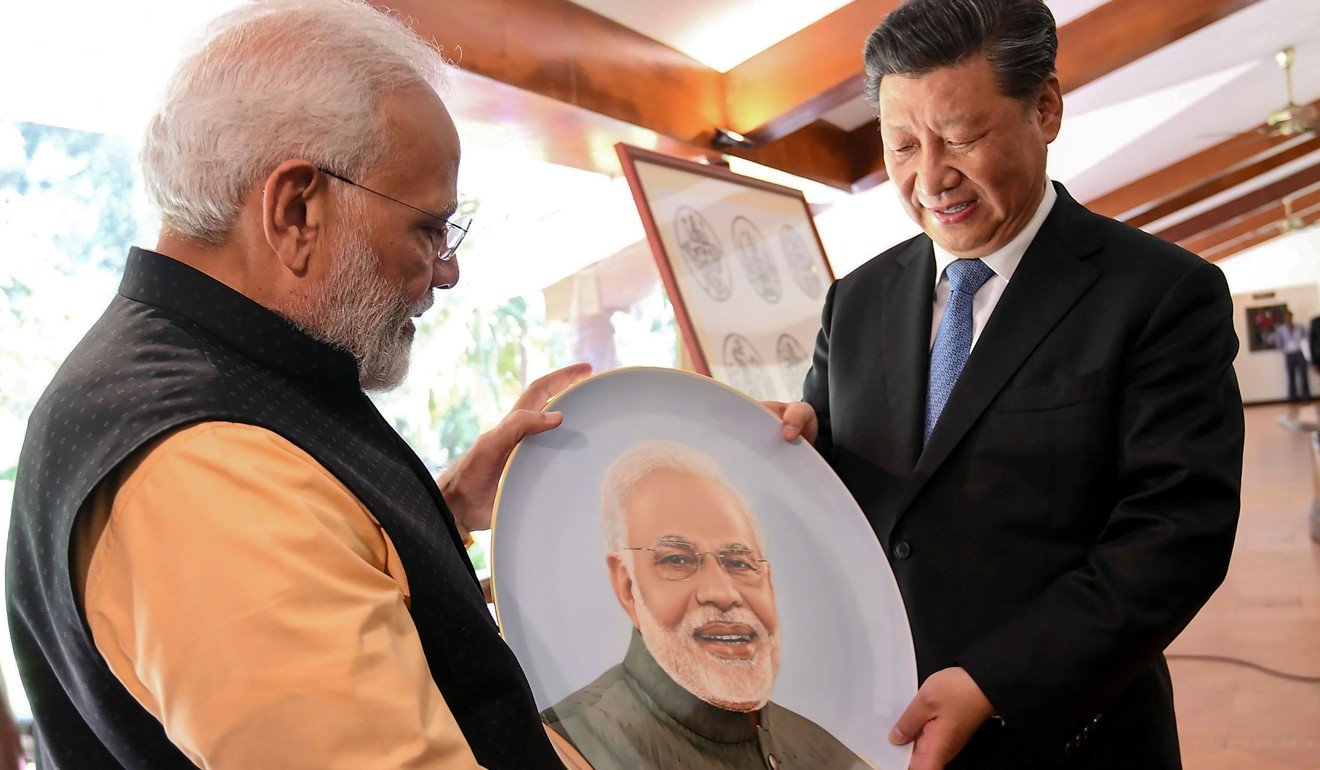
Narendra Modi exchanges gifts with Xi Jinping. Photo: AFP
Negotiations are ongoing with talks taking place in Bangkok this week, but India’s domestic producers have opposed the agreement over fears of a flood of Chinese imports. On Friday, the Indian government rejected clauses in the agreement related to e-commerce, according to reports.
Gokhale told the media briefing that both leaders, who met in the coastal town of Mamallapuram about 50km away from Chennai, briefly discussed the RCEP.
“PM Modi said India was looking forward to the RCEP but it is important that RCEP is balanced, that a balance is maintained in trade in goods, trade in services and investments,” he said, adding that Xi agreed to further discussions of India’s concerns on the issue.
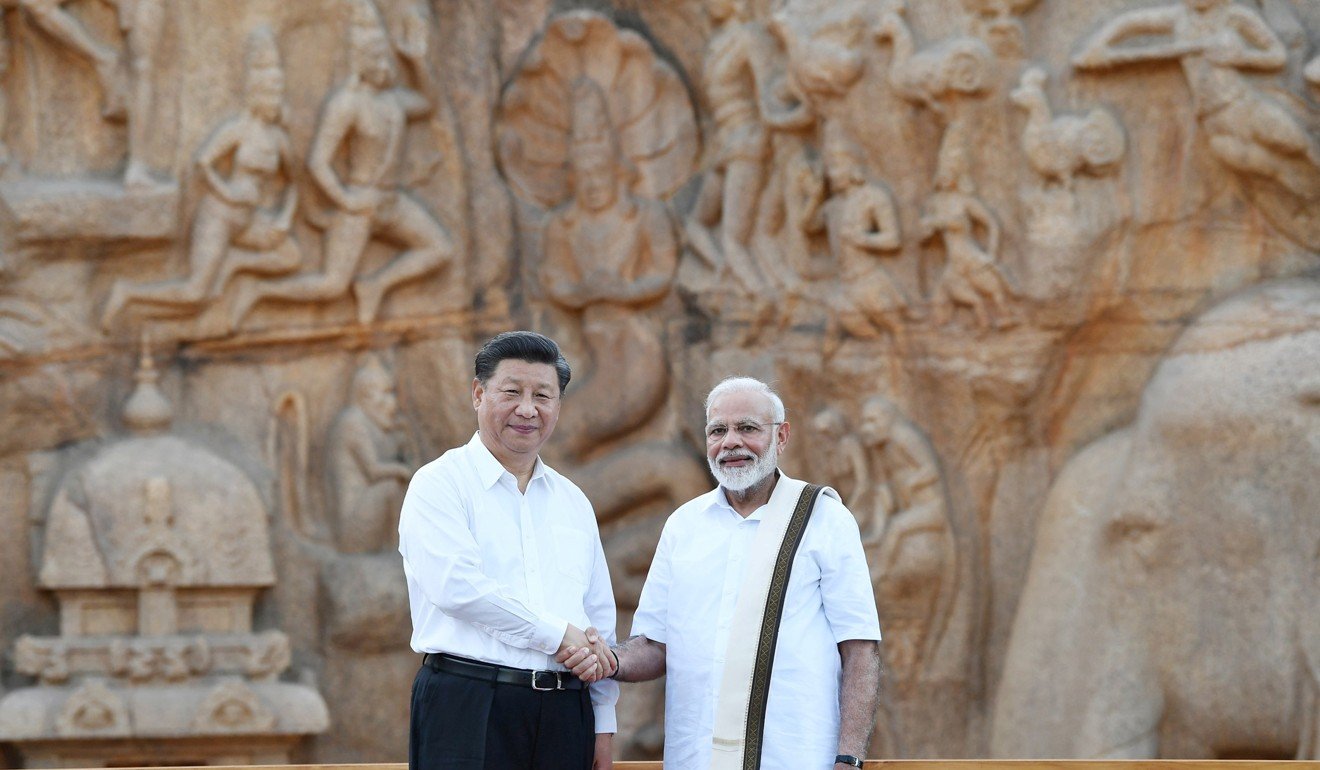
Narendra Modi with Xi Jinping in Mamallapuram. Photo: EPA
CCTV said Xi had six suggestions for how China and India could further improve ties, including assessing each other correctly and stepping up cooperation between their militaries. Besides economic and trade dialogue, China welcomed Indian pharmaceutical and IT companies to invest there, he said.
“We should look at disputes with a correct mind, and not let disputes affect cooperation.
“Both sides should properly and fairly get a solution for border disputes that are acceptable to each other … [and] cautiously handle each other’s core interests, and take proper measures to control issues that cannot be resolved immediately,” the president reportedly said.
Gokhale told reporters that both countries had agreed to pursue, through special representatives, an ongoing dialogue on their disputed border. China and India have held more than 20 rounds of talks to resolve their boundary dispute, over which they went to war in 1962. Different mechanisms have been set up to maintain peace along the 4,000-kilometre (2,485-mile) so-called Line of Actual Control.
Xi and Modi bank on chemistry as they talk trade and terrorism
Gokhale confirmed that the leaders – who met for a total of seven hours over Friday and Saturday, with the bulk of their time spent in one-on-one talks – did not discuss
has lobbied its allies – including its all-weather friend China – to support its opposition to the move. New Delhi had reacted sharply to Beijing’s move to take the matter to the United Nations, insisting that it was a purely bilateral issue. Two days before the summit, Xi had hosted Pakistan Prime Minister Imran Khan and had assured him of China’s support on all core issues, a statement that had irked India.
Gokhale said both leaders “emphasised the importance of having independent and autonomous foreign policies”.
“President Xi said that the two countries needed to have more extensive dialogue in order to understand each other’s perspectives on major global and regional issues,” he added.
Narendra Modi exchanges gifts with Xi Jinping. Photo: AFP
The leaders also discussed terrorism, with a statement issued later by New Delhi saying both sides would make efforts to ensure the international community strengthened its framework “against training, financing and supporting terrorist groups throughout the world and on a non-discriminatory basis”.
The China-led multilateral Financial Action Task Force, which has been investigating Pakistan’s efforts to stamp out the financing of terrorism, is expected to decide soon if it would add Islamabad to its blacklist along with Iran and North Korea, a move that could invite stringent economic sanctions and drive away international financial institutions, both of which could affect Pakistan’s already-indebted economy adversely.
Gokhale added that as 2020 is the 70th anniversary of diplomatic ties between both countries, India and China will hold 70 events next year to promote people-to-people ties, with Modi accepting an invitation by Xi for the next informal summit to be held in China.
Both leaders had struck positive notes on the summit – with Xi describing their discussions as “candid” and between friends and Modi hailing the “Chennai Connect” meeting as marking a new era of cooperation between both countries.
War games, Kashmir and a US$57b question: the issues as Xi meets Modi
But analysts said they would be looking to see how the newly-announced high-level mechanism on trade panned out.
Narayani Basu, a New Delhi-based author, foreign policy analyst and China watcher felt the summit had achieved its purpose of bagging small wins for both sides.
“Discussing contentious issues would have defeated the purpose of the summit. The idea behind such a summit must be that despite the overarching posturing on different divergent issues, the two countries can achieve the easily-achievable wins. That is what the summit seems to have tried doing.”
But in terms of actual outcomes, she said she remained sceptical.
“I don’t think there has been much progress in the ties between the two countries since the last summit in Wuhan. Hence, this time, there is a lot more caution and scepticism towards such a summit,” she said, referring to the first summit last year in the Chinese city of Wuhan.
During Xi’s visit to southern India, which lasted 24 hours in all, Modi took him on a personal tour of temple monuments dating back to the seventh and eighth century in Mamallapuram when regional leaders had trade ties with Chinese provinces. He was also shown local artisan handicrafts and art forms, and gifted a handwoven silk portrait, a lamp and a painting.
Xi gave Modi a porcelain plate with the image of the prime minister’s face printed on it.
Xi Jinping with Narendra Modi in Mamallapuram. Photo: Reuters
On Friday, New Delhi announced that visa rules for Chinese nationals visiting India would be relaxed, with multiple-entry visas with a validity period of five years available from this month onwards. At present, most visas are single-entry and usually for between 30 and 60 days. Visa fees would also be reduced, the government said, with the multiple-entry visa costing US$80.
This was aimed at further enhancing “people-to-people exchanges between the two countries and [encouraging] more Chinese tourists to choose India as a destination for tourism purposes,” it said in a statement.
Xi left Chennai on Saturday afternoon and arrived in Nepal, which lies in between India and China. He will be the first Chinese president to visit Nepal in 22 years and is expected to sign a slew of deals with Nepal’s Prime Minister K.P. Sharma Oli, including the planned extension of the rail link from remote, mountainous Tibet to Nepal’s capital, Kathmandu.
The link will be part of Beijing’s ambitious infrastructure project to boost trade, the
More than 120 countries have signed on to the BRI, including Pakistan, where a series of projects worth US$46 billion are being constructed under the China-Pakistan Economic Corridor (CPEC). India has snubbed the BRI and questioned the transparency of funding agreements.
Chief executive Rupert Hogg says staff who ‘support or participate in illegal protests’ would face disciplinary action that ‘may include termination of employment’
Airline’s shares down 4.37 per cent on Monday morning to lowest level in 10 years, despite it complying with orders on Friday from China’s aviation authority
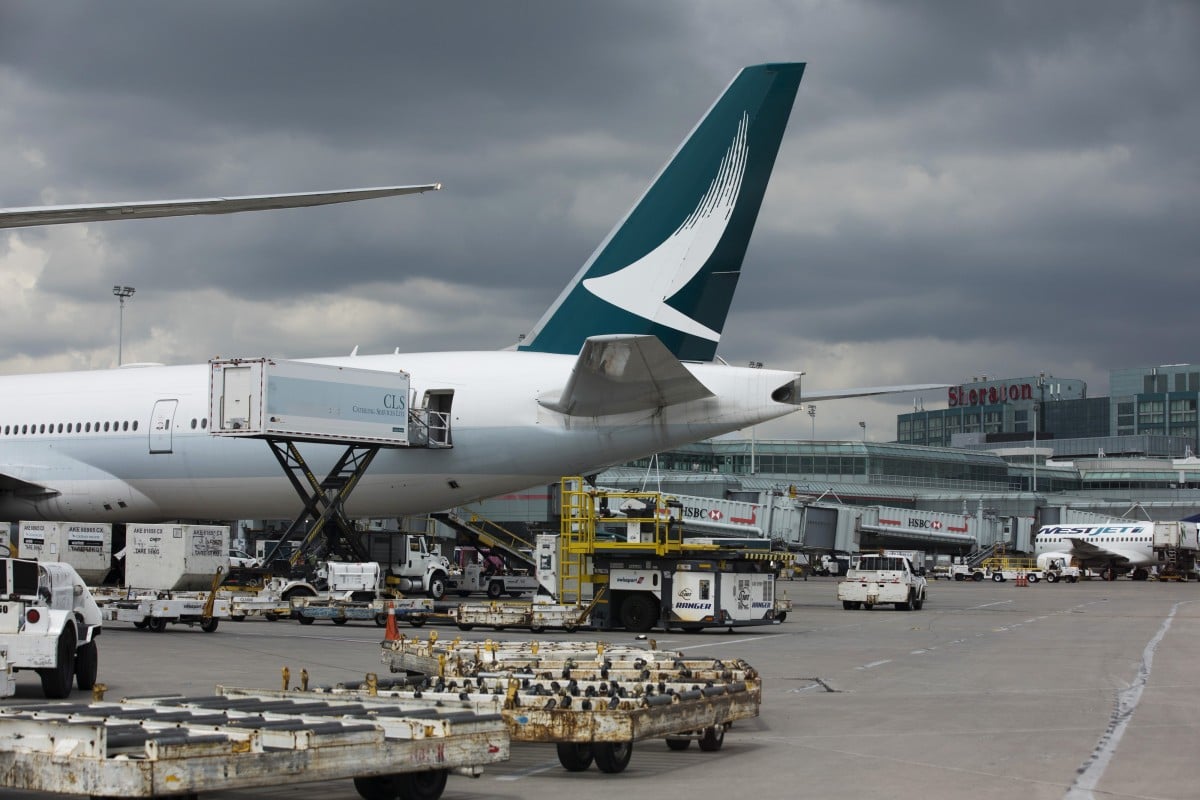
Cathay Pacific moved over the weekend to comply with new orders from China’s aviation authority. Photo: Bloomberg
Cathay Pacific has warned that it would sack staff taking part in illegal protests in Hong Kong, saying it would take a “zero tolerance” approach, as its shares slumped to their lowest level in 10 years in morning trading on Monday.
In a note to staff on Monday, chief executive Rupert Hogg said staff who “support or participate in illegal protests” would face disciplinary action that “could be serious and may include termination of employment”.
His warning indicated an escalation by the company, under pressure to crack down on employees after China’s civil aviation regulator said on Friday that airline staff supporting the Hong Kong protests would be barred from flights going to, from or through mainland China.
“We are all obliged to abide by law at all times,” Hogg said. “Cathay Pacific Group has a zero-tolerance approach to illegal activities. Specifically, in the current context, there will be disciplinary consequences for employees who support or participate in illegal protests. These consequences could be serious and may include termination of employment.”
By noon in Hong Kong, the stock had fallen 4.37 per cent to HK$9.85 (US$1.26), its lowest level since June 2009. Losses dragged the carrier’s parent company Swire Pacific down 5.4 per cent to HK$77.50, making it the worst performer on Hong Kong’s stock market during morning trading.
This was the lowest price since October 2018 for Swire, which owns 45 per cent of the airline. Air China, which owns 22.7 per cent of Cathay, also fell 1.53 per cent in Hong
On Friday, the Civil Aviation Administration of China (CAAC) told Hong Kong’s flagship carrier that any staff members who had taken part in what it called “illegal protests”, “violent actions” and “overly radical activities” would not be allowed to fly to or from the mainland, in a first warning shot at a Hong Kong-based corporate giant.
The CAAC also said that the airline would have to submit identification details of all crew operating all services using mainland China airspace, and that flights with unapproved crew lists would be barred. It gave the airline until Thursday to submit a detailed plan to improve its procedures.
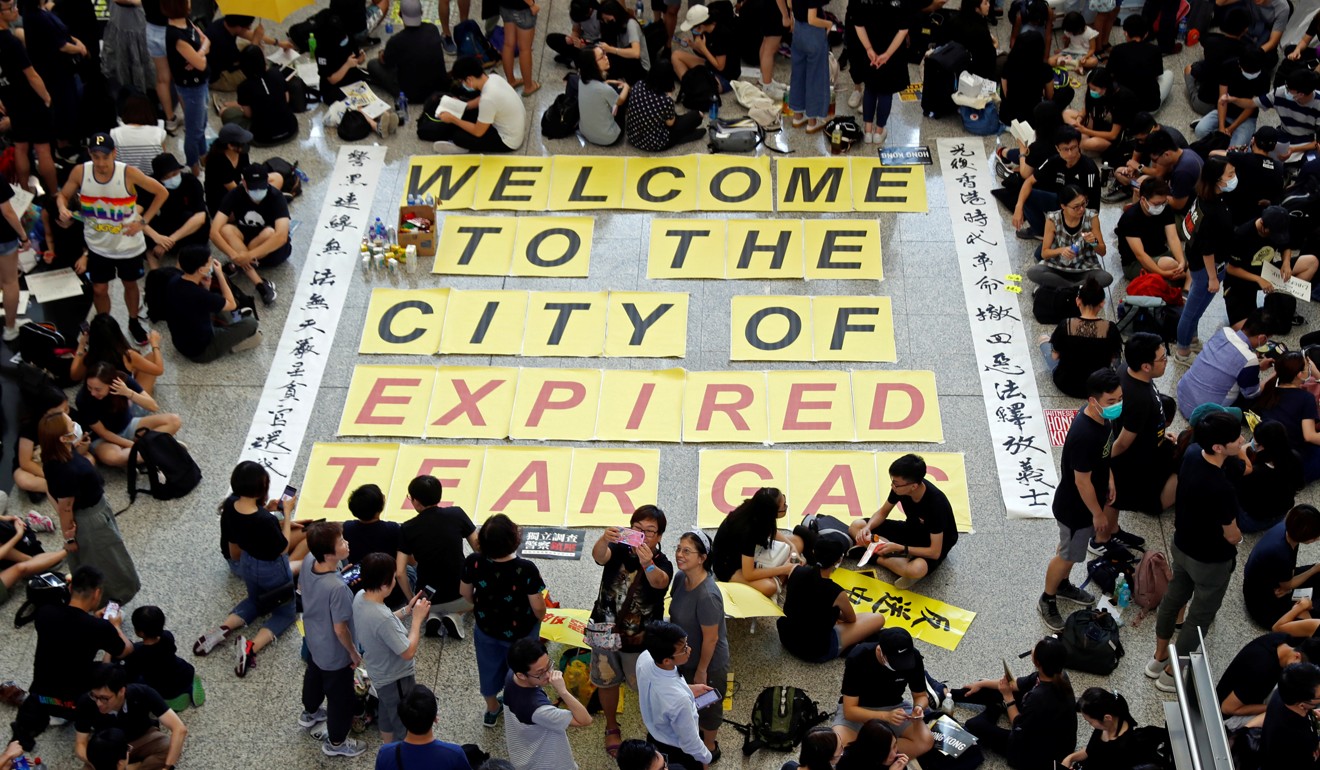
Anti-extradition bill protesters join a sit-in protest at Hong Kong International Airport on Sunday. Photo: Reuters
Cathay Pacific had earlier said it would not stop staff members from taking part in demonstrations.
On Wednesday, Cathay Pacific chairman John Slosar said the company would not rein in staff for openly supporting the protests. “We certainly wouldn’t dream of telling them what they have to think about something,” Slosar said.
But in his second statement in two days in relations to the CAAC’s sanctions, Hogg said the “actions and words” of staff outside of work hours could have a “significant effect on the company”, adding that the actions of a few of Cathay’s 34,000 employees would be seen as a company position.
He also asked staff to not “support or participate” in the illegal protest at the airport, saying the carrier was concerned that the protests could become disorderly and violent.
No flights by Cathay Pacific, nor by its subsidiaries Cathay Dragon or HK Express, were delayed or cancelled on Saturday or Sunday, the company said.
The CAAC’s move was widely seen as a clear warning to Hong Kong’s business community to toe Beijing’s line to pressure ongoing anti-government protests in the city that have been taking place for over two months.
Despite the airline acting over the weekend to comply with the rules, Chinese state media continued to put pressure on the company.
Global Times, a tabloid associated with Communist Party mouthpiece People’s Daily, said on Sunday the airline had still not allayed all concerns despite its adjustments to comply with the ruling.
Carrie Lam’s remarks about Beijing’s sovereignty ‘add fuel to the fire’, analysts warn
“These are only small steps [showing] that Cathay Pacific is heading towards the right direction, and their sincerity will need to be tested over time,” the tabloid said in an opinion article on Sunday.
It said 2,000 company staff joined citywide strikes last Monday, and cited the case of a pilot who was arrested and charged with rioting during a demonstration on July 28.
“Cathay Pacific has touched on this behaviour lightly, which has a huge impact on the trust the industry and the public have towards the company,” the article said.
State broadcaster CCTV published a short video on Weibo on Monday morning of its anchor issuing further warnings to the airline, saying there were reports of staff continuing to join “illegal gatherings” and asking tourists not to go to Hong Kong.
“If this continues, it’s not a matter of whether or not people would still want to come to Hong Kong, but whether they would still want to be on your airline,” Kang Hui said in a one-minute video.
“Let me send a friendly reminder: one would not be in trouble had one not asked for it,” Kang said, in Mandarin and then in English, translating the popular Chinese internet meme phrase “No zuo no die” and claiming some Cathay Pacific staff pretended not to understand Mandarin. Cantonese is the dominant language in Hong Kong.
Elsewhere, the company announced that two of its airport employees
for leaking passenger information about a Hong Kong police soccer team who had been on a flight to mainland China. It has also suspended the pilot who was among 44 people charged with rioting on July 28.
Although the company does not clearly specify its country-by-country performance, China and Hong Kong produced half of all its 2018 revenue – HK$57 billion of a total of HK$111 billion. A fifth of all the carrier’s flight are to and from the mainland.
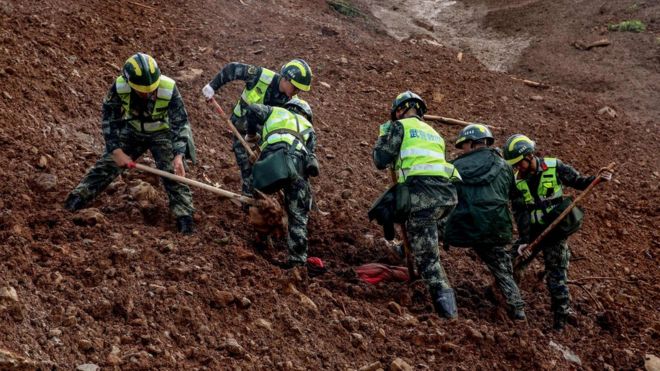
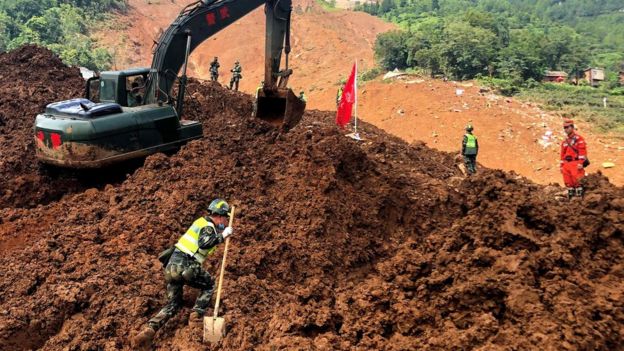
BEIJING (Reuters) – Eighteen people were killed and 14 were missing in eastern China on Saturday in a landslide triggered by a major typhoon, which caused widespread transport disruptions and the evacuation of more than one million people, state broadcaster CCTV reported.
Typhoon Lekima made landfall early on Saturday in the eastern province of Zhejiang with maximum winds of 187 km (116 miles) per hour, although it had weakened from its earlier designation as a “super” typhoon, the official Xinhua news agency reported.
Thousands of flights were cancelled in eastern China, according to the country’s aviation regulator, with most flights into and out of Shanghai’s two major airports cancelled on Saturday afternoon, their websites showed.
China’s weather bureau on Saturday issued an orange alert, its second highest, after posting a red alert on Friday, when the storm forced flight cancellations in Taiwan and shut markets and businesses on the island.
The deadly landslide occurred about 130 km north of the coastal city of Wenzhou, when a natural dam collapsed in an area deluged with 160 millimetres (6.3 inches) of rain within three hours, CCTV reported.
The storm was moving northward at 15 kph and was gradually weakening, Xinhua reported, citing the weather bureau.
High winds and heavy rains battered the financial hub of Shanghai on Saturday afternoon, and Shanghai Disneyland was shut for the day.
Nearly 200 hundred trains through the city of Jinan in Shandong province had been suspended until Monday, Xinhua reported.
More than 250,000 residents in Shanghai and 800,000 in Zhejiang province had been evacuated due to the typhoon, and 2.72 million households in Zhejiang had power blackouts as strong wind and rain downed electricity transmission lines, state media reported.
Some 200 houses in six cities in Zhejiang had collapsed, and 66,300 hectares (163,830 acres) of farmland had been destroyed, CCTV said.
The storm was predicted to reach Jiangsu province by the early hours of Sunday and veer over the Yellow Sea before continuing north and making landfall again in Shandong province, CCTV said.
Coastal businesses in Zhejiang were shut and the Ministry of Emergency Management warned of potential risk of fire, explosions and toxic gas leaks at chemical parks and oil refineries.
China has inflated its population data so much that its status as the world’s most populous country may be false
This happens so provinces can get education subsidies and Beijing can hide the results of decades of family planning
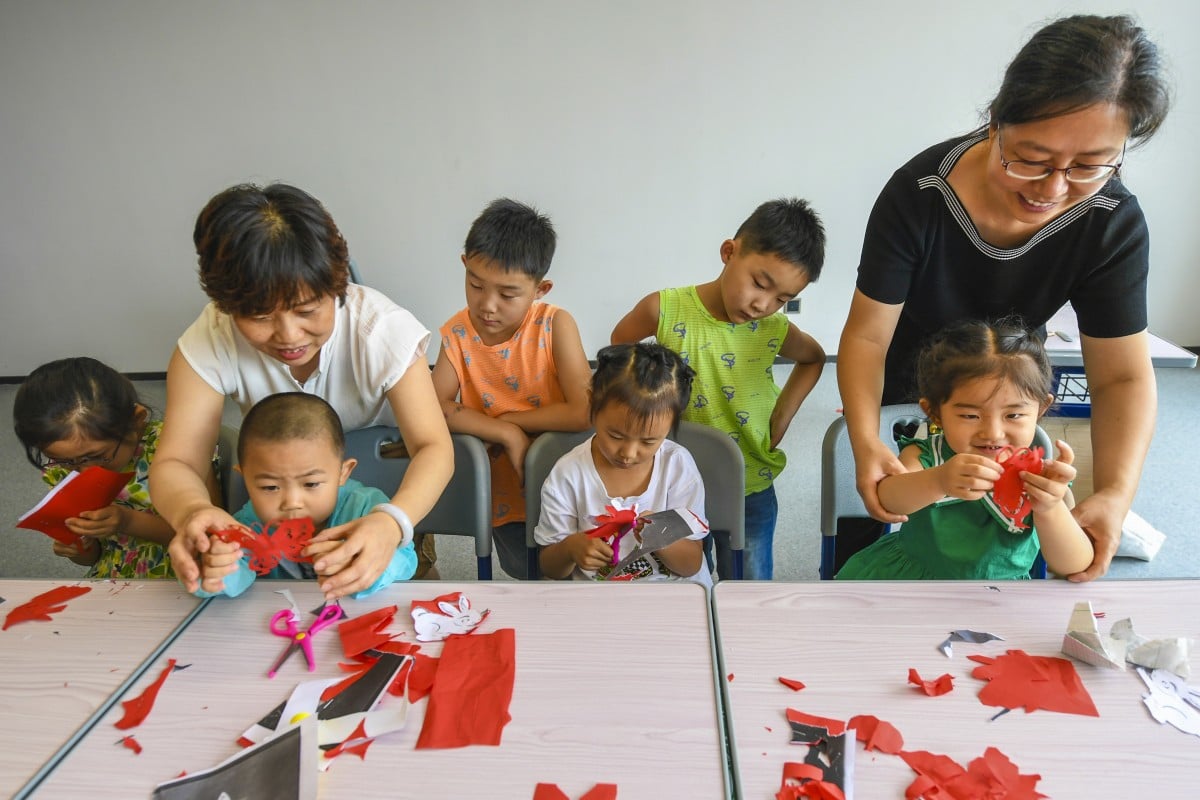
Children in Xianghe county, Hebei province, learn the traditional art of paper-cutting during their summer vacation. The over-reporting of student in enrolment in Chinese schools points to a bigger problem with obtaining an accurate population count. Photo: Xinhua
China’s official demographic figures, including the now-cliched “country of 1.4 billion people”, seriously misrepresent the country’s real population landscape. The real size of China’s population could be 115 million fewer than the official number, putting China behind India in terms of population.
This massive error, equal to the combined populations of the United Kingdom and Spain, is a product of China’s rigged population statistics system, influenced by the vested interests of China’s family planning authority.
To start with, the raw data of China’s population figures were “adjusted”. China’s total fertility rate, or the number of kids per woman throughout her life, dropped below the watershed level of 2.1 in 1991, from which moment the population size of the next generation would be smaller than the current one, and the average total fertility rate was 1.36 in 1994-2018, according to data from census and surveys. However, the family planning authority in charge of the country’s population control refused to believe the numbers and “adjusted” the rate to 1.6-1.8 and, accordingly, the official population size.
For instance, the real total fertility rate in 2000 was 1.22, according to a census result, but the government revised it to 1.8. Accordingly, the country had 14.1 million new births in 2000, but the government revised the figure by 26 per cent to 17.7 million. A census, which is conducted every 10 years, should provide the truest picture of China’s demographic situation. But for the 2000 census, the government was unhappy about the original finding of 1.24 billion and revised it up to 1.27 billion.
One incentive to inflate population size is that China’s family planning authority needs to present a picture of a “rapidly growing population” to justify the country’s brutal family control policies and even the very existence of the birth control apparatus.
The basis for these adjustments, according to the Chinese government, is the size of primary school enrolment. For the official statisticians, the primary school enrolment data should be reliable because public education covers every Chinese child. They were wrong, however, because primary school enrolment data in China is often inflated so that local authorities can claim more education subsidies from Beijing.
China should simply adapt to having fewer babies
In 2012, one school in Anhui was found over-reporting its student size by 42 per cent to claim subsidies, and another school in Hubei province was discovered in the same year over-reporting student size by more than 300 per cent – and these two cases are the tip of an iceberg.
According to a report by CCTV on January 7, 2012, the Jieshou city in Anhui province reported 51,586 primary school students, when the actual number was only 36,234, allowing them to extract an additional 10.63 million yuan (about US$1.54 million) in state funding. On June 4, 2012, China Youth Daily reported that a middle school in Yangxin county, Hubei province reported 3,000 students, while the actual number was only 700.
The latest census in 2010 also shows the tendency of over-reporting. For example, the original aggregated population of Fujian province was only 33.29 million, which was revised to 36.89 million. China’s government claimed it found 1.34 billion people during the census, but there were inconsistencies. For instance, government data showed that China had 366 million new births in 1991-2010, but the group aged 0-19 in 2010 census was only 321 million.
The official number of births in 2011-2018 is also overestimated by 40 million. While Beijing is overestimating new births, it is underreporting the other end of population change – death. Some Chinese families have a tendency of not reporting deaths to the government in order to keep receiving social welfare.
Also, according to UN data, there was a net international emigration of 8 million from China in 1991-2018. But Chinese officials ignored this data.
China’s population to peak in 2023, five years earlier than official estimates
It’s not an easy job to get a country’s population number right. This is especially true in China, where the territory is vast and domestic migration is frequent.
But Beijing’s mishandling of the country’s population figures has been clumsy and easy to spot. China’s real population in 2018 should be 1.280 billion, instead of the officially announced 1.395 billion. China’s economic, social, political, educational and diplomatic policies are all based on false demographic data. After decades of brutal implementation of birth control, often involving forced abortions and hefty fines, maybe it’s time for China to review its population figures carefully to take stock of the economic and social costs of this controversial demographic experiment.
Father of three is killed as flames engulf car in crash at stop light in Henan
Woman from wealthy family is held as police investigate drink-driving
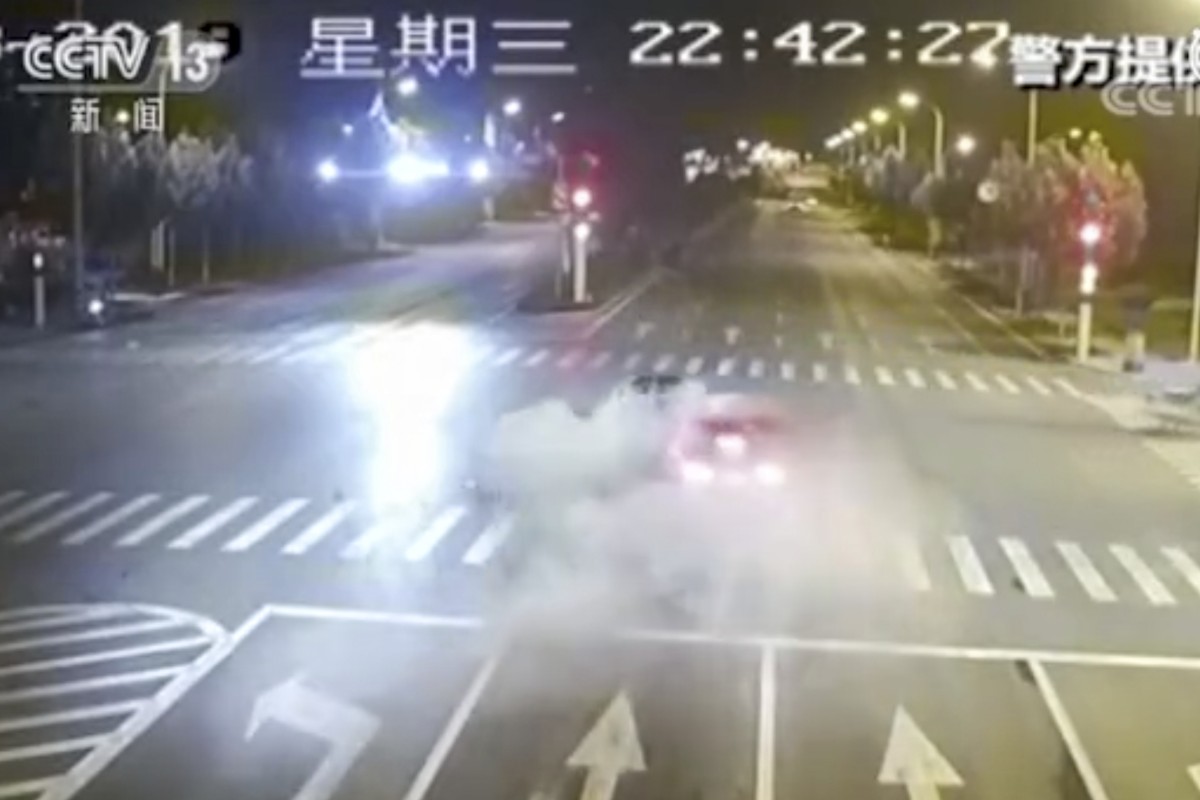
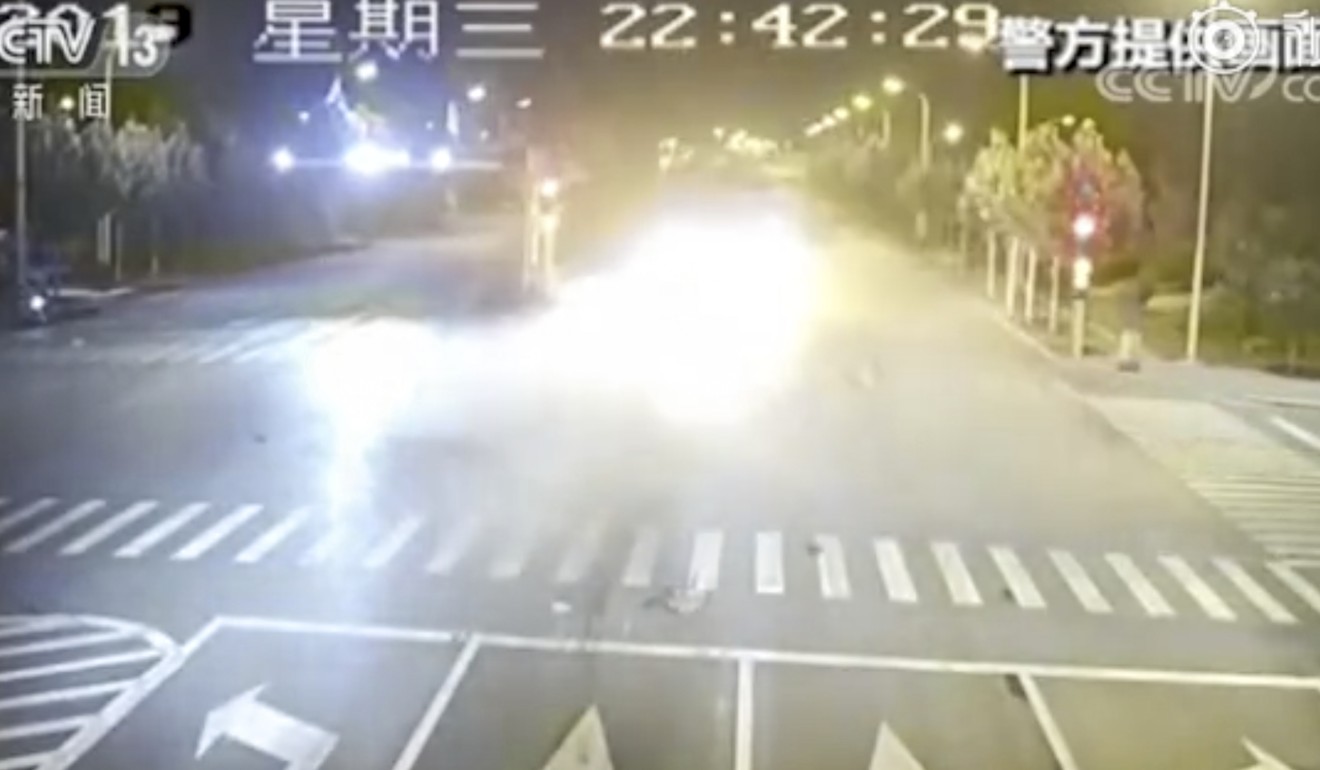
Footage from an intersection in Yongcheng, Henan shows the BMW being propelled across the road before bursting into flames. Photo: Weibo
A driver and her two passengers are in custody in central China after the Maserati SUV she was driving slammed into a BMW, killing two men.
Police said a 23-year-old woman surnamed Tan drove the Maserati through the streets of Yongcheng in Henan province on Wednesday night, scraping against cars on the way.
They said her vehicle struck the BMW at a red traffic light, causing it to burst into flames, killing two passengers and injuring the driver.
Tan and two others in the SUV, a woman and a man, were also injured. All three were detained by police but have not yet been charged. Police said Tan returned a blood-alcohol reading of 0.167 – well over the legal limit of 0.02.
State broadcaster CCTV reported that Tan and friends Zhang and Liu had met at a barbecue restaurant that night for dinner, according to police. After drinking, Tan took her friends for a drive. The Maserati scraped against multiple cars before the driver was slowed down by pedestrians signalling for her to stop, but she suddenly sped away from the scene. It crashed into the BMW soon afterwards, CCTV said.
The BMW bursts into flames after being shoved across the intersection. Photo: Weibo
Two men in the back of the BMW were killed in the fire that engulfed the vehicle, while the driver, also a man, suffered severe burns, according to the report. The occupants of the Maserati were treated in hospital for bone fractures and abdominal injuries, CCTV said.
Man arrested after car crashes into shop, injuring 12, in Tsim Sha Tsui, Hong Kong
The accident has prompted heated online discussion in China, with some calling for the death penalty for “such reckless behaviour and disregard for the law”.
Others have doxxed the detained driver – finding photos on a Weibo account that allegedly belonged to Tan showing she had an appetite for luxury goods and expensive cars.
In recent years, a “hate the rich” sentiment has emerged in Chinese society. As the wealth gap widens, many people have become vocal about injustices they feel are fuelled by the affluent and privileged.
Others voiced anger at the legal system, saying wealthy people could buy the law.
Coach driver in crash that left five dead and 32 injured had been working 12-hour shifts, Hong Kong police say


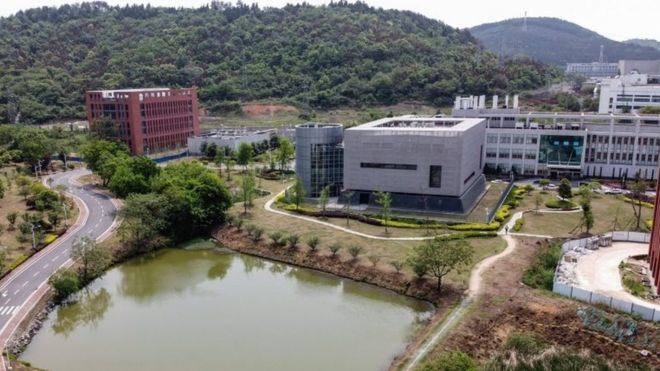 Image copyright AFP / GETTY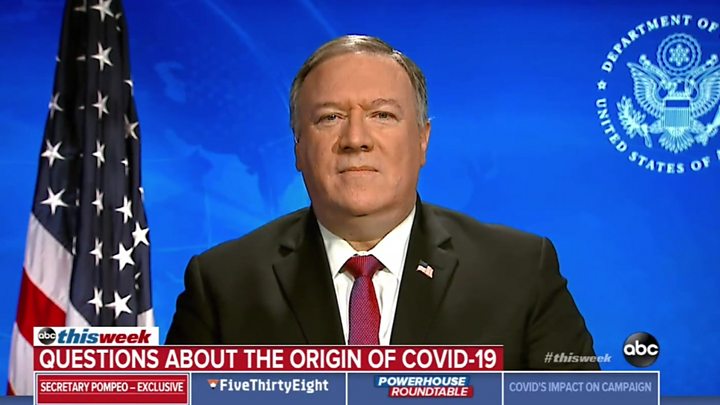



 CHINDIA ALERT: You'll be living in their world, very soon